Please log in to view this content
Ineffective Marketing
Don’t Work for Free
BRX Pro Tip: How to be a Mega Connector

/
RSS Feed

BRX Pro Tip: How to be a Mega Connector
Stone Payton: [00:00:00] Welcome back to Business RadioX Pro Tips. Lee Kantor and Stone Payton here with you. Lee, I’d like to invest a moment, if we could, talking about the idea of a mega connector, and every bit is important, how to become a mega connector?
Lee Kantor: [00:00:15] Yeah. I think being a mega connector is kind of a mindset shift. And it’s one of the benefits that the Business RadioX Studio partners have when they are serving a community. It’s because we get to meet and connect with so many people in the business ecosystem. And we’re friends and we have relationships with a very diverse group of folks.
Lee Kantor: [00:00:40] So, the way to leverage being a mega connector in our system, one of the ways is, I would make an effort to connect with the folks in academia. Now, that might seem counterintuitive because usually they’re not going to pay you any money and they’re not going to make money from them directly. But it will establish yourself as having resources that are very valuable to people who will pay you money.
Lee Kantor: [00:01:06] If you have a Rolodex filled with academic experts, those people are great people to know and they can provide lots of value to your for-profit businesses that you know. Because if you can connect them and the research that those academic experts have can benefit these for-profit businesses and you help make that happen, you become a very valuable resource because, now, if you can plug yourself into a university system, you will know a bunch of people doing interesting research. And most business people in their normal business world aren’t aware of that.
Lee Kantor: [00:01:44] So, if you want to really kind of plug into that niche, I would recommend reaching out to universities, find the department that you want to serve, and start inviting some of the professors on the shows to talk about the research. And then, once you start seeing that, then you can match them and connect them with clients or prospective clients that you’ve met with in the past.
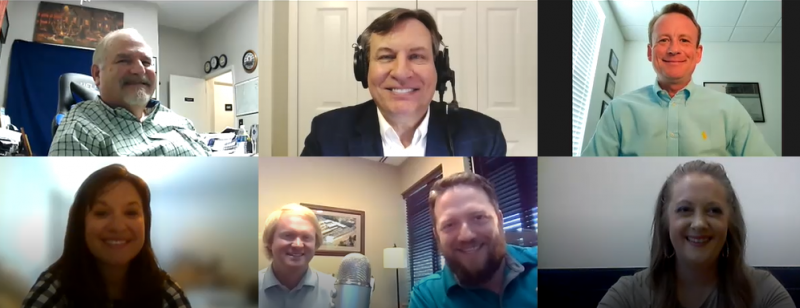
Rome Floyd Chamber Small Business Spotlight – Christine Pilgrim and Megan Otwell with Junior Service League of Rome, Lee Jennings with R.L. Jennings and Associates, and Ben Chandler and Casey Tuggle with Easy Auto
/
RSS Feed
Get Clear on Your Best Fit Client
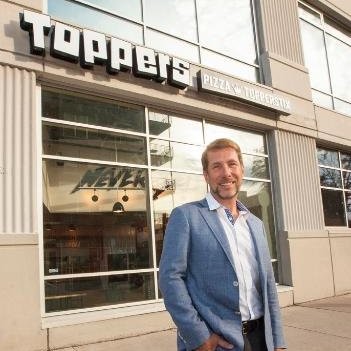
Scott Gittrich with Topper’s Pizza
/
RSS Feed
Brought To You By SeoSamba . . . Comprehensive, High Performing Marketing Solutions For Mature And Emerging Franchise Brands . . . To Supercharge Your Franchise Marketing, Go To seosamba.com.
 Scott Gittrich can’t remember the first pizza he delivered as a driver for Domino’s Pizza in 1984, but he does remember that it was the beginning of a life-long love affair.
Gittrich and his wife skimped and saved as he worked his way up the Domino’s ranks before taking a chance and opening his first Toppers Pizza in 1991 in Champaign, Illinois at the age of 21. The brand now boasts more than 70 locations across the U.S. and Gittrich hasn’t lost an ounce of passion for the business.
Headquartered in Wisconsin, Toppers is now one of the fastest growing better-pizza chains in the United States. The brand has doubled in size over the last three years and completely sold out three states based on growth spurred by both existing franchisees and established multi-unit operators.
Connect with Scott on LinkedIn and follow Topper’s Pizza on Facebook and Twitter.
This transcript is machine transcribed by Sonix
TRANSCRIPT
Intro: [00:00:07] Welcome to Franchise Marketing Radio, brought to you by SEOSamba comprehensive high performing marketing solutions for mature and emerging franchise brands. To supercharge your franchise marketing, go to seosamba.com. That’s seosamba.com
Lee Kantor: [00:00:32] Lee Kantor here, another episode of Franchise Marketing Radio, and this is going to be a fun one. Today we have with us Scott Gittrich with Topper’s Pizza. Welcome, Scott. How are you doing? I am doing well. Thank you so much for doing this today. I’m excited to learn your story. Tell us a little bit about Topper’s Pizza.
Scott Gittrich: [00:00:53] A little bit about Topper’s pizza. We consider ourselves the well-established but emerging brand because we’re at the front end of of some big growth here. I’m the founder of the business. We started 30 years ago this August. Our our founding vision was to be the QSR pizza place that makes our food from scratch and brings a bowl variety and recipes to our customers. So that’s where we that’s where we sit in the in the in the pizza industry. We’ve got a sixty nine restaurants in about 10 states. We’re headquartered in Whitewater, Wisconsin, and about two thirds of our restaurants are in Wisconsin and Minnesota. We’ve got a great average unit volumes, great franchise, great franchise Proposition four for business people. It’s been an incredible last three years and in particular during covid our concept with a commitment to technology, small footprints, delivery, fresh food made from scratch really has has done well. And here kind of emerging out of the pandemic, it’s more of the same. So we continue up over last year and we just feel really great about the environment where we’re positioned for the future.
Lee Kantor: [00:02:32] Now, let’s talk a little bit more about kind of the back story. You’ve been involved in the pizza industry like since you were a kid. And you talk about what attracted you to pizza as a young person and then what inspired you to kind of go out on your own at such a young age to start Topper’s?
Scott Gittrich: [00:02:53] Yeah, well, oh, man, you know, it’s. That’s an interesting way you ask that question, you know, little kids end up wanting to be teachers or policemen because that’s what they see. And I don’t know, I. I have a. I have fond memories of pizza places, you know, growing up and connecting with family and friends over pizza. It’s just it’s unequivocally the best food on Earth. I know that sounds ridiculous, but started in restaurants when I was 15. You touched a couple of really great leaders who really showed me a path to a wonderful career in restaurant in the restaurant business. I studied engineering and in college. And I actually have a degree in psychology. But my but truly, my heart’s always been in restaurants and such incredible humble work. Anybody that anybody has been on their hands and knees scrubbing the baseboard or or cooking and certainly for minimum wage, saying yes or no, sir, about cold fries or whatever. And I just have a strong and strong piece of my heart is is connected to the industry. I am. So I saved up some money working in working in a restaurant, saved up thirty thousand dollars with my my then wife. And you know, we saw the landscape of pizza was had emerged to be this at that point in nineteen ninety one there were essentially four mammoth pizza, food chain food, pizza food companies and. I felt like we felt that there was a real opportunity to do something special with the food, bring that QSR aspect, the delivery, small footprint, kind of the kitchen platform.
Scott Gittrich: [00:05:02] But to really do pizza, right. To respect pizza, make it from scratch. You have bold recipes, I mean, there are about 10 pizza toppings in nineteen ninety one, and we we we kind of broke the mold and put chicken on pizza and taco. And today we have mac and cheese and buffalo chicken and we put cheese curds on pizza. And, you know, Nashville hot chicken is what we’re doing right now. And we do have a big plant based line of pizzas and we’re just kind of the pizza place that that respects pizza and does it that we think does it right. We use, you know, real Wisconsin cheese, which you might think that the big people use, you know, real, real one hundred percent cheese. But that’s not true. They freeze it. They put fillers in it. And so that’s us. We do it right. Pizza. And we deliver it the way customers want. Topper’s dotcom. We’ve invested millions of dollars into our e-commerce solution and it is just incredible. We do. Last week it was almost seventy four percent of all of our sales came in, did digitally. So and that just continues to climb almost on a weekly basis. So we’ve just set ourselves up for what consumers, the way consumers like to like to eat today.
Lee Kantor: [00:06:34] Now, when you started it, was it built around? OK, I’m going to franchisees because at that time there was for whatever reason, I mean, you probably can you can speak to this better than I can. That part of the country, pizza places, you know, we’re born. You know what makes it about that part of the country that so, you know, that inspired the founding of so many pizza outfits.
Scott Gittrich: [00:07:00] Yeah, that’s an interesting question I’ve asked myself about myself, I suppose that certainly there’s some touch to pizza really got its foothold in the United States out of World War Two and all the guys that had spent some time in Italy in that kind of thing. That’s that’s the story. Certainly New York’s a hotbed of great pizza and Chicago. But certainly there’s a lot of a lot of change emerged out of the Midwest. I mean, you’re you’re right. Some great mom and pops on the coast and that kind of thing and everywhere. But some great chains have come out of the Midwest. It’s it’s it’s interesting. I’m going to have to go ahead and place it up, put it on those historical things. But, you know, when I started it, I didn’t necessarily think I wasn’t thinking, OK, I’m going to start a big franchise company and hired a bunch of consultants for that kind of thing. I’m really a restaurant person in my heart and an operator, and that’s what I grew up in. So we did think that, God willing, if we did a great job and customers loved us, that we fancied that it could be a great opportunity for the Topper’s pizza nation that we didn’t know yet. Those team members and people that if if we did a great job, that we suspected that if we could pull it off that it was it could grow. We believed in the opportunity, but we fought tooth and nail and I fought tooth and nail all along, just running great restaurants, taking care of customers, taking care of team members. And those first franchisees were team members. They were people who had grown up at Topper’s Pizza, spent a few years at Topper’s. They believed in what we were doing. They scratched up a little money from family and opened up, opened up a restaurant. And some of those franchisees are still franchisees today and have sent their kids off to college and have made great livings running three, four or five Topper’s pizza restaurants that they’ve opened over the years. So it’s pretty special now.
Lee Kantor: [00:09:12] So when you started out, you weren’t dreaming of of kind of empire building. You were just trying to make a good restaurant, a good pizza, and really separate yourself from a quality and innovation standpoint.
Scott Gittrich: [00:09:27] Yeah, I mean, it would probably be disingenuous to say that I didn’t have big business dreams. I I certainly did think that because I worked at a good restaurant companies that had grown and grown through franchising. Matter of fact, I’ve worked for franchisees a couple of times and really admired the franchise concept I. You know, my last my last gig was working for a franchisee at Domino’s Pizza for seven and a half years, and he’s one of my is he’s still today one of my business heroes. He’s retired now, but quite something. And I, I believe in the franchising idea that. Both parties, franchisor franchisee, when together, nobody can nobody can really win at the expense of the other. It’s it’s like a marriage. So you outside of a restaurant. The restaurant industry. I’m drawn to the franchising industry. I believe in it. It’s it’s quite something to be supportive of entrepreneurs, people that are putting all of their hard earned money on the line and pour in their heart into into basically the brand that, you know, that we’ve built over the years and not here. It works for them to to grow their own empire. And it’s it’s pretty it’s pretty awesome what’s happening right now and the people that are coming to us and the momentum that we’re where we’re building here as our current and new franchisees continue to grow.
Lee Kantor: [00:11:15] Now, can you talk about that transition from when you have your own restaurant and it’s about serving that customer and making the pies and being consistent and, you know, serving those people and growing sales individually in that restaurant. And then you decide to become a franchise owner and really put the pedal to the ground there. And now your training and development company and you’re helping other people sell one more pie and helping them make money faster. Was that kind of you know, that’s an entirely different business. Now you’re you’re doing a different kind of task every day and you’re having different metrics for success in that world. Ultimately, you’re helping people eat more pizza. But in your world now as a franchise owner, you’re helping other people sell more pizza. So how did that go? Did was that smooth sailing because of your experience with that franchisee, or was that something that was kind of at least a mental shift, I would imagine, of going from that, you know, local sales to OK, now I’m training and developing other folks?
Scott Gittrich: [00:12:23] It’s a good question. I think that there’s a personal question and a business question in there on the personal side. And it’s kind of all fun in some ways, like it’s an opportunity to learn and continue to grow in my role, you know, today as a CEO of, you know, a system of seventy five million dollars versus showing up every day in a restaurant twenty five, thirty years ago and working with a team of restaurant people to serve customers and certainly different but extremely interrelated work that the experience just builds on itself. For me personally, there’s certainly a part of me that. Thinks of my days actually in a restaurant in some ways, I’ve kind of idealized that, I always think of it like if I were a basketball player and eventually I owned the team or I was in upper management. And I kind of have a role. But I imagine myself on game day, sitting up in a skybox and looking down on the court and saying to the person next to me, I used to be a player, if something like that. I mean, I’ve I’ve actually joked with my wife that in retirement maybe we could start a little pizza place, you know, just the place that’s open three or four days a week where we just know our customers and have a small team.
Scott Gittrich: [00:13:51] And it sounds kind of silly, but it just it’s just like a lot of people’s work, you know, as you as you become successful, you work yourself out of whatever that great job was that got you first into that that line of work. Now, that being said, I love the work that I do today a lot. It’s definitely different. The you know, the shift is the shift is still one of scale and giving to run a great restaurant, still your drink, your pouring your time and energy into the people around you. And you’re building great restaurant people today. It’s you know, it’s having the right team at Topper’s Pizza that are pouring their time and energies into franchisee’s into management multiunit folks, store general managers. It still is a very giving sort of work because it’s people focused and it’s it’s a commitment to helping the people around you succeed at what they do and kind of let in and being very confident that if they’re successful, that that’s going to lead to the success, your own personal success, but also the success of the organization.
Scott Gittrich: [00:15:19] And that that’s really that’s really where we’re at. It’s you know, I’ll tell you this, there’s there’s franchise companies that are very good at you know, it’s almost like many people have a great idea in the rest. And the pizza business, I’d say when Fast Casual first came out, the Blazers models of the world, you know, whenever that was six, eight years ago, there was about a hundred of those places that immediately popped up, particularly on the coast. It was like every investment group went out and bought a single restaurant and tried to franchise it. And, you know, and they may have had business smarts, maybe even some of them had franchising smart, but it didn’t grow organically from some real concept that actually worked and resonated at the customer level in a store. So I’ll tell you what, if I could if I had to choose one thing, if you’ve got great restaurants that customers love and are fanatic for and and then you build you build up the business on top of that, or you’re a great business person and you’re going to figure out the restaurant as you go. That’s that’s born to lose right there.
Lee Kantor: [00:16:38] Right. You got to have that foundation. And the and the super fans are real. It’s not manufactured. And I think a lot of folks I think you’re exactly right that they have a concept and they just scale and hope. And, you know, that’s just tough for that franchisee because they’re buying the hope, you know, so that’s why, you know, the franchising world has those kind of stories of the disgruntled franchisee because of that. Now, in your case, it sounds like you built a really solid foundation. And it isn’t until fairly recently that the pedals to the ground and and you’re really expanding aggressively.
Scott Gittrich: [00:17:22] Yeah, we’ve had. We’ve opened double digit stores, and in any year, twice in the last five, six years or so, we’ve had our wave the forward kind of on environment, connecting with us and that kind of thing. But there’s been such a reset in the restaurant business. In the last in the last particularly year, you know, depending on who you believe, twenty to twenty five percent of the restaurants in the United States have closed every every single business. And, of course, every restaurant is has tried to quickly if they weren’t already, they tried to quickly go to delivery, trying to go to their go to e-commerce and try to find the partners that are going to work with them to be able to offer customers the right access, the right technological channels that customers look for. I’m telling you the things that are hot right now and that are. I realize that that’s not the right way to say it, because it’s not the things that are hot. It’s it’s it’s immerge the entire time. So these things are in our DNA and they really are in our DNA. From the time I started in restaurants to today, we made a bet, a bet that delivery was the way of the future. And for the last 30 years, food delivery has gone one direction, one direction. I mean, when I first started Topper’s, people would walk in the restaurant and they would they would literally look around and say, where do I sit down and eat? And we would we would explain to them what delivery, what we would say. It’s like Chinese. I mean, it’s amazing to think it was just 30 years ago that basically food delivery was still kind of emerging.
Scott Gittrich: [00:19:23] And today it’s like every restaurant, if they weren’t doing it a year and a half ago, they rushed to it now. And we self performed delivery. It’s in our DNA. This is what we do. And it’s very easy to see restaurant companies that are struggling to do that. Right, or they’re paying the better part of all of their sales to other people to market and and perform their delivery. Our technology, we were truly one of the first e-commerce restaurants in two thousand seven. Topper’s Dotcom was launched as a as a restaurant e-commerce engine. Of course, we did very little business as 14 years ago. I mean, again, this is amazing to think, but we have poured millions of dollars into our own proprietary e-commerce and point of sale solution so that during the pandemic we were set to serve our customers in this extremely important way. We didn’t have to try to quickly figure it out. We’re born and bred for this thing. And then the last piece I would say is, is the menu. We kind of sit in this place of quality, bold recipes. So it’s a little more complicated than maybe your classic franchise, how we how we cook and what we do in our kitchens. But it’s what consumers really are looking to get as high quality food that that serves diverse lifestyles. And even some of those lifestyles are identity kind of lifestyles like plant based pito, this kind of thing. And we’re uniquely set up to succeed in this in this environment.
Lee Kantor: [00:21:14] So let’s talk a little bit about the idea of franchisee. Is it that kind of person that always had the dream of having a pizza place, or is this a person that’s buying this as to add a complimentary piece to their already existing franchise portfolio?
Scott Gittrich: [00:21:29] Yeah, we’ve succeeded with both of those people, the thing that’s that is common among the right, the right fit for Takeshita is that they’re engaged. So we have a very strong culture where Topper’s is not going to be the right fit for somebody who has a portfolio of businesses unless they have committed and committed people that truly are in it, in it to be in the pizza business. It’s not the kind of thing where you’re the the franchisee is is off on a boat and somehow some manager is making it happen by themselves. Now, that being said, we certainly have. High net worth, folks, that that are business people who work with great restaurant operators, who are that person who run the Topper’s feet, their Topper’s pizza franchise. In that way, that that works. So. You know, that’s that’s the common thing, so we we have a franchise opportunities for a single store operators in the markets where we already served. So in Wisconsin, Minnesota, the Carolinas, Nebraska, and these places where we already have a good foothold, we have great single store opportunities for those for those in those markets, in places where it takes a little more wherewithal in order to be able to go into a market and build awareness more quickly where you really want two or three franchise companies that really can build out a market or make up make a strong footprint in three, four, five years. Know it takes a little bit more wherewithal. So we take both we take both approaches depending on the market and people.
Lee Kantor: [00:23:36] Now, if somebody wanted to learn more about Toppers, have a more substantive conversation with you or somebody on the team, what’s the website?
Scott Gittrich: [00:23:43] Topper’s dot com. You can find it. That’s our that’s our e-commerce site that you can find the button. There are Topper’s franchise dot com.
Lee Kantor: [00:23:51] Good stuff. Well, Scott, thank you so much for sharing your story today. You’re doing important work. We appreciate you.
Scott Gittrich: [00:23:56] Thanks. Good questions. Have a great day.
Lee Kantor: [00:23:59] All right. This is Lee Kantor. We’ll see how next time on Franchise Marketing Radio.
Barbara Blackwell with Chicken Salad Chick
/
RSS Feed
Brought To You By SeoSamba . . . Comprehensive, High Performing Marketing Solutions For Mature And Emerging Franchise Brands . . . To Supercharge Your Franchise Marketing, Go To seosamba.com.
 Chicken Salad Chick’s Director of Catering Barbara Blackwell is the ultimate example of an accomplished female leader, overseeing the rapidly expanding famed restaurant brand’s catering operations across all 190 locations nationwide.
Blackwell is an accomplished sales and marketing leader and has merited rave reviews – from catering Bill Clinton’s Democratic Nominee Party at Macy’s Herald Square in NYC and being featured in the New York Times for coordinating a Guest Chef’s Series for Columbia University. She is also a current member of Alpha Kappa Alpha Sorority Inc. and works closely with the Friends for Life Foundation, Inc.
Follow Chicken Salad Chick on Facebook, Twitter and Instagram.
What You’ll Learn in This Episode
- Barbara’s story and what led her to join Chicken Salad Chick
- About Chicken Salad Chick and what the brand is known for
- Barbara’s secret to success as Director of Catering
- Advice for young women wanting to advance their careers
- Chicken Salad Chick’s current footprint and expansion plans
This transcript is machine transcribed by Sonix
TRANSCRIPT
Intro: Welcome to Franchise Marketing Radio, brought to you by SEOSamba comprehensive high performing marketing solutions for mature and emerging franchise brands. To supercharge your franchise marketing, go to seosamba.com. That’s seosamba.com
Lee Kantor: Lee Kantor here, another episode of Franchise Marketing Radio, and this is going to be a good one to have with us, Barbara Blackwell with Chicken Salad Chick. Welcome, Barbara.
Barbara Blackwell: Thank you so much, Lee. I’m so excited to be here.
Lee Kantor: Well, before we get too far into things, tell us about chicken salad chick.
Barbara Blackwell: Well, so chicken salad chicks started with our founder, Stacey Brown, when she was on a quest to find the perfect chicken salad, when she quickly realized that the perfect chicken salad was different for everyone. So in her kitchen, she went to work creating recipes for 12 different flavors. This turned into a home based business which soon became so popular that she could no longer operated out of her home. And this led to our first restaurant in Auburn, Alabama. And today we have one hundred and ninety three restaurants in 17 states.
Lee Kantor: So when she initially came up with the concept, it wasn’t to build a franchise or empire. It was, hey, I got this cool idea. Let me experiment, let me play around. And then it just kind of organically grew there in Alabama.
Barbara Blackwell: Yes, absolutely. So she was really just looking for the perfect chicken salad and she couldn’t find it. So she started with a couple of recipes and she tested it out with friends, family and neighbors. And then, you know, she would test out with their friend and they say, well, why don’t you add some grapes? Because I kind of like grapes and maybe some nuts in my chicken salad. And then she tried that with a relative and they’d say, well, I don’t really like fruity nutty. I kind of like spicy. How about some halal pinos? So it really started to evolve from there. And that’s when, like I said, she realized that the perfect chicken salad was different for everyone. And she started with 12 original recipes and that really came from family and friends. So there is a personal connection.
Lee Kantor: So then what was the impetus to say, you know what, this can be a franchise.
Barbara Blackwell: Well, so when she opened up the first restaurant and Allburn. It was it was a take out business unit, she ran out of over 40 pounds of chicken salad in one hour. And then every day she would make more chicken salad and she continued to run out. So she looked at her business partner, she says, I think we really have something here. And it became so popular in the community that they really thought they had something that could really be franchised and scalable.
Lee Kantor: So after that first store, then they went on the path to franchise.
Barbara Blackwell: Well, yes, so they went to find some franchise partners that can help them seed, see the seed, the business so that they could then begin to grow and franchise the business.
Lee Kantor: And then from that standpoint, it becomes a different business. Right. Like at one point you’re selling chicken salad and the next thing you’re selling chicken salad franchises.
Barbara Blackwell: Well, yeah. Yeah, no, absolutely.
Lee Kantor: So how did she handle that kind of transition?
Barbara Blackwell: Well, because it was important for us to maintain the made from scratch element, because we make our chicken every day by hand from scratch. The important piece there was to make sure that we didn’t lose that. So a lot was put into how do we scale the recipe among the 12 flavors so that we can maintain that flavor profile. And the other piece was, how do we maintain this Southern hospitality feel that was part of the first restaurant. So those were definitely some of the components that were factored in to the expansion.
Lee Kantor: Now, having expanded already, you know, close to two hundred locations, is it are you as ideal franchisee? Is it that person with a dream of I want to have my own chicken salad restaurant or is this a complementary brand in someone’s portfolio?
Barbara Blackwell: Yeah, so it’s a little bit of both. And we have some very unique franchise owners in that many have not even been in the restaurant business before. We have several owners that are husband and wife owners. We have owners that the entire family is getting into the business. And then we have those traditional owners where they have other restaurant concepts in their portfolio.
Lee Kantor: So now, from your standpoint, you don’t care which direction they come from or you’re looking for more of one over the other.
Barbara Blackwell: Well, now, I mean, we’re looking for someone that wants to get into the restaurant business but really is getting into it because they really enjoy serving others. They love the Southern hospitality. They obviously love this story, the genesis for the brand, and they want to be a part of that. The other piece is that we’re we’re very involved in our communities. So those people that come on board as franchisees are oftentimes well known in their communities because they’re serving their communities and other capacities.
Lee Kantor: So now your role with the organization is the director of catering. How does catering come into play for individual franchisees?
Barbara Blackwell: Yeah, so catering is the perfect complement for our brand, and so we’ve been able to scale and grow the program by building a solid infrastructure that makes it very easy for our owner operators to execute this off premise opportunity.
Lee Kantor: So your job is to do what, then invent kind of clever ways for them to penetrate the local market with catering options, or are you helping them actually build these relationships locally?
Barbara Blackwell: Yeah, so I’m I’m pretty much involved in the entire process from a scalable standpoint, so I help you develop the menu, develop the technology and under other vendor partners that we need to be able to help our owner operators execute at the store level, building a website that offers ease of ordering for our customers. I also work with our marketing team to develop social media, digital and sales tactics for our owner operators to be able to create awareness trial of catering in their communities. And we like the high touch. So oftentimes we’re out with samples visiting local businesses in order to generate trial.
Lee Kantor: Now for like what’s kind of the best case scenario in terms of the percentage of their revenue coming from catering, is that a large percentage of overall revenue?
Barbara Blackwell: Well, right now, I would not say it’s a large percentage of our primary business is our dynan business, our catering business is secondary to that. But certainly we’re building that that business as a percent of sales
Lee Kantor: Because that’s a great way for them to enhance their sales and kind of minimally disrupting their day to day operations right
Barbara Blackwell: Now. Absolutely. Catering is one of the best ways to drive incremental sales because you’re using your existing staff where you’re utilizing the existing food products that we have. Our chicken salad travels very well. So it’s it’s ideal for catering. Our menu appeals to both folks looking to plan social events as well as corporate business meetings.
Lee Kantor: So it doesn’t have to be a kind of a business lunch. It could be, you know, like a shower, wedding shower or something.
Barbara Blackwell: Oh, absolutely. You know, every week where we’re catering baby showers and wedding showers and then throughout the week, we’re working with corporate businesses. We’re working with churches and medical centers, you name it, we are catering is ideal for every business segment.
Lee Kantor: So now you mentioned the original 12 flavors. How often do the flavors get kind of refreshed or do those 12 stay the same and then you kind of cycle in seasonal flavors or maybe regional or local flavors?
Barbara Blackwell: Yeah. So the original 12 flavors are constant to our menu. But what we do is we offer Aalto flavors throughout the year. So about four times a year we’re going to introduce a limited time only flavor. And so that introduces new product news. Now, while a lot of our guests, they select their favorite, there are opportunities to try something new.
Lee Kantor: Is there a new one going on now?
Barbara Blackwell: Yes, our Pams Parmesan Caesar is in stores now. So certainly you want to try it. It is absolutely delicious.
Lee Kantor: And then you’re that’s something you’re constantly year round working on and then you’re just rolling them out once you’ve got it all figured out quarterly.
Barbara Blackwell: Yeah, so, I mean, while the recipe is certainly important, we like the personal connection, so Pam’s farmers are on. Cesar is actually named after a team member that work with us. And unfortunately, she lost her battle with cancer. So you’ll find with every flavor there is a personal connection similar to the 12 that’s similar to the original 12 flavors that were connected to Stacey, whether they were friends or relatives. So that’s part of what you’ll always see.
Lee Kantor: So now what is when you have somebody in the market? What are some of the things they’re doing to kind of immerse themselves in that local market to really serve their clients?
Barbara Blackwell: Yeah, no, thank you for that question. So each and every market is different, so our local owner operators connect with the local charities and community efforts that resonate with their their guests. And so typically, when we have a grand opening, we’re going to collect funds to support the local food bank or support cancer research. So it really is predicated on the on the community. So oftentimes our owners will select that partnership.
Lee Kantor: And then so that you give them some autonomy and what you’re the the nonprofits that are kind of aligned with them and and in line with you so that it becomes personal.
Barbara Blackwell: Absolutely. Absolutely.
Lee Kantor: So now are your franchisees, are they primarily women or are they both genders? Like what is the typical profile of that franchisee look like?
Barbara Blackwell: Yeah, they are. They are absolutely both genders. Like I said earlier, we do have several husband and wife owners. So yes, it is both genders.
Lee Kantor: So it could be like a family or like maybe a parent and a child can say, hey, let’s do this so we can really work together, because it sounds like the whole vibe is very family oriented. And you want to create that kind of comfortable space where people it kind of it’s almost nostalgic in some ways.
Barbara Blackwell: Now you’re. No, you’re absolutely you’re absolutely right. I just met a a family. It was it’s a dad. It’s a daughter and it’s a son. And they’re going to be opening up a chicken salad chick here in the next month or so. So. So you’re absolutely right.
Lee Kantor: So now do you have any advice for young women like that, want to maybe pursue this as a career or just kind of maybe share a little bit about your story, about how you’ve been able to kind of achieve so much in your career now?
Barbara Blackwell: Thank you. So so my entire career has been in the restaurant industry. I’ve worked in operations, marketing and catering sales across several business segments from fast food to fine dining. And over the last several years, I find that I keep coming back to the restaurant catering space just because I enjoy it so much. And so with that said, what I would say is do something that you enjoy, because if you enjoy it, you will excel. And when you excel at something over a course of several years, you will become an expert. And once you become an expert, you’ve built intellectual capital that companies will find valuable. I would also say that you want to work, learn and have fun. I’ve been doing this for many years and I’m still learning, but I’m having fun at the same time. And then finally, you probably heard this before, but network, network, network, I’ve been able to build some really awesome relationships with industry peers. And that’s been extremely helpful, because when I’m dealing with a certain situation, looking for solutions, I can reach out to one of my industry peers for some feedback. Also, when you network job opportunities and again you’ve become an expert, job opportunities come looking for you. And so that’s a great place to be. And then finally, I would say find a professional mentor. I’ve had a professional mentor throughout my career.
Lee Kantor: Now, in terms of chicken salad chick, what is the growth plans coming up? Are you bullish, you know, as we come out of this pandemic or things break in your way?
Barbara Blackwell: Yeah, we’re actually opening up new store next next week and Slidell, Louisiana, and we have some other upcoming grand openings and Hopkinsville, Kentucky. So we are planning to end the year with over two hundred stores. We have several stores slated for opening next year. And our long term expansion plan is to have 500 stores by twenty twenty five.
Lee Kantor: And then you’re building kind of from the southeast outward.
Barbara Blackwell: Well, yeah, so we’re currently our stores are located in the southern border up around the south east, and then if you come in, we’re over to Ohio and down to Texas. So that’s our existing territory. We’re building out and some of those areas and then we’re going to continue to expand.
Lee Kantor: Well, Barbara, thank you so much for sharing your story today. It’s an amazing journey that you’ve been on and the impact that you’re having on folks is real. Thank you for that. Thank you. Now, if somebody wants to learn more about chicken salad, check whether the restaurant or the franchise opportunity is their website.
Barbara Blackwell: Absolutely. Please visit us at chicken salad, check dot com to view our restaurant and catering menus and to find a restaurant near you and find out more about our franchise opportunities.
Lee Kantor: Good stuff. Well, thank you again, Barbara, for sharing your story. Thank you. All right, this is Lee Kantor, we’ll see our next time, our Franchise Marketing Radio.
Trusting and Agile: Chocolate Soup and Assembly – Making Sure that Employee Recognition Comes First EP 12

/
RSS Feed
Trusting and Agile: Chocolate Soup and Assembly – Making Sure that Employee Recognition Comes First EP 12
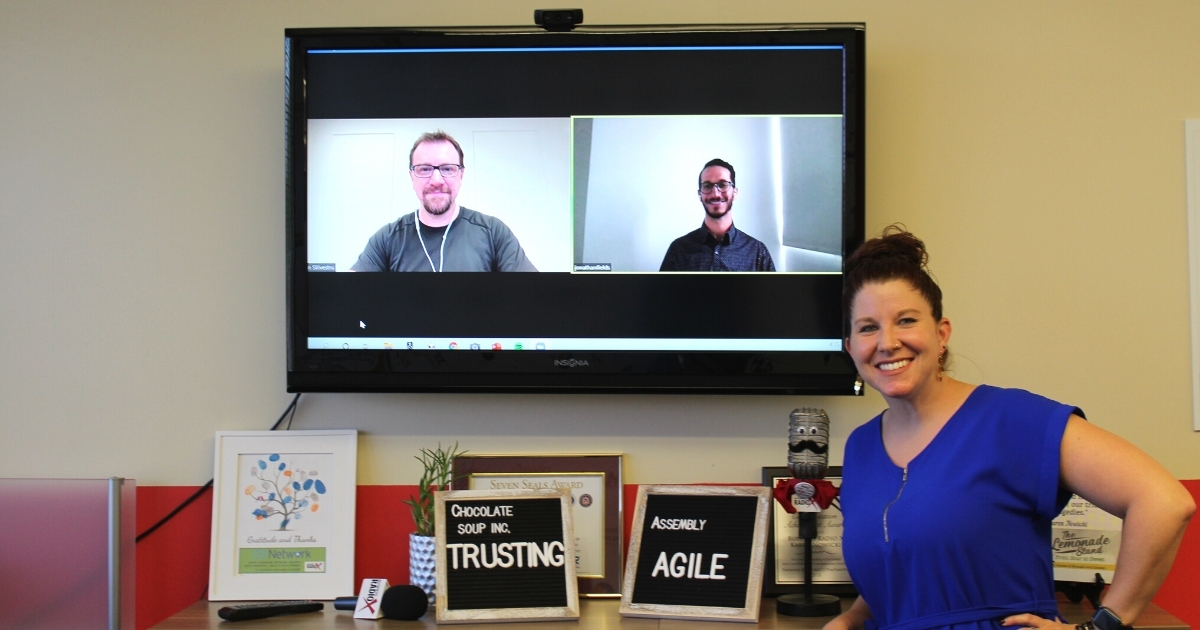
This episode of Culture Crush focused on the conversation of employee recognition. We were able to highlight two great individuals leading two employee recognition companies. Dan Silivestru with Chocolate Soup and Jonathan Fields with Assembly provided insight into the need for company recognition to the employees as we way that can increase company culture, brand recognition, and increase engagement and retention of the staff.
Their two companies compliment each other with the support they give to employee recognition. Assembly allows the employees the opportunity to provide recognition to their peers while Chocolate Soup allows the leadership team to provide recognition to the employees on all of their special days.
85% OF HR LEADERS SAY EMPLOYEE RECOGNITION PROGRAMS ENHANCE THEIR ORGANIZATIONAL CULTURE.
79% OF EMPLOYEES SAY THEY WOULD BE MORE LOYAL TO THEIR EMPLOYERS IF THEY RECEIVED MORE RECOGNITION.
This episode is great for all listeners. We can all connect with working for a company with a good culture or a bad culture, so we can all connect to the discussion of employee recognition as well.
We encourage company leaders to listen to this episode to gain two new resources that are designed to help employee recognition and therefor the overall health of the company culture. These two resources can drastically help improve the engagement of the staff by showing them the recognition they need.

Chocolate Soup was born out of a sheer passion for building great company culture in support of happy, caring, and respectful teams. They’re here to help companies of all sizes discover the power of radical generosity, surprise and delight by recognizing important employee milestones with expertly curated, personal gifts.
Chocolate Soup offers a subscription-based employee recognition program that delivers beautifully curated gift boxes filled with treats and gifts. Companies can recognize their employees’ work anniversaries, birthdays, children and pet birthdays and more.
They also offer custom gift boxes for company events or for unique milestones including weddings and new home purchases.
Chocolate Soup lives and breathes employee happiness!
 Dan Silivestru is the co-founder and CEO of Chocolate Soup. A life-long entrepreneur, Dan and his partner Pj Lowe have founded three previous startups, selling TinyHippos to RIM (BlackBerry) in 2011.
Their experience closing down their last startup, bitHound, gave them the idea for Chocolate Soup and its mission to help companies with employee recognition, engagement, and retention through beautifully curated, locally sourced gift boxes.
In addition to running Chocolate Soup, Dan also serves on the board of several startups and mentors early-stage founders with their startups.
Follow Chocolate Soup on LinkedIn, Facebook, Twitter and Instagram.

Assembly is an employee recognition and rewards solution that ensure employees feel appreciated and acknowledged for their hard work.
 Jonathan Fields started his career in investment banking. After one short year he realized that his efforts were not truly valued and wanted to work in a more collaborative environment. Jonathan joined a small startup called ZipRecruiter as the 15th employee. The company went on to grow to over 1,000 employees and recently went public.
After 7 amazing years at ZipRecruiter Jonathan realized he wanted to better the employee experience and make work more efficient so he went on to build Assembly. In the past year Assembly has grown over 3,000% and continues to better work life culture in this changing environment.
Jonathan is an avid golfer, lives in Marina Del Rey with his fiance Eliana and has a mini golden doodle named Charlie. Jonathan also has a very immature sense of humor and is obsessed with Coldstone.
Follow Assembly on LinkedIn.
About Culture Crush
Culture Crush is officially relaunched! We are thankful to Debra Caron who launched and hosted the show originally. Culture Crush is back with a new host but the same focus- highlighting what makes a great company culture and how it affects the overall success of a company.
Culture is not just a tag word to be thrown around. It is not something you throw in job descriptions to draw people to applying for jobs within a company.
According to Marcus Buckingham and Ashely Goodall in their book Nine Lies About Work, “Culture is the tenants of how we behave. It’s like a family creed. This is how we operate and treat each other in the family.”
On this long form podcast we will highlight companies local to Arizona and beyond that are crushing it with great culture!
We will talk with company leaders to learn about real-life experiences, tips, and best practices for creating a healthy work environment where employees are finding joy and satisfaction in their work while also striving and growing within the company.
About the Host
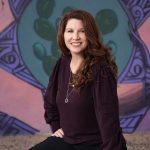 Kindra Maples is your new host taking the lead on the relaunch of Culture Crush! She is spartan racer, past animal trainer, previous magician’s assistant, and has a weakness for Oreo cookie shakes. Her journey working with people actually started working with animals as a teenager (don’t worry we won’t go that far back for her bio).
She worked for over 15 years in the zoo industry working with animals and the public. Her passion of working with animals shifted into working with people in education, operations and leadership roles. From there her passion of leadership and helping people develop has continued to grow.
Then came the opportunity for relaunching the Culture Crush Podcast and she jumped on it. Leadership, growth, and strong company cultures are all areas that Kindra is interested in diving into further.
Shout Outs
We want to thank a few people for their behind the scenes effort in helping this relaunch to come to life. James Johnson with Tailored Penguin Media Company LLC.– It is a small, but powerful video production company with a goal to deliver the very best by articulating the vision of your brand in a visually creative way. Gordon Murray with Flash PhotoVideo, LLC. -Flash Gordon has been photographing since high school and evolving since then with new products that will equip, encourage, engage, and enable. Renee Blundon with Renee Blundon Design – She is not only one of the best free divers (that’s not how she helped with the podcast) but she is great with graphics design and taking the direction for the vision that you have while also adding creative ideas to bring to your vision to life.
These are just a few of the folks that supported the relaunch of the podcast. If you would like to be part of the Culture Crush team or would like to support underwriting the show- please reach out: culturecrushpodcast@gmail.com
About Our Sponsor
For 23 years Catholic Education Arizona has helped serve underserved children with $268 million in scholarships. Catholic High Schools have a 99.4% graduation rate and 97% move on to higher education or military service.
Participating partners like APS, BBVA, and Grand Canyon University receive a dollar-for-dollar Arizona State Tax Credit. The corporate partners enjoy helping our future work force, Building the Arizona community and future leaders!
The partners also enjoy promotion in Catholic Education Arizona’s newsletter, social media channels and podcast! For more information, call 602-218-6542 or visit www.ceaz.org – they are changing lives one scholarship at a time!














