Business RadioX ®

  • Home
  • Business RadioX ® Communities
    • Southeast
      • Alabama
        • Birmingham
      • Florida
        • Orlando
        • Pensacola
        • South Florida
        • Tampa
        • Tallahassee
      • Georgia
        • Atlanta
        • Cherokee
        • Forsyth
        • Greater Perimeter
        • Gwinnett
        • North Fulton
        • North Georgia
        • Northeast Georgia
        • Rome
        • Savannah
      • Louisiana
        • New Orleans
      • North Carolina
        • Charlotte
        • Raleigh
      • Tennessee
        • Chattanooga
        • Nashville
      • Virginia
        • Richmond
    • South Central
      • Arkansas
        • Northwest Arkansas
    • Midwest
      • Illinois
        • Chicago
      • Michigan
        • Detroit
      • Minnesota
        • Minneapolis St. Paul
      • Missouri
        • St. Louis
      • Ohio
        • Cleveland
        • Columbus
        • Dayton
    • Southwest
      • Arizona
        • Phoenix
        • Tucson
        • Valley
      • Texas
        • Austin
        • Dallas
        • Houston
    • West
      • California
        • Bay Area
        • LA
        • Pasadena
      • Colorado
        • Denver
      • Hawaii
        • Oahu
  • FAQs
  • About Us
    • Our Mission
    • Our Audience
    • Why It Works
    • What People Are Saying
    • BRX in the News
  • Resources
    • BRX Pro Tips
    • B2B Marketing: The 4Rs
    • High Velocity Selling Habits
    • Why Most B2B Media Strategies Fail
    • 9 Reasons To Sponsor A Business RadioX ® Show
  • Partner With Us
  • Veteran Business RadioX ®

Raj Chokshi with Redwood Wealth Management

October 10, 2018 by Stone Payton

Just My Segment
Just My Segment
Raj Chokshi with Redwood Wealth Management
Loading
00:00 /
RSS Feed
Share
Link
Embed

Download file

Raj Chokshi – CPA, MBA, CFP®

Partner, Wealth Manager

For Raj Chokshi, his friends and family, it was a given that Raj would embark on a career that involved numbers and owning a business. After all, Raj came from a family where everyone was self-employed and the family boasted a long line of accountants and CPAs. Adding one more was a safe bet.

But Raj’s path to Atlanta and to the creation of Redwood Wealth Management was unique. Born 100 miles north of London in Leicestershire, England, Raj moved to Connecticut at age 10, then to Massachusetts for middle school and finally to Cordele, Georgia, for high school.

As a high school student in Cordele, Raj hardly exhibited the traits of a man destined to be in wealth management. He worked as sports photographer for the local newspaper, the Cordele Dispatch, and shot photos for his high school yearbook. Adding to his photography passion, Raj worked as disc jockey for a local country radio station with the handle “Raj on the Radio.”

With college, however, Raj returned to numbers, earned his undergraduate degree in accounting from the University of Georgia and passing the CPA exam immediately after college. Hired by the world-renowned accounting and tax-planning firm of Arthur Andersen, Raj learned how to do tax planning and returns while working for some of the wealthiest individuals in Atlanta.

Raj returned to school to get his MBA in financial planning from Georgia State University and then founded Redwood Wealth Management. Raj’s credentials also include a CPA (Certified Public Accountant) and a CFP (Certified Financial Planner™).

Raj’s passion for financial planning reveals itself through Redwood every day as he relishes in taking complex financial subject matter and simplifying it to make it understandable.

Raj lives in Alpharetta with his wife, Shruti, his son, Milan, and his daughter, Ria. When he’s not managing wealth plans for clients, he enjoys time with his family, working out and—his latest adventure—scuba diving!

Carve It Up

October 4, 2018 by Stone Payton

If you’ve been a Guest on any Business RadioX ® show, you have our expressed permission to use the audio from the episode you were on in any way you see fit to educate your market and promote your work — including carving out just your segment. 

You can make this custom edit on your own, or the pros from our audio shop can do it for you at JustMySegment.com.

If we do it for you, we’ll send you the finished file, host your segment in our library, and provide you with embed code so you can publish a nice looking player on your own website or blog.

Here’s An Example . . .

Filed Under: Uncategorized

Bryan Russell and Ron Crump featured on Atlanta Business Radio

August 21, 2018 by Stone Payton

Just My Segment
Just My Segment
Bryan Russell and Ron Crump featured on Atlanta Business Radio
Loading
00:00 /
RSS Feed
Share
Link
Embed

Download file

Use Our Embed Feature

August 12, 2018 by Stone Payton

How To Use Our Podcast Player Embed Feature

Our Podcast Player Embed Feature is one of the easiest and most effective ways to let your community know you were a Featured Guest on the Business RadioX ® Network.  We’ve used this Embed Feature below to demonstrate . . .

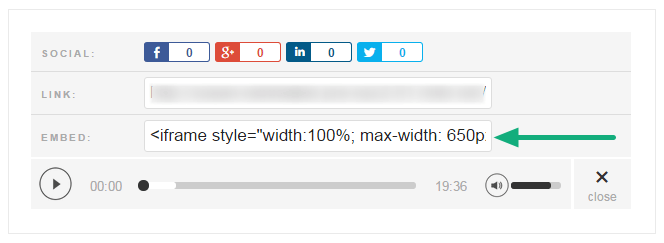
Simply click on the “Share Button” in the podcast player, copy the embed code, and paste this code in the HTML section of any page or post on your own website.


Stone HTTPS Audio Test

July 21, 2018 by Stone Payton

LeeHeadshotMic
BRX National
Stone HTTPS Audio Test
Loading
00:00 /
RSS Feed
Share
Link
Embed

Download file

Just A Test . . .

Larry Carver With Carver & Associates

June 5, 2018 by Stone Payton

Just My Segment
Just My Segment
Larry Carver With Carver & Associates
Loading
00:00 /
RSS Feed
Share
Link
Embed

Download file

Krisztina Bell With No Vacancy Home Staging

May 10, 2018 by Stone Payton

Just My Segment
Just My Segment
Krisztina Bell With No Vacancy Home Staging
Loading
00:00 /
RSS Feed
Share
Link
Embed

Download file

Supply Chain Now Webinar Series: Georgia Tech LEAP featuring Chuck Easley

May 7, 2018 by Stone Payton

http://stats.businessradiox.com/27842.mp4

Supply Chain Now Radio Webinar_GA_Tech_LEAP_042818.mp4

: Good morning, and welcome to a special episode of Supply Chain Now Radio. We are broadcasting live today from the supply chain capital of the East Coast, Atlanta, Georgia. Today’s episode is presented by the APICS Atlanta Chapter. And we welcome all of our fellow APICS members from around the globe, as well as any nonmembers and guests that maybe dialed in too. We appreciate you joining us.

: My name is Scott Luton. And I serve as your host for today’s session. We’ll tackle what APICS is in a minute, but our session today will focus on the hot topics of talent and workforce development. And we’ll highlight one program in particular that is growing here in the State of Georgia. Our featured presenter today is Mr. Chuck Easley. More about Chuck in just a minute, but, as always, we’re glad to have you with us here today on Supply Chain Now Radio.

: Let’s talk about ground rules real quick. Our attendees will be on mute as we’re looking to optimize the audio experience. And with that said, let’s make it as interactive as possible. So, please do submit your questions with the chat toolbar, and we’ll answer as many as we have time for at the conclusion of today’s webinar. And finally, a PDF of today’s presentation and recording will be sent out in the next few days to each of our registrants.

: As I mentioned, today’s webinar is brought to you in part by APICS Atlanta. For those of you new to APICS, we are the premier industry association dedicated to end-to-end supply chain management. Around the world, our organization serves over 45,000 members. Locally, we’ve been serving the Metro Atlanta area for over 50 years with almost 700 members. We conduct a wide variety of events focused on best practice sharing, professional development, and networking. From an education perspective, we offer widely recognized certifications, such as our CPIM, our CSCP, and our CLTD.

: We’re very pleased to be launching a new education partnership with the Georgia Tech Supply Chain and Logistics Institute starting in July 2018. We’re committed to serving our community and our industry with active task force that’s focused on addressing the skills gap, fostering and advocating for progressive leadership and effective policies of inclusion, and serving our veterans community, especially focused on their successful transition into the private sector.

: If you want more information on how we can serve you or your organization, reach out to our APICS Atlanta board of directors at info@APICSAtlanta.org or visit our website at APICSAtlanta.org. We’re happy to help.

: So, I’ve got the pleasure of introducing our guest speaker today, Mr. Chuck Easley. Chuck brings more than 25 years of corporate and consulting experience to the table. Currently, he is part of the staff at the Georgia Tech Supply Chain and Logistics Institute, where his learnings and expertise help enhance, develop, customize, and deliver programs and courses for the organization.

: He also leads his own firm, EPIC Performance Group LLC, which is focused on strategy execution of supply chain optimization and design, business transformation, operations improvement, and executive coaching. Previously, Chuck has served as a Senior Director of Labor, Engineering, and Process Optimization at Walgreens. And prior to that, he held senior roles with Lowes Companies and Kurt Salmon Associates, which is now part of Accenture.

: Easley has spent his entire career leading and facilitating major change, process improvement, performance improvement. He holds a wide variety of recognition credentials and awards for his work in industry and in our communities. We could fill up the whole hour with all of those recognitions.

: On a personal note, Chuck is highly involved in the Metro Atlanta community. Chuck is a Rotarian, an elder in the Presbyterian Church, and has served on the board for many civic and nonprofit groups. He’s also a certified youth coach motivational speaker, a fitness consultant, and certainly a friend of the APICS Atlanta Chapter. With no further ado, here’s Mr. Chuck Easley.

: Wow. Thank you for that. I’m very happy to be here. And, I mean, to have you do introductions for me all the time, it is very, very humbling. I appreciate the thought and the depth that you went to. And, hopefully, they will have some fun.

: I’m very pleased to be here to talk about what’s happening in the State of Georgia, and specifically, at large, the Metropolitan Atlanta, and the opportunities that may exist for you that are listening to learn more about it, take advantage of it, and possibly figure out how you might support or get involved. A lot’s been going on, as I’m sure you know, because you’re in this particular industry, but I want to share with you just a couple of things that are happening at Georgia Tech that we’re very excited about.

: Often, people say you have to have some kind of an acronym to make something official, to get people’s attention, or as different psychologists might say it, a primacy and recency effect to help people remember.

: LEAP is what I want you to remember, Logistics Education and Pathways. That’s what the program is called. The program is focused on workforce development for opportunity youth, at the age range of 16 to 24, and also veterans. This comes under the umbrella of what’s happening at Georgia Tech is very exciting. There’s a mantra that’s been put out creating the Next. This is a part of creating the Next. What is it that Georgia Tech is doing in this particular arena, and as a whole host of other initiatives that exist? But in this particular one on workforce development, there’s a lot going on, we’re excited about it, and want to tell you about it.

: You can see a website there in the lower left that, actually, you can go to to learn a little bit more about it. And if you have questions, you can reach out to myself, as well as the institute, as well as other contacts that may be indicated at APICS with Scott. Please keep in mind that this is something that has been in the works for roughly about two, two and a half years. So, while it’s new, we’re making progress.

: Georgia, a lot going on. The Governor’s High Demand Career Initiative, one of them that was identified was supply chain and logistics. We have veterans returning consistently, particularly as different conflicts around the world are either diminishing or sometimes escalating, and troops need to be moved in and out.

: Within the state, hundreds of DC’s, thousands of supply chain operation functions all in our state. And the number is going to keep going up. If you look at the State of Georgia and Metropolitan Atlanta, there’s a strong up curve in terms of what’s happening and what the opportunities may be.

: In particular, when we think of supply chain and logistics; and you look at what’s happening with Savannah in partnership with Charleston, as well as with the Atlanta Airport; and, historically, with Atlanta being called terminus; and if you go downtown, Five Points still there, you understand that there is a connection point for moving goods, services, and information, and money coming through the State of Georgia. That is all a part of what we think of when we think of supply chain. There’s a movement of ideas, the movement of money, the movement of product, the movement of services.

: Now, the interesting thing about this is, as I’m sure you may know, you don’t necessarily need to have a college degree to have a successful rewarding career. You can, however, there are other options that exist to have a rewarding, fruitful experience and career in this area, and to get off to a great start with an entry level role.

: This particular initiative, LEAP, is to help with that jump off, that getting off to a good start, and in some instances where people may be looking at a transition like veterans in transition. Sometimes, it’s the language that they may have to learn is different. The principles, the methods, the procedures are hard casts, are very well-known, and can be executed.

: However, sometimes the language, something as simple as going for military time to civilian time, something as simple as how you contract and think of a unit. Is of a truck? Is it a case? What might it be? That vocabulary transition can be helped by this course particularly for veterans. Or those who may not have thought of supply chain logistics as a career path, this helps with that too. But, additionally, they get a sense of the principles, the techniques, the theories, the metrics that exist.

: So, what happened with JP Morgan Chase back in 2015 was under their corporate social responsibility mantra. They were trying to identify where they could have an impact in the community. Workforce development became the area that they wanted to focus on, and supply chain and logistics was the particular industry. They approached Georgia Tech. We partnered with them. We developed a series of courses. We took on the initiative. And then, we launched in February 2016. We started the development fall of 2015.

: What came out of that is four courses. They’re all online. They are self-paced. There are assessments built in because this is a part of the Board of Regents. The University System Board of Regents for the State of Georgia has approved these courses. And as a part of it, assessments needed to be built in. You have a unit that you’ll study, a test you’ll take at the end, a score that you need to make, and then a series of introspective and discussion-based questions that you have to answer. And then, you will be allowed to go on to the next unit.

: Once you have completed the units, all of them, you’ll receive a certificate that has been signed by a Professional Education Department, as well as the President of Georgia Tech. Courses are basically 40 hours to complete. There are no textbooks. It’s written at a 12th grade level. And, again, the minimum age is 16.

: Additionally, we can see the progress of the students. We can see where they may be having challenges. If the student is unable to pass a particular unit test after two attempts, then they get reverted to myself and another colleague, Mike Connor, where we’ll help them from an instructional standpoint to get back on the right track.

: You can take one course, you can take all of them, but look at the first one, Supply Chain Management Principles. That’s the overall course. It’s typically a great one to take if you are only going to take one. It covers all of the components: warehousing, transportation, customer service, so have you.

: The other three are more specific. Of course, warehouse operations looks at that, which happens within the four walls. Transportation, technically, what you think about is what happens outside the four walls. And in, of course, customer service operations is both, what happens within the four walls, troubleshooting, taking orders, processing, some of administrative things as well as once it goes to the customer, is it what they expected? Is the quality of the load there? Did it come in at the time that it was supposed to?

: Again, four courses, very positive feedback. We’ve been administering them since February 2016. And we want you to know about it and think of it in two different ways. Is this something that you may want to use as a component of if someone were to apply for a job at your company? Two, is this something that you might want to have people who are at your company go through to help advance them? And then, I’ll add a third, just in case, from a community impact standpoint, you may want to sponsor or support a particular group or entity that may be ideal for this type of opportunity.

: These components are very critical, and we deliver them in a series of ways. The learning happens online, and by interacting with the instructors, as well as some other things. What you see right now lays those things out. We have a supply chain game simulation. Some of you may remember it as the beer game. We modify it to the potato chip game because we’ve got people 16, 17, 18, 19, 20 taking it.

: We also include industry expert lunch and learns. You know, we’ve had a a general who’s a part of the faculty at Georgia Tech in the ISyE School, who actually comes in and will talk with the students about some of the logistics aspects from a military standpoint. We’ve got other alums, myself, who’ll speak, and Mike Connor, one of the instructors, as well has a history with Home Depot, Coca-Cola, and BellSouth, and others around who are either involved with the school and/or other aspects of the Georgia Tech experience.

: We have internet lab, tremendous lab. It actually is sort of the forethought of what’s happening, the innovation component, if you will. And we have student ambassadors that can share their own personal experiences, and learning, and growth. The one thing about that internet lab, it’s almost like mission control when you go in and you see it. It’s pretty exciting. It has some of the newest thinking ways of what might be possible out there.

: One of the other things that happens with this program is there are career opportunities. You know, we will review resumes, we’ll give some advice, but, ultimately, we want to try to help create a pipeline, a pipeline of trained individuals who improve the level of workforce readiness for supply chain logistics in Metropolitan Atlanta, the State of Georgia.

: We also have a Supply Chain Day where we bring companies specifically looking at bringing people in in the area of supply chain. APICS is a tremendous sponsor of it. We typically have 15 to 20 companies come in, and we tend to do three or four of those a year. We had one that we weren’t able to do in January because of the storm that came through, but other than things like that, typically, we see the three or four times a year.

: But that gives you a chance to engage. It also helps companies that may be primarily looking for undergraduate and graduate students to think outside the box about other opportunities and roles, and bring their personnel or HR professionals in to help channel and interview some of those students who may be in transition between college and high school, transitioning from things like being in the military back to civilian life, or looking for career change.

: One of the biggest things about this program is the employer engagement. Ideally, we will have a balance of graduates who are ready and employers who are eager. One of the goals is to have roughly 20 employers who would want to be a part of identifying and interviewing students who have completed these programs. We’re looking for those now. It’s a great opportunity.

: As I’m sure as you’re thinking about it, yeah, it helps reduce the time in terms of training, the cost. It can help you get up to speed that much more quicker, and it can become a part of your professional development that you may provide for your employees, or it could become a part of the criteria that someone needs to provide when they come in and they interview or they apply for a a particular position.

: One of the things that happens when you’ve completed the course is you do get continuing education credits. It’s under our Profession Education Department. You have a transcript with that department. We, often, do a graduation ceremony. We also try and make sure that people are comfortable and confident in the interview that they may be having for the entry level role.

: One of the other things that happens is, as I mentioned, people are looking to do a career change or even a job change within supply chain. They can focus in on one of these four courses, and it helps give them a credential, more confidence, and improve their ability in the interview process.

: We have stories of success where students have completed a program, interviewed, gone on to work, been promoted in less than a year. And that’s what we like to hear. And we just want that to become that much more the norm. And you can help us.

: Some other things in terms of what the action opportunities may be, to give you examples, Schneider National supported our effort in 2017, and we were able to partner with Covington, and Newton County to drive home some things in that particular county. So, JP Morgan Chase got it started. They helped us build a tremendous foundation. They provided emotional support, as well, as we have tried to expand like go into Covington in Newton County. And even now, with discussions about a possible extension.

: Coming to Newton County though was at a crossroad. They had particular industries that had left the county, the mayor of Covington had a goal of zero unemployment, and they were looking at a gap between supply chain jobs and people who could perform those jobs.

: We met with them, talked about what might be possible, and developed a pilot summer of 2017. We had over a hundred people complete a course, higher than 70% completion rate. And it was met with such enthusiasm that the elected leaders of Newton County and the City of Covington wanted to support a phase two, which we started in March of 2018 after we had a graduation ceremony for those who had completed the course in 2017.

: It was held at the Newton College Career Academy. It was very exciting. We even had a visit from Buzz, which I think add a little energy to the outcome. And there’s a pipeline that has been developed in Newton County and the City of Covington. There’s, additionally, a pipeline in Metropolitan Atlanta. And we want you to know about it. We want you to be able to understand what the opportunity is, what the value is. And if and when there are questions that you have on how you could either get engaged, support it, or be a part of that pipeline in terms of receiving those particular students, let us know.

: A little more detail about what happened in Covington. We expanded it to more than five counties that touched Covington because we found that, in many instances, people may work in a particular county, but they don’t live there.

: So, some of the lessons learned too. We had an open lab that would occur twice a week for about three months, and also once a month on Saturdays. We’re also were able to have students, as they complete a course, be invited to Supply Chain Day, and come into Newton County, who sponsored a career fair, a job fair, that actually was very well received. Hundreds of people attended. And all of it was wrapped around this effort of how do we close that gap in terms of workforce readiness, particularly supply chain and logistics.

: The graduates program, as I mentioned, was March 8th. It was very well attended by family members, by graduates, by city council, members of Covington, and county commissioners for Newton. We’re very appreciative of Newton College Career Academy for allowing us to host the event there, and we think it went off very, very well.

: So, here are different ways. You may be thinking, “Okay, I think I know enough now. What can I do? What’s the do?” Well, here’s an example of different dos. There’s a pilot that we did. Some municipalities, some counties may want to try to do something similar to what we’ve done with Newton County and Covington. We’re open to that. Some may want to just go ahead and do a phase 2 where we’re kind of expanding it and driving towards whom else might be able to be involved. Social media leveraging. Also, partnering with the employers. But if you want to approve the concept first, the pilot is fine.

: Also, in Newton County, there’s a school called RISE Academy, which is to give students sort of a second chance. So, I think any of us that have been on reserve past probably 18 months has either asked for, deserved, needed, required, or really value another opportunity. Otherwise, we’re not learning. You can also have students take it, and they progress individually. We’ve had students from all over the Metropolitan Atlanta area who, on their own, found us at the website, taking the course, some taking many courses.

: But the two biggest impacts that we found are internal cohorts and external cohorts. An internal cohort is basically structured within a particular classroom setting where there’s a routine, a meeting, and there’s an instructor or proctor, and that has a tie to some kind of grade, or outcome, or expectation of performance for that particular student.

: A field cohort is possibility two. JUMA, an organization focused on teaching work life skills and financial independence. Oftentimes, we’ll use this type of model where you may have seen them because those particular members of the organization often run some of the concessions at SunTrust Park or at Mercedes-Benz Stadium. And they’re in a pipeline a process of developing work skill, job skills, and then looking at how they might channel that toward a particular career path after they’ve gotten that foundation.

They, typically, meet at least once a week. And that becomes a touch point for those particular students to help support each other and drive home change. We created study groups with them and captains, which was kind of a bit of a hybrid, which I think helped a lot.

: Also, with Newton County and Covington, in our pilot, we did a little bit more of a hybrid too because those two sessions during the week with Newton College Career Academy, we had proctors there, as well as instructors, like myself and Mike Connor, who can answer questions, help them through the coursework, but everyone that was a proctor had taken the course to find new material. And we could provide hard copies of the course if getting online was a bit of a challenge.

: As I mentioned, you saw some of the high schools previously that have been a part of this. We’re looking at approaching other high schools in different counties, different areas. We’re open to anyone who may have an interest in helping with that, particularly, if you have a STEM program or CTAE program.

: Here’s some of those stories that I was mentioning earlier. Abe Cheung was a student at high school, a senior, completed four courses, started working in a purchasing role before he graduated from high school. David, took a course his senior year in North Atlanta, applied for a role at the startup of Delta Material Services. They saw that he had taken the course, called him in for an interview. He started working before he graduated. Devyon Johnson is a part of JUMA. He took the course, started working at UPS during the holiday season. And in less than four months was promoted to supervisor.

: Overall, since we launched 2016, over 350 students have complete a course. Our completion rate is right around 70%. We found that, typically, a little more than 10% of the students will take more than one course. As we’ve talked with them, we’ll meet with them and talk about the fact that the course helps them build confidence, understand not only what they’re talking about, but when they interview, the questions that they ask, and the reaction that they get from the interviewer demonstrates that they know the material, the content, and what the work would involve.

: And once on the job, the ideas they come up with, the ways in which they work through certain things drives home the fact that, not only are they well-prepared, but they’re very knowledgeable, and they’ve learned how to apply the learning.

: One exercise, for example, I would do with some of the JUMA students who would run the concession stand, is talk about what happens when you you run out of food? What happens when you run out of certain things at a particular event? How do you manage the customer? How do you manage the process? How do you go back, and improve it, and understand how it can be done better? How do you manage inventory? How do you make sure that you don’t necessarily run out? How do you have some kind of an expedited process where if you do, you can quickly refill? All parts of supply chain logistics.

: Additionally, some of that coaching that we may provide. A counseling help students channel what opportunities may exist now that they’ve completed some of these courses, but also different things that they might be thinking of as sort of their next step, thinking out the box a little bit.

: One of the bottom-line things that we found is, you know, I’m sure of all of us have heard different phrases like, you know, “It’s not your dad, such and such. It’s not your mom, such and such, or the one that your granddad or your grand mom had before,” you know.

: So, supply chain and logistics is not what your professor may have thought about years ago. It’s not what your family, or your uncle, or your great-uncle may have thought about years ago. What they thought about years ago still exists. It is so much more than four walls with cartons. We used to joke around and say, “You’re kicking cartons,” right.

: Well, right now, you’ve got something that looks like a transformer that might work with you, depending upon what industry you’re in. It’s really cool, it’s exciting, it’s constantly evolving, and it goes from concept to consumer. When I was with KSA in our supply chain group, in our innovation center, that was one of the core things we talked about is from concept to consumer.

: So, now, with all the different avenues from when it used to be … Remember, the old mail order thing in the comic book, Scott, where, you know, you can order the onion gum or something, and they would come in six weeks or whatever? Okay, now, you got necessarily … Well, you could order the onion gum, and it will come to you in two hours.

: Right.

: Okay. It’s still logistics. It’s still supply chain. It’s just that the time has shrunk, and the expectations of the consumer has changed.

: New demands.

: New demands. Many new demands. And how is it we can be dynamic and be reactive, but, more importantly, be proactive in this arena? And that’s just to say we’re excited about this in helping people understand that you can actually find rewarding experiences outside of what you may think traditionally is supply chain logistics.

: The Supply Chain Days that I talked about earlier, here’s some examples some of the companies who have come. Some come every time, some come half the time, two out of the four times that we do it, but this gives you an expanse. If you are interested in your company participating, you can contact us. There’ll be contact information at the end of this. And we’ll be glad to have you. The next one is going to be in September. And we’re looking forward to it, and hope to have a standing room-only crowd.

: You also see here some of the companies who, in addition to those who are looking for undergraduates and graduates, who tended to also look for some LEAP graduates, having their personnel department or HR professionals come in, and help identify, and set up interviews for these particular individuals as well.

: In some instances, it’s the first time they’ve been in a forum like a job or career fair such as on a college campus. We do it at Industrial Engineering School, the Stewart School of Industrial Systems Engineering at Georgia Tech. It’s very well received. But that’s a part of the expanse of the learning too. Some may think they may want to come to Georgia Tech as well after that experience, others may want to pursue the opportunities that exists with the credential that they have, but the door is open for either one.

: But, also, it’s not only lets them expand their eyes on what’s possible, but also those particular employers. And we’re very eager about identifying who might be available and willing to be a part of helping channel and be the other end of the pipeline for these particular students.

: Now, there’s different ways to sponsor this or be involved. You can do it at a general level with the benefits of going through the program to overall help drive different things that we’re trying to do like what Schneider did. There’s also dedicated sponsorship where you may identify a particular group. It could be Girl Scouts. It could be Boy Scouts. It could be the youth or junior achievement organization at a particular high school. There are many different ways to think about it. It could be veterans in transition, whatever it might be. Sometimes, you may want to focus on helping a particular group.

: And then, also, there may be individual benefactors who would want to help within a community, but also some companies that are saying, “Hey, we’d like to offer this to our employees, and make this a part of what they’re doing for their overall development,” or “Hey, we have a startup coming, and we need to hire significant amount of people where we’re going to train them on our methods and procedures, but we want them to have a basic general understanding of what’s going on and how the processes work, why they’re lined the way they are, and what’s happening upstream and downstream.”

: Anyone of these three are opportunities. And if there’s something else you think of, we’d be open to hearing that. But think about them, and consider if you’d like to touch base with us about how you might get engaged or get involved. We’re excited about it. We want people to come. We’re looking at making a difference. We really, really want you to be a part of what Georgia Tech is doing, and what the State of Georgia is doing, and what many people in our state need: a chance, an opportunity, hope, support, and preparation.

: You know I had to put that in, Scott. I can’t resist it. But what’s the next step? What are you doing?

: Right.

: You like that. It’s a good thing. Smile about it. Enjoy it. Be a part of this. This is something that is helping Georgia get on the map. Other times, we talk about it, but, hey, if Georgia is known for the film industry, if we’re known for Coca-Cola, UPS, Home Depot, what have you, and maybe the A work, you never know, but why can’t we be known for supply chain and logistics? We have it, but why can’t it be a marquee state of choice, municipality of choice, a destination for companies as they’re looking to gain that competitive advantage from a supply chain and logistics standpoint?

: Here’s some other opportunities that exist at Georgia Tech in terms of ways in which you can engage. We’ve got eight certificate programs. The ones I was talking about earlier are four, but if you have a different level of management, more advanced or senior, and you’d like for them to kind of advance that learning, we have some other things that may be helpful for them.

: Additionally, these courses are, typically, online in Spanish and English. We have Capstone projects. Some companies are looking to address an issue in their company, and they’re trying to figure out, “Hey, can we get some resources and expertise come in and help us solve this that’s part of the graduation process with students at Georgia Tech?”, we’re open to that. We have innovation network for members who come in and want to just learn about the newest and latest things, and also share learnings with others.

: And also, we’re more than willing to help identify people who may either want to pursue degree programs, or in terms of the Georgia Tech students come in and just see a part of if they want that experience. But all in all, this is special. We’re excited to have it going on. We hope you’re a little bit more excited or a lot excited and want to know more about what can be done, how, when, and where. And we’re available to help you do that.

: LEAP into the future. You can google us. Here’s the website you can go to learn more about the program. And we look forward him from you.

: Thanks, Chuck. Well, on that last note, you’re going to hear from some of our attendees here today.

: Look forward to it.

: We’ve got some questions teed up, but, you know, before we pose a couple questions to you, I do want to-

: Sure.

: … share. You know, our mission at Supply Chain Now Radio is really to spotlight the best in all things supply chain. And clearly, the Georgia Tech Supply Chain Logistics Institute’s a world-class institution in the supply chain space. And, personally, and I’m very partisan here, but the LEAP Program is one of the more practical workforce development opportunities, not just a program, but a huge opportunity for employers, cities, counties, you name it.

: Absolutely.

: So glad that, from an APICS Atlanta perspective and really from a Supply Chain Now Radio perspective, these are types of initiatives we love to support.

: Thank you for APICS’ support. You’re very helpful.

: You bet. All right. So, first question here, Chuck, comes from Dave. And Dave asked, “Chuck, what are some of your key lessons learned from your experience with workforce development?

: I’d say one I mentioned a little bit early, and that is you have to think about two things. How do you find and engage the potential student? And then, how do you help them progress? To that end, the internal and external cohort was something that we developed after about eight months of really focusing more on individual participation. And we saw a 7x increase in completion percentage success.

: Wow.

: And that’s something that … You know, those numbers are beyond staggering. Well, we know that was fundamentally a change that we made, and it drove toward a couple of things. People have a goal as they complete if, you tie it into something like in a classroom or what have you. Additionally, there is an excitement because if you can create kind of support groups that can help each other, one person may feel more comfortable at one concept than the other.

: And then, we can more easily track and reinforce because if we create a cohort, we can look at that cohort as a subset of all students that might be taking, and that proctor can, then, follow up with them individually as well.

: I’d say the other thing that we’ve learned is this idea initiative of workforce development is like a series of links in a chain. And the education training part is a part of the chain. And one of the things that I think happens over time is it’s very similar with what you see in business where senior execs may say, “We’re having issues. We’re having difficulty. We need a new system.” They get the new system, Scott. And what happens? Right. It’s just part of the horizon.

: Part of the horizon, yeah.

: It’s like, why isn’t the egg boiling, okay? We put water in it. We got a new pot. We turned it on. Why isn’t the egg boiling? Well, one of the things that happens is what comes with a new system is training, thinking upstream downstream with the different processes, and procedures, and the overall impact, you know. And if you don’t look at it that way, effective change can’t happen. It’s people, process, and systems.

: And so, workforce development is no different. You can have the education and training, but if you’re not able to access, and identify, and assess the particular candidates that may have that interest, that’s a bottleneck. If you’re not able to, also, identify employers that are willing to engage, interview, and provide opportunities, and really connect to those pipelines, once the education changes happen, that’s a disconnect.

: So, on that note, Chuck, when it comes to employers, is it fair to say that since the LEAP Program has launched, one of the areas that the team behind LEAP would really like to see grow is the number of employers that really see this for the resource, and the opportunities, and engage, and support?

: Yes, absolutely. Absolutely because we think it’s at a … We have a critical mass. We’ve got over 300-350 students who have completed a course, who are ready to kind of … Like the Kentucky Derby that’s coming up in a few weeks, they’re at the gate, they’re ready to go, and we want to make sure that those gates get open, and they can run.

: We’re looking to identify those partners, and are more than willing to engage with different companies and organizations to see how we might be able to make that a fruitful connection and make it one of our top priorities for 2018.

: So, you get 350 students that have shown the initiative to seek out this program-

: Yes.

: … to participate, to add to their skill set. So, for employers that are struggling to find these types of-.

: Yes.

: …resources, reach out with Georgia Tech. Yeah.

: We have a solution. Reach out to Georgia Tech. We have an answer to your problem. Sometimes, it might be a symptom, but we like to get to the root cause at Georgia Tech. And we think that this is a good way to solve that.

: The other thing I would say is that what’s hard is if those channels, those systems, those processes exist, particularly once you completed college degree; yet, there’s kind of a gap when we think about the opportunity youth and the veterans, where if we think about it like from a college experience or something like that, you may have completed your degree, graduated. A part of the institution handles that part, but all those may have remembered when we got that call either after graduation or halfway through our senior year when either a guardian parent and/or mentor said, “So, what are you going to do after?” And after, there was a long silence.

: Probably within the next three hours, we walk across campus to the Placement Center, and discovered what was going on. And that center was there to help with that next step. The challenge for the opportunity youth and those veterans in transition, in many instances, they can’t walk half a mile or quarter a mile and go to the placement center. So, the distance is greater.

: And also understanding that that’s a resource that’s available for them. And so, what we’re doing is creating that bridge and looking for those potential employer partners to bridge, not only that gap, but could create a much better connection point from when they get the accolade and the achievement of completing the course, they get the reward of the interview and opportunity to apply in a job.

: Okay, perfect. And so, to our audience, whether you’re an employer, or a county, or a city, or a school, or some other entity that has a vested interest, and we all have a vested interest in developing opportunity youth and in other aspects of our workforce, there’s four main areas you can plug into the LEAP Program.

: Number one, if you want to utilize LEAP program as your own boarding talent and give them a firm foundation for a supply chain, logistics, warehousing, that’d be an outstanding opportunity. Number two, you can develop your current team with the LEAP Program, give them a common language to rally around, right?

: Exactly, exactly.

: Number three, access to the pipeline. And so, Chuck mentioned 350 students have come through, and it’s growing. This phase two is starting to heat up. So, reach out to Georgia Tech, and maybe identify some folks that you want to interview and speak to in person. See if they’re a good fit for your operation.

: I can say right now, even like in the phase two in Newton, we’ve got roughly 80 people who have applied just since the early part of March. And about half of those have gone through the registration process as well. So, you know, the number is growing.

: I want to circle back to Newton in just a second. And number four, if you want to sponsor a group. You know, we’ve talked about veterans. This should be a great program, especially for first-term veterans that get out. And we all know of some of the challenges related to successful transition. But if you want to sponsor a certain group, or a search school, or you name it, reach out the Chuck Easley, and we can figure out a way to make that happen too. So, circle back to Newton because Newton is a … They were an early adopter.

: Yes, right. Very progressive and very innovative. Great pioneers.

: So, Mayor Ronnie Johnson over there, which you mentioned earlier.

: Marcello Banes, Ralph Staffins, President of Chamber.

: Yup.

: As was David Bernd-

: David Bernd.

: … whom you introduced us to, the Head of Economic Development.

: Special group, and Serra Hall, also big part of that group. So, early adopters, progressive leaders. They saw huge opportunity before a lot of folks. You know, very few counties jumped in with both feet like they have. Talk about what they saw.

: It was a great meeting. You had set up a meeting with myself and Dave Berndt, who’s Head of Economic Development. We talked, kind of brainstormed, understood what their needs were, what the pain was, and felt that we had a remedy. We met with a group of stakeholders, including Tim Smith who heads the CTAE Program, who opened up the Newton College Career Academy for us, and understood the connection. He even went and took one of the courses online just to kind of get a base and a feel for what the value would be.

: It was one of those moments where things come together so well. What we were talking about with them and what they were needing, the issue was not about what we’re going to do or why. It was when. And pretty quickly, it was April 2017, we came up with a marketing plan. We came up with a launch. We came up with a kickoff event at the the Old County Courthouse that took place in mid-July. And we were off and running.

: The people in the room were very open, and willing, and committing things like, “Hey, we can do the tutorial sessions,” or “We can have some of the sessions at the Newton College Career Academy. We want to make sure people have access. We can make hard copies available to people.” All of those things were driven by, “What can we do to help the community?”

: You know, Ronnie talks about … Ronnie Johnson talks about — the mayor of Covington — zero unemployment, and how do we get to that. And they also could see, they had the vision to see other things that were coming like Three Ring in terms of film production and other things that they would need to make sure they had that ability, and they fully grasp the depth and breadth of the supply chain industry.

: So, special group in Newton. 80-85 folks ready to go. So, if you’re in that area, that I-20 corridor maybe, reach out to Georgia Tech. They can help facilitate some of those great interviews with some of the great candidates.

: We, actually, have a total of over a hundred because we did the pilot.

: Okay.

: And so, yeah, we’ve got over a hundred from the pilot, and we’ve got 80 who have now applied in the last month or so for this next phase, and about 30, for about half of those, have actually started taking the courses.

: Wow.

: What a great success story early on. And, of course, there’s going to be a lot more ripple effect in Newton County as a result of the LEAP Program. So, broader picture, we probably both want to give a big high five out to Chad Moten and the whole JP Morgan Chase team, right?

: Absolutely.

: It wouldn’t happen without their vision, without their impetus. And Reinhardt also inside the development group, you know, really … with the foundation, really kind of drove toward what can we do to make a difference. I think, the key is when you come with that particular initiative or that thought process, and identify a partner to help you with it, not only did they put the elbow grease into it, but they also put the funding into it, but they also put the follow up into it.

: And, you know, Chad and those who have been very supportive and coming to all of our kickoffs, all of our graduations, and telling the story about why JP Morgan Chase did what they did, what the hope was, what the lasting impact would be. And also help identify some potential employers, which I think is a is a tremendous example of their commitment. And it’s a different kind of what I kind of call … what you call active social responsibility, or what you call dynamic community involvement because they did much more than write a check. Basically, they understood what-

: They wrote a check though.

: They wrote a check too, which helped get it started. But then, once they wrote the check, they were still involved. And that’s one of those things where I think when you have that happen, you always like the check; yet, when you have that additional involvement, you do have a sense of partnership.

: Sure.

: And I’ll give you an example. So, yesterday, we were in Livingston Elementary in Newton County. And to illustrate exactly what you’re saying, Chad Moten was there.

: Yes, he was.

: He was sitting down with fifth graders-

: That’s right, talking supplies and whatnot.

: And he had a blast.

: Okay.

: He had a blast. He couldn’t stop talking about it, you know. He not only enjoyed being there, but, to me, the light bulbs went off. And all of a sudden now, you can sit there and go, “Okay. In 10, 12, 15 years, these students will be entering the workplace.”

: That’s right.

: And then, more importantly, look at how differences are being made right now. And then LEAP also helps from a standpoint of bridging that gap for those who are not necessarily in elementary school who are going to get that kind of exposure. It’s kind of a both end.

: That’s right.

: And now, you know, check him out when he tells the story, but he was very, very engaged. So, a different kind of investment. Investment of their time and energy.

: And showing up.

: Yeah, that’s right. Yup.e

: Well, good deal. I could sit here and talk with Chuck Easley for hours on end. I really believe in what the team over there at the Georgia Tech Supply Chain and Logistics Institute is doing. They’re moving the needle. They’re creating a big contributing factor in the economic engine that does make Georgia the number one state to do business in. What? Five years in a row now, I believe.

: That’s right, and counting.

: And counting, that’s right. From an APICS Atlanta perspective, we really appreciate the partnership that we’ve established for several years now. We’re looking forward to what’s next in that partnership. And Chuck, thanks for being on-

: Thank you.

: … Supply Chain Now Radio here today.

: Georgia Tech’s excited to be a part of this. I think the thing to make sure we keep in mind is the faculty constantly looks at innovating and updating the the courses based on what’s happening out there. You know, the faculty’s been ranked number one for over 22 years of graduate and undergraduate in this arena. And we continue to put our thought leadership into the courses. We’re excited about helping Georgia be that destination state of choice when you think about supply chain and logistics. Why not? And go jackets.

: Okay.

: I couldn’t resist.

: That’s right. A great way a great way to wrap up. So, we’re going to make sure you have Chuck Easley’s contact information in the follow-up information that goes out. And we’re going to conclude our session on just a couple of final items. First, we’ve invited each of you to join us for one of our upcoming webinars sessions. We’ve got a whole host of different topics we’re going to be covering in the next couple of months from advance analytics, to tackling the Amazon effect, to omni-channel, reverse logistics. Chuck could probably speak to most of these topics, but we’d invite you to join us for some really interactive, very practical-

: Those are great topics.

: … webinars. That’s right. Those are great topics.

: Guide your decision process and makes you think differently.

: Secondly, if you like to volunteer with APICS Atlanta, we’re going to be back out Newton County on May 16. As again, we’re taking a team of volunteers out into, I believe, it’s Fairview Elementary School, to share a one hour Supply Chain 101. Again, here, we’re just planting seeds of awareness about all things supply chain with elementary students.

: Elementary?

: That’s right.

: One thing that I think, to that point, Scott, that’s pretty important is I talked about the supply chain game, the simulation where it’s called the beer game. We, now, call it the potato chip game.

: That’s right.

: But it’s taking that and those concepts, and pulling it back downstream to an earlier learning moment, which connects the dots, and gets people and students think about that differently. And, you know, when those students went home, they told their parents, or the guardians, or what have you about what they just learned.

: Absolutely, yeah. Since November, we have presented Supply Chain 101 to over 400 students as part of this growing program. We would take it to all four corners of the State of Georgia, and looking forward to being back out in that thought leadership capital of Newton County, Georgia. So, thirdly-

: Movers and shakers.

: That’s right, movers and shakers. Again, we want to talk about our new aspect to our current partnership with the Georgia Tech Supply Chain Logistics Institute. We’re really excited about hosting and facilitating our CSCP and CLTV training on campus here in Atlanta starting in July 2018. So, this is going to be a two-and-a-half day boot camp style session. So, rather than-

: So great.

: … the five Saturday sessions that we’ve had in the past, which takes some time, and you go up your weekend, you can fly into Atlanta in the world’s best greatest airport.

: Absolutely.

: Spend two and a half days at a world-class institution.

: Even with the varsity.

: Even the varsity, absolutely. A couple times even.

: You got to do it. You got to do it.

: And then, fly out with your with a credential certificate from Georgia Tech. And then, of course, you can take the exam when you’re ready, but great, great opportunity for supply chain professionals who want to add that credential.

: So, for more information on any of these things, you can, again, reach out to us at info@APICSAtlanta.org or check out our website, www.APICSAtlanta.org. And, of course, if there is anything I can do to serve as a resource for you and your organization, please don’t hesitate to reach out. So, Chuck, before we conclude today’s session-

: Yeah.

: … final thought on your end.

: I would just want to say that APICS is doing a great job in pushing the envelope in the community, in the State of Georgia. We’re excited to be a partner with you. Additionally, hopefully, you’re excited about what we’re doing at Georgia Tech and creating the Next, particularly in this arena. If you’d like to be a part of it, learn more about it, and help make the difference. You know, this is not a passive state. This is not something where we just want to watch things happen. Like you had a coach who used talked about don’t watch the paint dry. Everybody wants a part of it. Don’t watch the paint dry or the grass grow.

: Right.

: Right. So, what are you doing to help move the needle? If you’re already doing something, fantastic. If you looking for something additional to do, please reach out. If you’re looking for something new to do, please reach out. Or if you’re looking to redirect, I think, we can help you. Again, we’ve got a pipeline. That pipe is going to continue to grow. And we want to make sure that we are linking those gaps and those partners such that, yeah, I don’t see any reason why we shouldn’t say Georgia is the state of choice for supply chain and logistics, and particularly Metropolitan Atlanta, and the best qualified, capable, and ready workforce exists in the state.

: And if nothing else, it’s, at least, worth a single conversation to figure out-

: Absolutely.

: … what makes sense. Okay.

: Change doesn’t happen without a conversation.

: Absolutely. You got that locked. Okay. So, as we wrap up today, we want to give a big thanks to our guest speaker, Chuck Easley-

: Thank you.

: … and the Georgia Tech Supply Chain Logistics Institute. Great presentation, straightforward, transparent, very helpful perspective, great resource for, again, any entity, organization, employer, city, county in the State of Georgia. We’d also like thank our sponsors, APICS Atlanta and Talent Stream. Of course, a big thank you to our audience for participating.

: On behalf of Supply Chain Now Radio, this is Scott Luton concluding today’s special episode out in the field where it’s all happening, going into the gemba, making it happen.

: That’s right.

: Have a wonderful week. We hope to reconnect again with you real soon. Thanks everybody.

Automatically convert audio to text with Sonix


Marla Adams With Babette’s Cafe

May 3, 2018 by Stone Payton

Just My Segment
Just My Segment
Marla Adams With Babette's Cafe
Loading
00:00 /
RSS Feed
Share
Link
Embed

Download file

MarlaAdams043018.mp3

Broadcasting live from the Business RadioX Studios in Atlanta, Georgia, it’s time for Atlanta Business Radio, spotlighting the city’s best businesses and the people who lead them.

: Next up on the Atlanta Business Radio, we have with us, chef owner of Babette’s Cafe, a real favorite of our previous guest, please join me in welcoming to the show, Ms. Marla. Adams. Hello there.

: Good morning. Thank you.

: So, did you pick up anything or anything viable on that last segment?

: Well, social media is a big concern for restaurants. And, unfortunately, after 25 years in business, I’m finding that a lot of my time is spent on social media and getting words out in platforms in this direct link. I, actually, kind of invested in a little company that send text alerts — They were in beta testing — to guests when we had last minute openings. And people loved the connection. I thought it would be a bother because I’m old, but they very much loved it. So, you know, it’s what everybody does. You know, it’s time-consuming Instagraming, Facebooking, it’s a big job. It’s a big job.

So, Marlan, what is Babette’s Cafe? And how did you come about finding it?

: Well, I started it 25 years ago. I’ve been in the restaurant business for 38 years. And I know I don’t look that old.

You don’t.

: But it’s radio.

: You should be all hunched over, and had you 38 years in the restaurant business.

: My back’s shot, but I started the restaurant on a shoestring. And I based it from the movie Babette’s Feast, which is … It’s a generation ago. Actually, it’s on Broadway right now.

Oh really?

They recreated it. It’s a short story, and it’s made into a movie. It won the Best Foreign Film. And it was about a woman chef in a very austere setting. And it was a woman housekeeper. And for this dinner or this event, she took some lottery winning, and created this incredible dinner, and it changed the community. It’s a very kind of … It’s a very beautiful story about food and what it can do to a group of people, so.

So, it impacted you enough to want to start your own restaurant, start your own business?

Now, starting my own business, I had hit a glass ceiling, honestly. I’m working for some other companies. And, you know, I just didn’t know what else to do. I mean, it’s just a crossroads. So, I had some support from my parents. You know, in the old days, you could open a restaurant on a shoestring. Now, you need investors and millions of dollars. So, you know, it’s just a point in my career where it was that or nothing because I couldn’t go back, and I didn’t feel comfortable going back ordering from somebody else.

So, why a restaurant? You just have a passion for food?

: Well, I have a degree from the University of Virginia in Russian studies. And I was going to go in-.

: It makes perfect sense.

Yes.

: As I was going to go into the agency, you know, “agency.” And that summer … I grew up in Northern Virginia. My father is in the agency. And then, I just took a break, and I said, “I think I’ll just, you know, go work in a bakery for summer.” And my father was very upset.

: And I loved it. I just liked working with my hands. I said, you know, “I can get paid for making pies, and cakes, and you know, standing on my feet all day. I mean, it was a craft, and it was a different part of the brain, and I just fell in love. So, I continued to cook for a few years, and then went to the Culinary Institute in Hyde Park. So, it just … I found my thing.

Did you feel that you need to go to the culinary institute get some level of higher education before you started, before you opened your own restaurant, or was that just another step?

: Oh yes.

Okay.

: Well, again, you know, women in the business where, you know, 30 years ago we’re not on the same par. In some instances, they still aren’t. So, I had to go get some credentials.

Okay.

: And then, I came back. I moved to Atlanta on a lark, and thought, “I’d go down here a year,” and here I am 35 years later in Atlanta. And the food season … The food business was just kind of blossoming with it and the restaurants. And I always had work. And it wasn’t … I never thought I’d open my own restaurant because it’s a headache. But you just get to point that you just don’t want to work for anybody else anymore.

Yes, I got that. So, you said you always had work. So, were you kind of like freelance? You’re doing events and-.

: No. I worked for other companies I worked for Buckehead Life. I worked for the Peasant Corporation, which you might remember, but not many people do. Again, another generation. And I opened a hotel during the Olympics, the Penta Hotel. So, I had-.

Wow.

: I had about 15 … Well, as a staff member, as a chef within one of the restaurants. So, then, they sent me abroad to open a couple of other restaurants and other hotels. So, now, I have some experience-.

Wow.

: … before I did it.

So, when you opened these restaurants, that mean you were the head chef at those or you did the business?

: No, no, no, no. I was … No, I was just … Actually, at that point, I was in the business side and the cost control side. It was an opportunity. It was an opportunity to live in hotels that were half finished-.

Wow.

: … and people think, “Oh, that’s great. That’s like …” You know, you don’t have hot water. CNN is the only television station. I mean, sorry. I’m not supposed to mash on other, but, yeah, every … I hurt my back, and had to get out of the kitchens for a while, but then I got into food and beverage, the management. I learned all about the computers and the cell systems. You just kind of have to take what, you know, life gives you and learn from it.

: So, without those experiences, I wouldn’t have been able to have a restaurant survive and excel for 25 years because it is very dollar-oriented.

Yeah. So, from beginning with the passion of loving to, you know, work with your hands and working with food, to going through all the way through the business side and learning from that aspect, was it hard for you to have kind of switch gears and do that from working with that food directly to switching to the management side? Was that challenging at all?

: It was, but in my own restaurant, and part of the reason, I’m I’m a restaurant girl. I mean, I haven’t expanded. You know, I’m very hands-on it in both areas. I have chefs. I have kitchen managers. I have bar managers. I have a management team. But, you know, if I lose a manager in one area, I’d go out there for a year. And then, I might lose the manager in another area, and I go back.

: So, I haven’t. And in the meantime, there’s all these other challenges with for getting in the other hand. You know, life is so much easier before reservations and the internet. So, I don’t like the management as much, but I’m good at it. And I want my team to progress and learn. And I challenge them, and I push them, and I get my money’s worth out of them. And they like working for me. Some people haven’t, but I have some people that have been with me for a long time.

Yeah. So, of all the experiences that you’ve had from starting working in a bakery and then all the way through now with traveling, and, I mean, in being in Atlanta during the Olympics, of all those experiences, what would you say helps you the most in relating to your employees now, and parting upon them wisdom, or just sharing your own experiences with them? Would you say there’s a particular experience that helps you the most in doing that?

: It’s maybe a negative experience. I worked in one of the hotels, and when I went into management in the hotel, my boss, the general manager of the hotel, I went to clear a table, and he said, “Oh, no, no. You should be telling somebody else to clear the table.” And I like, “She’s busy. The table’s dirty, and the customers are around. I’m going to go tidy the tables.”

: So, I am very hands on. I mean, I like pouring a glass of wine for the guest. I liked … You know, I brought bread and water to a table the other night, and they go, “Oh my god. The owner. I can’t believe you’re doing this.” It’s what I like to do. So, I like polishing silverware. I like cleaning shrimp. I mean, not so much just shrimp anymore, but I’ve cleaned a lot of shrimp. But, you know, I’m very … I think that’s what makes Babette’s unique is that I’m there. I don’t have a … I’m not just looking at spreadsheets. Spreadsheets just put me to sleep.

But it’s true. And as that level of it’s so personable having the owner of the restaurant come out and serve you, or come out and just pour your wine, pour your glass of water, that’s … I mean, it adds that level of intimacy that’s different than, you know, a bigger restaurant or one that maybe uses so much the traditional forms of media, like you’re talking about before.

: I mean, I use all those forms of media too. But, yes, I do. But, it’s just what Babette’s is. I mean, I think, it’s very unique in Atlanta. And we’ve been there 25 years. And there are a lot of the restaurant groups that have been open 25 years. Everybody says, “Oh, you’re the only one.” But, you know, Bambinelli has been around, Sotto Sotto has been around. I don’t want to plug too many of my competition, but, you know, we’re all of the same age, and we all have been doing a long time. And I guess, we’re all figuring out our exit strategies, but I don’t have one yet.

Well, that’s good. But coming out on the … I mean, you said you’ve been around for 25 years in Atlanta, and then coming … Just going through the internet age and everything that’s come up with social media, how have you kind of stayed in front of that? I mean, clearly, it’s the history and what Babette’s Cafe is and what it means in that personal touch, but how else have you stayed in front of that, and still been around for 25 years, and been so popular?

: You just have to adapt. I mean, any business has to adapt. It was a big change for us. And a lot … At the beginning, we were all very excited about it because it was, “Wow, this is just so easy. It’s just a great tool,” but now, you know, the algorithm help is, you know. So, now, I have someone that I hired to do Instagram and Facebook-.

: Oh wow.

: … photographs. And we try to do it in-house, and we couldn’t do it. And, now, local search and web designers. I mean, it takes a lot of time, and it’s is very frustrating, and it’s very expensive, but …

Yeah, it’s crazy how much it-

: And it takes away from what I want to do, but-.

Exactly, exactly.

: But-

: How are we doing on the … I don’t know what the right word is, which may be part of the problem. Gender equity, women being able to make it in this arena.

: I think that they’re very capable. I think that some of them go and raise families, and they’re not in a position to work the evenings and the weekends. I find that with the new cool dads. That’s the problem with the men too, you know, when they have young kids. I’ve lost some people to their children.

: I think that a lot of women, when they get into the older restaurants, you know, I’m talking maybe 10 years ago, the cooks the ladies were kind of kept in the cold station, the pantry, the salads. And, you know, I just always, you know, push them, and said, “No, you’re doing this now.”

: And I think there are a lot of women in the business, but it’s not conducive to families. I raised a daughter. My husband and I raised a daughter, but we had a unique situation. He was a detective at the Atlanta Police Department, and he worked the same hours as I did, and we paid a lot for nannies the first few years. He retired, and he became the primary caregiver. He did a good job.

: But the opportunity, I think, is there. It’s if the women are going to just take the challenge. Women are a little shy, “Oh, I don’t know how to do this,” and they back off a little bit. And I think men, on the other hand, say “Yeah, I can do it.”

: We’re not shy enough.

: Yeah. And they can’t. So, they don’t listen. So, they fail. So, there’s pros and cons of both. We deal with them differently.

Yeah. As, I mean, be the owner of Babette’s, and just how do you impart that upon your employees and these people that come into your work, and between men and women trying to bridge that gap, and making them understand, and helping them to understand, again, utilizing the experiences that you had?

: Now, I tell them some stories, and I tell them, “Well, I did this before you were born.” And, you know, I just … It’s the way you treat them and what you expect out of them. And you see, the other members of the staff see it. And so, it’s just the way Babette’s has always been.

Yeah. And that’s one of the things that, you know, it’s a, tenet. I guess, it holds and how you’ve been able to be around for 25 years.

: Yeah.

Yeah.

: I succeeded in some male kitchens, and I’ve surprised them. You know, just, I’m not afraid. I’m cautious, but I’m not afraid. I’ll do it.

Where does that fearlessness come from?

: I’m vain, I don’t want to fail, and I don’t when I look back. And that’s probably the strongest.

: I want to hear about Chef Justin.

: Well, Justin is actually leaving us.

: Ouch.

: Yes. We’re talking about … Yes, there we go. He has … He’s leaving. He has a young son, and choseShe has to go.And then

Shifts to killing him. So he’s taken a job that. Is. During the day. So I am. I have a young woman on my staff. I have I have a couple of guys that he works for preteens. Wow 15 years. And they. Know the Jinshan inside and out. The young girl that. Joined us last summer she’s very young but she’s younger than me and she is just going to be you know the candidate to take over. The. Ordering and you know the. Cost controls and kind of us as a kitchen manager so it’s an opportunity actually for her to step up. And be given that opportunity. So. I mean. Just I thought we would go into the. Into the old age together separate great guy. But. Things changed and I have someone on board and I’ll probably be back in the kitchen. Yeah. I’m kind of excited about. My friend the staff is sick of me. And. I get in the way. So. We’ll see what’s what are these things. I have been seeing all these are Petrosky. Of pork and veal and milk and you’re talking about God.

I brought shading. OK. Can I have one more. Katie it’s like four or five there I’ve got there is a pastry we make. You know I mean maybe we make everything in house or bread and this is a

Grocery a Tetragon reduction sauce with it. But my staff estimates will cringe if they hear this but. My husband was cleaning the kitchen. Which I was very happy he did. And he threw away my little ramekin tariff reductions so it does not have much Harragon. But paroquet they’ve been on. It’s actually a. Dish from my aunt. My. Father was Albanian so I grew up with a lot of Middle Eastern influences. I lived in Istanbul as a child. So it’s kind of. Wishes. It’s

Just a all meat pastry. Well it’s delicious. It’s great and so is a big part of what you do to then creating new recipes coming up with new new dishes or is that just. Do you draw on like your heritage on mailing recipes.

I do some family recipes but they’re a little too middle eastern. I’m trying to do European provincial. Google has made us French. Nobody Googles European provincial OK. We cannot come up with. Right. So we’ve come up with French. And my husband’s aunts saying you can’t do it. I said yes but we you know we tag Italians you know. So we’re trying to be southern Mediterranean Mediterranean. And. I come up with dishes and I go back to the food and as kind of my sense of the vernacular of suits of. What you would get. In a farmhouse. In Europe. You know you’re not going to get. Foam and you’re not going to get food stacked high you’re going to get. A lamb stew. You’re going to get what’s out of the car. We’re very seasonal unit seasons. Don’t really mesh. In Georgia with what you might think so we wait on English peas and we wait on you know. Marilyn crab and you know so we wait on those things so it’s the menus constantly evolving and. I have some. Items on my menu that I can never change. Parish kids will never go. And then. You know I rotate. The restaurant come up but I’m always kind of looking back to. It just have to put your head in a different place and it’s a very different place from the marketing and the customer pulls and that kind of thing. So. You don’t have to kind of. Weed out my garden and think about the food and. Then what what well or what’s coming in now. It’s nice. You know you have. To. Artichokes we insist on California our chicks are much nicer than the Mex artistic and sorry. We are by a lot of produce from mix whether we know we’re going or not. And. You know some music I’m here and we’re going to use them there and let’s try something new with the artichoke. So the food kind of dictates where we’re going.

Ok. And so do you find yourself having to kind of set up different amounts of time to. I mean give mental space to that just so to think about the business side of it but you’re also taking consideration. The quality of food and where it’s coming from and what you want the dishes to be in the season.

It is just kind of two different mindsets it’s complete two different mindsets and it’s at least two different days. Yeah I mean I really have to go in and say I’m not going to look at this these numbers I’m not going to do this I’m not going to answer these phone calls. And then of course you come up with the dish and you’ve got to go back and you get accosted got to see whether the values err. What would you can charge for it. Or what. Is going to. Be perceived as valuable or. Say you have to. Sudan apply it to the business. But. It’s. And that’s what I find very challenging even with buying wine or. You know it’s. There are just so many different parts of the restaurant business so if you’re bored. You are not. Pushing yourself. There’s a book to read on why there there’s a winemaker to study there is a way that my husband and I just went to California and we drove through. Santa Barbara and I said you know there’s a lot of good wine that comes from signing a barber in others. And we know vineyards here and vineyards there people you know people we buy from so. It’s very exciting.

Yeah I mean it certainly seems like that it sounds better on really super exciting. So is there a particular story maybe a peach and that’s coming to that. That’s for years and maybe a dish that impacted them or just maybe a reason why they keep coming back. I think we have we have some other house people have been with us a long time and

They’re comfortable. It’s the weight taper off older Sal rests on it’s quieter. I mean on Saturday nights it’s pretty loud but. It’s quieter. Restaurant I say that the biggest compliment I had was I had a long long time customer passed away. And in his will. He left a party. At the events for all of us.

And I’m just like wow that’s the best.

The highlight. Now we got a lot of. Lot of regulars. But you know we try and get people to open 25 years. You need you need the younger people. So their target audience is 30. And up. Don’t need the really younger people that look just to drink a lot.

Yeah there’s a there’s a clear divide. Oh yes. Oh yeah. So how do you get the word out about Babette’s and how could we learn more and visit you. Well we. Talk about. Who we are

And I don’t want to say it’s it’s it’s more or less. But this is my staff this. Is they’re all in. The red are all as committed to path’s as I am. We have a. E-mail us Chenelle just people knowing the story people knowing what really goes on behind. A restaurant and you know that lives and impacts and. You know. People that. You take care of staffs and whether you have insurance or not. We’re a small company. It’s cheaper. They. Don’t get insurance through us. You know but you try and take care of them. It’s just telling the story. And we send out e-mails which we have about 5000 people on our e-mail list and you have to find you have to come into the restaurant to sign up. We don’t. Have online. Fina because we want wanted. You know when I went and so that is actually our best. Marketing. Is e-mails to try and just do them once mom. And. Facebook and. Someone’s taken over Instagram. I don’t have instagram. I don’t know how to open the app but we’re getting traffic. You know it goes. I know. I was watching on your shows recently. And they had a supervisor. So the figures it’s just. Familiarity more towards hearing your name. So you go to events you do advance.

All right. So best coordinates. Website. Phone number e-mail was the best white

Babbitts cafe prom. That’s cafe. You’ll find everything there. It’s a nice very expensive site.

Well Marla thank you so much for coming in here with us. Thank you so much for the more food winter we should leave that last one for grandma. George Casey thank you both for being part of the show. A lot of fun. Absolutely. Just need second to work and that you can. All right. Don’t paid for Katie galley and our guest today. Everyone here at the business review family. Say. We’ll see you next time. On Atlanta Business Review.

Automatically convert audio to text with Sonix


  • « Previous Page
  • 1
  • …
  • 9
  • 10
  • 11
  • 12
  • 13
  • …
  • 31
  • Next Page »

Business RadioX ® Network


Our Most Recent Episode

CONNECT WITH US

  • Email
  • Facebook
  • LinkedIn
  • Twitter
  • YouTube

Our Mission

We help local business leaders get the word out about the important work they’re doing to serve their market, their community, and their profession.

We support and celebrate business by sharing positive business stories that traditional media ignores. Some media leans left. Some media leans right. We lean business.

Sponsor a Show

Build Relationships and Grow Your Business. Click here for more details.

Partner With Us

Discover More Here

Terms and Conditions
Privacy Policy

Connect with us

Want to keep up with the latest in pro-business news across the network? Follow us on social media for the latest stories!
  • Email
  • Facebook
  • Google+
  • LinkedIn
  • Twitter
  • YouTube

Business RadioX® Headquarters
1000 Abernathy Rd. NE
Building 400, Suite L-10
Sandy Springs, GA 30328

© 2025 Business RadioX ® · Rainmaker Platform

BRXStudioCoversLA

Wait! Don’t Miss an Episode of LA Business Radio

BRXStudioCoversDENVER

Wait! Don’t Miss an Episode of Denver Business Radio

BRXStudioCoversPENSACOLA

Wait! Don’t Miss an Episode of Pensacola Business Radio

BRXStudioCoversBIRMINGHAM

Wait! Don’t Miss an Episode of Birmingham Business Radio

BRXStudioCoversTALLAHASSEE

Wait! Don’t Miss an Episode of Tallahassee Business Radio

BRXStudioCoversRALEIGH

Wait! Don’t Miss an Episode of Raleigh Business Radio

BRXStudioCoversRICHMONDNoWhite

Wait! Don’t Miss an Episode of Richmond Business Radio

BRXStudioCoversNASHVILLENoWhite

Wait! Don’t Miss an Episode of Nashville Business Radio

BRXStudioCoversDETROIT

Wait! Don’t Miss an Episode of Detroit Business Radio

BRXStudioCoversSTLOUIS

Wait! Don’t Miss an Episode of St. Louis Business Radio

BRXStudioCoversCOLUMBUS-small

Wait! Don’t Miss an Episode of Columbus Business Radio

Coachthecoach-08-08

Wait! Don’t Miss an Episode of Coach the Coach

BRXStudioCoversBAYAREA

Wait! Don’t Miss an Episode of Bay Area Business Radio

BRXStudioCoversCHICAGO

Wait! Don’t Miss an Episode of Chicago Business Radio

Wait! Don’t Miss an Episode of Atlanta Business Radio