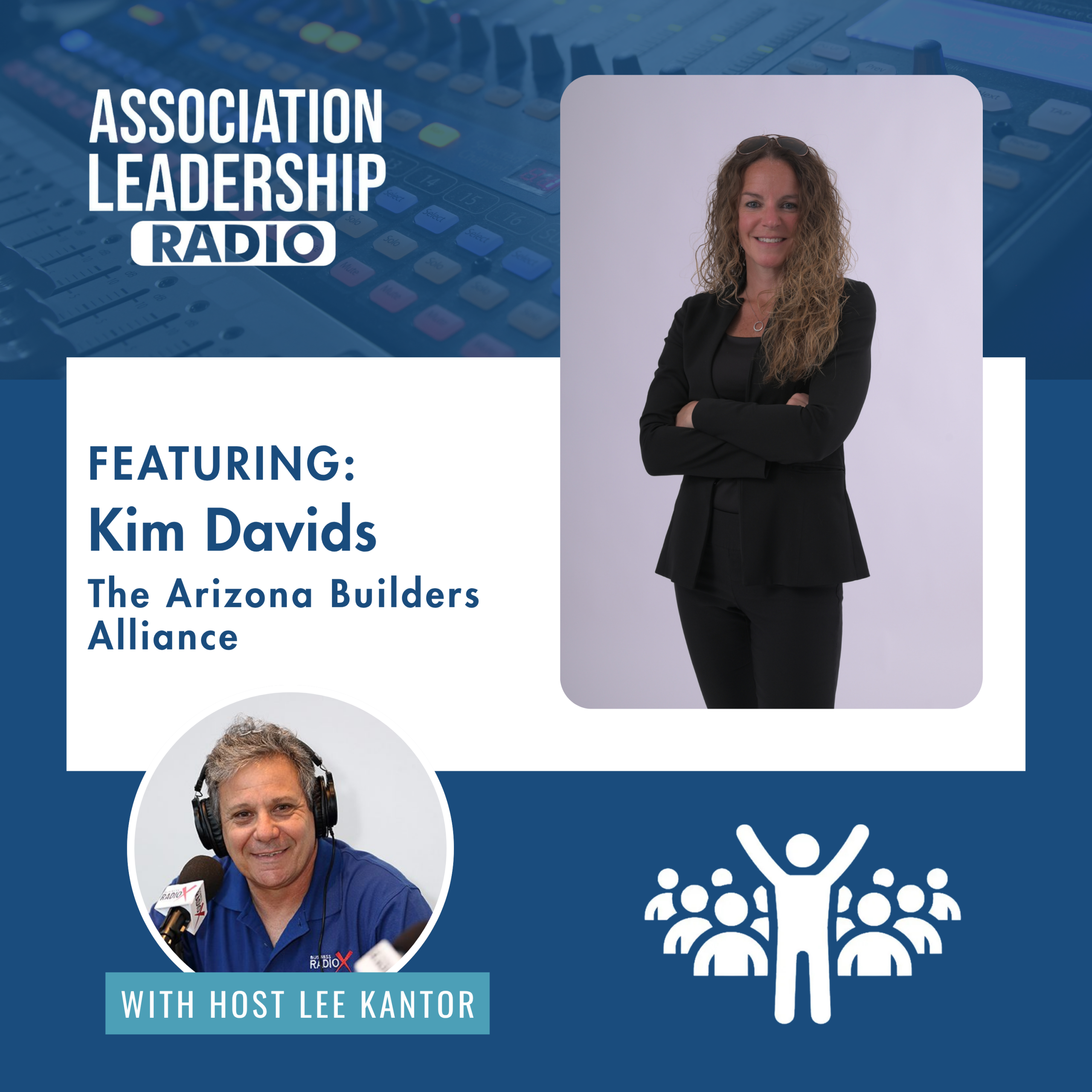

In this episode of Association Leadership Radio, Lee Kantor speaks with Kim Davids, President and CEO of the Arizona Builders Alliance (ABA). Kim shares her background in civil engineering and general contracting before transitioning into association leadership. She discusses the ABA’s mission to educate, advocate, and support Arizona’s commercial and industrial construction community through networking, political advocacy, and workforce development. With over 300 member companies and apprenticeship programs enrolling hundreds of students, the ABA offers resources for all levels. Kim emphasizes that engagement is key to maximizing membership benefits and professional growth within the industry.
 Kim Davids serves as the President and CEO of the Arizona Builders Alliance, bringing over 20 years of construction industry experience to her role.
Her career trajectory exemplifies dedication and expertise, progressing through key operational positions at some of the region’s largest general contractors including Clayco, The Weitz Company, and W.E. O’Neil Construction. Upon graduating college with a degree in civil engineering, Kim started as a Project Manager/Superintendent and worked up to Project Executive, General Manager, and Vice President.
Kim’s leadership has consistently driven year-over-year growth in regional offices, leveraging her extensive project execution experience.
Her influence extends beyond her immediate role, as evidenced by her membership in various industry-relevant organizations such as YPO, a global community of over 35,000 chief executives across 150 countries, her board membership at Valley Partnership and participation in the Business Journals Leadership Trust and Greater Phoenix Chamber of Commerce.
Follow Arizona Builders Alliance on LinkedIn.
Episode Highlights
- Overview of the Arizona Builders Alliance (ABA) and its mission
- Importance of education and workforce development in the construction industry
- Benefits of membership in the ABA for individuals and companies
- Advocacy efforts and political engagement related to construction regulations
- Overview of apprenticeship programs and their role in workforce training
- Tailoring educational programs to meet industry needs
- Engagement strategies for members to maximize their involvement
- Networking opportunities and community building within the construction sector
- Personal growth and leadership development through association participation
- The impact of the ABA on member companies and individuals in the construction industry
 This transcript is machine transcribed by Sonix.
TRANSCRIPT
Intro: Broadcasting live from the Business RadioX Studios in Atlanta, Georgia. It’s time for Association Leadership Radio. Now, here’s your host.
Lee Kantor: Lee Kantor hear another episode of Association Leadership Radio. And this is going to be a good one. But before we get started, it’s important to recognize our sponsor, Business RadioX. If you’re a business coach or a consultant who’s tired of being a best kept secret, set up a call with Stone Payton at brookstone.com to unlock your perpetual prospect pipeline. Today on the show, we have the president and CEO with the Arizona Builders Alliance, Kim Davids. Welcome.
Kim Davids: Thanks for having me.
Lee Kantor: Well, I am excited to get to learn about your association. Tell us about the ABA, what’s your mission purpose and how you serve them, folks.
Kim Davids: So the Arizona Builders Alliance, also known as the ABA, is a premier trade association for commercial and industrial contractors in the state of Arizona. Our vision is to be the leading voice of Arizona’s construction community, serving as the catalyst for growth, development and transformation. And our mission is that we are driven by our members and we educate, advocate and support free enterprise through integrity, collaboration, and camaraderie.
Lee Kantor: So what’s your backstory? How’d you get involved in a leadership position with this great organization?
Kim Davids: Well, in a former life, I used to work for a general contracting company. I have a civil engineering degree from the University of Illinois, and in 2007, I moved out to the Arizona market. Perfect timing right before the downturn. And it worked for a handful of general contracting companies used to run the southwest region for an international company, and during that time I went through many of the ABA education programs. I taught for the ABA programs and also served on the board. So when the opportunity came or a leadership role within the organization, it just seemed fitting to to jump right in and see if I could give back to the industry in the state of Arizona.
Lee Kantor: So when you took over in the leadership capacity, what were some of the kind of the low hanging fruit you wanted to take care of right at the start?
Kim Davids: I think some of the things to start, we pride ourselves on our education focus, and we’ve been the ABA since 1994, and we have some very specific flagship programs that have been tried and true and legacy programs. And I think they’ve been amazing for the workforce, but really wanted to just find out what our industry leaders and their employees and their team members needed. And so a relook at some of the curriculums to make it a little bit more current, leaving the legacy of the program intact, but really trying to revamp and, and bring in, you know, as, as we’re constantly changing more technology, different aspects, uh, you know, workforce shortages, all of that, just some real world applications into those programs versus just more kind of textbook standard, you know, repeating the same curriculum year after year.
Lee Kantor: So how big is the kind of the membership base for the ABA? Like how many, uh, how many kind of builders and people within those industries are there right now in Arizona.
Kim Davids: We currently have over 300 member companies, and that is comprised of probably about a 70/30 split between general contractors and subcontractors being 70% and about 30% on what we call affiliate members that are all of the supporting, whether it be vendors, staffing companies, insurance, finance, all of the different aspects that aren’t specifically, uh, construction companies, but support the industry as a whole.
Lee Kantor: Now, for folks who are out there doing the work but aren’t yet a member, can you share some of like, what’s your elevator pitch to them about why it’s important for them to get involved with the association?
Kim Davids: My elevator pitch is that a lot of people think that because we are a trade association that you cannot. It’s not a place where you can find work or you’re not gonna, you know, get that next job. Um, I, I challenge that theory and that thought because we only get better together when you are in a room of your peers, um, all different, you know, shapes and sizes and makeups of whether it’s family owned Esop corporations, um, regional, local, um, you know, you know, we have, we have an office in Phoenix, we have an office down in Tucson. We’re, we’re statewide. And I think bringing people together is paramount to what the ABA offers. We, we help educate each other. We help support each other. Uh, we, we, you know, some subcontractors get their next job with a GC together, some GCS, if they’re either too busy or don’t do a certain type of work, we’ll, we’ll recommend other general contractors. So it’s not necessarily a, you know, owner owner, um, space where contractors will come and actually, you know, sign up their next project, but they will find partners and true peers to help grow and make us better together. And that is what the importance of the ABA brings to anyone who isn’t currently a member.
Lee Kantor: Now, when an organization joins, um, the association, is that something where their employees get the benefit of their also members, or is it something they have to join separately?
Kim Davids: No, you’re absolutely. Uh, it’s the, the member, uh, company is, um, all of the employees that belong to that member company are members. So it is not a per individual basis. It’s per company.
Lee Kantor: And that just by itself, that should be a no brainer, right? If you work for any organization that’s a member, it only benefits you by going and taking advantage of all the great resources you provide.
Kim Davids: Absolutely.
Lee Kantor: Now, are you seeing that trickle down or the. Are the employees taking advantage of the membership to the degree you’d like them to in a.
Kim Davids: In a time where workforce is very tight. We are finding that while people want to come and participate and education is just one facet of what the ABA does, we have, um, community service, uh, opportunities, we have committees, other ways to give back. We have events and networking. We have a lot of people that are, are very engaged within the ABA, but also have their day jobs and, um, may not be able to come to all of the different facets. So whether you have a passion to, um, you know, for, for personal growth, to take some of our education or if you want to give back with our community service and other aspects, there’s, there’s many ways to get involved and with a lot of new contractors moving to Arizona. What’s interesting is we are finding that if employees from one company have joined a different company, those employees are the advocate for the A, B, A, and talking to their new employer that is new to the market, saying you need to be a part of the A, B, A, we want to get involved. And this is where we. We like to spend some of our, our time and, and efforts.
Lee Kantor: Yeah. I’m with you 100%. This is one of the things, especially for young people that are new to any industry really to be involved in the trade association, even a little bit is better than not being involved at all, because this is a chance for you to demonstrate leadership skills. You can volunteer, you can take leadership positions and demonstrate your worth and your passion and your desire and your work ethic in front of people that could be hiring you. Maybe not today, but tomorrow or a year from now.
Kim Davids: Well, I think what’s also important is, is all of our education or the majority of our education is volunteer based. So it’s an opportunity as people go through our programs, they can then come back and actually be the teachers in those programs. Um, and also within our committees and on our boards that we have, there are definitely leadership opportunities. So really it’s an opportunity to just engage and integrate yourself within the construction industry. And, and I couldn’t agree more with your assessment.
Lee Kantor: Now you mentioned advocacy. Can you talk a little bit about, um, how that plays out for a member? Like how are they benefiting from your advocacy efforts?
Kim Davids: So right now we are in our second year of, uh, a political action campaign, both from, uh, at the state level. We also have federal PACs, um, that we, that we, uh, can contribute to. But we had started two years ago a, uh, pet, two political action campaigns where one you can support individually, and then also another one where you’re, uh, the corporation or the company that you, um, that you’re employed by can support. And what, what advocacy does is as we’re trying to navigate, um, our, our free enterprise and, um, our, our focus of construction within, uh, the state of Arizona when bills are passed or at least brought to light, we are there on the front lines, working with the other associations in the state to ensure that we are fighting for what’s best for the construction community. Sometimes what, what is very surprising or was surprising to me when I took on this role is a lot of our lawmakers and and. Congressmen and senators don’t always understand the implications of the way that a bill is written. So we have the opportunity to go and meet with them, have them come in and speak to our boards and to our our classes, and talk about what it really means to be a construction company within the state of Arizona. And so that opportunity for us to be that partner, have those connections, really support the candidates that are for construction, pro development, pro, pro construction industry really helps move the needle and keep Arizona a place that will continue to be a booming construction market for years to come.
Lee Kantor: Right. It’s how many times does a politician just do something and not really speak to experts that can explain maybe some of the unintended consequences of their actions. I mean, I think it’s so important for leaders like yourself to explain. You know, when you knock this domino over, there’s going to be an impact somewhere else. And this is what could happen. Uh, just to have some awareness of what, you know, they can be doing something that maybe make political sense, but it can really affect people down the line.
Kim Davids: Absolutely. And one thing that we found out in the last election cycle, I mean, in the state of Arizona, you end up getting this book of bills and how to vote and whether it’s for construction or not. We do a simple education class of bring your ballot, and we’re going to go through every single bill. And if you vote yes, this is the ramification. If you vote no, this is the ramification. I mean, it’s very overwhelming when you get, uh, some of these things that, that come to you and you think you’re voting one way, the way that it’s written because it’s written to kind of confuse you, but it really helps you understand, um, just the simple, the simple jargon of okay, what, what does this really mean long term? Um, when we vote this way, because it’s really important that, you know, the public needs to have a voice and, and their vote matters. And we’re here to try to help people understand, um, how to make that more simple and, and impactful.
Lee Kantor: And, and to your point, you do need help because these things are written in a way that, like you said, it seems like on purpose that it says one thing but means something else. A lot of the time.
Kim Davids: Yeah. Sometimes can seem that way.
Lee Kantor: Now, can you talk a little bit about the apprenticeship programs? Because I think that’s so important in today’s, um, as one of the choices when it comes to education and a way to get somebody ready to enter the workforce. Can you talk about, uh, that kind of work and how you help that, uh, happen for folks?
Kim Davids: Yeah. We currently have, um, an electrical apprenticeship program have been running that for quite some time. We just started or restarted our mechanical apprenticeship program. Um, we recently just moved into a new 200 zero square foot facility. So we have all of our educational opportunities, whether it be, um, the more technical and soft skill and leadership, um, education content I talked about earlier and our apprenticeship program under one house or under one roof and the opportunity for us to then scale what we offer to our member companies. And, and you don’t have to be a member of the ABA to actually enroll into our apprenticeship program, but we have the opportunity now to, to get creative with how we offer the classes currently or in the past, it has been only in the evenings from 5 to 7 at night. And mind you, these men and women go to work all day and then they go to school. By night they do a Monday, Wednesday and a Tuesday. Thursday. So now that we are, um, under one roof, we have the opportunity to prevent, to provide some hybrid opportunities to maybe do one day a month, maybe stack it up, we’re really able to reach out to the companies that are putting employees through our program to find out what they need.
Kim Davids: And we are trying to figure out a way to best suit those needs with the flexibility that we have in our new space. But the electrical apprenticeship program has, uh, right now, we are currently at 350 people enrolled for the fall semester. So we are growing and we are excited about the future of, of that program and starting with a smaller class on the mechanical program. Um, but really excited about bringing that, um, offering more opportunities for those two specific trades in the future. It’s interesting when when people come to us and say, you know, this is what we need. We need to train our, our, our skilled staff. And, um, really, how can you help us? We are now at a point where we can work with them and get, uh, make that happen because we have the resources and the space available to, to really give back to our, our companies.
Lee Kantor: Now, are you saying that as an area of opportunity for the companies in Arizona where they where maybe with your help, uh, either creating the actual curriculum or partnering with maybe one of the, um, colleges or trade organizations to that the, the organization, the company can say, hey, we need more workers like this and help them actually create a curriculum that helps deliver that after the person graduates. Is that something that you try to facilitate for your corporate members?
Kim Davids: Absolutely. Um, you know, our apprenticeship program, we were, uh, previously under the NCER curriculum and we switched over to Mike Holt. And that curriculum allows us a little bit more flexibility, more hands on approach versus textbook. And really the idea is continuing education, uh, for, for the apprentices as they become journeymen. And really beyond giving them that opportunity for what is it like in the field, you know, that those, those true soft skills, those leadership focused elements that really get lost when you’re, you’re focusing on all the technical aspects of an apprenticeship program.
Lee Kantor: Yeah, it’s a total win win, in my opinion. I mean, this is something where the organization wins and then the, the person, the individual wins. I mean, they’re getting the skills and the knowledge. And then the organization might be getting an employee. So everybody is coming out ahead from this.
Kim Davids: Yeah. And what’s interesting is when you’re going through an apprenticeship program, you have to be employed and have on the job training, on the job hours. And while most of our individuals are sponsored by their companies, there are a number of people that are self-pay. And so they are themselves taking this initiative to advance and further themselves within their own careers.
Lee Kantor: So they’re investing in themselves.
Kim Davids: Yes.
Lee Kantor: Now, um, what advice would you give somebody like you came into Arizona from elsewhere? Can you share, like if you were, um, giving advice to somebody else who was doing what you were doing, what’s the best way to plug in and get the most out of a membership of the Arizona Builders Alliance? How would you kind of recommend them going about kind of getting the most juice from the squeeze of being a member?
Kim Davids: I it’s all about engagement. I mean, I’m a firm believer of you, you, you, you get what you give and if you. We have some low hanging fruit. We have some mixers. We just did one last Thursday. Over 200 people showed up to go to one of our our premier trade partners association or offices. Um, and it’s just an opportunity for people to showcase their business, um, getting involved on a, on a committee giving back. That’s where you learn, uh, from, from your peers and get more social aspect. Obviously, I’m a proponent of education. I still teach some of our classes. Um, I was just in a meeting before this talking about, you know, what, what different curriculum and, and content we can provide, what do people need? And how can we be that solution for our members? Um, really just, you know, stop by, we’re here every day. We love to have our members here in our office and just talk to any of us. We’ll, we’ll figure out a way to get you plugged in, whether it be from the event side, whether you’re here in the Phoenix Valley or if you’re down in Tucson, um, really just come by and we’ll figure out the best way to, to get you involved.
Lee Kantor: Now, what is it? If I own a business, a construction business in Arizona, I’m not yet a member. Um, I call you up. What is the conversation like? You. It sounds like you can create some bespoke benefits to my firm based on what I need. And then you can give extra benefits to my employees because they become members. There’s. It sounds like what you’re offering is a lot more than, hey, join this association. Like it sounds pretty bespoke.
Kim Davids: Yeah, I think each. I mean, you have to think about it. Some of the contractors that are moving to Arizona, they’re large national and sometimes international companies. So they may not need, um, you know, certain education, they may have different trainings within their own organization. Um, so they may not need some of the education content, but or maybe some of the leadership, uh, cohorts that we have. But we do offer other, you know, interview prep and other different resources. And so maybe they’d want to tap into that or they’re just looking to network and find new trades. So come to one of our mixers and come to some of our events and, um, get the name out that you’re actually here in town. Um, others don’t have. They’re a smaller operation and they don’t have any of the training. And so we serve as that resource for them. So we really try to listen to what each member is looking for or what they think they need. Um, within the, the state, as they, as they’re here, whether they’re, they’ve been here for decades or they’re, they’re new and we try to figure out how to best, um, serve them, uh, all the way from the C-suite down to the, you know, the, the entry level positions in their company.
Lee Kantor: Now, is there a story you can share that maybe illustrates the impact that your association has on a company. You don’t have to name the organization, but maybe share the challenge they came to you with and how you were able to help them maybe get to a new level.
Kim Davids: Mm. Um, I mean, I feel like that happens every day, whether it be in, in micro situations or, or, or big situations. Um, from, you know, an advocacy standpoint, um, you know, the big topic this year has been project labor agreements and folks have come in and said, listen, we’re up against X, Y, z project and we really need some help and some resources to help us move this along, um, in the other direction. And we’ve done that. We’ve also had, um, individuals graduate from some of our education programs and stand up and give speeches at our graduation ceremony at the end of the day and talk about how, impactful and motivating the class was and inspirational to themselves and their career. So while while I feel like we want to make a bigger difference on at, at the company level, I, I don’t want to overstep the, the focus on how we are impacting individuals every single day, um, regardless of, of how they’re involved with the A, B, A.
Lee Kantor: And you yourself are a success story. Somebody coming in from outside to now leading the organization. I mean, that speaks volumes about you.
Kim Davids: It actually, it’s funny, I, I think back to how did I get here? But I, you know, as a, as a member company, uh, you know, I, I would volunteer, I went through the courses and sat on the board and it’s, it’s an association near and dear to my heart. And now I have the opportunity to give back. So it’s really quite, quite the privilege.
Lee Kantor: So what do you need more of? How can we help you?
Kim Davids: Uh, I think this is great getting getting this opportunity to talk about, you know, what we stand for and the impact that we we hope to make. It’s not about us, it’s about our members. And thank you for this opportunity to, um, showcase us. And hopefully from this, we’ll get some, some interested people, uh, knocking on our door and coming in to say hello.
Lee Kantor: Well, if somebody wants to connect with you or somebody on the team, what’s the website? What’s the best way to connect?
Kim Davids: Uh, the website is AZ builders.org.
Lee Kantor: All right. Well, Kim, thank you so much for sharing your story today. You’re doing such important work and we appreciate you.
Kim Davids: Thank you so much. Thanks for having me.
Lee Kantor: All right. This is Lee Kantor. We’ll see you all next time on Association Leadership Radio.















