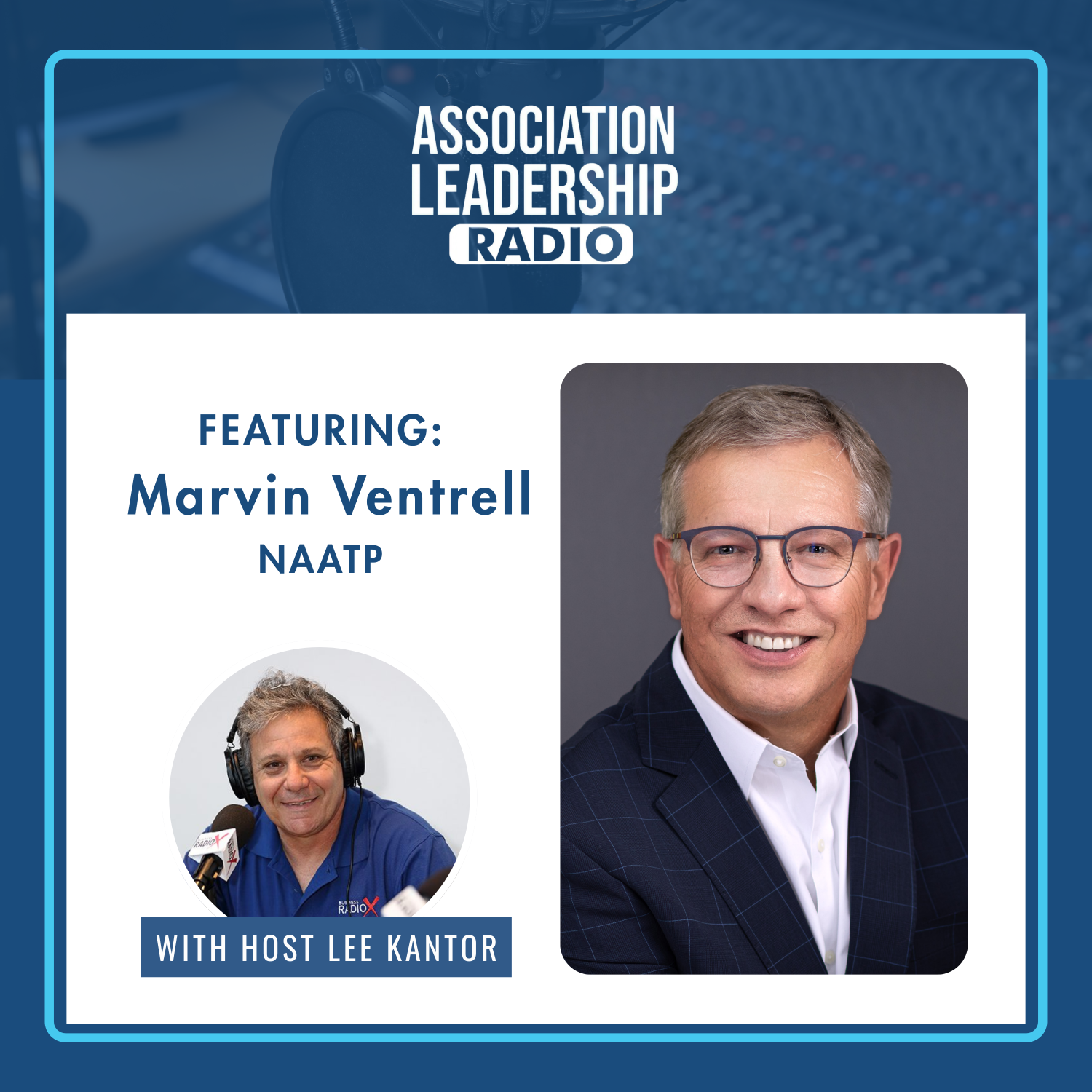

In this episode of Association Leadership Radio, Lee Kantor interviews Marvin Ventrell, CEO of the National Association of Addiction Treatment Providers (NAATP). Marvin discusses NAATP’s 47-year history, its mission to support and professionalize addiction treatment, and the evolving landscape of the field. Topics include the medical nature of addiction, industry growth, the impact of insurance reforms, regulatory standards, and ongoing challenges such as stigma and funding. Marvin also highlights NAATP’s advocacy, educational resources, and efforts to ensure quality care, encouraging listeners to access trusted treatment through accredited providers.

 Marvin Ventrell was named CEO of the National Association of Addiction Treatment Providers (NAATP) in 2015, continuing his decades long year career as a practicing attorney, professor, professional association director, and addiction treatment executive.
Mr. Ventrell’s career has been devoted to advocating for populations in need and building legal and health care system responses to meet those needs. In addition to serving in executive leadership roles in several national social welfare and justice agencies, he has authored two textbooks on law and social justice, book chapters and peer reviewed articles on law, medicine, social services, behavioral health, and addiction treatment and recovery.
He is a frequent commentator in the national media and lecturer at treatment programs, conferences, universities, and agencies.
Prior to joining NAATP, Mr. Ventrell served as Program Director at Harmony Foundation and as a consultant to CeDAR at the University of Colorado Health Sciences Center, both Colorado based addiction treatment programs.
He testified before the United States Congress and has served as a consultant to the U.S. Department of Health and Human Services. He is the recipient of numerous distinctions including the American Bar Association National Advocacy Award, the National Council of Juvenile Court Judges Meritorious Service Award, the University of Colorado School of Medicine Kempe Award, and the Ashley Innovator Award given for impact in the field of recovery through innovation, commitment, and dynamic thinking.
Mr. Ventrell’s focus while leading NAATP has been to secure the place of addiction treatment in health care through the establishment of treatment program ethics, professionalism, integrity, and evidence-based efficacy.
NAATP, founded in 1978, is professional membership association of addiction treatment providers whose mission is to provide leadership, advocacy, training, and member support services to ensure the equitable availability and highest quality of addiction treatment.
NAATP has prospered under Mr. Ventrell’s leadership and in 2020, the association created the Foundation for Recovery Science and Education (FoRSE), an unprecedented effort to collect and measure patient treatment characteristics and outcomes on a global scale.
Follow NAATP on LinkedIn.
Episode Highlights
- Overview of the National Association of Addiction Treatment Providers (NAATP) and its history.
- The mission and role of NAATP in supporting addiction treatment providers.
- Evolution of addiction treatment practices over the past 47 years.
- Types of addictions addressed in treatment, including substance and process addictions.
- The impact of the opioid crisis and the ongoing prevalence of alcohol-related issues.
- Business models of addiction treatment providers, including non-profit and for-profit structures.
- Trends in consolidation within the addiction treatment industry.
- Standards and regulations in addiction treatment and the importance of accreditation.
- Financial challenges faced by treatment providers and the significance of fair reimbursement rates.
- Efforts to reduce stigma surrounding addiction and improve public understanding of addiction as a disease.
 This transcript is machine transcribed by Sonix.
TRANSCRIPT
Intro: Broadcasting live from the Business RadioX studios in Atlanta, Georgia. It’s time for Association Leadership Radio. Now, here’s your host.
Lee Kantor: Lee Kantor. Here, another episode of Association Leadership Radio. And this is going to be a good one. Today on the show, we have the CEO of the National Association of Addiction Treatment Providers, Marvin Ventrell. Welcome.
Marvin Ventrell: Thank you. Lee. Glad to be here.
Lee Kantor: Well, I’m excited to learn about your association. Tell us about the NAATP. How you serving folks?
Marvin Ventrell: Yeah, well, we’ve been serving them for 47 years. I just finished before we jumped on a letter to our members thanking them for 47 years of service. So what NAATP is the National Association of Addiction Treatment Providers is our country’s professional membership society and trade association for treatment programs. So our members, thousands of them across the country, are sometimes referred to as rehab, although I don’t love that term because it really doesn’t mean much because really what treatment providers are is healthcare. Addiction is a disease. But we, uh, for now, for 47 years, have been serving, uh, those folks, helping them be successful, helping them improve their practice, helping them be visible and ultimately helping people recover from the deadly disease of addiction.
Lee Kantor: So can you talk about 47 years ago, how did this even come about? What was kind of the genesis of it?
Marvin Ventrell: Yeah, yeah. Well, it’s very different marketplace now than it was 47 years ago. You know, we we exist as a substance use disorder is the technically appropriate and medical term for addiction. Addiction has kind of a pejorative, kind of a negative sound to it. We use it all the time. In fact, it’s in our name. But sud substance use disorder is really the medical term. It’s a disease centered in the brain with biological, psychological and social manifestations as how we talk about it in, in medicine and in social science. So these days we deliver health care. But in 1978, when we were founded, addiction treatment was really still in its infancy. You know, we had some programs like Hazelden Betty Ford Foundation, and there were a handful of treatment providers around the country who were doing this work and wisely said, let’s not do this independently of one another. Let’s come together, share our best practices, and increase the proliferation of of treatment centers in the country. There are there are there are millions of people suffering from the disease. And everybody will benefit if we come together as a trade association and society. So I believe, and I think there’s plenty of evidence to back this up, that professions need professional societies. I’m a lawyer also. Right. So lawyers have have the American Bar Association and its various tenants. Doctors have the American Medical Association engineers, accountants have professional societies. These professional societies are the glue that hold a profession together, support it as a whole, increase its importance and let the public know how valuable these services are. So. So that’s, uh, that’s what happened. A handful of of people who were running treatment centers said, let’s get together. And they had a meeting in California and formed the association with, you know, a few dozen members. Um, and we’ve been growing ever since.
Lee Kantor: Now, were the original addictions that were being treated. Were they ever alcohol or was alcohol kind of seen as something separate than than the drugs or the the afflictions that you’re dealing with or we’re dealing with then and now.
Marvin Ventrell: No. Well, you know, if there’s one constant in addiction or substance use disorder, it’s alcohol. So in those days it was primarily alcohol. We, you know, we treatment was thought of primarily as treatment for alcoholism. And, um, but there were other substances. Drugs have been around for a long time, you know, all kinds of drugs, um, benzodiazepines, uh, stimulants, heroin, cocaine, methamphetamine. You know, these kinds of drugs have been around. Well, meth came later, but these kinds of drugs have always been around. But but predominantly in the early days, it was treatment for alcoholism. Now. I mean, the country knows about the opioid crisis, which has, uh, killed millions of, of Americans. And, um, it became a national crisis. But I’ll tell you, even though it is imperative that we address it and other drugs. Alcohol remains the biggest killer. People don’t know that. But ultimately, the the the substance that harms Americans the most is alcohol. And um, and so, you know, I always try to make that point. Alcohol is a painful alcohol disorder is a painful disease. It kills you slowly. It makes you sick slowly. It kills you slowly. That’s very different than the lethality of a drug, like, uh, like heroin, um, which can kill you in one bad use. So, you know, all our work treatment centers deal with all of it, and we call it, you know, these are, uh, co-morbid substances, poly substances. Most people who come to treatment Lee are not one thing. They typically have an alcohol disorder, but they also typically have another drug that is harming them. And and more frequently than not these days it is an opioid. Um, so yeah.
Lee Kantor: Now, when it comes to addiction, you also include like gambling addiction or sex addiction that don’t really, uh, tie itself to a substance.
Marvin Ventrell: Yeah. I mean, that’s a really good question. And it depends on the treatment program. Treatment programs need to be good at what they do. So when you look at our membership, for example, at Net-A-Porter, you’ll find this, uh, directory, it’s called the ID, the addiction industry directory. And it will list all of the treatment providers, the treatment providers around the country. And it will indicate what they, what they, what they, uh, cover. So you will have programs that that are just focused on alcohol use. Um, most programs will will focus on most of the dangerous substances. But some of our programs, in fact, many of our programs also, um, focus, um, on what we call the process disorders, because they are addictive by nature and they’re, they’re included as, as as addictive disorders in the DSM. That’s the manual that mental health uses to diagnose things. And so gambling and sex addiction absolutely are at the top of those lists. Um, and gambling has proliferated since um, sports gambling became legalized across the board. I mean, I love ESPN, I’m a sports fan. I watch it all the time, but I, you know, every five minutes there’s another ad for how to gamble on a sport. And it’s it’s, uh, it’s ruining people’s lives. I’ll just say it as plainly as that. It is ruining people’s lives. And, um, you know, uh, folks are making a lot of money from it.
Marvin Ventrell: You know, it. So you put at the end of the ad, you know, if you have a gambling problem, please, please seek help. Well, okay. That’s good. I guess it’s better to have that on there than not, but but frankly, I wish this, uh, this proliferation of gambling hadn’t happened. One of the things I like to tell people, whether it’s a process disorder or, um, a substance, the more of a harmful thing you put in front of the human population, the more harm there will be. So when there’s a proliferation of a certain drug, that drug becomes, uh, more and more dangerous. Marijuana, for example, legalized in in many places, medical marijuana legalized in almost almost all places. Um, uh, addiction, uh, marijuana psychosis has, has been significantly on the rise because of the potency of, of marijuana. And, you know, sometimes when you talk about marijuana, people are thinking, you know, this sounds like an old, um, uh, conservative sort of, um, you know, uh, uh, abnormal fear of marijuana. Look, everybody has smoked some weed in college, that kind of thing. But that’s not what we’re talking about. We’re talking about people, especially young brains, who get who, who don’t develop properly or later in life who become like, literally experienced marijuana psychosis. So, um, I’m not sure what I was going with all that. Lee, but but that’s, uh, that’s a piece of it as well.
Lee Kantor: Now, how do you kind of draw the lines of what addiction merits a treatment providers help like? Because you can make a case for, well, obesity and I’m addicted to junk food or I’m addicted to I mean, cigarettes, um, is a substance. Like, how do you decide what substances warrant a treatment for and what substances are just like, well, you know, you’re a human, so eat what you want, you know, sure, obesity is an issue, but you know, we’re not going to cover that. As you know, we’re not going to have treatment for that.
Marvin Ventrell: Well you know. Yeah, that’s this is a really interesting point that you bring up. So. Eating disorder is a medical disorder. It is a disorder again in the, in the DSM.
Lee Kantor: Right. But eating disorder like a bulimia or anorexia. But what about just the person that is 100 pounds overweight right.
Marvin Ventrell: Or the 15 that I can’t seem to lose for that for that matter. As you get a little older, the gut doesn’t want to go away. No. That’s right. So here’s a way to think about it. Let’s use alcohol as an example. Addiction or substance use disorder? Let’s say it that way. You know, when we just say addiction, we think, well, is a person an addict or is or is the person not an addict? As if that’s just one thing. That’s an artificial way to talk about it. What we should talk about is a continuum of disorder. So on a continuum of substance use disorder, using alcohol as an example, there are many people who have no issue with it. Right? And and never will. Now, there’s a lot of reasons for that. One of which is, is, um, an individual’s makeup. Um, for example, um, uh, diction is heritable. Uh, if, if an individual has parents who have suffered from substance use disorder, they are much more likely themselves to suffer from a substance use disorder. So there’s a lot of there’s a lot of biology in all of this. Remember I said it’s a biological, psychological and social disorder. So the brain science, you know we can literally see addiction in the brain. So part of your answer is we can literally see addiction in the brain. The choice mechanisms in the frontal lobe of of a human’s brain are interrupted, literally interrupted, so that they can’t and don’t make good choices relative to substance use. Once the addiction takes hold, takes hold. Okay, so set that aside for a second and let’s talk about this continuum.
Marvin Ventrell: Um, some people have no problem with it. Others develop a problem. Right. So, I mean, and how do you know you have a problem? Well, you don’t feel as well physically. You probably don’t feel as well emotionally. You might start experiencing some depression or anxiety. And most people will have a small substance use disorder that they can address, maybe on their own by by just good practices. That happens a lot. Maybe a little help from family members or friends, maybe seeing a therapist, right. Who can help one recover from a mild form of disorder. That is a substance use disorder. That individual probably does not need to go to residential addiction treatment at all. But on the other end of the spectrum are people who, if they continue to drink for another week, they’re going to die, right? It’s going to kill them. That person needs to go to treatment. So where in in the line of all of that, uh, do we do we fall? Well, that’s why a professional has to do a clinical assessment. There are substance use disorder. Physicians and counselors have the ability to assess an individual’s problem with drugs or alcohol, and determine the appropriate placement. There is a colleague organization of ours called Asam. That’s the American Society for Addiction Medicine. And they are the docs, and they are the docs who work in the treatment centers. And they have what are called the Asam placement criteria. And those are the the technical rules by which we determine the level of someone’s, uh, disorder and where therefore in the treatment context, to place them.
Lee Kantor: Now, you mentioned earlier that addiction’s been around forever. Um, does everybody is this just inherent in humans that everybody kind of has a drug of choice and that they could be susceptible to, you know, taking it too far and it becomes disruptive in their life, you know. Um, like you mentioned, the 15 pounds you’d like to lose, like, you know, just because you like cookies, you know, once in a while, you know, and obviously you’re not eating cookies at every meal, you know, 24 over seven. But some people may be they behave in that manner. Is that just inherent in in being human, that there is something that could we could, um, turn into an addiction if we’re, you know, if we let it or if it’s available or it’s in our face.
Marvin Ventrell: Another really good question. We’re learning more about that. So first of all, I need to stay in my own lane. I’m not a doctor or a clinician. I’m the I’m the I’m the CEO of the provider association. I know a lot about this field, but I’m not qualified to render certain kinds of opinions. But what I will tell you is that we are learning more and more through such things as gene markers that people do indeed have a propensity to become addicted to a substance. There are people who, if they, you know, uh, use cocaine once, will never be able to put it down. There are people who use cocaine once and say, I didn’t. I don’t get what all the fuss is about. I didn’t really like that. Well, it’s the same thing. I mean, let’s put it in a clinical context and assume that it’s that they used exactly the same thing at the exact same time and place. Those two individuals, uh, biology and brain chemistry, respond to that drug differently. Um, it doesn’t call for more. There are folks who, as soon as that substance is ingested, the brain calls for more. And it wants to prioritize that above calling for other things, ultimately including your own health and even caring for your your your children. You know, we say things like, how could that mother possibly, uh, choose drugs and alcohol over her child? Well, this is a horrible thing, but at some point, literally, the brain is incapable of, uh, making those choices. So, um, human beings seem for as long as, as as we have known, human and substances have been available.
Marvin Ventrell: Human beings have suffered from them. In the 19th century, think about in the 1800s and early 1900s, um, alcoholism was rampant. And by the way, people don’t know this, but cocaine was widely used in the 1800s by typically by sort of aristocratic society in America. So this is not like some crazy thing that just started in the 1960s and 70s. It’s been around for a long, for a long time. Um, but, uh, it does seem that human beings, there’s something about the human condition that makes us us tend toward the abuse of substances. About 50 million people aged 12 and over in the United States qualify or meet what we say meet the criteria for a substance use disorder. So I guess, in a layman’s way of answering your question, um, there does seem to be something in the human condition that makes us prone to to substance use disorder. But again, at the same time, some people aren’t. Most of us know folks like this. You know, you think about your your youth, your high school or your college days and you went to parties. You could almost, you know, can you think back at like, that guy was drinking a little differently than everybody else, right? That woman was drinking a little differently or using a little differently. The rest of us grew up and put it down, but some people didn’t. What’s that all about? Well, it it’s it’s about a lot of things, but it’s certainly about about their biological makeup as well.
Lee Kantor: Now, in the way that you serve your members, um, are these members, are they like, what’s the business model for a treatment? Um, provider? Like what? What is their are they going about this as the medical profession, trying to help folks or is there a business like are there franchises of this. Like what is the business around treatment?
Marvin Ventrell: Yeah. Yeah. Um, well, it’s a business and it, it exists as a for profit business. In some instances it exists as a not for profit in some instances. Historically, what you what you had like back in the 70s and mostly in the 80s were a lot of very small, typically nonprofit, um, residential treatment programs. So there would be a program that had, let’s say, 50 beds. It had a small budget, maybe of somewhere from 5 to $10 million in gross annual revenue. It was probably founded as a nonprofit 500 1C3. And it had a tiny profit margin. You know, one, two, you know, it was 4% back in the day. If you had a profit margin of 4% in this business, you were killing it. But look, if your job was simply to keep the doors open and keep good treatment coming, it wasn’t about profit sharing. That’s fine. You’re right. You just got to stay in business. But, um, as as the work continued and as it became more and more possible to to make money. This is America. This is what we do. This is capitalism. As it became more and more possible to make money by providing treatment. And there’s no reason why a for profit doesn’t provide excellent treatment. Um, uh, then the business models began to develop in much more sophisticated ways.
Marvin Ventrell: So, so these days, um, look, NAATP is a microcosm of treatment in the country. There are probably as many as 30,000 treatment programs, recovery programs of some kind that purport to do something. Well, that’s 30,000. You know, NAATP is about a thousand, right? It’s a voluntary membership association. Our members are comprised of that little small member that I talked to you about a minute ago, with $5 million all the way to our highest category, which is which is gross annual revenue in excess of 50 million. And even that pales in comparison to the large behavioral health companies that have now come along. So, um, as is typical, what has happened in this economy as it happened in other health care economies, is we have a field that has consolidated through mergers and acquisitions, and there are fewer of the little guys and more of the big guys. When you produce scale, you know, when you go from 50 beds to um, uh, 15,000 beds. When you produce that kind of scale, if run properly, there can be considerable revenue. We have seen in recent years the advent of Wall Street money, private equity has come into addiction treatment in a big way.
Marvin Ventrell: Um, there’s a couple of reasons for that. One is the Affordable Care Act, what we think of as Obamacare. The Affordable Care Act created a revenue stream for addiction treatment by making substance use disorder one of the ten essential health care benefits that must exist in policies traded on the exchange. So boom, we’ve got now we’ve got a revenue source. So if a, uh, commercial insurance, uh, payer covers addiction, uh, and trades on the market, they have to cover, uh, addiction. And according to the law, they have to cover it with parity. That is to say, uh, on par with other disorders. They can’t have special rules for addiction. So between this parity law and Affordable Care Act, there’s a revenue stream that didn’t used to exist. And so that that brings investors um, and entrepreneurs. And so we see all manner of treatment programs now that range, as I say, from these, from these small ones to large behavioral health companies. And the trend, uh, has continued toward consolidation, um, now probably going on 20 years. So, um, our association doesn’t look like it used to look, it’s not a bunch of these small providers. It’s it’s a lot more large behavioral health companies that do all kinds of things, including substance use disorder.
Lee Kantor: So now, as part of your organization, are you do you have kind of standards that have to be upheld, or is there something from that standpoint like kind of, um, a way of doing business or their do’s and don’ts. Like what is kind of because like you mentioned, it’s kind of the wild West out there to some degree.
Marvin Ventrell: Well, yeah, I think we’re taming the Wild West a bit. Addiction is, as I said, back in the 70s, it wasn’t even thought of as part of healthcare. It wasn’t generally understood that this was a this was a brain disease. But as it as it developed into healthcare, um, and it became more professionalized, you know, in the early days, it was kind of like institutionalized Alcoholics Anonymous. I should step back. Our country’s response to alcoholism, uh, that ultimately become substance use disorder, really very much begins with the good progress made by the founding of Alcoholics Anonymous in 1939 and into the 1940s. That’s a social program, right? Aa is a social program. It’s a good social program. Helps millions of people. Um, early treatment was kind of an incorporation of Alcoholics Anonymous within a residential setting. What happens from there, though? Is it professionalizes? Right. We recognize the science. We recognize pharmacology can help with all of this. And so it professionalizes into a profession that needs standards. So back to your question. The answer is yes. First of all, there are accrediting bodies. We’re not an accrediting body. We’re the professional membership society. But there are accrediting bodies. We require all of our members to be accredited by by one of the accrediting bodies.
Marvin Ventrell: The the primary accrediting bodies are to the joint what’s called the Joint Commission. And another one is called Carf CRF. And they accredit and they have standards. You can’t be accredited unless you meet certain operational standards. So their concern is primarily quality and safety. So we here at Natpe are primarily concerned with proper operations. And so we have a document called the Quality Assurance Guidebook. The Quality Assurance Guidebook, which we just published the second edition of, and it identifies the 12 core competencies of operating an addiction treatment center. Um, you know, ranging from, you know, proper workforce to, um, billing practices, um, uh, you know, ratio of, uh, patients to counselors, all of those kinds of things. So. So, yes, I would say that addiction medicine and addiction treatment has not quite gotten to the level of other, more long standing medical practices. We don’t have the rigor of, I don’t know, orthopedics or, you know, um, uh, cardiology, but we’re getting there. And, um, and folks should not go to treatment programs that don’t have that accreditation and follow things like the quality assurance standards.
Lee Kantor: So what, um, in what kind of ways are you helping your members? Like, is there, uh, chapters around the country, or do you have, uh, annual meetings? Like, in what ways are you kind of serving your membership?
Marvin Ventrell: Yeah, we don’t have chapters. You know, off and on. We’ve toyed with having local affiliates, but we just exist as a as a national, uh, entity. And we do a number of things. We have an educational program that includes frequent educational seminars. We mostly do those through webinars. These days. We have a major national conference every year. Our 47th will be in May this this year in, in, um, uh, in Florida, uh, Amelia Island, Florida. And the nation’s providers will come together for that conference and learn and share information. And we put on that meeting. So we do we have these educational programs, educational resources. Um, another thing we do is advocate for our members in the political sphere. So, um, we have a dedicated public policy advocacy component of our work, where we go to Washington and fight for programs that help treatment centers be effective and thereby help people recover from the disease. So funding is hugely important, and we always have to be advocating for for that. We also want to get our folks paid. And so the primary way in which, you know, rich people will always be able to afford treatment, they can write a check, but it’s expensive. You know, it’s a $50,000 to stay at a good treatment program for a month. And that’s that might sound like a not a lot of money, but it’s relative to health care. It’s not. Think what it would cost you to stay in the hospital for 30 days. It’s a lot more than than $50,000. I mean, a test could cost $50,000. So what we need to do is ensure that this funding streams from our public money.
Marvin Ventrell: Medicare and Medicaid continue to flow, but also and our members are mostly commercial insurance providers. Also that that commercial insurance the big the big providers, what we think of as the providers, um, the four major payers in addiction treatment and they, you know, Aetna um United uh, Optum, those, those, those folks are reimbursing treatment providers at fair rates. And that’s really a tough a tough thing because rates by and large are not adequate. And so we fight to get our members paid at the level that they ought to be paid. And we argue with the insurance, uh, payers that the better the treatment, the more you should pay. Right? We measure our work and, and um, and pay us accordingly. The there’s actually a very significant natap program that’s happening happening right now. It’s called the tick program tick. It stands for Transparency and coverage. Some years ago this is a little known piece of legislation, but some years ago, Congress passed a law that requires insurers to disclose their reimbursement rates on in a national database so that we could have transparency, understand what we’re what we’re looking at, and create appropriate competition and and quality. So all the insurers did this, but they did it in such a way that the the average person cannot possibly dissect and figure out this information. They’re what are called machine readable files. So a human can’t do it. Right. You got to have sophisticated machine readable file, um, technology. So. All right. Well then then that’s what we’re going to develop.
Marvin Ventrell: So NAATP in combination with a company called Third Horizon. Um, uh, pulled the data, uh, sorted the data. And just for the first time in 2025, we produced a report that discloses what the major national insurance companies are paying, and that is designed to democratize the field. It’s designed to create fair competition and to give the, um, give the treatment provider a fair shot at, um, uh, negotiating for good rates. If you don’t know what the it has been traditionally against the, the, um, rules to communicate your rates with another provider. Um, and in fact the, the reimbursement contracts typically prohibit that. Well, now, because of this law and our ability at NAATP And nobody else has done this, to my knowledge. To pull this data, we now give our our members the opportunity to look at this report and say, hey, this is what you’re paying us. We provide the same service as this guy across the street. How about we equalize those those those rates as opposed to it just being willy nilly? There’s a saying in our field regarding payment from an insurance company that if you’ve met one payer in one state, you’ve met one payer in one state, meaning that it is all over the board. It’s different from payer to payer, from state to state, um, even within states. Uh, and it’s very different. So it’s I would say that the payment reimbursement payment is, is more Wild West than anything still. And we need to we just need to make it fair.
Lee Kantor: Now what do you need more of? How can we help? Do you need more treatment providers that join, uh, your association? Do you need more consumers to kind of know, to go to your website or to choose one of your providers, like.
Marvin Ventrell: I would say, if you hadn’t given me those two examples, those are the two examples that I would have given you. So one of the things we want to do is help people understand that a substance use disorder, addiction is a disease. It’s not a moral failure. It’s not a failure of the will. It doesn’t make you a deficient human being. It makes you sick. And if you have diabetes, you go to the doctor. And if you have, you know, a traditional medical disorder, you seek help. And that’s the way we need to look at addiction. We talk about it as stigma. There’s so much stigma surrounding the disease that the public doesn’t seek help. Most people who need treatment don’t get treatment. Well, here, let me give you this statistic. Approximately 80% of the people who need addiction treatment don’t get it. Only 20% get it. Take diabetes. I use that as an example 80. It’s just the converse. 80% of the public who has diabetes gets diabetes treatment. So what? And why is that? A big piece of it is stigma. Um, people not seeking care. People not wanting to seek care. We say addiction is a disease that tells you you don’t have a disease. And that’s kind of true. You know, it sneaks up on people and and they don’t seek care. So we want to get rid of this stigma. Uh, we want folks to know that they can come to NAATP. Um, uh, a lot of our resources are for our members, but we also have educational materials for the public, and we have the Ade, the Addiction industry directory, which is where I would want everyone to go to find treatment.
Marvin Ventrell: Because you can’t just be in a Tap member. You have to qualify. You have to meet licensing and accreditation standards. Um, you have to follow a strict ethics code, and you aspire to the guidelines of the quality assurance guidebook that I talked about earlier. So stigma, education, all of that. Um, and then the other piece is we need to, um, elect politicians who understand that, um, we’re looking at as many as 800 people a day in this country dying from some form of addiction, and that’s unnecessary. We can treat this. And so if we fund it properly, frankly, if we get fair insurance reimbursement rates, we can, you know, we can make a proper dent in this and address it as we have other, other areas. So, um, uh, get educated, seek assistance. And if you’re an operator or you’re thinking of becoming an operator and you want to invest in this, come to us. Come to us first so that you can, you know, look, I want good providers to be members, but mostly I don’t want people to get into this work not knowing what they’re doing, because there’s too much harm that can be caused to, to the public. So, you know, um, those are the things I would stress.
Lee Kantor: So one more time, the website, if somebody wants to learn more or connect with you or somebody on the team.
Marvin Ventrell: Yeah. It’s easy. Natasha n um, and, um, you can contact our staff. We’re headquartered in Colorado. I work out of DC for for political access. Um, uh, but we’ve got lots of folks available to help, and we’re a nonprofit organization. Our job is to help people get treatment and to help that treatment be good treatment.
Lee Kantor: Well, Marvin, thank you so much for sharing your story today, doing such important work. And we appreciate you.
Marvin Ventrell: Appreciate you. Take care.
Lee Kantor: All right. This is Lee Kantor. We’ll see you all next time on Association Leadership Radio.














