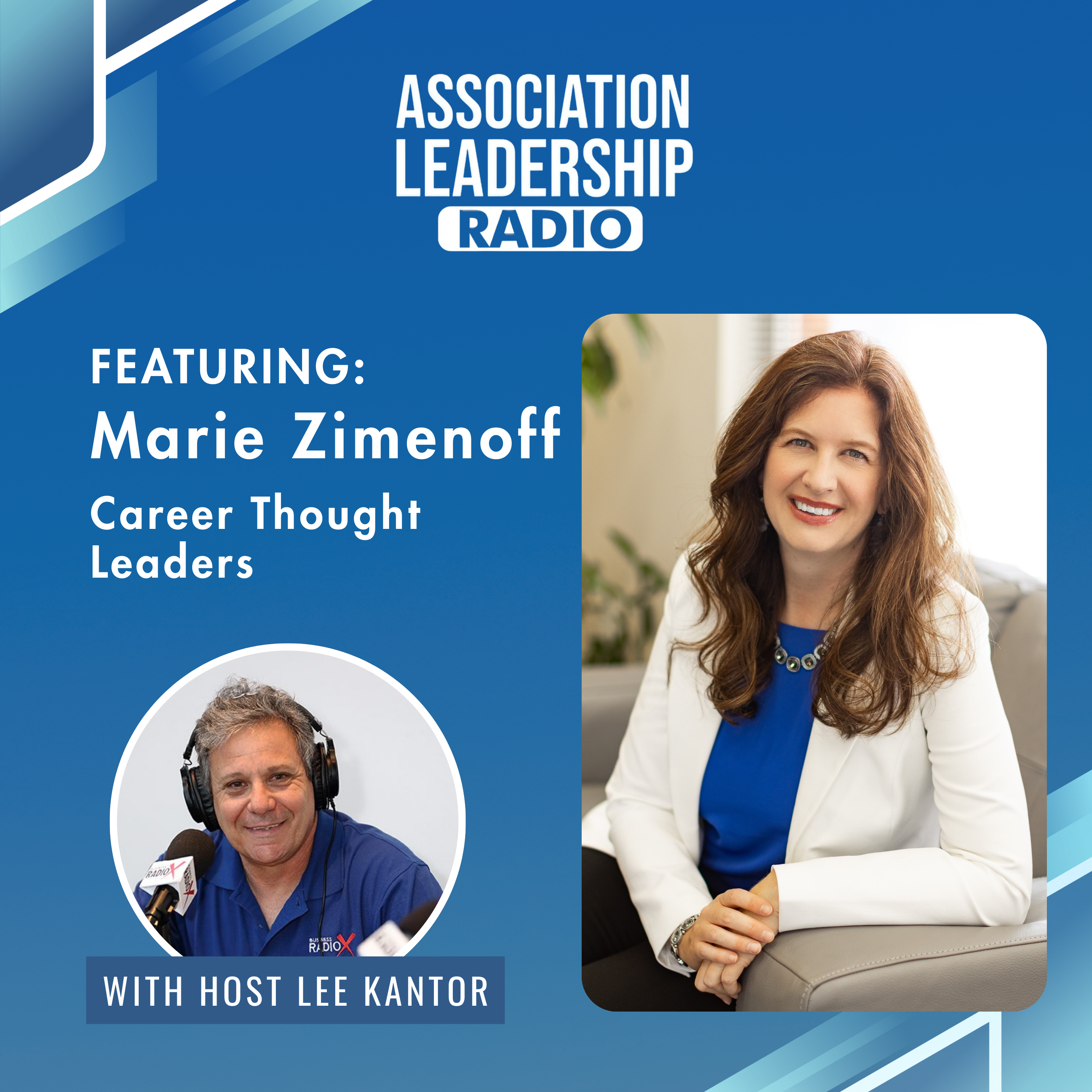

In this episode of Association Leadership Radio, Lee Kantor talks with Marie Zimenoff, CEO of Career Thought Leaders. Marie discusses her organization’s role in supporting career coaches, resume writers, and personal branding strategists globally. She highlights the evolution of career coaching, the importance of community among coaches, and the essential skills needed for effective coaching. The conversation also addresses the challenges job seekers face in today’s competitive market and the proactive strategies they should adopt. Marie emphasizes the need for legitimacy in coaching, combating misinformation, and the value of modern tools and continuous learning for career coaches.
 Marie Zimenoff is known as a pioneer on the leading edge of career industry trends and technology. She began her professional career as an advisor and recruiter in higher education while completing her MEd in human resource studies, career and counselling development. In 2008—the peak of the Great Recession—Marie left the university to start her business.
Inspired by a passion to make a difference in the industry, as CEO of Career Thought Leaders and Resume Writing Academy, she trains career professionals around the globe in resume writing, career coaching, and business development through webinars, certifications, and weekly Trend Tuesday Live videos on the Career Thought Leaders YouTube channel.
She is known internationally for sharing practical tools and technology tips that prepare audiences for the future of work.
Connect with Marie on LinkedIn.
What You’ll Learn in This Episode
- The role and significance of Career Thought Leaders in supporting career coaches and job seekers.
- The evolution of career coaching from its historical roots to its current state.
- Challenges faced by job seekers in a competitive job market, especially during economic uncertainty.
- The importance of empowering clients and building their confidence in the job search process.
- Essential skills and qualities that make a successful career coach.
- The misconception that optimizing resumes and LinkedIn profiles alone guarantees job success.
- The necessity of proactive networking and relationship-building in job searching.
- The value of community and collaboration among career coaches for sharing knowledge and best practices.
- The impact of misinformation in the career coaching industry and the need for credible advice.
- The diverse backgrounds of career coaches and how this diversity enhances the coaching experience.
 This transcript is machine transcribed by Podsqueeze.
TRANSCRIPT
Intro 00:00:02 Broadcasting live from the business radio X Studios in Atlanta, Georgia. It’s time for Association Leadership Radio. Now here’s your host.
Lee Kantor 00:00:20 Lee Cantor here, another episode of Association Leadership Radio. And this is going to be a good one. Today on the show we have Marie Siminoff and she is the CEO of Career Thought Leaders. Welcome.
Marie Zimenoff 00:00:33 Welcome. Thank you for having me. I’m glad to be here.
Lee Kantor 00:00:36 Well, I’m so excited to learn what you’re up to. Tell us a little bit about Career Thought Leaders. How you serving folks?
Marie Zimenoff 00:00:42 Yeah. So Career Thought Leaders is an international organization that serves, I always say, people who help people find jobs. So career coaches, resume writers, personal branding strategists, people that help individuals move into a new job or move up in a job and find something that makes them happy and feel fulfilled in their work.
Lee Kantor 00:01:05 Are there a lot of those folks out there?
Marie Zimenoff 00:01:07 You know, it’s kind of surprising. So we serve individuals in about 40 countries. You know, anywhere you can think of there are people that are doing this kind of work.
Marie Zimenoff 00:01:19 We have people who have gone through our certifications that are in India, Singapore, Nigeria, obviously all across the US and Canada. It’s just amazing to see the different way that careers are talked about in different places, but that we’re all doing the same basic kind of work, trying to help people find a way to use their talents and earn a livable wage.
Lee Kantor 00:01:50 Now, this type of career coaching is this kind of a new phenomenon, or has this been going on for a long time, but maybe only like a few people were taking advantage of it, but now it seems like more and more it’s been democratized to a certain degree.
Marie Zimenoff 00:02:03 You know, it’s interesting. So, I mean, the roots of this work are the vocational counseling that was being done in high schools. You know, ever since probably the very early 1900s, and then got a kick up in 1950s when especially people were coming back from war and trying to figure out what they were going to do. And you saw some of the assessments, like the Myers-Briggs Type Indicator.
Marie Zimenoff 00:02:27 And those types of things came more onto the scene at that time. The independent career practitioner has been well, well and thriving, I would say at least since the mid 80s. Career. Thought leaders was in founded as Career Masters Alliance in the mid 90s, and then changed names to Career Thought Leaders in 2009. So I’d say at least since the early to mid 90s, there’s been a fairly large market for resume writing career coaching for an independent, and in addition to the work that’s been going on at universities, community colleges, high schools, workforce centers around the U.S., but also around the globe, and there’s similar types of activities going on.
Lee Kantor 00:03:17 So what’s your backstory? How did you get to the point where you’re now kind of over a membership group that’s helping serve all these folks?
Marie Zimenoff 00:03:26 Yeah. So I started in in college, I wanted to be a counselor. I thought I wanted to be a school counselor. And then, as you know, as we find things happen, I took my first school counseling class and heard the other people in that class, many of whom were high school teachers, becoming counselors, just talking about their work and and how they were mainly creating schedules and working with parents.
Marie Zimenoff 00:03:51 And I thought, well, that wasn’t quite what I had in mind. So I got an opportunity to do an internship at a local community college, as well as work in an academic department at Colorado State University, and started to get into, okay, maybe I could work at a college. And then while I was in my master’s degree program, I had an opportunity to do a internship at a private practice. And, I really enjoyed the diversity, and I was working in the private practice with private clients. I was also teaching at the local workforce center because it was the Great Recession of 2008 at that time. And so I just saw the opportunity to go out on my own, contracting with Workforce Center, working with different resume writers and, just, you know, one thing happens, falls into another. I became president of a national organization. And they got to know the owners of career thought leaders through that role. And so in 2015, I actually just celebrated my ten year anniversary. I took over the leadership of Korea Thought Leaders and Resume Writing academy in February March of 2015.
Lee Kantor 00:05:11 So you started out through like the, I guess, the classics through the school system, and you got to sample each of those. But then when you went into private practice and you saw the the variety of different individuals at different stages of their career, that was more rewarding and that resonated with you.
Marie Zimenoff 00:05:28 Yeah. And just the opportunity, to bring because I’ve always been a learner and, and, you know, had the opportunity to go out and get training in all these different methodologies and modalities and was bringing that back to my university colleagues as well as the local workforce center colleagues. And I saw that they sometimes just didn’t have the thirst for it, or oftentimes didn’t have the funding for it. And that opportunity to have a bigger impact by up leveling the other coaches then by, you know, not just impacting individual clients one by one, but impacting all of the clients that they were serving as well. And that was I really enjoyed that creating curriculum. I started training coaches in, you know, 2010 or so at the workforce centers and was developing courses for them to use with their individuals coming through the workforce Center.
Marie Zimenoff 00:06:30 A lot of them had never seen mid-level professionals coming through the workforce center, right. They were serving more of the the TANF population, folks that have been unemployed, folks that were more entry level blue collar roles. And then when the Great Recession hit, you had engineers and scientists and all of these folks coming into the workforce centers, and they didn’t have the tools to to help them. And so that was really where my thirst for knowledge met the need of this audience, who needed new knowledge and new tools, and created a bunch of programs that then got rolled into career thought leaders when I took over the leadership for the organization.
Lee Kantor 00:07:13 Now, what is kind of the clientele of a typical, career coach? Are they are they focused locally or are they the world’s their oyster. Like, what type of clients do they go after, or do they have a niche like they specialize in engineers or how does that work?
Marie Zimenoff 00:07:31 Yeah. That’s interesting. We were just doing a lead generation class with our coaches, and it’s very similar to what we teach our job seekers that the more defined you are, the more proactive you can be.
Marie Zimenoff 00:07:44 That doesn’t mean that everybody needs to niche down in every area. But you’ve got Geography industry role level. You can pick between those things. You know, how specific do you want to be? If you want to be local, then you can have more breadth than some of the other ways because you’re promoting local, you’re marketing through local channels, those types of things. If you want to be international, then you probably have to be more focused in terms of industry and role so that you can break through the noise and have some proactive marketing channels that you can find and use. So some people, you know, do target more and age group or level some people target more. The industry, you know, they’re really into. We have a colleague that’s really into the program management project management industry. And there’s a lot of different ways to to pick a niche. But there are coaches that serve every niche from, you know, all the different levels, all the different types of careers. And, you know, people who are not high earners are still paying for these types of services because it keeps them out of work, you know, less time and those types of things.
Marie Zimenoff 00:09:01 And then there are quite a few people in our industry who focus on executives, but there’s definitely an option for everyone to get help because people don’t know how to navigate the landscape to find a job today.
Lee Kantor 00:09:17 So now in your group, is it, it’s targeted towards people that are helping other people get into a new or, their current career, finding a job in some manner?
Marie Zimenoff 00:09:30 Yeah, yeah. So our coaches are mainly career coaches, job search coaches, interview preparation, resume writers, as well as, some leadership coaches. A lot of times the leadership kind of crosses over with career now.
Lee Kantor 00:09:48 How does it how do you differentiate yourself from like a recruiter?
Marie Zimenoff 00:09:52 Yeah. So recruiters work on the company side. Recruiters are paid by the company. They’re trying to find candidates for a company. And there’s very few headhunters that a job seeker can pay to find them. A job that’s really not a thing. Most of the time, when a job seeker is approached by someone who says they do that, it is either a scam straight up, or it’s a recruiter who’s guaranteeing interviews.
Marie Zimenoff 00:10:21 But that’s because they’re they’re got employers they’re working with, so they’re really not guaranteeing the job. There’s a few specific industries where there actually are valid headhunters that an individual can hire to go out and find them a job, but recruiters are typically working for the company to hire someone. A coach is working with an individual not just to find a job, but to learn the process of job search and to be more confident. To understand how to network, to understand how to reach, you know, reach out to recruiters. To understand how to communicate their background in a strategic way. So they’re working on the individuals side to give them the skills they need to find a job.
Lee Kantor 00:11:12 And to make them as marketable as possible.
Marie Zimenoff 00:11:15 Exactly.
Lee Kantor 00:11:17 Because I run into so many people that, they never get asked, like recruiters are never finding them and they’re always questioning, like, what am I? What do I have to do to get someone to pick me? And that’s a very vulnerable position to be in. And I’m sure it’s very frustrating.
Marie Zimenoff 00:11:36 It is, you know, and people will say, oh, this must be a great time for your business with the market. And I’m like, well, not really. Like coaches want to be empowering. We want to help people who are employed, but looking to make a move from that position of power. Working with people who are laid off, unemployed, struggling. Like, of course we want to do that work because it’s important work to get people back to work and feeling like they’re contributing to their family, their life, all of that. But that is very emotionally hard work to do for both the candidate and the coach. It’s very important work, but I wouldn’t necessarily say it’s a great time for our business because it is. It’s hard. It’s not easy to find a job right now in some sections. It’s, you know, it’s very all over the place. But it it is more challenging of a market. And that means that, you know, we’re dealing with people who are, as you just pointed out, struggling with the Identity part of it, and do I matter? And how do I get people to pay attention to me? And all of that just gets even more frustrating during this time, during these times of economic uncertainty.
Lee Kantor 00:12:54 So what are the qualities of a good career coach? What are some of the must have qualities?
Marie Zimenoff 00:13:01 So the challenge for a career coach in particular, is that we’re constantly walking the line between consultant and coach, because people come to us and because they want our expertise in how to find a job. But when it comes right down to it, each individual is an expert in their own personal approach, their own will and will not dos right? Their own industry, perhaps. And so we are a guide, but we do have to provide a little bit more direction structure sometimes information than then some other types of coaches do. Because there is a structure to career transition to career exploration. There’s a pattern to it. And so we’re holding this container for the pattern while being very careful not to step too much into that advisor or consultant role to the place where we disempower the client from driving their own success. Right. We can’t go to an interview with them. We can’t go to their job for them.
Marie Zimenoff 00:14:08 And so they have to make those decisions themselves. Even though when they initially come to us, they think we should tell them how to do it right. so it’s a it is a place that requires a lot of, self-knowledge and being able to recognize when we’re giving advice and when to switch back into the coach role. So you have to have strong coaching role skills. You also need that knowledge of the career development process, the career change process. Job search. You have to know those things, but yet be almost confident enough that you don’t have to rely on your knowledge of those things to add value to your client, because you understand the real value you add to your client is leading them to find their own answers. Even though there are best practices and those types of things out there.
Lee Kantor 00:15:05 Now, I would imagine in today’s world, some of your work has to be around how to optimize your LinkedIn profile or or have a good, you know, submission of a resume or cover letter, things that are the blocking and tackling, I would imagine, of today’s job search.
Marie Zimenoff 00:15:22 Yes. Yeah. And to help job seekers not get stuck there, because in some ways those are a false focus. Because no matter how much you optimize your LinkedIn profile. The idea that you’re magically going to get found by a recruiter is is somewhat hooey, right? I mean, yes, we want an optimized profile. We want those keywords in there. But when it comes right down to it, your job search is going to be proactive. Researching people, networking with people, making connections so that someone refers you to that, to that recruiter. Because even the best profiles are one of a million, you know, maybe one of a couple thousand, depending on the type of work you’re aiming for. And so yes, we need that piece, but we also have to help people not get hyper focused or stuck there because it’s kind of like a business, right? You got a business, you got a website. But if you just sat around optimizing your website, in today’s world, you’d still have a hard time getting found.
Marie Zimenoff 00:16:32 You’ve got to go out there and drive traffic to your website, right?
Lee Kantor 00:16:35 You have to build relationships. You have to be proactive. You can’t. I think a lot of people are looking for that silver bullet where like, oh, I’m going to optimize my LinkedIn. I’m going to, you know, submit so many things on these job boards. And then I’ll just sit back and wait for the offers to come in. But I think that, like you said, it’s those even the weak ties amongst your network that’s going to get you your job more likely than just submitting and then being picked. Right.
Marie Zimenoff 00:17:06 Exactly. And it’s a balance because you do need to apply to things that are a good fit, and you have to have strong documents to be able to do that. And yet when people get stuck there too much, then they get disheartened because they’re not hearing back. And it’s like, well, there’s really nothing wrong with what you’re doing. It’s just that we’ve got to get some other plates spinning here as well.
Lee Kantor 00:17:29 But are those plates the ones that, as a coach, you have a harder time getting the people to do that kind of work. The, you know, go and meet somebody or have a conversation with a human being and talk about it. Or if you know somebody in that company, even though they’re not the hiring manager, still meet them because they might know somebody that is hiring, like, you know, all that kind of legwork that helps you just increases your chances of being referred in by somebody and having a leg up. So you’re kind of differentiate yourself.
Marie Zimenoff 00:18:01 Exactly. And so we give our coaches, I like to liken it to a menu. So there’s many different job search tactics that people could apply. you know, warm networking, cold networking, outreach, volunteering. There’s just there’s all these things that they could apply. Talking to recruiters, we want to help people choose the things that they’ll do, because it doesn’t matter if it’s the best strategy on earth, if you won’t do it right.
Marie Zimenoff 00:18:29 Right. We want to help people figure out how to execute those options in a way that they can execute. so there’s, you know, we were just talking about, you know, all the different ways to quote unquote, network. And so a coach is getting here’s the menu of things that you can do to be most effective in your search. Where do you want to start? What feels like a good fit for you. And then even inside of those those tactics that people might choose, there’s nuances in how they do it that they can align with their personal style, with their industry, with their role, with their level. Everything is is going to be done just a little bit differently, so that it’s something that that they can consistently execute. Because we know that’s really the difference, right? When you’re in business, whatever it is. Execution is the secret sauce and it with job search. That’s maybe even more true because no one’s going to do it for you.
Lee Kantor 00:19:33 And I would think that this is where your association is so important to the coaches out there, because you’re hearing and learning of best practices and these little nuances and tweaks that might be occurring to stay as current as possible, that an individual doing this by themselves, without the help of a community like yours, that they would be falling behind and their things might become more obsolete faster than what you’re learning, kind of on a day to day basis.
Marie Zimenoff 00:20:00 Exactly. And it’s the power of the community that helps keep each other up to date, because it’s a lot in our field. Right. We’re talking economics, political, you know, the rate of change in a job, the rate of technology that’s changing all jobs, there’s a lot to know, which makes it exciting for most of us. But it does make it challenging to make sure we’re not giving outdated information, that we don’t get caught. You know, I like to say that we talk about trends, but not what’s trendy, because what’s trendy can actually hurt people. you know, kind of put them on a path that isn’t going to be successful right now, but it’s what’s going on are the trends that we really need to pay attention to versus what’s just trendy and is going to come and go.
Lee Kantor 00:20:52 And also and it gives the, coach the legitimacy because like you mentioned, that in this world, you’re unfortunately dealing with some people that are making kind of false promises and that that you don’t want to be kind of lumped in with that type of a, of a recruiter or career coach.
Marie Zimenoff 00:21:11 And it’s challenging because there’s a lot of people out there who say, oh, you know, this coach doesn’t know what they’re talking about. And it’s, you know, a lot of it’s context and what they’ve experienced. And there are people giving advice that I don’t agree with. Does that necessarily mean they’re wrong or bad? We have to talk more about the context. I do see things that I wish oh, people wouldn’t say that in such a broad, sweeping way because part of what they’re saying might be true. But the overarching impact of it is sometimes harmful. Like the whole, you know, your resume has got to be optimized, or these data points that people throw around 80% of of resumes never get seen by a human. It’s like, where on earth did that come from? That is not true. Yes, there may be a percentage of resumes that is not seen by human, but it is nowhere near 80%. And so those fear tactic statements and sometimes unfortunately coaches share that with the best of intentions.
Marie Zimenoff 00:22:07 Right. Trying to help people be more thoughtful in what they’re doing. But when we share those data points that are false, it ultimately backfires. So those are definitely things that make it challenging in our space to communicate the strategies and the need for coaching, but not to do it in a way that that, continue some of those false narratives.
Lee Kantor 00:22:32 Now, is there a story you can share, maybe one of the members that you have that you work with, that they started at a certain level. And now being associated with the association and their learning and the community that they’ve been able to, you know, maybe do some interesting things as their career has evolved.
Marie Zimenoff 00:22:51 Yeah, it’s been thinking about some, one individual who’s just getting into career space. So one of our main topic types of, of clients is a coach who may have coaching training but not career specific. And so they come in and they’re like, okay, I’ve been helping people with this, but it’s like kind of the blind leading the blind, right? We’re we’re wandering around out here and, and we’re doing some things, but we’re not getting there very quickly.
Marie Zimenoff 00:23:19 And most of our work is to create structures and programs that people can use with their clients so that they’re not spending as much time teaching and doing those things in the sessions. They’ve got worksheets and a structure that the client can do. Then they come into the session and we’re having more focused conversations, more reflective conversations that move the work forward instead of the spiral, which is in some cases inevitable in the career space. But, we have that, that, that process and structure kind of laid out for us so that then we can pay more attention to the human inside of it as we go. And so this woman, you know, has great coaching background, wanting to figure out how do I help people change careers in a more structured way, and now has been doing it for a few months, maybe about almost a year. Seeing that process and the, the the Process and the progress. That’s what I was looking for, the progress that the clients make. Faster with just a few, just a few tweaks to this.
Marie Zimenoff 00:24:37 The structure. So that she can help people go through it and still, you know, managing it when clients have kickbacks. Right. Or back setbacks.
Lee Kantor 00:24:48 Setbacks. Right.
Marie Zimenoff 00:24:50 Yeah. But you’ve got this structure that you can lead people through. And so you’re getting better results with clients, which means they’re happier. They’re referring more of their friends and family to you. And you’re feeling more successful because you’ve got that structure to, to lead to their outcomes that they wanted.
Lee Kantor 00:25:07 So what is your biggest challenge right now? Is it to get new members, to, you know, to grow and have, you know, more coaches throughout the world be part of your organization? What do you need more of and how can we help?
Marie Zimenoff 00:25:23 Yeah. I mean, our mission. So in addition to being a membership organization, we’re also, you know, a think tank. We have a lot of free resources out there available, like our Career thought Leaders YouTube channel. And, you know, our mission is to provide those resources so that everyone doing this work, whether they’re a member of our organization or not, that everyone doing this work is got the best tools, the latest information, and therefore getting the better outcomes for their clients of all ages.
Marie Zimenoff 00:25:56 So we’d love to get more eyes on our YouTube channel, especially more people engaging with those resources free and paid because things are moving quickly. And if they are coaching with job search methods from ten years ago, they’re likely missing out on a lot of the tools that they are job seekers could be using to do the parts that can be done faster, faster and spend more time with the challenges, the fears that keep people from doing the work that really matters.
Lee Kantor 00:26:31 Now, what is kind of the the person that isn’t a career coach yet? What are they doing before they become a career coach? Usually, do they come from HR or do they come from coaching?
Marie Zimenoff 00:26:43 They come from all over. So we get people that have been managers or leaders in organizations. We get, you know, teachers. We’re getting some university folks who are getting let go. With the swift change in educational funding, both in the US and in Canada. we do get HR professionals, some recruiters that want to add this type of work to their recruiting practice.
Marie Zimenoff 00:27:11 it is a variety of backgrounds. Like I said, we got the project manager turned career coach that focuses on helping people in that industry marketers brands. Yeah that and it’s that’s part of the beauty to is that you people from all over come to be coaches and then they can help people. Not only, you know, where they’ve been all over the place, but they can help people specifically that are coming out of the same place as they’ve been.
Lee Kantor 00:27:41 And does your work happen all virtually or online, or do you have chapters around the world?
Marie Zimenoff 00:27:48 Yeah, we are 90% virtual. we all we’ve been. So before my time, we were doing tele classes where we mailed things to people and had tele classes. so we’ve been doing zoom since before it was a thing, before everyone else was. And and like I said, 40 different countries around the world. We get together in person once a year, and have that opportunity to deepen the colleague relationships. chips, but we get together while our membership group gets together every Tuesday virtually around the globe.
Marie Zimenoff 00:28:25 And we have that opportunity to to learn from what other people are doing, all around the globe.
Lee Kantor 00:28:33 And do you have any advice for other, association leaders out there when it comes to engaging a remote, virtual membership? Are there some do’s and don’ts you’ve learned over the years in order to keep people engaged and keep people excited about being part of it?
Marie Zimenoff 00:28:50 Yeah. So we have, we have a really engaged group. I’m, I’m told from my members that part of what makes it so inclusive is that I am, well, I, I try to practice what I preach. So I am leading the group, but I am not I am not the focus of it. And I think as an association leader, that can be challenging because you want to put together the structures and those types of things. But when it comes right down to it, you get more engagement if the if your members have ownership. And so like we have just one example. We have a Facebook group. And I don’t have to comment on every post.
Marie Zimenoff 00:29:34 I don’t have to do any kind of campy. Oh it’s Tuesday. Share your favorite technology types of posts. It grew very organically because we didn’t create a sage on the on the stage feel. It’s not about me. It’s not about me being the the most all knowing person. it’s really about the community coming together and sharing with each other, which as adults, when we get to share, when we get to be the teacher, that’s really when we learn. And so we try to step back and create those opportunities for the people in our association.
Lee Kantor 00:30:14 Good stuff. Well, if somebody wants to learn more, get Ahold of you or somebody on the team, what is the website? What’s the best way to connect?
Marie Zimenoff 00:30:22 Yeah. Career thought leaders. Career thought leaders. And like I said, our Career thought leaders YouTube channel is, always cranking out new content there, as well as our LinkedIn page, obviously, since we’re in the career space, career thought leaders LinkedIn page, and individually independent, my personal page, happy to connect with people there as well.
Lee Kantor 00:30:46 Well, Marie, thank you so much for sharing your story today. You’re doing important work and we appreciate you.
Marie Zimenoff 00:30:52 Well, thank you so much. It was fun to to chat with you for a little while.
Lee Kantor 00:30:55 All right. This is Lee Kanter. We’ll see you all next time on Association Leadership Radio.














