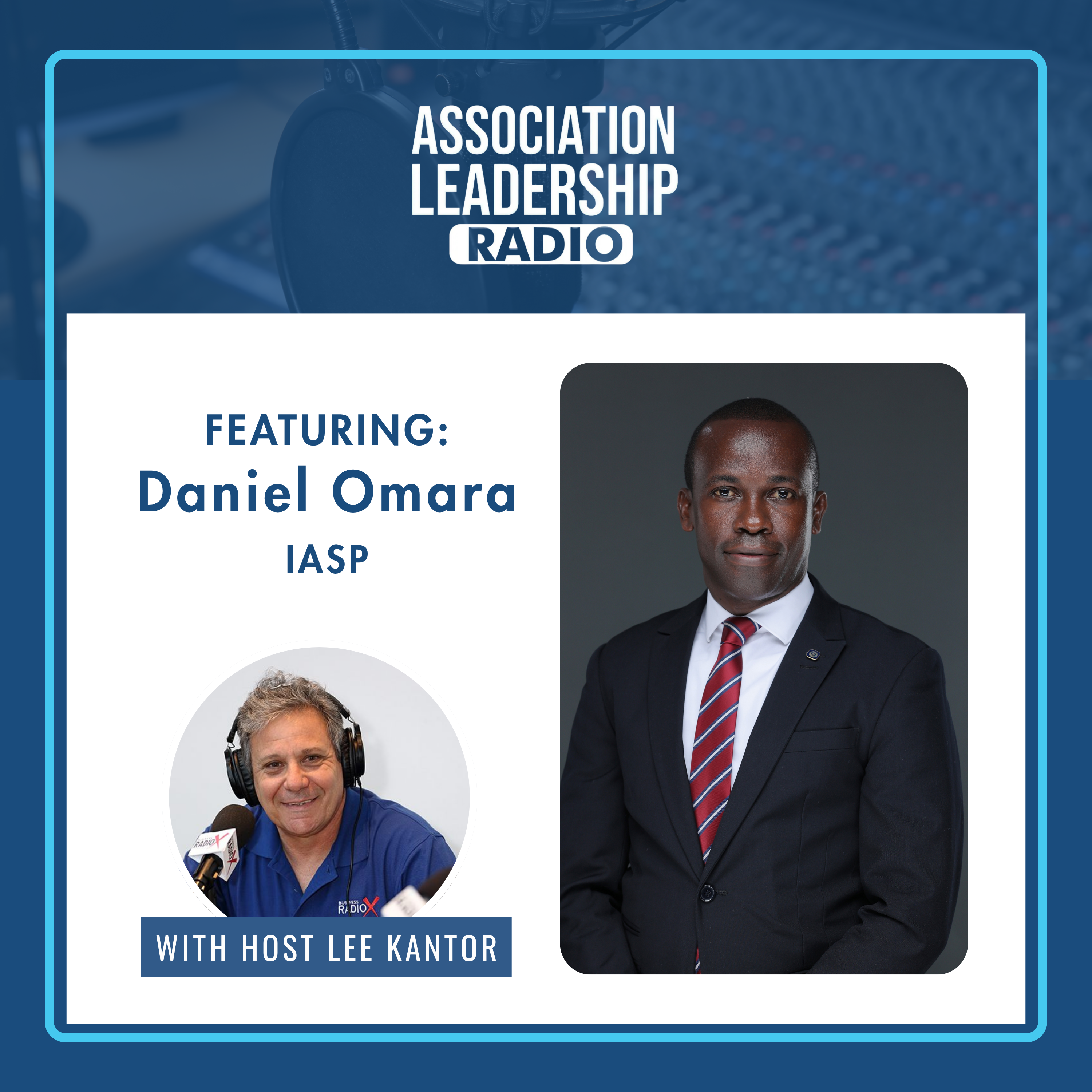

On this episode of Association Leadership Radio, Lee Kantor talks with Daniel Omara, President of the International Association for Strategy Professionals, who shares perspectives on the organization’s role in advancing strategy management globally. Daniel discusses the association’s pillars, its expanding international chapters, certification programs, and the importance of knowledge sharing and cross-cultural collaboration for strategy professionals worldwide.
 Daniel Omara is a motivated achiever and team player with charismatic leadership, excellent communication skills and business savvy that enables organizations to achieve high level strategic objectives, and drive performance culture that would align all processes and systems to deliver high impact results.
He has specialized skills and knowledge in corporate strategy and economic policy with an extensive experience in public/Government services particularly, tax revenue administration, public financial management and central banking services.
His knowledge base includes economic issues in regional integration, macroeconomic management in resource rich countries among others. Daniel is a certified Strategy Management Professional (SMP) by the International Association for Strategy Professionals (IASP). He holds an MBA (Corporate Strategy and Economic Policy) from Maastricht School of Management/Maastricht University, the Netherlands, Bachelor of Business Administration (Accountancy) from Makerere University Uganda and a Balanced Scorecard  Master Professional certification from the George Washington University College of Professional Studies, U.S.A, Key Performance Indicator Professional certification (KPIP) from the Strategy Management Group/The Balanced Scorecard Institute, USA, certified PRINCE2® Practitioner (Axelos, UK), Gender and Macroeconomics, IMF Africa Training Institute, Economic Issues in Regional Integration, IMF Africa Training Institute among others. CURRENT ROLE Manager Strategy Management and Work Planning in the Strategy and Innovation Department of the Central Bank of Uganda.
Daniel coordinates the formulation and implementation of the Bank of Uganda strategy and supports the preparation of Departmental operational annual work plans and budgets. He’s the President of the IASP Global and Past President IASP Uganda Chapter.
Follow IASP on LinkedIn.
Episode Highlights
- Daniel introduces the International Association for Strategy Professionals and outlines its mission to connect and empower strategy professionals across 13 countries.
- Membership benefits are explored, including certifications, resources, global networking, and the organization’s commitment to professional growth.
- The core strategic pillars: membership growth and retention, strategic partnerships, and organizational sustainability.
- Certification programs for strategy practitioners, detailing application, examination, and the increasing global enrollment, especially in Saudi Arabia.
- The annual global conference is highlighted as a keystone event, bringing members together for learning, networking, and community development through targeted sessions and communities of practice.
 This transcript is machine transcribed by Sonix.
TRANSCRIPT
Intro: Broadcasting live from the Business RadioX studios in Atlanta, Georgia. It’s time for Association Leadership Radio. Now here’s your host.
Lee Kantor: Lee Kantor here another episode of Association Leadership Radio. And this is going to be a good one. Today on the show, we have the President of the International Association for Strategy Professionals, Daniel Omara. Welcome.
Daniel Omara: Thank you. Thank you very much, Lee, and greetings to all the listeners. I am speaking to you all the way from Kampala, Uganda.
Lee Kantor: Oh, a long, long way away. Well, for folks who aren’t familiar, do you mind sharing a little bit about the International Association for Strategy Professionals? How are you serving folks?
Daniel Omara: Sure. Of course. So as I said, my name is Daniel Omara and I’m the president of the International Association for Strategy Professionals. We are a nonprofit organization, uh, started in California in 1999. Today we are based in Michigan. Uh, and we basically, you know, strive to be the global standard bearer for organizational transformation and success through strategy. Mission is to support and connect global strategy professionals to engage in thought leadership, share practical resources, participate in personal development, and seek certification transforming their careers and organizations. And we’ve been doing this since 1999. As I said, you can find us on, uh, strategy Association, DoD, or we are based in Livonia, small city Livonia in Michigan.
Lee Kantor: So tell us a little bit about the type of work when you when I joined the association. First, who who should join number one and number two, what are some of the benefits of being part of this community?
Daniel Omara: Thank you very much, Lee. So who should join? Anybody interested in strategy? The practice of strategy, the profession of strategy management can join. But we encourage all our strategy professionals across the world to join the association, because this is where we have shared learning. We have, um, experiences from different strategy professionals from across the globe, by the way, we reach out to over 9000 People across the globe, and we’re present in 13 different countries where we have chapters. Our newest chapter is in Kazakhstan, a very small state in the former Balkan states close to Russia. So all these strategy professionals can join all those in the practice of strategic planning, in government, in the public sector, in the private sector and nonprofits. Uh, all these are welcome to join. You could be a project manager and you’re not doing strategy. You’re still welcome, uh, to, you know, join the association because the strategy that we, um, uh, support, the strategy that we advocate for in different institutions supports strategic, uh, management in terms of project management as well.
Lee Kantor: So what are some of those kind of strategic pillars of excellence when it comes to strategy?
Daniel Omara: Okay. Before I go to the pillars of our strategic planning of for the ISP, you had asked me about the benefits. I could just mention 1 or 2. But most importantly is the knowledge sharing from different experts. Um, we hold annual global conferences and I’ll speak to that much later, but the knowledge sharing across the different professionals gives, um, a point of benchmark that, uh, we could all learn from. But among that, we have a certification program, which is the only kind in a field of strategy. So we have, uh, two strategic planning certification programs. One is called the Strategic planning professional. This is when you have experience in, uh, practicing strategy up to five years and beyond. Five years. If you’re engaging with a C-suite executives, you can apply to attain the certification known as the Strategic Management Professional. Smp and a number of folks in the US have got this certification. Are we expanding across the globe to Africa now and in the Middle East, especially in Saudi Arabia? So in our strategy, uh, we have three strategic pillars. One is the membership, where our goal is to increase membership. And we do not just want to grow a membership, but we want to retain our membership. Today we stand at about, uh, just, um, just over 700 members across the globe. Uh, that’s in the 13 chapters that I talked about. Our second pillar is connections.
Daniel Omara: This is where we want to grow partnerships, because in this field of strategy, it’s very important to work with our strategic partners. So here we um, our goal is to ensure that we have, um, the kind of partners that we can, uh, work with in running our webinars, in running our different programs, in, uh, supporting our strategy work across the globe, in our different chapters and also provide thought leadership. Uh, and we do this through the certification program, uh, webinars. And we have a newsletter called the Strategy Week. Uh, strategy, sorry, the Strategic Edge and the strategy magazine that goes out to over 9000 people. The third pillar, but not the least is organizational Or sustainability. And here we strive to see that we first of all, financially sustainable. We saw the, um, experience that we went through during the Covid pandemic that we were not able to run most of our activities just like every other institution. But it gave us a learning, um, point that we need to be at a point where we are sustainable financially rather than surviving. So we’re on that path to sustainability financially, but we also ensure that we maintain, um, a lean workforce, uh, our staff, that we can support even when we are constrained. So those are the three strategic pillars that drive our institution for this current strategic planning period, 2024 2026.
Lee Kantor: And then you mentioned that one of the benefits of, being part of the organizations is you can get a certification in strategy.
Daniel Omara: That’s right.
Lee Kantor: And then this certification, what is required other than just the having the title and the years of service, is there a test or is there some way to demonstrate that you have these skills?
Daniel Omara: That’s a very good question, Lee. So first of all, certification program, uh, has an independent, uh, body that examines the applications that are submitted, but also that sets the, um, exams for each of these, uh, two programs, ESP and the SMP. So what? And this is based in Canada, uh, where we have our certification director, uh, and the main office that runs all the operations around the certification exam. So when you would like to attain the SBP or SMP, you submit a qualification application. This application will be received by the Certification Director. They will submit to the Certification Commission that will review your application based on your work experience. Based on your, um, college qualifications and your experience, uh, around the field of strategy that would determine which of the certification programs, uh, would be best suited, uh, for your case, either SBP or SMP. So we, once you are, um, have gone through and have been admitted, uh, you’ll be advised on which program and you can start your study program on your own. The materials are available. Uh, we send that to you, but you can also find the material on our website. Once you remember, you are able to download our body of knowledge plus a lot of other resources. However, we have what we call certification preparation providers. These actually train our programs so you can enroll in any of their programs to prepare for certification exams. So there is an exam at the end of it all which you must pass. And the pass mark is 75%. It’s a three hour exam. And once you have passed, you then attain the SMP or ESP qualification.
Lee Kantor: Now another pillar of excellence is connections. As the leader of the organization, what are you doing to kind of facilitate and encourage the connections between the members? And are you creating events? Are you, um, doing kind of zoom calls? How how do you how do you help the members connect amongst themselves and form a true community?
Daniel Omara: Very good question, Lee. So of the 13, uh, chapters that we have across the globe, each of these chapters, uh, is required to organize a member engagement programs. Uh, these could be in form of, um, webinars, uh, in form of, uh, in-person workshops. And these could also be in form of um, conferences. They can have, uh, regional conferences. We just held the first ever um regional conference in Africa, and this was hosted by the ISP Uganda chapter in 2024, in August. And we had, uh, my colleagues on the board, uh, come over from the US, uh, to attend. And we had quite a great media coverage in Uganda. We had attendees from Nigeria, Kenya, the neighboring countries, Rwanda, the Democratic Republic of Congo and many others. So each of these chapters has different programs which, um, we guide, uh, centrally at the association headquarters in Michigan. And just to ensure that, um, the programs do not, you know, um, uh, compete with one another. Um, but they are routine programs that they have. We also run webinars. Excuse me. We run webinars. And these webinars are from different topics. And these topics, uh, can be decided, um, by the sponsors or these topics can be, um, decided by the speakers themselves. But of course, we we’ve got to go through them to see that, um, they create value to the members. So you find that members are always engaged in different programs across the different chapters. And when I come to speak about the global conference, then it will, you know, bring in the aspect of the universal program that brings all the members and, and those intending to join and to to one room during that global conference.
Lee Kantor: Now, as the leader of the organization, what is the kind of the metric that matters to you at the end of maybe the year when you and your team are getting together to assess how you’ve done from a strategic standpoint, what is what are some of the things that have to happen in order for you to be high fiving each other at the end of the year, when it comes to achieving your strategic objectives?
Daniel Omara: Fantastic. So we’re a nonprofit Profit organization, but you still need to survive. As I said, we need to be sustainable, as I said earlier. So one of the metrics that, um, keeps me awake, keeps, uh, the entire board awake is to see that we first of all, financially sustainable. So we look at our numbers and we’ve set targets to grow our revenue. The revenue comes from, uh, member subscription that is paid annually. The revenue also comes from our programs that we run the certification program. So once we have achieved our targets on, uh, say, um, on financials, uh, then we can be sure that, yes, the association, uh, will be sustainable. The second, uh, metric that we look at is the membership growth, uh, end retention as I spoke too much earlier. So we’d like to see that over the next, uh, two years, during our strategic planning, uh, cycle, we grow our membership by at least 10%. And I said we just slightly over 700 members. And this this number came from about 300, um, a couple of years ago. So we’re doing great, uh, to see that we increase this during my presidency. Uh, that started in June, July this year. I promised that we need to grow membership to 1000.
Daniel Omara: So, um, all the time monitoring this metric to see that the numbers go up. But we also retain, uh, as much as possible in terms of connections here. We’re mainly concerned with, um, the, uh, certification program. So once we see many enrollments to the certification program. We are happy and we’ve been happy on this, mainly from the number of people joining the certification program from Saudi Arabia. We could see over 50% or 50, sorry, 50 members, uh, people joining, um, the certification program in one sitting. Um, that’s quite a remarkable, uh, performance. But we want to grow this across and to enable us to grow across the globe. We’re also doing translation, uh, of our strategy, uh, certification programs in different languages. We’ve done in Arabic. We’ve done in, uh, we’re doing now in, uh, Spanish, uh, still in the works, but in Arabic. We have succeeded, uh, in doing that in these areas. So those three plus conference, uh, the number of, uh, people signing up for conference. Very important that every year when we organize these annual conferences, uh, we set base, um, base numbers that we should work with. And once we achieve these numbers, we, we believe that we’re good to go.
Lee Kantor: Now, when it comes to strategy, is there a global strategy that works in for all cultures and all countries in all situations, or is strategy something different in different parts of the world?
Daniel Omara: That’s a fantastic question, Lee. So strategy across the globe, is it a plug and play that you can use in different cultures or in any part of the world? Uh, perhaps. No, in my view. And yes as well, yes, that the basics would remain the same. The concept of strategy will remain the same. Are you designing a strategy? Are you formulating a strategy that works for you in the next three, five, ten years? All right. There are basics that must be there. You’ve got to have your priorities clearly set. You’ve got to have metrics to assess progress towards achieving your goals. You’ve got to have the vehicles of transformation. If I may say that your strategic initiatives have got to be in place to drive, uh, your, um, goal and these remain, um, the same. These are standard, uh, measures. These are standard formats. These are standard, uh, concepts that will apply in any environment, any culture. However, when it comes to execution, this is where the play is much more interesting because different cultures, um, appreciate strategy implementation in different ways. In fact, even within this, the culture, which is quite similar, but in an institution, every institution has got different cultures. So you might find in a population of the same culture, but institutions within that population have different cultures. And so there will be differences in execution based on, um, the nature of the institution or the culture in the institution. So it’s not a one size fits all, uh, in as far as execution is concerned. And execution actually is one of the biggest challenges for us in strategy management because of the one big factor culture. And that is why, um, one, you know, scholar Peter Drucker once said strategy is eaten by culture, or culture eats strategy for breakfast, lunch, and we’ve gone ahead to add it, even dinner. So you have to work very hard to ensure that you bring your culture to align with your strategy, or vice versa. And so strategy is not a one size fits all in as far as execution is concerned. But in terms of the concept, the framework, that’s the same, uh, across the board.
Lee Kantor: Now, don’t you think that any organization that is global right now, or is thinking about becoming global, should become a member of the International Association for Strategy Professionals to just help them understand kind of the The nuances involved when you are implementing a strategy that might be working successfully for you in your community, but you need some other eyes and other people looking at this thing when it comes to international growth, and an association like yours is a great place to start to begin having those conversations.
Daniel Omara: Absolutely. So encourage all these institutions that are going through, um, their strategy journey that are starting their strategy journey. Come join the ISP, the International Association for Strategy Professionals, and meet these different experts, uh, in different sectors, public and private or non-profits. And you learn a lot, uh, from these experts. By the way, we have experiences and practitioners in the US military. Um, no wonder then, that, uh, strategy as a subject, uh, was, um, uh, a subject of the military, um, in the Art of War by Sun Tzu. Uh, he says, well, the military well, not quoting, you know, word for word, but strategy is quite instrumental in the military. And so it’s so interesting to see how the military applies strategy. And when we share, you know, experiences, um, not going to the detail of the military, but in as far as strategy is concerned, then we see that there are many lessons that, um, other institutions that are not in the military can still learn from. But also you have a wide range of, um, practitioners, uh, that can give this support. And we have the body of knowledge that, uh, provides a clear five, uh, steps to strategy, uh, formulation up to execution. This includes engagement and this information is available on our website. Um, the book uh, now 3.0 is free to members. Otherwise, if you’re not a member, you can purchase it at, uh, 50 USD. So this will give you, um, the different steps that you can take in strategy, uh, from formulation to execution. And so we encourage, um, different companies, different institutions, whichever size, to come join us and learn from us. And one of the developments still in the works is we now using data, uh, across sectors to see the success rates in strategy execution. And this is going to be very interesting when we release that out. Um, and we’re working with one of our partners. I may not share that now because we are still in the works, but it will give very realistic numbers. Uh, on the success rates, but also the failure rates in strategy execution across different sectors.
Lee Kantor: And every year you have an annual global conference. Is that right?
Daniel Omara: That’s right. So every year around about May June, we hold an annual conference. Um, the last conference was in Philadelphia in the United States. Pennsylvania was a great conference. We had over 100 people attend and great speakers, um, on different areas. And this was a success. Um, and the previous conference was in Atlanta, uh, in Georgia. The next conference, 2026, will be in Manitoba, uh, in Canada, Winnipeg, Manitoba, By Canada. And we look forward to, um, you know, people coming in to, uh, attend. Uh, registration will start in December. But for our international attendees, um, they can always start the registration process early because of, uh, visa requirements. But during the annual conferences, we have speakers from across, um, different sectors, but also the topics that are presented here, uh, provide a very good, uh, benchmark for practitioners, even us who are running this association, uh, we still learn each and every day. So we sit in and listen to these speakers, and there’s always 1 or 2 things to learn from here. But far from that, this is the point where we get our members to have in-person interaction, but also we have different groups called the Communities of practice. So we have the government communities of practice, where people in the public sector meet to share their experiences in the same kind of environment in government. And we also have the Women in strategy, uh, community of practice. Again, they come together and share their experiences, how they’re doing, strategy formulation, execution. Uh, in, in as far as, you know, the women are concerned and the challenges and all that. And these different communities of practice really support our members. Um, and they provide a connection, uh, during the annual conferences. And of course, there’s time for fun, uh, during the conferences. So it’s not just, um, heavy professional topics that are discussed during these conferences.
Lee Kantor: Well, Daniel, it’s been a pleasure getting to know you and your organization. The website one more time is Strategic Association. Is that right?
Daniel Omara: The address is. Strategy. Association. Org.
Lee Kantor: Strategy. Association. Org.
Daniel Omara: Org. That’s right.
Lee Kantor: Well Daniel, thank you again for sharing your story. You’re doing such important work and we appreciate you.
Daniel Omara: Thank you very much, Lee, for this opportunity. You can find us on LinkedIn. You can find us on Facebook. You can find us on X, formerly Twitter. And we’re always happy to work with you. Thank you very much, Lee.
Lee Kantor: All right. This is Lee Kantor. We’ll see you all next time on Association Leadership Radio.














