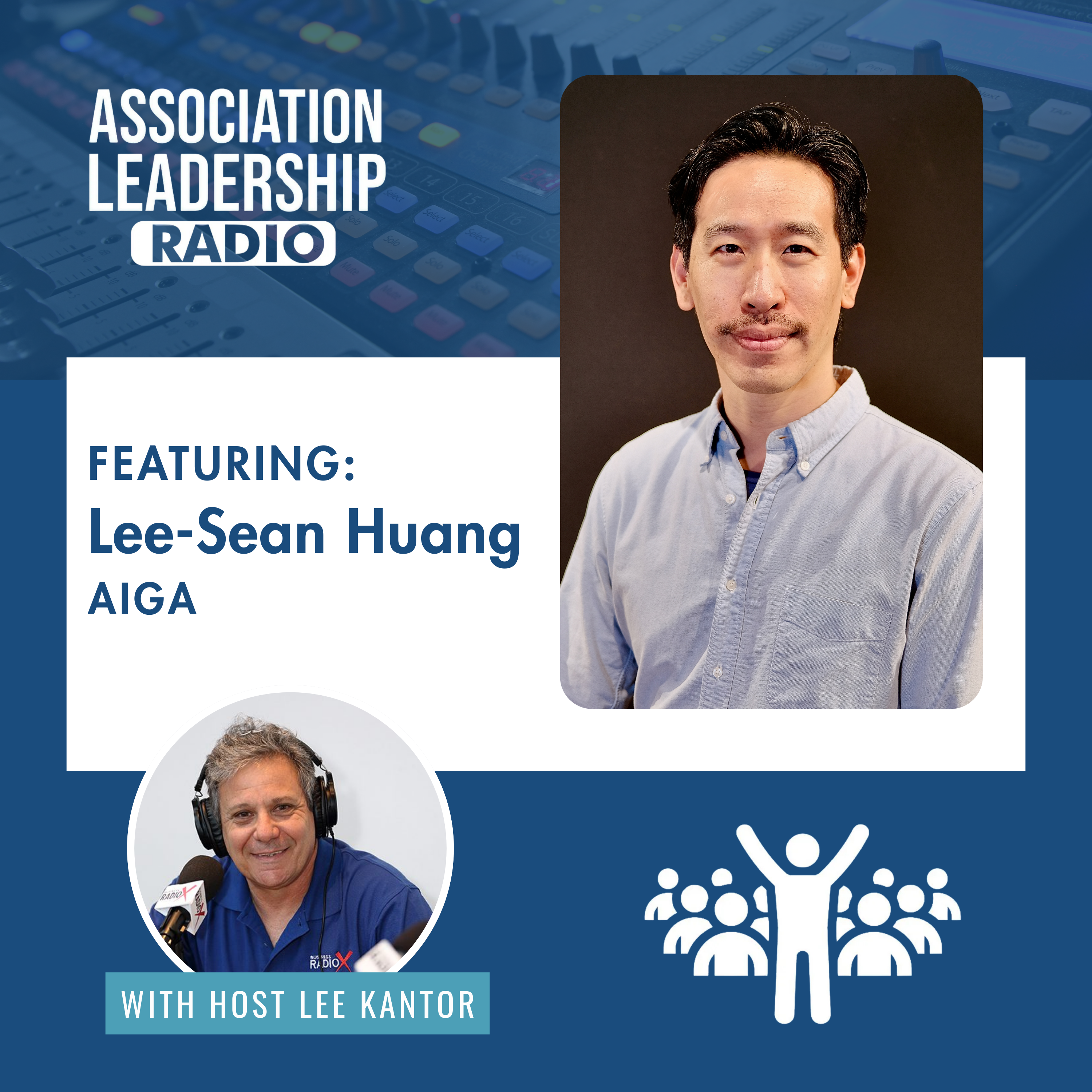

In this episode of Association Leadership Radio, Lee Kantor interviews Lee-Sean Huang, Co-Executive Director of Learning and Programs at AIGA. They discuss AIGA’s evolution, its role in supporting designers through professional development, ethics, and adapting to technological changes like AI. The conversation explores the balance between art and commerce in design, the importance of business and advocacy skills, and how AIGA fosters community and learning. They also highlight the upcoming national conference and encourage broader engagement with design as a vital force in business and society.

 Lee-Sean Huang is the Co-Executive Director of Learning and Programs at AIGA, the professional association for design, which advances design as a professional craft, strategic advantage, and vital cultural force.
In 2013, he co-founded Foossa, a creative consultancy focused on facilitating community-centered design and social innovation. He has taught design, media, and innovation at New York University, the Parsons School of Design, the School of Visual Arts, the College of Staten Island, and Emerson College.
He earned a bachelor’s degree in Government from Harvard and a master’s in Interactive Telecommunications from NYU.
Follow AIGA on LinkedIn, Facebook and X.
Episode Highlights
- History and evolution of AIGA (American Institute of Graphic Arts) since its founding in 1914.
- AIGA’s mission focused on professional development, ethical standards, and resources for designers.
- The impact of technological advancements, particularly AI, on the design profession.
- The adaptation of AIGA’s learning programs to include business skills and project management.
- The diverse membership of AIGA, including freelancers, in-house professionals, educators, and students.
- The upcoming national conference in Los Angeles and its theme of “Design and Performance.”
- The evolving identity of designers and the balance between art and commerce.
- The importance of advocacy and communication skills for designers in professional settings.
- The relationship between design and fine art, and the iterative nature of the design process.
- AIGA’s role in bridging the gap between design education and professional practice.
 This transcript is machine transcribed by Sonix.
TRANSCRIPT
Intro: Broadcasting live from the Business RadioX studios in Atlanta, Georgia. It’s time for Association Leadership Radio. Now here’s your host.
Lee Kantor: Lee Kantor here another episode of Association Leadership Radio, and this is going to be a good one. Today we have Lee-Sean Huang, who is the co-executive director, Learning and Programs Organization AIGA, the professional association for design. Welcome.
Lee-Sean Huang: Thanks for having me, Lee.
Lee Kantor: Well, I am excited to learn what you’re up to. Uh, for those who aren’t familiar, can you tell us a little bit about AIGA? How you serving folks?
Lee-Sean Huang: Yeah. So AIGA, we’re actually pretty old. We were founded back in 1918 or 1916, over 100 years ago, as the American Institute of Graphic Arts. It started out as a small social club of New York City based illustrators, publishers, engravers, printers. Imagine that kind of analog era and fast forward. Today we now have thousands of members across the US. Some international members as well. And we’re really focused on professional development for designers, as well as setting some standards for ethics in business, in the design business. Also helping the design community with things like sample contracts for freelance design work. And we’re in the midst of our conference season right now. We’re currently working on planning our conference, putting it on next month in October in Los Angeles. So we have experiences, we have learning, we have networking really focused on design and creative leadership.
Lee Kantor: So how has I mean, you mentioned being around for 100 years. Obviously, the industry has evolved dramatically. How has the membership evolved to match that? Are you changing kind of definitions of design designers. Has that altered as well as the industry has kind of evolved?
Lee-Sean Huang: Yeah, definitely. And I just had to look it up. It was 1914 we were founded. So it’s definitely evolved a lot since then. Obviously I haven’t been around all of that time personally, but just even in my own lifetime, we’ve seen certainly computers enter the picture. We’ve seen software like Canva making it easier for folks who maybe don’t have formal graphic design training to do graphic design. And then certainly with AI to makes it even easier for people, or lowering the bar of accessibility for graphic communications. So part of what we’ve been trying to figure out is, yeah, what does it mean to be a designer? There’s the human impulse. There’s like the basic fundamental communication of visual communications, right? That in our especially social media age was just everywhere with graphics everywhere. But then there’s maybe a smaller, more narrowly defined subset of people who are professional designers. Some of them may have titles like graphic designer or art director creative director, but we’re seeing more and more folks who are don’t necessarily have designer in their names, and we’re trying to really get on their radar as well. Say like, well, you are doing design. You know, come to us and let’s talk about what we do, our craft, you know, share inspiration and also learn from each other.
Lee Kantor: Now, are most of your membership are they working kind of for a paycheck for a company, or are they mostly kind of contract labor or freelance?
Lee-Sean Huang: You know, it’s fairly spread out across the board, actually. I would say it’s about, uh, half and half folks who are working either freelance or in a design agency. So essentially consulting, um, selling their services as designers. But we also have about half of the folks who are professionals in in-house positions. So they’re working in a corporation, or they’re the graphic designer for a nonprofit. Uh, and then I would say a significant portion of our membership is also educators and students. So professors of design as well as students of design. So we’re really trying to bridge this gap between what’s happening in design schools and academia and professional practice as well.
Lee Kantor: Now, you mentioned earlier, like the advent of AI and how that impacts people now can type in, you know, create a background, you know, by using text, you can create images and design elements. How is is that kind of is that is that a net positive or are you looking at that as a net positive that now more people could see themselves as designers, or is it a net negative in that now it seems like anybody could be a designer? I guess photographers probably went through the same challenge with phones.
Lee-Sean Huang: Definitely. Yeah, I feel like, you know, or even with writers, right. There are a small subset of people who are professional writers, authors. But like everyone, pretty much anyone who’s literate writes, right. So I think it’s starting to get in that direction for graphic design, for visual communications. I think among our community, this is still something that’s hotly debated. Our board recently drafted a statement on design and AI that’s now being shown to members of our chapter leaders, um, for comment. So it’s open to our members for a period of comment. Um, and we’ll be working on publishing that once we’ve had a chance to get that, uh, commenting and debating happening in our community. But I think there are folks who are legitimately concerned about their jobs. Other people, I think are hopeful and see, like, okay, there’s still a human dimension that we’ll need. Right. I think I, I don’t remember who tweeted this, but or which social media at this point, but somebody had said like, oh, well, AI will completely replace human designers when clients know exactly what they want. Right. And so there’s still this human need to really interpret what your clients, whether you’re in consulting or your internal clients in-house, like figuring out what they need, what they want, and translating that. Um, obviously AI is probably going to get better at some of this stuff, but I think there’s still a human element of research and testing and just, uh, client management, uh, that is needed even if our craft is changing. But, you know, we’ve already seen a change from analog to digital and now with AI. So it’s kind of, uh, comes with the territory of being a designer.
Lee Kantor: Now, from an association standpoint, does this mean that you’re spending more of your time, you know, trying to figure out ways to provide more and more value to your members? So is the value changing from, um, you know, helping them, educating them about the craft of design to networking, giving them access to opportunities where they can, you know, make more money and grow their career. Um, or now is it, like, kind of teaching them how to, you know, differentiate themselves from AI and help them figure out ways that they can use AI as a tool instead of being replaced by AI?
Lee-Sean Huang: Yeah. So a big focus certainly in the last five years, maybe a little bit longer, uh, pre-pandemic as well, we have really been focused on our learning programs, have been on what we call the design adjacent, uh, kind of thing. So it’s things like project management, uh, things like running a small business. If you’re a freelancer, you’re running your own studio. And that has really come. That demand has come from our members. Um, often they, you know, in some ways it’s not hard to find ways to learn the craft of design. You know, you can enroll. There are tons of great design schools across the country, across the world, online. There are tons of free resources on YouTube. All sorts of things like that. So the focus of our learning programs really are on connecting designers to things like the business side of things, the project management side of things, the ethical side of things, the understanding of intellectual property, for example. So these are these kind of professional skills that we focused on. Um, and in terms of navigating AI, I think, um, we’re trying to figure out how these pieces fit together. But are things like, okay, well, how do you manage a client relationship? Uh, and explain maybe to a client, it’s like, oh, I put in a prompt into, uh, you know, some generative AI, and I got this thing and being able to explain, like, okay, well, can you actually protect this as IP, or is this just a starting point as a mood board that a human is going to work on it and then you can, uh, protect it. So understanding, you know, the legal and the business dimensions of things and the relational dimensions of things is really where we’ve been focused on our, uh, on our learning programs.
Lee Kantor: Now, you mentioned a conference coming up. Um, do you have chapters or is this done all kind of virtually at this time?
Lee-Sean Huang: We have a chapter system, so we have chapters across the country. So we’re collaborating with the Los Angeles chapter for this conference. Um, as part of the national organization, which is where I sit. Uh, we do a lot of the heavy lifting of the, uh, the National Conference, our flagship conference, some of our chapters, I think, like in Arizona and some other places, do their own regional conferences. But this is our big one. This is our real tentpole event. And then we work with the LA chapter. They’ve done some sort of off site pre-conference and post-conference, uh, parties and, and events like that. So we collaborate in that sense. Um, and our conference theme is design and performance. So performance whether uh, sort of pitching your work, but also performance in the business sense of your, you know, your quarterly performance. Um, so we have a variety of speakers on that workshops and, uh, interactive things as well.
Lee Kantor: So, um, you’re really focused in on helping that designer kind of make the most out of their career and, and whether that career is in corporate or if it’s as an entrepreneur and you want to really equip them with the best and latest information in order to kind of differentiate themselves and be the kind of the best them they can be.
Lee-Sean Huang: Absolutely. And we see this with some of our long time members who have decades in the industry. What we see with designers and career paths, whether, as you say, they go into starting their own design firms or they, uh, climb the ladder in a corporate environment, is that the skills that get you in the door and into your first few design jobs aren’t necessarily the skills that carry you on into leadership and more senior positions. And so we really think about design as something that we all love. But, um, you know, I used to run my own studio before I joined the staff here at AIGA. So I also saw that, you know, starting out, I was very hands on. And then as things got bigger and more complex, you know, it was more more management, more creative direction. I wasn’t like directly hands on in the design software as much. Um, and so, you know, there is an identity change and shift as part of that. But we want to be with designers that whole way to equip them for that, or also just help them see that there are different choices, choices, different paths that they can take, um, as they grow. And even if they no longer have designer as part of their job title, they’re still using their skills, uh, their creative skills, their visualization skills in whatever leadership positions they might be in.
Lee Kantor: So what was it for you that made you want to take the leap into association work from, uh, kind of the craft of design?
Lee-Sean Huang: Yeah. You know, I had always been kind of balancing out my time between the craft of doing client work and also teaching. I was actually a teacher before I became a designer. I started my career teaching junior high, so I loved that element of working with young people. And then when I became a designer and went to grad school for that, I had the opportunity to teach at design schools like SVA, the School of Visual Arts in New York, as well as the Parsons School of Design. So I still teach there. Um, part time, teach one class a semester at those schools, and I was originally hired at AIGA to be a liaison. They wanted someone who had a design education background to be a liaison with the broader design education community at AIGA. And so from there, my role expanded into creating content. Um, and then kind of fast forward through the years, uh, with different people transitioning out of the organization and things like that. Um, I was, you know, moved up and ended up, uh, full time. And in this current role as co-executive director, uh, so I still very much see it as, uh, being an educator and promoting the craft in that sense. Uh, but maybe in a less hands on way than what I do in the classroom. It’s more about designing the programs, the conferences and and making that available to our membership and to the wider design community.
Lee Kantor: Now, I remember somebody said something to me that it was kind of shocking, but I think it’s important. He said that when young people, uh, you know, at kindergarten or early, very young, um, you ask them, are you an artist? They all raise their hand. I’m an artist. But you get to, like, fifth grade and you ask the same question, and barely anybody raises their hand. Only the person like they can draw. Are you seeing kind of a similar thing in very young people? And does that translate to older people? I mean, you still deal with kind of young people. Um, uh, are they are you seeing the quantity as many people are kind of raising their hand and saying, you know, I’m a designer, I’m an artist?
Lee-Sean Huang: Yeah. You know, I recently saw a piece, uh, I don’t remember if it was New York magazine or something, but it was, um, basically profiling art schools in New York City who have actually seen their enrollments go up for fine arts programs, which are adjacent to design programs, I would say. And so I think part of it is, especially in this digital age and this AI driven age where there’s just a lot of, you know, stuff out there, um, folks maybe want something more human, more hands on, more, more analog, uh, in this way. So we do see interest in, uh, folks who want to get involved in art and design. Um, you know, we’ve we’ve seen waves of this, um, until some of the recent, uh, downturns in hiring, you know, the tech industry was hiring a ton of designers. Um, and so that was also driving a lot of people into the profession. Even if they started out as graphic designers, they might become user experience designers. Uh, user interface designers, uh, like that, you know, we’ll see what happens with, uh, big tech in terms of the job market there. But I think there’s still a lot of opportunities for people who want to express themselves, but also are looking for a profession where they can earn a decent living. They can be creative but also solve real world problems. Try to make things. Make products and services work better for their users, or also make the world more beautiful. Right. So there’s a whole range of things you can do as a designer.
Lee Kantor: Do you find that the people who are artists first, um, versus the person that’s a business person that’s looking at design as a mechanism to, uh, be effective in a business sense, or are those two different types of people to get into this, or are they or are they one or the other?
Lee-Sean Huang: You know, I think there’s you’re pointing to like obviously there are lots of pathways into design. For me it was through art. So my master’s degree is, um, from the Tisch School of the Arts, uh, in at NYU. Um, but we also see folks who come in from the business side of things. So prior to joining AIG, for example, I in my studio, we did a lot of corporate trainings as well, uh, where we would work with business leaders who wanted to learn more about creativity, about design thinking, which, uh, kind of had its moment, I think, as a buzzword and as a trend, but I think it’s still valid in terms of thinking about design thinking as, as a method for creative problem solving and having that as, like a, a shared vocabulary to help us tame that chaos of creativity, of innovation, creating something new. Right? There’s, um, especially in corporate environments where we’re trying to be efficient. There’s something that’s explicitly about kind of surplus and inefficient, about creative processes, where you have to do lots of bad design in order to get to good design. You have to have lots of bad ideas in order to get to good ideas. And so, yeah, to, you know, fully answer your question. I know it kind of went on a tangent there, but is you do have like the artists who want to learn more about business and engage in design, but you also have the business people who want to see, like, what is the magic here of design and how do I make it fit within a more structured, more corporate environments. And so we see both.
Lee Kantor: Yeah, I would imagine that’s, uh, for a lot of people, this is it’s not that simple of a thing. I mean, there’s, I mean, a lot of art, you know, strictly creative artists. People have, you know, it’s a stigma to sell out or to, you know, do something for a commercial reasons. Uh, it’s, um, I would imagine this is a challenge in your work when you’re working with an artist versus somebody. Hey, if you want to make money, you have. There’s parameters and and, you know, a lot of good art has parameters like, that’s not necessarily a bad thing, but, um, I remember I have a degree in advertising, and one of the tenets back then when I was learning was it it’s not creative unless it sells. So, you know, are we making art for art’s sake? Are we making art for commerce sake? And if the agency wants to stay around, somebody better buy something, Thing.
Lee-Sean Huang: Right? Yeah. And I don’t know if it was Steve Jobs or who it was. There’s that quote of real artists ship, right? And this idea of, like, how do you. It’s one thing, you know, and I think it’s really beautiful and great to create art for your own sake, whether it’s just in your own bedroom or you want to share it on your Instagram. And then there’s a different part of this is like being creative as a profession and figuring out like how you get paid by clients to do that, but also like, okay, does what you make actually ship as like concrete, tangible products and services out in the world? And so, um, you know, there’s different ways of scaling that ambition and thinking about it. Um, and it’s still, I think, hotly debated within our community. There are folks who want to distance design from fine art and say, like, no, designers are actually, you know, more methodical. We’re really about solving these problems, uh, creatively, but not like artists who are more open ended. And then I think there are folks and I’m kind of on this side of like, okay, well, we have to embrace, uh, the art side of things, but just understand commerce as well, right? Because as a designer, because we work at the intersection of a lot of different fields, it’s important to go out there, to go to concerts, go to art museums and get that kind of inspiration, because especially on the internet, you know, it’s the algorithms are just delivering and recycling a lot of the same stuff and everyone’s copying from each other. So it’s good to, like, break out into other creative fields and find inspiration there.
Lee Kantor: Yeah. And you mentioned earlier that how much of design is just doing creating something and then throwing it away because you don’t like it or putting it aside or using an element of it. And, and you know, when accountants run businesses and they see that as waste instead of seeing it as that’s the process, like you have to have some waste in the process. You can’t just hit home runs at every pitch, like you’re going to strike out if you’re trying to hit a home run, like there’s going to be misses.
Lee-Sean Huang: Absolutely.
Lee Kantor: And then so is this part of the kind of what you’re trying to overall teach your members or get them to understand on how to navigate some of these hard questions, or answer some of these hard questions and, and feel confident when they’re in kind of those meetings where they have to defend some things that are maybe gray areas.
Lee-Sean Huang: Yeah, absolutely. I think I could break that down a little bit more. Right. Some of it is just like literally learning the lingo of business and some of these core concepts, right? Like knowing what a PNL is and being able to read a balance sheet. If you’re a designer who’s at that level where like your creative decisions affect the business side of things. So there’s those like very specific business skills. Then I think there’s these advocacy skills, as you were alluding to, Lee, which is being able to explain your creative choices to your clients. Right. And a lot of design stuff we sometimes think of as subjective, like, oh, I don’t like this shade of orange. Or can you choose a different font? Um, that sort of thing. But being able to explain, like, okay, well, what is the, you know, historical reference of this or what is, uh, something that is trademarkable as a logo or, you know, like linking it to real sort of business or intellectual property kind of issues or saying like, okay, well, as a legibility issue and making sure that this is accessible, you know, the colors have to be this way, the fonts have to be this way. So like really grounding it in stuff like that beyond just the purely subjective of taste. Um, so I think that’s a related thing. Like how do you translate design concepts into things that matter that, uh, decision makers would care about beyond the purely subjective? Um, yeah. So I think there’s, you know, a couple parts of that, like how designers can interface with non-designers in their professional lives.
Lee Kantor: So what do you need more of? How can we help you? Or do you need more people to kind of raise their hand and say, okay, I guess I am a designer and I should join this association so I can kind of be the best me. Um, do you need more corporate, uh, folks? Like, what do you need more of?
Lee-Sean Huang: I think, yeah, we are, uh, we want more people. You know, we welcome more members. Um, a lot of what we do is, uh, available to the entire design community. So in some ways, we function a little bit like, uh, like public radio or PBS in that, like, we are member supported. But the benefits of what we do are open to everyone. Obviously you need to get a ticket to go to our conference. But for example, we’ll post the videos online a few months afterwards. We run a podcast that is free and open to everyone. Um, so I think the invitation to folks listening to this is maybe you’re not a designer, that’s not your job, but you’re interested in design, and you want to see the work of designers doing interesting things. You want to learn more about how design fits into business context. We welcome folks like that as members as well. So, um, yeah, please join us. Or at least come learn more and, uh, continue that conversation with us.
Lee Kantor: Yeah, I agree 100% of what you’re saying. This is such an important, uh, group to be involved with, because, I mean, somebody told me recently, like, every company’s a tech company nowadays. It’s like everybody’s a design company. I mean.
Lee-Sean Huang: Totally.
Lee Kantor: Uh, if you’re not being mindful and proactive about design and just doing whatever you’re doing, you’re missing out. Because design is important and design has an impact, and design has benefits that you may not be considering.
Lee-Sean Huang: Yeah. Exactly right. Basically, except for what exists out there in nature. Everything is designed right from the hardware and software we’re using to have this conversation to, you know, all the physical things in my office right here, right now. Um, and so our world is designed in that sense. So understanding the processes of design, understanding how that fits in. And also there are lots of non-designers who make design decisions, right? There are product managers. There are just other business leaders who are making these design decisions. So I think it behooves them, behooves you to learn more about what it is that these designers are doing, what we designers are doing, and some of the processes and the reasoning behind these choices.
Lee Kantor: So if somebody wants to learn more, what’s the website? What’s the best way to connect?
Lee-Sean Huang: Yeah, we’re at AIG or at AIG Design on Instagram and LinkedIn and on YouTube.
Lee Kantor: Well, thank you so much for sharing your story today. You’re doing such important work and we appreciate you.
Lee-Sean Huang: Yeah. Thanks so much for having me, Lee. It was great to have this conversation.
Lee Kantor: All right. This is Lee Kantor. We’ll see you all next time on Association Leadership Radio.














