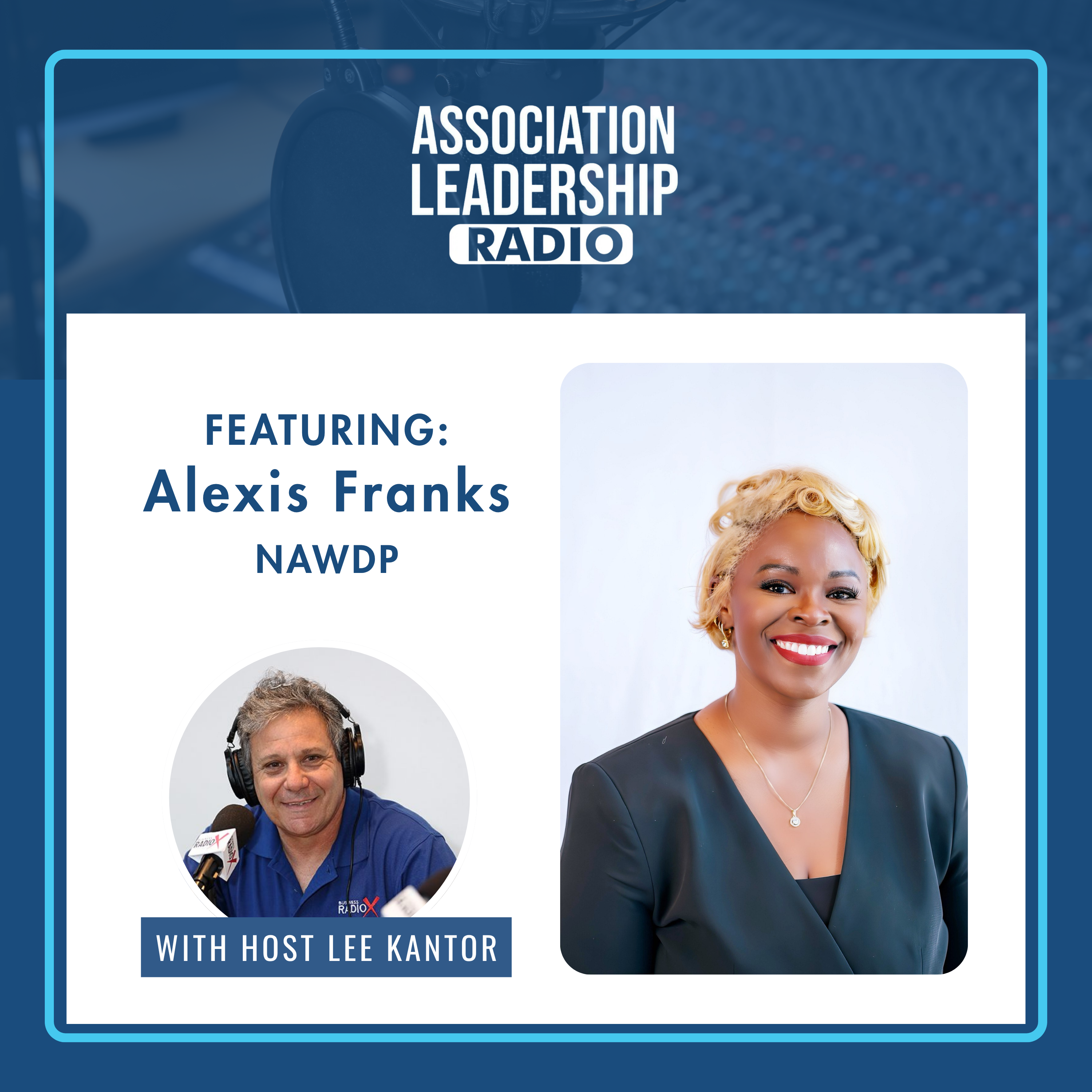

In this episode of Association Leadership Radio, Lee Kantor interviews Alexis Franks, Director of Membership at the National Association of Workforce Development Professionals (NAWDP). Alexis discusses NAWDP’s mission to connect workforce professionals, bridge the gap between job seekers and employers, and develop talent pipelines through partnerships with businesses, schools, and vocational programs. She highlights innovative youth apprenticeship initiatives, the importance of employer engagement, and the need to raise awareness about workforce development services available nationwide.
 Alexis Franks, Director of Membership with National Association of Workforce Development Professionals (NAWDP), has over a decade of experience in workforce development. Alexis has designed and implemented innovative programs for both youth and adult populations.
She has also played a key role in growing dynamic Business Services programs and strengthening connections between employers and the workforce. In her role at NAWDP, Alexis supports the needs of workforce professionals nationwide, enhancing membership engagement and ensuring that the organization continues to meet the evolving demands of the field.
She has also honed skills in managing membership programs, fostering collaboration, and driving organizational growth. Alexis is a Certified Workforce Development Professional (CWDP) with areas of expertise including managing programmatic performance, motivating teams to achieve impactful results, and empowering communities through workforce initiatives.
Connect with Alexis on LinkedIn.
Episode Highlights
- Mission and objectives of the National Association of Workforce Development Professionals (NAWDP)
- Role of workforce development professionals in connecting job seekers with employers
- Partnerships with employers, vocational organizations, and educational institutions
- Development of training programs and career pathways for youth and adults
- Importance of understanding employer needs and building talent pipelines
- Examples of successful workforce development initiatives and programs
- Engagement strategies for employers of various sizes in workforce development
- Support services offered to individuals seeking employment and skill development
- The significance of raising awareness about available workforce programs
- Collaboration with state and regional associations to share best practices and resources
 This transcript is machine transcribed by Sonix.
TRANSCRIPT
Intro: Broadcasting live from the Business RadioX studios in Atlanta, Georgia. It’s time for Association Leadership Radio. Now here’s your host.
Lee Kantor: Lee Kantor here another episode of Association Leadership Radio. And this is going to be a good one. Today on the show, we have Director of Membership with the National Association of Workforce Development Professionals, Alexis Franks. Welcome.
Alexis Franks: Hi. Thank you for having me.
Lee Kantor: Well, I’m so excited to learn what you’re up to. Tell us about your mission.
Alexis Franks: All right. So again, yes, my name is Alexis Franks. I’m with the National Association of Workforce Development Professionals. We call our association NAWDP for short. So you’ll hear me reference it as not up throughout our conversation today. And really what we do as an association is connect workforce development professionals. And what that means is we support the people and organizations that help individuals in their local communities gain skills and find employment to advance their careers. So whether they’re just starting off as youth or adults, that may be changing career fields or learning new skills, we support and workforce development programs support that learning and then connecting to employers after those skills have been gained.
Lee Kantor: So how do you work with employers, like how does that relationship go?
Alexis Franks: Awesome. That’s a great question. So many of our members include what we consider frontline career or workforce development specialists. On one side that work with individuals seeking careers. On the other side, we do have what we call business and industry services, and teams of individuals that connect with employers on a day to day basis to really understand what their needs are, where they looking to create a talent pipeline, whether that’s with human resources departments, with CEOs, with directors of any type of industry. We really try to seek to connect those individuals that have the skills and the employers that need the skills. So our business services teams of those programs that we support connect with employers on a day to day basis to really understand how we can support their growth.
Lee Kantor: So you’re kind of a bridge between the employees and the employers.
Alexis Franks: Absolutely. That’s a great way of putting it. We definitely try to bridge that gap and make sure that employers really have access to qualified workforce and talent.
Lee Kantor: So now how would this work? Kind of in a real life example. So like say there’s a manufacturer in a community and they’re like, you know what we need? You know, 100 more people with this specific skill. Do they let you know? And then maybe you work with some of the vocational organizations or some of the schools to say, hey, we need some people here. Why don’t we put together a curriculum that’s going to help, you know, fill that gap?
Alexis Franks: Well, that is a great example of some of the work that we try to support. Uh, many of our members operate in workforce programs in their local communities. So they’re really the front line and first point of contact for any employer that is looking for talent. Where we come in is we provide support through federal or state or local programing that offers those career services. So, um, many of the members that we have do operate this work in their communities, but they receive training for from us on how to operate those programs. So how are we really working with an individual to develop what their career pathway looks like? How do we assess what their need is, even if it’s not even just including workforce, there may be some other supports or services that they need. How do we prepare that individual to put them in front of an employer? Um, and then on the back end, how do we actually engage with employers to understand what their need is locally? But our members are doing this work on a day to day basis. We support how the program operates, um, and understanding how to meet those federal requirements or state and local requirements that come along with implementing a workforce program.
Lee Kantor: So now, in your role, uh, in membership, um, what is kind of a day in the life look like for you?
Alexis Franks: So that can be very busy from day to day. It really depends on where we are in our stream of program services. So we operate, um, three national conferences or our signature events each year. Um, we’re actually getting prepared to go to our youth symposium, that is a conference that we host each year that focuses on individuals that provide career services to the age range, typically between 16 and 24 year olds. So we know with that working with youth that may present a number of different challenges and barriers. Um, so we work with those professionals that provide services to youth to make sure that they understand how to approach a youth that may need some trauma informed care, um, that may need some mental health first aid services. And how do we provide those, even though our focus is getting an individual skills to become employed. How do we make sure that all of those things are offered? Those services are offered so that we can help an individual to be successful. Um, so in any day of the week, we are always preparing for our conferences. We have another a number of other virtual social sessions that we provide, um, as well, that typically just connect individuals to share best practices across the country. So those are some of the things that we look at as far as our programs on a day to day basis. And then our other membership benefits really happen authentically and organically on our online community as well. So we always have a number of different conversations of how are you providing this service to these individuals? Uh, and I like to see myself as that connector of resources. Um, we also offer our Certified Workforce Development Professional certificate. So at any time during the week, we’re also fielding questions and answering different, um, inquiries on how you can become a certified professional in this type of work as well. So again, very busy, but in a great way. Of course.
Lee Kantor: Now, you mentioned youth being one of the constituents that you’re serving it when you’re preparing, like I think you said, 16 to 20 4 or 26 somewhere in the, I guess, high school and a little older range. Are you, uh, helping them kind of find a path for themselves? And that might be college. It might be vocational. It might be maybe apprentice. Like, are there different kind of paths for that young person to go in, uh, based on what’s the best fit for themselves?
Alexis Franks: Yes, absolutely. And workforce programs try to seek to find what works best for each individual. So you typically come in to or receive services that start out with an assessment. Where are they now? What do they enjoy about school? Maybe some individuals enjoy math or history instead of science. And so, um, so we try to look at each individual based on what they feel their strengths are, and then try to seek to match skills that they already enjoy with what may be a career option. Um, many workforce programs already offer career exploration opportunities, so that may look like paid or unpaid internships or job shadowing. And as you mentioned, apprenticeship programs or pre-apprenticeship programs as well. Those are all opportunities that youth may need. Um, just to understand what career options are really out there for them. Uh, some youth may not be ready or prepared to enter a college or university and commit to four years worth of learning. So we try to make sure that we’re there exposed to all of the options. Maybe there’s a certificate program that can really open up their eyes to a career pathway. Um, so sometimes it takes having the conversation with that student or that youth to say, here’s what your options are. How can we choose what best works for you? And our conferences really focus around workshops and best practices on how you’re having those conversations, and really introducing youth to all of the options that may be presented to them.
Lee Kantor: Now, is your organization, um, kind of national, or do you have chapters in local markets or regional markets like, like how do you do like where are your boots on the ground?
Alexis Franks: So yes, we do. We do operate nationally, although our, um, home office and our headquarters is based out of Missouri. Uh, we have members from across the country and ten, uh, outside U.S. territories and other countries as well. So we do try to operate and pull in as many best practices from other workforce professionals across the country. Um, we do not offer currently chapters, but what we do is partner with state and regional associations in different parts of the country, um, that also offer these boots on the ground, um, outreach and programs to connect with individuals in their areas. Uh, so we have a number of partners that are, uh, all spread out, uh, really honestly, um, and associations of workforce boards, um, and other workforce development professionals, and we all stay connected. We are a very tight knit group of workforce professionals in general, but we want to share best practices as much as we can to make sure that individuals are really building for themselves a career pathway that works for them.
Lee Kantor: So would that work? Like if somebody in a state or a city is doing something that, uh, starts getting traction or they get good results, then that kind of program is, is then bubbled up to somebody in leadership, and then you try to kind of make other areas aware of how it’s working. So everybody can kind of quickly, uh, adjust and adapt based on kind of the new learning.
Alexis Franks: Yes, absolutely, absolutely. And there are some best practices that we find are shared successes, that we find that we definitely want to encourage other programs and communities to make scalable or to make work for them. One thing that we found with all workforce programs is they may look a little bit different, but at the foundation, our goal is to make sure that individuals can become employed and self-sufficient. So we try to seek new and innovative ways of offering those services all the time. Um, uh, and typically those best practices are not hard to implement. We just have to make sure that they’re done in a way that works locally, that meets the state or local community’s workforce needs. Um, but there’s so many things that are happening. It’s it’s almost like that, uh, quote that there’s really nothing new under the sun, but it’s really how we can implement those things in a way that works for the people that we serve every single day.
Lee Kantor: Now, is there a program or initiative that you’ve seen work that you were like, wow, this thing is really impactful, and you were able to kind of roll it out into to make a bigger impact. Is there something that you remember that you know, kind of stands out in your mind like, hey, we made this happen, and look at how many more people were able to help.
Alexis Franks: Absolutely, absolutely. And there’s so many different examples that come to mind. Uh, we recently had the opportunity to connect with, some programs in the Midwest and out West in Wisconsin, with a couple of groups out of Colorado. And what they’re really seeking to do is connect youth to a different type of learning that is almost an apprenticeship or pre-apprenticeship style of learning, but they’re really presented with an employer problem. Um, how can they increase their capacity for an employer to create or build new revenue? And a group of youth may be able to come together and they’re led by an adult, um, kind of coordinator of that work. Um, but they will seek to almost in a project based, project based learning, address that employer’s problem and provide solutions. So this isn’t necessarily your typical type of internship or pre-apprenticeship program, but what it does is allow youth the creativity to come together to solve an employer’s problem. And this is done. So providing a youth with incentives. So if he is a paid experience, but they’re actually operating as a junior board of directors on how they are addressing an employer’s problem so that that employer can continue to grow and sustain locally. Um, that type of model for us is really seen as a way of allowing youth not to just participate in a work based learning, but to really be creative in how they show their skills and what they’ve applied. Uh, from learning in, in the classroom for an employer. Um, so we’ve been able to see those examples really get their start, uh, and now working to see how other states can implement that type of learning for youth in their K-12 systems or even in their community college systems as well.
Lee Kantor: So what do you need more of? How can we help? Do you need more employers to kind of raise their hand and say, hey, we’d love to partner with you, or do you need more people in these local areas to, um, get more young people involved? Like what? What do you need more of? How can we help you?
Alexis Franks: So, uh, we would love actually the engagement of employers across the community. Now more than ever, as technology shifts and labor market needs shift, employers want need to be at the forefront of the conversation of what happens in workforce development programs. So we want to engage associations and other employers, large corporations, small businesses, all that have a need for developing a workforce talent pipeline to really engage with us to say, how can we help support you and your business needs? Um, we also need just the support of making sure that the word spreads about these programs. Um, and within our industry workforce is known as a well kept secret. And we don’t want it to be that way anymore. We want to spread the wealth and spread the word that we are here. And our workforce. Programs provide services, uh, that offer career readiness for any individual at all times. And many times, those services come to an individual and an employer at no cost. So we really want to make sure that we spread the word about workforce and what it means in our communities. Why it matters and really get individuals engaged. Um, the best way to do that. Uh, all across the nation, there are either what is called a one stop or career center in local communities. If there’s not one near you, we suggest that you look up the closest one and really and start start to engage with those one stops. America’s job centers or your local workforce development boards. That is the best way to support us as a national organization. We really want you to connect locally so we can share the wealth and build an even larger community of work ready talent.
Lee Kantor: And like you said, this is one of those things where there’s no risk or of any kind to just reach out and have a conversation. Like it may not work out, but there’s no reason to not at least know each other and see if there’s way explore ways to work together, because the upside is so big and the downside so minimal.
Alexis Franks: Absolutely, absolutely. And we try to provide them the best success that we know how. And really having just starting with a conversation, what are your needs? How can we help to support you whether you’re an individual or an organization or employer? We workforce programs are here to support in every way possible. And that conversation. You’re right. It can never hurt. And it helps to build the network, right? We want to continue to grow. Um, so we want to be a part of that network of support.
Lee Kantor: And that’s employers of any size, right? Like, you don’t care if there’s five employees or 500, right?
Alexis Franks: Absolutely, absolutely.
Lee Kantor: And then you work with business associations as well in local markets.
Alexis Franks: Yes, yes we do. And that is one of the areas that our we offer an annual business services academy. Um, so that is really where we try to engage with those business teams that are connecting with employer and industry on a day to day basis. A lot of our members do also include economic development or collaboratives and associations of industry partners. Uh, so we want to continue to grow our engagement there as well, for those employers to be able to understand how workforce programs can support them as well. So definitely engaging if you can’t with us, with your local business services teams through your workforce development boards. Um, and we’ll scale that up to see how we can get involved and support.
Lee Kantor: So that includes, like you said, economic development or chambers of commerce.
Alexis Franks: Absolutely, yes.
Lee Kantor: Well, Alexis, amazing work. You must be so. It must be so rewarding the impact you’re making in communities all over the places. It must be just really, you must sleep good at night.
Alexis Franks: Well, I sleep well, but I know that there’s still a lot of work to be done. Um, we’re we’re connecting in so many different areas, but we still have a number of individuals that are still seeking opportunities in areas to grow in their careers. So we know, yes, there’s great work happening, but we want to continue that that work and really help to see it grow. Um, so anything that we can do to support local employers or programs, and how you all can connect with us is really through our website at Newport. But we offer a lot of services and benefits just to be able to make sure that individuals and employers can grow. Um, so yes, definitely, we want to see that continue to happen.
Lee Kantor: And that’s north.
Alexis Franks: Yes, that is correct.
Lee Kantor: Well, Alexis, thank you so much for sharing your story today. You’re doing such important work and we appreciate you.
Alexis Franks: All right. Thank you so much for having me. We appreciate being a part of the show and really look forward to continuing to grow. Thank you.
Lee Kantor: All right. This is Lee Kantor. We’ll see you all next time on Association Leadership Radio.














