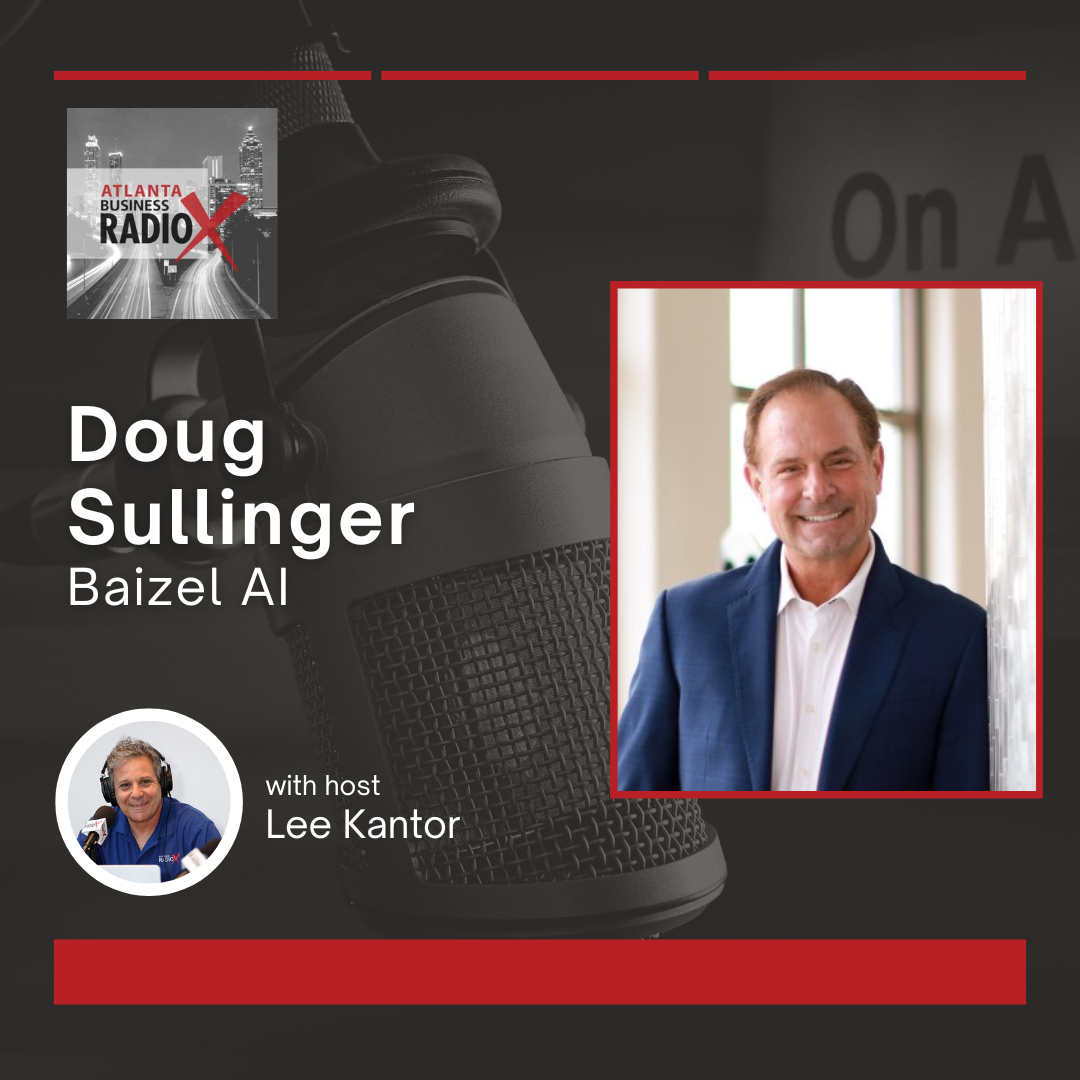

 In this episode of Atlanta Business Radio, Lee Kantor interviews Doug Sullinger, CEO and founder of Baizel AI. Sullinger explains how Baizel AI uses AI and large-scale property data to modernize commercial real estate site selection. The platform helps investors, brokers, developers, and franchise operators quickly evaluate any property across the U.S. by analyzing factors like traffic patterns, zoning, demographics, and nearby points of interest, then producing a feasibility score in minutes instead of weeks. Baizel AI is offered as a subscription service with a mobile app and includes support from real estate professionals. The company also provides free access to universities like Georgia Tech to train future industry professionals.

 Doug Sullinger is the Founder and CEO of Baizel AI, an AI-powered site selection platform transforming how commercial real estate decisions are made. Based in Tampa, Florida, he leads Baizel’s go-to-market strategy as the company defines a new category at the intersection of commercial real estate, artificial intelligence, and PropTech.
In addition to Baizel, Doug serves as Principal of Vendita, the parent company behind Vendita CRE, Vendita AI, and Vendita Digital. This integrated ecosystem provides Baizel with a unique advantage—acting as a real-time testing ground of brokers, operators, and data partners that continuously refine the platform against active deal flow.
His expertise spans AI-driven decision intelligence, commercial real estate strategy, and building scalable go-to-market infrastructure for vertical SaaS platforms.
He is particularly focused on helping businesses move faster and make more confident location decisions by replacing outdated processes with data-driven, AI-powered insights.
Connect with Doug on LinkedIn.
What You’ll Learn In This Episode
- How AI is transforming commercial real estate site selection and feasibility analysis
- Why traditional property research and evaluation can take weeks or months without AI
- The role of large-scale, cleaned datasets in producing reliable real estate insights
- How Baizel AI evaluates properties using factors like traffic, zoning, demographics, and location context
- How AI-generated scoring systems help investors and brokers compare and prioritize sites quickly
- Why data quality and structured models matter more than generic AI prompts in real-world applications
- How AI tools can help brokers and franchise operators make faster, more informed decisions
- The emerging use of AI in franchise expansion, engineering, and development planning
- How educational institutions are using AI tools to prepare future real estate professionals
- The broader shift from manual analysis to AI-assisted decision-making in commercial real estate
 This transcript is machine transcribed by Sonix.
TRANSCRIPT
Intro: Broadcasting live from the Business RadioX Studio in Atlanta, Georgia. It’s time for Atlanta Business Radio, brought to you by My Global Presence, the award winning Atlanta public relations agency that elevates brands and non-profits through authentic storytelling and national media campaigns. Find them at my global presence.com. Now, here’s your host.
Lee Kantor: Lee Kantor here, another episode of Atlanta Business Radio. And this is going to be a good one. But before we get started, it’s important to recognize our sponsor, My Global Presence. If you want global visibility and meaningful impact, go to my global presence.com. Today on the show, we have the CEO and founder of Baizel AI, Doug Sullinger. Welcome.
Doug Sullinger: Hey, Lee. Nice. Thank you.
Lee Kantor: Well, I’m excited to learn what you’re up to. Tell us a little bit about Baizel AI. How are you serving folks?
Doug Sullinger: Well, Baizel was the creation of myself as a technologist and my fiance as a commercial real estate broker. And it’s a really funny story. Several years ago, when I was moving out of the technology realm and trying to sort of retire out, we got together and we were sitting down and I said, you know, tell me more about this commercial real estate. How do you guys do this? And it seems like, you know, I’ve been working with the largest technology companies in the world. We’re implementing, you know, state of the art technology. My entire career working for companies like IBM, you know, companies like General Motors, things like that. And I said, so how does this whole how do you find properties? How do you find customers? Tell me about the business. And so she says, well, why don’t you come with me? And so we went and met with one of her developers and he was giving me all the parameters of, hey, I’m trying to invest in, you know, building out a gas station location or another guy was trying to build out like a multifamily. And he’s I said, so, well, that’s great. Well, how do you go find these properties? And we’re driving down the road. She says, look around. I said, what do you mean? Well, look around. This is how we find it. And I said, you can’t be serious. And so I started researching what was going on in commercial real estate and realized that there are at least 20 years behind most industries about where they are as far as adopting of any sort of technology. And this is about the time when we’re just really starting to talk about AI there in 2023. And I said, I think we can build something that can actually make a whole difference in this entire industry. So that’s what we’ve built, is an AI tool for site selection and analysis for the commercial real estate industry across the entire United States.
Lee Kantor: Now, when you say site selection, is it primarily where there’s already been a site or is it also include kind of raw land where it potentially could hold a site?
Doug Sullinger: Any, any piece of property. We have data on every property across the entire United States. So we’re not a listing agent. Like there’s like costar out there. We’re there to help the investor, the developer, the broker, an engineer, help them literally find the best locations for their particular investment. So an investor is going to go out and look at maybe traffic patterns. They’ll look at zoning, they’re going to look at different different elements around there. Maybe it could be how close a school is. You know, universities are a big thing for certain retail locations. They, you know, fit very well. So what we found is that they, these guys are out and they were putting all this information together and they would, you know, spend a month to three months actually putting all the data together. And they’re saying then it came to the end of that three months and they’d say, this isn’t going to work for my use. And I said, that’s insane. So we’ve built a technology that actually gives them analysis on that tool, on that property right away. So now they’re not spending three months. They’re literally spending 3 to 5 minutes on finding what works ideally for them.
Lee Kantor: So now commercial real estate obviously is a broad term and a broad field. Is this kind of have a best case scenario for certain niches within commercial real estate?
Doug Sullinger: No, it’s not a niche. I mean, any we can we can apply it towards any kind of particular use. It can be for retail, industrial, multifamily.
Lee Kantor: So it doesn’t matter. You can just adjust the variables and it’ll find what you’re looking for.
Doug Sullinger: Exactly, exactly. And we couldn’t do that before AI. That was the big difference. We could pull the data together. And I’ve worked my entire life in the data field. We could pull the data together and get it clean. And which is the most important part is where you start. But now with AI, it can actually analyze and determine, is this going to work for your particular use? And then we have a model that the AI hits up against and says, yeah, this is going to work best. This corner location is going to work very well for you for a gas station, or maybe this corner is going to work. You know, this other piece of property is going to work very well for a multifamily location. But the, you know, vice versa, if you go actually and look at that and say, well, I’m a multifamily builder and I found this piece of property, it don’t it may not work for my particular use. Our tool really gives you that analysis right up front and gives you a score of 1 to 100. So you don’t have to be an expert on every part of it. It can literally give you a feasibility report and say, this is how you get started with looking at a particular asset.
Lee Kantor: Now, you mentioned the gas station. Would it work for a franchise or could it determine like, okay, this spot would be good for a yoga studio, but it wouldn’t be good for a yogurt shop.
Doug Sullinger: Absolutely. Yeah. You could look at traffic patterns, income, things of that nature. We look at all those different factors that you would take into consideration. There’s about 150 different data sets that we actually look at to help make that decision.
Lee Kantor: So now once you kind of conceptualize this and then now obviously executed it, um, who were kind of the first, uh, kind of beta testers that actually put this to use. So you can see if it really was going to do the stuff you hoped it would.
Doug Sullinger: Well, you know, we’re also a broker, you know, we, you know, we, we’re broker, we’re very, you know, we have a lot of relationships with franchisees. So some of our first customers were, you know, a franchise franchise franchisees that are out there looking to say, hey, where should we put the ideal sites so that they can find the best sites for their franchisees to invest in? So that’s where we started, was in the franchise world. Then what was interesting to us, we moved into the engineering world. Um, engineers are always being approached after they’ve got gone through and looked at a piece of property. Now the developer or the. And, you know, the investor is going to go to the engineer and say, hey, can you put up a drawing? Start doing the due diligence on this property. They’ll spend five, $6,000 on that with our with Baizel. It’s a simple report and it’s a 500 $500 a month subscription. Now you’re saving yourself some real dollars.
Lee Kantor: And then so they would do this before they got the contract. Or is this like after the the people have already kind of committed. Now you got to figure out if it’s going to work.
Doug Sullinger: The way it works is we can literally go into a particular geographic area and we can say, type in, you know, let’s say we can go to Atlanta and say, give me the 20 best locations for a yogurt shop, and it’ll literally give you a 1 to 1, 1 to 20 score on the 20 best locations. So you haven’t even, you haven’t done anything other than just started to work with our tool. You haven’t even, we haven’t gone out to the internet other than coming to Baizel. You haven’t. You did not have to go out and drive the site. You know, you basically sat there and I kind of look at it as you can be literally sitting with our mobile app in a carpool lane, waiting for your children, and you can literally determine where the best location for that yogurt site is.
Lee Kantor: So like, that’s helpful for Franchiser, who maybe just sold us a territory in Iowa. And then they’re like, okay, here’s five recommendations for where the site should be.
Doug Sullinger: Exactly. And we do that a lot. We work with a lot of different franchises, uh, and, you know, franchisers and then helping their franchisees find the best locations and we can help all over the, all over the country. We don’t even a lot of times we don’t even see, we don’t even meet some of our people face to face. We do everything over the phone and through Zoom calls just like this.
Lee Kantor: So now how did did you kind of do any back testing to see if how accurate you are when it comes to predicting if sites are good or not?
Doug Sullinger: Um, we have done some testing on it. We’re starting to the main thing we started to do was testing the quality of our data. That was the first place. So that’s one of the things about a lot of your open AI models, like open AI cloud that’s out there, they’re going up and hitting against the internet, and there’s a lot of data out there that’s not very good. So we’ve been testing the quality of our data, and we feel that we’re within about 98% accuracy as far as what that actual property is. So if we’re that close as far as what that asset is, then it’s up to you as the investor to really decide, you know, the parameters are for making that the right location, right? Making the right selection. Now we have put our model in there and we’ve started to test our model. And everybody has a little different set of requirements. So it’s, it’s a, we kind of call it a college educated guess. This is going to be the best location. You still need to have the investors gut instinct to decide whether this is going to work for you or not.
Lee Kantor: Right. But when it comes to a recommendation, like if you’re saying this is the best, you know, McDonald’s site or chick fil A site. You can see if it would have picked that site, you know, in the past based on the same parameters. And then is it pulling the ones that are truly the top performers within that brand?
Doug Sullinger: It is. We don’t we can’t get brand. When you look into brands like that, they’re always looking for sales volumes. And that’s very hard data to get. So we can go back to the franchisee or the franchisee and the franchisor and say, hey, what are your best performing stores? And we’ll map that and say, here are the parameters for my best performing store. And then we can look at all the different data that we had around that particular store. And then we can go back and compare that to the new sites that we’re picking up today. So that’s how we do that by just comparing what was worked well in the past and what is now available for the future. And so we’re doing that. We’re starting to work on those metrics to determine we just don’t have enough data yet to really give you an accurate. Give you an exact accuracy on that. But we do look at all the different data sets that you would have that you would look at to make that selection. So that’s what we that’s where we start that with.
Lee Kantor: So when you brought this to the market, was this something there like, where have you been all my life? Or was this kind of a skepticism? Like what? How have they embraced this so far?
Doug Sullinger: You know, it’s it’s all over the board. Um, you’ve got, it’s this industry is, you know, a lot of the people in there, they’re, you know, they’re a little bit, you know, up there picking up technology. It’s like, hey, my dad didn’t need this. What really sold it to me was a good, good client of ours and a good friend of ours. He came to us and he saw our product built in different hotels, um, all throughout Southern Florida and things like that. And when we went through and showed him the tool, he said, this is exactly how I would do it. I was just doing on the back of a cocktail napkin. And he goes, I’d use my gut instinct to come up with the same, same solution. He goes. Maybe some of the factors that I think are important would be different, because maybe the next guy has other factors a little bit different. He goes. But the first time I showed it to a real good, a good, good client, you know, became one of our clients. When I first showed it to him, he said, this is exactly how I built it. The next gentleman, I took it to a Harvard graduate, of all people. When I showed it to him, he said, yep, this is how I would build the same thing. So we did that with several people when we were, you know, in early stages of the tool. And now it’s really just getting people adopting to the different AI tools. So when I say our competitors out there in the market are not other software companies like us, it’s really the open AI models. It’s like, how do we make, you know, you see all this noise about using AI, using Claude for your real estate or using ChatGPT for your real estate? That’s really the people that we kind of, you know, go up against as far as competitors. But when we That’s who we’re kind of fighting. It’s still trying to get the mindshare and getting people accepting the fact that AI is here and how to really utilize the AI tools.
Lee Kantor: So the biggest competitor is the do it Yourselfer, who thinks they can do the same thing just by popping into ChatGPT and putting in some, you know, creating an agent there.
Doug Sullinger: Yes, that would be our biggest one. And that’s not easy because I literally have at one point in time, we had up to 11 developers and.
Lee Kantor: Right. I mean, that seems like good luck. I mean, if you want to do that, that sounds like good luck, you know? Sounds good. Sounds good.
Doug Sullinger: Yeah. And basically what you’re getting when you look at Instagram and you see that all these, all your, all your buying from people saying, we can set up your real estate prompts, they’re just buying a series of prompts to guide the AI tool to be able to, you know, to guide Claude or, or, and guide ChatGPT. They’re just buying a series of prompts to say, hey, this will get you your answer. Well that’s great, but what if when that that knowledge or that person that sold you this problem goes away? What are you going to do? Right now, you got to become an AI expert, as well as being a financial expert as buying a capital raise person, as well as building the property, as willing to negotiate your franchise deals. You got a lot of hats you’re wearing. And now you got to add on being a technologist and figuring out how to develop with AI. Okay. Good luck.
Lee Kantor: Yeah. And also, this is a moment in time. I mean, tomorrow there’s going to be a new AI agent that does different things and yours isn’t going to work like it worked today. I mean, this does not feel like a do it yourself challenge. It sounds like somebody who has been there done that better be driving this car.
Doug Sullinger: Exactly. That what works here so well is that I have a whole I have, you know, I have 20 different, um, commercial real estate experts right outside my door. So I’m constantly going to them and asking, hey, is this type of information valuable? What can you do with this? Or I go to my existing customers and say, hey, we’re going to add this particular feature. This is what we can build with AI. And is this something of value to you? Most of the features that we’ve got built so far, it would take, it would take somebody at least two years to get this build out. And then the most important part, and I’m always going to stress this, it’s about the data, okay? If you don’t have good data, then you’re going to get garbage. It’s garbage in, garbage out. And so we’ve been made that as a very that’s a very key attribute of our, of our tool set. And that’s why we started measuring the quality of our data, because I don’t, because I believe that probably 70% of the data that you’re pulling from those chat GPT models, there’s going to be something wrong with it because it’s basically it’s human beings. Put that information out there. We’re taking it and cleansing it and matching it. And we’ve actually set our own data model and data sets together by pulling the 130 different data sets and actually matching that appropriately.
Doug Sullinger: So I use an example. You know, I live in Tampa, Florida. You know, I look at Tampa general, most of the data would call that a hospital here. Well guess what? If you go over to Orange County, go over to Orlando. They’re going to call that same facility a medical center. So you got to match that and put that together. So you can’t just go out and figure out how to, you know, put your cool, cool prompts together and then come up with a model. You know, that’s great. But then what are you going to run it up against? You’re still going to miss things. You’re going to get garbage responses or you’re going to get questionable stuff. And then then you’re looking at data coming from public public sources, right? Well, you still have public people. You know, you have the you still have people touching that data when they input it. So there’s always those types of things you got to work through to get the data right. But then you got to get the models correct so you can make that get your right decisions out of it. That’s why we saw we’re not just site selection. We really call ourselves site analysis. Will this work for your particular use? That’s what we want to answer.
Lee Kantor: Now, you mentioned franchisors. This would work, I would imagine, for the people building apartments or condos or things like that. Would it work for homes like if they’re building a development or is that a different animal?
Doug Sullinger: Yes, the same thing. We actually do have some home builders, large home builders that do that have used our tool for that. Um, they’re well known. Um, they’re, we’re under NDA with several of them, but yeah, we use that a lot and they’ll come in and they’ll go out and search the dirt that’s out there. And we even, we even provide the data of who owns that particular property as well. So you can take this, go out and search that and say, well, this is off market. Now. I can either call them myself or I can have somebody in my office call them and try to get that property freed up so that I can possibly build it myself, you know, build that before it even hits market in this particular here in Florida. And I’m not sure exactly how Atlanta is. We have a shortage of land down here. So you have to do that. Very few good deals ever hit. Hit the ever get listed. So most of its off market stuff.
Lee Kantor: So if you were to prioritize who the, um, you know, first clients for, uh, for you are, is what’s the order of priority?
Doug Sullinger: Um, our first client was, was a brokerage office and they had about 50 brokers. They were our first one. So that was really our first really, they, they really helped us prove out the value.
Lee Kantor: So commercial. So other commercial real estate brokerage firms are your first clients?
Doug Sullinger: Yes, they were our first ones. And then they and, and this was one of the exciting parts about it. They had some young brokers in there. And this is another issue within the commercial real estate space. When you’re a broker and you’re trying to get into this into this market, it may take you two years before you ever get your first commission. Well, we were able to give Baizel to one of their young, a couple, their young brokers, and within six months, the one gentleman had a $5 million deal. What. Baizel allowed him to do was having much better discussion with that investor that he was representing. So now he can talk about, you know, land use. He can talk about the traffic patterns. He can talk about how it’s permitted. He can talk about, hey, this is designed to be used this way. So and that’s all information that we provide. What is the potential use for that particular property. Now you’re talking the same language as your investor. And that’s why these when we have several young brokers that have literally been able to break into the, into the field and start making money within 9 to 12 months where they would have been, you know, they would have had to, you know, had to work with this master broker and take part of their commissions or they would have had to, you know, have somebody feed them or they, you know, they have to, they have to starve for two years before they start making money. But this, what Baizel does is really accelerates that knowledge for the younger brokers and younger people in the industry.
Lee Kantor: So what do you need more of? How can we help?
Doug Sullinger: We need users. We need knowledge. We need to get this out in the marketplace. We feel ourselves in the being in an analysis position. That’s where we just need we just get the word out there. And this is having conversations like this about how we’re trying to change the industry is very important to us. And, you know, one of the things that we’ve been able to do, and I’ve been a big, big supporter of this, we actually let universities, um, use our product for, for free. So the, um, Georgia Tech is they have a real estate group, um, that they, it’s, they’re part of, and then there’s about 400 members of them. So what we’ve done is actually given Baizel to them until they graduate. So now they’re able to go out and use that in the real estate clubs or use it for their courses and get, get knowledge about how to become a professional in the real estate space when they graduate, then they come to they actually then come over and buy Baizel, and they can have a head start into this industry and have a great career.
Lee Kantor: Well, congratulations on all the momentum. I mean, this seems like you have the right, uh, tool at the right time. So, uh, kudos to you for pulling this off. I mean, what you’ve done is not easy by any stretch. And, uh, best of luck moving forward. Is there a way if somebody wants to learn more, is there is it possible to kind of try it or is it you have, uh, it’s a subscription. How does it work?
Doug Sullinger: It’s a subscription. Um, you can come to us, come to basal.ai. It’s easy, easy to get access to it. You can buy it right there on the website. There’s a mobile version, which we feel we just released that we’re really excited that, uh, literally we just got our approval from Apple today, which is no easy feat. It took us about six months to do that. Now, Tim, I literally sent an email to Tim Cook directly. Didn’t get a response, but at least I sent an email to him, um, to help us get through that process. So, you know, that’s what you know right now you can go to basal.ai. We’re happy to get on the phone with you. Just give us a call and we’ll try it out. You know, tell us what you’re looking for and we’ll put it right on a Zoom call just like this or, you know, call like this and we’ll go through and we’ll show you exactly how the product works. And after you buy it, we actually give you a success manager that is a professional real estate broker. So you will always have that knowledge of how to transact along with that. So you can use our brokers or you can use your own brokers. Um, it’s up to you, but we will literally help you through the entire process after you sign up and become a client of ours and basal.ai, that’s where we are.
Lee Kantor: And that’s baizel.ai.
Doug Sullinger: Yes, it is just after we named it after Baizel Hayden. So, you know, we do have to give our bourbon friends some.
Lee Kantor: Well, Doug, thank you so much for sharing your story today. You’re doing such important work and we appreciate you.
Doug Sullinger: Great. Thank you. Lee.
Lee Kantor: All right. This is Lee Kantor. We’ll see you all next time on Atlanta Business Radio.















