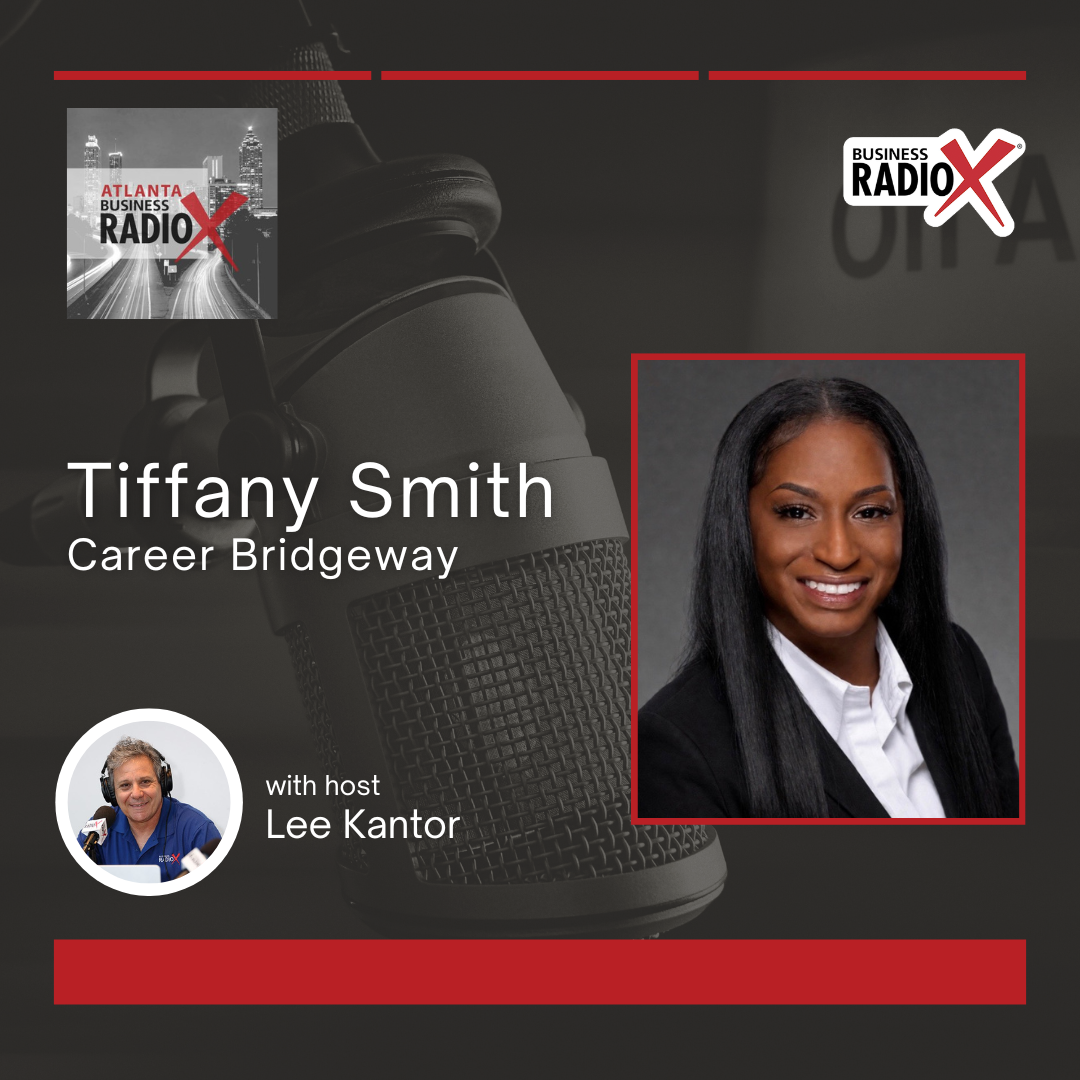

 In this episode of Atlanta Business Radio, Lee Kantor interviews Tiffany Smith of Career Bridgeway about closing Georgia’s workforce gap by connecting employers, job seekers, educational institutions, workforce organizations, and government partners. Tiffany explains how Career Bridgeway uses technology and AI to improve hiring transparency, identify skills gaps, protect job seekers from scams, and create stronger connections between employers and schools.

Tiffany Smith is a Workforce Innovation and Continuous Improvement Leader whose mission is to help strengthen Georgia’s workforce and drive economic growth through innovation.
She is the Founder of Career Bridgeway, a technology-driven workforce platform designed to bridge the gap between employers, job seekers, educators, workforce organizations, and economic development partners.
With more than a decade of experience leading operational excellence, business transformation, and workforce initiatives, she has helped organizations solve complex business challenges, improve organizational performance, and develop talent strategies that support long-term growth.
Her expertise in continuous improvement provides a unique perspective on one of Georgia’s most pressing challenges—building a workforce ecosystem that better aligns talent with employer demand.
Recognizing that today’s workforce challenges extend far beyond filling open positions, she founded Career Bridgeway to address hiring inefficiencies, employer transparency, ghost job postings, job scams, and the disconnect between workforce training and industry needs.
Her vision is to create a trusted workforce ecosystem where technology, collaboration, and transparency empower job seekers, strengthen employers, and support sustainable economic development.
She is passionate about helping position Georgia as the national model for workforce innovation by fostering stronger partnerships between business, education, government, and workforce organizations.
Through Career Bridgeway, she is working to redefine how talent and opportunity connect—creating a more transparent, trusted, and effective workforce ecosystem for Georgia’s future.
What You’ll Learn In This Episode
- Bridging the gap between employers and qualified job seekers
- Creating stronger partnerships between businesses and educational institutions
- Identifying and addressing workforce skills gaps
- Using AI to improve candidate matching and hiring efficiency
- Protecting job seekers from fraudulent job postings and scams
- Building talent pipelines through technical and educational programs
- Making hiring more transparent for both employers and candidates
- Addressing workforce challenges to support Georgia’s economic growth
 This transcript is machine transcribed by Sonix.
TRANSCRIPT
Intro: Broadcasting live from the Business RadioX Studio in Atlanta, Georgia. It’s time for Atlanta Business Radio, brought to you by My Global Presence. The award winning Atlanta public relations agency that elevates brands and non-profits through authentic storytelling and national media campaigns. Find them at myglobalpresence.com. Now, here’s your host.
Lee Kantor: Lee Kantor here, another episode of Atlanta Business Radio. And this is gonna be a good one. But before we get started, it’s important to recognize our sponsor, my Global Presence. If you want global visibility and meaningful impact, go to myglobalpresence.com. Today on Atlanta Business Radio, we have Tiffany Smith with Career Bridgeway. Welcome.
Tiffany Smith: Thank you, Lee, for having me today.
Lee Kantor: Well, I am excited to learn what you’re up to. Tell us about Career Bridgeway. How are you serving folks?
Tiffany Smith: Yes. So Career Bridgeway is a workforce ecosystem where we’re working to connect employers, job seekers, educators, workforce organizations, and government partners in a way that we can create greater transparency, trust, and opportunity. Our mission here at Career Bridgeway is to help bridge that workforce gap, that support economic growth, and make it easier for talent and opportunity to find each other in the state of Georgia.
Lee Kantor: So what’s your backstory? How’d you get involved in this line of work?
Tiffany Smith: I have a professional background in continuous improvement, so I work with a lot of fortune 500 companies here in the state of Georgia. And just during my career with working at continuous improvement and working with various companies. I, you know, just identify gaps during a hiring process. So that got me wanting to dig a little deeper and just develop career bridgeway.
Lee Kantor: So how does it work? So if I’m looking for a job, how do I connect with you and how do you help me? And if I’m an employer that needs employees, how do I connect with you and how do you serve me?
Tiffany Smith: Yes. So what we do is that we actually partner right now we’re going and we partner with different businesses and we’re actually have a candid conversations with them and asking them, you know, what are some of their hiring gaps? And instead of us just being a actual job board, we actually work with, you know, educational institutes, employers, and we help bridge that gap. So if you have a hiring need, we have that connection as far as with the universities we have on our platform. We have job seekers where we make the hiring process a little more transparent. The environment that we’re in today is that we see a gap where employers say they can’t find a qualified candidates. While we have job seekers telling us that they can’t find opportunities. While both can be true at the same time, when the system lacks transparency, trust and effective communication, we’re seeing like skills mismatches, outdated hiring processes, job scams, job postings, ghosting, job postings, and limited visibility into the employer expectation. So when they go on our platform, we actually, um, do a thorough looking at the candidate and matching them with the right employer. And so that way we’re helping bridging that gap.
Lee Kantor: So what types of employers do you work with? Is it primarily? Is there a certain industries that you work with a lot or is it anybody?
Tiffany Smith: So we’re actually doing a pilot now within our organization. So we’re got with manufacturing industries, healthcare industries, but we’re open to work with anyone that have, you know, those hiring needs and where we can fill in the gap and help them.
Lee Kantor: So if you’re a manufacturer listening and you are looking for employees, if they connect with you, you, you start to understand what type of employees they’re looking for. And then you help find those employees. Or do you work with kind of educational institutions to make sure that when they graduate, there’s a job for them?
Tiffany Smith: Yes. So we work with, um, institutions, uh, educational institutions. And what we do is that, um, we help when we have like someone that’s graduating, um, we look at their skill sets and we already have that relationship with the employer and kind of bridge them together where they’re actually finding, you know, the candidates that have the skill set that they need. Um, what we find out is that we have, um, a lot of these institutions, a lot of these workforce agencies, they working in silos instead of working together. Um, it can help bridge that workforce, um, system hiring system in the state of Georgia. So we just want to bridge that gap.
Lee Kantor: So now, um, are you working with universities or are they kind of vocational schools? What type of educational institutions do you normally partner with?
Tiffany Smith: So right now we’re partner with, um, Georgia Tech and we actually, um, partner with Georgia State. We are right now having conversations with, partnered with technical schools as well.
Lee Kantor: And then from their standpoint, they just kind of give you access to the students, or the student can decide if they want to kind of go through your program so that you can help them get a job when they graduate.
Tiffany Smith: Yes, absolutely. Um, by us having that, um, partnership with the, the universities and also where we’re looking at, um, having conversations with technical schools, you know, we have that inside that they would collect the data just to see what are some of the gaps that all these employers are having. So we’re actually feeding that information to the schools and letting them know that, okay, hey, these are some of the, um, the skill sets that are needed in the workforce. So that way when they have students coming to their institution, they can have that data say, okay, hey, these are the top skills that are hiring right now at an all time high, you know, kind of help guide them as far as, you know, hey, these are some of the skills they want to look at. So they have better opportunities of when they come out of school, they can have those chances of getting hired at certain employers here in the state of Georgia.
Lee Kantor: So you’re kind of that’s one of the ways you’re a bridge is you’re giving the educational institutions an idea of, hey, if you had a bunch of people who had this skill, then they’d be hired fast. So maybe you should add that to your curriculum.
Tiffany Smith: Yes, absolutely.
Lee Kantor: Now is there so you mentioned earlier that a lot of companies say they need people, and there’s a lot of people that say, I have those skills. Why is there kind of a disconnect right now? Why is the system not working properly right now?
Tiffany Smith: Well, for right now, um, what career Bridgeway is doing is that that makes us different from, um, a particular job board is that we’re actually partnered with, you know, a lot of companies and say, okay, hey, what exactly do you need? So that way when they put those positions on career Bridgeway, we’re making sure that, okay, hey, they have a defined explanation of what they’re actually looking for. What we identified is that, yeah, they’re hiring. They know. Okay, hey, I need a welder, but they’re not putting like, the right qualifications of what’s needed to make sure that they have once they come to the company, this candidate have the right skill sets. That’s one thing. Another thing is that, um, just a lot of these platforms, they not we have the technology within career Bridgeway is that we actually do a more, um, streamlined and thorough check to make sure that we’re matching, um, the job seeker with the right employer. So in our platform, when you go on, when a job seeker go on our platform. They not only just uploading a resume, we’re actually giving them a score to say, okay, hey, you have 57% chance that you might get hired. We’re recommend that, you know, hey, you go to this institution or these are some of the skill sets you’re lacking. So we help them, letting them know that, okay, hey, you may apply for this job, but just from what the employer is actually looking for and what, um, you don’t meet those requirements. So we’re kind of help guiding, um, the job seeker define work that actually matched their skills.
Lee Kantor: Right? Because a lot of times the job seeker thinks they just because they know whatever that topic is, they have the right skills, but the employer might be looking for something specific that they lack. And knowing that ahead of time, they can decide to get more training or whatever it takes to get, uh, the right qualifications in order to land the job.
Tiffany Smith: Yes. And that’s what we’re um. And that’s where the gap comes in that um, even even what’s going on now after we did like some beta testing, you know, they have AI and they’re just looking for these keywords and they go ahead and get sent to their employer. So we’re going beyond looking at some of the key words we have to actually building those relationships and helping them, you know, draft as far as like, what are some of the skill sets, asking the right questions behind the scenes to make sure that, okay, hey, you really know what you need an employer. So that way when we’re giving you candidates that we’re giving you quality candidates. So it shortened the time of when a job is posted on a different job board. Um, it just kind of narrowed that, that search and it helps them hire faster.
Lee Kantor: And also. So just by making it, like you said, more transparent, that way you’re managing the expectations of both sides. So the employee doesn’t get mad that they’re being ghosted. They just lack certain qualifications. And the employer’s not getting as frustrated because now they know they’re bringing in people that have the right skills.
Tiffany Smith: Yes. And another thing too, even with, you know, job scams, it’s just like we’re building those relationships because we, we also do something. This is where the trust comes in is because even before we work with an employer or before you can even post on career Bridgeway, we’re making sure that you’re a legitimate company. So that way when you come on our platform, you’re not, um, applying to a, a job that is, that is not actually a job. They’re actually trying to get information from you or are trying to do malicious stuff. So we’re protecting the job seeker as well.
Lee Kantor: Right? Because that’s happening all over the place, right? That’s why so many job seekers are so frustrated.
Tiffany Smith: Yes. Yes, definitely.
Lee Kantor: So if you were a job seeker, what are some of the things you would do to get hired as quickly as possible?
Tiffany Smith: So if I was a job seeker, I would make sure that I would actually, you know, read the job description carefully, look at all the skill sets that are needed. And, um, just really do like a self evaluation or yourself and just make sure that, you know, your chances are greater at getting connected to an employer. I know a lot of times we see job seekers, they just be like, okay, I just have, you know, um, a, a, I just dropped my, my resume so it can look good in order so I can get a call back. But in all actuality, that’s not only her and yourself, but it also frustrating on the business side too, because once they interview you, you don’t have those skill sets.
Lee Kantor: So how would you, um, how does your firm leverage technology right now? Are you using AI?
Tiffany Smith: Yes, we are using AI. So we’re using AI to actually identify those gaps where the job seeker does not have all the qualification. We also use AI to actually we’re doing everything on our end to make sure that every job posting is legitimate. But we also scan for, um, common words or common phrases that kind of makes us seem suspect that it’s not a legitimate job. So what we do is that instead of posting it on our platform, it goes to an internal review to make sure that everything gets posted on our platform. That is legitimate jobs that job seekers are applying for. So we use AI in various ways to make sure that we’re protecting the job seekers, but also we’re protecting the businesses to make sure that they’re getting quality candidates that are applying and that they’re interviewing.
Lee Kantor: Now, how do you feel about kind of is there any trends in Georgia that you’re seeing? Is this a good place to come if you’re from out of state? Should you be coming here to look for a job? Um, what, what is kind of your take on the, the workforce here in Georgia right now?
Tiffany Smith: Well, the workforce here constantly, um, currently in Georgia, there are employers that are actually hiring. So I would tell anyone that’s coming into the state of Georgia that’s looking for work, just to make sure that, um, you do have the skill set for any job that you’re applying for before you uproot it and made their move to come to Georgia. But there there are jobs. There are employees that are actually hiring. They just haven’t found quality candidates.
Lee Kantor: Now, does that are you kind of optimistic regarding people that are college educated versus people with, um, maybe only a high school diploma? Like, is there opportunity for everybody in Georgia.
Tiffany Smith: This opportunity for everyone? So now that a lot of, um, students that come out of high school, they’re actually going to trade school, so they’re not going to get a college degree. And there are a lot of, um, fields out here now that are all time high that are good wages that are, you know, just getting a trade. So and then even, you know, the college kids, um, I hear some of the college kids that, you know, they’re having issues with coming work, but what we’re finding work, But what I am identifying is that they’re having issues finding work because of that gap that we’re having. The universities are not talking to like the workforce agency. They’re not connected to the employers to try to help. Okay, hey, we got 300 graduates that’s coming out of this institution. Um, let’s partner, let’s have these relationships with these businesses. So when we say, okay, hey, we got 300 students. Um, in this graduating class, 75% of them have jobs. So we’re just having those connections and building those relationships with, you know, employers. That’s headquarters here in, in, in Georgia. Um, so their graduates can have jobs. And that’s what we’re lacking here.
Lee Kantor: Now, who is your client? Is, is everybody your client, the employer, the educational institution, the workforce Agency and the potential employee. Are those all potential clients for you?
Tiffany Smith: Right. Okay. So this is how we work. So our clients is, um, the employers and um, the job seekers. So the employers, they on our platform, um, the job seekers, we help guide them at no cost with, for them. Um, but there is a slight cost for the employers to kind of help them, you know, find talent. Um, um, but we do work with government officials looking at different programs, working with, um, the mayors and different cities and just see what they’re lacking. It’s no cost to them because we want to help make, um, Georgia, um, the state where, you know, hey, our hiring process, you know, economic development is thriving. We’re getting more businesses to come to the state of Georgia. But our main source of, um clients is the businesses in the state of Georgia.
Lee Kantor: Now, is there a story that you can share that illustrates how you work with your clients? Do you have a client? You don’t have to name the name of the company, but maybe share how the problem they had and how you were able to help them.
Tiffany Smith: Yeah. So I had a client that, um, would just have been, um, issues with um, hiring. Um, so we went in there and actually, um, did like a root cause as far as like why they kept getting the same type of, um, candidates that are applying for the job. But for one thing, they didn’t really, you know, line out as far as what their specific needs. Um, so we help them with that, um, connected them with, um, an institute here in the state of Georgia that actually, you know, have those skill sets and just connected them. And so they started, you know, working together. So long story short is that they started having like a pipeline of graduates coming from their technical institute, getting jobs at this employer. So now that what they started off as having a deficit of, um, welder skill sets, now they have all kind of welders coming, um, into the organization. So that is one success story that we have been seeing, but it’s just getting to the root cause of actually what you’re looking for and why you’ve been having these challenges. And then career Bridgeway, we go in there and just kind of help, um, address those challenges and help match you with the right institute, the right candidates and to get your business thriving.
Lee Kantor: So if somebody wants to learn more and, um, connect with you. Is there a website? What’s the best way to get Ahold of you and start one of these partnerships? Whether you’re an employer or an educational institution, a workforce agency or a candidate?
Tiffany Smith: Yes. So we do have a website is careerbridgeway.com. And also you can reach me at tsmith@careerbridgeway.com to learn more about the services and how we can partner with you and help you, um, get the, the candidates that you need at your organization. And also if you’re a job seeker, how we can help get you connected with the right employer.
Lee Kantor: Good stuff. Well, congratulations on all the success. You’re doing important work and we appreciate you.
Tiffany Smith: Oh, thank you so much.
Lee Kantor: All right, this Lee Kantor, we’ll see you all next time on Atlanta Business Radio.















