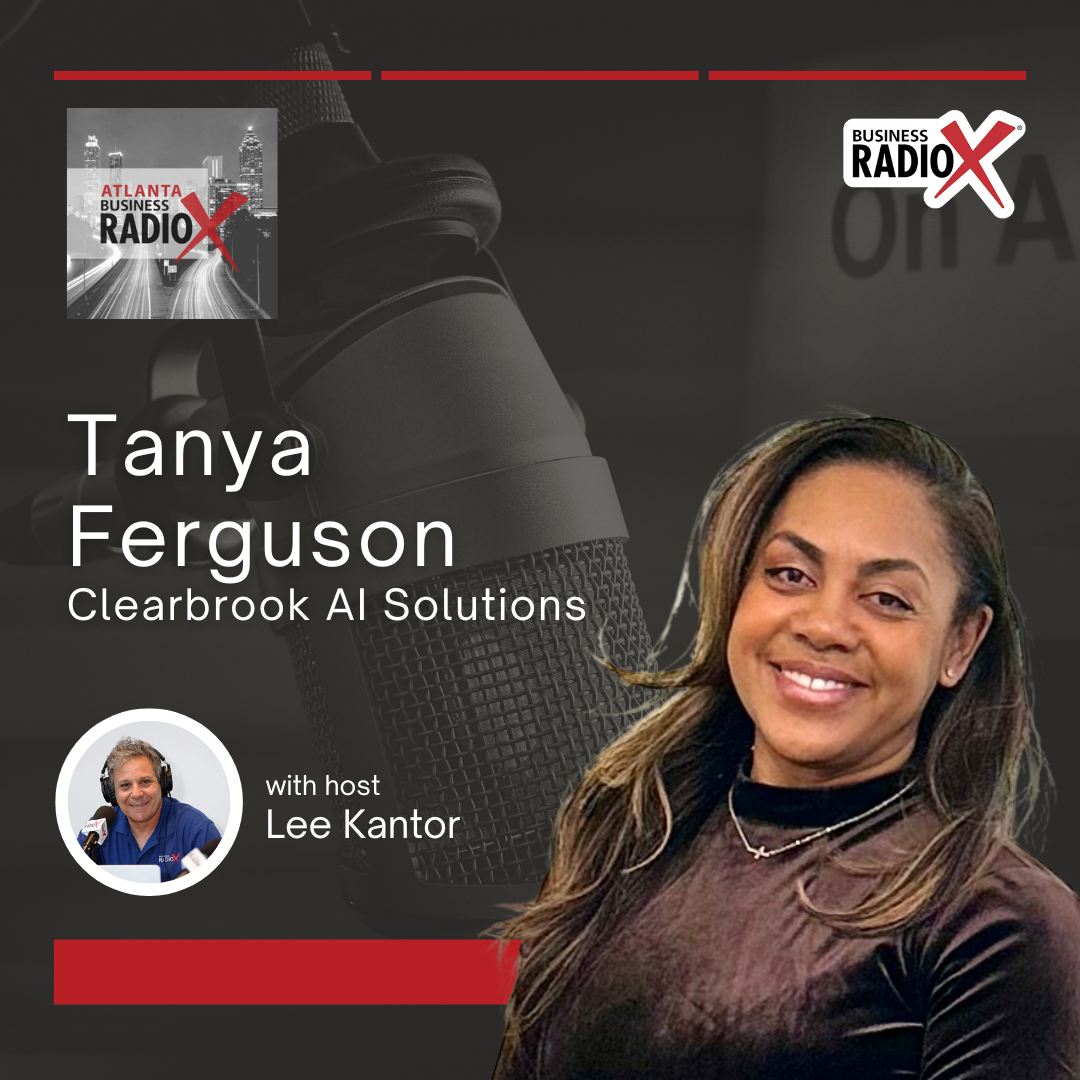

 In this episode of Atlanta Business Radio, Lee Kantor interviews Tanya Ferguson, owner of Clearbrook AI Solutions. Drawing on 20 years in the insurance industry, Tanya now helps small businesses identify operational inefficiencies and implement AI and automation solutions. She explains her “Save first, make second” philosophy, focusing on consolidating technology stacks and eliminating wasteful expenses. Tanya shares real-world examples, including saving a physical therapy client 30 hours weekly through automated scheduling and reactivating dormant customer lists for a fashion designer. She outlines her three-step process: audit, implementation, and maintenance, serving businesses with revenues between $300,000 and $10 million.

 Tanya Ferguson is the founder of Clearbrook AI Solutions, an Atlanta-based firm that helps insurance agency owners put AI to work in plain English — cutting costs and saving time without disrupting how their teams already operate. Over 15+ years in insurance and business leadership, she built revenue teams topping $40M and trained more than 500 six-figure agents before launching Clearbrook in 2026.
She was recently a featured guest on Pain to Performance, a top-100 Apple Business podcast, where she shared her human-first take on AI. Tanya’s focus: most owners don’t need more tools, they need their existing operation to run better.
Connect with Tanya on LinkedIn and Facebook.
What You’ll Learn In This Episode
- Importance of identifying operational inefficiencies in small businesses.
- Role of AI and automation in improving business efficiency and reducing costs.
- Background and transition of the speaker from the insurance industry to AI solutions.
- Challenges small businesses face with technology stacks and multiple subscriptions.
- Process of auditing and implementing AI solutions tailored to individual business needs.
- Real-life examples of how automation has saved time and increased revenue for clients.
- Financial structure of services offered, including audit, implementation, and maintenance.
- The speaker’s approach to working with small businesses across various industries.
- Advice for small business owners on starting to incorporate AI into their operations.
- Resources for learning more about AI solutions and connecting with the speaker.
 This transcript is machine transcribed by Sonix.
TRANSCRIPT
Intro: Broadcasting live from the Business RadioX Studio in Atlanta, Georgia. It’s time for Atlanta Business Radio, brought to you by My Global Presence. The award winning Atlanta public relations agency that elevates brands and non-profits through authentic storytelling and national media campaigns. Find them at my global presence.com. Now, here’s your host.
Lee Kantor: Lee Kantor here, another episode of Atlanta Business Radio, and this is gonna be a good one. But before we get started, it’s important to recognize our sponsor, My Global Presence. If you want global visibility and meaningful impact, go to my global presence.com. Today on the show, we have the owner of Clearbrook AI Solutions, Tanya Ferguson. Welcome.
Tanya Ferguson: Good morning. Good morning. I’m so happy to be here.
Lee Kantor: Well, I am excited.
Tanya Ferguson: To be able to talk to your audience.
Lee Kantor: Well, I’m excited to learn what you’re up to. Tell us about Clearbrook AI solutions. How are you serving folks?
Tanya Ferguson: Yes, well, I am serving purely the small business, which I absolutely love. And, and what we do is we really follow a money trail through the business operations. So we take a look at their people, their processes and their technology. And we find out through the course of, of running through that money trail, where’s money leaking out of their business? We use an opportunity to find those leaks. And when we find those leaks, we use AI and automation to fill in those gaps. So one of the things that I do a little bit different than maybe other consultants or others in this business, is that when I look at the structure of the business, the initial priority is to set a new foundation where it is running more efficiently and it’s running smoother with the automation kind of at its base. And then we start taking a look at revenue opportunities. So we like to say, say, say first, make second.
Lee Kantor: So what is your backstory? How did you get involved in this line of work?
Tanya Ferguson: Yeah. So I was 20 years in the insurance business. I went up the ranks and became a top producer. Really found my, my role of my niche in, in building other top producers. So I made hundreds of six figure earners and number one agents and built multi-million dollar teams over the years. And at the end of last year, November of last year, I stumbled into an AI tool that would help insurance agents train and learn through using the tool instead of always practicing on real people, live people. And I was very excited about what this thing was. And, and I kind of went into a rabbit hole of all of these things that this AI thing could help with. I wasn’t very familiar with it much before that, other than just kind of hearing it being thrown around. I talked to some of the owners and said, hey, there’s this thing here, and they seem to be interested but not excited about it. And from there I thought, well, I’m right. I think that there’s really something here, um, in this, in this AI world. And I, and I took the leap and I, and I started a company behind it. So I’m betting my career that I was right.
Lee Kantor: So now that you’ve kind of dug in and explored the world of AI and all the different tools that are available, um, how did you start kind of building out the systems that a small business person needs rather than like you found that, hey, I found this AI solution. And then, you know, a lot of business owners are like, oh, I found this AI thing. Oh, I’m going to buy that. And that’s 20 bucks a month. And then, oh, here’s another one. Oh, that’s another $10 a month. And all of a sudden you have a tech stack of, you know, 20, 50 different tools that you’re paying a small subscription on any given one of them. But they, it might be an overlapping, you know, things that they’re doing or it may not be working anymore. You don’t even know, like, how did you kind of build a system that is efficiently going to work for a small business owner?
Tanya Ferguson: Yeah. Well, I’m so glad you said that because this is my absolute favorite thing to talk about. Um, when you are running a business and, and, and your listeners know this, right? When you’re running a business, you’ve got time to run a business. Ai is moving at the speed of light. And so every day there’s a new tool, there’s a new, uh, this has come out, there’s an adjustment to the tool that was already here. And you can build tech stacks, like you said, of hundreds of dollars a month, sometimes thousands of dollars a month, and they all do all of these different things and they all overlap. And you don’t know what one thing is doing to the next. It’s kind of that shiny object thing. And so what my role really is, is to work with an owner and let them get back to doing the business of running their business. So when I come in, this is not about getting more tools. It’s not about adding to your stack. I want to come in and see what is your business actually doing? What do you need the business to actually do? And then from there, now I can see, okay, you have all these, these tools, do we even need them all? Sometimes we don’t.
Tanya Ferguson: Sometimes we can consolidate five tools into one. And at the end of the day, my, my clients, they always seem to have this sigh of relief that if I could figure out how to trademark that, I would. But they have this sigh of relief because they think, oh, okay, that’s all I need to do. So now I can just get back to work and what I can allow AI to do, which at its best in business, AI is invisible. It is working behind the scenes. It is just making things move. And so now you don’t have to. If you’re running a business, you should not have to stay on top of every new tool and every new thing and every new adjustment. You, you started a business because you were passionate about that thing. So what my role is, is I come in, I handle all of the, the things and the, the, the admin and the automations that AI can handle. And then I allow you to go be a human and go run your business.
Lee Kantor: Now, how does that work kind of in a real life scenario? Can you share what it’s like? Like, what is the pain that your client is having right before they hire you? And let’s walk through once they say, hey, Tonya, this is what I need. And then you start talking to me and walking me through how it’s going to really work in my business. So first off, let’s start with what’s that initial pain that the small business owners are dealing with?
Tanya Ferguson: Yeah. So the first thing that happens is always an interview, right? Because every business is different. And so I always interview the owner first, and then I interview any of their key employees. If they have a lot of different departments, just kind of the head of each department. And I want to find out what does the business look like from the vantage point of the owner, and then what does the business look like from the vantage point of everybody kind of boots on the ground? Once we have all of that, now we can figure out where is the pain in the business because sometimes, um, the owners don’t know, you know, they see the business one way, but their office manager sees the business a very different way. So a couple of real life examples. I have one client who, um, is in the physical therapy world. Wellness world. A lot of locations, a lot of, um, her schedule is different between each location. She’s got 4 or 5 different locations and they each do something a little bit different. So she was scheduling all of the appointments with her clients manually. So every time they needed a spot, she would, they would call or they would text and they would kind of have this back and forth, um, text happening in order to get her schedule filled up. Well, sometimes she’s with a patient, right? So she’s working so she can’t take the call, she can’t take the email and it would sit for hours or it would sit for a day before she could get back to them.
Tanya Ferguson: And all of this was costing her time was costing her business. We were able to just take all of those calendars, take all of the different times, take all of the locations, and we were able to put it into one place where now the clients can just go through and do it themselves. It saved this client 30 hours a week in time just by by doing that. Now, that may sound very simple and very boring, and I really hate to break it to everybody, but that’s all this is. It’s a really simple, really boring part of your business that saves you a ton of time and a ton of money. Uh, another client had a list that she’s been in business, she’s a fashion designer, been in business a long time, and she’s got this list. She’s got loyalty points and things like that that nobody knows how to track. She has a list of people she hasn’t reached, she has a loyal base, but then a number or percentage of people that have never come back and they just don’t know. So we have a program called Dust of Dollars, where we go back and we just reactivate that whole list through a sequence of, um, of, of touch points. And now that has come back and has flooded her business. So these are very simple, very small, very quote unquote boring parts of the business that put a ton that save you a ton of time and put a ton of revenue back into your business.
Lee Kantor: So now how does this work from a financial standpoint in terms of the client and you? Is this something that I’m just hiring you as a consultant to fix my calendar problem, and then you fix it and then I pay you a fee and then we’re done. Or is this something that I’m, that you’re a new subscription that I have that I have a clear Brook subscription, and then I’m paying you on a regular basis to either do new things or maintain the ones you just built.
Tanya Ferguson: Yes. So there’s kind of a three step process. So the first step is we have that interview and that’s just the audit, right? So that that is a an initial part of our business. It’s the audit. You have all the information in detail. You can take that and you can take it wherever you want to implement it. The second part is implementation. If you decide to work with us and have us implement all of these tools, then now we’re a part of the process of actually restructuring your business. So so that is the implementation role. Yes, there is a maintenance fee afterwards. It’s minimal, it’s small. But in the world of AI, because it does move so quickly, if there is a change or anything that is modified, we want to be able to do it quickly. And and the best way to do that is for me to actually have kind of a foot still in, in the door. Um, I will say that of the clients that we’ve had, we have been able to either consolidate or eliminate the tech stacks, uh, a lot of the tech stack. So adding that as a, as a maintenance fee, I mean, you can opt out, but I absolutely would not because that allows us to get in and to keep your business, um, the most current.
Lee Kantor: Now I would imagine for some firms, if you keep doing this and you just start kind of adding different tasks and maybe automating different areas of my business, you become kind of my operations manager.
Tanya Ferguson: So there’s a little bit of operations manager in there, but I wouldn’t call it a role in the business, because what we have actually found is that your operations managers, the humans that are in your office, they need this because what you don’t see as the owner is that because your operations manager is so good, they’re working really hard and they’re getting extra things put on their plate. And because they’re hard workers, they’re just absorbing all of this additional stuff where, quite frankly, they had a main job. They they keep the business going as well. And all of this additional stuff is all stuff that they created on the side. They have folders that just have names on it that they keep track of. They have sticky notes over here. So when I have talked to office managers, it’s funny because initially when I go in, they are very nervous to talk to me. I find that they get very they’re just a little bit skittish. They don’t know what’s going on. And by the end of the conversation, they are just as excited as the owner because they realize, you know what, I need to work. But some of this stuff is holding me down too. So if you can get some of those things off my plate, then I can go and actually handle the real roles of my job. So I have not found an issue where, um, you know, I have entered into their company as the operations manager. That that seems to be just fine with whoever you’ve hired.
Lee Kantor: So you’re like the operations manager’s best friend.
Tanya Ferguson: I’m their best friend. I’m gonna rename myself that now. I’m the operation manager’s best friend.
Lee Kantor: So now do you have a niche like you mentioned, a strong background in insurance, but now you’ve said that some of the examples you shared weren’t in insurance. Is there a size of a company or an amount of sales or the number of employees? Like, what’s the best fit client for you?
Tanya Ferguson: Yeah. So it’s funny how business works, right? I had initially jumped into this and said, I’m just going to work with insurance agencies. Um, and then I started getting phone calls from so many different industries needing help. And I was able to help them and they were giving me that, that sigh of relief that, that I have kind of grown to love now. And so what I’ve realized is I don’t have a niche with regard to industry. Um, so I didn’t get bigger, but I got wider. I am firmly in the small business market. So our average is probably 300,000 to 3 million. Um, our range Probably tops out at about 8 to 10 million. Um, anything beyond that, um, is, is, is, is another world and is, is somebody else’s to help. I really love being able to look at, um, my owner or look at the founder that I’m working with that has been doing this and has their business and loves their business and is drowning and I’m able to come in and see, uh, immediate help and immediate movement. So, uh, so I am firmly in the small business, but I’m across all industries.
Lee Kantor: And is there any advice you would give folks who may not be ready for you just yet? Um, on how to handle kind of AI in their business? Like what are some baby steps they could take to, um, you know, at least kind of get their toe in the water here a little bit and get comfortable with AI.
Tanya Ferguson: Yeah. You know, anything that AI can do, you can do manually, Right. Ai just kind of steps in and it takes the manual part out. And that automation just means that you do it over and over again. So when it comes to the program, like dust for dollars where we’re re-activating, um, old leads, you can do that. So if you have an old list of clients that you think are dead or cold or archived, go back through that, that list, email them, say hello, send a text, you know, make a phone call. So these things that these, these are still business things. Um, AI just comes in and makes them a little bit easier. So you can do that manually. If you want to step into the world of AI and take whatever tool you have, take whatever tool you like, whether it’s ChatGPT or Claude or any of any of the others. And, and just upload it and just ask the system, hey, can you send, can you generate a message for me where I can reengage. Um. These clients. Can you send a message, uh, to this list of people for me? So just start very, very small. Anything that you do really well, um, manually start with that task and then just ask the system, hey, I’m doing it this way. Can you just scale this? Can you just do it on a bigger scale for me, if you start very small, um, AI is very good at talking back with you to kind of walk you through the steps.
Lee Kantor: Now, is this something that, um, if you’re new to this, do you have to buy the paid version of any of these, uh, AI or is it something that you can at least try the, try it with the free version.
Tanya Ferguson: You can try on free versions, you can try free version once you start to pay, um, for any of the tools you’re doing a lot, uh, you’re doing a lot in there so you can take advantage of the free versions for sure.
Lee Kantor: Now, if somebody wants to learn more about Clearbrook, what is the website? What is the best way to connect?
Tanya Ferguson: Yeah, best way to connect and go to my website is Clearbrook AI solutions.com. Um, you can find me on LinkedIn under my name, Tanya Ferguson. You can find me on, uh, on Instagram through my name, Tanya Ferguson. Um, enterprise mommy is also at on on Instagram, but, um, I’m everywhere. I don’t know if I can leave phone numbers or anything here, but they can definitely reach out. Um, in, in any of those, any of those platforms for anybody that needs help.
Lee Kantor: Well, Tanya, thank you so much for sharing your story today. You’re doing such important work and we appreciate you.
Tanya Ferguson: Thank you so much. And thank you to everybody listening.
Lee Kantor: All right. This is Lee Kantor. We’ll see you all next time on Atlanta Business Radio.















