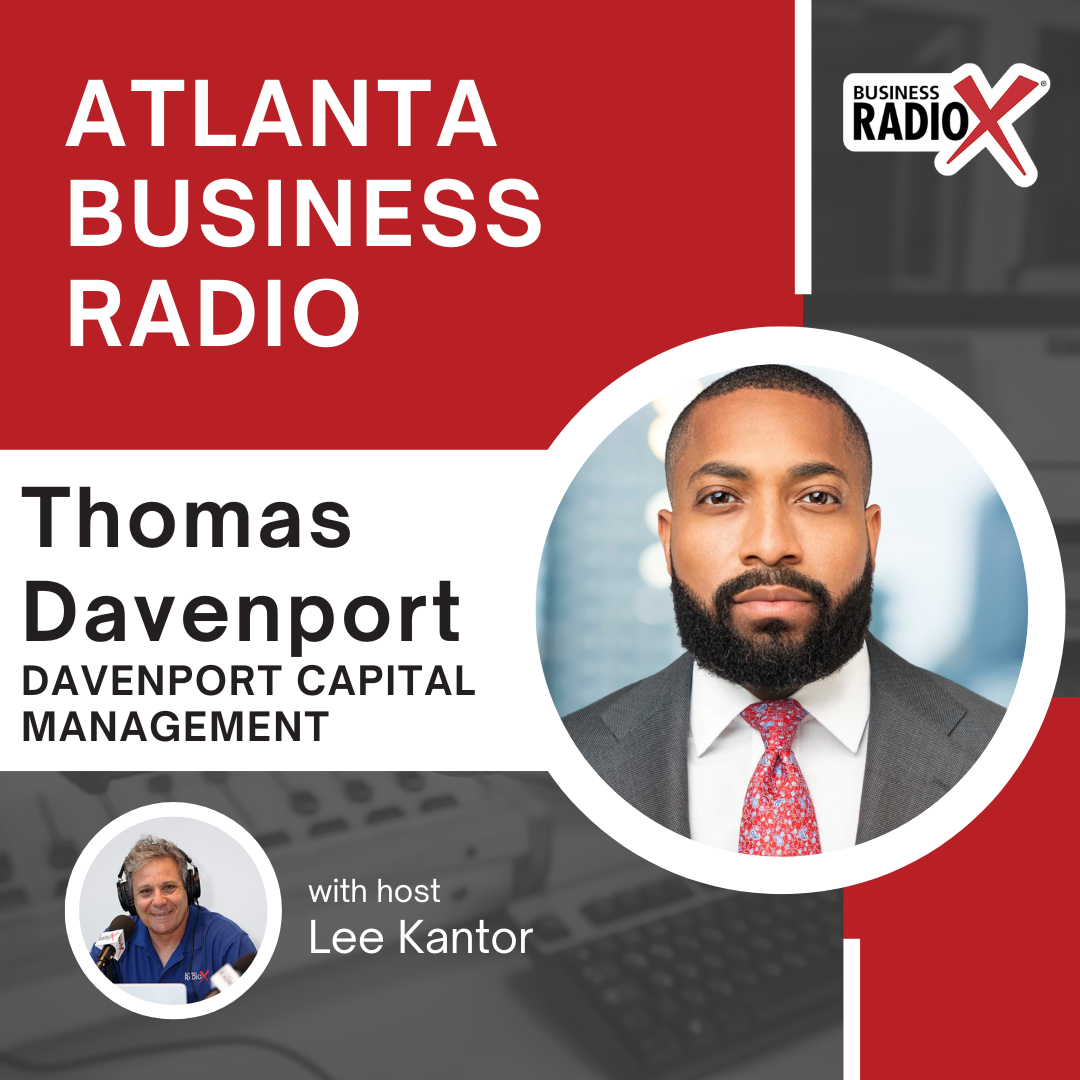

 In this episode of Atlanta Business Radio, Lee interviews Thomas Davenport, Managing Partner at Davenport Capital Management. Thomas discusses his firm’s patient capital approach to investing in privately held companies, focusing on long-term value and partnership rather than quick exits. He shares insights on selecting high-integrity management teams, the importance of cultural fit, and best practices for business growth. The conversation highlights Davenport Capital’s commitment to supporting family-owned businesses through thoughtful transitions, sustainable growth, and collaborative relationships, offering a compelling alternative to traditional private equity models.

 Thomas Davenport is an entrepreneur, operator, and board member focused on building and overseeing businesses in manufacturing and commercial services.
He is the Managing Partner of Davenport Capital Management (DCM), a private holding company that owns a portfolio of operating companies across infrastructure, industrial services, and manufacturing.
DCM’s portfolio includes Direct Services Group, a technical infrastructure services company supporting telecommunications and energy networks; Steeltoe Advisory, an industrial-focused investment banking and advisory business; and Shakespeare Company, a materials science and specialty manufacturing company. Thomas serves on the board of each of the portfolio companies.
His work centers on leadership, execution, and long-term value creation.
Connect with Thomas on LinkedIn.
What You’ll Learn In This Episode
- Davenport Capital Management’s patient capital strategy for investing in privately held companies.
- The contrast between patient capital and traditional private equity approaches focused on quick exits.
- Importance of integrity, management quality, and cultural fit in investment decisions.
- Thomas Davenport’s background in investment banking and its influence on his investment philosophy.
- Criteria for selecting companies to invest in, including management integrity and business potential.
- The significance of thorough due diligence and post-acquisition planning.
- The role of cultural alignment in fostering successful partnerships with businesses.
- Strategies for sourcing investment opportunities and building relationships with potential sellers.
- Best practices for growing businesses, including the importance of listening and understanding employee dynamics.
- The benefits of a mindful, planned sale versus urgent transactions for business owners.
 This transcript is machine transcribed by Sonix.
TRANSCRIPT
Intro: Broadcasting live from the Business RadioX studio in Atlanta, Georgia. It’s time for Atlanta Business Radio, brought to you by Kennesaw State University’s Executive MBA program. The accelerated degree program for working professionals looking to advance their career and enhance their leadership skills. And now here’s your host.
Lee Kantor: Lee Kantor here, another episode of Atlanta Business Radio. And this is going to be a good one. But before we get started, it’s important to recognize our sponsor, CSU’s executive MBA program. Without them, we couldn’t be sharing these important stories. Today on the show, we have the managing partner with Davenport Capital Management, Thomas Davenport. Welcome.
Thomas Davenport: Thank you.
Lee Kantor: Well, I’m excited to learn what you’re up to. Tell us about Davenport Capital Management. How are you serving, folks?
Thomas Davenport: Sure. So Davenport Capital Management is a holding company, and we invest similar to private equity, where we are buying companies that are privately held and implementing a value creation strategy to help grow those businesses, implement technological improvements and, you know, get a return for ourselves or our shareholders as we think about exiting. But being a holding company, there are opportunities in businesses where if it aligns appropriately, we don’t have to exit and we can keep those companies in perpetuity.
Lee Kantor: So is that a difference between what you do in a private equity firm, like a private equity firm is looking to exit?
Thomas Davenport: Correct. That that is a differentiator. And, you know, we everyone says that they have patient capital. But we’re you know, we’re walking walking the talk if you will.
Lee Kantor: So what’s your backstory? How’d you get involved in this line of work?
Thomas Davenport: Sure. So I grew up as a financial services professional and spent some time in New York on Wall Street as an investment banker, covering the types of companies that I work with daily. So I was in what they called an industrials investment banker. So I focused on manufacturing and distribution businesses as well as commercial services. So think kind of blue collar services. And those are those are the types of businesses and operators that we partner with in our day to day lives.
Lee Kantor: So what got you interested in that niche? I mean, what what about it kind of drew you to that?
Thomas Davenport: You know, for me, you know, when you’re when you’re going through the recruiting process that is investment banking, you know, it always comes up, you know, what are you you know, what sectors do you want to focus in. And for me, I like tangible assets I like companies that are making widgets, I like touring plants and facilities. I like thinking about line optimization. And so it, you know, the manufacturing space and space and the services ecosystem just resonates well with me. And I think it’s because I grew up where my, my dad actually was responsible for, for building post offices. And so he did a lot of infrastructure work. And I kind of gleaned some of the things from him about his day to day work. And then my mom is a financial services professional, so I kind of just blended, I guess, the elements of the two of them to, to formulate my own path.
Lee Kantor: So when you went out on your own and you were going to be the one making the investment in these organizations, what had you learned? That kind of gives you an edge to determine, okay, I should invest in this one, but not this one. Like, are there things you look for or are the red flags green flags? Like what? What is kind of gets on your radar or something positive and also what’s on your radar as a potential negative.
Thomas Davenport: So I think foundationally when I got into the investment banking business, my first clients out of business school were family offices. And so family offices look and feel like private equity at the larger levels. But again, they have kind of that patient capital. And in advising those companies I got to meet a number of managers. Um, and we you know, when you’re going through an M&A transaction, you’re spending a lot of time with these folks. Uh, and, you know, they would kind of tell me stories or give me lessons learned. And so I think that helped me develop, um, some instinct and intuition around what, what our red flags and what does good look like. And then so if you were to say, what what are we looking for? We want to be the first, uh, outside capital provider into a company. Um, we’re looking for businesses that have high integrity management teams, folks going through some type of inflection point, whether that’s succession planning, um, absentee ownership or some catalyst for why they need to find a new sponsor or need to exit the business. Uh, and we spend a lot of time with these management teams while we’re diligence ING the business, but also kind of looking towards the post close future with kind of our 100 day plan and, um, and our value creation exercise on the back end. And so it’s a lot, of, lot of legwork around, can I see myself working with these folks every day? Uh, one so call it they call it the airplane test. But two, you know what? What are the the growth levers that we can augment? And does it align well with, with our capabilities and our Rolodex and and our track record of, of growing and building businesses.
Lee Kantor: Now, you mentioned a couple times this, um, kind of patient investing style. Why do you see that as advantageous? Uh, rather than go to the private equity route where they are looking to exit after a fairly short period of time.
Thomas Davenport: I think for a lot of owner entrepreneurs, they they may be, you know, first, second or third generation business owners, and they’ve been pillars in their community and they’ve been a job creator and a job provider. Um, and so being in a situation where we’re patient and where we’re willing to kind of pay a fair value, but we’re, you know, we don’t want to over lever the business or we don’t want to come in and put too much debt in or strip it apart. That’s not our play. Um, that resonates well with folks that are thinking about the legacy and the continuity for their employees on the back end. And so the ability to to walk into a situation, evaluate and be thoughtful about your, your systematic change, um, tends to resonate really well with, with owner entrepreneurs. And to the extent they end up staying with us post transition, which often happens a year or two post close. We will work with with the seller, um, to truly transition the business. Um, just making sure that we’re going to be a thoughtful partner, um, in our evaluation of the business, but also in our, in our desires to kind of move processes and implement our own thoughts going forward so that that patient just seems to want to think it bodes well for really good decisions. But two, um, it aligns well with seller expectations around who’s here, who’s care. They’re going to entrust their business to post close.
Lee Kantor: Now I can definitely see how, uh, the person selling the business to you would appreciate that, because they don’t want to be another one of the horror stories of, you know, a company that just ladled with debt and then, you know, sold for parts a few years later. But why? Why did you choose to go the path you’ve gone? It sounds like that, that that culture and values are important to you. Like you weren’t looking at this as just a transactional, you know, way to make money. Um, just by, you know, kind of buying and selling and flipping a business.
Thomas Davenport: Correct. Yeah. I think the, the folks that I worked with early in my career and what I admired is that they were able to take companies and have them in kind of in the family business for, you know, a decade plus. Um, and that was really attractive just to see how they, they had evolved their holdings over time. Um, and I think, you know, from a, from a job creation and, you know, I also have a background in public policy. Um, you know, I think we’re we’re kind of doing our part as well in terms of contributing to the economy, upskilling employees and and making sure that in this in what is kind of an uncertain landscape in front of us, with all the technology advancements, that there’s good folks at the table helping create value and having respect and and reverence for for the people that do do create that value.
Lee Kantor: Now, in the industry that you’re in, um, what percent take the tact that you take versus the private equity kind of flip a business tact. Are you in the minority or do more?
Thomas Davenport: Yeah, I would say we’re in the minority. I think there’s there’s there’s a lot of pressure, um, from from the allocators to find teams that can go in, create value. And it has its place. I mean, that there’s they’re serving a need as well. But, you know, we’re looking to, to, to align with and partner with sellers, um, more so than kind of come in and and tell them everything was wrong and, and change everything up. But and certainly not to vilify or demonize other participants in, in the buyout space. There’s a lot of great folks. Um, But we just we found attacked. Uh, it seems to work. It seems to resonate. And so we continue to move forward.
Lee Kantor: Do you see more firms, uh, kind of going the way that you’re going or, like, is this a trend now or is this something are you kind of a contrarian?
Thomas Davenport: Uh, you know, I think we are. I think there is a trend. I think there’s, you know, anywhere you can make a profit, there’ll be folks to follow. Um, but I think this is something that I saw 20 years ago when I got into the business. And, you know, I’m kind of following in the footsteps of folks that I’ve personally admired and companies that I’ve seen grow and execute well. So.
Lee Kantor: So what if a private equity person was here? What would they say that to say? Oh, Thomas, that’s not how to do this. This. You’re doing it wrong. Like, this is like, what is the what is how are they seeing things so differently than you’re seeing them?
Thomas Davenport: Different incentives. You know, we’re we’re investing our own capital. And then I’m also aligning with and I’m aligning candidly with some private equity firms that that view the world similarly to us. Right. They do they do take a patient tack. They they are thoughtful about the, the, you know, GPS or holding companies or folks that they’re other investors they’re working with. Um, so there are people in the industry that definitely align with us. If someone was a little different than us, then they may say, look, we’ve got, you know, capital that’s been allocated to us. Um, we can be more aggressive because we’re time bound. Uh, and, you know, being more aggressive could end up being a better price for the seller, right? So the seller could walk away with with more cash at close than maybe what we’re looking to do, because we really seek alignment from from sellers. And that could be alignment, could be staying on in the business alignment could be, um, rolling equity. It could be, you know, helping us with some seller financing. Um, and so, you know, if you want a all cash deal and, you know, take it and run. We’re we’re probably not your partner, but there are enough participants in the, in the markets that you can probably find that partner if you got a good business.
Lee Kantor: Now, when you’re choosing which companies to partner with, um, are they typically coming to you or are you finding them and then saying, hey, you know, is it time to think about a transition? Like, like who is courting who?
Thomas Davenport: Uh, it’s a bit of a mix, probably 80 over 20. We’re courting the company versus them courting us. But there are times where I might get a center of influence. Maybe their attorney calls me and says, hey, I’ve got a situation that you you should look at. Um, so, you know, usually attorneys, accountants, other trusted That advisers may may knock on our door and show us opportunities. We see quite a bit from the investment banking firms around the country. And so there, you know, we’ve been doing this long enough that we get inbound deal flow. And then, you know, I attend a lot of trade shows for our portfolio companies. And so just in the natural ecosystem of meeting other operators that can spark, uh, opportunities and conversations around acquisition.
Lee Kantor: So what type of activity should a leader of one of these companies be doing to catch your eye? Like what? What are you looking for? Um, you know, when you are on the lookout for the next opportunity, what are some of the things they could be doing that you might perk up and say, hey, maybe we should check these guys out.
Thomas Davenport: Uh, you know, I think, you know, at the core for us is high integrity management team. So operating your business in a, in a, in a fashion that, that is, that is rigorous and credible, and and you’re following the rules. Um, I think that’s foundational. And then the other piece is, you know, we’re looking for companies typically that have diversified customer base, um, long standing relationships, um, some, some level of secret sauce or some edge in the marketplace. Um, and, and then the other piece is just, you know, as we meet folks through trade shows or, um, or find folks through centers of influence, um, being open to a conversation and being candid, um, you know, we’re we’re not going to abscond with the company. And we’re also not afraid of warts. I mean, privately held businesses do a lot of great things and do a lot of great things well, and there are some things that require some improvement or need a different perspective to, to help it execute efficiently. And I think that’s where we think we offer value. Uh, so we’re not afraid to have the tough conversations. We’re not afraid to talk about the deficiencies in the business.
Lee Kantor: Now, is there a story you can share? You don’t have to name the name of the company, but maybe share. They came to you and maybe they had plateaued. Maybe they were. You know, it was one of these succession situations where the leader just wanted to exit and wanted to partner with you, but you were able to kind of give them a boost and maybe get them to a level they had never attained on their own.
Thomas Davenport: Yeah. So I had a business that I worked with a handful of years ago. Um, the management team had actually bought the company back from private equity. They were not happy with their sponsor. Um, and the business kind of going through the Great Recession had had shrunk in half. And so management felt like they could they could grow the business back better and more efficiently than the sponsor could. Um, sponsor being private equity owner. And, uh, they bought the business back they had, you know, they had grown the business organically. They were in a legacy, um, Financing facility at a at a bank where they had changed relationship managers for 4 or 5 times through the ownership period. And so we’re kind of an orphan at their financial institution. Uh, and they kind of approached, um, us around, you know, could could we invest some, some growth capital in the business? Uh, and so what we did after looking at the business, we we ended up investing some growth capital, but also helped them move to a new bank home. Um, where we had a relationship and they would get the right kind of attention and guidance and support.
Thomas Davenport: Uh, and that business grew three x under our leadership. Um, we helped them, you know, originally they wanted to buy other companies, um, and we discovered that that an organic growth strategy in the sectors that they played was going to be a much better return on capital, and they were able to grow again three x organically, just through kind of evaluating without the headache of trying to integrate other kind of small engineering firms. And so that that was a success story. We helped transition. The existing CEO, helped him retire, groomed the CFO to take his place, and then backfilled kind of some key management roles in the organization. We formalized a board of directors to help provide them some guidance and also provide a bridge to help them with the business development side of the of the equation. And so, you know, all in all things, things worked well, doesn’t mean they weren’t challenging days, doesn’t mean that all all ideas were well received initially. But I think we we learned how to work well together. And that guidance ended up creating meaningful value for all involved.
Lee Kantor: Now for doing this for so long with so many different types of companies, have you learned some kind of Just best practices when it comes to taking a business to a new level that may be just a listener today might benefit from. Are there some do’s and don’ts that you like to implement when you’re working with a company that you know has a high probability of success that can help them grow or, or, uh, you know, maybe create the culture that they need to grow?
Thomas Davenport: Look, I think there are some foundational parts of the exercise that I think create value. Um, in every but the the value creation execution looks different in every company. So fundamentally listen more than you speak. You’ve got managers at the table sometimes have been at a company 30 years. I mean, take in and and hear, hear what they’re saying. Also hear what they’re not saying. Um, they’re there every, you know, every once we start telling our own stories, um, you know, we we become disciples of that story and so that that’s how we position it. But what are the what are they leaving out? What were the missed opportunities? What were some of the things in between the lines? Uh, and to the extent that you’re listening and not having preconceived notions, that’ll help you idiot. I think on better, better ideas and how to triage business issues. Um, and I think the other piece is just, um. Just being thoughtful about about execution and understanding kind of employee dynamics and some of the interpersonal piece. I think good bedside manner goes a long way. Um, and learning how to, how to navigate, um, the various personalities, especially as you’re, you’re an outsider implementing change. You may be the owner on the door, but they’ve been reporting to a different party for for years. So tread lightly with, with existing allegiances and learn how to curry favor appropriately. I think the the human people side of things is, is is a very big driver in getting getting the most out of the workforce that you inherit.
Lee Kantor: Now, when you’re deciding which companies to partner with, how are you kind of judging their culture? And is that an important kind of make or break part of the equation for you?
Thomas Davenport: Uh, yeah, I spend time. I mean, we spend a lot of time with the with the company and the management team members. I always tell them, look, we’re going to date for a bit here. Um, so we’re going to have dinners. We’re going to I’m going to pop by for coffee. I might do a ride along with you. Um, you know, depending on the advisor that they have in place, I mean, a good investment banker is not going to let you be too intrusive. Um, but to the extent that I can spend time with them and just get to know them and understand the business. Well, I think that’s a that’s a big piece of making sure we’re confident that we’re going to allocate millions of dollars towards, you know, buying this business and growing this business.
Lee Kantor: Now, what is kind of that ideal client for you? What is that business look like in terms of size, number of employees? Like what are the kind of at least the foundational elements you need for platforms?
Thomas Davenport: Now we’re targeting companies 50 million to $250 million in revenue. That’s kind of what they you know, it’s a broad range of what they call the lower middle market. Um, for add on acquisitions for existing portfolio companies will look smaller. I mean, it will go down as little as 10 million of revenue. If if we think it’s going to be added to the business. Um, but that’s, that’s kind of our, our sweet spot, which is below the radar of a lot of kind of large scale if, if there are household name private equity firms where they play. Um, but there’s a, you know, there’s a large swath of American businesses and, and baby boomer generation that need to need to sell and transact. And so there’s there’s a lot of fertile ground. And I think those types, those size businesses are also on the the precipice of opportunity where you can continue to scale them. And, and, and there’s a lot that you can do.
Lee Kantor: Now are you I would imagine you want to start a conversation with these people well before it’s time to make a decision. Like how far in advance do you like to at least initiate some sort of getting to know you conversations?
Thomas Davenport: Uh, outside of a catalyst, meaning, you know, something happens in, in they just have to transact, um, like life happens or there’s some dynamic at the table where they need to need to go. And we’d like to meet folks maybe a year in advance. Um, I think I think, you know, a long courtship is not necessarily the it’s not necessarily an advantage. Um, you know, kind of like you have buyers that are tire kickers, you have sellers that are tire kickers. And so if you’re courting someone two and three years, that’s, that’s that’s not our, our thing. We, you know, we like to find folks that are, you know, thoughtfully planning, thinking about a transition. But they’ve but they’ve kind of made there’s, there’s an emotional piece of this M&A process, especially if you’ve been owning and owning and running a business for a while, where they just need to make peace with the fact that they want to make the transition. And I think once that clicks, that’s probably a year’s worth of planning and then execution on a transaction.
Lee Kantor: But does it work better when there is some sense of I’m like, I’m mindfully doing this rather than I have to do this.
Thomas Davenport: Ah, yes, there there is. Yeah. I think, you know, books are better, things are cleaner. Um, your folks have had time to really think about it. Hopefully they thought about some succession planning. So if if there’s some thoughtful planning in front of it. One. You probably get a better valuation. And two. You’ve you’ve, um. You just likely inherit as a, as a buyer a better, um, management team and circumstance for, for the transaction.
Lee Kantor: Right. I would imagine if you have to make a move, then it could be more chaotic and there might be more triaging of situations where if they know, okay, this is going to happen at around this time, systems and transfers can be in place and nobody’s kind of blindsided.
Thomas Davenport: Correct. And that being said, that’s where it helps having a sophisticated buyer on the other side that’s gone through this multiple times because I’ve we’ve bought things out of bankruptcy. We’ve had, you know, very short, you know, court mandated timelines to get things done, diligence. And we keep a we keep an army of of due diligence advisors at the ready. Um, for circumstances like that. Uh, and so I think buyer sophistication matters a lot. If you if you got a situation where you need to move quickly and and thoughtfully.
Lee Kantor: But it’s interesting because you, you the the buyer, you’re the buyer who is seasoned veterans, but you prefer people that this is the first time they’re doing a transaction like this.
Thomas Davenport: Correct.
Lee Kantor: And what’s the thinking there? They have they’ve they’ve maybe got some scar tissue that just creates friction. Like what’s the reasoning behind that?
Thomas Davenport: Yeah, that’s part of it. Um, you know, it’s they’ve they’ve had a, um, they’ve had a bad marriage and so they may be less open. Um, or they could or some of the opportunities to create value have, have changed or someone’s, you know, attempted to create value and, and in the organization and they failed. I mean, that’s part of it is it’s just, you know, asset selection and failed execution tends to lead to the next sale from outside investor.
Lee Kantor: So you’d rather have kind of a clean slate.
Thomas Davenport: So clean slate with the owner operator understand the culture at its source. Um, and that that to me helps us understand what we’re working with. And because we’ve got a more of a patient structure, it is more of a family office type structure where, you know, we’re we’re inviting them into our ecosystem. My, my finance people across different platforms are able to leverage each other for for connectivity. And so it’s it’s more than just us at the table. Um, and making sure that we’re, we’re inviting folks that are good, good partners and we feel like we’ve screened them well because we’re plugging them into an ecosystem where getting along is important.
Lee Kantor: Right? It’s why we do a lot of interviews with startups and it’s like, you know, smart money versus dumb money. I mean, the money might look the same, but it’s really not.
Thomas Davenport: Correct, correct.
Lee Kantor: So what do you need more of? How can we help you?
Thomas Davenport: Uh, look, I appreciate the time and allowing me to get get our story out there. Um, I think the thing for us is, you know, if there’s owner entrepreneurs that are looking to exit or thinking about exiting their business, um, we could be a good resource, whether with the right buyer to be determined. Um, but we but we play in the market. We understand the private capital markets, know a lot of lenders, know a lot of centers of influence and advisors. And so, you know, there’s sometimes I have conversations with folks and we just solve their business problems and never speak again. Um, or make a referral to someone that can help, you know, execute on some of the things or pain points we discussed. Um, and so, you know, love to meet great, smart people running interesting businesses in an honest and ethical manner. And that’s our that’s our thing. So happy to happy to connect. And so I think, you know, your audience is probably one where there might be a handful of folks where that that resonates and would be open to a conversation.
Lee Kantor: And if they wanted to connect with you or learn more, is there a website? What’s the best way to connect?
Thomas Davenport: Yeah. So best way to connect I would say, is LinkedIn. I would look up Thomas Davenport and LinkedIn. I’m based here in Atlanta and we also have a website, Davenport cap com and that’s Davenport and cap like short for Capital.com.
Lee Kantor: Well Thomas, thank you so much for sharing your story today, doing such important work. And we appreciate you.
Thomas Davenport: Thank you Lee, I appreciate that.
Lee Kantor: All right. This is Lee Kantor. We’ll see you all next time on Atlanta Business Radio.














