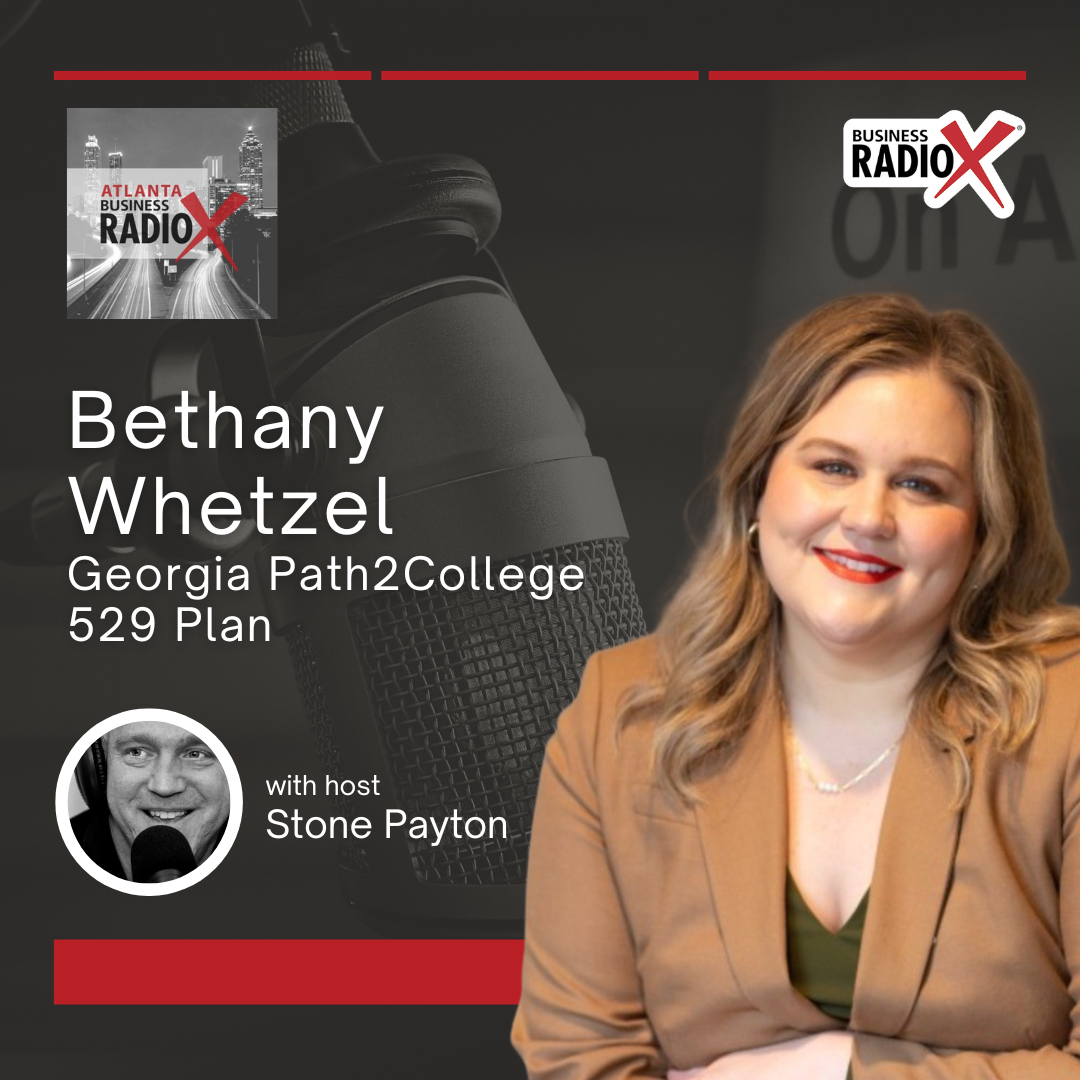


In this episode of Atlanta Business Radio, Stone Payton talks with Bethany Whetzel from the Georgia Path2College 529 Plan. They discuss the benefits and features of the state-sponsored 529 college savings plan, which helps families save for future educational expenses with tax advantages and various investment options. Bethany explains qualified education expenses, the importance of early savings, and the ability to gift contributions. Stone shares his personal interest as an expectant grandfather, making the topic particularly relevant. The episode also highlights sweepstakes for newborns and children, encouraging early investment in education.
 Bethany Whezel is the Treasury Program Director at Georgia’s Office of the State Treasurer.
She oversees Oversee the management, administration, and outreach for four core Treasury programs Path2College 529 Plan, Georgia STABLE Plan, Secured Deposit Program, and the Cash Management Improvement Act (CMIA).
She’s worked for a number of Georgia departments including the Georgia Vocational Rehabilitation Agency, the Office of the Inspector General, the Georgia Department of Corrections, and the the Georgia Government Transparency & Campaign Finance Commission.
Follow Georgia Path2College 529 Plan on LinkedIn, Facebook and Instagram.
What You’ll Learn in This Episode
- About Georgia’s Path2College 529 Plan
- How a 529 plan works
- How the funds can be used for education
- The advantages over other ways to save for college
- What happens if you don’t use all the money
- The Path from Pre-K to college sweepstakes
 This transcript is machine transcribed by Sonix.
TRANSCRIPT
Intro: Broadcasting live from the Business RadioX studio in Atlanta, Georgia. It’s time for Atlanta Business Radio, brought to you by Kennesaw State University’s Executive MBA program, the accelerated degree program for working professionals looking to advance their career and enhance their leadership skills. And now, here’s your host.
Stone Payton: Welcome to another exciting and informative edition of Atlanta Business Radio. Stone Payton here with you this afternoon. This is going to be a good one. Please join me in welcoming to the broadcast with Georgia Path2College 529 plan Bethany Whetzel. How are you?
Bethany Whetzel: I’m great. Stone, thank you so much for having me today. I’m glad to be here and to have an opportunity to talk a little bit about path to college.
Stone Payton: Well, it is an absolute pleasure to have you on the broadcast. There’s so much that I personally do not know about this program. I want to inform our listeners, I want to inform me, and I will just share with you from a personal standpoint, I am on Grandfather Watch. I should have a grandson within a week. And so topics like this are very much on my mind for sure.
Bethany Whetzel: This could actually couldn’t be any more timely for you. Um, because we have some exciting opportunities for newborns that are born in the state of Georgia that hopefully, um, can maybe help your grandchild.
Stone Payton: All right, so let’s start with a little bit of a primer. Maybe, uh, share with us what exactly is the Georgia Path to College 529 plan? And then we’ll just kind of talk it through.
Bethany Whetzel: Sure. So, um, path to college is path to college. Uh, 529 College savings plan is Georgia’s one and only state sponsored 529 college Savings plan. So if someone is not familiar with the college savings plan, it is a vehicle for someone to save money and invest money, uh, for an individual’s education, future educational needs. And it has some very specific benefits. Um, there’s some unique tax tax advantages. It’s flexible and there’s really great range of investment options. And, um, really proud to say that Georgia’s path to college plan is the lowest in the nation as far as fees.
Stone Payton: Wow. I got a ton of questions about the plan itself. But before we even go there, I got to know what’s the backstory? How did you find yourself in this line of work, Bethany?
Bethany Whetzel: Well, really, I mean, by luck, this has been a great fit for me. I have worked for the state of Georgia. So past to college is, um, obviously it is the state’s, uh, 529 college savings Plan, and it is administered by the office of the State Treasurer. We are overseen by the Georgia Higher Education Savings Plan Board. The chair of that board is actually the governor of Georgia. Um, and so I work for the Georgia office of the State Treasurer. And previous, uh, previous to before I came to the office of the state Treasurer, I worked with numerous state agencies doing program administration and outreach, and, um, worked in a legal capacity. I have a tax background as well. And so this job in, um, overseeing the path to college, 529 college savings plan really kind of marries my, um, interest in taxes, compliance. But the wonderful and great part of outreach in helping, um, people, uh, reach their goals and make a difference in the lives of children and youth across Georgia who, um, who are planning for future educational opportunities.
Stone Payton: Well, I have to believe this must be incredibly rewarding work for you.
Bethany Whetzel: It really is. It’s been a great it’s it’s honestly been so great. And it’s been great, uh, seeing the children and, um, speaking really, even just to my peers or, uh, coworkers and other individuals when they say I had a path to college plan. And it helped me, uh, you know, go through college. I have, um, one friend that when we were discussing, um, my job, she said, you know what? I had a path to college plan, and I had a little bit of money left over. So when I had my first born, I deposited, I created an account for my first born daughter, and I deposited my leftover money. I transferred that over to her. So not only did it fund her education, but that little bit of leftover is going to go towards her daughter’s, um, future education expenses. So it just it really is great.
Stone Payton: Yeah. All right. So I’ve heard the term 529. That’s about where my knowledge begins and ends. End. So walk us through it a little, if you would.
Bethany Whetzel: Of course. So, um, it’s called a 529 plan because it’s authorized by section 529 of the Internal Revenue Code. And that code section allows, um individuals, it allows for certain investment. Um, accounts for you to put after tax dollars, um, in what a lot of people are more familiar with sometimes are, um, our IRAs or um, so those retirement accounts, this, uh, investment account is specifically for college and, um, education savings. So it’s called a 529 college savings plan. And what it allows someone to do the Internal Revenue Code, it allows someone to put dollars into a 529, uh, investment plan. So for Georgia that hopefully your choice would be path to college, and it allows an individual to put that money in there to select an investment option. And, um, there’s. And then it allows for, uh, two different tax benefits. One, uh, earnings earned on, uh, the investments that you’ve made, that money is tax deferred. And then the second thing that is, um, that is similar across the board of all path to college, excuse me, of all 529 college savings plans, is that if you, uh, take the money, if you withdraw the money out for a qualified education expense, then that is a tax free money. So that investment income you earn, if you withdraw it for a qualified education expenses, you’re not going to have to pay federal income taxes. But what makes the path to college plan so special is that if you are a Georgia resident and you, um, take that money out, you’re also going to get a third benefit, which is that you’re going to get a state income tax deduction. And that tax deduction is pretty generous. It’s um, $4,000 $0 for a single filer per beneficiary, and then up to $8,000 for a joint filer per beneficiary. So if you have multiple children and you’re giving, you know, $16,000. 8000 to 1 and 8000 to another, and you’re filing jointly, you can get an income tax deduction up to $16,000.
Stone Payton: Wow. That is encouraging. And so these qualified. Um, what do you call it?
Bethany Whetzel: They’re called qualified education expenses. So that’s kind of a mouthful.
Stone Payton: So what are some things that would qualify and what are maybe some examples that that might not qualify.
Bethany Whetzel: So the big the big thing that comes into mind when you think of a qualified education expense. And I think a lot of people this is just where it ends, is tuition at any accredited private or public college or university, community college, technical college, graduate school or professional school across the US. And also, um, many universities that are abroad. So that’s typically what you think of when you think of, okay, this is how I’m going to spend the money. But you also, um, for post-secondary education, certain room and board related expenses qualify fees, books, supplies and other equipment needed for enrollment and attendance are qualified expenses. Computers, technology. Um, so those are all qualifying expenses for post-secondary. And but then there’s a couple of special things is that you can use, um, money up to $10,000 a year for K through 12 expenses for certain K through 12 expenses. Um, and that would be a qualified education withdrawal. And, um, another thing is that you could repay student loans up to $10,000 in the lifetime per beneficiary. Um, that would be a qualified education expenses, something that would not be a qualified education expenses, even though it is related to attending college would be, um, would be buying a car for your child. Um, that would not be a qualified education expense. And then if you were just to withdraw the money just so you would have cash, that’s going to be a taxable event and would not be a qualifying expense.
Stone Payton: Okay. So let’s say that I did grab a little bit out of there and maybe even with the best intentions. And then I turned around and bought a boat or car or whatever that does it. Does that sink the whole thing, or I just have to pay taxes on that piece of it.
Bethany Whetzel: You just have to pay taxes on the piece that you withdrew.
Stone Payton: Okay. And I want to clarify something because I may just be hearing what I want to hear here.
Bethany Whetzel: That that happens sometimes.
Stone Payton: Yeah, it happens to me a lot. So, um, do they do does the kid have to go to a state school or in the state of Georgia? What are the rules on that?
Bethany Whetzel: There are no rules. It’s, uh, any school, professional school across the United States. And then again, some that are abroad. So just because you’re investing in Georgia’s 529 college savings plan, it doesn’t mean that you are limited to spending that money on a Georgia University college technical college apprenticeship program. It could be anywhere across the country that qualifies.
Stone Payton: And is this something you can get going with? Like, you don’t have to have a great big pile of money to get this thing set up right. You can just start seeding it a little bit with relatively small amounts of money.
Bethany Whetzel: Exactly. You only need to open an account. You only need to to have a $25 contribution that’s as little as as you need. And what we’ve seen is that no matter the dollar amount that you’re putting in, just the act of putting money in and letting a youth or a loved one or a child know that you believe in them and that you’re putting you believe in them so much that you are putting money aside, um, in an account again, no matter how much it is. That said, that is a huge confidence booster for a child to know that someone believes in them that much. And then again, the earlier you start saving, the better, because the benefit of a 529 college savings plan is that you’re going to get that compounded interest. So you’re going to, you know, you’re going to get earnings and then you’re going to get earnings on top of those earnings. The longer that you keep it in there. So any amount of money is better than no money for sure.
Stone Payton: So I’ve just experienced in the space of about 5 or 6 minutes, learning a great deal about something I didn’t know the first thing about which, which makes me think that a big part of your responsibility of day in the life of Bethany and her team is getting getting the word out and educating people like me that really don’t understand or know about this. Is that accurate?
Bethany Whetzel: That is that is very accurate. And so our office and our program administrator, um, we are available at any point, you know, if you have a community organization or group that has a would love, you know, for us to come talk and and present this program or we, you know, set up at booths and hand out information. We’re always available to take take, um, part of those opportunities because the more people that we know, um, the more people that know about path to college, the more people that are going to participate in the you know, we’re always looking in the state of Georgia to invest in the education of our workforce. And so, you know, a lot of times, the education opportunities that we have, um, for our residents and they’re going to stay here. Um, it’s only going to, you know, better the entire state.
Stone Payton: Is there a direct path where I can do this on my own? And or can I call my money guy? Not that I have one. I’m just making. This is hypothetical. Can I call my money guy and say, okay, Rochester, I want to do one of these 529 things like, what’s the path? What’s the best way to just kind of get things going?
Bethany Whetzel: Right. So we have a website. It’s. The number two college c o l e g the numbers five two, nine. Com that’s our website. And you can go to our website and open account there by yourself. It’s um path to college is what we call a direct sold plan. So you don’t have to go through a financial advisor to open an account. But if you have a financial advisor, um, that’s great. And they can assist you in choosing the investment option that you may want or what strategy to use. But it you do, it’s you do not have to have, um, a financial person to open the account for you. You can just head to the website, open an account. Doesn’t take very long. Um, all of the transactions can occur online. And one thing that’s really great about our program that I want to make sure that I, that I mentioned is that we have a platform called You gift. And so let’s say Stone that you open an account, um, for your grandchild and let’s say your grandchild has other grandparents as well that want to contribute it to it. You can set up this gifting page and send the link to those grandparents. And they can contribute through that link to your grandchild. Um, by Path to College 529 College Savings plan so they can have one big plan together.
Stone Payton: Oh, I love that. I’m going to start my email list right now because, you know, I might not be rich, but Mom and Dad are.
Bethany Whetzel: There you go.
Stone Payton: My brother. So I’m just going to put together this whole. I got a whole marketing campaign spinning in my my head right now.
Bethany Whetzel: There you go. And a lot of times, you know, a parent may want to would prefer that you put money in an investment account. Then give them, you know, a plastic toy that they they’ll only be interested in the box, um, when they get it. So I think it’s a great way to, to give a gift and, um, a lasting gift that really will impact the future of the beneficiary.
Stone Payton: And I’m jesting a little bit. I mean, I do study and try to keep an eye on, you know, how to make money with money and of course, invest some. But, um, it’s not like I’m just buying this and putting it in a virtual drawer. I’ve got some choices of some things or some vehicles I can invest in along the way. Yes.
Bethany Whetzel: You’re exactly right. So there’s really two primary investment, um, kind of paths, if you will, for a path to college. You can choose static investment portfolio portfolios. And those are people who generally are like a little more investment savvy and want to have a heavier hand in managing and choosing the funds that they are investing in. And then we have something that is our most popular choice. We have these enrollment year investment portfolios where you select the year that the beneficiary, so the child would be enrolling or be needing to access those funds. And then basically, um, the plan does the investment for you, where as you get closer to that enrollment date, it starts investing in more conservative options, because that’s when you’re going to start needing to access those funds and protect those funds more. So it’s it’s called a glide path. And so there’s enrollment your investment portfolios static investment portfolios. And um, the static take into account whether what your risk tolerance is. And on our website, you can actually take a little quiz to determine what your risk tolerance is. And it’ll kind of recommend plans relating to that too.
Stone Payton: So I likely don’t have the IQ points to actually do the calculation, but it is my understanding and candidly, my experience that if you will do something like this, that money will grow if you’ll leave it alone. This, this, this compound interest thing is it really is the the eighth wonder of the world, isn’t it?
Bethany Whetzel: Right. It’s just hard sometimes to be patient and to wait for it. But you’re exactly right. Um, that’s, you know, really basically, to some degree, free money. Um, at the end of the day.
Stone Payton: Okay. I believe I read somewhere in my, uh, notes something about a sweepstakes.
Bethany Whetzel: Correct. So from time to time, the path to college 529 College savings plan runs a couple of sweepstakes. We just closed our sweepstakes for We Care, which is a partnership with the Department of Early Care and Learning, where we award um for scholarships to students at a licensed child care centers. Uh, we award contributions of $1,529 to a path to college account, and then we do a corresponding award to each child care facility. So they have some free money to, um, continue to invest in those children. Uh, we also have a path from pre-K to college sweepstakes, which is for um, pre kindergartners that are attending Georgia pre KS and again for winners, um, in different regions of the state. And we award $1,529 to each of those winners and a corresponding, um, 1520. If you see there’s a pattern here of 500, $529 to kind of go with the 529 plan, but the one that you are going to be the most interested in stone is that we have a newborn sweepstakes. And this year we have expanded it to make sure that, um, two babies are going to be awarded a sweepstakes prize, and that award is $5,529. And, um, so we’re awarding two babies born in the state of Georgia, um, that in a path to college account to get them started on their, uh, college savings journey.
Stone Payton: Oh, I think that is fantastic, because you’re right. That is the one that I’m interested in. All right, so how quickly can I. I need to wait for this baby to be born. Is that when I can pull the trigger, or is there like.
Bethany Whetzel: That’s when you pull the trigger is when the baby is born. So it may be today. It may be tomorrow, right?
Stone Payton: It’s. Well, this this baby has been scheduled like a conference call, so we’ll see. But, you know, I think they come when they. When they want to. Okay. So you can begin as early as they are actually here.
Bethany Whetzel: Correct.
Stone Payton: But this also strikes me as one of those things that’s it’s probably never really too late either. Right. Because didn’t you. Maybe it was before we came on air, but I feel like you touched on being able to use some of these funds. Even if, you know, grandbaby one doesn’t use it, we can let grandbaby two use it. Walk me back.
Bethany Whetzel: Exactly, exactly. You can move funds to different beneficiaries at different times. Um, another thing, you know, a lot of people are concerned about setting up a path to college or any not just a path to college account, but any college savings account, because they don’t they think, well, I don’t know what my child is going to do in the future. Is college in their future? And, um, a great thing that um, happened, um, starting in January. January 1st of 2024. Is that 529 college savings funds could be rolled over into a Roth IRA. So if your child doesn’t use all their funds or they don’t go to college, if the account has been around, um, for 15 years, you can roll that into a retirement account for them. So it’s not that all is lost or you’re going to, you know, have to take the money out and have to pay taxes on it. There are some options. If that money, um, you know, doesn’t get used or you can put it to a different beneficiary for sure. There’s obviously tax rules surrounding that, but that’s basically the gist of that.
Stone Payton: I love it, and it’s not my nature to try to poke holes in things, but I if if it were my job to do it, I don’t know where I’d poke this thing.
Bethany Whetzel: Well, I’m glad to hear that.
Stone Payton: Oh my God, you must feel so good about the work you’re doing and truly enjoy it.
Bethany Whetzel: I do. Well, you know, it doesn’t hurt when you are educating people or promoting a product that is something that you believe in and you truly believe is a great choice for Georgians. And knowing that we’re managing it in a way where we are stewarding the, um, the, the money of investors, um, in a responsible way, and then also having the lowest fees, um, across the country. So we’re really making sure that everyone is getting a good return on their investment, if you will. Um, a good bang for their buck. And, um, so, yeah. So I do feel great. Honestly, I feel great every day I get to come to work. Um, because Path to College, uh, is a great program.
Stone Payton: All right, before we wrap, I’m going to switch gears on you a little bit, if I if I might, I don’t know when or where or how you would find the time, because I get the idea that you’re pretty consumed with this work and you clearly enjoy it. But I am interested and often our listeners are as well. Hobbies, interests? Pursuits outside the scope of this work. When you’re not doing this, anything that you, uh, really enjoy or have a tendency to to, to nerd out about and step away and get recharged.
Bethany Whetzel: Well, I mean, I would say that my big thing is I’m an I am an, uh, Atlanta dweller. Uh, I live in the East Lake neighborhood, and I have a great community and a lot of neighbors. And so really, what I do after work every day is I take my two dogs for a walk. I have a poodle. Um, she’s ten years old, and then I have a, um, a doodle, and he’s four years old, and we walk around the neighborhood and visit with our neighbors and, um, you know, hang out with the kids and watch watch them play basketball and soccer. And so that really is where my heart is. And what I enjoy doing kind of outside of work is just interacting with still interacting with people and just, um, finding community where I can and hanging out with my dogs. So.
Stone Payton: Well, you are clearly the right person for the job. And, uh, just based on my brief interaction with you, I bet that you’re able to create the same level of enthusiasm and commitment and passion within your whole team. The work you’re doing is so important and obviously incredibly helpful for those of us that are just, you know, we’re out there trying grinding it out, and we want to provide for for a safe and secure future for, uh, for our loved ones. Uh, all right, let’s I want to make sure that our listeners, uh, know how to get in touch with you or someone on your team or be able to tap into your work. So let’s leave them with a website or something. So that’s easy for them to, to learn more and and get on this path.
Bethany Whetzel: Okay. Um, so the best place to get started is our website. And so that is um WW 252.com. So it’s. The number 2COLLE the numbers 529.com.
Stone Payton: Bethany, what a delight! It has been a real joy visiting with you. I have thoroughly enjoyed the conversation. I’ve learned a ton and I feel like our listeners have as well. Thank you for your insight and your perspective. This has been an incredible conversation. You’re you really are doing important work and we we sure appreciate you.
Bethany Whetzel: Well, thank you so much, Stone, and thank you for your time. And I appreciate the people who are listening. And if they have any questions, they can just reach out.
Stone Payton: Fantastic. All right. Until next time. This is Stone Payton for our guest today, Bethany Whetzel with Georgia Path2College 529 plan. And everyone here at the Business RadioX family saying, we’ll see you again on Atlanta Business Radio.














