
 Internationally recognized thought leader and speaker, Michelle Beyo has graced prestigious stages worldwide, including Santa Barbara TEDx, Money20/20, Fintech Meetup, and Open Banking Expo, sparking dialogue on finance’s future.
A dedicated mentor and Money20/20 RiseUp alum, she serves on the Advisory Boards of Tillo Rewards and VoPay.
As President and Board Member of Open Banking Network Canada (OFNC), she champions consumer data rights, transparency, and security in finance.
Her passion for leveraging technology to drive financial inclusion shapes global finance innovation and was the catalyst for Finavator.
Honored as one of Toronto’s Top 50 Women Leaders (2023) and Most Outstanding FinTech Executive Canada (2022), Michelle also earned a spot on the Women in FinTech Global Power List (2021) and contributed to the USA bestseller Habits of Success.
Connect with Michelle on LinkedIn.
 This transcript is machine transcribed by Sonix.
TRANSCRIPT
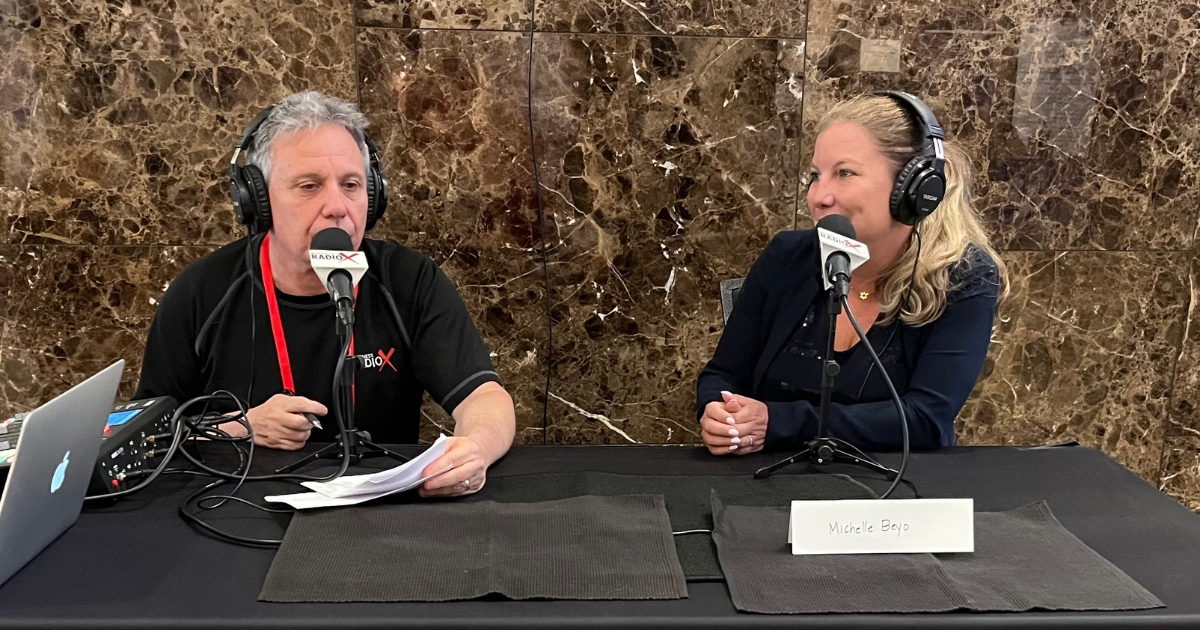
Intro: Broadcasting live from Fintech South 2025 at the Woodruff Arts Center in Atlanta, Georgia. It’s time for Atlanta Business Radio now. Here’s your host.
Lee Kantor: Lee Kantor here. Broadcasting live from Fintech South 2025. So excited to be talking to my next guest Michelle Beyo with Finovator. Welcome.
Michelle Beyo: Thank you.
Lee Kantor: Well, for folks who aren’t familiar. Tell us a little bit about Finovator. How you serving folks.
Michelle Beyo: Yeah. Thank you for having me I’m really excited to be at Fintech South. Uh, started Finovator six years ago. It’s a future of finance consultancy largely focused on helping companies get to the future of finance by working with fintechs or enabling some type of technology that’s going to get them closer to the future of finance for their consumers.
Lee Kantor: So who is that ideal sales prospect for you? Who who should be using innovator?
Michelle Beyo: So definitely credit unions smaller banks corporations. Also helping some fintechs are. Our expertise is largely sitting in helping the product innovation, followed by marketing, followed by strategic sales, and have helped a couple companies come over from the UK into the US market and just drive out visibility, growth and their first clients.
Lee Kantor: So what is kind of the pain they’re having right before they contact you?
Michelle Beyo: They’re definitely trying to figure out where to spend their time and focus to try and expand their business lines. So if they’re sitting there and they see real time rails, open banking, digital identity and cross-border payments, and they don’t know where to focus or who to work with, that’s when it’s time to call for innovator.
Lee Kantor: So what’s your backstory? How’d you get involved in this line of work?
Michelle Beyo: Yeah, so I spent six years in telco, eight years in online shopping, affiliate marketing, ran Alaska, Lufthansa, Delta, United online shopping mall platforms. And I did three years in prepaid. Actually spent a lot of time in Atlanta because I was working for income out of their international office in Toronto ran sales and marketing as well as their. Business development infrastructure for three years. I launched WeChat for them at 7-Eleven at its first ever test pilot in Vancouver, and that was the moment that I realized the future of finance was living elsewhere. It was coming out of Asia, and we were about ten years behind in North America. So I actually left, took the first Ivy course focused on blockchain, digital identity and fintech, and went off into a startup land. I went to go work for a company as a chief client officer focused at a blockchain, uh, working with digital identity consent on blockchain in 2018, and learned everything never to do at a startup, essentially. And then one month, 2020, and after being selected as one of 30 women selected out of 500 to come into money 2020 for an accelerant program in 2019. The next day I started innovator. I didn’t want to give the PR to the startup and thought it was a pretty good way to kick off company.
Lee Kantor: So how do you attack an event like fintech? So up.
Michelle Beyo: I do about 20 events a year and I’m usually speaking, so I was honored to be the emcee for the Open Finance Embedded Finance stage yesterday, and moderating a panel on embedded finance impact for consumers. So when I come into a conference, my plan is always to download the app as soon as it’s available. Find 1520 people that I want to potentially meet with, uh, try and book out those meetings, as well as make sure that there’s breakfasts, dinners, lunches, uh, of interaction and max out my 2 or 3 days in Atlanta.
Lee Kantor: So what do you think of the Atlanta kind of fintech ecosystem.
Michelle Beyo: Knowing that income comes from here? So many payment infrastructures come through the Atlanta infrastructure. So it’s a great hub to sit down and talk about payments in the future of finance, because there is so many organizations that are like head office here in Atlanta. And I think Fintech South is a good memory of bringing old businesses or structured businesses in with new fintechs and innovation, and see how they could work together to get to the future of finance.
Lee Kantor: So you spend most of your time, I guess, traveling and going to these conferences, speaking. That’s it’s almost once a week now, right?
Michelle Beyo: So yeah, I’m traveling quite a bit. That’s without question. Thankfully, I work for my phone often and most of my clients are at these events with me. So I try and bring my clients with me kind of on a road show so I never have to go to their offices. But they’re they’re always kind of beside me when I hit new conference. And it’s a good way to get them on stage usually, as well as interacting and getting them new potential clients.
Lee Kantor: So is there any trends or technology that you’re most excited about moving forward?
Michelle Beyo: I’m hugely passionate about open data, and I don’t think a lot of people talk about it. I think they talk about open banking, which is the first use case to an open data economy. I’d like consent to be the core infrastructure for everything we do, from our cell phone number being the first use case that I own that number, and I move telcos based on that. I come from that space. So I understand when telcos used to own us and own our phone number and the freedom it gave us to allow to choose what color telco to use at that same choice in banking, that same choice in healthcare in the future so that I can move my data can move with me, and I’m in control of where I want to live and who I want to work with instead of the banks or the like. Healthcare infrastructures owning my data. I would like to have that be a core infrastructure.
Lee Kantor: So how far along are we on that? Kind of. Is that a dream that’s going to come true or it will.
Michelle Beyo: There’s 98 countries in the world who’ve moved to open banking, 43 to open finance, and about two to open data, the UK and Australia. Um, Australia actually legislated consumer data right, for open banking, then open finance, open telco, open energy and moving to open data. So they’re the first in the world to have like a legislated consumer data. Right. And I’m hoping we we can get there. Denmark just actually announced an IP right for your face, your voice and your likeness, just like you owning a song. You actually own your identity. That’s where we need to get to. But we are kind of far from there right now.
Lee Kantor: So what’s a baby step?
Michelle Beyo: Oh 1033 is having some challenges. So I was excited about 1033 in the sense that it was going to ensure that all banks had an API to share their data in a structured way. But it does look like the CFPB is going to change that rule. And I don’t know what it’s going to look like. But let’s say this 100 million consumers in America are already using open banking. It’s allowing them to have choice. It’s allowing them to pick different service solutions, and it’s helping to personalize everything they do. I don’t think we can get away from open banking, open finance. Even if banks want to start charging for that data, it’s definitely going to change how that looks. But I think there should still be some baseline. Like I own my phone number, I should own my banking core data. But if the banks want to improve on that data and give me analytics and charge for premium API, I totally understand that, but charging me for my baseline access feels unethical.
Lee Kantor: Yeah, I don’t think they’re kind of leading with, uh, generosity or, uh, openness. That’s not their first move.
Speaker4: No, I think, you know, when there’s.
Michelle Beyo: So many other countries that are sharing the example of how this infrastructure is working, consumer first infrastructure is definitely the trend of the world. And I think we’re going to get there regardless of how this path looks. And it’s going to be about consumer control and consumer empowerment.
Lee Kantor: So what do you need more of? How can we help you?
Michelle Beyo: I, I’m looking to help more companies really, truly get into the future of finance. I’m really honored that Fintech South let me promote my masterclass, uh, gave a 25% discount called Fintech South on Innovators six hour masterclass. I spent about nine months last year putting this together. It’s 20 years of everything I’ve ever learned. On the future of finance, trying to get people to be less fearful of the future and start understanding digital identity, cybersecurity, Web3, blockchain, open finance, open data, embedded finance, fintech and base and ISO 2002. I definitely geeked out in this course, and I’m hoping some people can spend six hours to expand their knowledge and start getting excited about the future of finance.
Lee Kantor: So if somebody wants to learn more, connect with you or somebody on your team, what’s the website? What’s the best way to connect?
Michelle Beyo: Yeah. So com is the website. You can find me on LinkedIn Michelle Bayo happy to connect with you. Happy to connect for a call. I’ve definitely come in to credit unions to train their board in their executive team in a half day session, and then they pick up the master class for additional training. So hoping we can get to the future of finance in North America faster.
Lee Kantor: Well, Michelle, thank you so much for sharing your story. You’re doing important work and we appreciate you.
Michelle Beyo: Thanks for having me. Have a great show.














