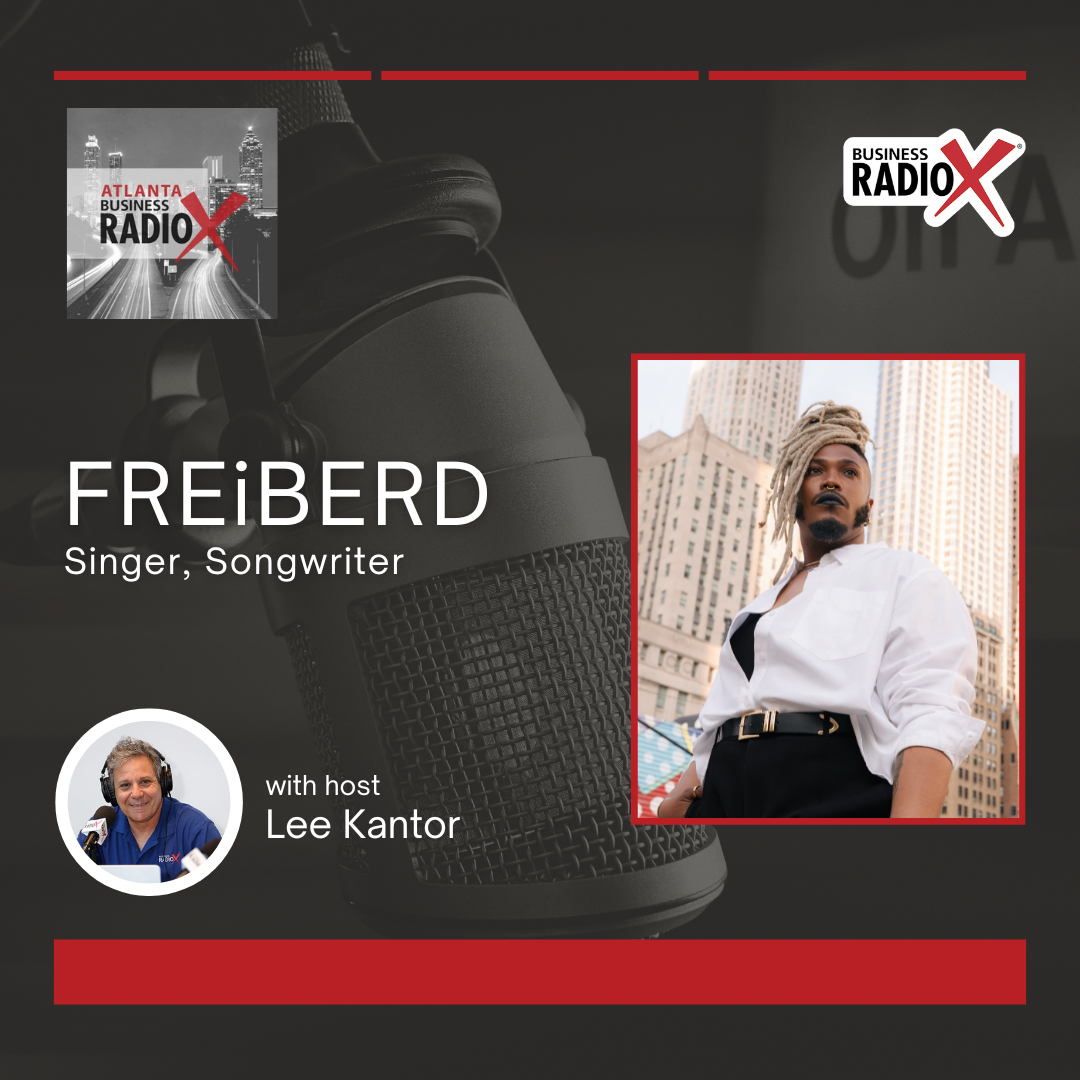

 In this episode of Atlanta Business Radio, Lee Kantor interviews FREiBERD, founder of We Are The BerdHaus and UNZP, about their journey from major-label artist to independent entrepreneur. FREiBERD shares how they built their own music label, developed a fashion and fragrance brand, and embraced a creator-first mindset rooted in purpose rather than fame. They discuss the importance of understanding your “why,” navigating collaboration, trusting intuition, and turning everyday observations into successful business ventures. The conversation also explores FREiBERD’s return to music after a seven-year hiatus and how creativity continues to fuel every aspect of their life and business.
 FREiBERD is an artist whose work blends Atmospheric Pop, Alternative R&B, Electronic textures, and Cinematic storytelling into emotionally immersive worlds shaped by sensuality, transformation, and self-expression.
With a striking visual identity and a sound that moves fluidly betweenvulnerability and control, FREiBERD creates music that feels both intimate andexpansive. Balancing lush melodies, layered emotion, and genre-blurringproduction with a distinct sense of mood and atmosphere.
Drawing inspiration from fashion, nightlife, movement, fantasy, and personalreinvention, FREiBERD approaches each release as a complete sensory experience,where sound, imagery, and emotion exist as one evolving language.
Follow FREiBERD on Tiktok, Facebook and Instagram.
What You’ll Learn In This Episode
 This transcript is machine transcribed by
TRANSCRIPT
Intro: Broadcasting live from the Business RadioX Studio in Atlanta, Georgia. It’s time for Atlanta Business Radio, brought to you by My Global Presence, the award winning Atlanta public relations agency that elevates brands and non-profits through authentic storytelling and national media campaigns. Find them at myglobalpresence.com. Now, here’s your host.
Lee Kantor: Lee Kantor here, another episode of Atlanta Business Radio. And this is going to be a good one. But before we get started, it’s important to recognize our sponsor, My Global Presence. If you want global visibility and meaningful impact, go to myglobalpresence.com. Today on the show, I am so excited to be talking with Freiberd, who is leading two amazing organizations. We Are The Birdhouse and UNZP. Welcome.
Freiberd: Hello. Hello.
Lee Kantor: Well, I am so excited to be talking to you to learn about this amazing story. First, let’s kick it off with We Are The Birdhouse. Can you share a little bit about that?
Freiberd: Yes. So we are the birdhouse is it is a music label that I created back in 2017. It was post being with major labels, touring and all that kind of stuff. And then realizing that, you know, there’s some things that I would much rather do myself and some parts of the industry that I didn’t really feel comfortable with or existing as myself fully. So I decided to go independent. And so I started We Are The Birdhouse, and here we are all these years later, nearly ten years actually.
Lee Kantor: So what goes into kind of taking that step and saying, okay, this is now my show. I’m doing it, my rules my way. Can you talk about that? Because there’s a lot of people that kind of dream of that, but very few people do what you do and take action.
Freiberd: It’s true. And it wasn’t without a lot of work. Obviously, having the experience of working with major labels as well as just from university time, all the way up until being an artist on a label myself, just learning the ins and outs of what it takes to put out an artist as a label. So all of the things you have to have in line, the team, the amount of work you want to put in behind it, what type of artist, what type of songs, how you want to deliver this, the platforms you want to reach, the networks. Having a network of people, all of these things that go into it. And then also just being an engine for yourself is really, really important. And I feel like that that’s what comes with the major label. It’s definitely an engine. A team of support behind you, but learning how to create that support system for yourself as an independent artist is, is something that I thought that I could pursue, and that’s what I did.
Lee Kantor: Now you make it sound pretty easy, but I know it was not easy. It’s not.
Freiberd: It’s definitely not. You know, and, and it’s probably it does sound that way now, but because I’ve been doing it for so long. So a lot of times like I don’t, I don’t, I haven’t forgotten how difficult it was to start, you know, just navigating. Okay, now I’m out in the streets building relationships for myself. I am networking hand handshake to handshake, you know, just building a support and you’re literally out as both the product and as well as the company who’s creating the product. So, you know, it’s, it’s a lot of groundwork. There is definitely a lot of groundwork and nothing really moves forward without putting that groundwork in. And then just understanding the foundation really, of what it is you want to do with your company or as an artist or as a label, like, okay, do you want to just focus on one artist? Do you want to create a foundation that supports many other artists, you know, so you really have to figure out exactly what the plan is prior to going into it so that you’ll have a trajectory of what things you’ll need to complete the task or to get the ball rolling.
Lee Kantor: Now, do you find when you talk to maybe aspiring artists like yourself, that they don’t realize how much energy you have to put forth in the marketing, the networking, like you said, the handshaking, all that stuff that you had to show up and do, that isn’t really the creating the art part of what they thought they were getting themselves into.
Freiberd: Right? You know, now I feel like people feel like it’s even easier because we’ve got things like the internet, we’ve got TikTok, we’ve got all these kind of trendy topics and things that people like to follow. And so seeing people become viral, all this kind of things like that, like people think, oh, it’s easy. Like, I’ll just create some cool content or something and I’ll go viral and then everyone will love me. And not understanding, like there is literally a system to keeping up with that. Even if you do, you know, have that experience of going viral or having something go viral, you have to be prepared for what happens next. You know what I mean? So what are your follow ups? What are you going to do now? Do you have music ready? Have you have you had experience recording music in the studio? Have you had experience performing? Are you going to perform live? Are you just going to release music and not ever perform live? So there’s a lot of things that I feel like now. People think it’s a lot easier and they can just jump into it, but then they’re like, wait, oh, this is actually a lot of work. And it’s like, yeah, it really is a lot of work. But if you, if you understand what, what and why have a good why for the reason you’re doing it. Then it becomes, it becomes fun. Yes, it’s daunting and there’s a lot of work involved, but you, you, it’s so rewarding as well. So each task you finish, um, each, each benchmark you cross, you’re just like it creates more and more of like a feeling of success. So you get these little wins over and over again and through those things. It just motivates you to keep going. So it is a lot of work. Sometimes it is incredibly difficult, but through your little wins through, uh, successfully moving forward and pushing things out there and seeing how it actually touches people are the little things that keep you going.
Lee Kantor: Now, uh, at the start of that, you said the word why the why you are doing this and that. That’s really at the heart of all of this, right? You have to have kind of a true North Star or a big why? Because if you’re just trying to be famous, that’s really hard because you’re probably just going to be copying the person that you like before you. And in order to really stand out, you got to be 100% you, right? Like you can’t, you can’t be kind of a knockoff of somebody else.
Freiberd: I think that’s very, very true. And I, this is why I took the approach of building a creative business as opposed to chasing fame. Um, I feel like for me, fame can become a byproduct of the work that I’ve put in and the amount of people that the art has touched. But my why has always been, um, because I have a certain level of life that I want to live, you understand, like a certain freedom that I, I, I love to live in my life. And in order to keep that or to live that way. There are just certain things that I have to do for myself and for my business to get it out there, to keep it out there so that I can continue to live the life that that makes me ultimately happy whilst I’m here.
Lee Kantor: And then it kind of when you’re clear on your why, making decisions become a lot easier, right? Because it’s not, uh, should I do this or that? It’s like, is this helping me get to where I want to go? Yes or no? It’s pretty simple. Like it’s easy. It’s important to kind of be as clear about what you’re not as, as what you are.
Freiberd: And that’s absolutely important. I feel like it’s, it’s one of those things where, okay, you can try all of that. And let me be clear as well, the journey of an artist or a creative person like you do have those times where you’re like, okay, well, let me try this or try that. You know, those things do happen. There is nothing wrong with experimenting as well, but at the same time, you have to know who you are at the bottom and understand your comfort with things. Understand what your values are and establish those things, and let that be parts that lead through your business as well to create your ethos.
Lee Kantor: Right. So yeah, absolutely. You have to be always experimenting. I think that should never go away because that is kind of part of the DNA of an artist. I think they’re always kind of pushing the edges and seeing where the edges are, if there are any. Um, so that’s, that’s kind of non-negotiable, but it’s also having a clarity around, um, who you are so you can live within that frame, I think is also important. So it’s a balance.
Freiberd: It is. And I mean, knowing who you are and also as an artist, I feel like a part of our job or one of our main jobs is to observe live. Yeah. So in the observations of life, including our own life, you begin to see patterns. You begin to see things that make sense to you. You begin to understand the world and how you relate to the world. And all of those become the building blocks of inspiration or things to try. You know, in regards to me finding the intersection between, um, music and fashion and my brand, doing fragrances as well as clothing. You know, it was an observation. So it’s like, okay, wherever I go, people are always complimenting how I smell. And the thing about that is what I loved about that is I’m, yes, I’m talented people, you know, enjoy the way that I look. They like my physical appearance and things of that nature. But people can say things like those sorts of compliments, even if they don’t mean it. When people stop and tell you that you smell good, it’s literally the best compliment you can ever get because it stopped them. They are having an actual neural moment where they have to stop and say, oh my gosh, this has stopped me in my tracks and I must say something. It’s a very real compliment. So me taking and observing that in my daily life and saying, you know, this is something that people really respond to. People really like this. I’m like, I would love to be a person who creates that experience for other people to experience. And so just paying attention to that and understanding that that came from something that I experienced in my own life. Observing that and then putting that into business is like a way that you learn from things that are happening in your actual life. Being yourself out in the world, but also observing those things and taking notes and putting those notes down and turning them into a business model.
Lee Kantor: And it’s building your brand across all the senses, not just 1 or 2.
Freiberd: Correct? Correct. Absolutely.
Lee Kantor: So now let’s talk a little bit about your music. You just released some music.
Freiberd: I did so this, this song I’ve just released just last Friday actually is called Act Like. And it’s been about it’s been about nearly seven years since I released music. And that came from a lot of things. Um, there was Covid happening. There was, you know, just deciding things that were going on in my life at the time and family and all those kind of different things that kind of took, you know, the lead in my attention. So, um, I took some time away from doing music and, and I don’t, I, I say that lightly because for the last six years I have been taking notes. I have my, my notes section in my phone is probably nearly at capacity, um, with all the notes and just the things that I jot down as I’m going through my daily life that have inspired me. So I’ve never stopped being inspired. And I also took notes of sonic things that just being inspired by things that I hear whilst I’m out in different cities that I’ve visited, hearing those things or being inspired by things that I’ve experienced or seen or people that I’ve encountered, stories, situations, all these things have. I’ve been taking notes for the last six years. And, um, when I ran into the producer that I’m currently working with, um, it just became a moment where, hey, look, you have a really cool talent and I have a really cool talent. And it may have, has been some time since you’ve done something, but I mean, what do you want to talk about? What do you want to do? And I had a list.
Freiberd: I was ready and, um, having that freedom again to create. Um, I feel like with music for me, I, I, I kind of worked a different way as opposed to, you know, some some artists, they’ll find things on YouTube and start learning how to write that way or, um, you know, people, they’ll, they’ll buy music from different sources and try to write or learn that way. Um, I’ve always thankfully known people who produce or create music, so I’ve always had the experience of creating fresh music in real time with the producer. And so that experience was the same with this, only it was different because one, I’ve had such a long break and I’ve had so much inspiration that I was exploding with ideas and just ready to, to get something down and just exploring new ways to write with this producer, new ways to create. Also both of us being incredibly quick. Um, we’re both very fast, which I loved. Um, but being able to keep up and move, move in the way that we moved, it was, it was really, really fun to do that. And so with Act Like it was literally the first song that we worked on from, from the project and, um, it set the tone for what we were going to create for the, for the other songs that we created for project.
Lee Kantor: Now you mentioned that, um, you know, creating music is a collaboration and a lot of the times and, and you like to work with a producer. Is there some advice you can share when working with a producer so you know, you’re on the right track that that is a good fit because, um, it’s a tricky thing because, you know, it might look good at first, but all of a sudden it can go get, you know, kind of come off the wheels a little bit. How do you know that you have a good fit? Is there some do’s and don’ts when choosing a producer for you?
Freiberd: You know what I will say. I will say when choosing a producer, definitely listening to their work first and seeing, okay, does this, does this inspire me? Does it move me? Do I feel connected to what they’re already creating? If that’s a yes, then it’s worth sitting down with. If you have the ability to sit down with this person now, you know we create via like Zoom or just like we’re doing now or any other kind of ways collaborating with other producers that you may find online, you know, can you build a relationship with this person? If you’re talking with them via chat or direct text or email or whatever you decide to speak with them with how, how, how is that cadence? How, how was the responses? How do they feel when you’re talking to them? Like, do they understand your ideas? Do they respect what you do? Are they in line with the things that you are in line with? Um, when it comes to creating music and, um, working together now, I will say one of the most important things that I have experienced over, over my time in working with producers in this way is, um, really discussing your work method. You really have to know how you create. And it’s so important to know how you create because that creates a framework of how you create with other people.
Freiberd: I am a person who loves, um, working with other people. I, I love it, it’s, it’s collaboration is so enjoyable because whilst I can feel and know that I have a talent, I also don’t know everything and I also love other perspectives. And because of that, I’m just always so interested in in what someone else will bring to the table or with our collaboration. We were both excited to see what we could bring out of each other, because there was a level of respect for what we had both already done. And so we’re going into that knowing that we both respected each other enough. There was a lot of times where there were there were things that we did not agree on, but it was like, okay, but what makes the most sense and what makes the song what’s best for the actual song? Not our egos, not, you know, I want to be right or you should be right or wrong. It’s what feels good, what feels the best and what makes sense for the song. So making the music be the most important part of it is also very important. Removing ego. If you’re going to collaborate, just go into it. Having fun and learning how to create with another person, right?
Lee Kantor: And making the project the objective, not either one of your egos that you’re trying to have an outcome that you’re both proud of. It doesn’t matter who did what or said what. Um, when I work with a writing partner of mine, we had a rule that was called King of the Hill. It was like a placeholder. We were like, okay, this is what we got right now. If you can come up with something better, you know, we’ll revisit it. But that’s what we’re going with right now just to move forward or otherwise, you know, you could have a roadblock and you’re stopped and nothing moves and it doesn’t. You don’t finish.
Freiberd: You don’t. And I feel like also between the two of us, we are both people that we absolutely must finish. We are finishers. Um, I think that’s important to know about yourself as well. Like, are you a person who will procrastinate? Like, you know, there’s a lot of things that I have grown over the years, my perfectionism, lowering that, the need for things to be perfect, um, learning how to, you know, find an acceptable ground, even though like my vision may be absolutely perfect, but okay, can I afford absolutely perfect right now? Maybe not, but where I am, how close can I get? Or who can I collaborate with that can get me as far as I can go in this time, this present time, and just knowing these things and being able to just put yourself aside and say, you know what, I want to one have fun. I want to be creative, which is what I’m here to do. This is. This is what I find the most exciting in life is being able to create. So why would I do anything in this moment to keep me from being able to do or have that experience, which is the most important part, and creating the final product when we get to that step. It’s like, oh my gosh, we did it. Like, look at this. Wow. You know, and everyone’s so happy. We’ve worked so hard for this exact feeling. And you get there by putting, putting that ego aside, by just communicating. Communicating was really important. Also learning each other’s communication styles, um, is also important because we do not communicate the same. We’re not from the same world. We’re not from the same, you know, style, but, you know, learning how to communicate and finding that middle ground also creates more respect and also helps you in your everyday life as well, because not everybody sees from your perspective. And so having the ability to say, you know what, let me hear what you have to say because this is not necessarily the way that I think. So let me learn or, you know, at least let me be able to hear something fresh.
Lee Kantor: Right? And then what about are you able to kind of let it go when it’s done? Um, and then just release it to the world and not, you know, kind of second guess.
Freiberd: I think that’s where I am now with last week, honestly. Um.
Freiberd: I did a, there’s a, there’s another change that happened in me on the way. And I feel like at the bottom of it, it’s also being able to, um, pivot and also being able to listen to those, just those ever so small little, uh, pushes or taps into your, your, your spirit or however you want to call it, um, your intuition, um, those little taps. It’s like, okay, I saw things. I have beautiful music that I’ve recorded with other producers over the last six years, and none of them have seen the light of day. I listened to these songs and find them incredible, and there was a label that I was working with as well who was like reminding me, hey, all of these songs are still going to be new to somebody else. But to me, oh, I’m beyond this phase of life, you know? So I can’t, I can’t even think about them anymore because I’m so past that phase of life. But what changed this time around was also like, you know what? I’m not going to let any more time pass without putting out something in this moment where I feel it. I want to have the full experience of being able to put it out at the same time in which I feel it and have created it. Um, I didn’t want more time to pass again to where I have beautiful songs that are just sitting on a hard drive.
Lee Kantor: Yeah. And that’s, I mean, I’m sure you’re That feeling is of excitement, but also a little nervous, but excited. And at some point you have to let it go. It has to be out. And then you have to, you know, kind of move on to your next project and, and, and you have no shortage of activities that you’re doing between music and fashion and fragrance. Oh my God. Like, so, you know, your to do list is pretty long, so you don’t have to kind of.
Freiberd: If you see, I have, I have, I have more than one to do list. I have a to do list for each business and a to do list for myself as a person. So.
Lee Kantor: Right. So at some point you got to let it go, right?
Freiberd: You do, you really do. You really do. And that it’s not always easy to do that. But also there’s comes a point where you’re like, listen, the art has to go. You can always make more art and you can always get better than this. Like this is great. But also there is growth and, and that happens in life naturally. You change, you grow, you learn, you experience new things. So just putting that, like believing in that and saying, you know what? Okay, I’m gonna do it. I’m gonna put it out. Uh, it’s out there. People gonna hear it. They’re gonna, they’re gonna like it or not like it. It doesn’t matter. My producers already texted me just two days ago saying, when are we going in the studio for the next project? So he’s, he’s he’s fostering that than I am. He’s already ready for us to start. Well, we actually in studio tomorrow to work on what’s next. But thankfully, again, I have notes from the last six years, so I already have notes of where I want to go with the next project. But here we are at the start of this brand new project. Um, that’s brand new to everybody in the world, but yes, we’re on to the next one already.
Lee Kantor: Well, I mean, you have to be emotionally or else you’re, you’re just kind of marinate in this one thing and you, like you said, you got a lot of art to produce. You know, this isn’t the only thing you’re ever going to make. You’re, you’re constantly making things Constantly.
Freiberd: I, I, I honestly never stop and people I don’t know, I, I, I kind of I’m a person who I literally live my life creating every single day that I wake up on my walks for cardio when I’m working out in the gym, when I am shopping, or when I’m just driving, there is always something that inspires me with every single thing that I do every day. So I’m constantly creating, whether it’s, whether it’s, it’s not necessarily always music. It can also be fashion and it can also be fragrances, things that I smell whilst I’m walking or different combinations or the way people react to certain things or how do I, how do I, how do I, how do I share that emotion in art? Or how do I capture that experience and put it in art, or put it in a clothing item or capture and put it in a fragrance? What notes would provoke that feeling again? So I’m always, always, always, always creating. It’s my favorite thing to do, and it’s what my life’s purpose is to do is to create things.
Lee Kantor: Well, we spend a lot of time on the music, but I don’t want to not talk about the fashion, talk about unzipped. And how did that even come about from. Did that just kind of was that birthed from the music or is that just something that you just said, I can do this and I’m going to do it.
Freiberd: You know.
Freiberd: I actually studied fashion in university. So that’s, you know, what one of my actual, what I graduated for in university was fashion marketing and design. So I whilst I actually know about that. Well, music has always been my passion. So fashion was more of a skill. I know how to sew, I could. So for people I do pattern making all of the things that people may need. I’ve helped people along the way and it’s helped me. You know, when I didn’t have like a full time job or something, I could always just pick up my sewing machine, do alterations or, you know, reach out to people who may want custom garments. And through those things, you know, just fashion is always just kind of been around me. But it wasn’t until 2020, uh, in New York, I was living in New York and, um, I had a neighbor upstairs who he was just buying things on Amazon actually, and he came down and was like, you got a sewing machine? Can you, can you just edit these for me? And I was like, what? Okay, this is, this is an odd request. And so whilst I was doing the edits on the pieces, of course, my mind got to thinking about, okay, well, why don’t they just sell adjustable versions of this? And that’s how the idea was born.
Freiberd: So I just started working on adjustable, um, for that. It was in particular it was underwear and started working on adjustable underwear. And I just tinkered about patterns and playing around with different ideas and concepts of, of what has been, what hasn’t been. Why hasn’t it been? Um, and until I got the idea and then I launched that in 2023 and um, since then it’s just, it’s been doing well. Um, it wasn’t until actually last year that I decided to move into fragrances as well. Um, because just again, observing live and seeing how people react to the way that I smell and my choice of fragrances, the choice of things that I love and just being like, you know what, I have a brand, I have relationships with stores. Um, my brand is growing in different, um, in different, uh, states. So why haven’t I done a fragrance? So that’s how fragrance was born just last year. And literally that’s the thing that’s taken off the most as well. So with that, it’s become kind of my hero product and I just love seeing people react to it.
Lee Kantor: Now, how do you you mentioned like kind of you go on your walks and you’re doing things outside and you capture like, oh, that smells good. Like, how do you kind of notate that?
Freiberd: It’s just a note actually. So I’m just like, okay, it kind of smells earthy or like fresh cut grass or like break a leaf and see like what, what am I getting out? Is this more on the eucalyptus side? You know, so just different things like that. Or like, if it’s like a floral that I’ve never smelled before, just try to describe it, you know, as best as I can. Maybe it’s, it’s on the sweeter side. It’s got a bit of honey to it. So also knowing the basis of like foods, vanillas and, and things like that, that you can use as your base helps me to kind of build on top of what it is that I’m smelling. So I’m like, okay, well, I have the notes and I kind of know what it is that I want to put. And now having the knowledge that I have in regards to all the different types of things that are available. Um, I can kind of pick and choose different things and just say, okay, we’re going to put these together and see if that really brings back that smell or that idea that I had in my mind.
Lee Kantor: So how long did it take to get the thing that’s in the in the bottle? Like how many iterations?
Freiberd: Um.
Freiberd: Oh, oh my gosh. So it took, it took about six months. And through that six months, we did about 4 or 5 different versions.
Lee Kantor: So you were pretty close pretty. You were close pretty fast then.
Freiberd: Well, I had an idea and then I, I, I knew that I wanted the base to be in vanilla and I wanted it to dry down to a vanilla and earth earth kind of an earthy vanilla. So I knew that is what I wanted the experience to be. But building the heart notes and the top notes was what the challenge was. And that was just like, okay, until we get this right. And then just also testing it with friends and family. Different people that I meet, um, also spraying it on myself and walking about in the public and seeing the reactions to people. The, um, when I started getting the most like, oh my gosh, what are you wearing? What are you wearing? I’m like, okay.
Lee Kantor: Now, you know, you’re close now you’re, you’re right there.
Freiberd: Exactly.
Freiberd: You know, so, um, and that’s also very fun because it’s like living experiments.
Lee Kantor: Right? You’re, you’re putting it out there. I mean, you’re literally it’s out there.
Freiberd: Yeah.
Lee Kantor: Well, if somebody wants to follow along and get a hold of the music or the fragrance or, or the fashion, what is the website? What is the best way to connect with you?
Freiberd: Yeah. So you can find all things music at simply freepeople.com. That’s freiberd.com. All of my music, everything in the history that I’ve done is accessible via there, my Instagram, all of my socials are my name, so it’s quite easy once you learn how to spell the name. It’s a little different, but once you get it, then you can find me everywhere, literally. Um, and then the brand unzip, it’s very simple as well. Unzp.shop. So that’s very simple as well. Not.com. It is.shop. And uh, if you look on Instagram, it is also unzi.shop. Just no eyes. So UNZP shop and you’ll find that on all socials as well.
Lee Kantor: Well it has been a joy chatting with you today. Thank you so much for sharing your story. You’re doing such important work and we appreciate you.
Freiberd: Thank you.
Freiberd: Thank you Lee, I appreciate you so much for taking the time to chat with me as well.
Lee Kantor: All right. This is Lee Kantor. We’ll see you all next time on Atlanta Business Radio.















