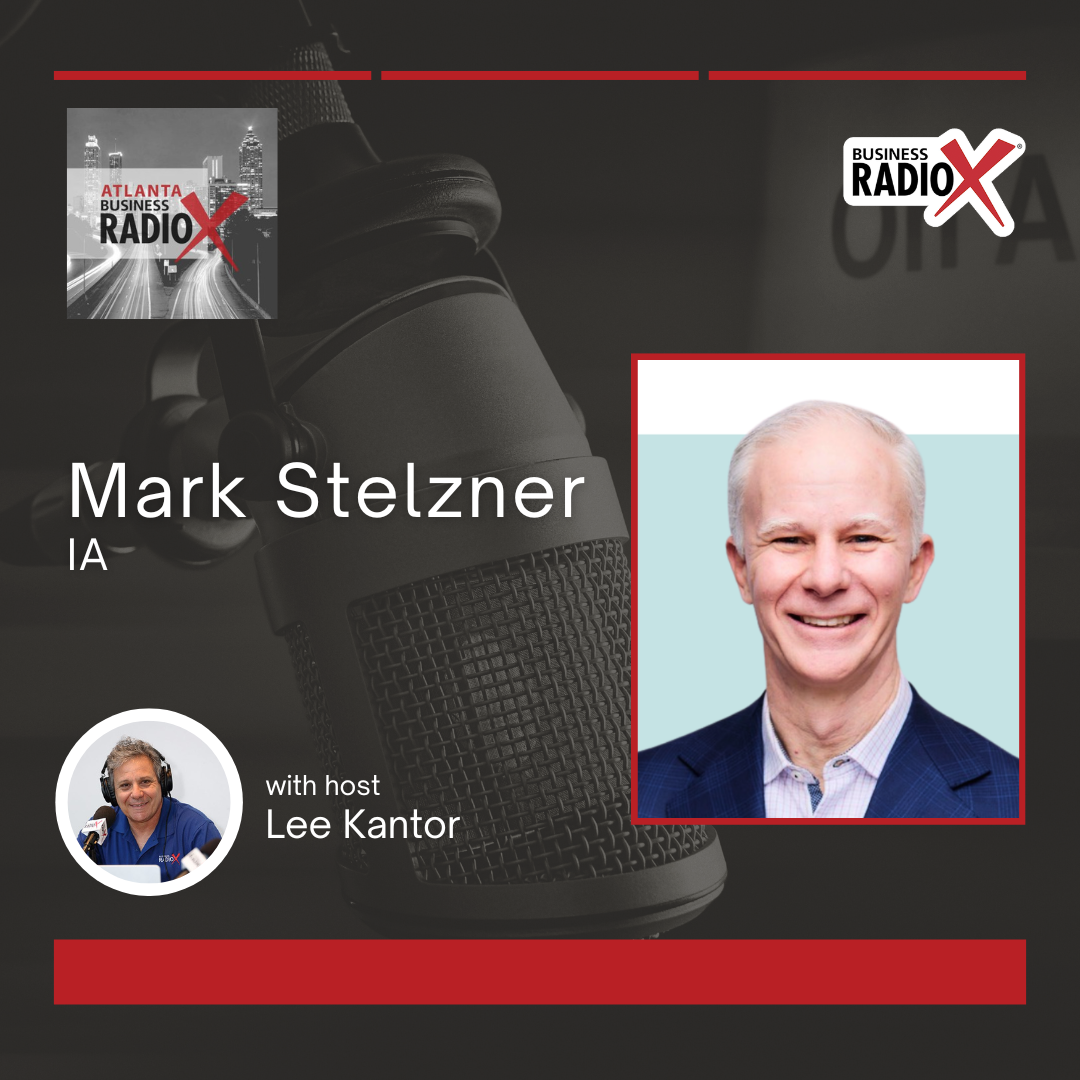

 In this episode of Atlanta Business Radio, Lee Kantor interviews Mark Stelzner, Founder and Managing Partner of IA, a consulting firm that helps Global 1000 organizations navigate large-scale people and business transformations. Mark shares insights from over two decades of advising major enterprises through mergers, acquisitions, organizational change, technology adoption, and workforce transformation. The conversation explores how businesses can scale strategically, build high-performing teams, embrace AI responsibly, and create sustainable change while maintaining a strong focus on people and organizational readiness.

 Mark Stelzner is the Founder and Managing Principal of IA, an advisory firm that helps organizations of all sizes and sectors achieve their transformation goals.
With over 30 years of experience in the industry, he is a trusted advisor to C-level leaders, offering unbiased and candid guidance on complex and strategic initiatives.
As a recognized thought leader in the HR technology and transformation space, he has been featured across hundreds of major media, industry, podcast, webinar, and live event platforms.
He co-authors a monthly column on HR transformation for Human Resource Executive, has been named a Top 100 HR Technology influencer for seven consecutive years, and is passionate about fostering relationships, sharing insights, and creating value for his clients, partners, and peers.
He is a graduate of the University of Texas at Austin.
Connect with Mark on LinkedIn.
What You’ll Learn In This Episode
- Starting small and focused creates a stronger foundation for long-term growth.
- Building a business around a clear niche accelerates differentiation and market credibility.
- Complementary leadership strengths create more scalable and resilient organizations.
- Successful transformation initiatives prioritize people, process, and organizational readiness.
- Strong relationships remain a critical driver of business growth and client success.
- Effective consultants empower clients to become self-sufficient rather than dependent.
- AI adoption delivers the greatest value when driven by business problems rather than technology alone.
- Continuous improvement is more sustainable than treating transformation as a one-time project.
- Governance and clear objectives are essential for successful AI implementation.
- Storytelling and business case development play a vital role in gaining organizational alignment and executive support.
 This transcript is machine transcribed by Sonix.
TRANSCRIPT
Intro: Broadcasting live from the Business RadioX Studio in Atlanta, Georgia. It’s time for Atlanta Business Radio, brought to you by My Global Presence, the award winning Atlanta public relations agency that elevates brands and non-profits through authentic storytelling and national media campaigns. Find them at myglobalpresence.com. Now, here’s your host.
Lee Kantor: Lee Kantor here, another episode of Atlanta Business Radio. And this is gonna be a good one. But before we get started, it’s important to recognize our sponsor, my Global Presence. If you want global visibility and meaningful impact, go to myglobalpresence.com. Today on the show, we have the founder and managing partner of IA, Mark Stelzner. Welcome.
Mark Stelzner: Thank you. Lee. Pleased to be with you.
Lee Kantor: Well, I am excited to learn what you’re up to. Please tell us a little bit about IA. How are you serving folks?
Mark Stelzner: Oh yeah. We run large scale primarily people transformation projects for the global 1000. It’s a firm that I founded a little over 20 years ago, which, if I was on video, is why I look so young and fresh. And, uh, and we support some of the largest organizations in the world as they’re navigating through moments of tremendous change, which is certainly the environment that we find ourselves.
Lee Kantor: So what’s your backstory? How did you get involved in this line of work?
Mark Stelzner: Oh my gosh. Accidentally who who chooses to get into HR transformation work? Lee that’s my question for your listeners. But I started actually studying aerospace engineering. I interned at NASA. I thought I was on an astronaut track and then, you know, time ran out, time to go get a full time job, which I did. But what I found is in every organization that I supported early in my career, that we were in the midst of transforming something. There was some catalyst for change, some reason that the organization was going through some modification, and this was back when dinosaurs roamed the earth in, you know, late 80s, early 90s. And through the course of my career, the one red thread is I like problems. I like big, messy, thorny problems. So as my career progressed and I had the great opportunity in the mid 2000 to open my own firm, I took all the lessons from working with some, again, some of the largest and complex companies that I worked for directly and decided to go after this as an advisory firm and have had the great pleasure again with working just such amazing brands and tremendous leaders over the course of the past 20 years.
Lee Kantor: Now, as an advisory firm, obviously you have some very well known competitors, name brand competitors. Any advice for other kind of challenger brands out there that are in a space where there are some, maybe incumbents in a lot of areas that everybody knows? Um, what advice would you give that leader to stand out and to differentiate themselves and to find that space where they can excel?
Mark Stelzner: I love that question, Lee, and I’ll start with mistakes I made, Lee, that I think probably lead to the advice that I would give now. Um, start really, really small. Um, when you first go out on your own or you’re coming from, let’s say an existing corporate role, for profit nonprofit, what have you, the feeling is you have to be a utility player. You have to be all things to all people. Um, but at this course in your career, you likely have both access and permission to some small segment of a small market. Start small, start where you have permission, where you have expertise, where you have existing tools, technologies, perspectives, build from the center and the core of strength. And then with permission over time through your initial client engagements, look for adjacencies. So if the center of your universe is X, what are the services that are required above and behind, you know, a heading to the side of where your core is and that’ll lead to your natural expansion. So go small in terms of scope, in terms of focus, in terms of offering. I would also say there is a tendency to try to be all things to all people in our lovely social media world.
Mark Stelzner: You know, you’re going to spread yourselves out. You’re going to use LinkedIn, you’re going to try to project to the world that you’re here and you’re trying to add value. Um, be very forensic in identifying the attributes of your perfect client. What are the challenges that they’re looking for? Where does your product or service intersect neatly into budgetary cycles? So with that small mindset, and given the fact that if you’re, you know, a founder led organization, you only have so much capacity and capability yourself, you start from a position of success and you start from a position of a pragmatic approach upon which you can build. And I would say, as always, relationships matter. Um, whether you’re introverted or extroverted, I think I’m getting more introverted over time. If I’m totally honest. Um, you know, you have to make the market aware that you exist. You have to put yourself out there, be a guest on lovely programs like yours, Lee. Um, but have a position, have a point of view and declare that definitively. Um, but again, go small to go big, I think will serve you well in any domain.
Lee Kantor: Now, when you started, was it, were you kind of founder led that you were the salesperson and the executor?
Mark Stelzner: 100%. Yeah. So I started by myself, um, and did exactly what was described. But again, some of the mistakes, you know, I’m almost embarrassed to say when I was on with executives early in the instantiation of IA, they’d ask me, well, what services do you offer? And of course, arrogant younger me would say, well, what problems do you have? And we’d get in this weird cyclical life cycle of sort of answer hunting, as opposed to me saying, well, here’s exactly what we do. I’m not sure if that’s purpose built for what you’re seeking or the challenges that you’re facing? Um, but what you’re alluding to also Li is you have to be able to sell and deliver concurrently. You can’t sit on your laurels. You have to continue to make your presence known while you’re supporting the wonderful organizations that you have the pleasure of working with.
Lee Kantor: So now, um, when you’re in there and you’re delivering value and, um, you’re kind of building outward from your, the place you started at some point, you had to find that next, uh, kind of, uh, partner in crime. How did you go about identifying who is the right fit person to join? Kind of a, an emerging firm that yours was.
Mark Stelzner: Really complementary capabilities. And I would say different capabilities were the next best move. Um, and not all individuals over the course of 20 years were a good fit for certainly the size and complexity of what we encounter these days. But, but the temptation, I think sometimes is to go immediately to who you know, or to look for individuals with the exact same characteristics that you have. My wonderful co-leader, who has been my co-leader, has been with our firm for 13 years. Um, she couldn’t be more different than me. And I mean that as a compliment. So one of the mistakes that I think I made also early Lee, is I was looking for I went immediately to folks I knew, but people you know, or people, you know, in the context of, let’s say, a like kind experience when you were working for a large organization, can’t always necessarily roll up their sleeves and play the utility player roles that you need, especially when you’re scrappy and especially when it’s new. And so I think I tried to replicate myself too early, and frankly, that didn’t scale. And what I wish I would have done has, you know, found the the co-leader that I have today, Kimberly, because we are different. And that differing perspective gives you a sparring partner and a thought partner that helps all boats rise. So I would say, um, I want someone who can carry water in some of the skills that are required in terms of marketing, storytelling, sales, etc. I need someone who can deliver, but I need someone who’s going to make things better, who, if we put everything on a blank page every year and reset, it, is going to have the kind of thought, partnership and thought leadership to look around corners or enlighten blind spots. That left to my own devices, I wouldn’t have seen.
Lee Kantor: Now, you mentioned early on that you work with the fortune 1000. Where is your sweet spot within that? Because that’s obviously broad and covers a lot of ground. Like what is the thing that separates I A from others? And what is it that you do best to help your clients?
Mark Stelzner: Yeah. So our median client today, Lee, is a 75,000 person enterprise in about 70 or 80 different countries. Our clients range in size from 1000 to 600,000 employees. Um, you know, the largest technology company in the world, the largest retail holding company in the world, so on and so forth, You know, logistics, manufacturing, supply chain, retail, healthcare, you name it. Um, one thing that sets us apart is we’re trying to eradicate the codependency on consultants. And this may sound, you know, sort of counterintuitive or antithetical to a for profit organization, but one of the premises in True North, we had, because I used to have to hire, you know, large consultancies in my prior corporate roles is I wanted to be a thought partner partner, but I also wanted to train organizations so they don’t need to lean on me forever. So our ethos and differentiation is that we’re not trying to embed and penetrate and radiate and stay forever. We’re there to add value until we until we don’t. And another differentiator is this isn’t about me. My job is to stand next to or behind the storied and capable leaders that are accountable and responsible, frankly, for these large scale transformation projects.
Mark Stelzner: But I’m not trying to self-aggrandizing my firm or myself. We are a support mechanism. And again, the goal is to drive autonomy and independence over time. The other thing is we advise on a lot of transformations that require service providers, providers of tools, technologies, even the large consulting firms themselves who, on paper you would suggest are competitors to us. We’re running those RFPs, we’re running those selections, but we don’t take money from anyone other than our clients. So we also wanted to eradicate any bias or preference based on some remuneration that may have perhaps been hidden from our actual buyers, from the C-suite among these large enterprises. And so we’re fiercely independent. We derive no revenue directly or indirectly from anyone. And therefore our guidance is without prejudice or bias. And that has led us. Lee um, you know, knock on something, but, you know, 100% net promoter score and reference ability. Um, you know, we’ve been perfect in the eyes of our clients, which certainly we work very, very hard every single day to, uh, to make sure that we’re supporting them in the way that we need to.
Lee Kantor: So but what is the pain they’re having right before they connect with you and engage with you? Is it something that is happening in the organization, or are they proactively trying to get ahead of something that could be happening? Like.
Mark Stelzner: Yeah, it’s things happening to them and by them. Um, so the, the two of them are, for example, large mergers or acquisitions. Activist investors were going private. We’re going public. There’s a big external catalyst for change of which we are reacting to. Um, perhaps it’s an impetus from the board. And we now need to execute and modify our ways of working, our operating model, our strategy, our tools and technologies, even our ethos and culture. Um, the happen by is we have initiatives, we believe that we can change, we believe we can get better. Our market dynamics are changing. We’re entering new markets, bringing new products and services. And again, a lot of our work centers on the people function or the HR function. We also support finance and IT as well. But if you think about what’s happening in the world of work, and we’ve certainly all been part of this from Covid forward, just starting with that time horizon is we’re thrust into the unknown. Um, what is AI going to do to the future of work and employment? What’s the best and highest use of internal versus external resources? How do we think about our location strategy, our service delivery strategy? How do we think about the consumption or awareness of the billions of dollars we spend in benefit programs? How do we think about, um, you know, how do we provision care? However, care is defined, uh, you know, financial, physical, emotional well-being to support our employees around the world.
Mark Stelzner: How do we navigate through legislative and regulatory complexity and then turnover, right. Um, you know, C-suite tenure is lowest than it has ever been. And so we know factually and functionally that when a new leader comes in to one of these large enterprises, that they’re coming in for a reason, they themselves their arrival as a catalyst for change. And how do we not think of transformation as a project that at the end we cut a logo cake and we celebrate and we’re done. We live in an area of continuous improvement and continuous change. So how do we build a muscle and a capability to both react to and prepare for the large level of uncertainty and chaos that we all live in, in our day to day lives?
Lee Kantor: So because there’s a new rule in my business, I have to talk about AI. And since you mentioned it, it’s now a fair game. Um.
Mark Stelzner: So bingo cards. That’s right.
Lee Kantor: Since, um, since you mentioned that you work with transformation and AI obviously is transformative. What are some of the do’s and don’ts for organizations that are trying to roll out AI or AI initiatives within their organization? Is it something that can be done kind of at a macro level, or is it something that has to be kind of team by team in order to effectively deploy it so that it is delivering on some of the promises.
Mark Stelzner: I think it’s both. I don’t think you can succeed either at a high order or a low order in isolation, but one of the philosophies that we bring forward is that it has to be process led, tech enabled. We have to start with problem statements or hypotheses or well documented use cases that we believe can be automated, augmented, supplemented, enhanced through the advent of artificial intelligence, however defined. What we find, unfortunately, is there are a lot of organizations who are buying into the notion that there’s automagical technology, and we have tech. And with this tech, I need to look for problems. We don’t think that’s effective. And we’ve seen, you know, more than our fair share of organizations spend tens and millions and hundreds of millions of dollars with little to no return on investment, because we have to start with problem statements and use cases. And so that’s one lesson learned along the way. So even as we federate this across our enterprise. We have to empower the people that are actually doing the work to raise their hand without fear or uncertainty about losing their job. To say, I see an opportunity for fixing what ails us. And a lot of that goes then to the ground game. We also have to be prepared to rapidly prototype and fail. And one thing certainly that doesn’t feel safe in today’s environment is this notion of I can fail and learn and fail again.
Mark Stelzner: There’s a drive toward perfection, and we believe in progress over perfection. We’re never going to get everything right. These aren’t magical tools. I was on with a very large healthcare organization just a few short hours ago talking about, well, is this a tool problem or is it a process problem as they’re bringing AI to their enterprise for the very first time? Um, the other thing is we have to really center on the employee experience or the end user experience, wherever the customer is. Have we thought about their journeys? Have we thought about ways in which they access and utilize these various tools and technologies? Have we thought about impediments to access? We worked with a lot of frontline organizations who have distribution centers or manufacturing centers. They don’t have devices that are authenticated that can even gain access to these tools and technology. So what’s our addressable market internally? Um, and then lastly, and more importantly, we have to really be forensic. This goes to kind of the ground game personally. We have to unpack work. So Lee, if you were going to take everything you do every single day and you were going to say, okay, what percentage of my time am I spent in maybe low value, but high volume activities that if I had the wherewithal, I’d love to spend more time preparing for my guests or upgrading my tools or whatever it may be to continue to develop and deploy your particular offerings.
Mark Stelzner: There are things that mirus down. Do we have the permission to basically say, yes, these things should be automated? And with that extra capacity, here are the opportunities that we have not had a chance to chase. The problem I’m seeing is there’s so little time that’s given for these projects and programs to be successfully measured, that we’re not reestablishing work, we’re not reskilling or upskilling our individuals, and we’re not thinking fundamentally about how work should change as a result of the advent or insertion of AI related capabilities. So it requires detail. It requires a point of view, it requires preparation, but it also requires guardrails. What’s immutable? Immutable, immovable, immutable? What is our true North? Things that we’re just not going to bend on, even if we have the choice to do so because we know we’ve lost our human way. If in fact we enable that in our enterprise. So there’s a lot of intentionality, Lee, that I see drives either success or a lack of success in these enterprise initiatives.
Lee Kantor: But how do you kind of rein in a technology that it almost has kind of infinite possibilities? And if it’s put in the hands of your really smart, innovative thinkers, it can really do amazing things while still keeping them kind of on task. Like it just the technology seems different than other technologies from the past.
Mark Stelzner: It is. Absolutely. And I think, you know, those who have really gone all in, we we see a different problem that’s emerging. So take those really smart stakeholders or technology leaders, what have you who have just absorbed and said, I’m going to create almost my own agentic organization. So think of you, Lee, as a leader. Well, my only direct reports are actually agents. And those agents work for me in the provisioning of work to a particular outcome. Or again, theory or asset that I’m trying to create. What gets a little interesting is oftentimes we can’t share those agents because those agents are learning from you. They’re listening in on today’s conversation, and they’re looking at the emails that you set up and the way you prescreen, you know, your particular guests and callers. But if you had a peer that wanted to use the logic and value of that particular agent that you yourself has trained, think of you. You’re the large language model, right? You’re you’re advising your course correcting, you’re auditing, you’re performing, you’re adjusting and you’re rereleasing. Um, a lot of that means we could have millions and millions of these things running around, but they’re in isolation from one another, not because of a technology issue, but because of a governance issue. So a lot of this has to do, again, with what’s the purposeful outcome that we’re trying to achieve.
Mark Stelzner: And there’s a lot of great experimentation going on. So we don’t want to quash that, but we have to be able to thread these technologies together into something that’s measurable and something that’s tangible. So we can basically separate signal from noise and try to quantify or qualify what we throw away and what we continue to build and iterate upon. You are 100% correct that without that kind of guardrails and governance, it can be unfettered. It can be the Wild West. And I think what’s coming home to roost right now is you’re reading the same news that I am is the cost basis. This stuff is expensive. So this notion of like token maxing, which is consuming all the possible units of AI that I possibly can. Not everybody can afford it. And the notion of democratization of AI, I think, is soon going to go away where the theory of we want everybody to use it, everyone should play in it, experimenting. We really can’t afford that. So now we’re going to end up pulling back to say, I need some justification or ROI as to why we would provision this particular capability to this org or this individual or this group, because we can’t afford for 100,000 people to play. It’s going to absolutely bankrupt the organization.
Lee Kantor: So is there a story you can share that maybe illustrates how you work with an organization and help it get to a new level? Don’t name the name of the organization, but maybe, uh, share the challenge they came to you with and how you were able to help them get to a new level.
Mark Stelzner: Yeah, absolutely. I’ll go back to my healthcare friends that I was with this morning, so my organization received. I was speaking at a conference. I met the head of HR for this roughly 6000 person healthcare organization at the conference. Um, two months later, my phone rang right before the holiday period in December and she said, we have a problem. We’re stuck. This particular organization is deploying enterprise AI. They are also looking at business process outsourcing. They are also looking at advancing their paper technology. And they are growing both organically in terms of building new hospitals and inorganically, in terms of acquiring assets in the region in which they operate. So what my team and I needed to do is parachute in very quickly. You know, the Navy Seals of transformation, assess the situation, help them with the contractual structure, with these new third parties, help them with the justification of the financials in the business case, help them organize themselves to get ready for the transformation. Stand up a program. Them prepare socialization with the C-suite and the board and basically drive alignment, readiness and, and purposefulness across this very complete notion of what they want to achieve. But it was that last mile of getting ready and getting started. So that was the moment they were pretty far along. They got as far as long as they could, and they called us to get in and get them through. And now we’ve had the great pleasure of working with them ever since for the past seven months, as now, I’m thinking about execution and ideation and change management and program management and communication styles and so on. But at the end of the day, that was the catalyst for change. Another organization that we work with is a tribal nation.
Mark Stelzner: They were looking to advance the tools and capabilities for their entire population for the very first time. So this was working with both the sovereign nation portion of the organization, call it their federal government equivalent, as well as their for profit, um, Business area around the entire transformation. This is end to end process optimization, writing down every single step of every single process that’s in scope. So think about payroll. You receive a paycheck. What’s the sausage making that goes into a paycheck? And if a paycheck needs to be corrected, what’s what needs to be done? What are literally the step by step actions to make sure that you get, in fact, a corrected pay if your time wasn’t recorded correctly or approved by your manager, there were 4475 individual steps for what happened between payrolls. And so we’re talking about efficiency. We’re talking about alignment. And the CFO who owned that function almost broke into tears because he’s like, it’s not that it’s inefficient and costing me money. It’s that my team. No wonder they’re sick. No wonder they’re working weekends. They’re having to work so hard because we haven’t given them the tools or approach or permission to change what we’ve been doing for the last 25 years. So our work is meant to be so Were detailed and elicited and brought forward in such a way that you can’t look away from the problem statement. And, Lee, one thing we do is these business cases, every business case that we’ve ever written since I founded this firm has been approved with no exception. Because this is storytelling, we have to be able to bring the unique attributes of an individual organization to life, and that’s something we’re particularly good at.
Lee Kantor: So if somebody wants to learn more, have a more substantive conversation with you or somebody on the team, what’s the website? What’s the best way to connect?
Mark Stelzner: Thankfully, you can obviously try to track me down on LinkedIn at Mark Stelzner or go to iatransforms.com.
Lee Kantor: Well, Mark, thank you so much for sharing your story today. You’re doing such important work and we appreciate you.
Mark Stelzner: Appreciate your time. Lee. Thank you again.
Lee Kantor: All right. This is Lee Kantor. We’ll see you all next time on Atlanta Business Radio.















