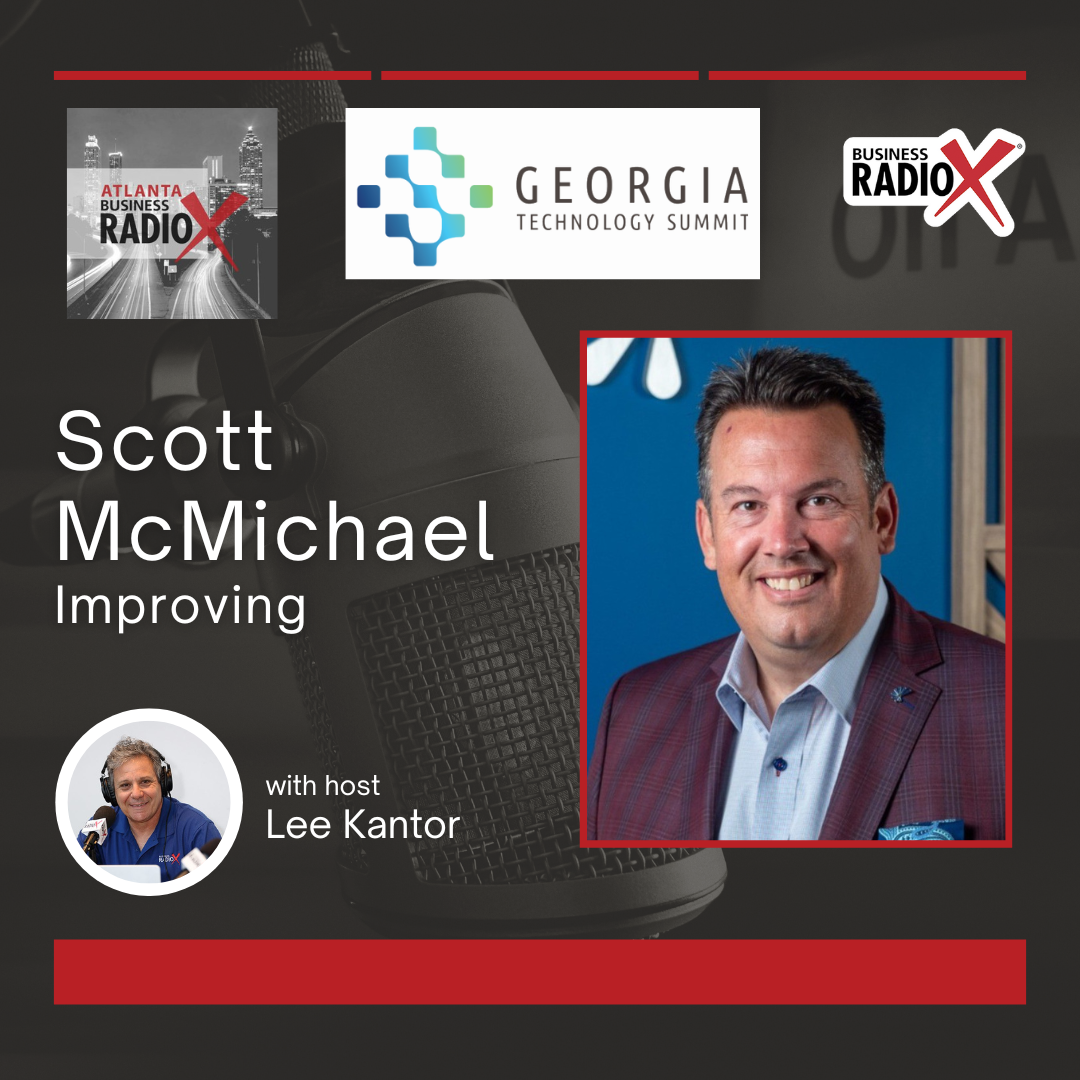


Georgia Technology Summit brings together 1000+ Georgia-focused technologists to network, learn, and engage with the latest trends in Georgia innovation. This year’s summit was held at the Woodruff Arts Center, a stunning and iconic cultural landmark located in the heart of Midtown Atlanta.
 Scott McMichael serves as Managing Director of North America at Improving, supporting the enterprises and having oversight of Improving’s strategic service offerings.
His primary focus is growing and positioning the company for greater impact across North America to positively change the perception of the IT profession. This includes business development, delivery excellence, plus attracting and growing technology professionals by creating a great work culture.
Prior to working with Improving, Scott held multiple leadership positions for consulting organizations – President and COO at Innovative Architects, which was acquired by Improving in 2019, and VP of Operations & Delivery at American System Corporation/Thoughtmill. As an energetic technology leader, Scott is passionate about assembling dynamic teams that deliver enterprise platform solutions.
He is a Georgia native, having served the client and his community of North Metro Atlanta for his entire career. He serves on the Alpharetta Chamber of Commerce Board of Directors, and is an active member of Conscious Capitalism’s Senior Leaders Network. Scott is a graduate of Southern Polytechnic State University and resides in Milton, Georgia with his wife and four kids.
Connect with Scott on LinkedIn.
 This transcript is machine transcribed by Sonix.
TRANSCRIPT
Intro: Broadcasting live from the Georgia Technology Summit 2025 at the Woodruff Arts Center. This is Business RadioX. And now here’s your host.
Lee Kantor: Lee Kantor here broadcasting live from the Georgia Technology Summit 2025. So excited to be talking to my next guest, Scott McMichael with Improving Atlanta. Also on the Tag board of Directors and co-chair of today’s event. Welcome, Scott.
Scott McMichael: It is good to be here. And it’s an active scene here in the lobby, isn’t it, Lee?
Lee Kantor: Yeah, there’s a lot of energy, a lot of excitement. So many people, so many familiar faces. How has the event evolved since you’ve been involved with it?
Scott McMichael: So this year I had the opportunity to be co-chair, and about halfway through the process, Larry Williams, who’s CEO of Tag, said, hey, I got a great idea. Why don’t we get a head start and start planning next year as well? So we’re trying to to to get ahead of things for next year. But the when you think about the evolution, I think that, um, there was a topic out there in the world called AI, the quantum verse. How long were we going to be able to ignore that? Now no one’s running around a tag event giving you their tip top secrets or or sharing their intellectual intellectual property on, on fobs or or through through some sort of, uh, agent. But this is a this issue is a big economic issue. This issue affects how we see data centers coming into our local economy, this issue of how we tackle AI. Um, I’ll use the term inside of my own business. They who who, uh, harness AI win the day. And we’re in the technology business, so we have an obligation to help our clients understand at really every level of their business how they’re connected to AI. So as we look at it through the lens of tag, we don’t have a choice but to address this topic from really every single angle. And that’s how they’ve structured that content for our guest today.
Lee Kantor: Now, how do you help your clients kind of decide what should we lean into when it comes to AI and what should we say? You know what? This is a human to human interaction that we don’t want to, uh, avoid happening. We want more human to human interaction. So how do you kind of, um, I was talking to another guest, and I mentioned this, like, just because you have a hammer doesn’t mean everything’s a nail. You. Part of being smart about this is knowing when to use the appropriate tool for the appropriate work that needs to be done.
Scott McMichael: It is a great question, Lee. And and you can print this on a fortune cookie tag, but, um, make no assumptions about how the client and where the client places their intellectual value, right? So we’ve done business with a nonprofit to build a registration system that now incorporates AI to that, that organizes camps for kids. Well, it sort of seems like that’s been done or is available and off the shelf. And you could go to CompUSA and pull cellophane right off the shelf, right. But that interaction and how they work with sponsors, how they interact with parents, is what they think is their most special sauce, their most special intellectual property. So that’s what we really try to get to the core of is, is this what makes you different, or is this what you have to have? If you have to have it, then there probably is a hammer on the shelf. If this is something that makes you uniquely different, then how do we uniquely deploy this sort of product scenario that that separates you out in the market? Because without that differentiation, it’s just an expensive. How did we end up with this on our cap table?
Lee Kantor: And it’s one of those things like um, when it comes to at one point there was the technology of I’m going to call somebody and they’re going to route me five times through some phone tree, right. And at one point, that was supposed to be elegant, and at one point that was supposed to solve some problems, right? But it just frustrates their customers a lot of times. So how do you kind of prevent AI from being that?
Scott McMichael: It’s it’s the scenario was actually spoken about on our stage today with Brett Taylor, who’s an aficionado at this sort of user experience. Um, when I look at those differences, I sort of say, uh, the difference in yesterday’s technology or an IVR technology like that is, is something that you can draw out in a, in a serial process, right? We could workflow that we could understand it, we could comprehend it, comprehend it. We could, uh, put together the marketing people, the product people, the technology people. We all now understand that one comes before two and two comes before three. This isn’t how we think about things anymore in technology at all, right? That interwovenness that speed of experience is just expected from those clients. And so now when we think about, uh, artificial intelligence and these, uh, agentic workflows, doing some thinking for us, we really believe that some of that thinking is good thinking, that that ability for me to not have to go through three steps. Step two, step three, step four, but to be able to skip to step five and really get to the right best, uh, solution for my answer. Solution to my problem. And maybe or maybe not. Do I speak with an individual human? Um. Those humans, we hope, upskill and become more and more intelligent. More and more, uh, higher, high skilled, more and more knowledgeable of the thing that they’re trying to solve for us. You know, we’ve been talking about, uh, technology replacing human capital since I started in this business 30 years ago, just at the onset of the web. I’m not sure I’ve replaced any jobs so far, actually, but I hope I have upskilled jobs along the way.
Lee Kantor: Now, from an improving Atlanta standpoint, who is the ideal customer for you improving?
Scott McMichael: Uh, Atlanta is our local office. We are part of a now global organization, and we have found we have this conversation on a pretty regular basis. It isn’t based on an industry, a technology, a a choice of technology platform. For us, it is the innovators, the people who have already decided that they’re not just a, a, an organization who needs enabling technology, but they’re an organization that is a technology organization that whether they ship pallets or make candies or order, uh, or provide pizzas to parties, they’ve already decided that a technology connected supply chain is what will differentiate them. It’s in the core of their business. We don’t want to be fighting an uphill battle on. Are we sure we need an app? Did we ever need the website? If you think about prior, you know, major decisions. So for us it is. It’s the group that’s like we’re enthusiastic about making ourselves different and really of more value through technology, regardless of of industry or tech.
Lee Kantor: And then so what is that problem that they’re having that it’s just not working as well as they’d like, or they’re frustrated by some element of it where improving is going to be able to improve their situation.
Scott McMichael: It’s a good question. One of the first, uh, things that we find is people have a a good fear of technology debt lest don’t get behind the eight ball. Are we still, uh, staying competitive? Do we have the tool sets now that are at our fingertips, that only the largest fortune 1000 could have had access to before? Can we now be the right size fish in that right size pond and leverage enterprise technology and elevate ourselves? Let us sit side by side with the top fortune companies. And so those are great conversations to have.
Lee Kantor: So you focus on mid market. Is that kind of your.
Speaker4: I would say.
Scott McMichael: Upper mid market. Um but there is no client that has been too small or too large in the last uh in the last year. So uh, some of our competition has really focused in and decided that there is a, a profile of client. That is where they need to focus. It’s where they are best situated. It’s the right size problem, the right size budget. We haven’t made that step yet. In our business, you find that we are sort of what we call a global boutique. We want to deploy local, um, in-office if we can, collaborative product development and systems integration and a sort of in that boutique way, like you really are collaborating and arm in arm and building that next, uh, piece of technology, but then be able to deploy globally when it’s time or when it’s time for that total cost of ownership or when it’s time to get to some more, to maybe less innovation and more operational, uh, stages of your products development.
Lee Kantor: So what do you need more of? How can we help you?
Scott McMichael: That’s a great question. It is always a pleasure to have Business RadioX present, uh, promoting what it is we do, uh, in, in the technology community across not just Atlanta, but across Georgia. I think that the more my sort of I see this as my sort of second career in tag, um, where I am in my career and where I am in my community is we want to make sure that everybody understands that when they send their kids off to MIT and these in Stanford and all these great, uh, institutions, that they know that that educational system is just as strong right here. Um, I think sometimes in our technology organization in Georgia, uh, the kids driving down the road would say, I have no idea what’s going on on the other side of that concrete wall. I believe that where you can help us and where we need to help ourselves, is to promote that vitality of the technology market that is right within our reach, a growing, booming leading technology market across Georgia.
Lee Kantor: And then, like you said, cast that wider net and not define technology so narrowly.
Scott McMichael: Well said.
Lee Kantor: So if somebody wants to connect with you, whether it’s about tag, whether it’s about next year’s summit or improving Atlanta, what are the best coordinates for you?
Scott McMichael: Absolutely. Reach out anytime. Scott McMichael at improving. Com or hit me up on LinkedIn.
Lee Kantor: And then improving his website.
Scott McMichael: Improving. Com.
Lee Kantor: Well Scott, thank you so much for sharing your story today. You’re doing such important work and we appreciate you.
Scott McMichael: Thanks, man.
Lee Kantor: All right. This is Lee Kantor back in a few. At Georgia Technology Summit 2025.














