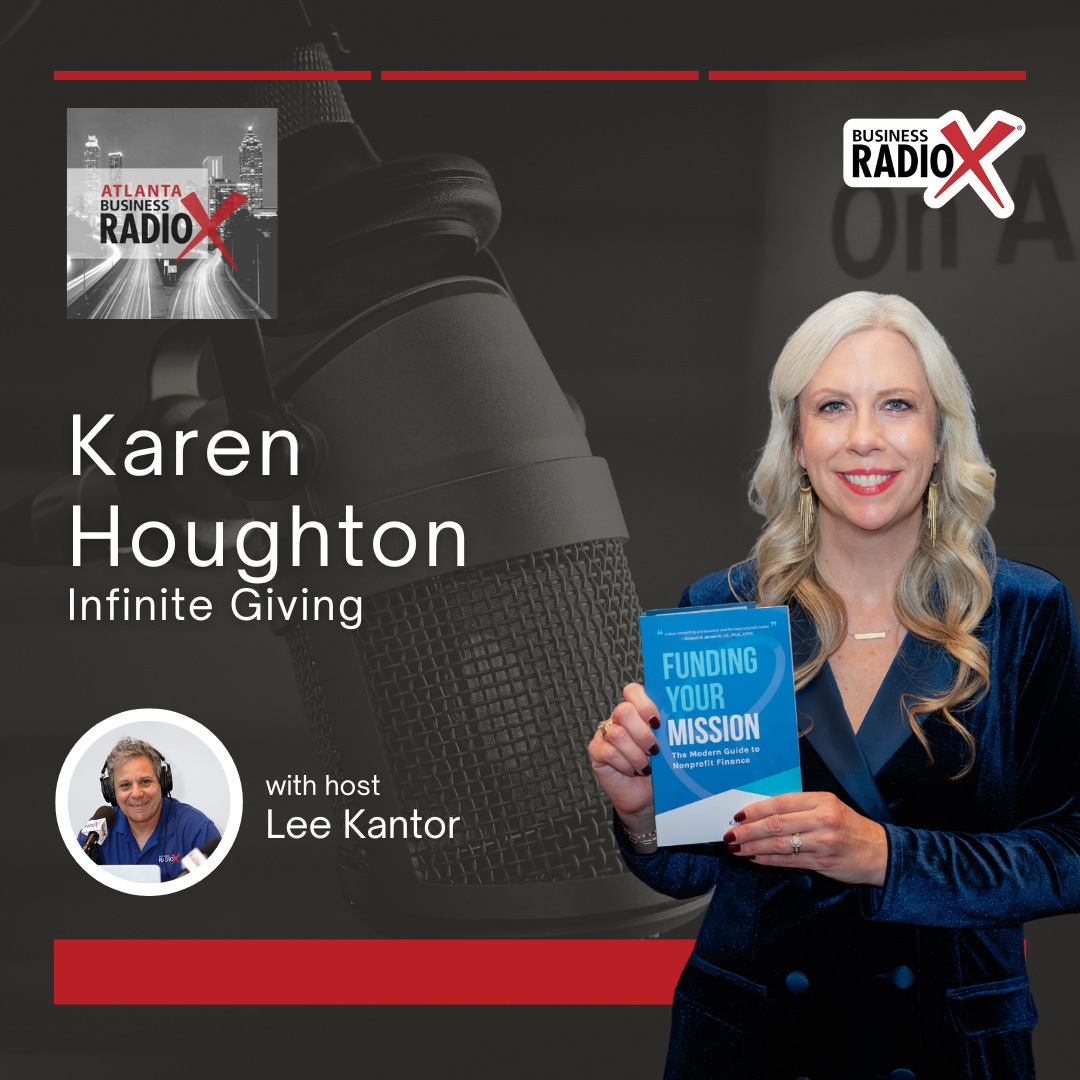

 In this episode of Atlanta Business Radio, Lee Kantor interviews Karen Houghton, CEO and co-founder of Infinite Giving. Karen discusses how Infinite Giving empowers small to midsize nonprofits by providing tailored financial technology and investment advisory services, including streamlined brokerage accounts and support for accepting stock gifts. She highlights the challenges nonprofits face in accessing sophisticated financial tools and shares how Infinite Giving bridges these gaps, helping organizations achieve financial sustainability and amplify their impact. Karen also introduces her book, “Funding Your Mission,” and encourages nonprofits to leverage these resources for greater growth and stewardship.

 Karen Houghton is the CEO and co-founder of Infinite Giving, a Registered Investment Advisor that helps nonprofits build financial sustainability.
With a background in both nonprofit leadership and venture capital, Karen brings a rare blend of heart and strategy to financial stewardship. She is passionate about democratizing access to wealth-building tools and guiding mission-driven organizations toward long-term financial health.
As a trusted advisor and advocate, she is reshaping how nonprofits think about money as a powerful resource for growing impact. Her work empowers tax-exempt entities to grow their assets, weather uncertainty, and fund their futures.
Connect with Karen on LinkedIn.
What You’ll Learn In This Episode
- Challenges faced by small to midsize nonprofits in managing and investing funds.
- Importance of financial sustainability for nonprofit organizations.
- The gap in financial services tailored to nonprofits, particularly smaller ones.
- The role of Infinite Giving in facilitating stock gifts and providing brokerage account services.
- Discussion on the limitations of traditional financial institutions for nonprofits.
- Strategies for nonprofits to manage cash and investments more effectively.
- Introduction of the book “Funding Your Mission: The Modern Guide to Nonprofit Finance.”
- The impact of streamlining the process for accepting stock gifts on nonprofit funding.
- The importance of fiduciary oversight and support for nonprofit financial management.
 This transcript is machine transcribed by Sonix.
TRANSCRIPT
Intro: Broadcasting live from the Business RadioX studio in Atlanta, Georgia. It’s time for Atlanta Business Radio, brought to you by Kennesaw State University’s Executive MBA program. The accelerated degree program for working professionals looking to advance their career and enhance their leadership skills. And now here’s your host.
Lee Kantor: Lee Kantor here, another episode of Atlanta Business Radio. And this is going to be a good one. But before we get started, it’s important to recognize our sponsor, CSU’s executive MBA program. Without them, we couldn’t be sharing these important stories. Today on the show, we have the CEO and co-founder of Infinite Giving, Karen Houghton, welcome.
Karen Houghton: Thank you. Good to be here, Lee.
Lee Kantor: Well, I’m excited to learn what you’re up to. I’ve been following your career for quite some time. For folks who aren’t familiar, can you share a little bit about infinite giving? How you serving folks?
Karen Houghton: Yeah, infinite Giving is a financial technology and investment advisory firm that exclusively serves nonprofits. So we are a fiduciary partner for tax exempt entities. And we are one place that can help them raise money, invest money and steward their money.
Lee Kantor: So what was kind of the genesis of the idea? How did you get involved in this line of work?
Karen Houghton: Well, I had a ten year career in the startup tech ecosystem in Atlanta as well as venture capital. I was a venture partner with Atlanta Ventures, but before that, I was actually the founder and executive director of a nonprofit. And so I’ve had the unique experience of filing for the 500 1C3 and being the fundraiser and working with boards. And then also as I grew into finance and deal size. I started serving on a lot of boards. So I’ve served on small nonprofit boards where we’re in a scarcity mindset, trying to build up our first reserve fund all the way to serving on the board of trustees at Barry College, right where we have a small $2 billion endowment. And so there’s a lot of different nonprofits out there. And our goal really is to serve the small to mid-size organizations who maybe are just with a bank or not sure what their investment strategies are or don’t even have a way to receive stock gifts. And that’s who we want to help, because we have a really passionate and firm belief that the more nonprofits that are financially sustainable, then the better our communities and and society will be. They’re often the ones doing some of the most important work at hand.
Lee Kantor: Now, do you have a niche within nonprofits? Do you focus on a certain type of nonprofit?
Karen Houghton: Yeah, We currently serve. As of today, we currently serve about 400 different nonprofit organizations all over the US, and they are in different industries. So we do a lot of national parks, schools, libraries, churches, ministries. So a bunch of different organizations. Probably what we’re defining is small to midsize is under 25 million in securities and savings.
Lee Kantor: So what is kind of the pain that they’re having where they’re like, I should contact Karen and her folks.
Karen Houghton: Well, what a lot of people don’t realize is that banks existed for more than a hundred years before the first tax exempt entity even existed. So if you’re listening to this and you are a business or retail client in the finance world here in the US, you’re like, what do you mean there’s no problems? All of this is so easy. If you are a tax exempt entity and you’ve done something like tried to open a brokerage account, or you have tried to get really good fiduciary advice from somebody who understands nonprofits, you realize it’s actually a lot harder than you think. 90% of nonprofit organizations in the US don’t even have a brokerage account. And because of that, they’re limited in how they can steward the funds they have. They can’t have endowments. They aren’t able to receive stock gifts. So it’s really quite limiting. And those major donors love to give those tax efficient gifts and those larger gifts. So what we’ve seen happen is that the big organizations stay really big. The small organizations stay really small because of the financial limitations that they face. So infinite giving is bridging that gap and trying to make it all easier and more accessible in a place made for them.
Lee Kantor: So the smaller ones are out there. They’re just getting like cash donations. That’s how they kind of mainly survive.
Karen Houghton: Yeah, and they have money sitting in a checking account sitting in a low yield savings account. If they’re wild and crazy, sometimes they are investing in a CD, right? Uh, but that is not the way that most savvy business folks or businesses actually grow, right? Most of us are in the market in some way, shape or form. Even if you have a retirement account, a 401 K, you are in the market. And the reason large non-profits and retail and business clients do that is because it works. Um, and so what’s interesting is that you take the nonprofit sector where financial stewardship is perhaps the most important. And we’re saying, actually, you only should have access to a checking and a savings account. Yes. Just leave. Leave donor money in a bank losing value to inflation because that’s responsible. So sometimes what feels safe to nonprofit leaders and donors is actually not good stewardship. We actually there’s a lot of really conservative ways where we can steward what we have as we seek. Financial sustainability as as organizations.
Lee Kantor: Now, um, for a lot of your clients, are you the first conversation they’re having about this or have they tried this before and it didn’t work out? Or are you the kind of the first person that said, okay, you’re unlocking a whole new potential area for financial stability and growth?
Karen Houghton: Huh? It does vary. Uh, we serve organizations where we’re their first brokerage account, and they’re asking questions like, can a nonprofit even invest? What are we allowed to do? Uh, there’s other, much more savvy organizations we serve, I think 46, in the Atlanta area. And they are oh, we have an investment account with our bank or someone’s brother’s uncle, uh, is investing our funds for us. And then often we’re like, great. What’s their nonprofit expertise? Where’s your investment policy statement? What fees are you paying? Uh, your funds are in a community foundation. What does that fee structure. And often just doing an audit of where are our funds? What are those returns? Why are they there? What are the fees? Um, how are we stewarding them with intention is a really helpful process that those volunteers or those, um, advisors who are helping, uh, those nonprofits may not have that expertise that’s needed.
Lee Kantor: Now, is your service like an advisory service where you’re kind of coaching them on how to do it? But are you also the place where they can, um, invest their funds?
Karen Houghton: Yes, we do both. So we are a registered investment advisor. So we do financial planning with them where we work through short term, mid term, long term strategies, whether it’s hey, do you want an FDIC sweet program so you don’t have to have six different banking partners to, you know, not go over your 250 K FDIC coverage to a brokerage money market, which is better than bank money markets typically. Right. And then we get into investment strategies where we do a lot of endowment creation, long term, uh, financial management disbursements, things like that. So yes, we’re investment advisors, but it often starts with cash. And how do we steward that cash? I actually have a book, uh, that we published called Funding Your Mission, and it’s a modern guide to nonprofit finance. You can find it on Barnes and Noble on Amazon. We’ve been a bestseller in nonprofit. Uh, but it talks through a lot of that of of hey, how do we think about moving from a scarcity mindset to a strategy mindset that ideally leads to sustainability? Or, hey, you have a checking account and you have an investment account, but isn’t there a whole bunch of funds that kind of sit in the middle right where you could have this midterm, like, hey, maybe you’re in fixed income, maybe you’re in mutual funds where you can grow cash in a conservative way. Um, and then even having, you know, the strategy and framework to use with boards and donors on, on how to move in that direction is quite helpful and often lacking in banking partners.
Lee Kantor: Now, can you share the story? Maybe early on when you had this idea and you were going to approach some non-profits? Can you share maybe that moment where somebody you know was your first client, or the first person you talked to and advised that helped them get kind of a return or an outcome that you were like, okay, this is something that that I can I’m getting traction. I have something here that’s going to help a lot of people.
Karen Houghton: Uh, sure. Like in our early, early days, uh, you know, we did a lot of customer discovery. We did over a hundred, uh, nonprofit leader interviews. Definitely made sure that we were building something with a large market. Um, the small to mid-size nonprofits, which is under 25 million, is securities, and savings is actually a $500 billion market here in the US that is incredibly underserved. Um, so we knew the market. We knew we had a lot of the data points. Um, and then once we launched, uh, I don’t think Aaron would mind me sharing this. So Aaron Hurst was the executive director of Endeavor Atlanta. And I sat down with him and he was like, yes, I understand the problem you’re solving, I experience it. I know we should be doing more with the funds we have. I know I should be receiving stock gifts. We don’t have access to any of that. There’s not an easy way to do it. Sign me up. And we had a few of those, um, just right out of the gate where it was a. Hey, we’ve got money that we want to. We want to work in steward. Uh, better. And we also want to open up those giving paths, um, to, to more of our donors. It may seem silly, but opening a brokerage account for a nonprofit, you and I individually can go online and do it in five minutes.
Karen Houghton: When you’re a nonprofit, it’s generally a 50 plus page application that requires wet ink, snail mail, and can take up to 12 weeks just to open a brokerage account. That’s why 90% of them plus don’t. And then there’s high minimums. A lot of organizations require, you know, a $2 million minimum, a half $1 million minimum. And that’s where it becomes really limiting. But we are one of the only firms that has the ability to streamline the entire painful process for a tax exempt entity. In fact, we have the only online brokerage account opening that exists for nonprofits in the country. So we take this very painful snail mail waiting 12 week process. And it’s a 30 minute appointment online and we have them up and going in three business days. Uh, and so we are trying to streamline all of that because again, we’re not serving business retail. And oh yeah, some non-profits, we were actually created to exclusively serve non-profits, which means we’re able to streamline a lot of the complex compliance requirements that non-profits have. We were made to serve them. So we solve a lot of pain points that they that exist for them in the traditional financial system.
Lee Kantor: And it sounds like the pain points are at the beginning, so that it would kind of preclude them from even starting, because it’s just too cumbersome to even attempt to begin because like, you know, whenever you have one of those situations where it’s it’s that difficult to apply. People just say, you know, they try it maybe, and then they get pushback and they’re like, why are we doing this is a distraction. There’s, you know, we should be doing other things where they’re missing out on a huge opportunity.
Karen Houghton: Right? It takes away from the mission. When something administrative becomes such a heavy lift, it becomes a burden rather than an opportunity. And it shouldn’t be that way. And even organizations who are like, okay, yes, we went through all that process ten years ago. We have a Vanguard account. Um, you know, it’s still like, great. Well, who’s rebalancing your accounts? Um, who’s suggesting no strategies? Who’s pulling your investment policy statement? Um, who’s looking at what other nonprofits are doing and helping with audit support? Oh, you receive stock gifts. Did you do the manual? You know, verbal confirmation? Did you sell it? Did you transfer the funds? Did your finance team create the receipt? It’s a very manual process, um, that we streamline all of that from receiving the gift to managing an endowment, handing the annual disbursement. So it’s more than just a strategy. There’s a whole process. Um, that’s very compliance heavy for tax exempt organizations, uh, that we really help streamline and lighten that lift, whether it’s their first time or they already have an investment strategy and they have a structure in place, but it’s still very manual. They don’t have that consistent fiduciary oversight. It’s somebody on the board who’s a volunteer. What do you do when that person rolls off the board? What do you do when you have three investment advisors on the board? You have conflict of interest. So really, the best practices for nonprofit organizations are to outsource, have an affordable, consistent fiduciary oversight that works very closely with the boards on that now.
Lee Kantor: Um, is there a story you can share regarding the once they unlocked, um, you know, people being able to donate and, uh, gift stocks that maybe they were skeptical or they were like, okay, let’s try it, but we don’t know. And then all of a sudden they got, you know, more than they had even imagined.
Karen Houghton: Absolutely. Well, the average online cash gifts like credit, debit online is $128. The average stock gift on a national level is $8,000. So these tend to be much larger gifts. Through the Infinite Giving platform, it averages closer to $14,000. And the reason these gifts are bigger, they’re less common, right? It’s anyone listening who is a donor. Right. It’s highly tax efficient to give stock gifts. Most of us hold the majority of our wealth in securities. And so you’re able to avoid paying capital gains taxes. And you get to deduct the full value of that gift. So it’s incredibly tax efficient to do so. Which is why those often tend to be larger gifts. So whether we’re streamlined, they already are doing it. And we’re streamlining a very archaic manual process. Uh, Or we’re allowing them to do it for the first time. Uh, it is a joy for us because we are seeing donors be generous. We are seeing non-profits be good stewards and do great work, and we get to be that processor and the bridge that connects those two.
Lee Kantor: So you’re seeing so sometimes you’re kind of unlocking something new and it’s dramatic, the amount of impact that’s coming to their bottom line and how many people they can serve and help and all that stuff.
Karen Houghton: Absolutely. It’s more tax efficient for the donors. It’s larger gifts for the non-profits. And then even if they’re already in that process, we are massively streamlining that experience, both for the nonprofit finance teams and the donor. So we’re increasing transparency and the administrative burden on a very traditional process.
Lee Kantor: And you mentioned that this, uh, this can you serve a variety of nonprofits so they could be a church, they could be an association. They could be any type of nonprofit.
Karen Houghton: Absolutely, yes. So any tax exempt status we can serve you.
Lee Kantor: And and that means even, um, you know, a family, um, what is it called, the family foundation or things like that? Trust foundation.
Karen Houghton: We can serve we we serve some foundations. Uh, here in Atlanta, we serve Venture Atlanta, we serve fintech Atlanta. So those would be associations. Uh, we serve a lot of charities, um, land trusts. Uh, so, yeah, a wide variety if there are multiple types of tax exempt statuses. But if you’re tax exempt, we’re able to serve you.
Lee Kantor: So if somebody wants to learn more, connect with you or somebody on the team or get a hold of that book, Funding Your Mission The Modern Guide to Nonprofit Finance. What is the website? What’s the best way to connect?
Karen Houghton: Yeah, funding your mission you can find on Amazon. That’s just a great resource to give to board members or your finance teams that is like, hey, here’s a framework that makes sense. We try to do a lot of storytelling. So for a finance book, uh, it’s pretty engaging. We got a lot of free resources in there. If you’d like to learn more, uh, we’d love to see how we can best support you. You can find us at Infinite Giving. Uh, and you can schedule a free consultation with us. Uh, you can do a 15 or 30 minute call, uh, and we can talk you through things. Uh, and, of course, you can email me directly if you’d like. Karen at infinite.
Lee Kantor: Com so what do you need more of? How can we help you?
Karen Houghton: We want to help more nonprofits. Uh, and so really, it’s sharing and spreading the word, uh, and making sure that more nonprofit organizations have efficient tools made for them who can essentially help them, you know, steward what they have with wisdom and ease.
Lee Kantor: Good stuff. Well, congratulations on all the success. Um, and, uh, thank you for everything you’re doing. You’re doing such important work, and we appreciate you.
Karen Houghton: Thank you. Lee, I appreciate it. It’s an honor. The when we look back and we see hundreds of nonprofit organizations who are becoming more financially sustainable. It is the greatest honor because these people are some of the most passionate folks doing some of the most important work, and we just get to be a small part of their journey. Uh, as they do that work.
Lee Kantor: Right. But the impact is real. I mean, the impact you’re having in the ripple effects that it’s causing. It’s just extremely, I’m sure, rewarding work.
Karen Houghton: Absolutely. I mean, to date, we’ve helped create more than $30 million in additional funding for nonprofits we serve.
Lee Kantor: Wow. Amazing story. Congratulations again.
Karen Houghton: Thank you. Lee. Appreciate it.
Lee Kantor: All right. This is Lee Kantor. We’ll see you all next time on Atlanta Business Radio.














