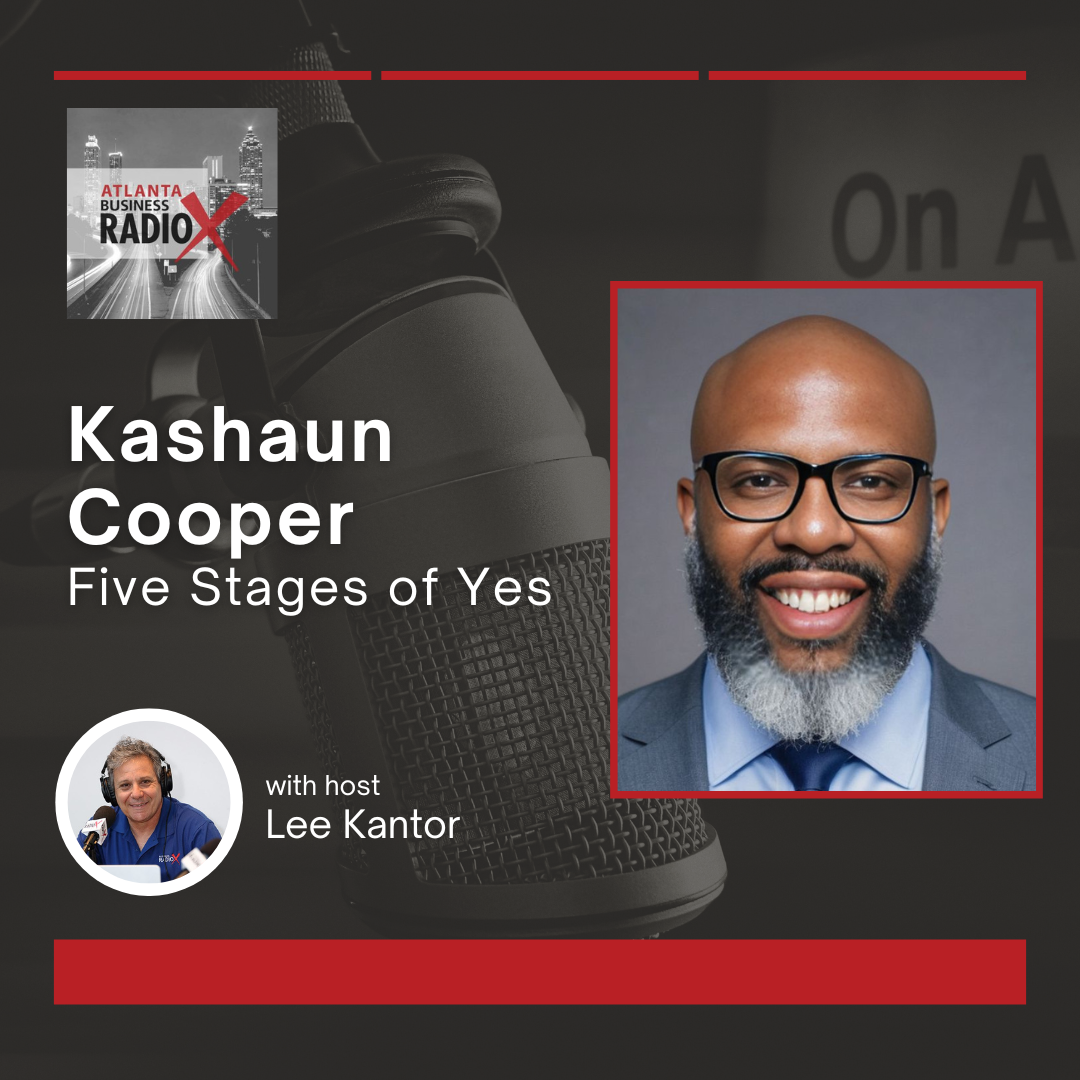

 In this episode of Atlanta Business Radio, Lee interviews Kashaun Cooper, founder of the Five Stages of Yes Leadership and Development Institute. Kashaun discusses how leadership under pressure reveals true behavior, not just intentions. He explains that mental toughness can be learned by identifying “pressure entry points” and practicing new responses. The conversation covers preparing teams for high-stress situations and the importance of aligning words with actions. Keshawn also introduces his Pressure System Index tool and shares insights on building resilient leadership in pressure-filled industries. Listeners are invited to connect with him for further resources.

 Kashaun Cooper is a Leadership Systems Architect and the founder of the Five Stages of Yes Leadership & Development Institute. His work focuses on how individuals and organizations respond when pressure rises.
He is the creator of the Pressure System Index (PSI) and the Responsibility Flow Diagnostic™, tools designed to make invisible behavioral patterns visible inside teams and leadership structures.
He works with founders, executives, and nonprofit leaders to help them identify default responses, clarify decision ownership, and stabilize performance in pressure-saturated environments.
Connect with Kashaun on LinkedIn.
What You’ll Learn In This Episode
- Leadership under pressure and its impact on behavior.
- The distinction between pressure creating behavior versus revealing it.
- The concept of mental toughness and its learnability.
- Identifying and understanding personal pressure entry points.
- Preparing teams for anticipated high-pressure situations.
- The role of scenario mapping and role-playing in team preparation.
- The Pressure System Index (PSI) as a diagnostic tool for pressure management.
- The importance of congruence between leaders’ words and actions under stress.
- The timeline for behavioral change and the formation of new habits.
- Industries particularly affected by high-pressure environments and the need for effective leadership.
 This transcript is machine transcribed by Sonix.
TRANSCRIPT
Intro: Broadcasting live from the Business RadioX studio in Atlanta, Georgia. It’s time for Atlanta Business Radio, brought to you by Kennesaw State University’s Executive MBA program. The accelerated degree program for working professionals looking to advance their career and enhance their leadership skills. And now, here’s your host.
Lee Kantor: Lee Kantor here, another episode of Atlanta Business Radio. And this is going to be a good one. But before we get started, it’s important to recognize our sponsor, Ksuz executive MBA program. Without them, we wouldn’t be sharing these important stories today on the show. We have Kashaun Cooper, who is a leadership systems architect and founder of Five Stages of Yes Leadership and Development Institute. Welcome.
Kashaun Cooper: Hey, Lee, thank you so much, man, I appreciate it. Thank you so much for allowing me to be here today. I look forward to this conversation.
Lee Kantor: Well, I’m excited to learn what you’re up to. Tell us about the five stages of Yes Leadership and Development Institute. How are you serving folks?
Kashaun Cooper: Man, man, this is a topic that I can talk about for hours. And I know we only have a few more a few moments. So I’m going to give you the, um, the abbreviated version, you and your listeners. So I’m the founder of the Five Stages of Yes Leadership and Development Institute. And, and where did that come from? Over the course of my, my working years, ever since I was a manager in my 20s. Now I’m in my 40s and I, I’ve been, I’ve been seeing a lot of things. I’ve seen a lot of things. I’ve been observing, observing a lot of things. There’s a lot of things that caught my eye in leadership, things that I did, certain behaviors and Responses that I did. And I looked back at myself and said, Keyshawn, why did you do that? And then I also looked at other leaders, my direct reports of the leaders, my my peers, my colleagues. And we will have discussions, uh, prior to certain situations. And then after the situation would take place, I would go, I would go to them and say, what happened? They would say, man, it was rough, man. It was just rough. And I had to do what I had to do. So over the course of my professional career, I studied how individuals and organizations behave when pressure rises. And my work is pretty simple, pretty simple to explain. Although I can talk for hours about it, it’s not when things are calm, it’s not when things are challenging, but when decisions, uh, actually matter. When timelines get tight, the walls are caving in on you, expectations are increasing. That’s when people are and when people are dependent on outcomes. That’s where I focus, because that’s where you really get to see how people operate. And that is the basis of the five stages of yes Leadership and Development Institute.
Lee Kantor: So what happened in your life that that you said, okay, I have to now dedicate a good portion of my career to work on this challenge. Like, what made you think that you have some unique ability to help people solve this for themselves?
Kashaun Cooper: That’s a that’s a great question. So it wasn’t just one thing that happened, Lee. It was a culmination of things, uh, down through the years. But what really, really tipped me over is when, um, I was a manager for a restaurant, a sports bar, and, um, I would have my, my manager’s meetings on Mondays and we would lay out all the expectations and, and, um, when, when the manager’s meeting is over, I’m, we slap in five, we’re going over expectations. Everybody’s excited. Everyone is clear, at least from my standpoint, and even they nodded. It let me know they were clear with it. But when it was time to go back into the kitchen and when the dinner rush would come, or on a Sunday or Saturday night or or Super Bowl or fight night, when those, uh, when those situations were arise, I started to see how those behaviors and what we talked about, the SOPs, all of those things went out the window. None of that mattered. So it was that event or those events during that time frame of working with that organization that I got to see really, really close how people say one thing and do another. And that’s when I concluded that even in myself, uh, I would say one thing I knew I knew what to say. I had the right belief. I had the right words. And when, when pressure hit us, um, we sort of changed directions. And that’s when I concluded that pressure does not create behavior. Pressure reveals it. Pressure exposes the structure of the organization and of the system. Pressure exposes, uh, decision patterns and, and most importantly, pressure exposes, uh, leadership behavior.
Lee Kantor: So now, do you think that the ability, the mental toughness, the ability to handle pressure, uh, is that something that there’s things you can do to learn to make yourself better at that? Or is it some people just naturally kind of have that mental toughness. I mean, in sports, you, you see, you know, with the highest levels, like in the NFL, there’s only a handful of like quarterbacks that thrive in a pressure situation where the rest are okay, but they’re not elite. Um, does it work the same in business? Are people or some people just better at this than others? Or is this something that can be learned?
Kashaun Cooper: That’s a great question and it’s definitely something that can be learned. Um, the reason for that is what I teach. I teach clarity, I teach understanding. Um, when I was in school, um, I, I hated school. This is a, this is a secret that I’m letting out to everyone right now. I absolutely hated school, but I wasn’t dumb and the teachers would get upset. My mother and father would get upset because they didn’t understand why I wasn’t dumb. But there were certain subjects that I just did not understand. One of them being English, I didn’t get it. I didn’t understand it. And because of that I decided to. I didn’t want to go to class. Sometimes I didn’t go to class, sometimes I didn’t. Most times I didn’t do the homework. God knows I didn’t do the projects. It’s because I didn’t understand. And as I got older and I started learning more about English, my understanding grew and that changed everything. So when it comes down to mental toughness or how to handle yourself under pressure, I’m not saying that you won’t fold. That’s not what I’m what I’m saying. What I’m saying is, and what I teach is how to identify your pressure entry points. That’s what I teach. I teach. Hey, when, when, when you’re in a pressure saturated moment, um, there are six, six areas, uh, that for the sake of time, I won’t go into them. Uh, but there are six areas that tend to happen, uh, where that, where pressure tends to enter. And one of the biggest ones is, uh, physiological activation. And that for me, and it may be for you, Lea, when I’m in a pressure saturated moment or my wife is about to bring me some bad news, she brings me a bottle of Excedrin Migraine, because the very first thing that happened to me is I get a headache. So once you learn where your pressure entry point is and understand the sequence. Then you can learn how to manage that pressure.
Lee Kantor: So how does this kind of relate specifically to a situation like let’s talk about your restaurant situation. You know, it’s the Super Bowl. Everybody in the room knows it’s a Super Bowl and everybody knows you’re going to be slammed at some point in time. It is just going to be just intense for hours. And you just better buckle up and we don’t have time for, you know, mental mistakes or kind of being distracted. You have to be game on. How do you prepare a team to handle a stressful situation, especially when you know it’s coming? Because there’s a lot of times when you don’t know when the stress is going to come, it just happens. Like all of a sudden, boom, now, you know, there’s a car accident, now you got to deal with it or there’s a medical emergency and now you have to deal with it. But something like in a work setting, a lot of times, you know, ahead of time, okay, we’re going to need everybody all hands on deck here.
Kashaun Cooper: Yeah, that’s a great point. And I that’s a question I get asked all the time. And that’s, um, that’s an example, um, an exercise that we go over, um, in different workshops. Um, there’s a, there’s a line, a sentence in my book, uh, the five stages of yes. Uh, for leaders moving from hesitation to ownership. And in the introduction, I talk about how, um, decide who you are going to be first before the pressure arise. So there is. And also in the back of the book, I talk about scenario mapping and basically role playing, um, going through a series of questions of, hey, when this happens, that happens. And this is what I, this is what I’ve learned and observed in my, um, my point of view and my experience is that, um, when pressure rises, people don’t rise to their training. Um, people tend to fall back to their defaults. So it’s a default response problem habits take over. Um, emotional patterns begin to repeat, learn responses, uh, activate and, uh, decision rules run automatically. So the question isn’t, uh, what people know, it’s what they automatically do under pressure. So your question is, hey, how do we get ahead of that? Number one, we have to work on our habits, work on our habits. And it doesn’t happen overnight. So when you’re in a pressure saturated moment, think about it in your life. Think about people that you encounter, no matter how many times they said they were not going to do something, they find themselves doing it. Have you ever experienced that? Have you witnessed that? Lee?
Lee Kantor: Sure. I’ve had, um, you know, lots of times where all of a sudden there is now a high level of stress. And now I have to, you know, deal with it. I have to make choices. I remember when my, uh, mother was very ill and she passed, but we were the family was sitting almost on a daily basis, having to make hard choices under pressure because of, you know, it was literally life and death. And something that helped me during that time was we kind of made a rule that was called one crisis at a time, where we were like, okay, there’s ten things that are important. Let’s pick the most important one and let’s focus in on that because it’s overwhelming to deal with ten simultaneously.
Kashaun Cooper: And what you thank you for sharing that story and what you just displayed here, uh, during this conversation is, uh, there’s a component in the default response is, uh, decision rules. So you and your family made a decision, made a decision in the, in this pressure, pressure saturated moment in in the the face of crisis. You and your family said, wait a minute. Stop, pause. We can’t handle ten crisis at the time. It’s just that that that doesn’t make sense. We’re going to get pulled in ten different directions and we’re going to be emotionally drained. So what you did was you decided you and your family decided this is how we are going to handle. So what I like to call that is learned responses under pressure. So how do you do that? You decide. First you make that decision. This is how I’m going to handle this situation. And here’s the deal. Lee um you can’t you can’t rise to a new default. You have to rehearse your way into a new default response and how you do it and pressure saturated moments. Those are teaching opportunities for you to, uh, when a situation happened, you may have responded one way, but now, because you decided this is how I’m going to move when pressure arises. Now your response is different.
Lee Kantor: So is that what happens during your workshops? Are you kind of playing this out and giving people repetitions in practice? Under these circumstances or simulated circumstances, so that.
Kashaun Cooper: That’s exactly what it is. It is simulated, um, environments, uh, simulated scenarios where we walk through, um, when I was in sales, I mean, that was one of my best jobs, man. When I was in in-home sales or they call it outside sales representative. And, uh, I would, we were going to homes and we, I, uh, I sold stairlifts and, and safety showers and one of the things, and I was in the last sales job I had prior to that, when I was 17, 18 years old, working at Sears and Roebuck in New York. So prior to that man, many, many years, Multiple decades went by before I entered the sales arena again. And one of the things that we used to do at our Wednesday meeting was role playing, and we had about 20 sales reps. But anytime our operations man operations manager said, does anyone want to role play? I was the first person to raise my hand. Why? Because it was in that moment. It was in the. It was in those opportunities that I learned how to navigate objections. So I took that and I brought it into my workshops, role playing people actually seeing themselves in scenarios. Now they know how to respond, um, which becomes a learned response. They know how to respond under any pressure.
Lee Kantor: So, um, when you’re, you’re doing this kind of work, what is kind of a signal maybe from a leader right now that might have a problem, but doesn’t know for sure? Is there some pain that they’re going through, or are there some symptoms of a problem that maybe they’re not connecting the dots where Keyshawn might be able to help me? Like, are there signs that you have an issue, you know, that you can kind of any signal or something that’s happening so I can go, hey, this could be a problem. It hasn’t revealed itself yet. Or maybe it’s, it’s a little problem, but it could turn into a bigger problem.
Kashaun Cooper: Yeah. That’s, uh, that’s a great question. And, and, you know, just from looking at someone, yeah, I can, I can, I can guess, but I created a, um, a diagnostic. Um, I took all the years of experience, created a diagnostic, um, which is called the pressure system index. And, um, the pressure system index is a group of questions and it basically, it walks the, um, the person who is, uh, taken. The assessment walked him through a series of questions and at the end of those questions you get a report basically talking about your your pressure entry point, um, where it talks about, uh, your physiology, your physiology, your physiological activation, your emotional regulation, cognitive clarity, um, uh, internal stability, uh, automatic patterning and behavior, uh, adaptability. Once someone takes the sci, uh, we go over the results and it is quite telling and also revealing, uh, to the individual who takes the psi because they say, wow. Um, my first question to them is always, were you surprised by your, or are you surprised by your results? And typically they say, uh, no, this is what I had an idea I just didn’t have. I didn’t have a name for it. Now I can see it. So based off of those results, now we put a plan in place. So when you have that manager who’s leading the team, a regional manager, a GM or a vice president who’s leading the team, now, you have this information to help them navigate to get ahead of the train, because what the purpose of the Sci, it is a leading indicator. Um, this is what happens before pressure, uh, hits the before pressure gets out of control. Um, when it enters, let’s say it enters the emotional regulation. That’s your entry point. What you want to do is you want to mitigate it fast before it spreads through the rest of the system. So the Sci diagnostic is a tool to help us identify those, uh, pressure entry points.
Lee Kantor: And then is this something that can be done? Uh, like you have to do it in person or is this something that they do individually online? Like how does somebody take advantage of this?
Kashaun Cooper: That is a great point. So on, on my website, uh, five stages of yes. Com the word five stages of. Yes it is. It is a sample of the of the. The psi. That one is more intense. That one is more for, for workshops. Um uh, that the one I’m talking about, but the one that’s on our website right now, that’s the one where they could quickly, that one literally takes probably 30s to do. And they, they can identify, um, how they handle pressure. Is it outward? Uh, do they deal with pressure outwardly? Do they deal with pressure inwardly holding it all in? Or is, or is it a balance? So that’s something they could go right to the website, click on the button and button and it would take them about 30s to do.
Lee Kantor: Now, is there a story you can share about maybe a team you work with that was able to, uh, you were able to help them? Like don’t name the name of the organization, but maybe share the challenge they came to you with and how you were able to help them get to a new level.
Kashaun Cooper: Absolutely. Um, now I, and I wasn’t going to, uh, share, Share. The name of the organization. So one of the things that I teach is pressure literacy, right? Most organizations teach us how to work, but very few, uh, people, uh, very few teach people how to operate when pressure rises, uh, how decisions change under pressure, how responsibility moves under stress, what behaviors become automatic, and so forth and so on. And once people understand pressure patterns, they stop guessing and they stop seeing. So, uh, there was one particular organization, um, and, um, yeah, one particular organization and they were having a management retention problem. Um, no matter what they did, they could not retain, um, any managers, um, they tried, uh, offering, uh, bonuses. Uh, they tried, uh, wellness. Um, they just tried so, so many creative things. Um, And what they found out is that none of them stuck. And and and, and I, I was shocked too, when they, when they told me, I said, wow, those are some, you know, really creative ways to retain managers. And what we did was I spent several days with them, uh, on the front line, working with managers, talking to them, talking to the staff.
Kashaun Cooper: And what I found out, it was one thing that a particular manager did. Um, it was, I mean, it was a specific day part and, uh, the store got, um, you know, really thick, um, got crowded and, and, uh, almost semi out of control. And what happened during that manager’s meeting, the manager said we were going to operate one way and what tend to happen, I mean, what end, what ended up happening was once, um, the, the store got heavy. Everything that this leader said went out the window. So what happened was His his his when he was emotionally sober. His words did not line up with his actions. Once pressure entered the room and he started to lose trust. So that’s what the issue was right there. There was a structural a structural problem with what he said out of his mouth and what he did with his actions. Um, and then once we figured out what his, uh, what his pressure point entry was, everything else changed.
Lee Kantor: And then the team improved.
Kashaun Cooper: The team improved. Yes. So what I’ve learned, Lee, is that although, um. Although. When no matter how. Let’s use a regional manager for this situation. The regional manager. He had his own default response. And what tends to happen when you lead a team, your leaders experience your your default response to situations. So they, they live inside of your default response as well. So if you are a person who are emotionally unregulated, you get irritated, frustration spikes, you throw things. I mean, you’re feeling overwhelmed. What do you think that’s going to happen to the team?
Lee Kantor: Yeah, of course it’ll trickle down. And especially if there’s like you mentioned before, if there’s incongruity between your words and your actions, the people tend to believe actions.
Kashaun Cooper: Oh, absolutely. Absolutely. So once we were able to identify his, uh, pressure, um, entry point, um, and how we were able to mitigate that and put certain systems in place, uh, we began to see a turnaround in the, in the staff because everything became congruent.
Lee Kantor: Now, is this something that happens where once you kind of everybody’s like, oh, I get it now. Then change can happen pretty rapidly. Or is this something that kind of takes a lot of time to implement and see results?
Kashaun Cooper: No, I’ve seen about 6 to 8 weeks. Um, uh, it’s not rapid as same day, but what happened same day is like you just stated, ah, I get it, I get it. So, uh, as I heard someone say, you can’t reach your destination overnight, but you definitely can change directions. So that’s what happens when individuals take the PSI and they see and we go over the results of the psi, the direction begins to change. You can see it. You can see it in their face. It’s like, ah, all right, I get it now. I, I so and that’s what you see, you see the aha moment. But like I stated before, these are these are defaults. These are habits that people have had for many, many, many years for one reason or another. So this is not something, uh, that, that changes over, uh, over a span of a day or two. Um, uh, you know, these are behaviors that have been automatic for, for people and they have never challenged these behaviors or thinkings. So now PS, uh, sy comes in and it doesn’t challenge their thinking. It just offers a new way to look at why they do what they do. So then that’s when you start seeing people rehearse their way to new defaults, um, instead of rising their way there.
Lee Kantor: So now is there a niche that you tend to work in or are they, is this kind of industry agnostic? Your work, because you mentioned retail, you mentioned hospitality. Is there, are those your specialties or do you work across industry?
Kashaun Cooper: I do work across industry, but there are certain industries that experience pressure saturated, um, environments more than others, such as retail, such as, uh, startup companies such as, um, uh, healthcare, uh, hospitality and restaurant industry. So, uh, those industries, nonprofit workforce development, uh, those are the industries that I typically work in because they are experiencing, uh, the pressure, um, you know, uh, right in their face.
Lee Kantor: So if somebody wants to learn more, have a more substantive conversation with you or somebody on the team, what’s the website? What’s the best way to connect?
Kashaun Cooper: It is w w w dot the number 5FIVE5 stages of yes.com. Well, you can reach out to me on LinkedIn.
Lee Kantor: Well, Keshawn, thank you so much for sharing your story today. You’re doing such important work and we appreciate you.
Kashaun Cooper: Thank you Lee. Thank you so much for having me.
Lee Kantor: All right. This is Lee Kantor. We’ll see you all next time on Atlanta Business Radio.














