
Rome International Film Festival is a non-profit bringing film & entertainment to Northwest Georgia.
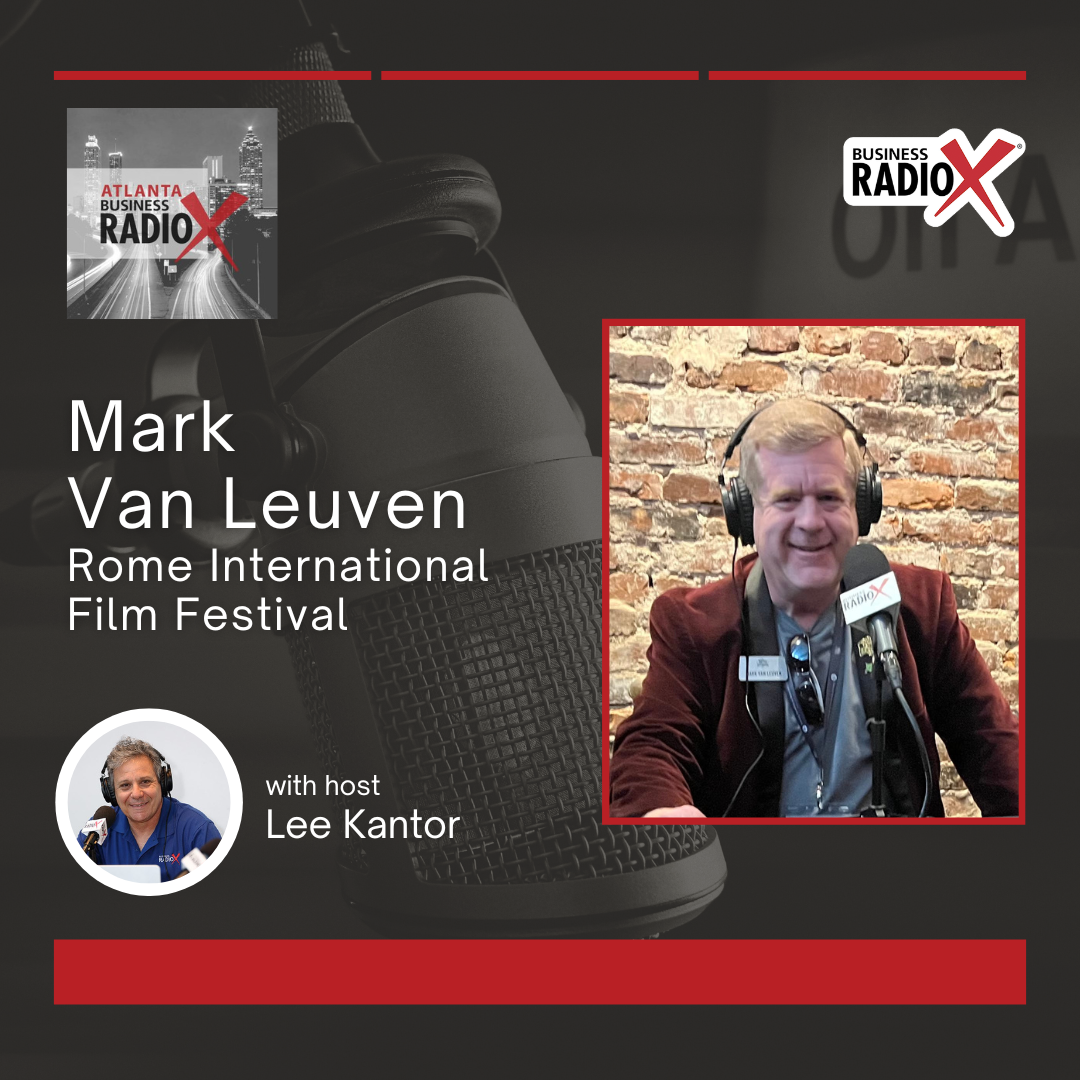
 Mark Van Leuven, Rome International Film Festival
 This transcript is machine transcribed by Sonix.
TRANSCRIPT
Intro: Broadcasting live from the Rome International Film Festival. It’s time for Atlanta Business Radio, brought to you by my global Presence. Now, here’s your host.
Lee Kantor: Lee Kantor. We’re broadcasting live from the Rome International Film Festival in downtown Rome, Georgia. So excited to be talking to Mark Van Leuven, who is on the board at this wonderful film festival. Welcome, Mark.
Mark Van Leuven: Glad to be on board. Good morning.
Lee Kantor: Mark. You’ve been here since the start, so why don’t you tell us a little bit about the history?
Mark Van Leuven: Well, I haven’t been here since the start. In a sense I have, because when they first did this 23 years ago, I came as an attendee. So just watching films and I ended up volunteering in about seven years ago, they brought me on the board 2021 to 24 was the president and I, I love the festival so much. I still believe in the product. I believe in the people most of all and the storytelling that I’m still involved.
Lee Kantor: So what? Why are film festivals important and why was it important for Rome to have their own?
Mark Van Leuven: At its core, it core comes down to storytelling. Film festivals are another medium for us to express the storytelling, the stories that are out there from not just the communities where the film festivals are held, but to bring them in from other parts of the world that we might not otherwise have the chance to hear. It brings people together. It’s fellowship. It’s it’s a communal experience for people to get together and share in the human experience.
Lee Kantor: So how has this film festival evolved over the years?
Mark Van Leuven: Well, it actually started up in Dahlonega. It used to be called diff, and for a few reasons. I think riff has a, has a has a better sound to it. Uh, Al Hodge and a few other folks were instrumental in bringing it to Rome, felt that that would bring value to our community because about 20 or 25 years ago, Rome really went through a renaissance of becoming a cultural hub of northwest Georgia and moving away from just the manufacturing roots, becoming something more than that. And we felt this was a good compliment, a good, a good centerpiece for us coming into not necessarily a mini Atlanta, but becoming a bedroom community that had a pulse.
Lee Kantor: And then it was important to kind of leverage the cachet of the film Um, as film is kind of that conduit to elevate the cultural status of Rome.
Mark Van Leuven: Absolutely. And to tie back into us emerging as more than just a manufacturing hub, which we did bring in some businesses like Pirelli and Suzuki, it one of the reasons also we were interested in bringing riff to Rome, or rather the powers that be at that time was because Pirelli was used to sponsoring other film festivals elsewhere, and it was a nice inducement to them saying, hey, we’ve got our own film festival. So it grew from there to, um, to becoming something more than just, um, just an inducement.
Lee Kantor: And then can you share a little bit over the years of how you’ve been able to attract such A-list celebrities to the event? How did that come about?
Mark Van Leuven: A lot of it was by the blood, sweat and tears. Some of it was luck. Uh, the first really big celebrity we had was in 2017. We had Burt Reynolds, and fortunately, we had some folks in town that brought Burt in town. He, um, and we flew him up. It was actually his last film festival. It was the last time that Burt had screened Smokey and the bandit at the City Auditorium. Not just about a few blocks from here. And from there, it’s between the blood, sweat and tears and sometimes just dumb luck or strategic dumb luck. We were able to induce other talent, if you want to call it. Not necessarily A-listers, but people who actually are dedicated to the medium of storytelling. And from there, if you were able to get A-listers, as you call them, great. We were able to get Billy Bob Thornton, we got Mario Van Peebles, we got Tim Blake Nelson, Ethan Hawke, we’ve got Danny McBride coming today. And we’ve also had other people in our orbits like Francis Ford Coppola. He was filming Megalopolis a few years ago. We sent him a box of wine, even though he stopped drinking a few years back, and it got his interest enough by the 1 or 2 paragraph blurbs we sent to him. He said, really interested in the festival, and he has worked in collaboration with Seth Ingram, who is our executive director, and was actually credited in the movie Megalopolis, which is which is a real wow.
Lee Kantor: Yeah, that’s a big deal. Now, in at the film festival, what does an attendee kind of what can they expect?
Mark Van Leuven: I think a lot of people film festivals around the world, especially in parts of the US, think film festivals are either. Under the impression that it’s all about the long stemmed cigarettes and the berets, that you have to be in that very unique, focused crowd that can only really appreciate film festivals like a film aficionado would. It’s more than that. Getting back to the storytelling, come look at the block and the selection of films we have. It’s like a charcuterie board. Choose something from that charcuterie board that looks appealing. You like it, you like it, you don’t. You don’t. And that’s what draws you in. And then it draws you in to discuss these projects, these labors of love with the filmmakers, with the with something as as humble as a grip, someone as humble as a grip or a production assistant because they all share the same passion. They were all there at that very beginning at that charcuterie board. And some of them decided to make it a career. Some of them did it. And that’s it’s that sense of community that you build, not just within your own community, but elsewhere also with the filmmakers.
Lee Kantor: And the access you get and the actual conversations you’re going to hear. It’s that’s special. Like you’re not going to get that by going to a film just randomly at a theater. Like it’s a different, it’s a full experience. Like you say, it’s a charcuterie because you can meet lots of different people, but you also get to have real human to human conversations with them.
Mark Van Leuven: You hit them. You hit it right on the head. We like to refer to our festival as a living room experience. We bring people to our community and have discussions with everyone, filmmakers and patrons alike, as though they were sitting in our living room just having a discussion. I mean, we do have a little bit of that paparazzi style element, but we are not a paparazzi driven festival. And that’s what we want to aim for, is aim for that humble experience where we can all just have a discussion and talk about what drives us and the stories that motivate us and get us out of bed every day.
Lee Kantor: And film is defined in a very broad way, right? This isn’t just feature film. There can be films of all shapes and sizes.
Mark Van Leuven: Absolutely. It’s anything from the experimental shorts, animated, uh, slots. You’ve got experimental, you’ve got arthouse, you’ve got student films, you’ve got documentaries, you’ve got feature length. We have just about everything. Charcuterie doesn’t really, if we want to get into the whole food reference doesn’t really cover it all because we have everything from charcuterie to a Tomahawk style steak.
Lee Kantor: So if somebody wants to learn more and get involved next year, um, or take. I guess the film festival ends tomorrow, right? And, uh, it does. There’s events happening throughout the weekend.
Mark Van Leuven: Absolutely. And it’s not just the film festival itself. One of the initiatives we pursued the last few years was to, to impress upon people that it’s not just a four day party, a four day experience of viewing films. We have what’s known as the Film and Entertainment Society, and we established it because we do hold events throughout the year for people who are truly invested in the storytelling experience through the medium of film, and they can check more out about it by going on to Rome International Film Festival. Check it out if you Google it, not the one in Italy. We’re actually, oddly enough, older than the one in Italy by about a couple of years. And we do have something. By quick side note, we have something on the platform that people submit films that says, you do realize that we are not enrollment and they have to check that box off.
Lee Kantor: So. Right.
Mark Van Leuven: And we’ve actually had some really happy accidents happen from that. And one of the happy accidents was the Israeli filmmaker that came here five years ago, which blossomed into the memorandum of understanding that we have with the community in southern Israel. So, yes, it is something that we do all year round. This is just the crown jewel. If you go to our website, you’ll see what we’ve got going on. And it’s, it’s really remarkable. And we would encourage people to do that.
Lee Kantor: And what’s a website.
Mark Van Leuven: Website is I have to correct me, if you go to Rome International Film Festival and then you and you’re uncertain whether it’s ours or not, put that in and put it in Rome, Georgia. It should be riff ga.com. But just to be safe, go to Rome International Film Festival and put Rome, Georgia, and you’ll you’ll pull us up.
Lee Kantor: And then what do you need more of? How can we help you? Do you need more sponsors? Do you need more filmmakers? You need what do you need?
Mark Van Leuven: Oh, we always need that. First and foremost, we need people who love storytelling, who love film. Bring that passion first. The sponsorships, whether it’s it’s monetary or in-kind, will follow from that easily. You will just come to our festival, even for a few hours. And if you get the bug, you’ll get the bug. You’ll know.
Lee Kantor: Well, Mark, thank you so much for coming on. Uh, you’re doing important work and we appreciate you.
Mark Van Leuven: Thank you.
Lee Kantor: All right, this is Lee Kantor back in a few at the Rome International Film Festival.