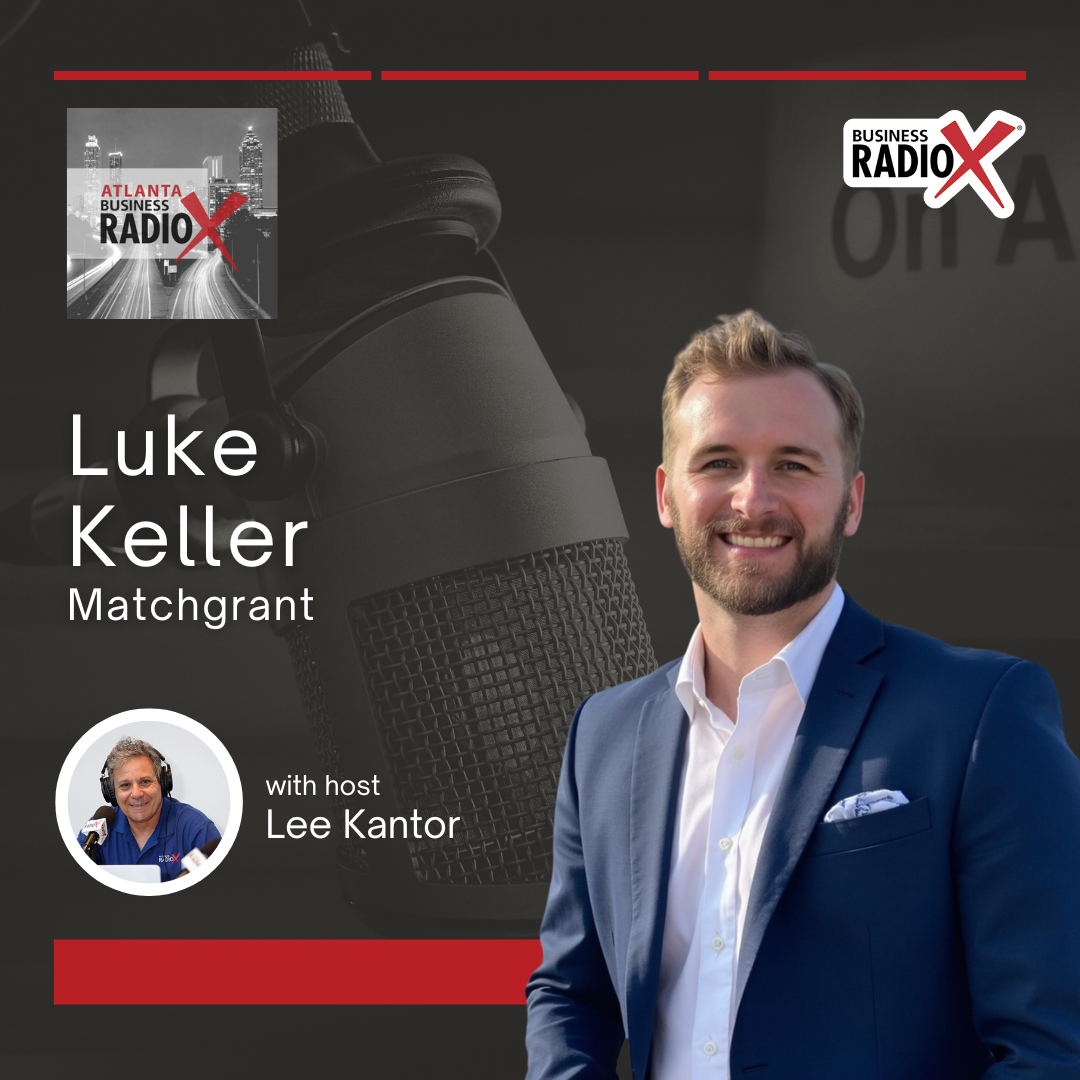

 In this episode of Atlanta Business Radio, Lee Kantor interviews Luke Keller, founder and builder dedicated to helping people flourish. Luke shares how he has spent the last decade launching ventures at the intersection of technology, social impact, and scale—including co-creating MatchGrant, an AI-powered grant-matching platform, and leading Tekton Career Training, which brings VR-based digital skills training to displaced communities around the world. He discusses his passion for taking ideas from sketch to scale, uniting people around bold visions, and equipping nonprofits and everyday individuals with tools traditionally reserved for larger institutions.

 Luke Keller is a founder and builder focused on one thing: helping people flourish. Over the last decade, he has launched ventures at the intersection of tech, social impact, and scale—co-creating MatchGrant (an AI-driven grant-matching platform built with 50+ nonprofit leaders) and leading Tekton Career Training (VR-powered hubs bringing digital skills to displaced people worldwide).
He specializes in taking ideas from sketch to scale, rallying people around big visions, and turning complex problems into simple solutions.
At the end of the day, his work is about giving nonprofits, communities, and everyday people the tools once reserved for the “big guys”—and doing it in a way that creates lasting impact.
Connect with Luke on LinkedIn and Facebook.
What You’ll Learn In This Episode
- Highlights a daily connection with nonprofits worldwide, including those addressing human trafficking, homelessness, refugee support, and school-based needs.
- Emphasizes a desire to serve more nonprofits and provide support for grant funding challenges.
- Invites organizations to try the grant-matching software through a 14-day trial to experience its value before committing.
 This transcript is machine transcribed by Sonix.
TRANSCRIPT
Intro: Broadcasting live from the Business RadioX studio in Atlanta, Georgia. It’s time for Atlanta Business Radio, brought to you by Kennesaw State University’s Executive MBA program. The accelerated degree program for working professionals looking to advance their career and enhance their leadership skills. And now here’s your host.
Lee Kantor: Lee Kantor here, another episode of Atlanta Business Radio. And this is going to be a good one. But before we get started, it’s important to recognize our sponsor, CSU’s executive MBA program. Without them, we wouldn’t be sharing these important stories. Today on the show, we have CEO of match Grant Luke Keller. Welcome.
Luke Keller: Thanks, Lee. Grateful to be here.
Lee Kantor: Well, I’m excited to learn what you’re up to. Tell us a little bit about match Grant. How are you serving folks?
Luke Keller: Yes, sir. Yeah. We, uh, we just launched. We’ve technically been at this for about six months. Uh uh, really, without releasing to the market, we built our platform originally for our own nonprofit, mostly based off the pain of just trying to find relevant, timely grant opportunities for our organization. We we were struggling on that. And we actually earlier this year lost a serious amount of funding. You might say we got Doge, lost some federal funds, and it kind of pushed us in a place where we just needed to find new, relevant, like I said, grant opportunities. And so our platform uses AI to surface the best fit foundations and grant grants available based off of our funding needs, based off our programs, as well as gives us the ability to manage those grants and kind of one seamless way.
Lee Kantor: So for folks who aren’t familiar about grants or how it works. Can you share a little bit about kind of grant 101?
Luke Keller: Well, Grant 101 love it. Okay. So as a nonprofit 500 1C3 um, there are a lot of, uh, foundations out there that they’re giving theses. So these are foundations sometimes, you know, attached to family offices to for profit companies. Um, they like they have to legally give away a lot of money every year. And so there’s some of these require an application process. Some of these are solicitation grants. And it’s just difficult. The existing software out there to find grants is expensive. Um, it’s generally why a lot of nonprofits end up hiring, uh, what you call development individuals. And those development people tend to be pretty costly to nonprofits. They’re very talented, but they also use a lot of this expensive software. So we just built a better mousetrap. We built a platform that kind of surfaces as grants and then helps kind of coach the nonprofits and that process of actually going through the application, you know, going and applying for those opportunities.
Lee Kantor: So these philanthropic grants are different than getting a grant from the government.
Luke Keller: No government grants are included. Yeah. So so there are government grants available for both for profits and nonprofits. And I should say like there are foundations that also give to for profits. It’s just a little bit different. We happen to focus on 501 C3 nonprofits. And our platform, you know, just surfaces those relevant grants and helps the process of applying and just makes it really easy. And and I will say lead to your question that also includes government grants. So you can also find government grants through the platform as well.
Lee Kantor: So um, is this is Grant, uh looking for grants, applying for grants. Is that something that every nonprofit should be doing if they’re not doing it already?
Luke Keller: My opinion, yes. In my opinion, the and I’ve now probably talked to. Oh man. I don’t even know hundreds and hundreds of nonprofits. We built the platform with 50 nonprofits we kind of co-created with them in beta. And so they helped directly, you know, push us in the direction to build a solution that was very helpful. And, uh, in that process, you know, that’s where we realized, like the organization, the organizations we see that tend to be the most well funded. Thus they get to have the most impactful programs, have a very diverse, uh, means of producing revenue. So that would be a mix of, you know, significant amount of money from individual donors. You know, that would be those, you know, individuals that that feel like they have to give, um, you know, they give on a monthly basis to an organization they care about. And then a significant amount of those also come from, from foundations. And then those foundations vary. So there could be family offices, like I said, sometimes those are called solicitation grants. So those are grants that, you know, by nature you can’t actually apply for. So you simply just need a tool that’s going to help connect you with the individuals that run those foundations, which our platform does as well.
Lee Kantor: And those, um, family offices, those could just be wealthy folks that just have some philanthropic arm. Right? So it’s hard to kind of find them and identify what is their, you know, where they want to invest or offer grants.
Luke Keller: Exactly. Yeah. In most cases, they actually they don’t have websites. They don’t. There’s no explicit way of applying. You just simply have to know, you know, the individuals and get your foot in the door. And so one of the ways our platform does that is that, you know, both by the matching. So the platform will match you with those and that you’re in that pursuit cycle, but also in search. So you can actually use our platform. Essentially every nonprofit Has to file a 990 every year. And so that that 990 I apologize. I have kids that have to wrangle at the moment as well. Um, but those 990 are filed by the non-profits every year. And then the the foundations also have to file a version of a 990. And so basically what we’ve done is we built a database that pulls in every 990 from the IRS website. That’s all public information, by the way. And then we’re able to essentially display that in a way that is very helpful for non-profits. So for example you can search for new foundations but you can also search for your peers. So if you’re a nonprofit, in this case, like us, that serves the refugee community here in Atlanta, I could search for organizations that do similar work to us and find who’s funding them and immediately turn those into opportunities that I can then pursue through the platform.
Lee Kantor: So you said initially you did this just for your own purposes because you were, I guess, frustrated by the current state of affairs when it comes to finding and matching up grants with, um, you know, your needs and everything. When did it occur to you of, hey, this is something that maybe we should roll out and this could be, uh, helpful to other folks?
Luke Keller: Yeah, that’s a great question. Um, I I’m a I’m a serial entrepreneur. I’ve built another tech company before. I’ve built a few other companies. In fact, you guys have actually interviewed me for one of the other ones I built years ago, and I sold, um, I had zero and and. Uh, building another business around this. This was simply a tool that I wanted to build to help our own organization, you know, find, manage our funding. And then in that process, I started winning grants faster. I started, you know, finding grants that otherwise I would not have been able to find. And that’s when it kind of occurred to me, you know, this is so powerful. This is this is a solution that most nonprofits should have in their hands, and most of them can’t afford, because our competitors are about ten times the cost of match grant match grants. Uh, for for most organizations, it’s about $2,000 per month. And whereas our competitors can be anywhere from 10 to 20 $20,000. Sorry, I said per month $2,000 per year. Uh, not per month. Uh, our competitors are more like 10 to $20,000 per year. And so, um, that’s also when I realized, you know, majority of nonprofits are are $600,000 or less in annual budget and spending, you know, $20,000 a year for a software solution, which, by the way, is still going to require you to do a lot of research. It’s just it’s just not obtainable for most non-profits. And so we we specifically focus as, as a solution that helps a majority of nonprofits find relevant grant opportunities. So to answer your question, uh, I would say once, once we launched and it was succeeding so much, we decided to open it up to other nonprofits we know and love in the Atlanta area, and they worked with us for about four months, literally weekly. Many of them, and helped us co-create what is now the solution. So I can’t take full credit for the success of our product. It truly was a labor of love, not just with us, but also with about 50 other nonprofits locally.
Lee Kantor: So. So if a nonprofit, they sign up for this or they get access to the software, then they can go on and then they just start putting in the terms that are relevant for them. And then those grants start bubbling up.
Luke Keller: Exactly. Yeah. It’s very easy to do. Um, you basically build out a profile. It takes two minutes to do. And then you essentially put in like, what are your funding needs, what are your programs? And then you click generate and it will immediately start generating relevant grant opportunities all forward facing. So nothing in the past, everything that’s going to be relevant to apply in the next few months as well as, you know, just being able to search for your peers as well.
Lee Kantor: And then it’s assuming the person knows how to write a grant, a grant proposal, and the assumption they they know how to take it from there.
Luke Keller: For the most part, that’s kind of where we’re at. Uh, I’ll give you a little bit of a look under the, uh, the engine, but we’re we’re building quickly building a solution that’s actually going to basically be an AI grant writing assistant, many grants that you actually have to apply for, for the most part, you know, you’re I’d say 80% of the application is universal, you know, so you apply for one foundation. You can take most of that 80% or so and use that same information, same data to apply for another one. And so essentially our our new version we’re launching in the next few months will write most of that. So it takes all your boilerplates your previous applications. And then you can drop in a new application and it will pre-fill out a decent part of that for you.
Lee Kantor: And then so you just have to fill out the part that’s kind of, um, customized or whatever specifics that this individual grant is asking for.
Luke Keller: Exactly. And then obviously submit that. Um, and I won’t I won’t speak too far into this because this is like an early version. But we are working actually with, uh, AWS, Amazon Web Services to create a version that will take it to the next level where you can actually put a lot of your grant writing on. There’s still always going to be a human in the loop requirement. Um, but it can put a lot of it on autopilot, where you can apply for a significant amount of grants more, but also ensure that those are only relevant grant opportunities to to you and your organization.
Lee Kantor: Now, can you share a little bit, maybe the story of of one of those early wins for you? When you plugged in your information into this thing you created and it bubbled up something that turned into a grant for you.
Luke Keller: Great question. Yeah. I have a very a very good one. So we, uh, one thing I was not fully aware of now that I might just be ignorant or, uh, um, not as experienced as maybe some more seasoned development people or executive directors, but I was not aware of hyper specific grants available for nonprofits to cover very specific line items. So, for example, you know, oftentimes you hear nonprofits say, we have a capital campaign, we’re going to build a building, we’re going to buy a building, or, you know, you need to pay for hardware and software, you know, can match grant pay for itself. And the short answer is, yes. You know, we’ve we’ve been able to help nonprofits like our own nonprofit find grants that were so hyper specific they could cover those line items, meaning like you could create a funding need in the platform that is simply technology, hardware and software. You know, new laptops for your team, paying for match grant, paying for your your website, hosting, whatever it might be. And we were able to find dozens and dozens of grants, mostly associated with big tech companies, but very easy grants to win. And so we were able to personally win about $10,000 in grants very quickly. Um, that was that covered those costs. And then beyond that, and more recent one is we were able to uncover grant opportunity with a very large bank and, uh, that has led to, uh, hundreds of thousands in potential grant opportunities for our organization. So, uh, and I hear those stories on a daily basis, you know, there’s, there’s nonprofits that are discovering new grant opportunities that feel like they finally have the tools they need to be able to go after Grant writing. Well.
Lee Kantor: And what percentage of nonprofits pursue grants versus those who just probably are overwhelmed or think it’s too hard to do, and they don’t even try?
Luke Keller: Honestly, a majority, I think. Look at grant writing almost through the like paralysis by analysis. I think they, they, they tend to have the assumption that, like, I just met with a nonprofit just before this call and they made the statement, oh, well, we’re nervous about the reporting side. Like, yeah, exciting. We win the grant. But then it adds burden to our team to have to report. And that can be true in some cases. But for the most part it’s that’s a that’s a false narrative. It’s there is reporting to be done. But it’s probably reporting that if you’re not already doing you should start doing, you know, its reporting of your own metrics. You know, how well are you using those funds, how much impact are you making? So I think there’s a little bit of a false narrative as like how scary or overwhelming it might be to actually start applying and winning grants. Um, I think partly it takes some it does take some time, you know. So for example, like an unsolicited grant is completely a networking opportunity. So you have got to network yourself into into the right room, or reach out to those people on LinkedIn, which our platform does that. So our platform actually gives you the contact information for board members that run these foundations. And that way you can actually reach out to them on LinkedIn and get your foot in the door. And otherwise it would be really difficult, right? You’d have to be going through hundreds and hundreds of pages of nine 90s to find the information, to find the names of those individuals that run these foundations. Um, so in my opinion, you know, there’s never there’s never a better chance to get started grant writing than right now, because it does. There’s a little bit of investment on the front end if you haven’t done it before, but it’s not as scary as you really would think. I mean, it’s definitely worth the effort in my opinion.
Lee Kantor: Yeah, and it’s one of those things once you’ve identified 50 or 100 places to ask for the grant, you just rinse and repeat that every year. You know, it’s you do the work one time, but it’s something it’s an investment, not an expense. Spent.
Luke Keller: You know, Lee, I’ve got a fun success story. So we we found a found a found a foundation through the platform, won a grant. And that that same foundation came back to us, uh, just about six months later, because we’ve been using the product a lot longer than it’s been released internally and, and essentially said, hey, we have a significant amount of excess in our budget to give away. Do you need any more money? And so our own nonprofit that, again, is in Clarkston, serving refugees two times over, was able to leverage the platform to win serious money. And so that kind of is what happens. You know, like you’re not going to win grants miraculously. You have to actually put in the effort. But once you do, once you start to establish those relationships, to be honest with you, Lee, most of the time I’m getting emails that are actually asking us to apply for grants these days.
Lee Kantor: Yeah, I interviewed so many nonprofits and so many of them, you know, they they invest all this energy and time on a like a gala. And when they could be spending time like this, that can really change their, um, nonprofit. And it seems like a much better use of their, you know, resources.
Luke Keller: Oh, absolutely. We in fact, we stopped. We did what we used to do them. And, you know, we would spend, I don’t know, ten, $20,000.
Lee Kantor: And the time and the time it takes to organize it and the people that have to get involved, like it’s just such a it just seems like a yesterday solution. And there’s, you know, better solutions today that are more efficient and have a better kind of outcome.
Luke Keller: Exactly, exactly. Yeah. You hit you hit the nail on the head, man. I, I stopped doing that mostly because the ROI was just not there. You know, we would spend months and months planning and spend thousands of dollars to throw the event. And then we’d come out and look at our, our net income on that would only be, you know, 4 or $5000. I know, I know some some nonprofits do really well, but I also just see the the time value of money for some of that stuff. And, and it’s just or the, the return on the money. I’m sorry. And it tends to be much better if you if you’re very strategic on writing grants.
Lee Kantor: So now what do you need more of? How can we help? Are you just trying to connect with nonprofits all over the place, or are you or do you have to build more relationships with foundations? Like what? What is kind of the area that you’re investing time in building kind of a database and relationships with?
Luke Keller: Yeah. Thank you for asking that question. I we definitely want to serve more nonprofits. We I mean, it’s my it’s my favorite part of what I get to do these days is I probably talk to between 10 and 15 nonprofits a day, quite literally, doing some of the most amazing work all around the globe. You know, organizations fighting human trafficking, organizations running food pantries and homeless shelters and serving refugees both domestically and abroad. Um, and in schools. I mean, we’re working with numbers of ptos, PTAs, private schools as well that also are are needing, you know, needing help with their grant. Grant funding. Um, so, frankly, to answer your question, we need I would love the opportunity to serve more non-profits. So if you’re a nonprofit, you’re listening. You can go to match grant matching. Um, and we give everybody a 14 day trial. So I would not ask you to buy it before you try it. We really want to show you that the software can add value to you and your organization, and we’d love the opportunity to serve you.
Lee Kantor: Well, Luke, thank you so much for sharing your story. You’re doing such important work and we appreciate you.
Luke Keller: It’s my pleasure. Thank you so much for your time, Lee.
Lee Kantor: All right. This is Lee Kantor. We’ll see you all next time on Atlanta Business Radio.














