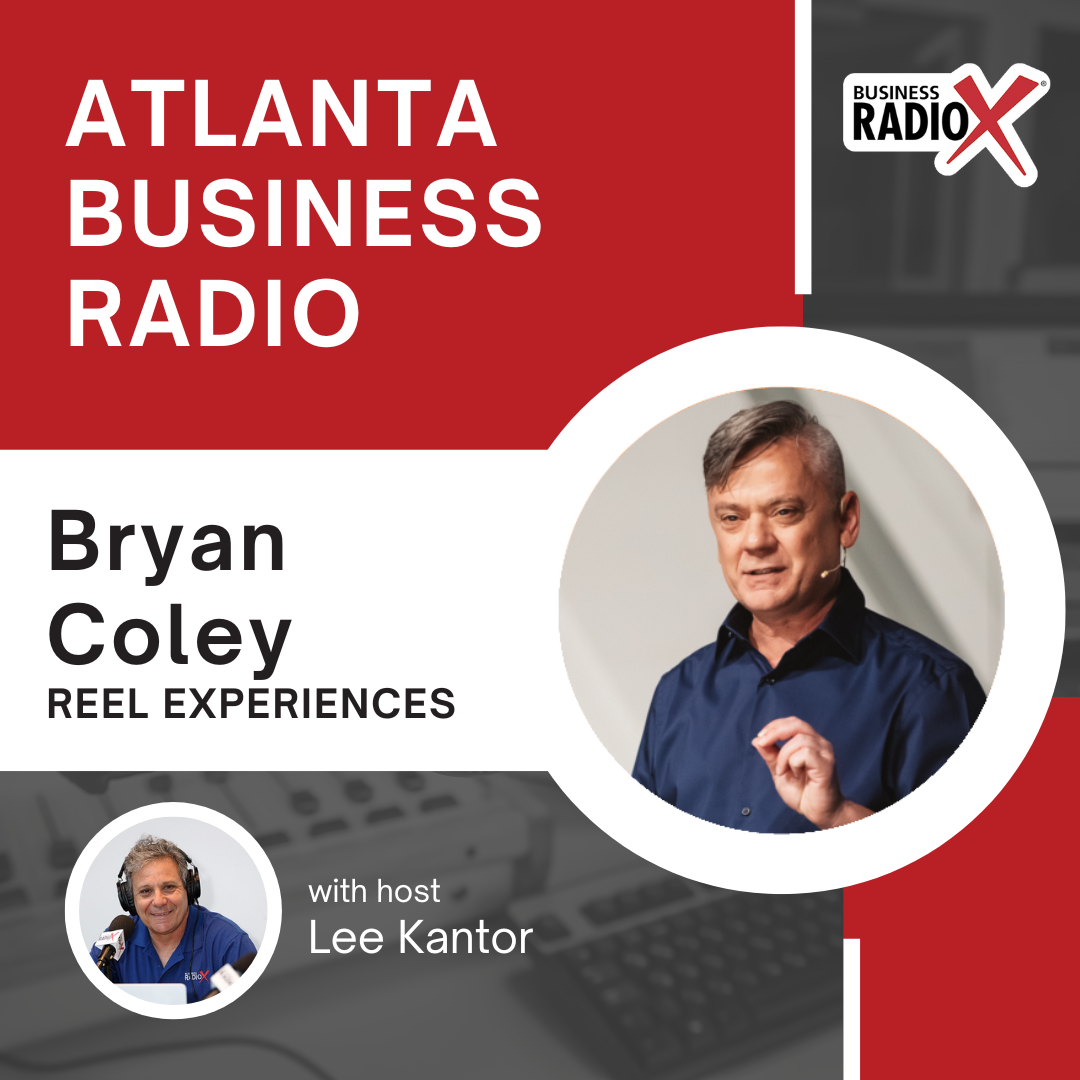

 In this episode of Atlanta Business Radio, Lee interviews Bryan Coley, founder of REEL Experiences. Bryan shares how his program uses people’s favorite movies as a tool for personal and team development in business settings. By exploring movie themes, characters, and stories, teams gain deeper self-awareness, empathy, and connection. Bryan discusses the program’s origins, its impact on leadership and organizational culture, and how movies foster authentic conversations. He also introduces new virtual offerings and reflects on analyzing Oscar-nominated films as cultural indicators, emphasizing the power of storytelling to inspire growth and understanding in the workplace.

 Bryan Coley is a graduate from NYU Film School and the founder of Reel Experiences, a company that helps people and teams see themselves and each other more clearly through their favorite moves.
He discovered that people could gain insights and change their lives based on their top 10 movies. Reel Experiences works with businesses to help develop their employees and teams.
Prior to REEL Experiences, Coley founded Art Within, a nonprofit organization with the goal to integrate faith and art in order to impact contemporary culture.
With 30+ years of storytelling experience, he is a skilled screenwriter and film director. He lives in Marietta, Georgia, with his wife and two children.
Connect with Bryan on LinkedIn and Facebook.
What You’ll Learn In This Episode
- The use of favorite movies as a tool for personal and team development.
- The evolution of REEL Experiences from assisting screenwriters to corporate team-building.
- Benefits of the program in fostering team cohesion, leadership development, and organizational culture.
- Customization of sessions to meet specific corporate needs, including DEI initiatives.
- Structure of a typical session, including discovery and personal storytelling components.
- The significance of participants’ movie choices in revealing personal insights and team dynamics.
- The role of movies in facilitating difficult conversations and enhancing empathy among team members.
- Introduction of new initiatives like “Reel Everywhere” for remote engagement.
- Brian’s analysis of Oscar-nominated films as reflections of societal themes and cultural currents.
 This transcript is machine transcribed by Sonix.
TRANSCRIPT
Intro: Broadcasting live from the Business RadioX studio in Atlanta, Georgia. It’s time for Atlanta Business Radio, brought to you by Kennesaw State University’s Executive MBA program. The accelerated degree program for working professionals looking to advance their career and enhance their leadership skills. And now, here’s your host.
Lee Kantor: Lee Kantor here, another episode of Atlanta Business Radio. And this is going to be a good one. But before we get started, it’s important to recognize our sponsor, CSU’s executive MBA program. Without them, we wouldn’t be sharing these important stories. Today on this show, we have the founder of REEL Experiences, Bryan Coley. Welcome.
Bryan Coley: Thanks for having me. Yeah, it’s great to be here.
Lee Kantor: Well, I’m excited to learn what you’re up to. Tell us about REEL experiences. How you serving folks?
Bryan Coley: Yeah. So REEL.
Came out as a happy accident. Uh, I spent most of my career in story and media arts and mainly working with story makers. So screenwriters, playwrights. And part of the way that we would help screenwriters and playwrights find the script that they could only write was we’d ask them what moved them and quickly that became their favorite movies. And so over time, we would use their favorite movies as a means of finding themes and connections in their movies that they should write about. Well, fast forward several years. I ended up making a movie. I am in the edit suite, kind of bored out of my mind working on, uh, editing a movie, and I decided to take these methods that we were using with writers and use it with just average, everyday people, and it kind of blew up. People were literally changing their lives based on the insights that they were finding in their movies. And so then it was like an oil well spewing out of different ways to look into their movies and ask questions and then different audiences that we served. So we first started serving marrieds and all kinds of nonprofit, like small groups and veterans coming back from war. And then eventually a friend of mine brought his team, his chick fil A team in, and we changed over to a for profit. And that was about nine years ago. And we’ve been working with all kinds of companies and government organizations, nonprofits, churches, all kinds of staffs, helping people see each other more clearly through the power of their favorite movies.
Lee Kantor: So how does it work in, uh, kind of in a business setting? So what is kind of the challenge the business is having where going through this exercise would be useful?
Bryan Coley: Yeah, most of the time people come to us because they’re going through change. Maybe it’s a new team leader, new team members or reorg, things like that in which they’re trying to figure out, how do we get to the work faster? Yet we know there’s this period of time of formation in which we need to establish trust. We need to understand each other’s stories. We need to be able to create a environment and a team culture. And so we’re really we had one team leader tell us that we do what would take six months. We do that in a day. So we kind of accelerate that time in which you’re trying to connect and and form as a team. Although I will say that we do all kinds of real experiences, we’ve been able to customize so many real experiences over the years based on the needs that corporations have. Like, for example, we help, uh, you know, teams be able to understand their brand through their movies or understand their vision and values. Um, we’ve done Dei experiences where we help people see and be able to share their story that maybe, you know, they wouldn’t be able to share without their movies, uh, kind of standing in for them and allowing them to tell their story. And then we’ve done all kinds of leadership experiences. Uh, helping people understand what kind of leaders they are. Helping them understand what triggers them to frustration. All kinds of ways in which movies are visual articulations. Uh, visual articulations of what? Um, maybe is, uh, going on with them as far as their growth, their personal growth, their leadership growth. And then ultimately their team development as well.
Lee Kantor: So what what does it look like when you’re in one of your sessions, or one of your experiences with a team or an individual, like is it is the starting point always like kind of your top, your favorite movies or the most impactful movies, or however you frame the list?
Bryan Coley: Yeah. Good question. I mean, usually people are like, I kind of get it, but what exactly are you doing? And so, uh, we have an app that team members submit their favorite movies, and it usually for the non movie lover, it helps them figure out what their top ten movies are for the movie lover. It helps them narrow it down and and so that’s done prior to the experience. And then in the experience, we have two halves of what we do. They’re usually the same no matter what we’re exploring. The first half is just what we call discovery, where we’re asking you questions about your movies, and that’s usually really dynamic. You’re rotating with different team members. It’s really fun. And you’re looking at trailers. Maybe you’re looking at clips and you’re really focused on the movie and just what the movie is telling you, or answering questions about the movie. And then we do a Jedi mind trick about halfway through in which we’re like, hey, maybe these insights that you’ve captured about your your movie characters actually have something to do with you. And so the second half of our experience is really diving into, you know, what, these movies and your story, how they intersect and ways in which, you know, those intersection kind of allow you to be seen more clearly by your team members.
Lee Kantor: So when you’re doing the first part, it’s kind of you’re just like your favorite ten movie. So you don’t say like my favorite ten comedies or it’s just general. What is kind of the broad, you know, my Mount Rushmore of ten movies?
Bryan Coley: Exactly. Yeah. A lot of people who are movie lovers, it’s really frustrating because they’re like, you gotta narrow it down to ten. Um, but, uh, you know, it really forms a palette. I call it like, a palette of parables that are just yours. So believe it or not, Lee, we have seen over 6000 top ten movie lists at this point, and not a single one has ever been the same. And we just believe that just speaks to your thumbprint being on your movies. And and one of the things we love about reel is that, you know, um, a lot of times people may use movies as illustrations for their points or, you know, they may have a keynote in which they add some movie clips or something like that. But what we try to do is we try to allow people to bring themselves to the table. So when you bring your movies to the table, it’s like you’re bringing a piece of yourself to the table. And so it’s not top down. It’s like a bottom up perspective. So even an experiment like, you know, a reel experience, like, uh, defining your vision and values, uh, allowing your team members to actually show you what they believe are expressions of your values or expressions of your mission. Um, is just so beautiful. Whenever you’re looking this wide range of the way people are showing you what you know, the company’s brand is or something like that.
Bryan Coley: So just really a way for people to bring something that connects to them, connects to their heart, connects to makes them laugh, you know, moves them to all kinds of different ways, whether it’s just entertainment, but it’s connected to them and they’re able to, you know, bring that to the table versus, you know, we had a a head of innovation, um, from a company. And he came and said, I want to, you know, do the real experience based on innovation. And I want you to show Apollo 13 and he gave me these all list of, of movies. And I said, well, you don’t need me for that. You just need a DVD player. But if you want me, then let’s bring your team in and bring their top ten movies in. And let’s ask them what’s the best image of innovation in their top ten movies. And so we would tease that out and make it into an experience where everybody has their own brand of innovation, you know, through their movies. And so it’s just a great expression of people having a sense of their thumbprint on whatever thematic or, or whatever, uh, we call it lens that we’re looking into in their movies.
Lee Kantor: Now, when you do this exercise, are you getting kind of the person’s best self in terms of how they want to present themselves? Like, are they going to really say saw four was my, you know, favorite movie?
Bryan Coley: We have had all four. I’m sure I’m not. You know, the day that I was really wondering whether it would happen and we had, you know, 50 Shades of Gray come through the door, and I was like, okay, well, here we go, you know? And it ended up being, you know, very insightful, believe it or not. Um, but yeah. So, you know, just last week, I had a group of C-suite executives from a company that’s been almost everybody there had been in the company for like over 20 years. And one of the guys was presenting, and his character that he identified with was Happy Gilmore, and he was just apologizing and apologizing the whole time, going, oh my gosh, there’s nothing here for me like, this is ridiculous that I pick Happy Gilmore. You know, like, you know, it’s just, you know, I just love comedies, that kind of thing. Well, the more we dived into it, he was totally Happy Gilmore and everybody on that team was like, this makes total sense now. Like, you are that person who, you know, like, our company tends to be the golf course, you know, like, and the golf culture. And you’re that guy who is bringing your hockey stick into that culture and like really being able to be authentic within that culture. And it just made him feel like, oh my gosh, yeah, this is me, you know, and and so even a movie like Happy Gilmore, I love because it’s like, you know, the the person was like, no, you’re not gonna find anything here. And I’m like, well, let’s just see. And sure enough, all of his team members were rallying around and celebrating the fact that he was Happy Gilmore.
Lee Kantor: So when you’re doing the exercise, are you at some point kind of honing in on the character, or is it maybe the director’s perspective, like, what is the kind of the the, um, focus point when you’re trying to to kind of, um, find that, you know, where is it the heart of what makes it their favorite?
Bryan Coley: Yeah, exactly. So our questions, you know, we’ve we’ve spent years and years designing questions that, you know, are just these set of questions that really we know the articulation of them and the follow up for them as far as facilitating really allow us to kind of bring out a person’s story. So for example, our character question, you know, we have four lenses that we do for what we call storyboard, which is pretty much our bread and butter. It’s the one that most teams go through. And they look through four different lenses. So they’ll look through the lens of character, they’ll look through the lens of desire, they’ll look through the lens of conflict or antagonism, and then they’ll look through the lens of change. And each of those, you know, we have questions that we’re asking the person. So for example, with character, we’re asking, you know, what character do you like and resonate with most. And then we’re exploring what are the heroic traits of that character. And so it’s all designed based on the way the person looks at the character. So for example, we might have a person who comes through and they’re looking at, uh, you know, a, let’s say a Top Gun Maverick or Maverick in Top Gun and you’ll have someone in one breakout room who talks about the heroic traits of of Maverick.
Bryan Coley: And then maybe somebody in the other room picked the same character. And when they come out and they do their presentations, they’re totally different because of the way that they look at that character. So we’re always trying to find what we call the specificity of how you look at, uh, your movies and how you look at those characters. Um, and so whenever we look at those four lenses, we’re looking at who you are. What you want is, is the desire lens, uh, what comes against you, like, you know, the lies that come in the internal struggle of the character. How is that possibly, maybe an internal struggle that you might have. And then, um, and then those keys to growth and change that are a part of every story we look at. What are those keys to growth and change for you as well. And that forms what we call your storyboard, which is, you know, drawing out those key elements of your story to be able to share with your team.
Lee Kantor: Now, one of my favorite movies is Pulp Fiction. Um, and what I like about that, I think, is just more about the structure and more Quentin Tarantino than any given character in there. His storytelling, the dialog, the pacing, the visuals, those kind of things are what makes it what I believe. One of my favorites, as opposed to any given character within the story.
Bryan Coley: Yeah, usually what happens is we hear that a lot. You know, where people say, well, I just picked this because, you know, like it makes me laugh or I pick this because I remember seeing this with my father when we were growing up. Or I picked this because, you know, it was a special movie that, you know, my wife and I when we were dating or something like that. And so different reasons and even technical reasons, like you’re saying. But ironically enough, what’s crazy is because you have ten movies, somehow that movie, like a movie like Pulp Fiction, you won’t expect it, but it’ll have something totally to do with another movie on your top ten, either thematically or something else that that you weren’t even expecting. We see that all the time. We call it the preponderance of evidence, because suddenly within your movies, you don’t just see one character who’s like something or who has a desire or who has an internal struggle. You start to see that, you know, there’s five characters in your top ten who have a similar internal struggle, you know, and so it creates that preponderance of evidence going, yeah, you know, like possibly this may be, you know, a part of your story.
Lee Kantor: So that’s why it’s important for you to have ten. That wasn’t just like, oh, I’m doing top ten. But like if you were to pick one or 2 or 4, that’s not enough data to kind of see a trend.
Bryan Coley: Exactly. Yeah. You know, oftentimes people are like, well, here’s my favorite movie. Now tell me everything about me. And I’m like, well, um, first of all, I’m not a tarot card reader. And second of all, you know, I want to hear what you think of this movie. And then third of all, you know, I’d love to surprise you with the fact that there’s probably connections within your movies. You know, um, there’s a game on the New York Times. I don’t know if you’ve ever played connections in the New York Times games and it, you know, has 16 words and you’re trying to figure out what four groups, four groups of four words go together. And then what’s the connection between those four words? And that’s sort of the way people’s top ten movies are. Is there this just like group of connections that you’re trying to find, what are the threads and patterns and connections between, uh, these movies that really are meaningful, um, to the person who suddenly sees them and is surprised by them, you know?
Lee Kantor: So is there a story that you can share about a team that’s gone through this experience and then maybe got an unexpected, uh, benefit from having done the real experience?
Bryan Coley: Yeah. I mean.
Lee Kantor: Obviously don’t don’t name the name of the yeah, the company, but maybe share the challenge that they were trying to work through and how you were able to help them.
Bryan Coley: Yeah. Um, I love that question because it actually happens every single real experience. But I’ll share the one that I love to tell the most. Um, and that is, uh, there was a leader, and I usually do a pre-brief meeting before every real experience, and I asked the leader, so tell me, your people, each one of them, and tell me what your development goals are for your people. And so she she was telling me about this one guy on the team and he just, you know, had been with the company about 15 years and he just could not, uh, well, she couldn’t get him to see that he could be a mentor on the team. Like there was something blocking him where he just didn’t see himself as a mentor. And, uh, so that was her development goal was for him to see himself as someone who could be a mentor on the team, uh, based on his years of experience. So we get to real and we get into the real experience. And he has a lot of films that are just fun films. You know, a lot of, you know, National Lampoon vacation and European vacation, you know, and all these kind of fun comedies. And we get to the to the part where he’s presenting, and he gets up and he presents his character, he presents his desire, and then he gets to the conflict lens, which is really him expressing like, what is the lies that a character would believe if you were a bad guy, what would you be telling this character? And so he reads these lies which are like, you are all washed up, like, you know, the industry has moved on without you.
Bryan Coley: Uh, you are, you know, just old and and you, you know, uh, don’t have any relevance, uh, anymore. And so, obviously, the next question I usually ask is, well, you know, what’s the movie? And he goes, well, it’s, it’s anchorman. And he said, it’s that moment where Ron Burgundy is in that telephone booth and he’s thinking, you know, all of they have women anchor women now, you know, and it’s the industry’s moved on. And, you know, he’s a relic. And, uh, you know, his whole life is falling apart because the industry is changing. And, um, and he no longer feels relevant. And so, you know, the natural next question is, well, so how does this intersect with you? Like, how is this maybe the way a bad guy wants to take you out? And he says, well, I mean, look at me.
Bryan Coley: He says, and look at them. And he points to his team and his team. He says, they’re all a bunch of, you know, uh, Gen Zers and millennials. And here I am, this old guy like I, you know, I feel like the industry has moved on without me. I feel like I’m no longer relevant. I feel like, you know, like I’m the old guy in the room. And of course, what happens in that moment is all of his, you know, Gen Z millennial, uh, teammates rush in and, you know, immediately in that moment say, oh my gosh, no, you have so much to offer us. You know, like, we need you, you know, like you’re not old, you’re not a relic. And and so in that moment, what happened was exactly what the team leader wanted, uh, which was for him to see that his team really wanted him to be a mentor and that he could be one for them. And it all came from Ron Burgundy and Anchorman, you know? So that’s the reason I love telling that story is because, yeah, it changed the team and it changed the team dynamic. And it happened in such an unexpected, surprising way through anchorman.
Lee Kantor: And it’s I mean, to the heart of what you’re doing is you’re you’re enabling kind of layered conversations with people who probably wouldn’t have these conversations if there wasn’t a safe frame to have the conversations.
Bryan Coley: Yeah, that’s a great way to say it. I mean, that’s that’s perfection right there. That is exactly the way I would say it is. I I’ve seen it over time that the movie characters are like stand ins for people, you know, they’re they’re they allow people to say things that they would never say, but they’ll, they would say it because the character is saying it or the character is an expression of it, and they’re able to have that character as a buffer so they feel safe. And, you know, it doesn’t feel so serious because it is fun. It’s movies, you know, um, and, you know, it allows them to, um, I call it visual articulation, which is visually articulate things by saying, hey, that up there on the screen that that’s me. That’s kind of a part of me, that’s a part of my story.
Lee Kantor: And they can share it easily because it’s like, oh, everybody’s seen that movie, or they know of that movie. It’s not me saying that. That’s me. You know, like there it’s done in. It’s they’re removed from the character, but they are the character. Um, you know, if you dig a little deeper, which you obviously are skilled enough to be able to do that rather than let people see it or not see it, you bring it to their attention.
Bryan Coley: Exactly. Yeah. Our job is just to say, you know, just ask the question, is this, you know what? What part of this is you, uh, you know, oftentimes what we do in rooms is we’ll maybe show a trailer and we’ll just tell the participant, hey, the one who’s whose movie it is, we’ll just say, hey, watch this trailer. And when you see something that you feel like is you like, you know, when it’s done, just point it out to us and say, I own this. This is me here. This is what’s great about me, you know? And then for the other teammates to be able to look at that same trailer and go, oh my gosh, that is so, you know, whoever the participant is, their name. And for those visuals to to be able to stay with people. So that’s one of the other things I love is that, you know, most of learning that you have kind of just fades away. But with movies, I have people all the time come back to real or come back to me and say, oh, you know, I still remember this person by their movie, and I still remember this moment for me.
Bryan Coley: You know, where it was, uh, this movie. And so, uh, you know, I have one team leader. He’s my star team leader. Uh, he’s come. He just came for his 14th time to real bringing, uh, bringing his team to real. And anytime he has a new team member, he just brings everybody back to real again. Um, or he gets a new team or something like that. And and, you know, at this point, I know his movie so well and know him so well that, you know, is so fun for almost me to watch his team get to know him through the fact that now he can articulate so well why he’s Rudy and why he’s Kevin Costner’s character in Draft Day, you know, and and I know him so well through these movies as well, you know? Um, so it’s just one of those things where, you know, you’re able to, uh, really know the people that you serve, uh, by remembering them through their movies, you know.
Lee Kantor: So you mentioned that the company has gone through some iterations and maybe, uh, change a little bit on your structure and how you’re serving and who you’re serving. Is there an ideal client Now that you’re looking to serve more.
Bryan Coley: Um. Good question. I think that, uh, one of the things I’m always cognizant of is just trying to find what is the needs of the marketplace. You know, like, where are people right now? Like, we’ve introduced two new real experiences this year. One is around change because, you know, we’re all going through so much chaos and change that we wanted to address that and say, okay, how can we create an experience where people understand how to navigate change better? Um, and then we, uh, introduce another experience this year around conflict and sort of what triggers you to conflict so you can understand what it is that’s frustrating you and what’s at the core of what’s frustrating. What are you fighting for? Um, and all through your characters and your movies, you’re finding this as well as what does it look like to be on the other side of you? If you know someone’s frustrated with you and have empathy for that person? So we just realized that the marketplace is is such right now that maybe those are some of the things that, um, you know, clients would be interested in as well as we do a lot of gatherings. So we do a lot of retreats, you know, where they just need some team building versus team development is what I would call those in which they’re just kind of looking for something fun.
Bryan Coley: And if it’s insightful, that’s a bonus. Or it might be around a thematic that the company is going through. And so we’re always looking for that. We’re always looking for like, what are what is it, you know, is there a corporate value that you’re really trying to get across this year? Let us help you with that. Let us help you help your people with that. Um, so it’s not necessarily a different, you know, vertical or anything like that as far as, uh, marketplace, but it’s more of, you know, how can we serve people in a way that feels, you know, a part of the the pain points that they have right now? Um, we are launching this year, um, really excited. We’re in beta testing right now, and we’re, um, doing focus groups next month on what I’m calling kind of, like real everywhere. Uh, the actual title is called A Real Story Map, in which anybody, anywhere could do real because we’re creating sort of an online experience, uh, almost like an assessment, but with your movies. So that’ll be the next thing I’m tackling is, uh, we’ve been limited so far with a little bit of, you know, either us having to come to people or, um, people having to come to us. And so this is our way of allowing anybody, anywhere to be able to do real.
Lee Kantor: Now, within the organization is the person that hires you, typically HR or the C-suite?
Bryan Coley: Question. Yeah. Um, I would say the, the, the most success we’ve had has been organizations in which the team leader, uh, you know, comes to us and finds us, and then they spread it along to other team leaders. Nothing against HR. In fact, I’m I’m speaking at Sherm this year here in Atlanta. Um, and I spoke last year at Sherm as well, so I really love the HR community. Um, sometimes HR is really hard to get through because they have their own initiatives and their own things they’re trying to to do, and so we end up being a part of some piece of, you know, um, their learning and development. But, um, the most success we’ve had has been companies where it kind of goes viral, where one team leader tells another team leader.
Lee Kantor: So if somebody wants to learn more, have a more substantive conversation with you or somebody on the team, what’s the website? What’s the best way to connect?
Bryan Coley: Yeah, the website is reel experiences. Com and that’s re experiences. Com and then um, you know we’re all in all the social media as well. But um, but ultimately, you know uh reelinfo@reelexperiences.com is uh an email, if you want to email that email it’ll come right to me. So reelinfo@reelexperiences.com and I can definitely, you know, help with pricing and with customization. Usually where we start is tell us how many people, how many people you have, uh, you know, how long you want us to do it for and then where we want to do it. So those are kind of the three starting points for how we start to customize the real experience for people.
Lee Kantor: Well, Brian, thank you so much for sharing your story today. You’re doing such important work and we appreciate you.
Bryan Coley: Lee I mean, come on. Thank you for this opportunity to talk to you. Hey, I want to know before we leave, like Pulp Fiction and like, what are some of the other movies?
Lee Kantor: Uh, other movies on my list would be mostly comedies, but Pulp Fiction is kind of an action movie that I like, but I. The list that you were naming are probably. I like planes, Trains and Automobiles. Nice. So I like things with heart and, um, and I like a good story, but I like movies, so I’ll watch bad movies. I just like movies. So, um.
Bryan Coley: That’s really good. Yeah, yeah. And one last thing to tell you is that every year I do the Oscars. Um. And I treat it like America’s top ten. Like, as if a participant gave me their top ten, and I kind of look and see what are the themes. And this is my 13th year of doing a breakdown of the themes of the Oscars. So, um, if people want to look on our, our, our YouTube, uh, reel experience, reel experiences, digital or you can find it at Reel Experiences. Um, then we’ll have a live, um, a live stream on Oscar Sunday, right before the Oscars, in which we will reveal, like, what are the themes that are coming out of the Oscars this year? I’ve found that most of the Oscars are actually highly prophetic, and they’re highly relevant, even though people don’t think they are at all. But it’s only when you look at them through, uh, them as being a palette of films versus just what wins. So, um, it’s a really wonderful exploration I’ve done. And believe it or not, the Oscars have predicted some of the most significant, uh, Events that we’ve had over the last 13 years of me studying it. Um, they foreshadowed it. I would I would say that our story. So, um, so.
Lee Kantor: You’re looking at the best pictures or all the best totality. It’s all the Best picture nominees, and you’re kind of taking that pile and saying and analyzing it from a cultural standpoint.
Bryan Coley: That’s exactly right. So I just looked for those connections and threads, just as if it was a person’s top ten. And, you know, I’ve been so, so blown away. Uh, you know, like last year, uh, was one of the bigger years where I, um, you know, said last year that all the Oscars were sort of looking at the concept of who will who will we be? All the characters were kind of asking this dramatic questions of who will we be? And and the answers in most of the films was we have to kind of defy the powers that be. Um, in order to do that. I think wicked is probably the best example that most people would know of the Oscar films, where you have a character who’s, you know, definitely dealing with identity and who she’s going to be. And she gets selected by the wizard to come to Oz, and then she finds out it’s kind of, you know, he’s kind of a puppet master. And so she defies the wizard, and that was part of it. And and this year, I think I said last year, I said, I think this year is going to be a year of defiance in some way. And of course, depending on what aisle you sit on, you know, you could look at Trump being the person who’s defying all kinds of norms, or you could look at, you know, all the kinds of defiance of different, uh, from elections to Minneapolis to I think the biggest thing I think that is kind of a little wink is, um, you know, Marjorie Taylor Greene was sort of that person who was like an insider, um, who immediately defied, you know, uh, the wizard and and ironically, her name is Marjorie Taylor Greene, which, uh, goes with Elphaba really nicely.
Lee Kantor: So it all ties together in a boat.
Bryan Coley: It all ties together. So, yeah, this is where people are going. Oh, this guy’s crazy. But believe it or not, um, you know, it has happened, uh, year after year where the Oscars have. Have been, uh, very relevant to what happens the next year in society.
Lee Kantor: So is that, um, kind of. Does that speak to the people who choose the best picture people or the people who make those movies because they’re curating that list?
Bryan Coley: Yeah. So I think, uh, you know, I think that’s the most wonderful part of it is you could easily see this as like, oh, well, Brian, you know, is, uh, liberal holiday Hollywood. And they’re they have their own agendas. And all these films are liberal agendas and things like that. But ironically enough, this is where you can take that out, because, you know, I could look at, like, one battle after another is probably the movie that will win this year, and it is definitely a thesis to like, immigration has all these kinds of, you know, strong themes to what’s playing out in society right now, but in relationship to the other films, it has nothing to do with that. Like, the filmmaker’s intent has nothing to do with the fact that what ties all the films together, you know? So that’s what I love, is that I even love to tell people that the three Oscar, the three Oscar years leading up to the first presidency of Trump were paving the way for a person like Trump, because it was all anti-establishment. It was all, you know, can we survive and be great again? These were some of the questions that were coming out of the Oscars.
Bryan Coley: And they were they were fulfilled by, I wouldn’t say fulfilled, but they were foreshadowing. A person like Trump to to to be the president. And so so to me, you know, when I look at that, I go, well, you know, like even that is goes against the grain of, of what you would think would be tied into the films. And, and likewise, it’s been the same from the other side. If you look at, um, years where, for example, right after Trump was elected in 2017, all of the Oscars were saying, we need to go back and look at our past and look at the sins of our past and get an accurate picture of our past. Well, that year, after the Oscars played out, was Charlottesville, where we were looking at statues and things of our past. And we were. And then the MeToo movement happened that, um, that, um, fall in which we were uncovering all the sins of, you know, these, uh, these people who had, uh, abused women. And so it was definitely one of those things where it just was playing out in society. Um, as far as, uh, you know, how we were to become a we as a culture, which is what the Oscars were asking.
Bryan Coley: So different things like that. And then in 2020, about a month before the pandemic, the Oscars were there. And the theme that came out of the Oscars, uh, that year, you know, I got up at what was then Pinewood Studios at the time before a gathering. And I said, the theme this year is that we need to test our devotion to each other to see if we’ll be our brothers and sisters keeper. And I don’t know how this is going to play out in society, but I just feel like, you know, this is the theme for this year. And then that was all 2020 was, was testing our devotion to our money, to our to masks, to everything else, to see if we would be our brother and sister’s keeper. And, um, and George Floyd happened, Covid happened. The, uh, you know, then we went into, uh, January 6th. So it was all in the election. It was just all very much testing our devotion to each other, uh, as a country, um, to see if we would be our brother and sister’s keeper. So that’s an examples of just how how the Oscars have been relevant, you know.
Lee Kantor: And if somebody wants to kind of check it out that you do this every year right before the Oscars.
Bryan Coley: I do. So, um, is.
Lee Kantor: It a live like you’re live and just, um.
Bryan Coley: Yeah.
Lee Kantor: You know, on video sharing it.
Bryan Coley: Yeah, we prerecord it live. The day before. And then we air it. Uh, right before the Oscars. So.
Lee Kantor: And then how many minutes is it typically?
Bryan Coley: Um, I try to make it short, so it’s usually about 30 minutes at, you know, around 30 minutes where I try to give the themes how the themes of last year played out in society and then the themes of this year and, you know, not being predictive, but just saying, hey, this is this is what I’m seeing as far as I usually I usually create a dramatic question like, here’s what the question is. These these films are all asking. And here’s what their answer is as far as you know, what I can see as their answer. And then trying to see, you know, what those words say about, you know, where we might be headed. So.
Lee Kantor: So the movies are your tarot cards.
Bryan Coley: Well, I don’t want to do tarot cards, but the movies are. My palette of parables is what I call it. Okay. Yeah. In fact, uh, this will take you into a whole nother level. But, you know, um, you know, for me, I’m a person of faith, and. And I just believe, you know, maybe maybe God is is a storyteller. Maybe that’s his language is is moving pictures and story. And so maybe he’s trying to talk to us, you know, and foreshadow where we’re headed. You know, I know that sounds even crazier. And a lot of people who are people of faith going, you gotta be kidding me, you know? But for me, I just have seen the supernatural nature of it all that I go, maybe God cares about our narrative and where we’re headed, you know?
Lee Kantor: Yeah. And and you’re seeing it through films and you’re able to kind of, um, you know, be an interpreter of of that language. Well, we appreciate it. And thank you again for sharing your story.
Bryan Coley: Thank you. Lee, I appreciate the time that you’ve taken with me. I appreciate it.
Lee Kantor: All right. This is Lee Kantor. We’ll see you all next time on Atlanta Business Radio.














