
Rome International Film Festival is a non-profit bringing film & entertainment to Northwest Georgia.
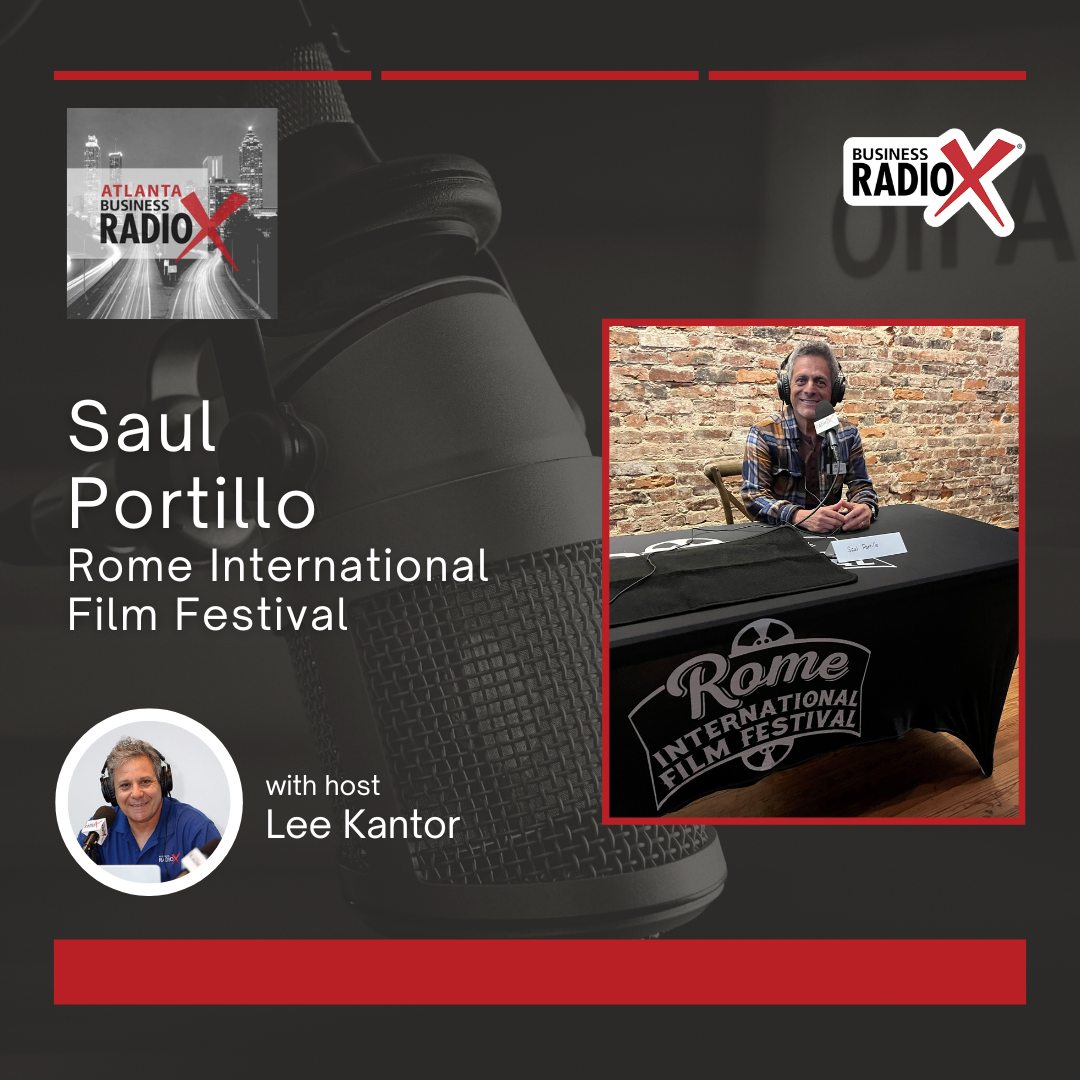
 Saul Portillo, Rome International Film Festival
 This transcript is machine transcribed by Sonix.
TRANSCRIPT
Intro: Broadcasting live from the Rome International Film Festival. It’s time for Atlanta Business Radio, brought to you by my global Presence. Now, here’s your host.
Lee Kantor: Lee Kantor here broadcasting live from the Rome International Film Festival in downtown Rome, Georgia. So excited to be talking to my next guest, Saul Portillo. He is on the board of riff. Welcome.
Saul Portillo: Thank you for having me. It’s a pleasure to be with you here this morning celebrating this beautiful festival of ours. Well, Saul.
Lee Kantor: Do you mind sharing a little bit about your take on what makes this festival so special?
Saul Portillo: You know, the common denominator that I hear every time in and out since my five year involvement with the with riff, I’m going to abbreviate that is that we are a boutique festival. And what makes a boutique? Everybody describes us as a family living room where everybody can just walk in absolutely relaxed, without any processes or procedures or protocol. They just feel that they are coming to a friend’s living room and enjoy some popcorn, maybe a soda, maybe a beer, whatever is available. Sit down and enjoy the beauty of cinema.
Lee Kantor: Now you’re involved as part of your career, as in, uh, photography in the arts, right? Yes.
Saul Portillo: So I’m actually a retired businessman. I did my living as in in the finance world. And, uh, so when I retired from, uh, business, I decided to pick up a hobby and that was photography. And then I began to study fine art photography. And it seems like I had a, a natural skill about it. And I have been very successful in fine art photography, competed internationally, have won many awards, Golden awards, best picture award. As a matter of fact, I was, uh, voted top 100 photographers in the United States by Wedding and Portrait Europe a couple of years ago, and through photography, I was able to plug in with Rome International Film Festival as a volunteer photographer my first year. And from there, then I moved up to becoming a board member and also the director of photography for the festival.
Lee Kantor: Now, for folks who are in the film industry, why would you recommend just going to film festivals in general? Why is it important? Like how do film festivals fit in into the work of an artist, a photographer, a filmmaker? It’s art.
Saul Portillo: It’s it’s absolutely pure art. And so anybody who’s in the art industry, whether you’re a singer, whether you’re a musician, whether you’re a painter, whether you’re a photographer, whether you’re a poet, whether you’re a filmmaker, if you are into art, filmmaking is art expressive in moving pictures. And so everything about a film festival involves the artistic eye and experience of artists from all genres and all disciplines.
Lee Kantor: Now, the Rome Film International Film Festival is special. How do you. How have you seen it kind of evolve over the years you’ve been involved?
Saul Portillo: Well, certainly, you know, uh, putting together a film festival is also like creating a film, a movie, uh, you plan it. We start planning our festival. I think we take a break at the month of January, maybe, but comes in February. We start planning the festival for, uh, down the road. So it takes a whole year practically to plan the festival. Nothing goes right. Nothing goes exactly as we planned. Just like a film. Uh, but we pull it off very well. We have a fantastic team of volunteers. We have fantastic board members. The community supports us, uh, people who have been here with us before. They also offer their support. And so the film festival, although it doesn’t run smoothly, nothing does. I suppose we actually are able year in and year out to pull out that warm boutique experience that we have come to be known for.
Lee Kantor: Now, as an attendee who, if you’re involved in any type of work in and around photography or film, how would you attack this event? How would you get the most out of this event if you were, uh, you know, somebody who wasn’t familiar with Rome or the festival.
Saul Portillo: Come here, show up at our events, show up in our social gatherings, our parties, our social gathering. Get to know people. Present yourself. Tell people who you are, what you do, where you’re from, and just simply begin a conversation. And through that conversation, you’re going to start making connections with people. You never dream of making connections. Uh, people from across the pond from Europe, from South America, from Asia, you begin to simply discover other creatives, and then that will develop into a relationship that may take you. I’ll give you an example. Never in my dreams did I ever thought that I was going to become a part of a Georgia film and entertainment delegation to the nation of Israel. I had that opportunity a week ago, actually, not even a week ago, four days ago. How did that happen? It happened because I was in a festival talking to people, making the connections, and suddenly you realize that there’s an opportunity presented to you, or that you yourself may present an opportunity to somebody else. And that’s the beauty of coming together in a film festival like ours here in Rome, Georgia.
Lee Kantor: And I think that’s something that people may not appreciate or maybe they underestimate, is that the access is phenomenal, right? The access you have to some of the top people in their field are you’re not going to be able to do this elsewhere. No. And this condensed period of time in one location.
Saul Portillo: Absolutely. Let me give you an example. I was in business for a long time in the financial world. And you go to conventions, you go to meetings, you go to. Gathering. And there’s always that mechanized, here’s my business card, here’s my business card, I do this, I do that. So there’s always that selling and buying processes that you find in business. A film festival is nothing but a relaxed group of creatives. Our goal is not to sell or buy anything. Our goal is not to brag about anything or exchange business cards. Our goal is to talk about what we have in common. Create something beautiful for the people to be inspired, to be moved, uh, to be encouraged through a visual, uh, motion picture, through photography, through a painting, through art, through a poet, through music. It is just a incredible conduit that people can just take off their guard and just be who they are and be the imaginative and creative human being that we, all of us, have inside. And a film festival is the most beautiful platform to provide that.
Lee Kantor: So if somebody wants to learn more and join the community, become a collaborator and benefit like you have, what’s the website? What’s the best way to connect?
Saul Portillo: Certainly. Thank you. So our website is riff ga.com, riffga.com. You go to our website, you can find information there. There is a, a tab that if you want to volunteer or if you want to request more information, we are always welcome volunteers or people who just simply want to be part of us. We won’t reject you. We’re going to put you to work and exploit your skills.
Lee Kantor: Well, Saul, thank you so much for spending time with us today. You’re doing such important work and we appreciate you.
Saul Portillo: Thank you so much for this opportunity. And hello, Georgia and everybody else.
Lee Kantor: All right. Back in a few at the Rome International Film Festival.