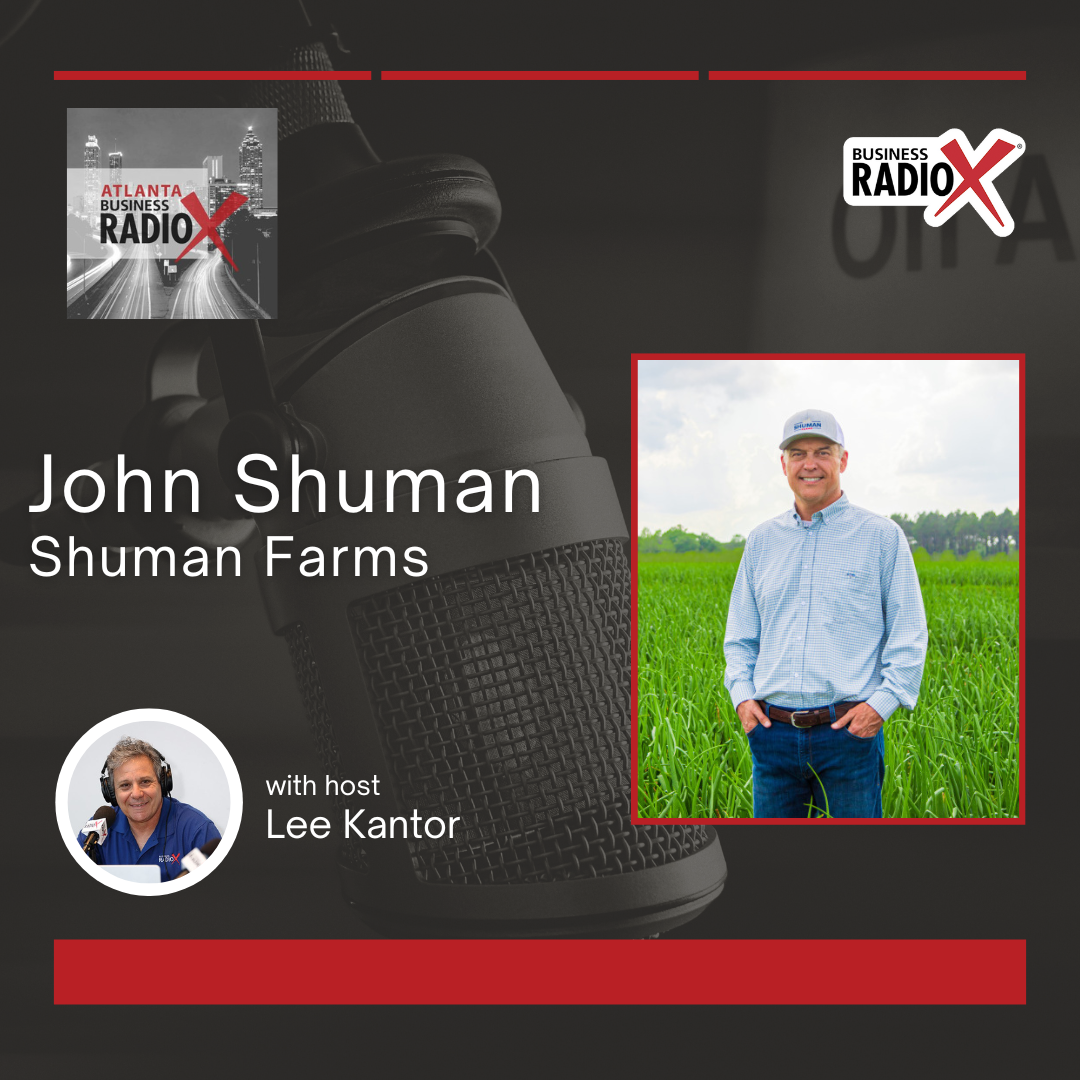

In this episode of Atlanta Business Radio, Lee Kantor interviews John Shuman, President and CEO of Shuman Farms. John shares the history and growth of Shuman Farms, the unique qualities of Vidalia sweet onions, and how the farm expanded to supply onions year-round by partnering with growers in Peru. The conversation covers industry regulations, branding, and the challenges facing family farms. Shuman also discusses their “Sweetest Ingredient” campaign, community outreach, and efforts to promote healthy eating and support food banks through the Healthy Family Project.

 John Shuman is the President and CEO of Shuman Farms, a leading grower and shipper of sweet onions based in Reidsville, Georgia. Raised in a farming family, John left college in 1993, just two classes shy of completing his business degree at Georgia Southern University, to assist with the family farm during a challenging period. The farm was struggling due to the lingering effects of the 1980s Farm Crisis, which had caused high interest rates and significant debt for many farmers, including the Shuman family.
In the late 1990s, John Shuman revitalized the family farm, establishing Shuman Farms, which has grown into one of the largest growers and shippers of sweet onions in North America. The company is renowned for its RealSweet® brand, introduced in 2001, which has become widely recognized in the produce industry.
Under his leadership, Shuman Farms has emphasized community involvement and philanthropy. In 2002, he founded the Healthy Family Project®, a cause-marketing organization dedicated to creating a healthier generation and giving back to families across the country. Since its inception, the project has raised more than $7.5 million for families and children in need.
John’s contributions to the agricultural industry have been widely recognized. In 2020, he was named Grower of the Year by the Vidalia Onion Committee, honoring his more than 25 years of service to the industry.
Through his commitment to quality, innovation, and community, John Shuman has significantly impacted the sweet onion industry and continues to lead Shuman Farms with a focus on excellence and social responsibility.
Connect with John on LinkedIn.
What You’ll Learn In This Episode
- The significance of Vidalia® onion season in Georgia
- How Shuman Farms has continued their education initiatives this season
- What initiatives Shuman Farms has put in place to give back to their local communities
- Shuman Farm’s annual ‘The Sweetest Ingredient’ campaign
 This transcript is machine transcribed by Sonix.
TRANSCRIPT
Intro: Broadcasting live from the Business RadioX studio in Atlanta, Georgia. It’s time for Atlanta Business Radio. Brought to you by Kennesaw State University’s Executive MBA program, the accelerated degree program for working professionals looking to advance their career and enhance their leadership skills. And now, here’s your host.
Lee Kantor: Lee Kantor here, another episode of Atlanta Business Radio. And this is going to be a good one. But before we get started, it’s important to recognize our sponsor, CSU’s executive MBA program. Without them, we couldn’t be sharing these important stories. Today on the show, we have John Shuman, who is the president and CEO of Shuman Farms. Welcome.
John Shuman: Thank you. Good to be here.
Lee Kantor: Well, I’m excited to learn what you’re up to. Tell us a little bit about Shuman Farms. How you serving, folks?
John Shuman: Yeah. Shuman Farms is a grower, packer and shipper of Sweet Onions year round. We’re primarily based out of Georgia, the Reidsville, Georgia area. We’re in the vanilla sweet onion business. And we we grew in partnership by the onions in the spring and summer. And then over the years, our business evolved as we served our customers and our grocery store partners, our retail partners. We expanded then to South America and to Peru. And we have a very good program down in Peru where we grow, pack and import sweet onions out of Peru through the port of Savannah. And we repacked in here in our facilities in southeast Georgia during the fall and winter months to serve our retail partners around North America, which we’ve done is year round. So what started out as about a sweet onion season? For us? Just the local season here has kind of expanded. Just the popularity of The Onion just kept growing and growing and growing and retailers one of those things year round. And we just couldn’t do that out of Georgia. So a lot of us, myself included in our competitors as well, we we turned to South America and found Peru about 25 years ago. So now we’re we’re in the year round. Sweet on your business today.
Lee Kantor: Now, can you tell us a little bit about the backstory? How did this start and how long have you been involved with it?
John Shuman: Yeah, I grew up in it. My dad was a grower. He was a farmer, and he also owned a Schumann fertilizer, which was a farm supply dealership in 2 or 3 counties here in southeast Georgia back in the late 60s, 70s and 80s, where he provided and served the local community farmers with seed and fertilizer. And so over the years, he got into farming himself. And in the mid 80s, early to mid 80s, he started growing by the onions when the onion just really was getting started. I mean, it, it been around for 50 years, but nobody knew about it. And I think in the mid to late 80s it just really took off. And you had Piggly Wiggly and Kroger put put Nevada in in their stores. And once they did, it just went. It took off like a rocket. So an industry was born and the onion, uh, I guess as you can say, the rest is history. So, yeah, my dad was in it and went through some financial tough times in the 80s and early 90s. And then when I got home from college, I was able to keep things going, so. Yeah.
Lee Kantor: So were you always, uh, going to take over the farm? Was that something on your roadmap or was it kind of out of necessity, or was it so how did that come about?
John Shuman: No, it was always a desire of mine. You know, I just follow my dad around as a kid and just watch what he did and just his passion for it and his love for it. And just we were in and around everything to do with farming 24 over seven. So it was, uh, kind of in our blood and so to speak, and, you know, has just become not so much what we do, but who we are. And, um, you know, it was something I didn’t want to do. It was a tough transition. There was I said dad was going through some tough financial problems and had to shut the farm down in the early 90s. And that happened to be the same year I came home and I was able to he helped me figure out a way to stay in the business, so to speak, and that’s what I did. So I really started from the ground up. But we never, you know, we never missed a year. So it was and it’s kind of built our testimony. But it’s been a good it’s been a good experience.
Lee Kantor: Now talk about kind of the history of the Vidalia onion. It had always been there and it was just never kind of like locally. You all knew about the quality and you knew that this was something special, but it never kind of left the borders of that region. And then all of a sudden word got out is that is that kind of what happened?
John Shuman: Yeah. So in the, in the, in the Great Depression back in the 30s, the local farmers were looking for a new cash crop. You know, things were tough obviously. And they were looking for a cash crop. And one farmer in particular, um, brought in some sweet onion plants and brought in some onion plants and planted them. And to everyone’s surprise, they were sweet and mild. And it just was kind of a local thing for, you know, for about 50 years and somewhere in the early to mid 80s, it just kind of got rediscovered. You know, before the advent of the interstate system, I-75 and I-95, uh, you had people from the Midwest and the northeast would come through southeast Georgia during the spring and summer and to go to Florida on vacation. And and you could buy these onions at the local farmers market. And that the name kind of picked up from that. People started calling them the sweet onions from Badia, those those sweet onions from Vidalia, because that’s where the local farmer’s market was. And highway one us, uh, one ran, uh, and went right through there. So, so running kind of gaining popularity and, and in the mid to late 80s, the state of Georgia, the state legislature picked it up and, um, put some definitions around the growing region. You can only grow them in 20 counties in southeast Georgia. And they, um, Got the trademark for the idea of Sweet Onion brand name. And so now we are all growing and packing and shipping as an industry, and we’re regulated by the Georgia Department of Agriculture. And Tyler Harper, our Commissioner of Agriculture is um, is is over that. So yeah, it’s a it’s an industry was born, so to speak, in the 80s and early 90s.
Lee Kantor: And it was pretty, um, pretty smart to kind of brand it and label it and then kind of make it a distinct thing. So it just wouldn’t be a sweet onion that kind of generic.
John Shuman: Yeah. And I’ll tell you, you know, for people who are not familiar with various regions, I’ll just say the state of Georgia is very blessed to have this honey. And it’s known throughout the world, and particularly North America, as the world’s most famous sweet onion. And I really do think Bobby Flay, I’ve said this many times, I think I think Bobby Flay said it best, and it really kind of captures how popular and how how much the body has penetrated pop culture. But the celebrity chef Bobby Flay once said, you know, the video is not only the world’s most famous onion is quite possibly the only famous onion. So I think that that kind of speaks into the affinity and to just what The Onion is to consumers.
Lee Kantor: Now, was that part of the kind of the marketing roadmap for the onions to partner with chefs like that and to get them in their hands so they can do what they do to make dishes in and around the onion.
John Shuman: You know, I think later on it was, I think early on just what really propelled the onion dues. You know, you walked into a grocery store in the 70s and early 80s, and there was just there were onions and the the sweet onion, the premium sweet onion, a mild flavor of sweet onion, was brand new to the market, so to speak. They’d been around a little bit, but nothing with any intentional marketing behind it as an industry. And so when the any came along, it the popularity of them really, the retailers really stepped back and looked at the industry and said, hey, this is something different here. We’ve got a whole new category in our grocery stores, and we want to merchandise this differently. We want to sell it differently. And by the way, we want to have these things year round. We couldn’t do that out of Georgia. And so that’s what I mentioned. We turn to Peru to expand our season. But again, when we’re when we’re down in South America, we’re selling sweet onions from Peru. We’re not selling onions to be a branded sweet onion. It has to be grown in Georgia. So. Right.
Lee Kantor: So there’s rules around they made rules around who can call it what and and there’s it’s not. You can’t just call it Vidalia unless it came from a region. Right.
John Shuman: That is correct. Yep. It has a trademark. And the state of Georgia regulates. And as growers, we have to license with the state of Georgia in two ways. One, we get a license to grow, pack and to pack the trademark. And then the next one is the trademark license. So yes, it’s a it’s highly regulated and I’m happy that it is. You know, early on there were some things going on that shouldn’t have been with growing regions around the country trying to trying to play on the About his popularity, but that’s all been taken care of now in this industry is really maturing. And, uh, the industry today is, you know, when I got in this business about 30 years ago, we had the industry was about 14 or 15,000 acres, and there was probably 300 growers in the industry, and most of them are in Tattnall County, which is Reidsville, where I’m headquartered. And about 60 to 65% of all the vendors are grown in Tattnall County. And then about 25 or 30% are grown in Toombs County, which is where the city of Adair is, where The Onion got its name.
John Shuman: So when you look at it, it’s really a little smaller than it sounds. You’ve got two counties producing about 85 to 90% of all of the onions. Um, but today, you know, the industry is around 10,000 acres and about 65 growers. And it’s really going through a lot of consolidation as as most industries have. You see acquisitions and mergers and consolidations and retailers are getting bigger and bigger and bigger, and they require their vendors to be at a scale and a scope to service their needs. And so, um, you know, when you think, well, if you’re here, you know, we used to be around 15,000 acres. Today we’re at ten. The industry is shrinking. Well, that’s not that’s not true at all, because over that 30 or 40 years we’ve learned how to grow these onions in a better, more efficient way. We’ve got better genetics, better varieties. And so we are actually producing more tonnage per acre than we did when we were growing 15,000 acres. We’re actually harvesting and shipping and producing more sweet onions on 10,000 acres than we ever did on 15,000.
Lee Kantor: Now, when the when the Sweet Onion first came about, you know, whatever. It’s what, 74. Oh it’s over. Is it a hundred years ago. Look how it it’s probably close to that right when it first became known. Was it something that all the farmers were like, hey, we got something and they all jumped on it? Or were people skeptical? Like, what was kind of the mindset back in the day when it was, you know, kind of new because sometimes, you know, the best ideas aren’t accepted by the population until they get some traction.
John Shuman: That’s very true. I think The onion and, you know, back in the Great Depression and in the 40s and 50s, it was not devout and it was just a sweet onion. And over time, it just became the sweet onion for everybody. But, you know, it’d be fun to step back and kind of see what they were thinking and how they responded to this. I’m I’m sure they didn’t quite know what to do with it, because back in those days, there wasn’t a sweet onion market. There wasn’t any demand for sweet onions. Um, it just again, it just kind of gained traction organically, if you will, and, and just kind of spread out and, and, um, when, when Kroger put it in their retail stores and took it national, it really the industry really got shot off like a rocket. It took off. And this was the late 80s Early to mid 90s, the industry was in aggressive growth mode and it was growing leaps and bounds. And by the late 90s we had hit market saturation. And, you know, every industry goes through these cycles. And so we were no different. And it takes a little while to find your equilibrium of supply and demand. And we I think we’ve done a good job of that here in Georgia.
Lee Kantor: Yeah. It was probably an interesting time when it came about. People tasted that. They knew it was different, but they just didn’t know that it was kind of different special, that this would be something that the world would be clamoring for, you know, a few decades later.
John Shuman: That’s very true. Yeah. And I think just the unique attributes of the onion, its versatility, you know, you can you can cut it, you can eat it raw, you can cook it, saute it, it goes in most any dish. And and it’s right here from the state of Georgia. It’s the only place in the world you can get it. And it truly is a unique growing region here. And you say, well, why why There’s 20 counties in southeast Georgia. Well, if you if you go 1 or 2 hours north around Macon, Georgia, it doesn’t work. If you go 1 or 2 hours south around South Georgia and north Florida, it doesn’t work. People have tried it. They’ve been trying for years to grow this onion on the Georgia Florida border. And it just doesn’t work. It gets too hot too early in the spring. So we have a mild winter here in this growing region. We have a an early spring. We have a unique soil composition. We’re in the sandy. We’re in the coastal plains of southeast Georgia. So we don’t have a lot of red clay. We have a sandy, loamy soil, and our nutrients are able to leach through the root zone by rainfall.
John Shuman: And so what that allows us to do, and therein lies the key to why this region is special is with proper rainfall and irrigation, you can leach all the nutrients through and out of the root zone. And we get to go back as farmers through soil sampling and through our experience with agronomists, and put back into the soil of the nutrients that we need to produce this premium sweet ending, and one of the key macronutrients is sulfur. And sulfur is critical to to cell wall structure of the onion to quality the shelf life. But it’s also critical to flavor and pungency, which is the heat. If you’ve ever cut an onion and it made you cry, if you’ve ever cut an onion that had a warm flavor to it, that’s pungency or proof of acid in the onion, which is its natural defense mechanism for that onion to survive. So, uh, but we can we were able to go back in and put just the right amount through our learning curve over the years and decades and, and really produce a mild, sweet flavor. And it truly is a unique experience.
Lee Kantor: Now, you mentioned that, um, the soil is kind of unique and you’re able to produce more onions in this in a kind of a smaller footprint than you had historically. Is there enough like, is there room for more growing? Like, is there just the land and the soil available, or are you kind of maxed out at this point?
John Shuman: No, I think there is. I think I think certainly over the 20 county production area, we do have room to expand the industry. I think what we’re bumping into now, like most industries and most products, is, um, we have full distribution throughout North America, um, uh, to all four corners of the United States and into Canada and, um, you know, and, and the popularity of The Onion has caught the attention of other growing regions in the United States who want to who want to play in that space. I don’t think they have the premium product that Georgia does. And in Nevada, sweet Onion. But nevertheless, there are no national standards on what you can brand as a sweet onion in this country. So we do have some competing, growing regions that do, um, play on the local factor. They do, uh, play on, on, you know, the carbon footprint, you know, short of the market type thing. And I don’t think they do have the premium product of about anything. But I think we do have some headwinds, particularly in California, in the Pacific Northwest, where there’s some local onions out there during June.
John Shuman: It’s right in the middle of our season here. So I think some of those competitive factors are the reason why The onion is, um, kind of found its its rhythm and its equilibrium. But it’s, you know, during our, during our seasons spring and summer, we there’s no, I don’t there’s not many retailers in North America that don’t carry about a, uh, you know, some level most of them carry in full distribution, which means they’ll carry the loose bulk jumbos, which you go into the grocery store and you can buy an onion loose. You just pick one onion up off the shelf and so that they carry the bulk and then they carry the bags. They’ll either carry the 2 or 3 or 4 or 5 pound bags. So most retailers do. I mean, it’s it’s uh, yeah. Again, it’s just something that we are very blessed to be a part of here in southeast Georgia. And the fact that we travel all over, you know, and all over North America promoting this onion is most people recognize the brand name and that’s something special.
Lee Kantor: Right? That’s a kind of point of differentiation that no one can take away from you. And it. And I think you have the mindshare that it locks in as this is the super premium product. This is the the one you want. Everything else is kind of a version of this.
John Shuman: Yeah. No doubt. It kind of gave the idea the popularity. The union gave birth to a year round sweet onion category for grocery stores. And that’s that’s the history of The Onion. It’s, um, when it came on the scene, you know, you’ve you’ve heard that if you want to be a market leader, you have to be first. Better or different. It’d be really good if you were all three. But, uh, and the onion was it was first better and different.
Lee Kantor: So now as part of, uh, Schumann Farms, you’re doing some things to keep kind of the, the top keep keep the brand and keep the onion at top of mind. Can you talk a little bit about this, uh, the Sweetest Ingredient campaign that you guys are working on?
John Shuman: Yeah. So that’s it’s been several years in the making. We, um, partner with local, uh, restaurants around the state of Georgia during the month of May, which is peak harvest season for the onion here in Georgia. And it’s just really a fun way to connect to, uh, consumers at the restaurant. Um, and just bring attention to The onion and its seasonality and, and get it in for chefs to prepare it and new and creative ways and really expand the use and and highlight the versatility of the idea. So it’s been a really good promotion for us. And and we’re trying to put it in front of, uh, consumers who may not be looking for volunteers, who may not have heard about the onions and just kind of bring attention to what the onion is, connect the consumer to the product and the growing region and really highlighted seasonality.
Lee Kantor: Yeah, and I’m sure there’s no shortage of chefs who want to use that ingredient. I mean, it’s it’s kind of a premium ingredient. And they and they can use their creativity. Is there anything kind of out out of the box that you’ve seen that some of these chefs are doing with the onions.
John Shuman: You know they are. They’ve got a lot of twists and turns on them. I’ve sampled a few of them. I’ve been to a couple of these restaurants during Restaurant Week in May and, um, you know, Murphy’s up in Virginia Highlands in Atlanta. They did a really good job, had a really good dish with a sauteed buddy. And, you know, I’ve seen other other, um, you know, restaurants try the, the, uh, French onion, the, a twist on the French onion soup and. Yeah, it’s, uh, it’s been really, really unique to see how they put their creative culinary expertise into this product.
Lee Kantor: So now, um, now that your business is multi generations, which is, uh, a difficult thing just by itself, uh, to achieve, what kind of legacy are you hoping to, uh, to leave? Is this something that you want to continue in the family? Uh, how do you see kind of, you know, your your future, uh, in the business.
John Shuman: Yeah. You know, I am second generation. My my two sons. My wife and I have two sons, and they’re 24 and 22. My oldest son, Luke, uh, graduated from the University of Georgia about a year and a half ago. And he joined the business as a third generation last year. And my youngest son, Jake, is a senior at Georgia Southern. And he’ll be graduating in December this year. And so he he plans to join us in January as well. So we’ve always been intentional about putting our children in front of the business and getting them involved and just showing them what we do and who we are and what’s going on. And but as they got older, you know, it’s it’s their decision. It’s their, you know, they we wanted them to take an interest in the business. We’re very blessed that they have taken an interest and, and have a desire to come back and learn. So we are excited about the third generation and, um, you know, keeping the family business going. There’s a lot of headwinds for small family businesses, particularly farms in America. And it’s, um, just the, you know, just the the tax structure trying to pass, uh, your assets down your children is a tremendous burden on small family farms. And and just, you know, farmland has continued to get more and more expensive. Our most important at one of our most important assets of being a farmers access to good farmland. And, as you know, um, being in and around Atlanta, it’s, uh, Georgia’s growing and, uh, there’s, there’s competition for land and subdivisions and development and all these things are good.
John Shuman: We all want economic progress, but we need to be we need to do it in a smart way to preserve assets like Farm City. You know, as we pass on, you know, as we have a desire to pass on our business to our children and to that third generation. These are kind of some of the headwinds that we’re faced with. And how do we navigate the landscape and ensure that we do it in a responsible way? Yeah. And I think just beyond that, you know, just over the years, we as a business and as our culture and who we are as a people, we wanted to stand for something more than just being in the sweet onion business. So we obviously got involved early on, wanting to connect to the to the consumers and to the to the neighborhoods and to the communities that have supported our product over the years. So we started a program over 20 years ago called Healthy Family Project. And it’s really, I think, one of our most important sustainability initiatives and is a company. And what we do, it’s really near and dear to me, but it has two missions. One is to educate, uh, children and parents on the benefits of eating a diet full of healthy fruits and vegetables, particularly sweet onions, and kind of putting a sweet onion as the center of the plate ingredient.
John Shuman: And the other one is we have a charity of choice and that is Feeding America. Food banks, we think, is farmers and growers in America. We have a a desire, and we feel like we have a responsibility to give back into food insecurity. And that initiative and Feeding America, food banks around the country doing a wonderful job meeting that need with boots on the ground. So we we support them as best we can. And over the years, this program has. You know what started out as a Human farms, um, community outreach program has just developed into a nationwide program. We’ve partnered with other grower shippers around the country and with retailers around the country, and we’ve been very blessed to have, I think, over 50 grower partners around North America. And I don’t even know how many retail stores, several thousand retail stores help us promote this campaign every spring and fall. And we have been collectively, all of us going together to support this, this need have donated over $8 million, uh, to, uh, charitable outreach causes and our retailers markets. And we’ve also donated more than 22 million meals to Feeding America Food Bank. So that’s something that’s really important. That’s a legacy we want to leave, uh, which I think is more important than growing sweet onions. I want to have a positive impact on these communities and our communities that, uh, support our product.
Lee Kantor: So if somebody wants to learn more Um, about the human farms, uh, you know, the initiatives you’re working on and the human. And to support the human farm brand. Uh, is there a website? Is there a way to connect social media? Is there?
John Shuman: Yeah. Yeah. Well, social media, of course, human farms. Um, and then our we have two brands, Real Sweet and Mister Buck’s. Um, you can go to human farms, google.com, uh, on the website and see our website and for recipes and some, uh, consumer, some, you know, versatility of the body. And you can check out real sweet. Com so yeah, there’s a couple of ways to connect with us.
Lee Kantor: Well, um, John, thank you so much for sharing your story today, doing such important work. And we appreciate you.
John Shuman: All right. Thank you. Lee, it’s been a pleasure.
Lee Kantor: All right. This is Lee Kantor. We’ll see you all next time on Atlanta Business Radio.














