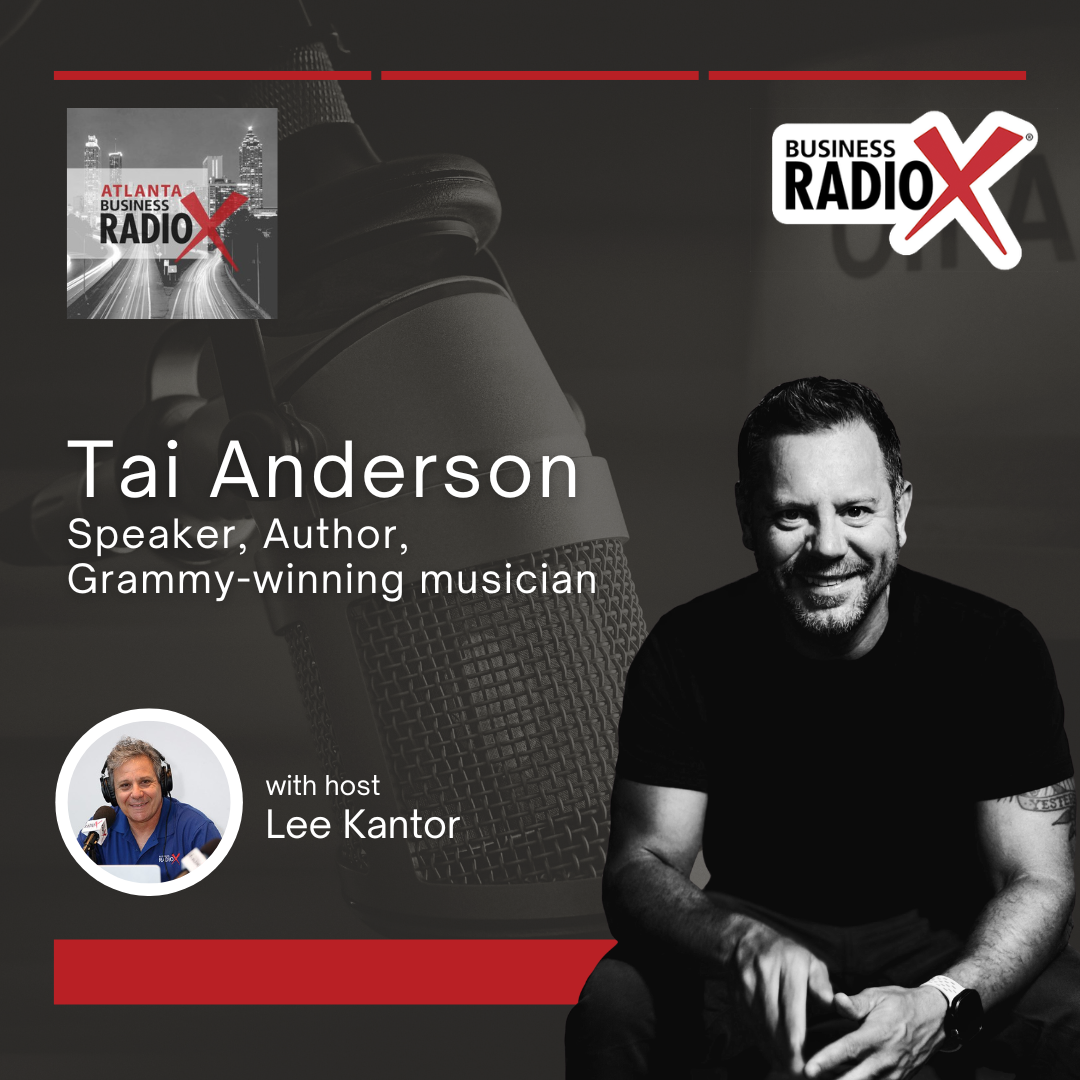

 In this episode of Atlanta Business Radio,Lee Kantor interviews Grammy-winning musician and author Tai Anderson, author of Market Like a Rockstar. Tai shares how his 22-year journey with Third Day inspired a fresh approach to marketing that goes beyond attracting customers to building loyal fans. He explores the Rock Star Set List framework, the power of trust and intentional customer experiences, and how businesses can turn customers into brand advocates through authentic connections, strong brand identity, and meaningful referrals.
 Tai Anderson has spent thirty years building one of music’s most beloved global brands as a founding member of the Grammy Award-winning band THIRD DAY. What he learned along the way about loyalty, storytelling, audience connection, and building something that lasts turned out to be a masterclass in marketing.
For the last ten years, he’s been proving it works off the stage. As Marketing and Creative Director at Supreme Lending Southeast, he applied those same instincts to one of the most human decisions people make: buying a home.
 He produced AI-driven video content, led brand strategy, and built education platforms that reached more than 6,000 customers.
Today, he speaks, consults, and writes full-time. He is the author of Market Like a Rockstar.
Tai lives in Woodstock, GA, with his wife Emily. He collects vinyl and wakes up early.
Connect with Tai on LinkedIn, Facebook and X.
What You’ll Learn In This Episode
- Transforming customers into loyal fans through meaningful brand experiences.
- Applying the Rock Star Set List framework to build lasting customer relationships.
- Creating intentional moments of delight that strengthen customer loyalty.
- Building trust by consistently keeping brand promises, even in challenging situations.
- Using referrals and word-of-mouth marketing to grow a business authentically.
- Embracing brand identity and serving a specific audience instead of trying to appeal to everyone.
- Applying the lessons of Third Day’s success to business marketing and long-term brand growth.
- Developing a grassroots marketing approach that prioritizes genuine relationships over mass attention.
 This transcript is machine transcribed by Sonix.
TRANSCRIPT
Intro: Broadcasting live from the Business RadioX Studio in Atlanta, Georgia. It’s time for Atlanta Business Radio, brought to you by My Global Presence, the award winning Atlanta public relations agency that elevates brands and non-profits through authentic storytelling and national media campaigns. Find them at myglobalpresence.com. Now, here’s your host.
Lee Kantor: Lee Kantor here, another episode of Atlanta Business Radio. And this is gonna be a good one. But before we get started, it’s important to recognize our sponsor, My Global Presence. If you want global visibility and meaningful impact, go to myglobalpresence.com. Today on Atlanta Business Radio, we have Grammy winning musician And author of the book Market Like a Rockstar, Tai Anderson. Welcome.
Tai Anderson: Thank you Lee. Great to be here.
Lee Kantor: Well, I am so excited to learn about your book. First off, Market Like a Rockstar. What a great idea. Tell us about kind of the genesis of the idea. How’d that come about?
Tai Anderson: Yeah. So I spent 22 years as the bass player for Third Day with a great run that started right in my basement in Roswell, Georgia, when I was 16 years old to about 2015. And I had, when our singer came to us and said he wanted to make a solo record, I said, I think I should go back to college and get my degree, and went back and got my marketing degree and stepped into the business world going, man, I’ve won four Grammys with Third day. Now with my marketing degree, Coca Cola probably wants to hire me to be their next CMO. And I found out that wasn’t the case because the whole world just saw what I did in music is just just as music and as marketing is something different. And then I started kind of workshopping, you know, a good decade ago, what became market like a rock star. And my, the premise is that everyone has the idea of marketing wrong or at least incomplete because we all focus just on getting attention and turning that into customers. Well, in the music business, we’re in the business of creating fans and the best brands in the world really create fans.
Tai Anderson: How do we do that? So I developed a framework for it called the Rock Star Set List, where it goes through each of the steps that takes someone, yes, through the traditional marketing channels, but past that first sale to where that loyalty is really expressed in identity, which is what we all do with the things that we’re fans of. So that’s how this book came to be, and it really came to life over this last year, I was running the the marketing and creative direction for a mortgage lender here in Alpharetta, Georgia. And the band came calling and said, let’s do a 30th anniversary tour. And so this book really came to life while I was on the tour bus, going all over the country, seeing that our fans showed up even 30 years later after our first record. Fandom is such a big deal that they packed out arenas, sold out Red Rocks in Colorado to to culminate the show. And it was just such an amazing experience. So really market like a rockstar is a love letter to fans.
Lee Kantor: Now is it? I mean, music and bands have an emotional connection with their fans. Is it possible, like you worked for the mortgage company? Like, is it possible for a company like a mortgage company to. I know they can aspire to have that kind of relationship, but is it realistic that people are going to fall in love with a mortgage company and and be curious where they’re at 30 years after they gave them the mortgage. Like, how does a business kind of take some of those emotional connections that a creative has and translate that into business?
Tai Anderson: Yeah, that’s a, that’s, that is the question. It’s such a great question. And the reality is we all experience it every day and we experience it in our own lives. I mean, the idea that a mortgage company could do that seems far fetched until you go, well, how in the world does Yeti do it? They’re selling coolers. And yet I like to say they’re selling the world’s most expensive sticker that comes with a free cooler. Because people are such fans of the brand, they, they, they base their identity around the brand. And we all see that with, you know, with Nike, with Apple had such a great campaign. I am a Mac, not just I prefer a Mac. So it starts with this idea that fandom isn’t just about preference. It’s really who we are. If I want to know who you are, especially as college football is kicked off right here in the South. Let me tell you what. Tell me who you’re a fan of. Tell me what you’re a fan of. So the idea at first it seems really aspirational and hard, but I would counter, gosh, you know, a musical connection. They might listen to, you know, our music here and there. A song might connect with them, hopefully that great live experience. But a mortgage lender, a real estate agent, anyone in a professional service, certainly anyone in, you know, your favorite restaurant, all of these things, they’re actually opportunities when you really move someone up that ladder of loyalty, that they can become a fan of you.
Tai Anderson: And part of that, ultimately what we’re looking to unlock is the most powerful thing in marketing. And what do fans do is they tell you about the things they’re fans of. They, they, they come to the shows, they buy the t shirts, so they mark it for you. So ultimately, what I feel like we’re marketing what I saw as being incomplete is a lot of tactics to talk to strangers, get them to customers, and then we basically stop talking to our customers or where it moves to a different department. But I think holistic marketing should be moving that customer all the way to where they feel so great about you that they’re out there telling their friends. And I think no matter what we do, that’s possible. You know, it’s, you know, if someone comes on your show, Lee, it’s like the opportunity is like, yes, they’re here. Hopefully, you know, people can hear about my book and all these great things, but ultimately what you really want is everyone who’s on to go, man, that was such a great experience. You got to go on Lee’s show. So all of us, no matter what we do, it’s unlocking. What’s that gap between that first interaction to someone really being a champion for you in the marketplace?
Lee Kantor: So now when you work with your clients, how do you kind of help them systematize that? Because that sounds good. And it sounds like, of course, it sounds like common sense. Of course, we want to elevate everything we do to be, um, kind of the get that word of mouth out there. And at the heart of word of mouth, it requires people to open up their mouth and tell people about you. So is there some things that I can do as a brand to help make that easier for my fans to, you know, tell other people about me rather than just keep me as this cool thing that they keep on the down low?
Tai Anderson: Yeah. Um, absolutely. And so that’s exactly what Rockstar does the, the framework. So I break it down into eight steps. It’s, you know, it’s an acronym for Rockstar. So sort of the traditional part of marketing we understand is a marketing funnel is the first part. That’s what’s rock. So reach, obtain information, cultivate a relationship, and then kick start something new when they make that first purchase. Unfortunately, that’s where the marketing funnel normally runs dry. And I contend, you know that if your marketing stops at that first sale, you’re destined to be a one hit wonder which none of us in music want to be. So what are those steps that really move someone from first, from that first interaction in customer to fan. That’s what I break down as star serve, trust, advance referral. And with that, I kind of break down each step in the book where serve is to me about creating those intentional moments of delight, which absolutely can be systemized. When you think about your marketing, everything on that top end is systemized. All your responses, your social media, all of these things. Well, how have you systemized that moment of delight when someone says yes to you? What are you doing in that first 48 hours to really let them know that you appreciate them and it goes beyond whatever the contract was. It’s that extra moment where you go, wow, they really care about me and I’m valued. The next step is trust. Trust is about keeping your promise no matter what, keeping that brand promise. My good friend and mentor wrote the foreword to the book Glenn Jackson. He heads up Jackson Spalding here in Atlanta.
Tai Anderson: He wrote a great book. I like holding up his book to A preeminence. And there he talks about trust being the most important five letter word in business. I think sometimes we think in business that means that nothing ever goes wrong. But actually, some of the brands that I admire most and the professional relationships I admire most. It doesn’t mean there hasn’t ever been static in the relationship or something that went off. But when someone really responds to that, well in that great, you know, customer service moment where they really live up to what they’ve promised, not looking for the fine print to get out of it. That helps advance someone up loyalty to the next step advance. That’s about going deeper in the relationship. I think for most companies, there’s that initial offering, but where can they go deeper, upsell, resell, cross-sell, all of those things? How do you deepen the relationship first? And then when it finally comes to activating a referral, where I systemize it as number one, you need to know how they feel. That’s where surveying tools are so powerful. I’m a big fan of the Net Promoter score. Just getting that one question answer where they tell you how they feel about you. How likely are you to refer? When they’ve self-identified as a 9 or 10, they’re a fan. And that’s when it comes to the power of the ask. So I like the illustration. I like to give. I don’t know if you are. I don’t know if you’re a coffee drinker. Lee. I am in the line of work you’re in. You must be a coffee drinker, am I right?
Lee Kantor: Yes.
Tai Anderson: Correct. So I don’t know if you’re like me, but for years I, I, I drink coffee, I travel well, you know, there’s no more convenient brand than Starbucks because they’re just everywhere. Maybe Dunkin Donuts, we can get an argument about that. But, uh, I never tipped at Starbucks till 2024. And I often when I’m speaking, I’ll ask people why and people come up with big things. Well, it’s a big corporation or they burn their coffee or this, that and the other. I’m like, well, it’s always been good for me. It’s convenient, it’s great. I never tip for a simple reason because they had a cash jar and I didn’t carry cash and you couldn’t tip when you checked out. But when I go to my local coffee shop and they turn that iPad around. I tip every time. And I’ve documented, you know, did my own little unscientific market research to watch that in practice for years. Well, now Starbucks has finally fixed their POS. And so when you go to check out now, even with credit card, which is what we all use, there’s a line for tip and baristas tips have gone up exponentially. So to me, when you talk about referral, when you’ve moved someone through all these steps where you know to reach them, you’ve got their information, you’ve cultivated a relationship with meaningful content, they’ve chosen you for that first time. You’ve created a moment of delight, you’ve kept your promise, and you’re growing in that relationship. You’ve earned the right to make the ask. But most of us are. Referral strategy is simply prayer. And even though I’m part of a Christian band, I’m a big fan of prayer. I don’t think that that is a great strategy to unlock and empower your customers to go to other people about you.
Lee Kantor: Now, speaking about your band, um, let’s go back to the early days of third day. What was it? Um. What happened that got you the escape velocity to, you know, go from. Oh, we’re a garage band to, you know, we’re selling out arenas.
Tai Anderson: Yeah. That’s a it’s a great question. Wasn’t one simple thing. Um, you certainly, you know, luck is, you know, the harder you work, the luckier you get. Um, I think first of all, um, what I talk about, you know, in the book I start the whole book is organized like, like a set list of a show. So if you’re a music fan, you’ll love it. If music isn’t your thing, you’re gonna hate this book. I probably it’s not a great way to launch it, but I’m just being honest because I go deep into the metaphor. Well, I start with the garage, and to me, a great band is about the who. I mean, think about your favorite bands if you love the Beatles. Well, who are the Beatles except for John, Paul, George and Ringo? I’m a big U2 fan. Bono the edge, Larry, Adam, you see behind me, Dave Matthews Band, Coldplay, my favorite bands, The who is inseparable from the band. Now think about that for what would Apple have been without Steve Jobs here in Atlanta? You know who who in Atlanta wasn’t given a free chick fil A card from Truett Cathy? Right? It’s the founder and the who is inseparable from the brand. So I think it starts by, uh, by getting the right people on the team, the right people in the band.
Tai Anderson: And I think for us, we just were very fortunately unscientifically. But the relationships that formed the band are singers and incredible talent, but those core relationships set the foundation for everything. And then I think what really helped us grow, we were we were already having great success coming out of. We were like a house band at the Strand in Marietta before they remodeled it. Uh, it’s much nicer now, but people would come out and see us and it started to grow from 100 to 200 to 500 people. Every time we played, we got some national attention. But the biggest thing that I think accounted for our success, that helped us, you know, win those Grammy Awards and become, you know, the the Christian music group and artist of the year. It was a meeting that we had right in between our first and second record. And the mainstream record companies had come to us, and they were basically telling us, we can help you cross over. We can help you reach more people, we can help get your your music on MTV and on mainstream radio and all of these things. All you have to do is just dilute who you are a little bit, maybe downplay the whole faith angle, be less of a Christian band and more of a rock band.
Tai Anderson: And I’ll never forget in that meeting was our booking agent, a guy named John Huey, who heads up CAA in Nashville. He had broken the police and Joan Jett and the Blackhearts and, uh, Michael W Smith and Amy Grant have been responsible for so much of their mainstream success. So they were just telling us again and again the mainstream label just dilute who you are. We can help you cross over. John Huey stands up and he says, I don’t believe in crossover. I believe in spillover. And then he got up and left. And I think us applying that message, which we definitely did, it went right into our next record. After that, let’s just be who we are for who we are, knowing our audience, knowing who we are, being true for that. You know, Seth Godin talks about the smallest viable audience. So us really understanding that, hey, we don’t need to try to reach everyone, which would require us to dilute who we are. Let’s be for our people. I think that was the single biggest thing that led to Third Day’s really incredible success and the longevity that we’ve been able to have.
Lee Kantor: Now, when that occurred, when that conversation occurred, Was the band like all in on that, or was there a debate or were there was there kind of, let’s talk about this or was this like an obvious. I mean, in hindsight, it’s obvious. It’s obvious.
Tai Anderson: Have you been in a band?
Lee Kantor: Well, I’ve been around, you know, any group of people, every. Well, any you put any group of people together and it’s hard to get consensus, you know, after, you know, the first conversation.
Tai Anderson: But yeah, that’s a great question. And I think it’s a great I think there’s a great business metaphor. I was probably the person in the band. I didn’t really come. I didn’t really understand Christian music. I was just a big U2 fan. So to me, it just seemed natural that you would sing about faith. And so I was all for, hey, the more people we can reach, the better. I’ve always been kind of that the marketing business guy for the band. And you know, the idea when you’re 21 years old, of course, you want to be on the same radio stations as Pearl jam and Stone Temple Pilots. I think that a lot of it was just, um, us applying that message of spillover. It requires you to really dig into who you are. And I think for us, us really just kind of accepting that, you know what? We are going to be the best Christian band in the world instead of trying to hide it. I mean, our name was Third Day. It seemed like a a hard thing to try to water down anyway. And there’s a lot of other bands, some of my favorite bands that come from the Christian space. I think have been able to successfully thread that needle. Bands like Need to Breathe and Switchfoot.
Tai Anderson: Even U2 or yes, the faith is part of it, but they’re not labeled as a Christian band. For us, our Secrets of Success was just going, this is who we are. And I do think some initial struggle. The record that we made after that was called offerings. And I remember having to lobby the other band members for a good, solid year that we should make this record. And there was just kind of resistance to it. I was like, I want to make a live record that takes these moments in our show that are so powerful, that are the fan favorites, and I want to capture that. Let’s do some new music. The rest of the band, hesitant, finally convinced them, went to the label. The label said, no, it’s not going to count towards your record deal. We said, great, pay us more. And they said, well, you have to pay for it yourself. We said, isn’t that what a label is supposed to do? Pay us even more? And that record, our previous record had sold about 300 000 records. Offerings went on to sell 2 million records and lifted up our entire career. And I think it was because really, for that first time, we found that real peace and accepting who we are and whose we are.
Lee Kantor: And, and then kind of going all in and doubling down, it wasn’t like we’re going to dip our toe.
Tai Anderson: Yeah. And I think, you know, there are those examples of pop music that’s just pop music, just like there’s brands out there that, you know, if they have a big enough budget, they can instantly just have that mass appeal. But again, you know, I mentioned Yeti before, when you think about Yeti, they went all in on who they were for and their success being so mainstream. They weren’t picturing, you know, soccer moms on a, on a 8 a.m. by, you know, by the field. They were picturing these outdoorsmen and obscure sports and, uh, you know, kayak fishermen and all these things, but because they served their audience so well, more people wanted to come to the party, you know, over my shoulder here, Dave Matthews Band, you know, they still every year go and sell out Lakewood or Amoris Park here in Atlanta, as they do every shed that they play, and culminate in three sold out nights at the Gorge in Washington state. Um, they’re not trying to be anything but themselves and they’re actually, you know, incredibly original. There’s no pop formula that says, you know, violin, saxophone, you know, they sort of broke the traditional rock and roll rules. They have long songs, but their fans love them and they grow because their fans say, you got to come experience this with me.
Tai Anderson: So I think that’s actually more true in business than it isn’t the best brands that have even had that mainstream success. It’s really been a spillover of them saying, this is who we are. And when brands get off track, it’s usually because they forget that, you know, you think about like a Lululemon grows out of going, hey, we’re gonna, you know, make, uh, you know, clothing that, you know, enhances their performance for, for people doing yoga. And then other people, like, I got a few Lululemon shirts. I ain’t doing yoga, right? But I want to be part of the party. And so I think that’s really a key for so much of us. And maybe this is a good reminder of no matter what you do, um, to really think about, you know, who’s a part of your team, who’s that dynamic because that DNA is going to imprint on your company, but also who are you trying to serve and be radically committed to that audience. And when you do that, well. Other people that are even outside of that say, I want to be a part of that, too.
Lee Kantor: Now is your work. Um, you mentioned working for, uh, as a marketing person for a company. Is that your like main job? And now you wrote this book, you know, kind of because you got a foot in two camps here with the music and the business, or are you now a consultant to help clients implement some of this rock star methodology?
Tai Anderson: Yeah. So it definitely just right on June was a big transition for me. So I, I had, I had worn sort of that dual hat throughout the tour, but as the tour was wrapping up, we had a sold out show here in Duluth in, in Georgia and sold out the arena there. And it really was just coming clear. I’d been working on this book, that, man, I need to really take this season and take this message to the larger world. So have kind of, you know, stepped away, at least for now from the, from the, the mortgage industry. And I’m out there, you know, taking this message in the book and then speaking at conferences, having some great opportunities to go to healthcare conferences and hospital associations with this message. So my plan for now is to promote this book, A step into public speaking, and then absolutely finding those relationships that really resonate to go, how can I install, how can I help install this, this rock star framework and to your organization so that you have a holistic framework that’s really taking your customers all the way to fandom.
Lee Kantor: Now, is your ideal client. Are you going to start with kind of the, in my opinion, the low hanging fruit of creatives like yourself, like people who are musicians or artists in some form or fashion and then get to, you know, like a CPA or you just taking on, you know, because, I mean, again, the, the foundation of the book is to kind of go all in on what your superpower is, right? So yeah. Is your superpower creative or is your superpower more kind of agnostic to any person that has a brand?
Tai Anderson: Yeah. I think that, um, when I think about who this is for, um, I do think that, you know, and part of that maybe it’s not the best marketing in the title because you hear market like a rockstar and maybe that communicates, hey, this is for the marketing person. I think it’s, you know, there are so many smaller businesses, entrepreneurs that they are the marketing person because they’re, they’re everything for their company. So I definitely feel like I was sitting with someone the other day and they said, you don’t want to target, uh, entrepreneurs or solopreneurs. You don’t want to target small businesses because they just don’t have the budget. And every dollar, you know, so they were kind of advising like, you need to go take this to a, to larger organizations. And although I’m open to that, I gotta say, kind of like practicing what I’m preaching. Over the last ten years with the mortgage lender, I got to teach this framework to thousands of real estate agents, and I just have a passion for bringing this to that small business where they’re going, hey, they’re in the struggle every day. Every dollar matters, and they’re having to decide it’s a real opportunity cost. Do I spend this on a Facebook ad targeting a stranger to try to get them in the door? Or do I allocate budget that I could really create a delight moment for an existing customer? Do I do a campaign to the sleeping beauties of maybe existing customers that have gone dormant? Or do I go out and once again hire an influencer to chase a stranger who’s never worked with me? So I have a passion for taking this to small businesses, the audience, it’s still kind of in that that phase of just going.
Tai Anderson: I think the first step for like for an artist is making great music they’re proud of, and then seeing where it resonates to see where that audience is. So I’m definitely in that early stage, But I think over the the next year, my hope is to take this to, you know, as many people as I can. But, uh, you know, maybe it’s the, uh, that faith angle of me, but I, I, I think definitely start in your own backyard and start with the relationships you have. And so, um, I’m getting great feedback already just from those that are checking out where they’re telling me, wow, I can’t wait to take this into work, share this with my team and see where we can implement it. So, um, really encouraged and, um, hopefully we’ll find the audience maybe in a year, I’ll come back and I’ll go, you know what? I really found it. This is specifically for the, you know, hospitality industry or specifically for healthcare. But I think right now I’m sort of in that phase of just going, let me put this song out here and really see who it really resonates with.
Lee Kantor: I mean, yeah, that’s always the first step is to create the art and then put it out there and let the market tell you, like, learn from the market a bit.
Tai Anderson: I do think, and that is the hard thing about the day and age we live in. I remember one time, you know, we were making a record and our record company came to us and they said, great, we want to sit down with you guys because we have the marketing plan for the record. And we’re like, we haven’t made the record yet. How can you have the marketing plan?
Lee Kantor: Just trust us. We just do your part. We’re the big brains over here that understand things you don’t know.
Tai Anderson: And so that’s where I absolutely think, you know, in any creative endeavor, but really should be for anything, you know, for any product you’re going to sell, you should make sure that it’s really good first. If you have a service, make sure you’ve honed those skills. So for me, step one was like, can I create a book that I’m proud of? And I feel like I feel really proud of it. You know, it was interesting because it’s like I was talking to other public speakers and they were kind of bemoaning that like, man, we have this passion and this talk that we love to give, but really what we spend most of our time doing is not working on our material. We spend the most time trying to be, you know, a social media influencer and creating content. And, you know, where even though a lot of times that content isn’t leading to your next speaking gig. And so we were kind of bemoaning that and I said, you know, it’s, it is such an interesting thing where, um, it’s so easy for all of us to put the cart before the horse, especially in this social media world. And we feel like attention is what we’re all trying to get. I really, even though, you know, it’s market like a rock star, I want to see if I can build something one at a time through fans, um, out there. It resonates with somebody. I want to say thank you to that person as they interact with me on social media or send me an email, whatever that is. And then I want to earn the right to make the ask. Did they pass it on to someone else? So it’s a, it’s an interesting idea in 2026, you know, last week the story was the robots are gonna, you know, kill us all. Um, can in the climate that we live in, is it still possible to build just a grassroots, small, one person at a time, reaching someone growing. And that’s really that’s the way so many great bands grow. And it’s the way that so many great brands have grown.
Lee Kantor: Yeah. I mean, I think that’s the future is that it’s we’re no longer a mass anymore. Like we’re just a bunch of fragmented little niches. And you just find your niche and talk to your niche and you can make a living and it’ll all be good. Like, I don’t think it’s something that I think the idea of a mass of anything is harder and harder as each day passes. It’s just we’re all if you ask anybody what TV show they watch, you know, 20 years ago, they would be kind of a collection that we would all have heard of. And now it’s infinite. Like people are consuming all kinds of things from all over the planet now. And it’s we don’t all kind of pay attention to the same thing anymore.
Tai Anderson: Yeah. But we all find, you know, for me, so many books that influenced this book, Seth Godin tribes. Um, you know, we, we do love still as we are all kind of more individualized when we ride in our cars by ourselves and we’re spending more time at screens. I do think there is this fundamental need for, for connection.
Lee Kantor: 100%. I think that’s universal. I think there’s certain kind of tenets that are universal. But you want to connect and but you’re not going to connect with the masses. Even the most famous rock stars. Yeah, aren’t really as famous as maybe the rock stars are back in the day.
Tai Anderson: Um, but with the best brands and the best bands where I was going with it is they, they, they do help lead a tribe that creates its own culture. Right? If you, if you go to the Dave Matthews Show, you know, their fans know exactly when he’s going to start. Yeah, they, their, their fans are connected on their, on their mobile app and they know every song and they collect the posters. So there is this community and culture. And the same thing for, you know, CrossFit, the same thing for Yeti, the same thing for Apple. So I think we’re all looking and a lot of times brands can be central to that community. So I think it is the responsibility of the brand to kind of help steward and usher in that community where people can find connection. But you’re absolutely right. You know, Seth Godin talks about you’re not for everybody, you’re for somebody. And I think that’s the biggest thing that, you know, I I’m, you know, humbly working through right now is like, hey, I’m starting. This is I have this metaphor from music to the business space. I want to put this message out there, who’s my somebody? Right. And, um, and so how I would advise someone else, it’s hard to do surgery on yourself. I think how you or I would advise someone else if they were starting a business, whatever is like, man, find out like, who are you for and.
Lee Kantor: And who are you not for like that, that that’s important too. And like, it’s not just right.
Tai Anderson: What problem are you trying to solve and just go? The worst kind of marketing and this is what I tell real estate agents. Uh, so many times through the years is like the worst kind of marketing is general marketing that is trying to reach everybody. Right. Hi. I’m George’s best real estate agent. Whether you’re looking for a, you know, beachside home in Savannah or a mountain top cabin in Blue Ridge, I’m your guy, right? That that connects with nobody. But if somebody says, hey, I’m the condo queen of Buckhead and I specifically.
Lee Kantor: Right. Or if if you’re a teacher that wants to buy a house, I’m your person. Like, no, it’s just easier to market. You know who the person is. Like, it’s not, you’re not trying to boil the ocean. You’re, you’re targeting one group of people that you can identify and find and have conversations with.
Tai Anderson: Yeah. And I think there’s, what’s great marketing is then when you see there is a community formed And that professional is an active participant, right?
Lee Kantor: And you insert yourself into it. You’re part of it. You’re you’re embedded in it. Then who’s the logical person to hire? Is that person.
Tai Anderson: Absolutely.
Lee Kantor: Like, it just makes sense. You’re just being a part of the community you want to serve.
Tai Anderson: Yeah. And I think that’s, you know, again, drawing it back to music, that’s what I’ve always felt from my favorite artists is I feel that community and it feels like the artist is leading it, but you all feel it together. I mean, I was a Bruce Springsteen show and he just came through Atlanta and you just felt like, wow, I’m not alone. Here’s 3000 people that feel just like I do.
Lee Kantor: Right. And that and that band is the soundtrack for your life or parts of your life.
Tai Anderson: Yeah. And again, I think going back to sort of how we started this idea of fandom, it’s, it’s identity. It’s not just preference. And the best brands understand that. I mean, again, I use the word, you know, I am I am a fan. I am a Mac. Um, you know, I, I do CrossFit, I think they’ve done a great job through the years of saying, you know, what is someone who does CrossFit say? They say I am a crossfitter present tense statement of identity. It’s just a different modality of exercise. And I think about other brands. Maybe they maybe they want to hire me after this. But like I’ve never heard anyone say just in the language, I am an orange theorizer. Right, right. For orange theory. So to me, there’s like some work that needs to be done because the best brands they do form. The negative connotation would be that cult like loyalty, I think has a lot of negative connotation. But if you think of cult as short for culture, um, the best brands get that. And, you know, and then again, it grows from that, like Nike is radically committed to, you know, enhancing the performance of athletes, you know, when they were making Jordans, they weren’t thinking about it being worn in every hip hop video. Um, but it’s just when something really achieves what we’ve been talking about, other people want to be a part of that. And, you know, and my contention, I see it in music all the time, you know, someone, you know goes, there’s gonna be plenty of people that were at Chris Stapleton at Mercedes Benz last month that will be at guns N roses this week. Uh, you know, coming up at Truist and that person, it’s the same person, but they get to participate in two different communities, one where they might put on a cowboy hat and one where they might put on their, uh, their leather studs, right. For some good old right.
Lee Kantor: Because people are complex. We’re not kind of monolithic. Like that’s the, again, the trap for a lot of brands is they think that there’s just one of them and it’s not people are too complex. And you, you have to think more kind of organically and holistically about what you’re doing from a marketing standpoint, I think that a lot of people miss the mark.
Tai Anderson: Yeah, this is a harder route because it feels what we all want is it’s slower.
Lee Kantor: That’s why it’s harder. It’s not harder because it’s harder. It’s harder because it doesn’t kind of reveal itself immediately. Whereas if you run a Facebook ad and you get 50 leads, you’re like over the moon. This is one at a time. So it’s harder, but it’s more long lasting. And it’ll and you’ll have people show up 30 years later if you earn their trust for 30 years instead of a group of people. How many bands have a million Spotify, um, you know, clicks and then they can’t tour because no one buys any of their stuff.
Tai Anderson: Yeah. And then how many bands are, you know, again, I think Dave Matthews is such a great example. When’s the last time there was a hit? Dave Matthews song?
Lee Kantor: Right. Exactly.
Tai Anderson: They’re not over 20 years, right. It’s they’re selling out every summer because they have fans. And how does it grow? And this is this is what’s exciting when you talk about referral in this attention economy where we’re all so inundated with just so much messaging. And, you know, we as a defense mechanism, our brains have to turn down the noise so we don’t even notice the ads, we don’t notice the messaging, whatever, just as a survival mechanism. I mean, it would be like a great Jim Carrey movie to see someone who responded to every commercial like we can’t. But what cuts through the noise every time? There is nothing more powerful than a trusted friend, or even even if it’s not that much of a friend. Even if, you know, even we were just meeting each other. But at the end of it you say, hey Ty, you said you loved, uh, you know, U2 and Coldplay and have you checked out this artist? Well, that’s going to cut through a thousand Spotify playlist promotions, right? And influence or whatever, because we’re, I think more and more, you know, and this is timely with the AI news last week and everything is like. I think that we are craving real and authenticity more than ever, and there’s nothing more real and authentic than a referral from a trusted friend where they’re saying, I’m going to put my credibility on the line. When you think about a professional service, hey, I want you to use my, my contract, right?
Lee Kantor: I’ve got a guy, you know, I’ve got a guy that that’s it’s game over. Once that happens.
Tai Anderson: Yeah, I have when I go shop for anything with my home, my first call is to just to my brother in law because he’s smarter than me. He’s more competent than me. He’s a meticulous researcher. If he’s chosen someone and he tells me that, right.
Lee Kantor: You don’t have to think it’s over. It’s done. Just give me their number. It’s over. I’m not pricing them. I’m not calling five other places. I’m just writing a check and it’s over. Yeah. And that’s what we all aspire to be. We want to be the brand where other people say, I got a guy or I got a girl. They. That’s what we all aspire to be. And it’s just people aren’t willing to kind of earn it. They just want it.
Tai Anderson: Yeah. And I think, you know, a lot of what I talk about, I think, you know, you’ve mentioned so many times, which I love, is trust and trust. You know, again, it is it is earned often in the hard situations, not the easy situations. You know, I think, um, an example that comes to mind, I chronicled in the book in my time at Supreme, we do a close on time fund on time guarantee. So this idea that like, hey, the biggest thing when you’re buying a home, the money needs to be there. When we say it’s going to be there. Well, we had a situation where the, we had a veteran, uh, borrower and they were doing a VA loan and by no fault of ours, government shutdown this and that, the VA put a delay on this product and it. The the natural, easy thing to do would have been to say, well, this isn’t our fault. We’re not responsible for this. We don’t have any accountability here, but instead we have a guy who. It’s not even his role, Charles Smith at our company, who is our in charge of recruiting, but he is a. I need to get this right because it’s not. He is a marine veteran, so he he had connections. He called up to the VA. We got the delay lifted. But in the meantime, our company called the borrower and we paid for his hotel for what ended up being about ten nights.
Tai Anderson: Now that got rid of any profit we would have made off that loan. But it was us doing the right thing and keeping our promise even when it was hard. Well, the hope and the long term play that we’ve been talking about is a customer like that. Even if that exchange, because there was a cost to doing what was right and keeping our promise. You know, the hope is that that person goes on to be a champion, certainly brings us their future business, but also is out there telling other people, you’re not going to believe this when it would have been easy to to look for the fine print. This company did right by me. And so I think I would challenge anyone listening. Ultimately, this is what I was always challenged real estate agents. I say, do you build the houses you buy and sell? And the vast majority of the time the answer is no. I’m like, so what are you really selling? And the answer is what you’ve said. Ultimately what you’re selling is trust. It’s the most powerful thing you have. And when you’re, when you are a, a someone who is selling trust, it is imperative that you keep your promise every single time.
Lee Kantor: Yeah. And I mean, one of the things you may not make money off that individual, but you have a story that shows the culture of your organization that every other next employee is going to hear, and every current employee is going to know that this is how we behave. So it’s it’s going to produce results. It just may not be directly aligned from that individual to a dollar, but it’s going to produce results over time. If you can do that over and over again.
Tai Anderson: Yeah. No. And I think Atlanta is such a great city where there’s so many examples of companies that, you know, they work with integrity, they do the right thing. They stand by what they do. You know, they they close on Sunday and do more business in six days than other companies do on seven. Right. You know, there’s, you know, obviously referencing the, the big, uh, the big chicken franchise. So it’s, uh, there’s so many examples here. And that’s, you know, that’s ultimately what we want is a, is, you know, what is your brand? You know, I love the quote where a brand is a promise, a good brand is a promise kept. I believe that’s Moi Kent, former CEO of Coca-Cola. And so, so important that that we’re out there keeping our promise, knowing that ultimately that, uh, that we are, that people are, it’s trust is just that, that rare precious resource that, that we’re exchanging in. And it’s a, you know, and we all know it. I mean, nothing moves the needle more when you know that someone has done right by you, even when it was hard. When a contractor stands by what they do, you know, gosh, you’re happy to go out there and champion to other people because it is such a rare and precious thing.
Lee Kantor: So if somebody wants to learn more about your book or get Ahold of you for speaking, what is the website? What’s the best way to connect?
Tai Anderson: Yeah. taianderson.live. Um, uh, TAI Anderson, marketlikearockstar.com. I’ll go into the same place. And out there on I think all of my socials are Tai Anderson 3D. Um, so yeah, really easy to connect with. I have all my emails are out there, all my links. Love to anyone. If they just want to send me a note, if they’re hearing from it. Love to hear from you. Certainly love to see, you know, get the book in your hands and, uh, and see if it resonates. And, uh, if there’s any way I can be helpful. I just really proud to be, you know, from this great city and, um, excited to launch this new thing and invite everyone to come along for the ride.
Lee Kantor: Good stuff. Well, congratulations on all the success and best of luck with the book. Uh, thank you so much for sharing your story today. You’re doing such important work and we appreciate you.
Tai Anderson: Thank you Lee.
Lee Kantor: All right. This Lee Kantor, we’ll see you all next time on Atlanta Business Radio.















