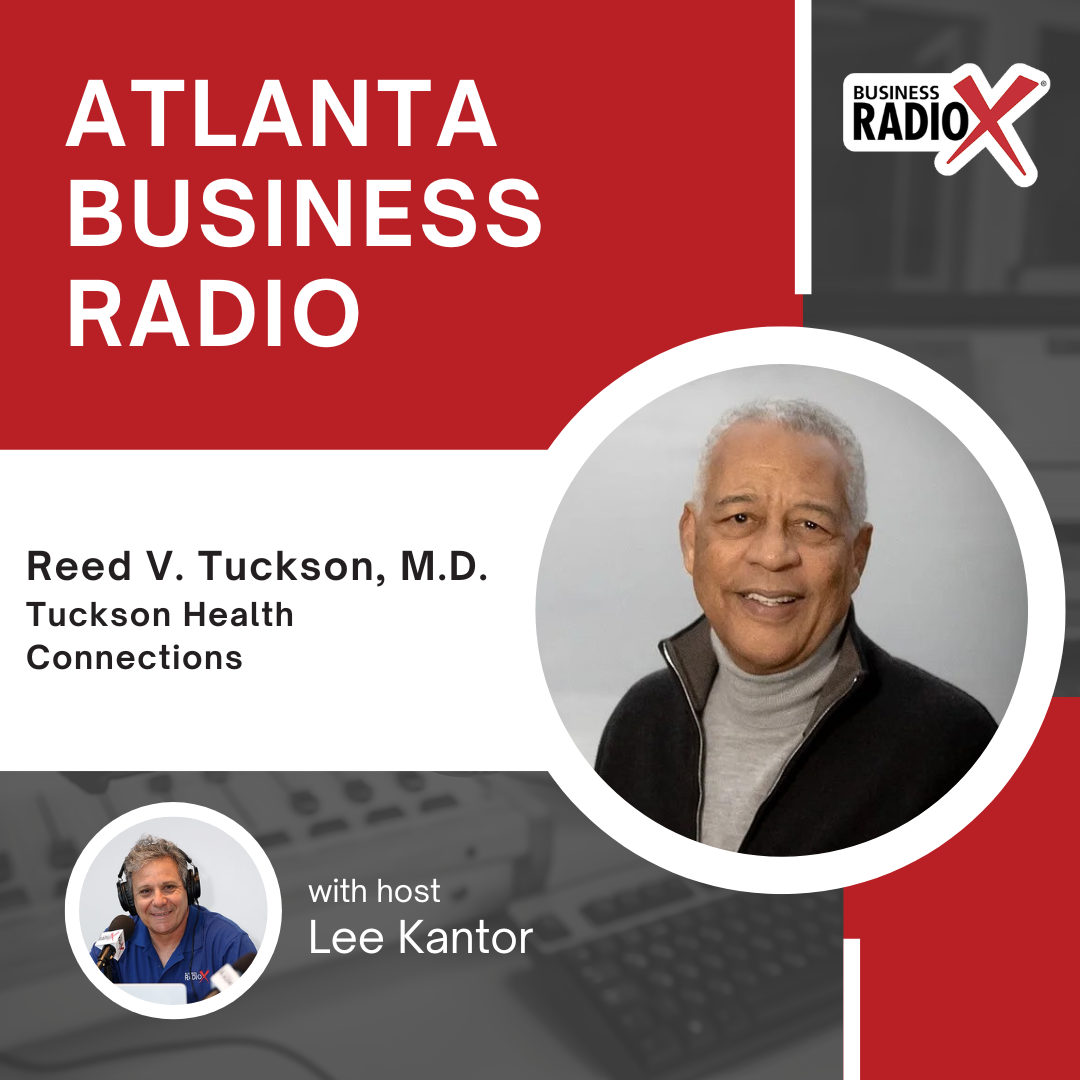

 In this episode of Atlanta Business Radio, Lee Kantor interviews Dr. Reed Tuckson, Managing Director of Tuckson Health Connections. Drawing on nearly five decades of leadership in healthcare, Dr. Tuckson shares insights on rebuilding trust in health systems, navigating polarization, and fostering meaningful conversations across differing viewpoints. He discusses the importance of empathy, scientific literacy, personal reflection, and human connection in creating healthier communities and a stronger future for healthcare.
 For almost half a century, Reed V. Tuckson, M.D., MACP, has been devoted to optimizing health, wellbeing, and healing as a physician and leader of a variety of health organizations. He has long been fascinated by the connection between the mind, body, and spirit, which has led him in a continuing exploration of spirituality’s role in health and healing.
His interest in creativity and photography was sparked when he received his first Brownie camera when he was ten years old.
Throughout his career, he has been passionate about bringing people together to create healthy individuals, families, communities, and a healthy nation.
In all of his work, he has consistently employed creative tools such as radio, drama productions, music, poetry, and visual arts to assist people in understanding the science of health and the process of personally appropriate health decision making.
When he was privileged to serve as the Commissioner of Public Health for his hometown of Washington, D.C. during the height of the HIV/Aids epidemic, he produced radio docudramas that provided real-world decision scenarios and that empowered people to protect their own health.
During his residency and fellowship in internal medicine at the Hospital of the University of Pennsylvania, he hosted a weekly preventive medicine show on the local jazz station that engaged local playwrights to bring humor and pathos to health discussions.
He founded the Black Coalition Against COVID (BCAC) at the beginning of the Pandemic. This national initiative of leading minority medical schools, medical and nursing professional societies, along with community and faith-based organizations, had its roots in the Anacostia section of Washington, D.C. where he reached out to local spoken word poets, film makers, musicians, and photographers to engage community residents in dialogues for protecting health.
He now supports the next phase of the BCAC in Anacostia, the initiative called Optimal Health Outcomes East of the River, which is a community-led effort to link together the many community- and faith-based organizations to realize maximum leverage, coordination, efficiency, and results.
During his education at Howard University and Georgetown University School of Medicine, he was fortunate to have performed regularly as a drummer in a local jazz collective and has been recorded on more than one occasion.
He also played occasionally in Philadelphia during his training in the Robert Wood Johnson Foundation Clinical Scholars fellowship, and while matriculating at the University of Pennsylvania’s Wharton School of Business.
He is the former vice president of the March of Dimes Birth Defects Foundation; president of the Charles R. Drew University of Medicine and Science; senior vice president of the American Medical Association; and executive vice president of United Health Group.
He is an elected member of the National Academy of Medicine and has had advisory roles at the National Institutes of Health.
He serves on the boards of the Johns Hopkins Berman Institute for Bioethics; the Hastings Center for Bioethics; KFF, the leading independent and nonpartisan source for health policy research, polling, and journalism; and Freedom House, which is dedicated to the core conviction that freedom flourishes in democratic nations where governments are accountable to their people.
He resides with his family in Georgia and is the father of three and a grandfather to two. He is proud to be the father and grandfather of two NCAA Rugby champions. He often speaks to groups on topics that all connect to his foundational concern: ensuring a safe, healthy, loving environment for generations to come.
Connect with Dr. Tuckson on LinkedIn.
What You’ll Learn In This Episode
- Understanding the role of trust in improving health outcomes and public confidence.
- Recognizing the impact of empathy and active listening in bridging societal divides.
- Strengthening scientific literacy to make more informed health decisions.
- Balancing technological innovation with critical thinking and human judgment.
- Building meaningful conversations across differing perspectives and experiences.
- Appreciating the value of personal reflection, gratitude, and human connection.
- Supporting collaboration between healthcare professionals, organizations, and communities.
- Creating a healthier future through shared values, understanding, and mutual respect.
 This transcript is machine transcribed by Sonix.
TRANSCRIPT
Intro: Broadcasting live from the Business RadioX Studio in Atlanta, Georgia. It’s time for Atlanta Business Radio, brought to you by My Global Presence, the award winning Atlanta public relations agency that elevates brands and non-profits through authentic storytelling and national media campaigns. Find them at myglobalpresence.com. Now, here’s your host.
Lee Kantor: Lee Kantor here, another episode of Atlanta Business Radio. And this is going to be a good one. But before we get started, it’s important to recognize our sponsor, My Global Presence. If you want global visibility and meaningful impact, go to myglobalpresence.com. Today on the show, we have the Managing Director with Tuckson Health Connections. Dr. Reed Tuckson. Welcome.
Dr. Reed Tuckson: Well thank you. It’s great to be with you and to be with your audience.
Lee Kantor: Well, I am excited to learn what you’re up to. Tell us about Tuckson Health connections. How are you serving folks?
Dr. Reed Tuckson: Well, you know, I’ve been lucky enough to have been in the health care and medical care field in various leadership roles for almost 50 years, and my life has been very much privileged by the opportunity and dedication to to help people. One of the great benefits of what I’ve been up to in my career has been to be involved in almost every sector of health and medical care. And so what my job now is as the as the managing director of Tuckson Health Connections is being able to, to connect up different parts of the health and medical care ecosystem and try to see if we can’t leverage the assets and the and the competencies of these various sectors so that we can ultimately make a difference in improving the health of the American people.
Lee Kantor: So kind of walk us through the backstory and what got you interested in solving this problem?
Dr. Reed Tuckson: I was, um, from a very early age, um, um, benefited from having a mother who was a visiting nurse in Washington, D.C. and as a little kid, I would watch her go out into the inner city of D.C. in the back alleys and with her black bag and her nurse’s hat and uniform on and minister to, to the poor. And she would come home and she would talk to us about the stories that she saw, the experiences that she had. Um, and that sort of has set in, in my mind and in my spirit, a sense of, of the need to, to serve a need for not only service, but, but informed service, uh, educated service. Uh, and so, um, I was lucky then to train as a health care professional. I’m a physician, a general internist, uh, trained at the University of Pennsylvania. And from there, my career has just sort of unfolded in a variety of ways, whether it’s working as a president of a university, medical university, being the senior physician for the March of Dimes Birth Defects Foundation, the commissioner of public Health in Washington, D.C., um, and many other jobs. And so I’ve really kind of sort of had a chance to, to, to place myself in, in, in, in, in opportunities where we can advance health. And now I’m trying to stitch together all of those, uh, understandings and knowledge into something that leverages into something more powerful than simply one activity.
Lee Kantor: So now who is the client for your services? And today.
Dr. Reed Tuckson: What I’m mainly focusing on today is working with the, with the entire health ecosystem and the American people, uh, to overcome the challenges of, of trust and the lack of confidence in the medical information that we have. And so I am working now with um, um, 100 organizations that represent the entire, uh, spectrum of health and scientifically informed, uh, information that informs health. Um, and so I’m working with them as we focus on a couple of things. Number one, trying to understand the lessons that we learned from the Covid pandemic, uh, where we found so many Americans were dissatisfied with the way the health system responded to them individually and how we responded to communities. I’m also working with them to learn, um, the better ways of how to listen to people who disagree with each other. How do we have conversations, uh, that span some of this toxic divisiveness, the tribalism, uh, the toxic discord that characterizes so much of American life today. What we’re trying to do is find ways of collaborating across the health care ecosystem, but also to have the ecosystem do a better job of collaborating with the American people, regardless of what our political affiliations may be, regardless of our tribal affiliations, how do we come together now in this very challenging time of division and co-create a healthy future for the nation together?
Lee Kantor: So how how do you recommend, um, when there is this level of polarization of to just can, can we just agree on some things because there has to be some common ground and there has to be some facts that we’re everyone is agreeing is a fact. How do you help kind of get everybody kind of singing from the same song sheet?
Dr. Reed Tuckson: Well, let’s make no, uh, let’s have no misunderstanding of the challenge of the thesis of your question. Uh, we are not any of us going to be pollyannaish enough to believe that the kinds of issues you laid out are going to be solved in the short run. These are going to be long term issues that we will have to work together on. Uh, I think that we are in an era that is defined by three interrelated factors that make the job difficult. Number one, we as a nation and even in our own communities do not have a shared vision, a shared values for what we consider to be appropriate health outcomes. Our values are not aligned. Secondly, as you indicated in your question, we don’t have a recognizable source of truth, a true north of truth when it comes to to information, scientific interpretations. And so we’re struggling with those two. But now on top of those, we’re struggling with the issue that our tribal affiliations, our our social networks, our political affiliations seem now to take precedence over even values conversations and fact conversations that are our need for personal identification with our group. Uh, really overrides so much. So what does that mean to me? What it means to me as a physician and a person who cares about, um, you know, our deepest feelings that are within us is that we each as individuals are going to need to take time and look at ourselves carefully, examine what are our strongest, uh, values as a human being, our values around protecting our children, our values around protecting and the, the frailty of the lives of the elderly, our values around human survival and the quality of that survival.
Dr. Reed Tuckson: We have to take a deep dive as individuals into the kinds of values that determine who we are. Similarly, we’re going to have to do a better job in the health care system of looking at our values that inform the mission of our organizations and our mission as health professionals. Are we more focused on money or power? Are we focused more on on on being right or having control? Or are we more focused on working together with people? So I think that where these political and macro level economic kinds of conversations that that that define so much of health care today, they are inevitable. They have to be dealt with. We have to recognize these divisions. But what we also have to realize that what’s probably the one single thing that will help us the most will be for us to get back inside of us, heal the divisions within ourselves. You know, we are we’re struggling. Most all of the people that I meet, they’re struggling. We’re angry all the time. Um, we’re in in opposition to some other issue. And so what I think we have to kind of start doing now, and that’s the work that I’m focused on the most is going inside and starting to look at who am I as a human being and how do I evaluate my accountabilities to the other human beings who share my time and who share my space?
Lee Kantor: And that’s a great place to start. And I think a lot of people would benefit from, um, doing that. Self-introspection. And when you do that, I think you realize when you’re like, you talked about, uh, different teams and when you’re talking about your team, you give a lot of grace and benefit of the doubt for the why are the members of my team are doing what they’re doing? But when the other team does something, we’re not so quick to give grace to the other team. Um, how do you how do you recommend, um, just as a human individual, how do you kind of open your mind to that idea of grace and of benefit of the doubt and things like that, that help create the empathy? I think that’s needed in order to maybe lower the temperature of some of this polarization.
Dr. Reed Tuckson: Well, I look at the words you’re using. They’re so good and so powerful in terms of what you’re saying. And, and I think that you’re right that we we don’t often enough give as you use the word grace. Um, to, to the quote other side. And then you use the word empathy. And that is really, really powerful. And so I think the way we do it is a couple of ways. Now, one of the, the ways that I have been really learning and benefiting from is not far from my home in Atlanta is the Chattahoochee River. Um, and I have taken, uh, uh, the habit of, um, of, of either being quietly meditative in the mornings, really being very quiet and still in the morning so that I can do that kind of reflection can kind of get in touch with myself. But those days that I don’t meditate and I’m not reflective indoors, I go to the river. And what I’m finding when I go to that river, at the very first light, I look at the at the at the weather report and find when is first light, not when the sun rises, but when the first light appears. And I try to be present, which is a key word being present, I try to be present and I am a photographer. So I bring my camera with me and I watch the world open up.
Dr. Reed Tuckson: And I am extraordinarily impressed, even at the, you know, the age that I am now and I’m in my 70s, I am still impressed at the awe and the wonder of life unfolding every day. And it just sort of transforms me. What I also then notice, uh, Lee, is that while I’m standing along the river, um, with my camera, people are coming by people of every ethnic group nationality. See, you hear so many different languages being spoken, and all of these people are in the same place, ostensibly having the same kinds of experiences. And it is amazing to me how often people stop and say hello or talk to each other. So what I’m getting at here, Lee, is that I think that one of the easiest ways that we start to get out of our own narrow, angry email, social media screeds, uh, is to put your, your, your cell phone down is to leave the newspapers alone, leave the TV, set off, go out and find your own river and, and just observe. Just sit there and be and then engage with the people around you. And all of a sudden you start to realize that at the levels of which human life is really important, at the core of who we are, really are, that we’re all the same. And now we begin to have the grammar of a coexistence that allows us to continue to have conversations.
Dr. Reed Tuckson: I think those are the the easiest ways, the other ways in addition to those, which I think is the starting point is having the willingness to learn to listen. It is often difficult to listen to someone who sees the world differently than you, because I have to show you that I am right, and I have to show you that you are wrong, and I have to also show you that because I’m right and you’re wrong, I’m better than you, I have more. I have something better than you have. Well, if we don’t learn to, to listen, to take the time and to learn to control our emotions so that when someone is saying something we don’t agree with, we can try to understand, how did you get to that place? What motivated your, uh, where you’re coming from? What are the things that you hold most dear that cause you to take position that you’re taking? And I think over time, it is really my hope and my experience that we can start to break down those divisions, or at least if we can’t solve getting in common agreement, at least we can learn to understand each other. And when we can learn to understand each other, that’s the beginning of change.
Lee Kantor: Yeah. And my hope is that we get back to even the, the level of, um, right and wrong versus good and evil. I think when it’s elevated to good and evil, then you’re taking the polarization to another level that can, it becomes harder and harder to kind of get back to a sense of normalcy and getting on the same page.
Dr. Reed Tuckson: I couldn’t agree with you more. I think that that is it. And, you know, and again, it’s that that sort of sense is that we have a tendency these days without often justification, uh, to be putting ourselves in the position as the arbiter of what is right or what is wrong. Now, in my field and in my world of science and medicine, uh, we struggle, uh, very much today, uh, with the notion of what is truth when it comes to scientific understanding. What is legitimate evidence upon which the American people, the American family, should make personally appropriate choices and decisions for themselves, their families, and their communities. And there is a big roaring debate right now on, um, the sources of, uh, that we can have confidence in and trust, uh, in terms of the validity of the science and how that science is being interpreted to affect human health. I find that to be one of the saddest, uh, elements of the characterizes the America of today. I particularly find it sad because as a physician and as someone who spent time in the lab and who spends a great deal of time with American scientists, I have a very keen understanding of how hard people work to get it right.
Dr. Reed Tuckson: I have a tremendous respect for America’s scientists and America’s physicians for trying to do the right thing. Unfortunately, we also know that there is no, uh, absolute purity in any professional discipline or in any sector of society. And so we in healthcare and science have our bad actors too. And unfortunately, sometimes the bad actors, uh, may cause people to doubt all of us. And so we’re fighting now really hard, uh, to be able to explain to the American people and partner with them around the notion of what is science, how do we do science, why you can have confidence in the scientific process and also the things that we in science need to do, uh, to change so that the American people’s concerns and their doubts can be addressed. Because at the end of the day, we now are in an era where there has to be a collaboration, a meeting of the minds. And I look forward to that, engage in that with enthusiasm with each day.
Lee Kantor: And, and I think that something that’s happening, and you touched on it earlier, is with the, um, so many people getting information in short form from questionable sources or from unreliable sources and the ability for those sources to be shared. And, um, you know, throughout a community, it does a disservice to the basic kind of level of critical thinking that a person has to have in order to discern, you know, what does scientific method mean, even at its core? And the fact that the scientific method encourages experimentation and, and is by definition the best answer we have today based on what we know today. Knowing that there might be things that we don’t know tomorrow that might change our opinion today, but doesn’t mean that today’s opinion is wrong necessarily.
Dr. Reed Tuckson: Oh, this. This is a very key observation, Lee, because you know, as you as as the, as the, as the, as the foundation of your of your point is that science is a process of continuous discovery. And it would be, you know, no reputable scientist says, oh, we now understand, you know, everything completely. We’ve got to nail down my paper or my discovery is the end. All of it all. No, we do know that we continuously challenge what we know. We also know that in science, we make hypotheses. We make a conjecture, and then we explore those. Unfortunately, there are some bad actors out there who will take a study that is done, and you find that your hypothesis did not prove to be true as some kind of a sign of incompetence, uh, of, uh, of, of, uh, that, you know, the scientists don’t know what they’re doing because their study, you know, didn’t work out. Um, but what I think also is going to be necessary is that, um, we’re going to need to, I think really, and I’m really hoping, and I’ve been advocating for this, that we really ramp up our science education in our schools. Our students really need to have a much better grounding in the scientific process, scientific principles, and scientific literacy, because the science that is being developed with each passing day.
Dr. Reed Tuckson: I’m right now talking to you from the Aspen Ideas Health Conference, bringing together some of the most brilliant people across the the healthcare landscape. Uh, every lecture that we’re receiving here is extraordinarily exciting in terms of the advancements that are being made, but those advancements are extremely complex. The science is complex, but at the end of the day, the American people are going to need to be participants in the use of this science. And so I really do hope that we find some kind of way to, to, to get into our school systems and, and give them the resources they need so that our children who are going to be graduating into this exciting technological world will have the tools with which to navigate it, and they’ll have the knowledge to be able to make personally appropriate choices and decisions. As the genomic era continues to expand, as the AI, um, competencies continue to expand, and these things are moving so rapidly that people are going to need to have great at least foundations upon which they can then build their knowledge as they become older adults.
Lee Kantor: And I hope that they use them as the tools that are meant to be, not a replacement or a shortcut. That means that I don’t have to learn those critical thinking skills.
Dr. Reed Tuckson: Well, you know, I’ve been excited and looking at the, at the issues of, of AI. Uh, I’ve been, um, you know, at first I thought because I’m in my 70s, well, this, that movement has passed me by. I can just sort of chill out now because, uh, you know, I’m, it’s not for me. But in fact, just the opposite has occurred. I have really dived into these things and I am benefiting greatly from them. But here’s the key thing. The key thing is to be able to use the new tools. You have to know the questions to ask. And not only do you need to ask a question that is one sentence long. To really use these tools, you need to write questions that have 4 or 5 and six sentences that really get down to the level of, of, of knowledge and detail that you need. And so that means that if you do not have an intellectual foundation, if you do not have a fundamental understanding of the world and the and the forces that are defining our world, you will not benefit as nearly as well from the tools as someone who has a much better understanding.
Lee Kantor: Right. And that’s my one of my fears in this area is that people just ask you one question and get an answer and think they’re done when you’re better served of, you know, asking it to check its work, asking it where it got its information, asking multiple questions around it and not necessarily taking your first shot at it as gospel.
Dr. Reed Tuckson: And the reason that that’s so important, Lee, is that, um, health, the health of an individual is extremely complex and very nuanced. I really, I’m one of some of the people that are at the meeting I’m at now are the leaders of Google and they do a very good job. Uh, they are, they are over. I understand now 1 billion health questions a day asks of the Google system. That’s extraordinary. But what you also need to know is that as good as whatever answer you’re going to get from that, interpreting that answer in the context of the complex human biology of an individual human being. Now, you know, you’re not just, uh, it’s not as easy because you’re going to need to make judgments. You’re going to need to understand how the information that you’re looking at is, relates to, let’s say, the drugs that you’re taking for a particular disease or the diseases that you have or the environment in which you live. All of these nuances are the things that physicians are trained and nurses and others are trained to understand. So the conversation that a person needs to have about their health, while it is very important and, and, and, and, and laudatory and praiseworthy that individuals are seeking out information and are taking much more responsibility for being well armed about their health, but to leave it only at what you do as an individual and not be able to have a conversation, a collaborative conversation, a, a, a, an equal conversation with your health professional. I think you’re missing a big piece of the puzzle.
Lee Kantor: Right? And I hope that health professionals are, are getting to be a little more comfortable that their patients are coming armed with some of this information, and they shouldn’t be defensive about it. They should be embracing their curiosity of their patient.
Dr. Reed Tuckson: Well, that is a desirable outcome. However, again, we we don’t ever want to be pollyannaish about the the challenges that are in front of. We have to to put the challenges in front of us squarely and, uh, and then, and then deal with them unafraid. And so the challenge that we have to your point is, first and foremost is time. Uh, physicians do not have a lot of time, uh, to be talking to the patient, especially when they do what, you know, what is being done now, where they come armed with 4 or 5 articles, and now they want to discuss those articles with their doc, which is, you know, praiseworthy. But at the end of the day, the physicians has only so much time to be able to devote. So we’re going to have to struggle with how to give the clinicians more time to be able to, to, to engage at the level of detail that that is needed. But what’s also challenging for the for the for the health care system is that many times patients will come in very belligerent about their point of view, that they may have some not good information that has been reinforced in their own tribal echo chamber, and they are fairly militant about their point of view, which makes it difficult for the physician to be able to give an alternative point of view that has been a learning that people like I’m trying to work on, and many others about. How do you start to say, well, look, just as we’re asking, uh, you know, people to learn to listen to each other, we as health professionals have to learn that process of listening.
Dr. Reed Tuckson: And then at the end of the day, we may not agree. And so instead of the relationship between the patient and the physician being destroyed by the fact that we don’t agree on a particular issue, we have to do everything in our power now to preserve the relationship. So we may argue or see a difference on, let’s say, the use of, of, uh, of vaccines to prevent other health problems down the road. That’s a big area of controversy these days. We may not agree on that, but whatever we do, we can’t let that disagreement become emotional or frustrating so that when the patient also has a breast cancer and there needs to be a discussion about the chemotherapy regimen that we can’t let our, our, our, our, our disagreement on certain issues affect the ability to have the kind of conversation to lead to a good outcome for something like the breast cancer. So we’ve got to just, again, come back to this principle that the conundrums that we are facing now, um, are not going to all just go away in another year or two years. We’re in a new place in American history. And this is a generational issue. And somehow together, the health care system and the American people are co-creating a new vision for the health of this nation. And that’s going to be a. Uh, a chaotic, uh, but I hope a deeply principled process.
Lee Kantor: Now, we’ve talked a little bit about the Aspen Ideas Festival that you’re part of. Can you share maybe some insights or any kind of top things you’ve learned thus far that’s really stood out to you?
Dr. Reed Tuckson: The thing that I have, uh, that has reinforced in this for me is that when you bring together several hundred, um, well trained, well informed, um, health professionals and scientists and you put them in a, in a, in a quiet space for three days, um, and ask them or, and create mechanisms by which they can share their expertise and challenge each other, uh, that there are real learnings that can occur. I know that I have advanced in the last couple of days, my understanding of many different topics in a way that I could not have done if I was sitting at home reading a book. But the key thing that that that in answer to your question specifically, the key thing that I am getting is the sense of principled behavior, the sense of, of, of, of, of integrity, the sense of people who are spending, you know, 18, 20 hours a day of their lives trying to solve human health problems, trying to solve the problems of how to get a health innovations cost effectively and affordably into the hands of the American people. And so what I’m getting at here is we all know that the American health system has very big problems. Uh, we have the problems of access. We have the problems of affordability. We have problems of quality. And what I come away from these kinds of meetings, at least again, being reinforced, is that there are so many people who absolutely love people who absolutely care about people and are devoting themselves in unusually intense ways to finding solutions to these problems.
Dr. Reed Tuckson: People here at meetings like this are not walking around decrying the problem, not celebrating how horrible things are, or they’re not spending a lot of time moaning and whining about whatever the concern may be. These are people who are trying to find the answer. And you know, Lee, we’re those people exist all over this country. They exist in every community. They exist in American hospitals all over the place. They exist in public health departments all over this country. They are really dedicated people. And unfortunately, they get beat up a lot. They get yelled at a lot. They get called names a lot. Too many of them have to have security guards around them because they are being, you know, deliberately attacked by people who aren’t quite as charitable as we would want them to be. I’ll put it that way. And so this these are tough times. But just know that if you are as an American citizen out there listening to this show. Whatever your frustrations are, whatever your upset is, at least I hope. I hope, and I don’t mean to be pollyannaish about it. I sincerely hope that you at least take some, some, some comfort in knowing that there are a lot of dedicated Americans of both parties or no party who absolutely are trying to get it right. And it’s going to take time, but we will get it right.
Lee Kantor: So what do you need more of? How can we help you?
Dr. Reed Tuckson: You know, I think the main thing that we can do together is to go back to the fundamentals. We need to establish a common humanity. We need to know when I go to the river with my camera and I take my photos and. And when I do my meditations, it becomes so clear, deep in the deepest part of my being that I am, you know, a child for me, a child of God. I, I my a sense of my oneness, My connectedness to the awe and wonder of what I see when the sun rises and the sun sets. My sense of. Of connectedness and oneness to the. To the trees and the water and the. And the geese. My sense of connectedness and oneness to the people who I encounter. I think we just have to take every opportunity to turn off the, the, the, the, the rancorous television to, to, to, to, to, to turn away from this preoccupation with social media, whose only premise is to make you mad. You know, the people who make money on making people mad. We’ve got to walk away from that. The life is just too beautiful. The human miracle is just too great. And so I’m just urging everyone take a moment. Close your eyes in the morning or in the evening. Find a quiet space. Drive to your river, drive to your forest and just walk and be at peace. And then you see somebody on the road. Don’t ask whether they are a are you a Republican or are you a Democrat? Do you belong? No. It’s hey, human being being here in nature, in oneness. I think if we don’t get to that, none of the policy debates will ever succeed, because all it will be is people trying to beat each other up and prove that they’re wrong. And I’m right and I’m better than you, as opposed to just simply saying, you know, we’re just one people. We’re human beings working together trying to get it right. I think you said it better than I will ever be able to say it. We have to give each other grace.
Lee Kantor: Yeah. Something I read a while ago that really stuck with me is, uh, it’s kind of the, the think of people as beginners and we’re all in training and, and when someone’s in training, you give them kind of some slack and you give them some benefit of the doubt. And if you look at everybody around you as, hey, we’re all just trying to figure this out to the best of our ability and just, just kind of lower the temperature here. Appreciate what you have. Have gratitude for all the things that are around you. Like you mentioned, we’re living in a great time. If we can just stop for a second and look around and appreciate it.
Dr. Reed Tuckson: And I’ll tell you the last thing I’ll say to you that, uh, you know, I’m, uh, I’ve gone, I’ve gotten so committed to this course of action that I’ve actually written and almost finished, uh, printing a book called meditations Along the Chattahoochee River. So I hope to be able to share that with you and your audience, uh, in a couple of months.
Lee Kantor: That that would be wonderful. Well, thank you so much for sharing your story today. You’re doing such important work and we appreciate you.
Dr. Reed Tuckson: And really, I thank you for the questions you asked. You are quite special. So thank you.
Lee Kantor: Thank you. All right. This is Lee Kantor. We’ll see you all next time on Atlanta Business Radio.















