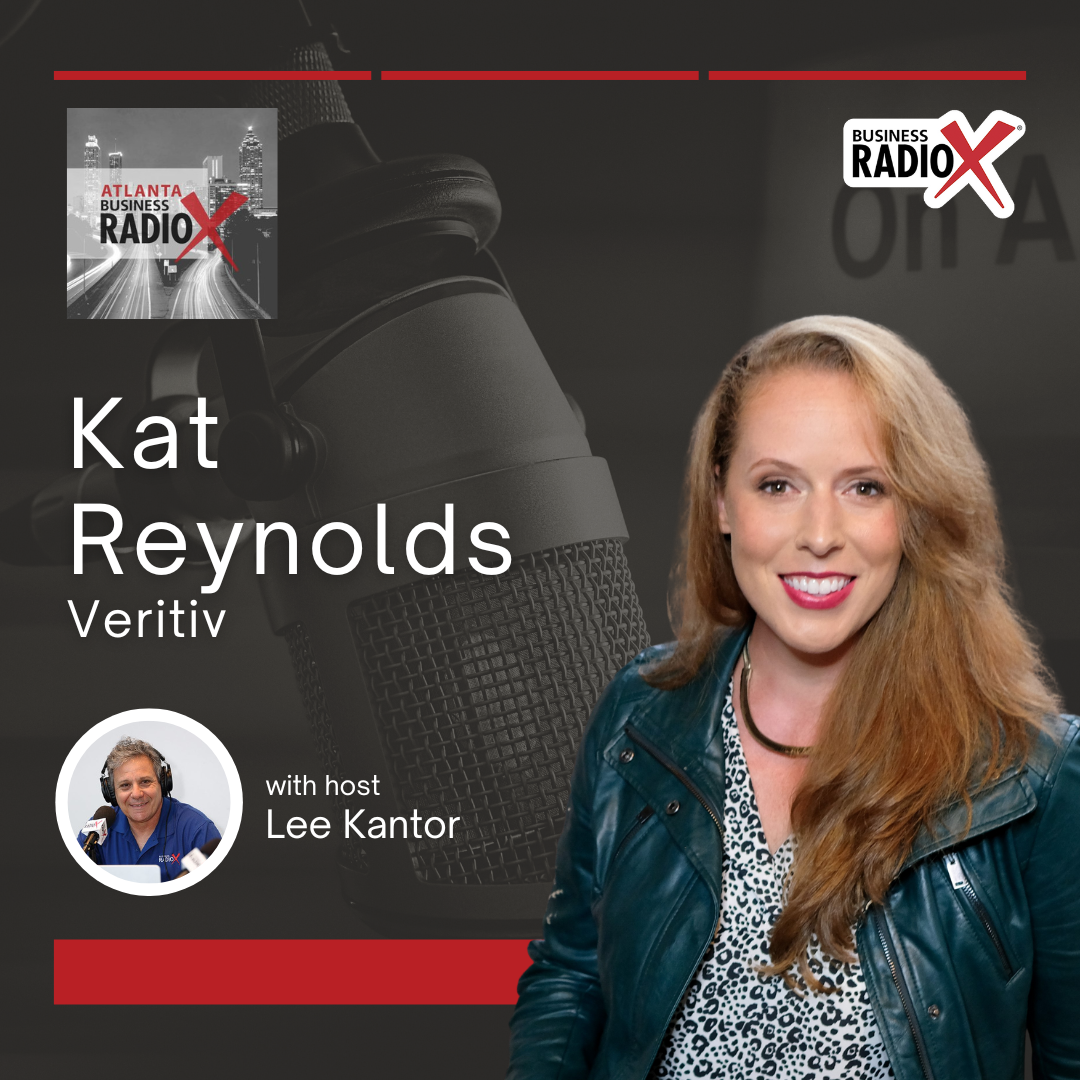

 In this episode of Atlanta Business Radio, host Lee Kantor talks with Kat Reynolds, Senior Manager of Corporate Social Impact at Veritiv, a packaging and logistics company. Kat shares how Veritiv integrates social responsibility into its business through employee volunteerism, nonprofit partnerships, and creative use of company resources. She discusses impactful initiatives like the “Goodness Campaign” and emphasizes the importance of authentic community engagement. Kat also offers advice for companies and nonprofits seeking to enhance their social impact, highlighting the value of meaningful partnerships and employee involvement.
 Kat Reynolds is a Community Relations Connector! She creates unique collaborations between corporations and nonprofits to help solve local social issues. For over a decade she worked in the nonprofit sector with United Way, The Alliance Theatre, Junior League of Atlanta, YWCA Georgia Women’s Policy Institute, GA Forward’s Young Gamechangers, Atlanta Women’s Foundation, and Corporate Volunteer Council of Atlanta.
Her favorite part of these experiences is the intersection of corporate, government and nonprofits in building transformational, sustainable solutions to local community’s most pressing needs. Her cross functional advocacy efforts proved successful when Georgia’s Safe Harbor Law was passed in 2015.
Currently, Kat is the Senior Manager of Community Relations at Veritiv Corporation, a fortune 500 company headquartered in Atlanta. She spearheaded a refreshed Veritiv Connects philanthropic strategy to advance programs that help individuals learn, grow, and thrive by investing in programs that support mentorship and sustainable communities. This includes implementing an online giving platform, expanding voluntarism across the U.S. and Mexico, and introducing new national nonprofit partnerships.
After only two years in the role, employee volunteerism has tripled, the donor advised fund increased by $3M, and matching gift contributions doubled. As a member of the Veritiv Cultural Alliance leadership team, she coaches employees in responsibly and respectfully giving back to their communities and instilling pride in giving WHERE you can HOW you can.
Before joining Veritiv Operating Company in 2022, she managed Mercedes-Benz USA’s Corporate Social Responsibility efforts. During that time, she implemented the Give Back employee program, expanded Greatness Lives Here, and introduced Curbside Caring during the pandemic.
One of her most memorable activations was the Girls Have No Limits campaign, which intended to break down gender stereotypes through female STEM mentorship (and race cars!). Under her vision, the company received recognition as the Atlanta Public Schools 2021 Corporate Partner of the Year.
She holds a Master of Arts in Arts Administration from Savannah College of Art and Design and Bachelor of Arts in both Speech Communications and Drama from The University of Georgia. She was honored as an Atlanta Business Chronicle Corporate Citizen 2023 Practitioner of the Year. Before working in the social impact space, she spent a majority of her career producing live theatre performances across the nation.
In her down time, Kat volunteers with The Junior League of Atlanta (13 years), is an Board member of Atlanta Corporate Volunteer Council, travels to a new country each year (30 and counting), and reports to her dog Pepper.
Connect with Kat on LinkedIn.
What You’ll Learn In This Episode
- How do they serve as a connector between companies and nonprofits
- How she design the Veritiv Connects program
- How do they identify what nonprofits to work with
 This transcript is machine transcribed by Sonix.
TRANSCRIPT
Intro: Broadcasting live from the Business RadioX studio in Atlanta, Georgia. It’s time for Atlanta Business Radio. Brought to you by Kennesaw State University’s Executive MBA program, the accelerated degree program for working professionals looking to advance their career and enhance their leadership skills. And now, here’s your host.
Lee Kantor: Lee Kantor here. Another episode of Atlanta Business Radio in. This is going to be a good one. But before we get started, it’s important to recognize our sponsor, CSU’s executive MBA program. Without them, we couldn’t be sharing these important stories. Today on Atlanta Business Radio, we have Kat Reynolds, who is the Senior mMnager of Corporate Social Impact at Veritiv. Welcome.
Kat Reynolds: Thank you. I’m so happy to be here.
Lee Kantor: Well, I’m excited to learn what you’re up to. For folks who aren’t familiar. Can you share a little bit about variety? How you serving folks?
Kat Reynolds: Yes, variety is a packaging and logistics company, and we service customers and suppliers in the United States and across Mexico. So you might see our trucks driving by. And I like to tell people that when you go to big box department stores where you might get your makeup or your shampoo, you might be purchasing design boxes from us that you don’t know about. So we do custom design also.
Lee Kantor: Right. It’s one of those companies that everybody is using, but no one knows that they’re there.
Kat Reynolds: That is exactly right. When I got here it’s a B to B company business to business. So it was a little different for me coming from direct to customer. In corporate social responsibility took me a while to wrap my head around very different.
Lee Kantor: So let’s talk a little bit about your role. How does corporate social impact kind of weave into the mission and purpose and the DNA of narrative.
Kat Reynolds: Well, Verda strongly believes, and I do. So I say this with authenticity, is that we need to do good work in the communities where our businesses are located and our employees live. If we’re not giving back and filling up the bucket of those companies, what are we doing? So my role is to help Verda continue to have a presence in those areas, and also perhaps to give presence through specific strategic and responsible donations, sponsorships and, uh, engagement, our skills and talents.
Lee Kantor: So, so how does that work for you? Kind of on a day to day basis, like what is a day for Kat look like?
Kat Reynolds: My colleagues will tell you that they can they can see what I’m doing and expect what I’m doing based on what I’m wearing that day. So I say that our philanthropic program is Vertov connects narrative, connects overseas volunteerism, um, public relations as it relates to social impact. We also see oversea corporate giving matching gifts and our philanthropic platforms for our employees, of which we have nearly, um, 5 to 6000. And so a day could be if I’m wearing a volunteer shirt, that means we’re going out in the community. If I’m wearing a business suit, I could be on a panel doing interviews, uh, doing site tours with nonprofit partners. Uh, but at the end of the day, there should always be a touchpoint with one of our variety of locations and a community partner.
Lee Kantor: So how does that kind of permeate all the employees we have here in Atlanta? Do they get to raise their hand and say, hey, I have a suggestion of a nonprofit we should support or like, how do you get there? Or they or they can volunteer, I guess, at one of the events that you guys are helping.
Kat Reynolds: Uh, yeah. So there’s I’m thinking three different ways to do that. So we have national nonprofit partners. They are Boys and Girls Club of America and Feeding America. We also engage with the Mexican, uh, equivalent, uh, Mexico food banks. And then there are Boys and Girls Club equivalents in that, uh, country. So all of our employees can go there. So we have a breadth and depth of engagement opportunities that are in all of those clubs and food banks underneath the umbrella of the Feeding America landscape. So that’s one way people can be engaged on their own time, um, at their own free will. My second point is, on their own time in 2024, we implemented volunteer time off. So every full time employee gets eight hours to use per year for volunteerism at an organization of their choice. So we wanted to give, again, free will ownership over how you engage and when and where you engage as an employee. And then yes, we do also create company wide events. And we usually do that during the month of April, which is National Volunteer Month at variety. If we celebrate October in October, where everyone donates men’s, children’s or women’s socks. And then those are distributed to nonprofits across our footprint that engage in rehousing or rehoming families or individuals. So last year, we raised 26,000 pairs of socks. Uh, so there’s a low barrier to entry, and, uh, people can take part if they will.
Lee Kantor: So let’s talk a little bit about your career in corporate social impact. Um, what drew you to them?
Kat Reynolds: Mm. Great question. Um, I’m going to go back to when I was a kid. Uh, so I won’t tell you how long ago that was, but my favorite Disney movie was Robin Hood with the little fox and the chicken that was made, Marion’s nurse. And, um, I always remember the fox Robin Hood helping the poor or the other little animals that were in the jail cell and helping distribute the money at the church with Friar Tuck, who I think was a gopher or something. And Mary Poppins also really influenced me in finding the good in everybody. And I remember Mr. Banks having, uh, a moment where his heart grew so big that he just quit his job at the bank and went out and flew a kite. So I think those two moments really influenced me that everyone has an opportunity to do good, and we can find the ways to do good for each other. Um, because on any other day it could be me that needs the help. And it has been in my life and I’ve received help before. Um, so I’d like to pay it back and pay it forward. So that’s my emotional reason why. Um, but there’s also a whole resume behind that. That, um, started in an unusual place.
Lee Kantor: Now, what advice would you give somebody who, um, is maybe trying to take the mantle of, uh, corporate social impact, uh, executive at their firm? Maybe they don’t have the resources that you obviously have. Imperative. But their heart is in kind of a similar place. Like, how would you begin crafting a social impact policy or just that type of energy at an organization that maybe doesn’t have an individual like yourself that is, you know, on the payroll to do this role.
Kat Reynolds: That’s a really good question. In I was hired in 2022. So before that narrative did not have someone on the payroll. And I would say to a company that wanted to stand that program up that the resources don’t always have to be cash funding or overhead cost. Uh, when your program gets going, that isn’t necessary. Tool. Uh, but the will and the want and the unique superpower that your company can give is the resource you need to start with an example for narrative. So we do packaging design. And I tapped the packaging design team the team of a team of industrial designers. Hey, would you all ever be interested in creating a packaging design for, say, Girl Scouts of Georgia or a United Way Back to School? Receptacle box. And they said, yeah, that’d be great, because we can use our design and creativity the way that we want to without necessarily being beholden to a template, um, or marketing color schemes that have been created for them. So that allowed them to use their creativity. It didn’t cost us anything technically, except for time. Um, and then we would print and we did this for Girl Scouts, and we’re doing this for United Way, and we’ve done this for Georgia Alliance Lighthouse Project, creating custom design packaging that we print and shipped to them. So it’s not a super heavy lift on our cash resources or our employee time resources, but it’s super valuable for the nonprofits who likely don’t have packaging design as a line item in their budgets.
Lee Kantor: And it aligns with your superpower. What Meredith does.
Kat Reynolds: Right? Um, if I could if I could delve into that a little bit deeper, would you mind? Sure. So that was a successful campaign with the Girl Scouts. And so I said, let’s call that Designing Goodness. And then someone asked us for toilet paper during Covid. We had some toilet paper in our inventory that was not being used, interestingly enough. So we were able to donate that amount of toilet paper to an organization, and we delivered it to them. And I said, huh, could we do that with other inventory that we might have that we can distribute to a local nonprofit? Thus delivering reign goodness came to fruition. And the third piece of our pillars is deploying goodness. And that’s where the volunteerism aspect comes. So we have now created a full goodness campaign. So designing, delivering and deploying goodness is where we will put our stake in the ground for what resources and talents we can give.
Lee Kantor: And the impact is real. Like you see the results of these kind of efforts probably every on a regular basis, right?
Kat Reynolds: Absolutely. And the breadth of the nonprofits that we’ve partnered with for delivering goodness that’s giving inventory from our warehouses that is non usable, not because it’s broken. It was maybe extra inventory. And so we have distributed last year to 44 different nonprofits and over $1 million worth of inventory. Convoy of Hope Salvation Army habitat for humanity is local schools, animal shelters. Take all of these items and use it for very unique things. It has also turned into an opportunity for evergreen disaster preparedness instead of reactionary after disasters. So there’s a lot of cleaning supplies and facility solution items that we are able to distribute. That really helps when those disasters strike.
Lee Kantor: So how do you identify which nonprofits to work with?
Kat Reynolds: That is the chess game of research. Um, it is different for designing and delivering and deploying for deploying goodness or volunteerism will always prioritize Boys and Girls Club, Feeding America, Junior achievement, um, and environmental organizations. Hyperlocal to Atlanta is tres Atlanta. Uh, but others that come to mind. Ah, keeping America beautiful or, uh, the conservancy programs or, um, river keepers and different chapters. So we prioritize and then see what is needed in our communities. And designing. Goodness, that’s the packaging design. If a nonprofit taps us on the shoulder, it’s first come, first serve. And we will only design for one nonprofit per year, one project per year, because it does take quite a long time from beginning to end, but delivering goodness. This is where we have variety of cultural allies. So our boots on the ground, um, project managers for all things good in every location for varied. And I say, listen, I don’t live in Iowa. Can my VCA ally in Iowa recommend a nonprofit? If Boys and Girls Club are feeding America cannot accept the inventory. And so that’s where a little bit of ownership, um, and self-selection and, uh, pride in unique communities and what those communities need and provide for our employees.
Lee Kantor: Now, in addition to the, the stuff, the, the three dimensional items that are are being kind of produced for these folks. There’s also kind of the, uh, IP, the intellectual, uh, information that you’re sharing. How do you identify which experts within your organizations to help those nonprofits? Um, you know, with that side of the business, just the brainpower that you all have there. Imperative.
Kat Reynolds: Yeah. So this is where finding your internal champions, in your internal advocates come into play. Uh, going back to your question about standing up a program without a lot of resources, if you have the person within the building that has the passion to do these philanthropic efforts, Find your advocates at a senior leadership level, and then have them recommend those subject matter experts to you. Um, so that kills a lot of birds with one stone. Um, so you get advocacy. You’re sharing what you’re doing and management knows about it, and then it’s a trickle down. And the person that they recommend to you might take this on as a project, which then that person could use in their end of year reviews. Um, as a other assignments, uh, as assigned um, or other responsibilities as assigned, but using it as feather in their hat at the end of the year, of how they can highlight their skills that they might not be able to use on a day to day basis.
Lee Kantor: Right. So it becomes a win win win all the way around?
Kat Reynolds: I think so.
Lee Kantor: Now, um, you mentioned boots on the ground. How many locations are there for relative. You mentioned the countries America American and Mexico, but like kind of in the state by state. Is there lots of narratives all over the place?
Kat Reynolds: Uh, change is a constant, but I have a number in my head, about 150, what we call VCA allies. And there might be multiple allies in a location with a large headcount. Uh, for example, Atlanta might have four vertical allies. Um, so we we have upwards of 150 to 170. And we communicate we the VCA leadership team once a month and let everyone know these activities are happening. We need your help. Or this is the result of the wonderful work that you have been doing. Um, and so providing and training and teaching since I am just one person. Um, and then exciting people and empowering them to go do the work is a big piece of, uh, leading without authority is another skill set for a CSR professional or corporate social impact professional.
Lee Kantor: So, um, how do you kind of share this impact that you’re making throughout the company? Is it something that like, how do you evangelize? Hey, we’re doing all this work that I’m sure when you do that, you’re attracting other people that are like, hey, I want I get help. You know, it’s one of those things that builds on itself.
Kat Reynolds: I think it goes back to culture and having the right people in the right spaces, the exporters, if you will. Um, we also have a rewards platform called Bravo. So when people do really great things, uh, we can gift points that are redeemable or transferable as donations. Often some people’s love languages gifts. So that’s the way to fulfill that. Some people’s love language is words of affirmation. That’s mine, for example. And so if someone says, great job, cat on a webcast. In an email, um, in front of someone else. Uh, that’s a great pat on the back. So continuing to inspire. Um, I hope I answered your question there.
Lee Kantor: Yeah. Well, I mean, having so many allies throughout the country, I would imagine that allows you to maybe, uh, spot some trends in what each of these different regions or sectors need. Is there some intelligence that you are all able to to gather just by having so many folks on the ground serving those, uh, through those nonprofit partners?
Kat Reynolds: So I’m thinking of two answers here. One is data. And so we do have a philanthropy portal that helps us grab a lot of data of how many people are volunteering, where in what city, what time of day, what types of organizations are they not only volunteering with, but donating to? Um, but Feeding America is the other answer, and that’s the strategy. So I was hearing from our VCA allies. We’re going to food banks. It’s so much fun to go to the food bank and serve clients directly and feel like I’m hand to hand helping the community. So after about two years, I strategically placed one of our senior leaders on the Atlanta Community Food Bank board to test out what was that type of experience. If our employees face to face with clients who are having a great time, if we get deeper into the nonprofit, is that a good experience? Is it well run? Is it worth our time? It was a positive piece of feedback. So then that is when we expanded to Feeding America. So we listened to what the senior leaders like, how the organizations were functioning and then what the employees liked. And then there is, of course, all of the, um, interesting to me, but might be a tad dry, but all the RFP and requests for proposal processes in granting. That could be in a whole other podcast.
Lee Kantor: Yeah, definitely. Now, what piece of advice would you give folks that are nonprofits? Um, you know, since you deal with so many of them around the country. Is there something just from your lens that could be, uh, insightful for them?
Kat Reynolds: Yeah. Great question. There are two pieces, and I hear this from my social impact colleagues all the time that we come across too many nonprofits that are doing too similar of missions. So I would really challenge nonprofits to consider consolidating or. Being more efficient in the missions that they serve and the problems that they address so that they can be, uh, more impactful in the community. Don’t try to do everything. Uh, you don’t have to be a master of all quality versus quantity. So that is to my nonprofit friends. And for the moment I forgot what the are. The second piece for non profit friends, when you are going to corporations or major donors for that matter, do your research first. What does the company focus on? What are their superpowers? What are their unique skills and see if that is a match for something that you need. And it might not be. It’s kind of like dating. They might be a wonderful person, but not the right match for you. And that might be the way with corporate donors and individual donors. So really do your research first. Um, and again, if you’re being efficient and effective with your mission and your budgets, then you’re really going to find a successful program that they can continue for long into the future.
Lee Kantor: Now, is there a story you could share? Maybe a moment that you realized, hey, we are making an impact. You may not want to name the organization, but maybe for you personally were you were able to say, look, this is important work. And and I got to do more of this.
Kat Reynolds: I think I have a story that, uh, in my career. Um, so we had I’ve worked at different companies. Um, Jen, is it okay if I. I’m not going to name companies, right?
Lee Kantor: Definitely don’t name them. But just maybe just the challenge they were having and how you were able to help.
Kat Reynolds: Sure. I worked at a company where you could go into the coffee room and hear five different languages spoken. Um, super global company. And I thought, this is hard to explain social impact because not every country needs it, focuses on it and functions like the United States social impact does. Um, so I need to get these employees in face to face with the clients that they’re serving. So we all went to, uh, local elementary school during holiday time. And the children throughout the year ahead accrued points for good behavior, good grades, attendance, etc., etc. and they were able to shop, quote unquote, with those points, uh, to purchase holiday gifts for someone other than themselves. And, uh, there was a child that did not speak English, and I thought, I bet that we have an employee who can uniquely help them. So I found that employee during the volunteer event, um, and matched him up with the student. And they had a wonderful shopping experience and hugged. And the little child held the person’s hand while they were shopping for mom and dad. And the employee said, I felt so special that only I could help that student in that moment. Um, so seeing the light bulbs go off for employees, how they can help. Um, and how the company helps. Just really fills my heart. And that makes me feel like the Robin Hood.
Lee Kantor: Amen to that. Now. Uh, what do you need more of? How can we help you?
Kat Reynolds: I want the community to look at Verda and know and believe that we are doing great things in the community, and we care. And just like you might not know about us doing all the good things in the background as a business. We’re doing that for our community partners and social impact as well. Not everything needs to, uh, be all over social media or in commercials or Super Bowl commercials. Um, you can quietly make change. And I want folks to know that there is doing the good work.
Lee Kantor: And if somebody wants to learn more about Vertov and the good work that you’re doing, is there a website? Is there a way to connect?
Kat Reynolds: Absolutely. Jen, correct me if I’m wrong. Uh, you can go to varieties.com specifically for the community impact work we’re doing about varieties and sustainability community. Check that out. Uh, I believe that openings for interns will come up in Q4. So that’s something for folks to look forward to.
Lee Kantor: Well, Kat, thank you so much for sharing your story today. You’re doing such important work and we appreciate you.
Kat Reynolds: Thank you. Lee, I appreciate your time today and just letting us tell our story.
Lee Kantor: All right. This is Lee Kantor. We’ll see you all next time on Atlanta Business Radio.














