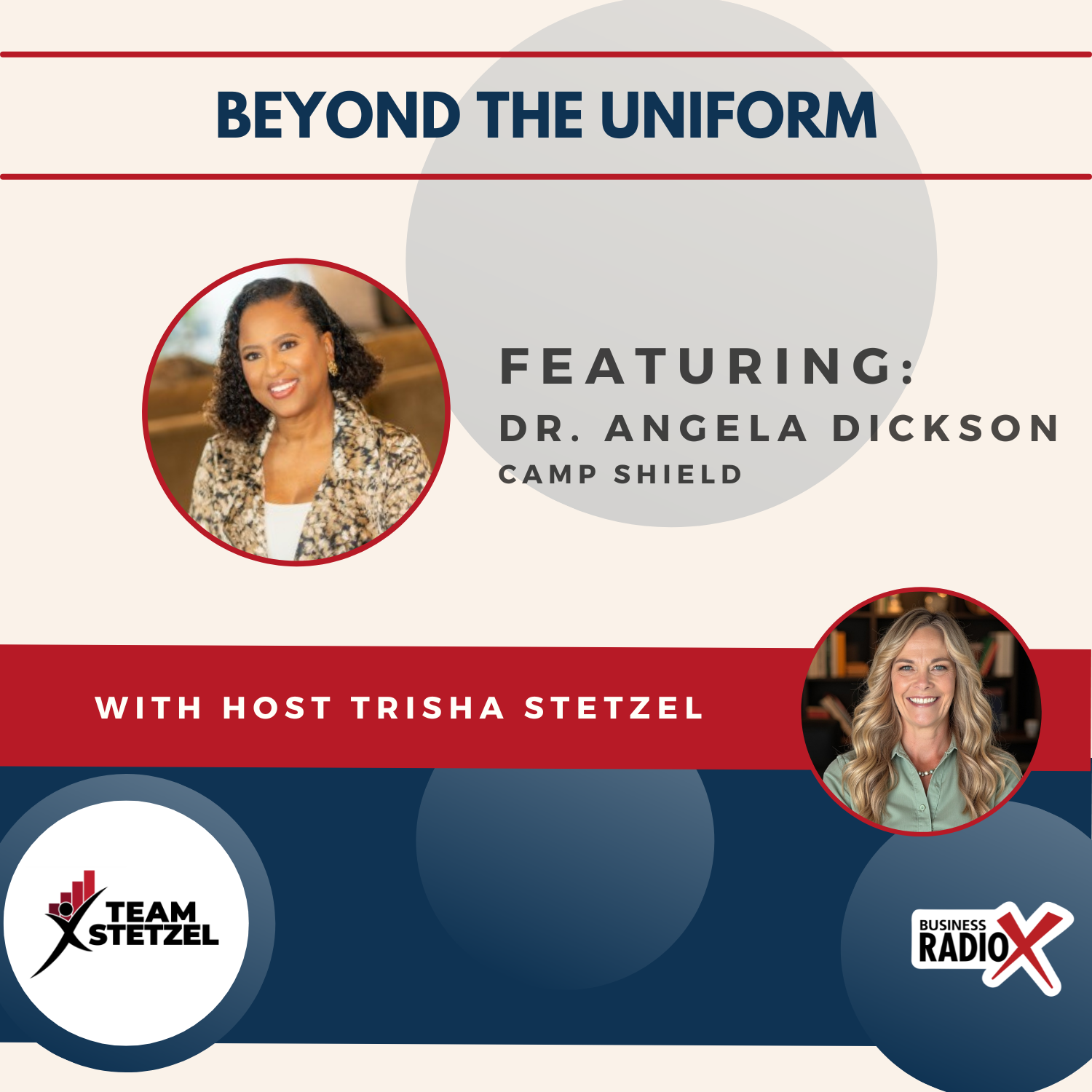

 Dr. Angela Dickson is a retired U.S. Air Force Master Sergeant, executive coach, facilitator, and advocate for women veterans.
After serving as superintendent of the Air Force’s largest mental health clinic, she dedicated her post-military career to leadership development, education, and helping veterans successfully navigate life beyond the uniform.
As a board leader with Camp Shield (After Military Service), Angela champions connection, resilience, and identity transformation for women veterans.
A self-described Story Reframer, she empowers leaders to redefine their narratives, embrace personal growth, and lead with purpose in every stage of life.
LinkedIn:https://www.linkedin.com/in/angelardickson/
 This transcript is machine transcribed by Sonix.
TRANSCRIPT
Intro: Broadcasting live from the Business RadioX Studios in Houston, Texas. It’s time for Houston Business Radio. Now, here’s your host.
Trisha Stetzel: Hello, Houston. Trisha Stetzel here bringing you another episode of Houston Business Radio Beyond the Uniform Series. I’m so excited to introduce you to my new friend and guest today, Angela Dickson. Or Dr. Angela Dickson, a retired military leader, woman veteran, advocate and board director and secretary for Camp Shield, also known as after military service. After a 20 year military career built on service, accountability and leadership, Angela has dedicated her next chapter to helping veterans, especially female veterans find community, purpose and visibility beyond the uniform. Her work focuses on leadership, resilience, personal growth, and challenging outdated narratives about what life after military service can look like. Angela, welcome to the show.
Dr. Angela Dickson: Thank you. It’s an honor to be here.
Trisha Stetzel: I’m so excited to have you. We were just reflecting before we started recording today about how much fun we had when we first met each other, just on a phone call, and there was so much energy and so excited to have you here because we’re both passionate about a lot of the same things. So tell us a little bit more about Dr. Angela Dixon.
Dr. Angela Dickson: Wonderful. Well, I’ll give you the short version. My elevator pitch. So I was born in Houston, raised in Louisiana. And when I came back to Houston, I had no idea what I was going to do with my life until I asked my uncle. Go. I couldn’t find a job. I didn’t want to be, you know, in a household where I wasn’t a provider. So my uncle said, well, you won’t make it in the Marines and definitely not the Army. You can’t swim. So not the Navy may as well go to the Air Force. Yeah. So there I went. Now, the funny part about being trained in the Air Force was the recruiter asked, well, what do you want to do? I was like, I don’t know. And he says, well, what do you want to do? When you were a little girl? I said, oh, a nurse. Ha ha. So he puts me in a medical career field where when they try to show me how to start an IV, I passed out and I thought, oh, gosh, they’re going to send me home. And then I got the hang of it. But they put me in labor and delivery. The next time I moved and I passed out again. I’m like, this is not working. So I quickly retrained and got into mental health and I was like, I still want to help people, but I don’t want the blood. I, I can’t do it. So I spent 16 years as a mental health professional and now I’ve been retired for 23 years. Time flies when you’re having fun. Here I am.
Trisha Stetzel: Wow. All right, so, Angela, I have to tell the audience, if they’re not looking at the video today, they should go and watch this YouTube video because there is no way, no way that you, this young lady did 20 years in the military and then another 20 plus in the work field. Wow. You are just radiating energy and I just love what you bring to the table. So tell me more, Angela, around this whole idea of serving after you’ve served. You had a 20 year career in the military, another 20 plus outside of the military. And I know that you’re still serving others. Where does that come from?
Dr. Angela Dickson: Well, as a child growing up, I was always that helper, always that kid wanting to fold clothes, clean the house, wash the dishes. Can I help you? And so the helping part of me just lingered through, you know, teenage years. Even in high school, I wasn’t a kid that got into a lot of trouble. I was scared, you know, I come from a country background and yeah, I was scared. So going into the military was at first I was like, okay, I’m not sure what this is, but I’m working with it. And as I continued, the helping part was easy because we are Technically watching each other’s back and someone asks for something. You don’t say. Why? You ask? Well, how would you like me to do that? When would you like me to do it? And it all just kind of came together. So, you know, helper, it’s one of my taglines, too.
Trisha Stetzel: Okay. Well, I love that. And not only were you serving in the military, but you were serving service members as a practitioner inside the service, which I think is amazing. Um, remembering way, way, way back when you left the military and made that transition, what do you feel like was your biggest adjustment coming out of the military and joining the workforce?
Dr. Angela Dickson: Oh that one. That’s easy. Figuring out what to wear every day. Because to tell you the funny story about the Air Force, I went in in 1983, long time ago. And back then, as soon as you got off the bus to basic training, you were called a rainbow. Because if you looked at everybody they had on their bright clothes and colorful, and then they put us in the military uniform. And it was a like a looking like a pickle, which is what we were called a pickle. Then you got your Air Force stripe and your name tape with your last name. Now you’re a canned pickle. So as a civilian, it’s like, well, drab green. Nah, let’s put some color to it. And I was like, I don’t know what to wear.
Trisha Stetzel: So funny. I, I think that is the biggest challenge. So many people, I say that all the time and so many people, I don’t think, understand how hard it is to look in the closet and see so many choices.
Dr. Angela Dickson: Exactly. And, you know, even with shoes being comfortable. I wore combat boots for 20 years. The cute heels. Now I love looking at them. And when someone can wear them and actually walk in them, it’s like, wow, that looks good. No.
Trisha Stetzel: Oh my goodness. So in the military really being defined by rank and responsibility, all of us are inside of the military. So how did you begin redefining your own personal identity beyond your closet when you came out of the military?
Dr. Angela Dickson: So with the rank and everything, it was a title, you know, just like when you get out of the military and you’re in a job, you’re a manager or you’re a supervisor or whatever, rank is the same thing. It’s just we have levels and you have to take a test in order to get to the rank, and you have to study for the test. And the test is not easy. So, you know, I always pride myself on the Air Force as to the leadership training we get and how we compete for promotions, which is through testing. You test all the way up to E nine and I made it to E seven. So I was pretty impressed with that. You know, my last job was superintendent of the largest mental health clinic in the Air Force. And so coming out of the military, I had to pivot really quick. My son is autistic. And so trying to have an autistic child in the military does not work because you’re moving every two years, three years or the longest I stayed in one space was five years. So having to make that pivot, I went into public school because it was easy. I was already in Texas. I got certified to be a teacher in special ed because with my mental health background, I felt that I could help other moms because at that time, I remember enrolling my son in a school and I said, okay, here is his diagnosis. He has Asperger’s syndrome. And the person said, how do you spell that?
Dr. Angela Dickson: Yeah.
Trisha Stetzel: Goodness. That’s a big shift in a transition for you. And because you have a mental health background, I’m I know the work that you’re doing now serving after you’ve served in Camp Shield, do you feel like that’s an extension of the work that you’ve always done?
Dr. Angela Dickson: Yes. My counselor brain never shuts off when I’m talking to folks because I retired on a Friday, went into public school that Monday, no break, and I dealt with children with special needs which special needs falls under mental health. And so being able to understand their differences, then, you know, pivoting from the children to the adults, being able to understand their differences. It all worked out. And with Camp Shield, I teach a strength class, and when we go on retreats, I’m there as a peer support. If they have a challenge with a trigger or a memory, I’m able to help talk to them. I don’t do therapy. I’m not a therapist, but because I have counselor training and also as a coach in my now civilian life, I try to pull all that together to help. And if you look at my LinkedIn profile, it says Story Reframed because I believe that whatever story you had in the past, you can turn the page and write a new chapter or completely redo the book.
Trisha Stetzel: I love that. And by the way, you guys, I found Dr. Dixon on LinkedIn. She is a gem of a person. And I’m so glad that we had so many things in common that LinkedIn suggested that we connect to each other. And now you’re here with me. I would love, um, I’d love to talk a little bit more about Camp Shield. So tell us what the mission is of the organization.
Dr. Angela Dickson: Wonderful. Yes. So Maggie Peterson, founder and CEO around 2017, time frame, found that here in our city in Houston, we didn’t have many women veteran related organizations. So she started off with Camp Shield. And I always like the idea. At the time, she had her best friend Mel. And then there was me. So it was Maggie, Mel and me, and we were working it, trying to do everything we could. Tagline for Camp Shield is connections saves lives. Which means as women vets, we have unique needs. We do things differently. We’re built differently. And so when we can connect with other women veterans, which we kind of fall in a class of our own because there’s a lingo, there’s a certain persona personality where automatic sisterhood comes into play. And when you can connect to organizations that are supporting specifically women veterans, it builds all kinds of bridges to where people find what they’re needing, especially if they’re in distress, and if they’re a single mom or if they’re, you know, without a job or without a place to live or money to pay Utilities. Camp shield is there to support.
Trisha Stetzel: Such an amazing organization. So for those interested in learning more about Camp Shield, where is the best place for them to find more information?
Dr. Angela Dickson: Yes, Camp shield.org. One neat thing about the word shield. Of course the S is capital. So is the H and so is the E. It spells she.
Trisha Stetzel: Wow, I didn’t even know that. That is amazing. So camp shield.org you guys, if you’re interested in looking for more information. And of course, I’m sure Dr. Dixon would love to connect with you if you might happen to find her on LinkedIn and see all the amazing things that she’s done over her journey in being a military vet, a woman in the workforce, and now supporting other women? Tell me more. Um, expand just a little bit more about the offerings or the things that Camp Shield offers to the women who are part of that organization.
Dr. Angela Dickson: Yes. Wonderful. So we’ve just gotten into a behavior activation model where once a month I run a group called Wonder Woman Wednesday and w w w we host that third Wednesday of every month starting at 430. And it’s an hour. There’s always a topic. And so that kind of keeps us targeted because sometimes when you come together, if you have a bunch of folks on the call, everybody wants to talk. But if we have a specific topic like resiliency or trust or responsibility, or what is it that you would do over, you know, how would you repeat an activity or an issue or something that didn’t go so well in your past, you know, just moving into content. Asking the ladies to first identify themselves. What branch of service? Because we always do our military shout out. And because I’m Air Force, if I have two or more Air Force people, I always say it’s an Air Force take over. You know, my other branches, they’re like, yeah, okay, whatever. You guys are called the Air Force. And I’m like, yes, and we can roll with the best of them.
Trisha Stetzel: Okay. Oh, I just love this. W w w.
Trisha Stetzel: Wonder Woman Wednesday, I love that. So if there are women listening today, Angela, what is the best way for them to connect into the organization?
Dr. Angela Dickson: Just go to any of your social media sites. We are on all of them. And just look up Camp Shield, connect with the site. The page. Send a message. Go to campfield.org. Respond in the chat space, or just reach out to myself or Maggie Peterson or Melissa Smith. And one of us will make sure that you get connected.
Trisha Stetzel: That’s fantastic. So that’s on the side of maybe I need something from Campfield, but I’ll bet there’s women listening today who want to continue to serve. Are there needs in the organization for volunteers and even monetary donations?
Dr. Angela Dickson: Oh, absolutely. Well, you know, the word nonprofit means no money. So yes, donations are greatly appreciated. I mean, it’s the only way that we can continue to help our women vets. But if you go on either of the social media platforms, you’ll know that Camp Shield supports the Women Veterans Empowerment Expo, which just happened a couple weeks ago for Women Veterans Day here in Texas. And then in December, we do a women veterans holiday party where the women bring their children and we have food and fun and a few prizes, and we try to get donations for gifts for the children.
Trisha Stetzel: Wait, wait, wait, did you say Women’s Veterans Day in Texas? I know about it, but not everybody does. This is very important. So let’s talk about that for a minute. Tell me more.
Dr. Angela Dickson: So June 12th was the day that the state signed it into action, that it would be Women Veterans Day. Now, on that day this year, I was in Washington, D.C., and we celebrated it there too. From what I understand, not all 50 states recognize it, but a very large majority do. And there’s some type of an event across the nation on June 12th or somewhere close to June 12th.
Trisha Stetzel: Thank you for that. I’m so glad that we’re getting that one out there because it is important. It’s it’s so important to recognize the service for all service members in particular, close to my heart. Female service members. All right. Um, oftentimes we, because we’re coming out of the military and we’re women, we do all the things for all the people, all the things for all the people. How has that shown up for you, Angela, particularly because you have a son who has extra needs. You’ve been a school teacher, you’ve served, you’ve been a nurse, you’ve been a practitioner in the mental health space. How has that shown up for you as just trying to do all of the things all of the time?
Dr. Angela Dickson: Oh, it’s very tiring. I had to learn, and this really has only come about the last few years. Um, in the military first, I say maybe ten years out it was still help everybody. I come last because if you ever look up the Air Force core values, it’s service before self. And over the last few years, I guess age matures us and we become wiser. I decided to flip it and it’s self before service because if I’m not okay, how can I take care of other people?
Trisha Stetzel: And it takes us too long to figure that out. Just saying. We’re already in burnout phase before we figure out that we need to take care of ourselves first. I love that self before service. One other thing that came up that I’m curious about it was from our our last conversation is hyper competence. I’d love for you to tell me your meaning of that and why we’re seeing it show up so often among veterans as particularly high achieving women.
Dr. Angela Dickson: Oh, it’s the old adage, a woman has to be ten times better at almost everything in a workplace or even in life. So the hyper part is just going way above and beyond, which is that burnout phase. The higher up you go, the quicker burnout comes. And so the competence part is we feel like if we’re looking at a job posting and we’re looking at the experience and the qualifications, we as women will read every single bullet. And if there’s only one that we know, I don’t know what that is. We won’t apply. Now our partners in crime will read it and they’ll be like, they’ll teach me. Let me apply. So if we can level off that hyper competence, because there is times when you need to be, especially if there’s a crisis or something going on, you’ve got to kick it into high gear. But if it’s just simple things, just take a chance because you never know when someone will need your skill or someone just wants to pick your brain and hear you talk.
Trisha Stetzel: Absolutely. How do you shift that mindset from, I need to check off every bullet to it’s okay for me to take this chance.
Dr. Angela Dickson: Oh, it takes practice.
Dr. Angela Dickson: Anyone who served in the military. We don’t just do things haphazardly. It’s always calculated. It’s always detailed and structured and strategic. So we just have to learn. While we are understanding the civilian world again, we have to learn how to just live and let go and move forward, minimize the stress, try to relate to things around us and not take things personal.
Trisha Stetzel: Do you find that it’s most of the time fear of failure, that we don’t take those risks?
Dr. Angela Dickson: Oh my gosh. Yes. In the military, you were sort of groomed to be perfect. You know, you had to watch each other’s back if you were in combat. That’s a whole nother podcast, actually. But when we look at ourselves in the mirror, it’s a certain thing that we were trained to see. And if there’s anything that looks like a flaw, then the confidence level decreases. But as you engage in the world without the uniform, you really have to practice on seeing yourself as a human being first, not a human doing.
Trisha Stetzel: Mhm. Oh, I like that. So many nuggets today, Angela. I love that a human being, not a human doing. Um, how important is it a particularly for those of us who were in the military and we worked in teams, there was a camaraderie. We didn’t do things alone. Generally speaking, how important is it to continue having the right groups of people surrounding you once you’ve left the military?
Dr. Angela Dickson: Oh, it is so important. And as I go back to Camp Shields tagline connections, you have to stay connected. We can’t do anything in isolation. I mean, you know, I worked labor and delivery for a very short minute. Think about birth of a child. They don’t come into the world by themselves. And so we need not to think. We have to always be by ourselves or do everything on our own. Help is there. Now, of course, military women, we are slow to ask for help, but it’s okay to ask for help.
Trisha Stetzel: Mhm. Absolutely. How important is it to be in the right room and surrounded by the right people?
Dr. Angela Dickson: Oh, that’s. Absolutely. If you’re a climber, which I always look at climbing a ladder in the corporate world, you climb with one hand going up, but that other hand should be behind you, pulling someone else with you. So if you’re in that room, talk up someone help someone else get to where you are because you have a next. And if someone can succeed you, then you’ve served a purpose in the world by helping other people.
Trisha Stetzel: Absolutely. Okay, so we’re getting to something that’s really like I’m neck deep in it and I love talking about it, which is visibility. Mhm. And I think that often female military veterans avoid the idea of visibility because we’ve been taught something completely different, which is just work harder and hopefully someone will notice. That’s just those are my words. So let’s talk a little bit about visibility and how important it is to be strategic about that visibility.
Dr. Angela Dickson: Yes, yes. When you’re invisible, nobody knows you’re there. But you’re right. Women will take a back seat. You know, we’ll be the quiet ones. As a matter of fact, I was listening to a book, um, about she can’t get the corner office or some title of that sort where in a meeting or even in an elevator, a woman will go all the way into the corner of the elevator and let everybody else come in. Our counterparts will just stand there and be like, well, find where you’re supposed to be, but this is where I am. And so we have to speak up when we need to. Of course, professionally and with courtesy and compassion. But we have to say something which in the military, when you think of and even in the veteran world, if you see something, say something, you know, don’t just keep quiet because sometimes people just really want to know what you’re thinking.
Trisha Stetzel: They do. And it’s so important that visibility to the people that are beside you, in front of you, behind you. It. When you said that hand behind it reminded me that people are watching us and we need to be strategic about the visibility we’re putting out there. People need to see what we’re doing so they know what’s possible, and they also know that you’re there and you care. Oh, exactly. Yes. Okay. So we’re at the back end of our conversation. We you do need to come back because I see so many other topics spawning from this conversation that we had today. But I would love for you to tell us if there’s a woman, a female veteran, that’s listening today and she’s struggling to find her next mission, what would you want her to know?
Dr. Angela Dickson: So what I have learned, our veteran community is word of mouth. We have no TV commercials. There are no shows that say, oh, go here, do this. So the simplest thing and everybody has a digital gadget of some type A phone, a tablet, a computer, whatever. Exactly. Google. So I have two besties and Google and ChatGPT. Well, now Google has Gemini, so I technically have three besties. I will have full force conversations with ChatGPT. As a matter of fact, the last one I was trying to figure out, well, how do I pivot for a new career or starting over in a career? I asked ChatGPT, what do I do? It gave me a laundry list. I was like, oh, okay, thank you. So if you need something, go to your search engines and just type it in. Type in a full conversation if you want to, because you know, AI is built into Google and it will answer your question and then ask you questions.
Trisha Stetzel: Mhm. I love that, and it gives you options. And then you can go and do more discovery and figure out what really fits you and what feels good. If we could all just be out there living our passion, right? I think that is so important. Angela, thank you so much for spending your time with me today. It has been a joy to share this conversation with you.
Dr. Angela Dickson: I have had a ball and I would love to talk more. I mean, I, I can talk, I’ve got the gift of gab, I think.
Trisha Stetzel: A gift of gab. Dr. Angela Dixon, you’ve been such a wonderful guest. Tell us one more time if folks are interested in learning more about Camp Shield, where should they go?
Dr. Angela Dickson: Camp shield dot ORG.
Trisha Stetzel: Camp shield no S. By the way, there’s a capital S, capital H, capital E, and shield, but there’s no S at the end. So it’s Camp shield.org, you guys. And please connect with Dr. Dixon on LinkedIn if you have the opportunity to do that as well. I appreciate your time today.
Dr. Angela Dickson: Thank you. Thank you.
Trisha Stetzel: All right you guys. That’s all the time we have for today. If you found value in this conversation that Angela and I had, please share it with a fellow entrepreneur, a veteran or a Houston leader ready to grow. And be sure to follow, rate and review the show. Of course, it helps us reach more bold business minds just like yours and your business. Your leadership and your legacy are built one intentional step at a time. So stay inspired, stay focused, and keep building the business and the life you deserve.















