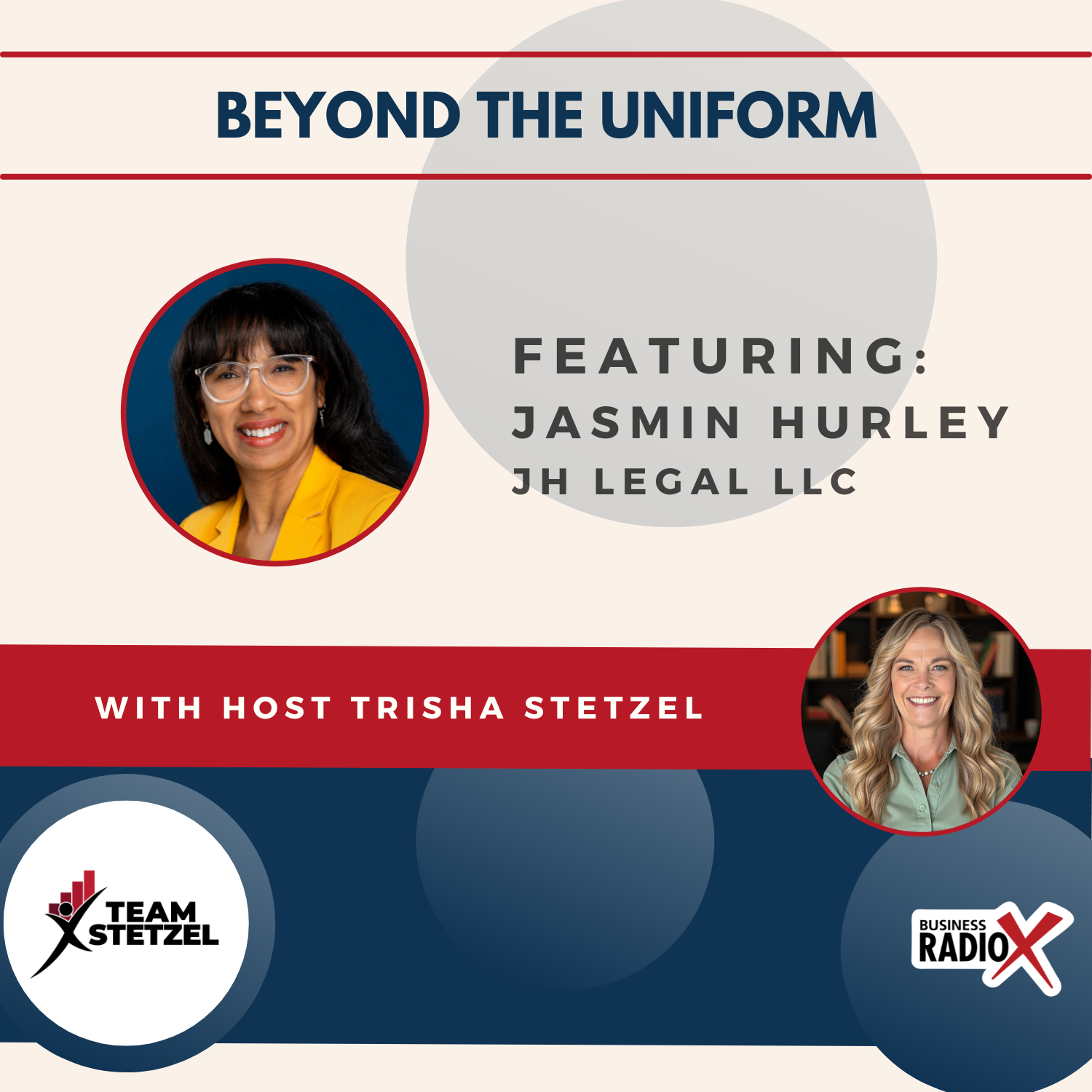

 Jasmin Hurley is the founder of JH Legal LLC, an Ohio-based business and intellectual property law firm that helps startups and growing businesses build strong legal foundations.
She advises entrepreneurs on business formation, contracts, financing, trademarks, copyrights, and brand protection, with a special passion for supporting women-, minority-, and veteran-owned businesses.
A U.S. Army combat veteran and Bronze Star recipient, Jasmin brings a practical, business-focused approach to every client engagement. She is also an active community leader, providing pro bono legal services and serving with numerous professional and civic organizations. 
Recognized by Super Lawyers and Best Lawyers, Jasmin is committed to helping businesses grow with confidence and long-term success.
LinkedIn: http://www.linkedin.com/in/jasminjhurley
 This transcript is machine transcribed by Sonix.
TRANSCRIPT
Intro: Broadcasting live from the Business RadioX Studios in Houston, Texas. It’s time for Houston Business Radio. Now, here’s your host.
Trisha Stetzel: Hello, Houston. Trisha Stetzel here bringing you another episode of Houston Business Radio Beyond the Uniform Series. I am so excited to introduce you to my guest today, Jasmin Hurley, founder and principal attorney of JH Legal, LLC, a business and intellectual property law firm serving startups, small businesses, and growth stage companies throughout their entire business lifecycle. Jasmin helps entrepreneurs build strong legal foundations from day one, advising on everything from business formation and governance to contracts, financing, trademarks, copyrights and brand protection. She is especially passionate about supporting women owned, minority owned and veteran owned businesses as they navigate growth and certification opportunities before becoming an attorney. Jasmin served as a military police officer in the United States Army, earning the Bronze Star while leading in high stakes environments where risk assessment, preparation and accountability were mission critical. Today, she brings that same discipline strategic mindset to helping business owners protect what they’re building and avoid costly mistakes before they happen. In addition to her legal practice, Jasmin is deeply involved in her community through pro bono legal work, rotary, Legal Aid Society of Columbus and numerous professional organizations. She has been recognized by both super lawyers and best lawyers for her work in corporate law. Jasmin, welcome to the show.
Jasmin Hurley: Hi, Trisha. How are you doing?
Trisha Stetzel: I’m very good. I’m so excited to get started today. It’s been a few weeks since the last time we connected.
Jasmin Hurley: Yeah, it’s been a little bit, uh, summer takes over. You know how it is.
Trisha Stetzel: That’s right. Absolutely. So, Jasmin, tell us a little bit more about yourself.
Jasmin Hurley: Oh, well, I feel like you you pretty comprehensive there. Um, well, I, you know, I, I always thought that I was going to be an attorney when I actually, um, so I went to, to West Point for undergrad, um, while I was at West Point, I said, I don’t know if this is really something for me. Um, you know, I was having a lot of fun being in the army, being a platoon leader, being with the troops. Um, and then once I left the military, that was when I really sat down and said, okay, I think I’m ready to, to go to law school and become an attorney. And I’m so glad I did that. Um, I’m so glad that I, I went that path and went that route. Um, and when I’m not practicing law, um, I am involved in my community and, you know, I’m a mom. I have two kids that are growing like weeds. I can’t keep them in pants and shoes for some strange reason. Uh, they grow out of those real quickly. Um, I swear I’m not feeding them anything extra. Um, and, you know, I, my, my husband and I were both veterans. So, you know, we, we really enjoy just spending time with our kids, um, spending time with our dog and our cat and, you know, traveling around the country, traveling, you know, through our state and, you know, just really, really raising them and, and, you know, seeing what, what amazing things they get into, um, they’re starting to get into sports and music and school activities. So, you know, they’re, they’re keeping us busy.
Trisha Stetzel: Yeah, I bet. So I, I want to start with, how do you get it all done? You’re a professional, you own a business, you support other businesses, you volunteer, you have kiddos, you’re a spouse. How do you get it all done? Jasmin.
Jasmin Hurley: Uh, I don’t, um, my husband’s a sales guy, and so one of the things he’s constantly asking himself in me is, what’s the ROI? And I did not realize just how important that was because there’s only so many hours in a day. So, you know, we’re constantly asking what’s the return on investment? Not, you know, so much in dollars and cents when it comes to our family. But what’s the longer term investment, you know, and what’s the longer term return? So it’s become a little bit of a of a joke and we’re like, okay, what’s the ROI of this? Um, so, and especially becoming a business owner over the last two years, really understanding that ROI and, you know, and saying no to some things, I still don’t say no to enough things, as you can tell. Um, but really evaluating, you know, what’s the, what’s the return on investment? Is it going Against, you know, the, the core, my core values, my core beliefs that, you know, is this going to be taking time away from my family? Is it worth it? Um, you know, is there a way that I can incorporate my family into it? So a lot of the community stuff that we’re doing now, now we’re incorporating our kids are old enough now so they can get involved. They can volunteer this weekend. We have a rotary event. You better believe kids are coming. Everyone’s, you know, everyone’s going to be involved. They’re going to be helping out. So as the kids get older, it’s great, you know, um, showing them what, what it means to get involved in the community and being that example. Um, and, you know, in a way passing on that, uh, that those lessons and that service, um, because, you know, that’s, that’s really why we do things in our community, right? We’re passing on the service, we’re passing on those lessons, we’re getting involved, we’re giving back to our community. And now they’re old enough to get involved in that, which is great.
Trisha Stetzel: Yeah, I love that. And I love how simple you put it. What’s the ROI? Like, you don’t have to ask any other questions. There are a lot of questions under that, but I love how simple that is. What’s the ROI on this thing? I’m saying yes to, um, and, you know, some of those no’s come with time. Uh, I’m just giving you a lead in. They do. They just come with time sometimes.
Jasmin Hurley: Honestly, I mean, I, I feel, you know, when I was when I was younger, I had all the time in the world, I would say yes to everything. Right. And the experiences you’re embracing the experiences. But as you get older, you realize that not all experiences are positive. Not all rooms. You’re I’m not saying you’re not meant to be in, but they’re not going to serve you. So, you know, really guarding that time. Um, and it’s a, it is a constant struggle for me to say, okay, is this, what’s the ROI? Is this a room that’s going to serve the greater good? Or is this just a room that I’m existing in?
Trisha Stetzel: Yeah, absolutely. All right. We’re circling back to that when I promise we’re coming back to those rooms because that’s something I want to talk about. But before we get there, tell me how your time in service really translated or shaped the way you think about what the business that you’re in now contracts, risk leadership, protecting a business.
Jasmin Hurley: Yeah. So for me, what I do, I can I do consider it a mission. Sure. It’s a, it’s a profession. I get paid to do it, but it, I think about it in a little bit more depth. Um, I think I, I understand that the businesses that are coming to me and asking me questions, this is their way of building their own legacy, especially working with veteran owned businesses. And, and, you know, this is their legacy. This is what they’re hoping to then give to either their children or it’s providing a life for them to be able to provide for their families, either their children or they may be caring for, you know, older family members in that way. Um, I always joke that the worst job that I had is, um, being a staff officer. It was the farthest away from soldiers. It was the least glamorous life. But what I was doing as a staff officer was planning, I was planning troop rotations. I was planning, you know, the details of someone moving from point A to point B, either as a larger company or down to a, um, you know, a dog team, a dog handler, and the actual working dog. That was the most detailed job I’ve ever been in while in the military. That has prepared me for what I do now. Because right now it’s all about the details.
Jasmin Hurley: It’s all about making sure and understanding how the relationships, how the documents are properly documented and the details in those documents actually reflect that relationship and reflect what has to happen if that relationship goes wrong and understanding that, um, things may go sideways and we need to make sure that we’re planning for that. As a plans officer. I had to plan for that. You know, we always talked about, you know, you were in the military, what’s the, what’s the worst case scenario? What’s the most likely scenario? What’s the, the best outcome? And it’s never they never, ever line up. There’s always the worst case, the best case, and the most likely the most likely is never your best case. So that’s the worst case scenario. Um, and that’s how I frame it to, to, to clients is, you know, here’s the best case scenario. Here’s the worst case, here’s most likely what’s going to happen and how we can mitigate it, you know, in, in these situations and in these ways. So, you know, I really have to give, um, you know, give, give the, the, the props to my, my last, uh, staff job as, as much as I hated it. It is the thing that has served me. Um, hands on every single day as being an attorney.
Trisha Stetzel: Wow. Okay. Little did you know what you were being prepared for.
Jasmin Hurley: Yeah. When I was getting yelled at about the placement of a period, um, that actually matters. And, you know, in, in that way, because the misplacement of a period in the contract, depending on what’s going on, it can fundamentally change that particular relationship. So.
Trisha Stetzel: Wow. Okay. So without getting in the weeds, let’s start with something that’s pretty high level. What are the most common legal mistakes you see startups making that if they had been planning like you were talking about? Yeah. Could have prevented that particular mistake or challenge.
Jasmin Hurley: First and foremost, not asking questions to professionals when the question arises and just letting it go, letting it go, letting it sit Because it then becomes a snowball effect, right? What starts out as maybe a small pebble starts rolling down the hill, it’s gaining momentum. It’s got snow, snow. And then you, you’ve got this big, you know, cartoon sized snowball that is bearing down on you. So, you know, I always tell folks, start establishing relationships with service providers. Now that’s your lawyer. That’s a banker. That’s, um, you know, those, those types of folks that, um, you know, are, can help you an accountant, a bookkeeper, um, a CPA, someone who can help you with your tax planning. All of those folks can help you avoid some of the pitfalls and some of those, those, um, you know, traps on down the line when it comes to taxes, when it comes to your business formation, when it comes to formalizing your relationships with, um, you know, your other founders, your other members, and what happens if those relationships fall apart?
Trisha Stetzel: Yeah, that’s a pretty scary thing. You go into business as friends and then yeah, yeah, you’ve got to have that legal piece in the back. So you guys probably need to talk to Jasmin before you get started. I’m just saying. Yeah, everybody listen, let’s.
Jasmin Hurley: Have the conversation. And you know, if I’m I’m a big proponent of education. You know, as I say, knowledge is power. And so at least knowing what the triggers are sooner rather than later can be really important. You can mitigate these situations. You know, for as attorneys, we are here about helping you mitigate your risk. Some folks and business is risky in and of itself. You know that you take on a lot of risk as a business owner. We are here to help you mitigate that risk. The ones those of us who actually want to help you, we are helping you identify and mitigate that risk. Now, if you say, look, I’m willing to take on some of this risk, fine. That’s a business decision, right? You are perfectly I take on risk as a business owner that normally I might tell folks, hey, don’t do that. I feel comfortable taking on certain types of risks. Right. Um, well, if you. That’s because I understand the risk that’s behind it. I understand what can happen. And I may have been mitigating in the background certain things that can minimize my risk. And so that’s what I try to do with my clients as well. And what a business attorney is definitely going to be able to do for you.
Trisha Stetzel: Yeah, absolutely. So I know there are some folks listening right now that are their heads are exploding because they’re thinking about the cost, the cost of all of these professional services that you just named off. And I know there’s a few ways to navigate that. So what would you say to those who might be thinking, gosh, I can’t afford all of these professional services in my startup.
Jasmin Hurley: Yeah, the access to affordable professional services is a real issue. Um, now folks have been turning to AI and that has helped that issue to a certain extent. It has also hampered that issue because folks are coming in and saying, here’s exactly what I want you to do when that is not what needs to happen. Right. Or, you know, remember, anything that you put on the internet in certain instances is discoverable. So if you have a sensitive legal, you know, legal issue by putting that out there, um, in your, uh, LLM of choice may not be the right answer. Um, finding folks that hit your price point is possible. There are a. Many, many practitioners that are looking at different pricing models. So not just the hourly right there. There are folks that still do the hourly billing. I do the hourly billing in certain situations, but there are a lot of attorneys, especially smaller boutique firms that are looking at providing services to smaller businesses on a more subscription based or project by project flat fee basis. So we’re out there when folks ask me, how do I find an attorney? I say, ask your friends, ask your fellow business owners.
Jasmin Hurley: If you are in a networking group, ask folks who are they using? What does their pricing look like? Is that helpful to you? Where have you had some friction? Check that person out. Your bar associations are also. Every. Every state has a bar association. Most metropolitan areas also have bar associations. Here in my little town in Ohio, we have a bar association. It’s a handful of people, but we still have a bar association. And being able to contact those bar associations, they’ll also be able to provide you with a better idea of what type of attorney you can. You should be consulting, and if they have any recommendations on folks that are usually in good standing with the bar, good standing with your state Supreme Court and who they can give you some suggestions for those folks, they may not be able to help you with the pricing, but they can at least help you figure out what type of attorney can be helpful for you in your particular situation.
Trisha Stetzel: Yeah, absolutely. So this is where everyone puts they stop the recording and they rewind it and they write down every question that you just put out there when they’re vetting the people that they want to bring on board. And, you know, there are so many fractional businesses out there now that do exactly what you’re talking about. And they can work for several companies at once. Meanwhile, splitting the cost across several businesses so that you don’t have to bear the brunt of just paying for it all by yourself. So, so many solutions out there. And Jasmin, I love the way you described it and the questions that you asked. I think they’re perfect for you to vet all of these people that we want to bring on board to help us with our businesses. Something, um, you know, before we move on, I know folks are already ready to ask you questions. They want to connect with you. What is the best way for them to reach out?
Jasmin Hurley: Yeah. So the best way, um, check out our website. It is j h legal ohio.com. You’ll be able to shoot me an email. Give me a phone call. You can even schedule a consultation on there. I do first 30 minutes are free. So you can do consultation right there on the website. Um, you can also reach out to me, contact at j h legal ohio.com.
Trisha Stetzel: Fantastic. Thank you so much. All right. I want to dive into something that you’re really passionate about, which is women owned, minority owned and veteran owned businesses. Why should those businesses or those business owners, excuse me, think differently about legal protection and those certification opportunities?
Jasmin Hurley: Yeah. So there are a lot of opportunities for those particular businesses when it comes to contracting. So that’s, you know, working as either prime or subcontract, you know, subcontractors either with the government or their local municipalities. The majority of states and majority municipalities have certification programs that certify that those types of businesses are, you know, owned by a veteran, owned by a woman, owned by a minority owned and controlled. Um, that also goes for the federal government. Now, there’s been some changes with the SBA on, on that. And, you know, we’re still kind of sitting, sitting in a, in a flux with the a a program and changes. Um, there’s, it looks like there might be some changes with the veteran owned certified businesses, veteran owned small business, um, set asides as well. But those are wonderful opportunities for brand new businesses to be able to work with the government. Guess what? The government usually pays its bills, right? It’s very rare that the government doesn’t pay its bills. So being able to work with those businesses and, you know, the government, the municipalities want to work with those types of businesses is a wonderful way for, you know, you to get, you know, get yourself off the ground. Now, it does come with some certification that has to happen. And more often than not, when formation occurs for those businesses, the missteps and gaps in the formation causes issues in certification, mainly in the control part of it. So most folks will say, okay, I am starting my business.
Jasmin Hurley: I am for me, I’m a woman. I’m a, I’m a minority. I’m a veteran. Okay, I will own 100% of my business. Great. Well, if I then have my husband come in and he is managing the business, which he can’t as a law firm in Ohio, it’s all me. There’s no other. There’s no other person other than an attorney that can come in and do that. But I often see, you know, women owned businesses, veteran owned businesses. They’ll take on partners and they may own 51%. But that partner is making all the decisions. That partner is the one who is either making all the decisions, or they need that partner’s input to be able to make those particular decisions. So then when they go for certification, they receive a rejection and they’re wondering why I own 51% or 51% or more. Well, you’re not actually controlling the business. You have to have unfettered control in that particular business. You don’t have to ask anyone else for permission to be able to do anything. And that means, you know, whether it’s bringing on another member, whether it’s taking on debt, you know, whether there are other things that are happening in your business that’s even dissolving the business. Now, there have been changes dependent upon certain programs, and not every program is the same. So I always tell folks, you know, take a look at the program that you are looking to be certified under, whether it’s under the federal government, whether it’s under your local municipality or local state, or if you’re looking at we Bank, Nova and Bbdc.
Jasmin Hurley: These are all the third party nonprofit organizations that certify for fortune 500 companies. Make sure you’re looking at the. Not only the, you know, the requirements, but truly understanding how they qualify and how they quantify, um, control. If you are outside of either an LLC, if you happen to be a different type of business, like an Esop or those types of things, you definitely, definitely want to pick up the phone, give an attorney a call, ask them questions about your formation, ask them questions about how you are incorporated, how you’re formed, how you’re organized. Um, and, you know, look through the requirements and look through what you know, who, who is sitting as certified in those particular, um, you know, against those particular organizations, they should be able to show you what right looks like or more often than not, what wrong looks like. It will save you money. It will save you time, you know, giving a call over to an attorney that knows what they’re talking about. We’ll be able to save you money because you’re not going out there and wasting 350 bucks. Or, you know, a, you know, any billable fees to have this reversed before you go out and you fix your certification or fix your formation, fix any of your governance issues on the back end, and then move forward positively, um, towards that certification.
Trisha Stetzel: Well, all right, I feel like this is the pick your brain with Jasmin episode. This is so great. You’ve been able to give us so much information.
Jasmin Hurley: It’s all legal, uh, all legal education and knowledge. None of it is advice.
Trisha Stetzel: That’s right. Exactly. Just for the record, we’re not giving any advice on this call ever.
Jasmin Hurley: Just information.
Trisha Stetzel: Just information. Um, tell tell me a bit about JH legal, um, who you’re working with and the types of services that you provide.
Jasmin Hurley: Yeah. So. Jh legal is, it was years, years in the making. So I started out working for larger law firms right out of law school. I was a summer intern, um, for larger law firm out of Columbus. Um, moved to two other larger law firms and then moved to a small, um, virtual law firm all the time thinking, you know, back in 2022, 2023, there’s got to be a different way to do this. Um, there are plenty of folks that I wanted to work with, but we were essentially priced out of working with each other or, um, you know, when you’re working for a larger law firm, we have clients that then conflict with smaller, smaller businesses, different types of businesses, alternative businesses, um, folks that are more on the creative side that maybe should have a business to protect them in their freelance work. So, you know, looking at legal and launching on my own, my focus is bringing that big law experience to the businesses that I see every day. I’m located in, you know, downtown, downtown Washington, courthouse, the businesses that I, you know, work for and work with are the ones that are around me. Um, they’re the coffee shop. They’re the flower shop. They are the, you know, the, the, the deli, the, the person who has the, you know, rental homes. They’re the ones that are starting businesses out of their basements and then moving into brick and mortar, just like I did this year. So, you know, I’m, I’m in the trenches with everyone and it’s fantastic. And I’m so glad that I’ve had the privilege to be able to do that. Um, working in a larger law, larger law firms working in big law was such a privilege. Not everybody gets to do it. And it was a fantastic training ground for being able to bring this to the people that I see every day in my community.
Trisha Stetzel: Oh my goodness. You’re still serving after you’ve served.
Jasmin Hurley: Oh, it never stops. It doesn’t.
Trisha Stetzel: Stops. Never stops. All right. Last topic. I told you I was going to circle back to this room that you were talking about. How important is it, Jasmin, to surround yourself with the right people as Your transitioning, building a business. Moving, changing, growing. How important is it to have the right people in the room with you?
Jasmin Hurley: Extremely important. It’s extremely important. I, you know, I’m constantly assessing whether, um, you know, the organization’s what I’m doing. Ah, um, are they they meeting my values? Am I meeting their values? Sometimes I’m not meeting their values. I’m not upholding my end of the, the bargain in, you know, being participating in an organization and being a present member. So that means, okay, either I need to reevaluate what I’m doing, or maybe at this particular point, I’m not able to provide the type of, um, you know, the type of focus for that particular organization. So, you know, I having that constant assessment. Um, and then also, you know, just being candid about where am I at my, you know, my stage of life. Um, you know, as, as a, as someone once said, I’m a hands on mom. And I was like, so you mean I’m a mom? Um, you know, like, what does that even mean?
Trisha Stetzel: Isn’t that isn’t that the one in the same, I don’t know.
Jasmin Hurley: Like hands on mom? What? What does that mean? You’re very involved. You’re very involved in your children’s lives. Yeah. Um, but, you know, everything is a cycle too. You know, we we have different chapters, different seasons in our lives. Um, so really evaluating, you know, the season and giving myself grace. It’s the one thing I don’t do enough of. Um, I’ll, I will give other people grace all day, every day and say, look, I understand your season of life. And you know, that’s the way things are. Um, I don’t give myself grace in such a graceful manner. So it’s, uh, you know, continuously growing and, and trying to, to do that. Um, and I think there are, there are definitely rooms where, um, you know, I I’m not supposed to be in. Um, if someone tells me I’m not supposed to be in that particular room, you better believe I’ll say, okay. Why?
Trisha Stetzel: Tell me more.
Jasmin Hurley: Barge into that room, or I realize that you know. Fine. If you don’t want me there, I’ll build my own room. Um. I’ve done it. I’ve done it multiple times. Um, I’ve been very blessed with having, um, equally, uh, stubborn people in my life, um, who, you know, we’ve, we’ve banded together and we’ve built our, we built our own rooms. We’ve built organizations where, you know, they served women veterans, we’ve built organizations, you know, starting a chamber of commerce for veterans. Um, we built together a brain trust here, you know, here in our town, um, to support our local, our local businesses and provide them with education and sourced grant money for them to be able to start and sustain their growing businesses. So, um, I’m, I’m the type of person where if you, if I bring an idea and someone tells me no, and I ask them why, and they say, well, it’s just because, just because or we, we’ve that’s the way that we’ve always done it. That’s a horrible answer. And that usually means that I’m going to try to prove you wrong. Um, much to the chagrin of the people around me. Don’t tell me you can’t tell me. No. It’s like, um, uh, the the, uh, I was a TV show, lost the character John Locke. And, you know, people would say, well, you can’t do. He’s like, don’t tell me what I can and cannot do. Even though he’s in a wheelchair after being paralyzed. It’s like, don’t tell me what I can or cannot do. Um, and so I’m, I’m a little bit like that, you know, don’t tell me what I can, can or cannot do. Um, I have to be the one that says like, oh, I probably should not be doing this. Uh.
Trisha Stetzel: Well, if you can’t find it or you’re not invited, then go build it. I, I believe I’m right there with you. I would lock arms with you and. And go. Let’s go! Build it if.
Jasmin Hurley: You believe in it. Enough. You can make it happen. And you know, I work with people like that every day who, you know, organizations or businesses where they say, I was looking for this. I didn’t find it, so I built it. Absolutely. Like hopping on board. How can I be helpful?
Trisha Stetzel: Yeah, absolutely. All right. Last question. What’s next for Jasmin Hurley and Jay H. Legal?
Jasmin Hurley: That’s a fantastic question. Um, I don’t sit still very often. Um, I think yesterday, uh, someone asked me a question about, um, an agricultural question. So then I was researching how to get an LLM in, uh, agricultural law. Um, I don’t think that’s going to happen, but, uh, for, for now, it’s, you know, I’m still within the first two years of JH legal. So we’re still in our building phase. We are still, you know, I use the we. It’s the royal we, but you know it. It is a family. It is a family business. When when you own your own business, the family is involved. Um, so, you know, my husband has been incredibly helpful. He’s offered to help me with outreach in the community. And, um, my daughter, she’s ten, but she’s my intern. She’s will probably be my first intern. Um, at some point I take her to, uh, bar association meetings and she is, uh, she is my intern. That’s how I introduce her from now on, that’s how she introduces herself to adults as my intern. Um, so, you know, for now, it’s, it’s continuing to serve my community, um, growing deeper roots here in the community.
Jasmin Hurley: Um, and, you know, looking at hopefully in the next couple of years, growing the team, um, in a more concerted way. Um, you know, I, I, I want to grow, but I want it to be natural and deliberate and not grow for the sake of growing. I’ve seen businesses that grow just for the sake of growing, and they grow too big without a foundation and they collapse. This is not something that I’m interested in doing. I want to build something that lasts, that I would love to be able to pass on to my daughter, pass on to my son, or pass on to somebody else who just says, hey, this is, you know, you built a great firm, would love to be able to help you sustain that. Um, preferably when I’m ready to retire and not like at 70 or 80 because we, I mean, we see attorneys that are practicing well into their 80s, which is fantastic. Um, but, you know, my, my intent is to hopefully be in an Airstream and traveling the country, you know, in my twilight years.
Trisha Stetzel: Yes. Oh my goodness, so many nuggets and so much education today. Jasmin, thank you so much for being with me and taking the time.
Jasmin Hurley: Of course. Thank you for having me, Trisha.
Trisha Stetzel: Absolutely. Tell us one more time the best way to connect with you.
Jasmin Hurley: Yeah. So you can check out check out our website. J h legal ohio.com. Uh, you can contact at legal ohio.com. And if you’re looking for more education, check out our YouTube page. It’s called Main Street Council. Um, just search up Main Street Council. You’ll be able to find it. I post weekly videos. Um, about a lot of the stuff that we talked about today. So we can get even more in depth. Um, and you can check those out. Uh, I’ve got you think I’ve got nuggets here. I’ve got some nuggets there as well about, especially about the do it yourself. You know, do yourself formation more things that can go wrong. So um, check that out and um, you know, message me if you have any questions if I can’t help you, um, let’s find somebody who can love it.
Trisha Stetzel: I that’s fantastic. I’ll grab that link from you and make sure that it’s in the show notes. So if you guys are sitting in front of your computer, just click on the link to the YouTube channel so that you can see all of those amazing nuggets from Jasmin. Thank you again. I appreciate your time today.
Jasmin Hurley: Thanks so much.
Trisha Stetzel: All right, you guys, that’s all the time we have for today. If you found value in this conversation that Jasmin and I had today, please share it with a fellow entrepreneur, veteran or Houston leader ready to grow. And of course, you need to follow, rate and review the show. It helps us reach more bold business minds just like yours and your business. Your leadership and your legacy are built one intentional step at a time. So stay inspired, stay focused, and keep building the business and the life you deserve.















