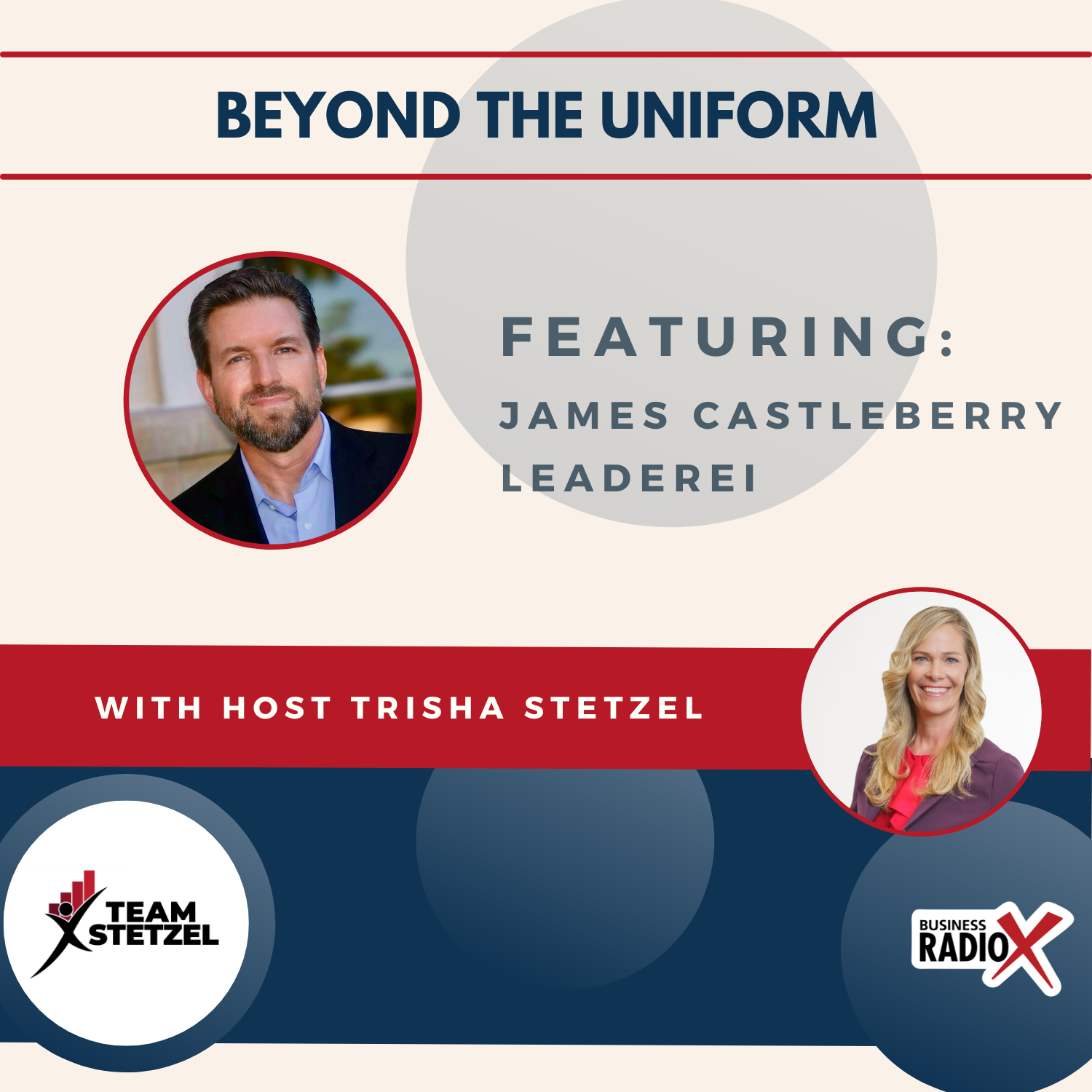


 James L. Castleberry is a retired U.S. military officer and the founder of Castleberry Coaching & Consulting and CEO of LeaderEI, a firm specializing in leadership development through emotional intelligence (EQ) strategies. With more than 25 years of leadership experience across the military, government, and private sectors, James helps organizations achieve measurable business results through customized coaching, training, and consulting solutions.
James is a recognized authority in the application of emotional intelligence in leadership, utilizing tools like EQ-i 2.0®, EQ360®, and MSCEIT® 2.0 to assess and develop emotionally intelligent leaders. In addition to serving executives and teams, he certifies HR professionals, consultants, and coaches to become EQ-i practitioners—building leadership pipelines focused on empathy, communication, and self-awareness.
In his conversation with Trisha, James reflected on his transition from military intelligence to executive coaching and discussed the critical role emotional intelligence plays in leading across generations and managing complex team dynamics. He highlighted the LeaderEI certification program, emphasizing how EQ can be learned and applied to improve leadership effectiveness, retention, and organizational culture. Known for his practical, research-backed, and people-first approach, James continues to impact leaders globally through in-person and virtual programs.
He holds certifications as a Senior Professional in Human Resources (SPHR), Certified Executive Coach, and Master EQ-i Trainer, and is a graduate of Harvard’s Leadership Coaching Strategies program. Based in Florida, James lives out his values of humility, service, and sustainable leadership impact.
LinkedIn: http://www.linkedin.com/in/james-l-castleberry
Website: http://www.leaderei.com
 This transcript is machine transcribed by Sonix.
TRANSCRIPT
Intro: Broadcasting live from the Business RadioX studios in Houston, Texas. It’s time for Houston Business Radio. Now, here’s your host.
Trisha Stetzel: Hello, Houston. Trisha Stetzel here bringing you another episode of Houston Business Radio beyond the uniform series. Today’s guest is James Castleberry, founder of Castleberry Coaching and Consulting and CEO of LeaderEI. James helps organizations achieve measurable results through consulting, training and executive coaching rooted in proven emotional intelligence strategies. That’s what the E stands for. Just in case you were curious, he is a retired US naval officer with over 25 years of leadership experience across military, government and corporate sectors. He’s led initiatives for NATO, US federal agencies and private companies alike. I’m not done, James. I’m almost there. James is a master trainer in the EQ, I 2.0 and EQ 360 assessments, and his work blends research backed tools with practical insights to help leaders boost performance, strengthen teams, and build emotionally intelligent cultures that retain top talent. I can’t wait to have this conversation. James, welcome to the show.
James Castleberry: Hi. Thank you so much. Excited to be here today. It’s lovely to be here with you. And I love the work that that you do and how you help veterans and business owners alike. So it’s really great to be here with you.
Trisha Stetzel: Thank you. So we need to know a little bit more about James and how you found this space in emotional intelligence and what really drew you to build this business.
Speaker4: What was it was quite an evolution.
James Castleberry: And, um, I. When I retired from the military, I was an intelligence officer for over 20 years. I started out enlisted, actually, in submarines, uh, but, uh, gained my commission and, and then became an intelligence officer. So I transitioned from U.S. Special Operations Command and went to work as an organizational development specialist within a healthcare organization. And it was the first time I’d been an individual contributor in quite a long time. Um, but I kind of backed into this laboratory of consulting and coaching, uh, in the middle of Covid. And so when I say a high pressure lab, that’s what I mean. Is that, okay, you are becoming a consultant. Uh, I was hired to help with leadership development programs. And and so that was based on leadership in the military. And so I come in and then, uh, I realized I was much more of a mentor than a coach. I had to develop that curiosity and ability to to listen. Uh. Shut up. James, listen. So. So I had to learn that the most important in coaching. Um, and then, uh, I developed such a heart for those folks in healthcare that were going through what they were going through. And the primary tool that we used was emotional intelligence to raise that self awareness so that we could understand what challenges they have, what where their strengths were, what blind spots were out there, and and what I specifically liked about the tool that we used was that unlike some of some of the other tools that are out there that are like personality type indicators to kind of tell you what you are, you know, one of the things that raise your hand if you know what letters you are right.
James Castleberry: And people will do that, or they’ll drop them in a chat or a webinar and that they know their letters. Um, but we were kind of left there. Your purple, your orange, your pink. But where’s the growth in that? Where’s the development? How does that help? You may understand more about yourself, but are you able to grow from that? And so emotional intelligence, uh, during Covid, uh, placed me in a position to help people that were really going through their own kind of trauma they hadn’t seen before. You know, they, um, you know, I liken it to, to combat, we we deploy and we go there and we see things that we’re not used to, and then we come back and we kind of work through our issues for them. During Covid, what I experienced was that they they were returning to trauma every day. And so when we would have our coaching sessions and those who participated in the leader development programs, um, it it was a break for them. I could never schedule a 30 minute call. It was a it was an hour to take, 30 minutes for them to just kind of decompress and, you know, feel safe and, uh, psychologically safe environment. And so some of that involved just decompressing a little and then getting into what challenges they were facing and using emotional intelligence to better understand themselves and, and where we could grow and develop.
James Castleberry: And so all of that led to, while I was there, establishing my own business, initially focused on helping veterans transition because I had such a heart for veterans. You don’t have a 30 year career without having a heart for veterans. And so I did and helped. And then I transitioned that a little bit to focus on, on the corporate world where I had the opportunity to go in and work with organizations going through change. Uh, I did some work with, uh, major defense companies, uh, some AI, AI startup. I even had the opportunity to work with. And so, um, learned a lot about consulting, transformation, change. And all along, using what I learned about emotional intelligence, and that two and a half year lab of of Covid and healthcare, uh, to help these other organizations. And so that was a foundation of my business, and it’s brought it to where I am today, where I like to certify other people in emotional intelligence tools. And so whether that’s individual coaches and consultants or if it’s their leader development team that’s internal, um, I feel that there’s such a great exponential impact that, that I can have that way. And so, um, I really like helping out with those tools. I can still do the same things myself, but I see this exponential impact when I can certify others in, in these great tools, uh, so that they can help people too. And so that’s kind of brought me to where I am today.
Trisha Stetzel: Fantastic story. So do you find that everyone’s on board and understands AI and EQ and all of the things that you and I are talking about, or is it something you have to educate people on?
James Castleberry: Yeah, absolutely. Have to educate people. And then there are some that you may and it’s interesting generationally it’s different. So if I’m talking to someone in business and they’re baby boomer, they will respond differently. Um, because their, their generation, um, you know, showing emotion was was bad, right. So there’s a they have a bias against those kind of things. Um, even Gen X folks like me, they, they all think it’s the newest fad. Yeah, yeah, we we we all know our mBTI letters, right? So yeah, we had that. That was great. Hr did it. Now we’re back to business. And uh, and so there is some of that. Now what’s interesting about when we get through millennials and Gen Z millennials is fascinating. The way that they look, emotional intelligence because they so believe in in the work environment being good for them. Um, and so, uh, that, that the culture is very important to millennials. Um, and then when you get to Gen Z, who are now in the workforce and working, and you think about a leader facing all of these different personalities on a daily basis, you know, we’ve used code switching in, uh, in different contexts. But think about emotionally intelligent code switching between generations, uh, required of leaders. And so we get to Gen Z. And these folks are very open. They may come in and sit down in your office and tell you what their therapist said.
James Castleberry: And now think about the communication among all these different generations, uh, together. So yeah, absolutely. It depends on who I’m talking to. Uh, can I sell emotional intelligence as something that benefits the organizations? And, uh, you know, we can bring statistics, we can bring data, we can show increases in, um, uh, Collaboration that can result in increased sales and achieving sales goals. We can show the difference in the impact to retention. We can show the difference in missed days and ramp up time and training. So we can provide all the data behind that. Um, it but it depends on who the audience. You have to adjust that story to whoever the audience is. And sometimes it’s easier to talk to them about and say, yeah, we need to do that. We see the value in it. And then, um, sometimes, uh, there’s an overall perception even of HR as a cost center and not a profit center, that that can create a bias. Uh, when you’re having those conversations and so, you know, is everyone receptive? Uh, initially, no, I’m not receptive to sales initially. Don’t pop in my inbox if I don’t know you and try to sell me something. Right. So, you know, I every, every person is different. I think that’s why emotional intelligence is so important. The number one blind spot for leaders is self-awareness.
James Castleberry: We see the results of our actions in the way that we interact with people. But there’s a lack of self-awareness. One of the most heartbreaking things that I see is, is people who are terminated for some behavior. You see, performance is not usually unless you’re at the C-suite level. Performance is not usually the reason that people are fired and terminated. It’s usually some behavior, and they usually don’t see it coming, because some of those behaviors, when they were more junior in organizations, resulted in performance results. So they don’t understand the Navy does a great job of putting it on the front of Navy times is this commanding officer was relieved. Um, and then you wonder, well, how aware was that person Performance evaluations were great. They obviously they promoted to be a commander, right. Uh, so their feedback they were receiving, at least from up above was great. Um, you know, so, um, yeah, I think that blind spot of self-awareness and and that’s in every interaction. Are you communicating the way that even a sales, the way that they need to hear it, or are they direct, compassionate, um, spirited, uh, or systematic communicator. Right. And then how does that communication style interplay with emotional intelligence are you framing your message right, for who’s receiving it? And so emotional intelligence impacts all of that.
Trisha Stetzel: Yeah. Wow. So, um, tell for those who don’t actually know about EQ and AI and why we’re using those synonymously. So let’s talk about that first and then let’s talk about what the diagnostic or the assessment. The EQ I 2.0. What does it actually measure so that we can catch people up who may not be familiar?
James Castleberry: Okay. So, um, I think it, uh, II became popularized in the late 90s. There was a book by, um, psychologist Daniel Goleman and, uh, and it was called Emotional Intelligence. And so it’s when people first heard of it. Um, but even the research before that, people started wondering when you look at highly successful people and this is what drove it. But when you look at highly successful people, they didn’t all have very high IQs. Um, and that had been the gold standard for measuring and predicting how successful people were going to be. So these researchers became very curious as to what’s that other intelligence that they’re employing, right. To be this successful because they don’t all have the same IQ, and then even people with very high IQs might not be that successful. Maybe that’s detrimental to their success. Um, so when people started researching that and, and then, uh, Goldman’s book came out, it was highly successful. And then it kind of grew out of that just raising awareness and, uh, different assessments came from that. The EQ 2.0 came from the initial work from Reuven Bar-On, an Israeli researcher, and, uh, and there was an initial, uh, EQ and then the way that the data was presented was changed in 2.0. But basically, um, just as IQ is a measure of cognitive intelligence, um, e is a measure in what the EQ gives you is a measure of emotional intelligence.
James Castleberry: Budgets. And so whatever your score is, it’s just like your IQ score. Except it said emotional intelligence score. And so that the the assessment serves as a baseline. And uh, it, uh, it collects data. They had a very good norm as valid reliable. We’ll talk about different sometimes different psychometric tests and the standards that they have to meet for validity and reliability. The whole webinar on it. Um, because if you’re making decisions in business and you’re using these assessments, um, there are certain standards, uh, based on industrial and organizational psychologists that, uh, that you should, uh, that standards of reliability and validity that you should use for decision making, high stakes decision, you know, can you use these instruments for inputs and, uh, for selection, for placement, uh, those kind of things for termination. Never, uh, you shouldn’t use those tools and it shouldn’t be the only input. Right. But but as an input. And so what API does is it has five composite uh categories and 15 subscales that that break down, uh, emotional intelligence into smaller bites. Um, I use the example of um, the self perception is one of the composites, one of the five composites. And in there it’s broken into those three subscales of self-regard, self actualization and emotional self-awareness. And so when you take the overall data set and you break it down into the composites and that many subscales, and then you see how well you performed against the norm, that’s the data in the research.
James Castleberry: Um, then then you can find areas where you have your strengths, uh, where where you have challenges and opportunities for improvement and where you can develop goals to improve. And so, um, it’s such a great tool. And, you know, when I would see it in, uh, in healthcare, the, the folks coming straight from the or sometimes we were doing interventions for communication because it was just so much stress. How are they handling stress? And we could use that tool to help. And you know, patterns develop in in healthcare that people with big hearts and they have very high empathy, um, maybe low assertiveness. Uh, their empathy was so high they didn’t want to disrupt things. And so they didn’t want to argue. And so their assertiveness might have been lower, but it’s a temporary condition. And this is why your self-awareness is is a temporary condition. Because eventually just suppressing all of that, um, all of the, the expectations and, and those kind of things and, and not getting your needs met because you’re empathetic for others and you just want to keep peace and result in strange things. Impulse control. So that they’re they’re making impulsive decisions.
James Castleberry: Or maybe they have a behavior issue, or they have some kind of outburst because for so long their empathy was very high, assertiveness low. They weren’t expressing themselves with their needs. And so how long can someone go? Their stress tolerance was low at that point. Another measure is stress tolerance. It was low at that point. Um, and so, you know, it can result when I talk about chunking these parts of emotional intelligence together like we spoke of before, if you think of how this could result, you have very high empathy, low assertiveness. You’re not expressing your needs clearly. Um, um, and the reason that you’re not is you don’t want to disrupt things. Uh, empathy. You have a heart for other people. You’re listening. Understanding. Um, but by suppressing, uh, your own needs, not clearly articulating expectations and needs, um, your stress management starts to decrease. Your coping decreases until you have challenges with impulse control because you’re not coping well. And so when we cluster and chunk these things together with, you know, some patterns emerge. So um, by people taking that assessment, millions now taking it, by the way, and they’ve actually, um, very intelligently they’re redoing the norm because if the initial norm is 20 years ago and it is a valid norm that’s going to be reliable, then it needs to reflect what society is doing today, right? Because people change.
James Castleberry: So, uh, they’re they’re redoing the norm there. But, um, when you look at different tools and validity and reliability, very strong. I saw the results of that because I saw literally transformations in people. Um, just by raising awareness, we generally people want to improve. Generally, people want to grow up. Even helping people understand their strengths can be very helpful. Uh, there’s a big focus with Clifton strengths. Gallup strengths on on. You know, here are your strengths. But one of the things I learned, uh, that we can use in emotional intelligence is once you know those, then you know what’s most valuable to you, what you value most. Well, then you also know what your biggest triggers are, right? Inherently, if honesty is a very important value to you and someone tells little white lies or they just glaze over, the truth person’s going to be in your triggers all you won’t know why. Why don’t I like that person? I really you know, I don’t understand. And so that’s why you don’t like them. If you value independence and someone’s kind of needy, right? And independence is a big value. Uh, you want to let someone just take a task and run with it? It’s a big value for you. And this person just keeps coming back for more and more instructions and directions.
James Castleberry: And I need to understand this better. That person could be in your trigger zone. I think it’s very important to understand, uh, for your triggers, to understand where, uh, where you value, um, different aspects, even of emotional intelligence and where if empathy is really important to you. If someone just seems indifferent, that person’s going to be your trigger zone. If problem solving is important to you, you’re kind of a systematic thinker and you know people will do what you tell them, but they’re not going to go fix things themselves. Being a trigger zone. So so now you take this and you apply it to leadership and leadership teams and you kind of see this dynamic. Then you add the have the dynamic of different generations and how they were raised and how they respond to different stimuli in the workplace. Um, it becomes this very complex thing to, to work out. And so if you’re not very intentional about yourself and if you’re not aware of those 15 subscales in emotional intelligence, you’re not working toward getting better in those areas where, you know, sustaining where you’re strong, but getting better in those areas for growth. Um, and then learning that yourself helps you to spot it in other people. Right? You spot it in other people, then how much better a leader can you be specifically for them?
Trisha Stetzel: Yeah. Okay, so I’d like to tackle those that may be skeptical about this whole measuring emotion thing because they don’t they’re not emotional people and they don’t want to go down that path. So, James, number one, have you worked with people who are skeptical in the beginning, and did you see a turnaround with them? Did they come around? And what were those results like once they adopted or adapted this idea that they can become better? When it comes to AI.
Speaker4: So what’s great?
James Castleberry: Despite skepticism, initial skepticism, the results are the same. So if they’re initially skeptical. But you know, I don’t do emotion. I’m like, well, okay, that’s the way you process information. That’s great. How’s it? And this is a coaching. How’s it working for you in your relationships? Right. They’ve already told you they don’t want to deal with emotions. Right. Relationships or emotions. So in how you deal with them. Right. So the results can be the same. Maybe they’re stressed out. Maybe they have time management challenges. Maybe they have challenges with empathy. Maybe they’re misunderstood. You know, maybe they’re great problem solvers, but they’re not that assertive, you know? Or on the other end, maybe they have low empathy. They just don’t consider the feelings of others. And everything is data based. They’re analytical. Right. Um, but when you start asking those questions. Okay, how, um, how does this show up in your life? You know, when you say that relationships are important, emotion is not important. What kind of feedback have you heard? You know, what are you getting? Would people agree with you? And if they agree with you, do they like it? Is you develop these conversations with them. And the great thing and this is what I think is so important about a valid and reliable tool, is because it is a valid tool.
James Castleberry: It is a reliable tool. We’ve got the, the um, statistics to support it, the data to support it. Then it’s going to have results because it is an accurate assessment. So those will be the areas you need to work in. It might not be where you want to work. That may be a hard area for you, but it will be the area where you could use the most improvement. And then I go back to this is a self-assessment. So even though there are other questions that that help with validity and reliability and and consistency, this is your assessment of yourself and your own mirror. It’s a self-assessment. And so if using this tool said well this is kind of the results based on data and your perceptions. So it’s hard for someone to come and say that it’s not you know, I don’t believe in this at all. So I’ve actually seen I think some of those hard cases are some of the best. You know this in general, some people are coachable and some are not. Maybe they don’t want to change. They’re not interested in changing. And that’s okay if you raise their awareness. I’ve helped people and then they come back months later.
James Castleberry: Hey, you know what? I’ve been thinking about this thing. Hopefully they’ll come back with a performance improvement plan. Right. But, you know, they come back later because now they’ve heard it. And so you know how to cognitively. How do they go through that if they’re systematic. Well you know this I heard this. These people are telling me this. That’s it’s not working for me. I don’t know what to do different. This is just me. So and I’ve had those people show up, too. Oh, this is me. Uh, you know, I had one lady, uh, I coached in healthcare. She said I’m just like my dad. They didn’t realize that these decisions were impacting others because they never asked. Right. Yeah. And so I see so much growth. One lady said, uh, she. Yeah. I’d like to go back and read testimonials. Well, one lady said it was so great I was able to come to work without crying. And so, you know, talk about impact, why that was so formative to me or retired military officer and then go into this incubator for emotional intelligence, uh, coaching and consulting. And, uh, during the middle of Covid and, and that’s kind of shaped where we are.
Trisha Stetzel: It’s beautiful. It’s been such a journey for you. So as we get to the back half of our conversation, I’ve got a couple of things left. One, I would love for you to talk a little bit about your certification program and who the best clients are for that. So someone is already adopted, adapted, loves AI, really wants to take it to the next level. So talk about that program. And then of course, I have a veteran question for you because I couldn’t let you leave without that.
James Castleberry: That’s great. Well, wouldn’t want to miss it. So, uh, certification program is you know, I tell people if you want to invest in the most impactful training that you could possibly have for your organization. Number one, invest in emotional intelligence, but get one of your people certified in providing administering this tool, debriefing it, and coaching emotional intelligence, whether that’s an external consultant and they use that or an internal consultant, and you use it in leader development programs, whether internal or external, it’s, you know, 16 hours, two days live. And so you sign up, you get access to an LMS, and then you take online modules and then you, you come into this, this live virtual environment like we’re in now. And you’re learning about the history of emotional intelligence. You’re learning about this model, the validity, reliability. You’re learning how to administer it. And then you’re learning how to interpret what the reports and the information provide, and then how that translates Flights into helping, uh, helping your folks with growth and development. How to how to set Smart goals so that so that something practical. We take these ideas of emotional intelligence and then and then we apply them to you and and then we deconstruct where your strengths are and, and where your challenges may be. And then we co-create this plan for development, um, that can really be impactful in your life. Um, in your work engagements, in your home engagements, um, increasing overall happiness. Um, you know, one of the measures is, is positivity. Are you positive? You know, and here are the things that contribute to that. Right. So, um, um, the the training is, is two days some pre modules that you do and then a test at the end.
James Castleberry: And uh, and then you have a license to be able to administer and use this great tool that, like I said, I saw proven in in a healthcare environment, a pretty intense healthcare environment. I was sold on it. I love to see, um, the development of people, you know. I love to see them grow. I love to see them come back and talk about the changes. And, um, so that’s that’s the certification program. It’s, uh, it’s, uh, it’s not a difficult program. Uh, there are some communication aspects to it because you have to be able to, um, juggle the different, the different subscales. Right. What does this mean when you’re interpreting. And then you for me, as a military officer learning about this, I had to shift from being a mentor to a coach and more asking questions instead of telling, right. So remain curious about the data. Try to understand from the client, um, what this means and how they completed this and what the results show and then co-create something. Sometimes their biggest deficit in emotional intelligence is not where they want to work. You can’t mentor them and say, hey, right here, that’s your problem. Nothing’s a problem. It’s an opportunity. And and and go where they want to go because it needs to be something that’s dear enough to them that they’re willing to work in that space. So the certification, uh, can be signed up for, uh, at my website. Com and and then after people sign up there and they enroll, then, uh, they’ll get signed up in a learning management system. We’ll go through a couple days of, um, uh, training. They’ll take their test, they’re certified, then they can purchase and use the tool.
Trisha Stetzel: Okay. That’s beautiful. So lottery.com is the best way to find that program. And, um, sign up with James to get certified. That’s fantastic. I really enjoyed our conversation today. So last question for you. What’s the one big thing that you brought with you through your military experience into the work that you do now?
James Castleberry: A couple of things. It’s so hard for me to do one, but I’ll try to keep it at one for you for time. But I think it was my exposure to so many different cultures, so many different people. And so because of that, I didn’t come in with a bunch of bias. I came in with, hey, these are all people that bring experiences of their own. They contribute in the world, and I need to listen. I need to understand them. I need to understand how we interact. And so I think, uh, you know, along with some of the leadership aspects, some of the aspects of being an intelligence officer that are process oriented. Uh, you know, I really brought just that, that exposure to, uh, to to so many different cultures, so many different. And that’s within the United States. And when I deployed, right, so many different cultures and, and that cultural awareness to where I wasn’t very surprised when someone came in the office to be able to help, you know, and as a leader, regardless of the generation, I’m trying to read a little bit. I’m trying to understand where they’re coming from, but I’m not going to make a judgment on even on stereotypes for a generation. And so I think that the biggest thing that that, uh, I learned from the military, um, was, um, not not to quickly judge people, but to, to listen, to be curious that that curiosity about where they’re coming from, where they’ve been, what they need.
Trisha Stetzel: That’s awesome. So, James, thank you again for your time today. Uh, everyone knows they can go to leader. Com to learn more about your programs. Is there another way that you would like for people to connect with you if they have questions or want to learn more.
James Castleberry: Sure, they can directly email me at James at dot com.
Trisha Stetzel: Beautiful, James, thank you so much for your time today. This has been an amazing conversation. You may have to come back because they have so many more questions for you.
James Castleberry: I’d love to come back. It’s been a pleasure.
Trisha Stetzel: Thank you so much. And that’s all the time we have for today. If you found value in this conversation, share it with a fellow entrepreneur, a veteran, or a Houston leader. Ready to grow. Be sure to follow, rate and review the show. It helps us reach more bold business minds just like yours and your business. Your leadership and your legacy are built one intentional step at a time. So stay inspired, stay focused, and keep building the business and the life you deserve.














