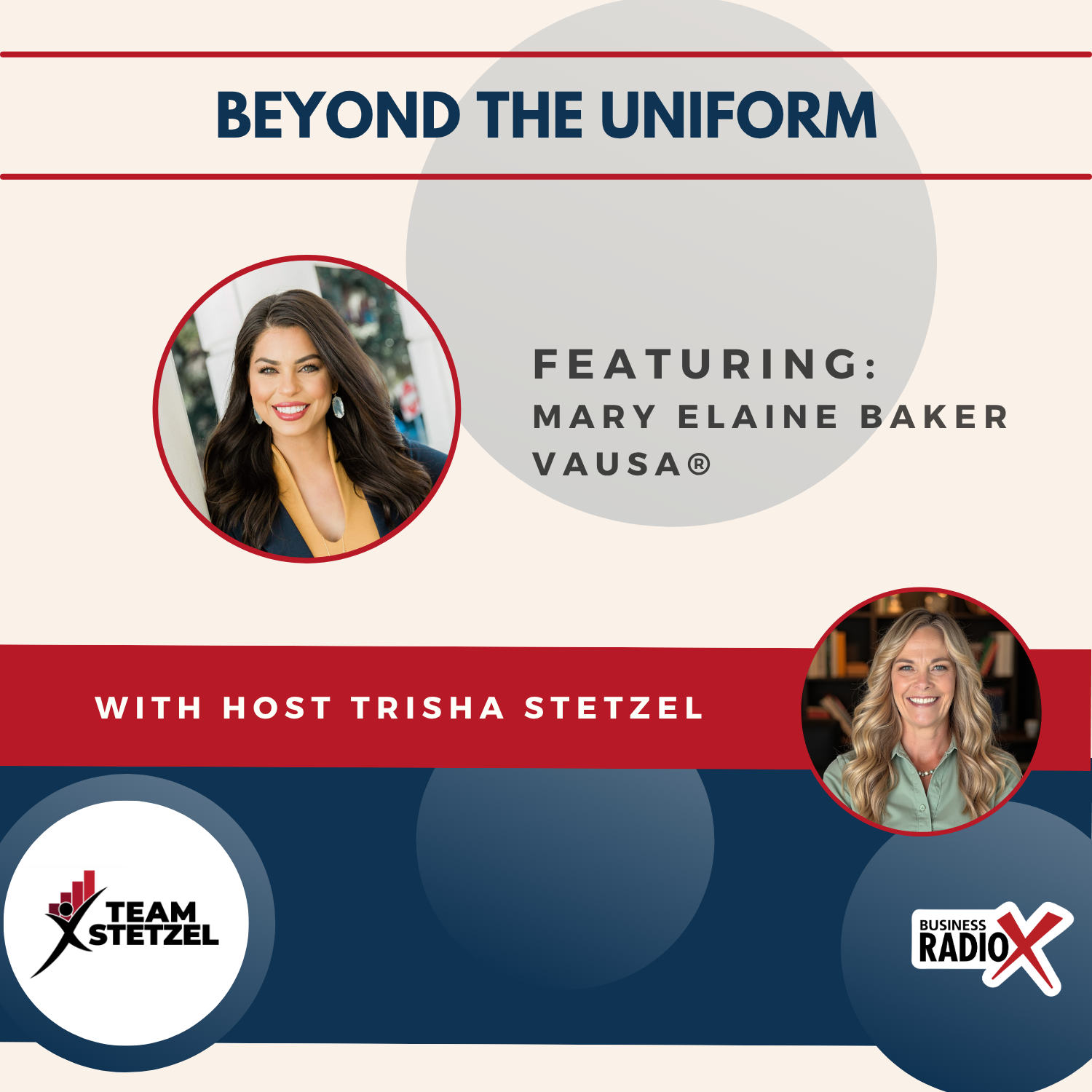

 Mary Elaine Baker is the co-founder and integrator of VAUSA®, a company she launched with her husband, Brett, in 2018 to create meaningful remote careers for military families while helping businesses build exceptional virtual teams.
As a veteran family, their mission is deeply personal. Brett served as an Army Ranger for nearly 13 years, and Mary Elaine began her career as a public school teacher before stepping into entrepreneurship. Today, Brett serves as the visionary of their businesses, while Mary Elaine serves as the integrator, turning ideas into systems, strategy into execution, and vision into sustainable growth.
An entrepreneur, culture builder, and advocate for whole-life integration, Mary Elaine specializes in building strong, purpose-driven cultures in remote workplaces and developing the people, systems, and rhythms that allow both businesses and individuals to flourish.
Her approach to leadership is rooted in the belief that success should not require sacrificing what matters most. She is passionate about integrating faith, family, business, health, and purpose and helping others build lives and organizations with the same intentionality.
Alongside building VAUSA, Mary Elaine and Brett homeschool their children and intentionally incorporate entrepreneurship, life skills, leadership, and real-world learning into family life. Mary Elaine believes that “living is learning” and that some of life’s most important work happens not only in the businesses we build, but in the people, families, and cultures we shape along the way.
That philosophy also extends to their family homestead. This year, the Bakers are officially launching Baker Roots & Ranch, a farm business rooted in regenerative farming, stewardship of the land, and a desire to build something meaningful for future generations.
Whether she is building a remote team, developing systems, raising children, or growing a business, Mary Elaine is passionate about creating healthy cultures and intentional systems that help people, families, businesses, and communities flourish.
LinkedIn: http://linkedin.com/in/mary-elaine-baker
Website: http://hirevausa.com
 This transcript is machine transcribed by Sonix
TRANSCRIPT
Intro: Broadcasting live from the Business RadioX Studios in Houston, Texas. It’s time for Houston Business Radio. Now, here’s your host.
Trisha Stetzel: Hello, Houston. Trisha Stetzel here bringing you another episode of Houston Business Radio Beyond the Uniform Series. It is my pleasure to introduce you to my guest today, Mary Elaine Baker, co-founder and integrator of the VAUSA, where she helps business owners and executives build exceptional virtual teams and create the systems that allow leaders to focus on the work only they can do. Mary Elaine is an entrepreneur, culture builder, and advocate for whole life integration who believes a healthy business should create a positive impact not only for its clients, but for its employees, leaders, families, and of course, the community. Her work is rooted in helping people build businesses that perform well without sacrificing what matters most. Mary Elaine, welcome to the show.
Mary Elaine Baker: Thank you. I’m so happy to be here.
Trisha Stetzel: I’m very excited about having you on the show. What else do we need to know about Mary Elaine?
Mary Elaine Baker: Oh, goodness. Um, well, uh, I live just outside of Savannah, Georgia, and I grew up in a military family myself. And I also married a an Army Ranger. And so he was in for about 13 years. I have two, two children. We do some homesteading. We also have a farm business. So and we also homeschool. So there’s no shortage of activities and things to do in the Baker home.
Trisha Stetzel: Okay, so I’m going to start with how do you get it all done? Mary Elaine, how do you get it all done?
Mary Elaine Baker: Um, well, it sounds kind of cheesy because this is literally what my business is about, but I feel like I’ve pretty much mastered the art of delegation. I don’t when I say all of these things, I am not doing it on my own. Uh, not even the homeschooling. So I have learned that I am not actually a superhero or superwoman and I need help. So yeah, so I have a great team of people around me who are very gifted in all kinds of things that I am not.
Trisha Stetzel: I love that, and we are definitely taking a deeper dive into that. But before we go there, um, I know that you started your career as a public school teacher and eventually co-founded this business, VA, USA, with your husband, Brett. So what led the two of you to start the company, and how did your experience as a military family really influence what you wanted to build?
Mary Elaine Baker: Yeah. So yes, I don’t have a business background. Never went to school for business, did not grow up in an entrepreneurial family. So, uh, I mean, entrepreneurship, I feel like kind of found me and I first became a virtual assistant. And that experience, the reason why I left education to become a virtual assistant was because my husband was gone way more than he was ever home. So I was very much operating essentially as a single mom, raising two children, holding down the fort with the home, and also with my full time career. And I started to wonder, what else could I do that’s going to allow me to still contribute financially to the family, still use my gifts and talents and, um, but also be more conducive for our military lifestyle, which required a lot of flexibility. And I learned about the world of virtual assisting. This is a very short version. Decided to try it in the middle school years, like during a summer and never looked back. The toothpaste is out of the tube, as they say. At that point, you could not put me back in those four walls again. I loved, first of all, I loved working for entrepreneurs. I had all my. I had three clients that were serial entrepreneurs themselves.
Mary Elaine Baker: And so I feel like my business school was part of just being able to support them on the back end. I love learning everything about how all the wheels on the bus work together. Um, loved supporting them. And what I realized was this was perfect. It literally checked all the boxes for what I needed. Like I mentioned earlier, it was like a weight was lifted for us. I was starting to, um, I wasn’t experiencing burnout anymore. And, uh, I realized, uh, both my husband and I, that this wasn’t just a Baker family problem. This wasn’t unique to marry Elaine. This wasn’t unique to the two of us, that what we were experiencing was actually a huge problem in America. And at that time, this was back in 2017. The unemployment rate for military spouses was four times higher than the national average, which blew my mind, you would think, because I grew up in a military family and my mom was a stay at home mom, you know, because a lot lots to do with our lifestyle and, and being married to someone in the military that I would know that. But I really didn’t realize that it was such a huge problem. And then I had friends asking me, how do you do this? Is this real? Are you actually making money? And so I, both my husband and I felt very, um, uh, almost convicted, like with this vision that, like, God wanted us to share this with other people, that this wasn’t meant for us to keep to ourselves.
Mary Elaine Baker: This was meant to be shared. And that my gift of teaching was actually going to be very helpful and useful in teaching other people how to do what I was doing. So that’s where it started with one friend who was also a Ranger wife. And I said, hey, do you want to learn how to do what I do? And I started handing off one by one, my clients to people that I would hire and train. And then when that grew into over time was a very, um, our secret sauce is really in our matching process. So we don’t just put a warm body with another warm body. We don’t just make a cattle call of like, hey, who wants to do this job? We are very strategic in our actual matching process. And, um, have gotten very, very good at what it takes to find the right person and put them in the right seat. Mhm.
Trisha Stetzel: Okay. I have so many questions for you.
Mary Elaine Baker: Okay.
Trisha Stetzel: Where, where I want to take this now is tell us about the services that you provide, because you talked a lot about VA and where, where this got started and the roots of this business. But I know that there is so much more that you and the people that are on your team are doing so. Tell us more about the services that VA USA supports entrepreneurs with.
Mary Elaine Baker: Yeah. So when I first heard about the world of virtual assisting, even then, I wasn’t even quite sure what that meant. And what I learned over time is that can mean essentially anything. Um, if it can be done with internet, a computer and a phone, it’s, it can fall into the bucket of a virtual assistant. So, um, but what we really are sweet spot in what we specialize in is anything in the administrative realm, which include include a lot of different things, but just think anything administrative, um, in finance. Uh, so think bookkeeping, uh, basic accounting, we don’t touch taxes. That’s the only limit that we just, we don’t do. Um, and, uh, marketing and those, those three buckets in and of themselves, the list of types of responsibilities can be very, very long. But those are the three main buckets that we normally hire. And we do matching for. Now we have, um, we do also traditional recruiting. Um, and you know, those can be more specialized. Uh, it tends to be more specialized, more specialized. We try to go more, more traditional recruiting route. Um, but those are the main three things that, uh, I would say we do the best.
Trisha Stetzel: Okay. Are you bringing on military spouses mainly? Tell me about who the, the, uh, who is on your team that’s actually doing the work for the entrepreneurs.
Mary Elaine Baker: So on average, we, we swing between 70 to 75% military affiliated on our team. That is really the heart of who we’re trying to serve. It’s, it’s not just the creation of the job for them because like I said, my problem was I needed something that was going to be flexible for our lifestyle. A lot of military spouses are moving every 2 to 3 years. Um, their resume does not look great because you can see the gaps in their resumes. You can see that they’re bouncing around. So a lot of employers won’t even take a second look when that resume hits their desk, unfortunately. And, um, what I have found is that employers are really missing out on incredible talent. And it’s not just the skills that they have. Um, and we have people that come in, uh, with, uh, I mean, doctorates, masters, incredible education, uh, and have all kinds of certifications and skills, but it’s the soft skills that I think this lifestyle really, um, develops in you over time is the character that my team has that really, my clients know that when frankly, crap hits the fan in their personal life or in their business that their assistant is not going to be. It’s not going to rock their boat. They will be a steady oak for them. They’re adaptable, they’re flexible. They can take challenges. They’re not going to break a sweat when things get hard. They’re incredibly loyal and dependable, and they have a heart for service because they’ve literally dedicated their whole life to it. Mhm. Um, so that caliber of individual, I feel so blessed that, I mean, that’s, that’s my team. That’s the kind of culture that’s been created over time. And it’s because they bring all of that to the table. They bring so much talent, but they bring so much heart. And it makes them just amazing people that we get to work with every day.
Trisha Stetzel: I love that, that’s amazing. I was just thinking, shout out to Susan Schram for introducing the two of us. Otherwise I wouldn’t be able to share this amazing work that you’re doing with the people who are listening today. Tell me about the businesses or industries that you’re supporting regularly. And I know that there may be some outliers, but generally speaking, if someone’s listening in a particular business or industry, uh, let’s help them perk up a little bit and say, gosh, the AUSA could help me.
Mary Elaine Baker: Does this apply? Yes. So, um, we, we don’t care what industry you’re in. So I just want to be clear on that. Uh, we and we are very boutique, uh, white glove, high touch. Uh, we, we have our standard processes for matching, but we curate everything based on who you are personally. Your values are extremely important in our matching process. Your personal values, the values of your organization and, um, and, and how you’re naturally wired. So I just want to make sure people don’t think that I have to be in a certain industry in order to work with us or, or to receive the benefit of hiring a virtual assistant in general, whether it’s through us or not. Um, the types of clients that we serve range from solopreneurs. Um, and it can be any kind of service or product, but, but as small as a solopreneur coach, consultant all the way to, we have clients who have a large number of employees under them and they have a brick and mortar and they’ve been in business for many years. Uh, so it just, that’s a huge range. I know that, but what we really, who we really love serving are values driven, purpose driven individuals. That matters more to us than anything else. Um, people who, uh, want to make a difference with their business. And that doesn’t mean you have to be a nonprofit. I want people, I want to work with people who understand that there’s, that they can make an impact with that profit that they’re making. Um, and that’s their that’s their deepest desires. Those are the people we love working with and they love. They receive a lot of value from being matched with the, the people and the culture of my team.
Trisha Stetzel: I love that I have so many people who come to me and ask Mary Elaine, who do you know who can find a military spouse or I need a remote person to do fill in the blank and you are at the top of my list. I’m so glad we had this conversation today. All right. There are listeners, I just know that really want to connect with you or learn more about the services that VA, USA provides. So where is the best place for them to get that information or connect with you?
Mary Elaine Baker: So our website is higher HIREVA usa.com. Um, but I’m also pretty active on LinkedIn. You can find me there at Mary Lane Baker. Please add me and shoot me a message and we can chat.
Trisha Stetzel: I would love that. And you guys tell Mary Elaine that you heard her here So she knows where you came from. I love that I want to take a deeper dive because I’m picking up on a few things here. One of them is delegation and what you created for yourself because you said you’re not doing it all. And I would love to know more about that. And then as we take a deeper dive into that, I want to talk about culture and really how we build a culture in these remote environments that we’re in. So let’s start with delegation. And first, I want you to tell us how you’re getting it all done with all of the team of people that are helping you.
Mary Elaine Baker: So the journey that I went on, you remember, I was the virtual assistant myself. Then I started letting go of my clients. I started the business and suddenly I’m an entrepreneur and now I am essentially my own client. And having to delegate and going through that experience really humbled me and gave me a lot more empathy and compassion for what it means to delegate. It can be extremely scary to let go. Um, but I have realized that to be a truly effective leader, we are all wired with certain gifts and our why of why we started our business normally starts to fade to the back as we scale and we grow, and we suddenly realize that we’re wearing a million different hats and we’re swamped, and we don’t know how to kind of get out of this hamster wheel of being reactive in our business and not really being able to work on it, or being able to do the one thing that we love the most. So what I have realized is I know, and I’m very self-aware now, what are the things that only I am good at that no one else can do? And then I had to basically do an audit and I do this regularly. This isn’t just a one time thing. This needs to be done. I would say do this quarterly, but evaluate, okay, where am I spending my time? Look at your calendar. What’s filling up your time? Do those align with your gifts? And are those the. Are those activities really the most impactful? Are you leveraging yourself to be the most impactful in your business? One um, to do I have any margin to take care of myself for the highest priorities in my life, for the highest priority people in my life and in your calendar will tell you where your priorities are.
Mary Elaine Baker: So what you say your priorities are versus where you’re actually spending your time. I would say just spend some time evaluating that and just be honest with yourself. Um, and then how much is your time actually worth? If you were to put a dollar amount to the hours that you spend and, um, really understand how much is your time per hour? Are those activities aligned with that dollar amount? And if no, then that’s that’s an opportunity for delegation. But what I realize is I probably delegated faster and more early on in my probably before I could technically even afford it. Um, but that temporary short term pain, and I’m not saying I’m not, I’m recommending this for everyone. I’m just saying this is my experience. Okay. Um, because I focus and I was so diligent whenever I did that, I knew it was a calculated risk for me. When I did that, I thought, okay, with those extra hours, I need to be spending so much more time in business development, curating strategic relationships and building the business, because that’s what stage I was in in my business at that time. And so that will evolve and change over time, which I which is why I recommend doing that kind of self audit quarterly.
Trisha Stetzel: Okay, I love that. I think it’s amazing. And I know that there are people listening today that say, gosh, I really want to delegate because my plate is full and I can’t do this and that, and I’m not working on my business. I’m 99.9% of the time working in my business, but I have no idea what I delegate. What would you say to those people that are like, I want to, but I don’t know how, and I’m not even sure where to start.
Mary Elaine Baker: Something that I’ve noticed with people over time and I hate stereotyping. Okay, I’m just going to say this, but generally speaking, I have found that really high achievers who also have one of the assessments that we use in our business is called the Working genius little plug for them. I highly recommend it. But one of the the gifts, one of the geniuses is called tenacity. And that means those individuals really are gifted at follow through and completion. And, um, you know, if you’re a hammer, everything’s a nail. We’re going to get it done. So high achievers who also have that gift. A lot of times we’ll struggle with delegation because they think also, well, I can just get it done faster. Um, but the trying to figure out what to delegate, I would start with that self audit and then brain dump and think of what are the activities that I do on a consistent basis. So start big annual, go down to quarterly, go down to monthly, then weekly and then daily. You can even do a journal or a log for like two weeks. That’s a great way to do that. You could get AI to help you also. Um, but if you were to create your own job description, you know, what would that look like if you were to list out all of your key responsibilities? Um, and then also if you haven’t created an accountability chart, we run on iOS.
Mary Elaine Baker: So some of this language might, might make sense to any listeners who follow iOS. But one of the things that we always have is an accountability chart, which is different than an org chart, but we, um, we create essentially boxes for every seat in the company. And I would ask, I would ask yourself to, if you created a box and a seat for every position in your company that exists, how many times, how many boxes is your name filling up? You know, and, and then you can prioritize. Okay. That that one is the one that I feel like I need to delegate first and I need to go find the right person for this. Um, when I started this business, AI wasn’t obviously a big thing. Um, but that can be a great thought partner in that too, of trying to figure out what can I delegate. These are all the things that I do. What are things that, um, these are my gifts. These are the things that I never want to let go of. What are the opportunities for me to let, let go? And then, um, help me in prioritizing that and develop that role?
Trisha Stetzel: Yeah, absolutely. And, you know, there are generally speaking, two, two buckets of entrepreneurs, those that are the, The person who’s actually doing the work, like as in a coach. So my craft is actually being the technician in my business. So I need someone to help me with all of the, the vision activities and the marketing activities and all of those things. And then the other one is someone who wants to just be the entrepreneur and can hire technicians. And I think in either case, your VA, USA can cover those things that can be delegated that are not their gifts.
Mary Elaine Baker: Yes. The first step, when a client comes to us, most of the time it’s almost like an A meeting. Like, I know I need help, I have a problem and they think I have to have it all figured out. They’ll tell me I’m a mess. Things are so disorganized I don’t even know where to start. Maybe I’ll come back later when I have it all figured out. But that’s part of the beauty of working with us, is that we we come alongside you. We meet you where you’re at? Where I would say the majority of our clients come to us like that, and we help kind of guide you through that process. But the first thing we do before we even go to the who in finding the right match, is determining that what. And so we, we, we kind of go through some of those exercises I described, but then we make what’s called a delegation responsibilities list. And then with through that list, we determine, okay, how many roles is this? Is this really describing one person, one role? Is this two potential, uh, seats we’re describing, or is this two different, very different types of brains? And then we prioritize that first role. Which one is going to make the most impact or is the most critical to fill first? So whether you, you know, work with an organization like us or not, I think that’s a good process to go through.
Trisha Stetzel: Yeah, absolutely. I just it’s what you, what your team brings to the table is so important. And for those who are listening, who are still afraid that you need to make everything perfect before you go get that help, just stop. You heard what Mary Lane said. You just need to have a conversation first. We know that it’s hard. We know that you probably have things scattered everywhere. We’ve all been there. Absolutely been there. So please reach out to Mary Lane to have that conversation. She will help you or her team can help you. I want to spend a couple of minutes talking about culture. There are people out there listening saying, gosh, I don’t know if I can work in this, this virtual world because I want someone sitting in my office so that I can keep an eye on them. So talk to me about this virtual culture that you’ve been able to build for yourself, and also help others thrive in their organizations virtually.
Mary Elaine Baker: Yes. So I know it’s probably we hear it all the time That, you know, you should hire based on values. And I 1,000% support that. Uh, so first, your culture stems from the values that you put out there. And it’s not, you can’t just slap something on a website. You can’t just say, all right, here’s, you know, integrity service, and you really need to spend some deep thought into not just what are those. And they can’t be aspirational. They have to be actually what you do and what you emulate now. Um, and what are those? And then deeper than that, what does it look like in action? And so actually develop those KPIs because those become the standard in which you’re looking for throughout the interview process. And when you, when you integrate this and weave it into your onboarding, your training, and you repeat them consistently throughout the journey of that employee or contractor working with you, it becomes part of your everyday language and you reward based off of it. That’s something that we do. So every month my team gets together and we welcome our new people, but then we also do a whole segment of just shout outs of, um, individuals that we have witnessed displaying our values in action. So we’re always weaving it back into, uh, what it is that, um, essentially the example in which what we want to see, we reward and we honor and we recognize based on that.
Mary Elaine Baker: So it can’t just be a one time, this is what we’re looking for. It has to be consistent throughout the entire journey of working together and what that looks like to work there. Um, so, and also fire based off of this. So if you’re going to hire based off of it, you cannot compromise on them ever. So if someone violates the value and you and you know, we all make mistakes, but I’m talking about it, you can tell that this is not actually a value that they have instilled in them. You have to let that person go. And I don’t care how good they are at their job. And that’s a bar that you just have to hold. And if you are, if you hold that boundary and you make that a standard in your company, what you’ll notice over time, yes, it’s painful. You’re going to lose people. But that pruning is absolutely necessary in your culture will thrive because of that. So have to hire from it, have to fire by it. And you have to not get all starry eyed when you come across and you interview someone who their resume is impeccable and you know that they are a rock star and you know that they could crush it in that role.
Mary Elaine Baker: But you see those yellow or red flags with the values portion. Um, you have to ask yourself, are these if I, if I have two candidates in front of me and I have one person who has the soft skills, maybe they’re not quite as experienced. And however, they meet every single value with flying colors. And I can tell that they’re going to be an excellent cultural fit versus someone else who they have more experience. I know they’re expert in their craft. They have the soft and all the hard skills I could ever ask for, and I know training them won’t be as painful. However, they’re yellow and the values always pick that right person fit with the values, and you know that you can train them up in some of those coachable issues that you may need to, um, work on with them because they’re going to last longer. They’re going to contribute not just with the skills, they’re going to contribute positively with the team environment that you want created. And they’re going to be more of a joy to work with.
Trisha Stetzel: Yes, yes and yes. All of the above. I’m I’m just head nodding. Mary Lane just head nodding. And you know, for those who are listening, if you don’t have your values laid out and your team doesn’t know what they are, that’s the work that you need to get done. Because it is true. The hiring, the firing, and the culture is all built around those values that come from you as the founder and what you really want that business to be. This has been such an amazing conversation. One last thing from you. Um, we talked about a lot of things. We gave a lot of great information that my listeners are going to be able to absorb. However, sometimes we just need one nugget. So if you could leave people, the listeners today with just one thing that you would like for them to take away from our conversation today, what would it be?
Mary Elaine Baker: I would, um, I would say to do honestly the self audit, I would say take some time, carve out one hour. Um, we call it a clarity break and just take one hour to do an actual hard look at where you’re spending your time, how you’re spending it and what you’re doing. And ask yourself, could I grow either personally or the business grow through delegation and just answer that question.
Trisha Stetzel: And then you’re going to call Mary Lane Baker.
Mary Elaine Baker: Call somebody. Okay. If the answer is yes, just do it.
Trisha Stetzel: Yeah, absolutely. Well, and have somebody by your side. Right. And know that you’re not know that you’re not alone. We have all been there. Look, being a business owner, being a leader of people is hard. And having someone by your side to be there for you and help hold you accountable to the things that you’ve done is so important. And Your team is doing that along with being delegated to so that that owner can show their leader, can show their gifts. I love that that was the biggest thing that I took away from today. So thank you so much. I appreciate you.
Mary Elaine Baker: Thank you.
Trisha Stetzel: All right, you guys, that’s all the time we have for today. If you found value in this conversation that Mary Elaine and I had today, please share it with a fellow entrepreneur, a veteran, or a Houston leader ready to grow. And be sure to follow, rate and review the show. It helps reach more bold business minds just like yours and your business. Your leadership and your legacy are built one intentional step at a time. So stay inspired, stay focused, and keep building the business and the life you deserve.