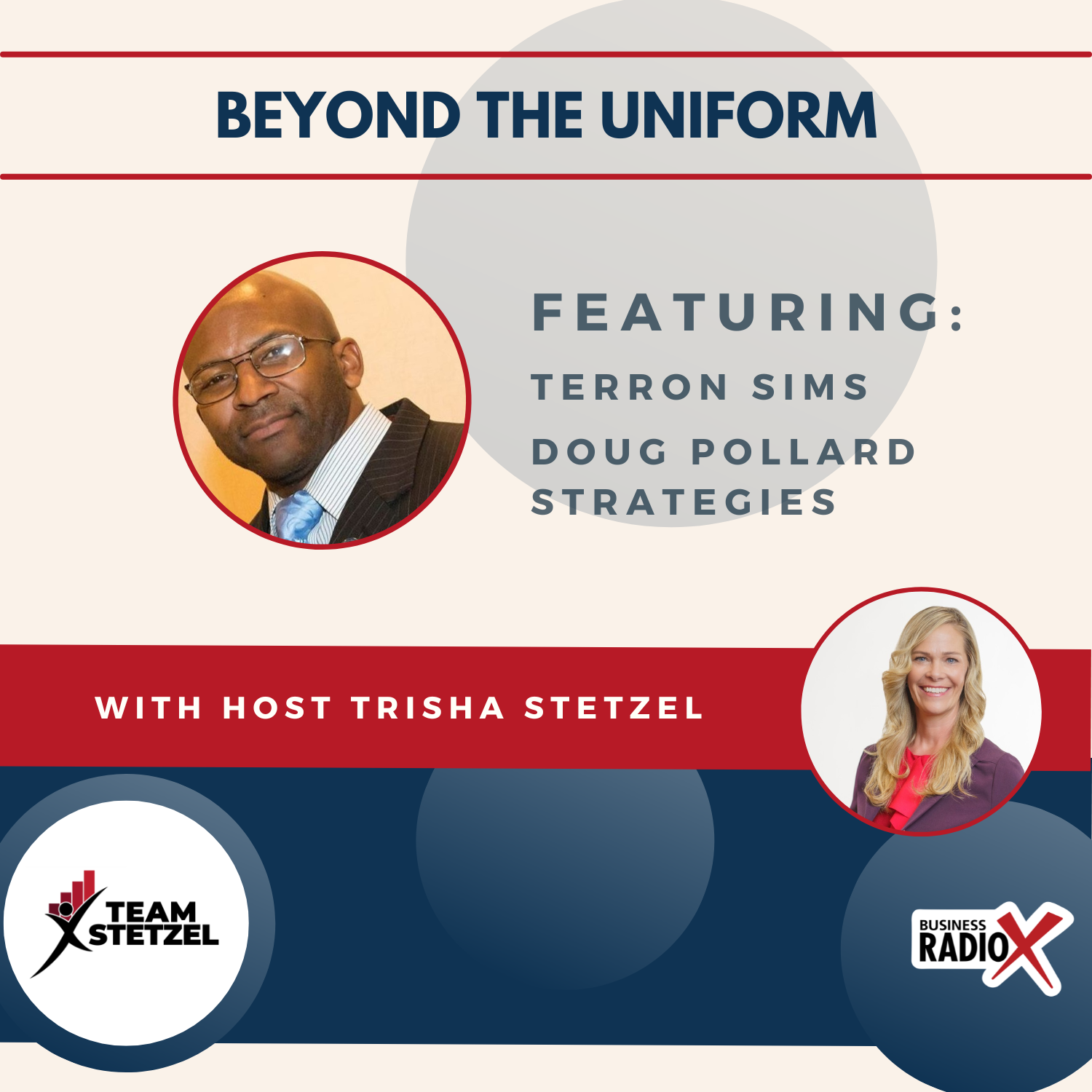

 Terron Sims is a combat veteran, national security expert, and graduate of West Point with over 30 years of leadership across the U.S. Army, Department of Defense, and federal government.
He served in Iraq in 2003, where he helped establish local governance and worked alongside U.S. and international agencies.
Terron has advised U.S. presidential candidates, foreign governments, and senior officials on national security and veterans’ issues. His work includes contributions to major defense initiatives, policy reform, and interagency collaboration.
Today, he continues to serve as a trusted advisor and advocate, bringing strategic insight and deep experience to matters of defense, leadership, and public policy.
LinkedIn:https://www.linkedin.com/in/terron-sims-ii/
 This transcript is machine transcribed by Sonix
TRANSCRIPT
Intro: Broadcasting live from the Business RadioX studios in Houston, Texas. It’s time for Houston Business Radio. Now, here’s your host.
Trisha Stetzel: Hello, Houston. Trisha Stetzel here bringing you another episode of Houston Business Radio. It is my pleasure to introduce my guest today, Terron Sims, the second senior strategy and operations executive at Doug Pollard Strategies, West Point graduate and combat veteran. Across three decades spanning the US Army, DoD and federal arenas, Terron has led in complex mission critical environments from mentoring district governance in Baghdad and partnering with the C, P, and UN to design a $29 million real world training village J at J as a national security subject matter expert. He advises US presidential campaigns and foreign governments. He has collaborated with Congress and state leaders on legislation and helped modernize systems inside the Pentagon, including key work on the DoD’s Sexual Assault Incident Database and streamlining Army installation budgets. Today, Terron’s channels channels that same rigor in the private and nonprofit sectors, chairing the board of Affordable Homes and Communities and advising organizations on strategy, crisis management and operational excellence. He’s a relationship builder who turns pressure into progress. And he’s here to share what resilient leadership really looks like. Terron , welcome to the show.
Terron Sims: Thanks for having me, Trish.
Trisha Stetzel: So much. We have so much to talk about today. Did you guys hear all of that? All those accolades? I know sometimes it’s a little embarrassing for us because we don’t get to hear or see those things about ourselves, right? Uh, but I am so honored to have you on the show today.
Terron Sims: I appreciate you inviting me on.
Trisha Stetzel: Absolutely. So tell us a little bit more about Terron .
Terron Sims: Well, we definitely don’t have enough time for that. But at the time that we do have, um, I’m a fourth generation veteran. Um, I grew up in the military culture. My dad’s a retired Marine Corps colonel. Uh, Mustang. Um, and so, you know, service to the nation and service to others is just something that’s been instilled in me from from day one or really from day zero. Um, and so I carry that with me wherever I go and whatever I do, uh, when people ask, what do you do? Which technically the answer is extremely complex. And really, there is no straight answer. I tell people I do good, good work with and for good people. Um, if you’re a good person and you have something you want to do, even if it doesn’t seem to be within my particular lane or subject matter expertise, um, always stand ready to assist those persons. Um, of course, the flip side goes, if I think you have bad character, you’re not getting any help. I don’t care how much money is involved. Um, it is what it is. Um, so, um, I actually do have family down in Houston. Um, in the Houston area. I, um, being that, um, my home state is Louisiana because my parents and in particular my dad, uh, which is the Creole side of my family, we got, you know, family from Saint Martinville, technically all the way to to Beaumont, Port Arthur. So, um, you can imagine there’s some family that are in Houston. Um, so shout out to them if they actually listen to the show.
Trisha Stetzel: Awesome. I love it. Um, tell us a little bit more about Doug Pollard Strategies.
Terron Sims: So I stood the company up back in 2010, the 2008, initially at the, uh, recommendation, lack of a better word of one of my primary mentors, uh, General Dan Crispin, who was the superintendent of the military academy when I was a cadet. And we’re still very close and in touch. Um, I just, um, finished losing my first, uh, political campaign. Needed something to do. Um, and so I formed it to and kind of just use it as a mechanism of, um, the end of the day, as I tell folks, especially once they get a little older, there’s nothing wrong with doing volunteer work for especially for little kids and old people. But, um, you shouldn’t be doing volunteer work for people who are making money off of your volunteer time. Um, so when I found myself in those positions where, um, people were asking me for advice, that seemed to be pretty easy. Simple answers from my end. But then they’re running off making money off that set advice. I said, well, yeah, let me form this thing. So when when said, you know, said advice is needed, I can at least collect a check. So, um, that was that so fast forwarding to the present? Um, I had recently gotten my Sdvosb certification for those who don’t know the acronym because it is a mouthful service, disabled veteran owned small business, which the SBA, Small Business Administration, the federal level administers in many states just like Texas, also have that designation for um, for veteran owned businesses and other other categories.
Terron Sims: So make sure you utilize that when you’re, uh, attempting to get business at the state and local jurisdictional level. But, um, I got that certification. And using that, though, I haven’t really been I haven’t really used it yet, which isn’t a bad thing. Um, I’ve decided to make the pivot instead of just being, like, a strategic advisor and consultant to actually going the traditional business route. So I’m currently. Um, Tricia knows some of this. I’m currently in the process of acquiring a couple companies. Um, I’m great at parachuting in or in my case, air salting in, because I don’t believe in jumping out of a perfectly good airplane. But I will jump out with a rope out of a helicopter. Um, but I’m the type of person who can jump into a chaotic situation organization and make it function. But for those of you all who are who have actually stood up your own businesses, and I applaud you for that, you you all recognize the, the the the amount of effort, um, and annoying effort at times frustrating effort it takes to actually get the get get your company up off the ground and get that first bit of revenue going so you can prove to the banks, you can get your line of credit and all this other stuff.
Terron Sims: Um, and so I decided to circumvent all that process because I attempted to do that and it was, um, I have no hair, so not much to lose in that category. Um, for those who can’t see this, I’m bald. Um, yeah. So I’m going through that that process now, and it’s been fun. It’s been educational. Um, yeah, it’s been fun. Educational. It’s fun. Frustrating sides of it too. But what’s what’s great about it is, you know, my ability to go in and kind of looking using these companies like they’re seeds, right? Like fruit seeds in this case, like, um, and being able to take a look at them and knowing how I can take that fruit and, and grow it exponentially in a manner in which the owners, the original owners don’t, didn’t or do not have the capacity to do so, whether it’s because they’re just tired, because they’ve been running the company for ten, 20 years, um, or the owners don’t have the resources that I do. Um, and the private and the public sector to grow the companies in the manner in which they would like. So, um. Utilizing maximizing my, my, my utility to again, help them because I’m not pushing them out. They’ll still be a part of the company, still have equity in the company, so that as I grow, they too will grow, which is, um, something that’s very important to me.
Trisha Stetzel: So can you tell me a little bit more about the companies that you like to work with?
Terron Sims: Um, to me it’s more about the people than the companies. So the example I use is, um, if you came to me and said, I have, um, these really cool little girl barrettes and I’ve got the, the numbers to show that we can make a whole lot of money making these barrettes, but I just need a little help, you know, getting to that point. I’ll help you. Now, obviously, again, as I said, I’m bald. I have nothing to do with little girl barrettes. I haven’t twisted or braided a little girl’s head since my little sister was a super little girl, and I’m old now. And so is she. Um, but if the person is again the person of good character, and I think you can make some money off of it, I will help you. Even if it has nothing to do with what I do. Um, but to more logically answer your question, Tricia, for me, it’s, um, digital it companies, uh, because that’s where we are. Um, is it, you know, as I state with folks, you know, politics is like the is like the, uh, modern day priesthood, um, digital.
Terron Sims: It is like electricity now, right? Um, you know, when, when I’m mentoring kids and the whole conversation of, well, what do you want to do? And they’re like it. I was like, well, you got to get more specific than that now because McDonald is it? Yeah. Right. Like it touches everything. Right. So for me it’s the IT solutions because we, um, you know, we live in a world now where people are. Decision makers are looking for actual solutions, and they’re not just looking for good ideas on paper. Um, and at the end of the day, um, if I can’t build it, if I can’t build the solution in my hand, proverbial me, then the only other way of building it is with some type of digital IT platform. So by having companies that are in that space, cybersecurity, um, artificial intelligence, machine learning and so forth, um, then you can pretty much solve any problem unless someone wants open heart surgery. But even then. Right. Um, all this real surgery done with robots, right? So. Right. Right.
Trisha Stetzel: It’s true. Mhm. Absolutely. Why don’t we dive into a little bit of this mission driven leadership. So, um, tell me more about how you’re able to still, um, anchor and operate under pressure based on what you learned just from going to West Point or your leadership in the military.
Terron Sims: Yeah. So it’s interesting because you’d like to think that it was like southern upbringing and black parents and church and the Marine Corps and the Army and West Point. Um, and and it’s all those things and it’s not just one. Right. And then there’s also that innate, um, you know, that that part of you that you can’t necessarily fully control, right? Like, we all have our natural impulses, right? Like, if I’m going to a restaurant and there’s clam chowder on the menu, I’m buying clam chowder, even if I know I shouldn’t eat it, because I’m not going to be able to eat the rest of my meal. Right. Just the opposite of of impulses. Um, and so I, I look at all of that too, because in, um, you know, West Point to me, as I explained to people when, especially when they hear negative stories about West Point graduates or, you know, senior officers who graduate from West Point, why do they do that? And it’s like a West Point. Education is like money in the sense of we all heard the phrase along the lines of money accentuates who you are, right? If you’re a good person, then you win the lottery. You know that money allows you to to exacerbate the amount of good you can do to the world.
Terron Sims: But at the same token, if you’re a bad person, you win the lottery. It’s over. Right? It’s bad news. Whatever. Whatever. You don’t have to get into that. We get it. And I look at a West Point degree, West Point education in the same manner, right? I mean, there’s a foundational things that West Point teaches us, but we’re 18 years old. We’ve learned from our parents, we’ve learned from whatever environment we came from, um, whatever church we went to or synagogue whatever. Um, and then we go to West Point. And so for me, it’s a combination of all those things. Um, the selfless service piece, um, you know, and again, maybe it began with, with my parents and maybe then it was further than church, so that when I got to West Point and, you know, when we’re taught the honor code of, you know, cadet, not lie, cheat or steal nor tolerate those who do, it’s like, oh, okay, that’s real. Right? Or, you know, when when you’re, uh, doing your first inspection and your, your, your sock drawer isn’t aligned properly in your platoon, you’re like, oh, did you just kill you just killed someone in your platoon. And you think that’s silly, but then you go to war and then you recognize, oh, like, I really have to have all my ducks in a row.
Terron Sims: I have to make sure my soldiers, my NCOs, all have the proper equipment and that the equipment’s kept kept up properly. Because if it’s not, then, yeah, we might actually die. Right. Um, and so, you know, I take my my education at West Point probably about as seriously as I do most other things, probably even more so than my faith in God. And only because God doesn’t mean me to fight his battles for him because he’s God. But, um, my school does, and it’s. I because Tricia and I, you and I had this conversation. Uh, you know, when we first met. Where it’s important to me for people who either have graduated from high school or have served worn the uniform to truly understand that those positive values that you were taught, because we all were taught the same values, um, even if you went to City Hall, you still had to come back and learn what you missed. Um, and that we take those values and apply them to the real world. And just because the real world has its own rules. Um, and sometimes those rules contradict the rules that we learned while in service. Doesn’t mean that we should not follow those rules. Um, because if the rules we that we learn and applied while we were in service in the Army, in the Marine Corps, whichever branch you served in, in whatever school you went to, right.
Terron Sims: If they were good, then to lead and achieve unity success, then they should be good out in the civilian world also and in your business, right? You shouldn’t have to be making unnecessary sacrifices towards your personnel and your staff, and to your mission solely because you want you care about making the bottom line, or you’re trying to make, um, an even bigger profit than you were the year before, or, um, thinking it’s okay to, to, uh, you know, not treat someone properly solely because you believe that you saw in the civilian world that and that’s what the other person did to make their money. You don’t know what they’re dealing with. They may not be sleeping anymore. They may. You know that person who made all that money stabbing, stabbing people in the back, you know, might be compensating with other things, um, because they know that they that they did the unethical, immoral or just the wrong thing. So sorry, it’s a roundabout answer on on my school, but, um, yeah, I mean, you see the background for those. You can see I love my. Yeah, I’ll be up there next week, but.
Trisha Stetzel: All right. Yeah. And for those of you who are not watching us on video, you should. So hop over to the YouTube channel and, uh, check out the video of Terron and I having this conversation. So I know people are already interested in connecting with you. What is the best way for folks to reach out or connect with you?
Terron Sims: Terron , there are two ways, uh, my company website and my personal website. Uh w-w-w-what strategies or com. Either way, um, that’ll get to me. I’m pretty good at responding, especially on a weekday. Don’t email me on the weekend. Um, but on weekdays, if you shoot me a note, I’m pretty, pretty diligent about getting back to people.
Trisha Stetzel: Fantastic. And, uh, just for clarity, on the website, it’s t e r r o n s I’m s.com. That’s how you guys can find his personal website. And Doug Pollard Strategies is the company website. Okay, Terron , you have not only, uh, with all of your military background and experience, but, uh, DoD and even post, uh, military service. You’ve been involved in big institutions or, um, groups, right? Like the affordable homes and communities like, uh, the DoD sexual assault incident database, like JR. So how did those things that you did, those institutions or those groups and that the space that you were working in on those larger projects, how did that, um, actually create or give you even more skills when it comes to leadership?
Terron Sims: Uh, good question. Um. Affordable Homes and Communities is unique because it’s it’s an affordable housing development organization corporation. But it’s a nonprofit. But it’s also but it’s one of those nonprofits that secretly has $1 billion worth of assets, um, is Houston based. So imagine, um, someone owning $1 billion worth of property in the greater Houston area, right? That’s I mean, that’s really the equivalent of of what we’re doing. And so we, um, we proudly waved the like the nonprofit banner, um, in regards to not only developing, um, homes and communities for, for, for, for, uh, for residents, but also providing the wraparound services and the piece that I’m most proud of, of what brought me into the organization, um, officially back in 2019 is their their youth in, uh, teen mentoring and tutoring programs. Uh, because for us, it isn’t just about ensuring that people, um, who are on the low income side of, of things, uh, have somewhere to live, but but that their children have the ability to climb above their parents station. Um, and so ensuring that those kids, um, that that their, that their children are, um, are, are getting tutored or, and are getting access to colleges and universities and are getting mentors to help them go down that career path. Um, and so that that’s been great. Um, to be honest with you. Um, it’s it’s the only once I left the hill, uh, back in, I forget, 2 or 3 years ago, it’s the only thing I went back to from a volunteer perspective. Um, in Arlington County in Virginia because, well, one, it is a great bullet point. Uh, but the mission itself, two, um, is extremely selfish, like where I tutor with in one of our community centers. None of the other tutors know I chair the board. I’m just the black guy who goes in helping kids with math and drinks coffee all night. Um. There’s that. Um.
Trisha Stetzel: And we have to learn to run these nonprofits as businesses. I mean, that’s the bottom line. If we’re not running them like a business, then we don’t have any money for the actual cause in these nonprofits. Right. Bottom line.
Terron Sims: Correct. And we hit a crisis that. I’d love to change that. Yeah.
Trisha Stetzel: Yeah, yeah. That’s right. Absolutely I totally agree. You’ve mentioned mentoring several times. You talked about it at the top of the hour or the top of our conversation around you being mentored. You also mentor and show up for these kids and families. Um, how how has mentoring played a role in you being the leader who you are today?
Speaker4: You know, the.
Terron Sims: You know, I, I, I’m glad you asked that question because I entered a role I was so I was like, well, I’ll just share this role. I was, uh, Sheila Jackson Lee’s chief of staff, um, for a short period. Um, and it’s been a while since I’d been in a role where I actually was in charge of like direct charge of of folks. Right. So I had the staff and I had our interns, um, both at the Houston office and in, um, the DC office. Uh, but folks on the DC office, we had many more interns than we had actual staff. And these interns were, you know, college kids, they were there, um, or just had graduated from college or something like that. And, um, the temperament in the office was such to where, um, my mentorship to them, to them just pivoted, um, their motivation and inspiration to, to do the work. Um, and I didn’t really realize it until I was getting ready to leave. And I had, you know, closing, uh, counseling sessions with, with, with each of them. And they shared with me, um, how much I really changed the energy in the office. Um, and I keep some every every blue moon.
Terron Sims: I’ll. I’ll open up one of the cards, um, when I need a pick me up. Um, just to, you know, because I don’t like pats on the back. Um, so, you know, just being able to read that my leadership was actually, um, relevant to young person’s life, um, means a lot. You know, when I sit on panels and people ask me, oh, you know, what’s your greatest accomplishment? This and that? Uh, I always go back to the pride I have in the soldiers I led who ended up doing great things in the army after I had left the army. Um, you know, I have kids who I say kids, but, you know, kids who retired as sergeant majors and first sergeants, who I got straight out of basic training when I still keep in touch with. So. So for me, it’s it’s about that intangible impact that the second, third, fourth degree level effect, um, positivity that you can have on someone because you don’t know. You know what? Bit of kindness or candor or compassion that you can share with someone at a particular moment that either changes their trajectory or leads them towards, um, towards quote unquote greatness.
Trisha Stetzel: Yeah, absolutely. Well, we we don’t know what baggage they bring to the table, right? We don’t always know what they’ve been through and what will resonate with them and how we can truly be good leaders for them. All right. As we get to the back, back end of our conversation, I’ve got one last question for you. Um, you’ve led in a lot of places in combat, in the government and even in the boardroom, as we just talked about. So if you could leave our listeners with one principle for leading with integrity when the stakes are high, what would it be?
Terron Sims: Oh, wow. Um, it’s never about you. Um, it’s always about the people you serve or the people who really have to do the work. Um, whenever I’ve written policy, we don’t have time for the whole story. But I remember explaining to a to a to a marine Corps squad leader two, many years ago, um, we were over at the uh, weapons training Battalion at Quantico, and he wanted to know why me and my colleagues were there, more colorful language he used. But I said, because it’s important for me that whatever policy that I’m either writing or or, um, or advising in the writing of and the people who are sitting at those tables making decisions that affect your life and the life of my little brother and life of my buddies, that that y’all’s welfare is on the front of their minds because they have to understand that you’re the ones who are having to execute these missions. Um, and so for me, that’s what’s always most important is thinking about the people who are affected by what I have to do because I’m always going to be okay. Um, I joke with friends. God’s got me so I don’t have to worry about, um, taking care of myself. So as long as you all take care of who you have to take care of. Um, like we say in the army, take care of your soldiers. Everything. Everything else takes care of itself.
Trisha Stetzel: Yeah, that’s true everywhere. And if we could all embrace that. Right, people first, uh, and making sure that they have what they need or any decisions that we’re making, we take them into consideration. That’s how we get by in in big organizations, right? Is include them in the decision making. Love that. Thank you so much for being with me today. I really appreciate your time.
Terron Sims: Oh, thanks for having me, Tricia. Thank you.
Trisha Stetzel: Yeah, absolutely. All right. One more time. How can people find you?
Terron Sims: Uh, my two websites, company, Doug Pollard Strategies. Com and then the personal Sims comm.
Trisha Stetzel: Perfect. You guys know I’ll put that in the show notes as well. So if you’re sitting in front of your computer, you can point and click and connect directly with Terron . If you’re in your car, please wait until you get home to point and click on anything. Uh, all right, you guys, that’s all the time we have for today. Terron , thank you so much again for your time. If you guys found value in this conversation we had today, please share it with a fellow entrepreneur, a veteran or a Houston leader ready to grow. And as always, be sure to rate and review the show. It helps us reach more bold business minds just like yours and your business. Your leadership and your legacy are built one intentional step at a time. So stay inspired, stay focused, and keep building the business and the life you deserve.














