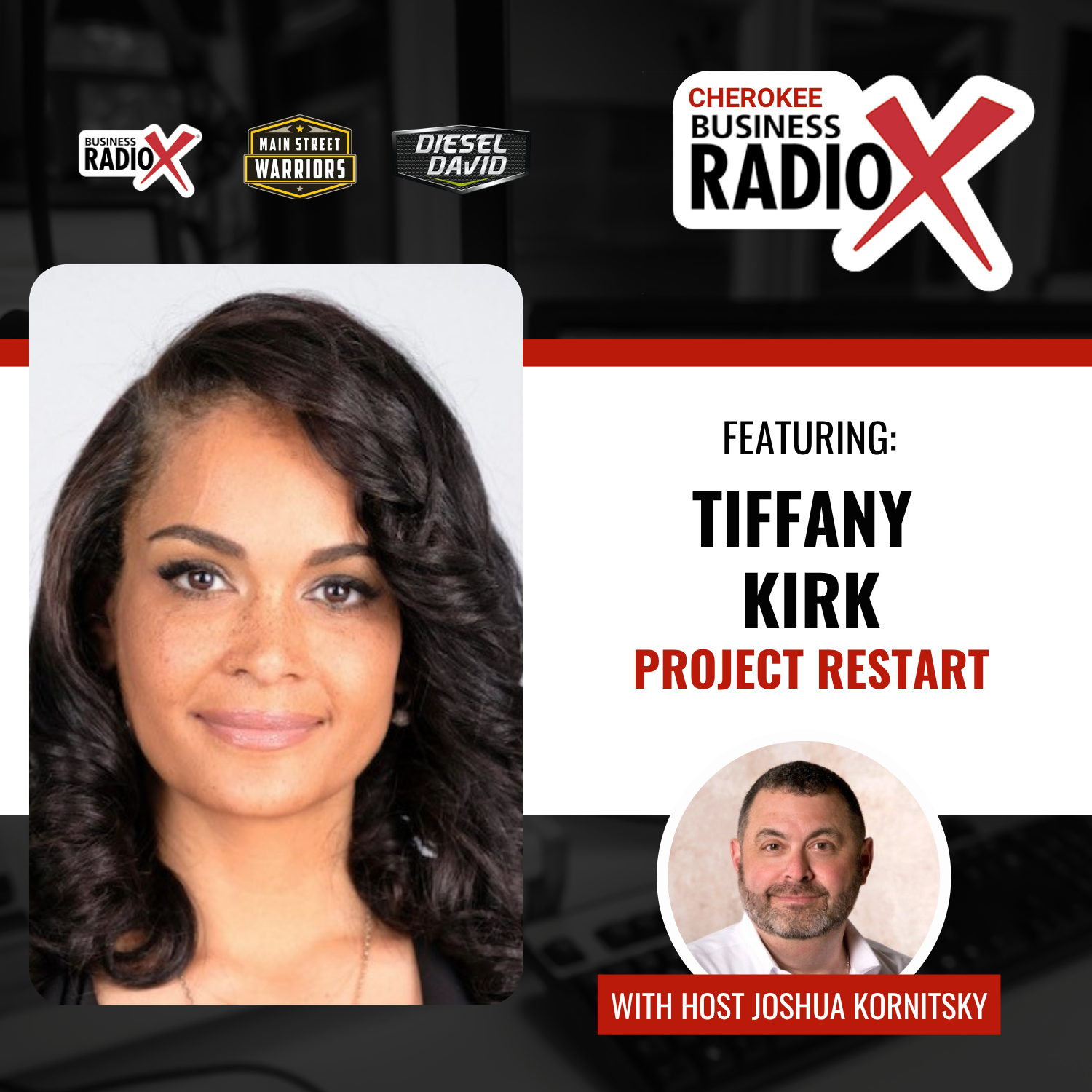


Brought to you by Diesel David and Main Street Warriors

In this episode of Cherokee Business Radio, Joshua Kornitsky interviews Tiffany Kirk, founder of Project Restart, a nonprofit helping formerly incarcerated individuals reintegrate into society. Tiffany shares her personal journey, including her brother’s decades-long justice impact, which inspired her work. She explains Project Restart’s 12-week program focusing on education, employment, and entrepreneurship, serving over 340 individuals since 2020. Tiffany addresses misconceptions about justice-impacted people, highlights racial disparities in incarceration, and discusses the organization’s expansion into correctional facilities and a new digital platform.

 Tiffany Kirk is a native of St. Paul, MN, where she completed her BA in Business Administration and earned her Elementary Teaching License at the University of St. Thomas.
Tiffany serves on the board of directors of the National Incarceration Association (NIA), on the Advisory Board of Center for Employment Opportunities (CEO) and is the immediate past board chair of Atlanta Neighborhood Development Partnership (ANDP), one of the largest affordable housing community development financial institutions in the Southeast.
Tiffany began her career as an Elementary School Teacher. From 2014-2022, she was the Community Development Coordinator for Pinnacle Financial Partners and Regions Bank and was responsible for overseeing Community Reinvestment Act (CRA) activities which aim to increase wealth and access to mainstream banking products and services for low-to-moderate income individuals and communities.
Tiffany is founder and Co-Director of Project Restart, a collaborative 501c3 nonprofit that provides life skills training, financial education, entrepreneurship training, mentorship and capital to program graduates.
The mission of Project Restart is to reduce recidivism and increase success outcomes among system-impacted individuals through connecting members with education, employment and entrepreneurship training. She has provided financial education, general education, workforce readiness and entrepreneurship training to incarcerated individuals and those reentering their communities from incarceration since 2006.
Connect with Tiffany on LinkedIn and follow Project Restart on LinkedIn, Instagram and Facebook.
Episode Highlights
- Personal journey of Tiffanyand her motivations for founding Project Restart.
- Challenges faced by individuals impacted by the justice system.
- The importance of education, employment, and entrepreneurship in reintegration.
- Structure and goals of Project Restart’s 12-week educational program.
- Misconceptions about justice-impacted individuals and their reintegration.
- The impact of systemic issues, including racial disparities in incarceration rates.
- Success stories of program participants and their contributions to the community.
- The significance of voluntary participation in rehabilitation programs.
- Opportunities for community involvement and support for Project Restart.
 This transcript is machine transcribed by Sonix.
TRANSCRIPT
Intro: Broadcasting live from the Business RadioX studios in Woodstock, Georgia. It’s time for Cherokee Business Radio. Now, here’s your host.
Joshua Kornitsky: Welcome back to Cherokee Business Radio. I’m your host, Joshua Kornitsky professional EOS implementer. And I’ve got a wonderful guest that I can’t wait to talk to. But before I do, I just want to remind everybody that today’s episode is brought to you in part by the Community Partner Program, the Business RadioX Main Street Warriors defending capitalism, promoting small business, and supporting our local community. For more information, please go to Mainstreet warriors.org. And a special note of thanks to our title sponsor for the Cherokee chapter of Main Street Warriors diesel David, Inc.. Please go check them out at diesel. David.com. So as I said, I’ve got a really, uh, just incredible guest here today. I want to introduce everyone to Tiffany Kirk. Tiffany is an entrepreneur, a community leader, and a nonprofit executive with a long history of working at the intersection of community development, economic opportunity, and social impact. After spending nearly a decade in community development with Regions Bank, she where she built a deep relationship across Atlanta’s nonprofit and funding communities. She is also the founder of Project Restart, an organization dedicated to helping individuals successfully transition back into their communities after incarceration and creating pathways for long term stability and success. Welcome, Tiffany. Thank you so much for giving us some of your time today.
Tiffany Kirk: Thank you so much. I’m happy to be here.
Joshua Kornitsky: Um, I always like to begin at the beginning. Tell us a little bit about your journey and what led to the creation of Project Restart and and maybe even why it matters to you.
Tiffany Kirk: Okay. Well, I’m a Saint Paul, Minnesota native, so I’m a Midwesterner that grew up in an era where I think most urban black communities were going through a substantial change. And that was, you know, the the 80s and 90s, you know, anywhere USA. And, um, you know, I lived in a community that was riddled with the same types of social issues that any other Detroit or Chicago, LA we’re going through. And that was, you know, gangs and drugs. And, um, that was on my block and many surrounding blocks in the community I came from. And, you know, I watched my brother in so many other young black men take this route of, um, trying to figure out where they fit in. And, you know, everybody wants to belong to something. And I think, you know, watching, watching my brother who was not an athlete and was somewhat socially awkward. Um, just take this path of being cool and being cool meant dressing well. Being cool meant fitting in with the people who were popular and in our community. It was it was the drug dealers.
Joshua Kornitsky: Which is no different than any community anywhere. Kids growing up want to fit in, right? I mean, it doesn’t matter what fitting in is. Looks different in different communities, but that’s not an unusual drive.
Tiffany Kirk: It’s not, it’s not. And I learned, you know, my thing was, I was I was a nerd, I was studious and so I liked I liked the programs, you know, if somebody came in my school offering up a summer camp that sounded interesting or some type of an academic or Girl Scouts, I was a part of all those things. I was I was in sports and as a girl, I think it’s different to be in sports and not be great because you can fail and just have fun with your friends. But when you’re a guy and you’re not good, you get, you know, you get talked about. And I saw that happen to my brother going to the gym and him shooting basketballs and his friends laughing, you know, at the at the neighborhood rec center. And so when you know, self esteem, if you think of Maslow’s hierarchy of needs, self esteem is up there at the top very much. And, and I think that’s a driver for a lot of us and for, for me, it just didn’t matter. I just wanted to have fun. I wanted to be with my friends. And I think for guys, that pressure is just different.
Joshua Kornitsky: And I think it’s different by the individual as well, right? Because it self esteem means something different to everybody. And it’s I believe it’s somewhat of an unconscious driver. Right? Right. I mean, yes, we all have our self-worth and our self-image, but that peer pressure, particularly at a younger age, you’re not really keenly aware of it as peer pressure. But that’s that is that desire to be respected, among others.
Tiffany Kirk: Exactly. And then you’ve got that also, you know, when you are I went through bullying. I saw my brother go through it as well. And there’s another desire to feel protected. And I think that.
Joshua Kornitsky: Safe.
Tiffany Kirk: Safe safety, you know, all of us want to belong. All of us want to feel safe. And I think that’s also a draw to a certain lifestyle for people that come from an inner city that don’t have a father in the household. Okay. This is part of those cycles that that I saw continuing. And when I think about all of the things that shaped me into who I am now and what I represent, these were the things that I saw and that I knew. I’m like, there’s a better way. There’s a better route. And I understood early that, you know, one interception of, of, um, you know, a meaningful conversation, uh, a meaningful connection for somebody at a pivotal stage in their life could be a game changer.
Joshua Kornitsky: 100%.
Tiffany Kirk: Yeah. So it just, and I’m proof of that.
Joshua Kornitsky: You know, that one teacher, that one church leader, that one community person who, who puts their hand on your shoulder at the right time?
Tiffany Kirk: Yeah.
Joshua Kornitsky: Um, so, so I gather from where we started that your brother was just as impacted.
Tiffany Kirk: Yes, he was, he was. And I saw from a you know, it was a first offense that led to several years, three years incarcerated, but over 20 years of community supervision. And that’s where I think a lot of people get caught up. And he’s still, to this day, working to have his record expunged. And he was told he was not a good candidate for a first time drug offense. And he is now 51 years old. And this was when he was in his early 20s that this offense took place.
Joshua Kornitsky: Wow.
Tiffany Kirk: And so this also was something that was, you know, eye opening for me in understanding that this, you know, being incarcerated doesn’t end when you walk outside the prison doors. It continues. And, um, the vast majority of people, I think 1 in 17 people in Georgia are under community supervision or incarcerated. And that’s a lot of people.
Joshua Kornitsky: When you say it continues, and I understand you mean under supervision.
Tiffany Kirk: Yes.
Joshua Kornitsky: But there’s there’s a mentality aspect as well, isn’t there?
Tiffany Kirk: Yes.
Joshua Kornitsky: That that for some it it stays with them. And the impact of their incarceration probably has a very long shadow.
Tiffany Kirk: Yeah, absolutely. It’s, you know, what we call institutionalized because you’ve you’ve been stripped of your human dignity from the time you walk through those doors or see the judge, even for the first time, or sit in that jail cell for ten years. Some people I’ve just heard at Fulton County Jail before seeing a judge and, you know, being given a sentence or being released. Um, there’s a certain dehumanization process that takes place. And I heard an alumni from another program I was the leader of say, you know, when you go through the military, it’s similar. You know, you’re kind of stripped down and, uh, you know, certain things are, you know, taken away from you, but you’re also built back up in a way. Right? And that doesn’t happen in incarceration.
Joshua Kornitsky: They just strip it.
Tiffany Kirk: Down, strip it down, but it’s never rebuilt. And so when you return home, I heard someone say also, you know, when I came home going in the store, I felt like everybody knew, like I was still wearing that uniform, like everybody knew. And I was just trying to blend in, but felt that the eyes were on me because I had this shameful record, you know, and so there’s a lot of mental, um, rehabilitation that needs to take place because it’s not being offered inside for the vast majority of people, you’ve got to be a pretty severe case of mental illness to go to any of the rehabilitation centers. And even in those cases, so many people are overlooked.
Joshua Kornitsky: Our just broadly speaking, our justice system is not well known for being a place to improve other than certain skills that we really aren’t looking to improve.
Tiffany Kirk: Exactly.
Joshua Kornitsky: How to. It’s not a great mental health resource.
Tiffany Kirk: It’s not, it’s not it’s it’s, it’s very tough for, for somebody to get the care that they need or to make the changes necessary to come home prepared to be self-sufficient.
Joshua Kornitsky: So it sounds like this is pretty near and dear to your heart for for very clear reasons. So what led what what is Project Restart and what led to its creation? What was your you’ve given us sort of your driver, but what, what made you put it into motion?
Tiffany Kirk: Yeah. I think being a teacher let me back up to the beginning of my career. I was a I was a teen mom. I had my son in 11th grade. And I could have been I could have been a statistic in this statistic. A program came into my high school and taught me all of the pathways to success how to complete a Fafsa. Never knew what it was, financial aid, how to get scholarships, took us to a college every Saturday and introduced us to CEOs and executives of fortune 500 companies in Minnesota. You know, Delta Airlines, Northwest Airlines at the time, three M, you know, and it was it was eye opening. That was, I think, the spark that started the drive in me to want to help others. Okay. And because it was a group of young black professionals that did this as a voluntary basis program.
Joshua Kornitsky: So they modeled the behavior that you’re now modeling.
Tiffany Kirk: Exactly.
Joshua Kornitsky: That’s fantastic.
Tiffany Kirk: And I’ll never, you know, I’ll never forget Infinity Systems was the name of that program. So that’s what sparked that initial interest. And I stayed on through my business degree and enrolled in a teaching licensure program, because at the time, there was a shortage of minority teachers in the Twin Cities. And so it was called the CU program Collaborative Urban Educators. And they would pay us $15,000 to get a teaching license. I thought, okay, I’ve already been coming to college and I’m used to it. Sure. At that time, I was on welfare. You know, section eight, I, I was low income. So 15000 was great for me. Absolutely. So that teaching started, you know, I was also a teaching assistant for my entire undergrad as a part of a scholarship requirement. This is how God works. You know, he puts you in these positions And these are mandates and requirements. And, you know, you, you, you connect with these things and you don’t realize what it’s leading you to. And it led me to realizing I love teaching. So I taught elementary school for the first four years of my career.
Joshua Kornitsky: And you are a saint, you know.
Tiffany Kirk: You know, as a 20 something year old teaching fifth graders for my first year, I’m like, oh my gosh, if I can do this, I can do anything.
Joshua Kornitsky: Yeah, pretty.
Tiffany Kirk: Much, you know, I learned curriculum. You know, I learned what curriculum was. I learned how to write a lesson plan. I learned how to test for background knowledge and test that someone really understood the concept that I taught at an early stage in my life. And fast forward got into banking after teaching because I was laid off because of budget cuts. They lose a lot of young talent in teaching because of seniority in buildings. So I left because there wasn’t a position available at the time. And and I thought, I want to teach, but I also want to use this business degree I have and found a teaching, um, well, an opening for someone to teach at a credit union.
Joshua Kornitsky: Okay.
Tiffany Kirk: To teach financial education. So this is where this is where the phase two starts. You know, where I’m starting to I created the curriculum and I started taking it out and cultivated 250 partnerships throughout my years in that credit union industry. And one of them was a rehabilitative program. And this is God again, working, putting these things in my pathway that end up becoming something further. Um, and someone audited that program and said, you’d be great at this men’s reentry program as their financial education teacher, because you teach at such a basic level, you’re not talking about stocks and bonds and retirement.
Joshua Kornitsky: You’re just talking about a savings account, savings account.
Tiffany Kirk: You know how to get out of check systems if you messed up in the past. And so that that led to me working at a men’s reentry program, moonlighting while working at the credit union with permission to be their GED teacher, their their financial editor teacher and their computer teacher. And so I taught Amanda Reed, you know, that was, that was amazing. Um, and then I worked at a women’s prison for an 18 month contract teaching financial aid came to Georgia and realized I wanted to stay in this space. So I started, um, with regions Bank as their financial education manager and then started taking the curriculum inside of a correctional facility. Metro reentry facility.
Joshua Kornitsky: Okay.
Tiffany Kirk: Project restart came about because I realized they need more than financial aid. There’s there, there are people coming with a business plan or want to get their CDL and don’t know what the steps are that they need to take to get it. And so I created the 12 week program. Well, I created a youth program first called the Lifers Life Restarted Program, and I worked with Fulton County Juvenile Courts. And then, um, I’ll be honest, the younger demographic, typically you’ve got to push the information to because they’re mandated to be there on a Saturday. It was different.
Joshua Kornitsky: Nobody wants to go to school on Saturday.
Tiffany Kirk: And then the adults were pulling it from me. It made it that much easier.
Joshua Kornitsky: Well, when you have a little perspective, suddenly you realize this information doesn’t come along every day. Yeah, right. So as an adult, you’re like, yeah, let’s spend a few minutes on that.
Tiffany Kirk: And your chances are more limited. As a younger person, you think, I got a chance after I got years?
Joshua Kornitsky: Oh, sure.
Tiffany Kirk: Right.
Joshua Kornitsky: You know, that’s that’s a universal truth. When you’re young, you live forever. Exactly. And and you believe that that today’s opportunities will be there tomorrow. And as we get older, we realize there are fewer of those.
Tiffany Kirk: Fewer and far.
Joshua Kornitsky: Between. So who does project restart, serve and and what what are you delivering? It sounds like it’s education based.
Tiffany Kirk: It is. So it is education based and we focus on the three E’s. That makes it really simple. It’s education and you know, training transitions, employment transitions and entrepreneurship.
Joshua Kornitsky: Okay.
Tiffany Kirk: Those are the three E’s. You know, we’re not advocacy, we’re not legislative. You know, we’re not pushing. We will, we will advocate for certain legislation, but we’re not that’s not our you’re.
Joshua Kornitsky: Not you’re not a lobbying group.
Tiffany Kirk: We’re not a lobbying group. Um, and so the three E’s, we take people, we work with people who have been incarcerated in the past. Our original programs were really just post release. And so every summer we were just hosting a 12 week curriculum. Um, that starts with self-exploration. We feel like you’ve got to understand yourself before you can plug into the system, you know? And I think so many people didn’t get that opportunity to examine who they were. What is my learning style? How do I learn best? What is my social style? You know, what are my aptitudes? How do I take this value system I have and make something meaningful out of it? That’s not just going to be a one and done or a just, you know, shot in the dark, but it’s going to really be helpful. It’s going to help my me to distinguish my identity so that I can find the pathway that’s going to stick.
Joshua Kornitsky: Well. And if I may, I’d like to ask a clarifying question. Project restart is, is a voluntary organization. So any, any of your students or students who have opted to be Yes. They’re correct. It’s absolutely a mandated program. So you get a very different thing when people show up because they want to learn versus like we just talked about when you’re told you have to. Yes. It very rarely sticks anyway.
Tiffany Kirk: Yes.
Joshua Kornitsky: So so the folks that you’re working with, both men and women.
Tiffany Kirk: Both men and women for the community version in 2026 for the first time, we’re also inside of two male facilities. Okay. So that same facility I started teaching financial education at through regions Bank is a facility that Project Restart is inside of. And so those are all males, but they elect to be in that class as well. They’re not required to be there. Right. So you’re right. None of the participants in our program have been court ordered or required. Do they know that it can enhance their their ability to potentially get certain occupational licensing or maybe come up for parole earlier? Absolutely. Um, but they’re not required to be there.
Joshua Kornitsky: Well, but that also I, at least in theory, would mean that those attending are there to get the most from it that they can.
Tiffany Kirk: Yes.
Joshua Kornitsky: So is it you had mentioned earlier, is it still a 12 week program?
Tiffany Kirk: Yes. So inside we’ve shortened it because we are in this first year and we’re piloting what this looks like inside. We we were funded, we were written into a Bureau of Justice grant. That’s a second Chance Act grant. And that grant requires that we are making improvements for education and employment. So Project Restart traditionally has another E, which is entrepreneurship. So we we don’t provide entrepreneurship training inside, although through the surveys that we’ve collected, they want more of that. And so we made for the next round incorporate some entrepreneurship.
Joshua Kornitsky: I’ll share some of what I know with you and see if I can help in some way. Yeah.
Tiffany Kirk: Um, so we do it for the outside and they even pitch for capital at the end towards their next steps from Project Restart. That’s the majority of where our funding goes. Um, but, but inside it is education and employment that we’re focused on and helping them to identify jobs. We’ve got three people in the last three months that we’ve been able to place in one in a culinary role, running a kitchen. From his past experience, that’s what he had experience in another with a moving company. And we’ve got another now that’s looking at for a battery company moving into that position. So cultivating employer relationships has become extremely important in.
Joshua Kornitsky: This space more.
Tiffany Kirk: Than anything else.
Joshua Kornitsky: I can only imagine. And do you now. So how old is is Project Restart as of now six years.
Tiffany Kirk: So we started in 2020 and before Covid hit February was when we put this collaborative effort together and.
Joshua Kornitsky: And.
Tiffany Kirk: Then March.
Joshua Kornitsky: And then March, everything changed.
Tiffany Kirk: March hit. We thought we were going to have an in-person program and, you know, and then George Floyd hit. And that really put the fire under. Sure. And that’s my home state. And it just was like, this is the right time to do this. And so it’s now six years old this summer. Um, so we started in 2020.
Joshua Kornitsky: Do you have any idea the number of folks that you that you have served? Do you, do you have any success stories without giving names out of privacy that that you can share with us?
Tiffany Kirk: Yeah, we’ve had, we’ve reached over 340 individuals at our last count. And that’s through also community events. We do an annual second chance summit in partnership partnership with the Atlanta Mayor’s Office of Violence Reduction and a radio station, magic 107.5. So we’ve been able to do breakout sessions. Um, 17 people opened accounts with regions Bank at the last year’s summit. And, you know, we’ve got some other success outcomes through through those types of events. But, um, we just hit the 100 mark in terms of alumni who have graduated from the, you know, the curriculum based program. Awesome. Um, and, you know, some of the success stories are taking someone that had a culinary business, you know, operating out of their home and having a few clients here or there to when they pitch for capital from us and get more equipment and can up their marketing efforts. Now, having a full scale, you know, culinary catering business where they’re taking on large contracts.
Joshua Kornitsky: And they’ve returned to their community in good standing and they’re having a positive impact.
Tiffany Kirk: Yeah. Positive impact. So that’s one and then another. I mean, she’s taking off in the advocacy space. She came to the program after being out after ten years. Um, inside came home and just had this fire in her, um, after being wrongfully, you know, convicted of a crime that she, you know, her boyfriend committed and she was able to help, you know, there was a, some legislation passed where, you know, individuals can only bail out up to three people per year from, from jail. And yes, and she was able to get a waiver in there for nonprofit organizations because that was the nature of hers. Right. And, you know, she’s now moving to, um, advocate for people with backgrounds to become a protected class. And in Minnesota, it was passed. So we got people that are in all these different spaces becoming leaders, and several are now back on our team working with us.
Joshua Kornitsky: That’s fantastic because they understand the value of of what the service that you’re providing to the, to their community is.
Tiffany Kirk: Yeah. They’ve, they’ve got a desire to, to help and lift others as they rise more than any other demographic I’ve ever, you know, been in front of or had the honor to teach and instruct.
Joshua Kornitsky: You clearly take this with a great deal of reverence. But I want to ask you what what I think is a hard question. And and, uh, we can talk about it as long as you like, but it’s a very open ended question. What are the misconceptions that people have about working with justice impacted returning citizens?
Tiffany Kirk: That is dangerous. First and foremost, I want to kill that myth. Um, I just gave you the numbers of how long or the years that I’ve been in this space, which is 20 years. I started in zero six in the first correctional facility doing financial education. And I’ve never felt uncomfortable. I’ve never been disrespected as a female, and at that time of.
Joshua Kornitsky: Walking into a place, one would make the assumption.
Tiffany Kirk: Yeah. That it’s dangerous. You must feel that. You know what? If these guys stalk you? What if I’ve never encountered that? Whereas I have encountered that from the general public in my.
Joshua Kornitsky: I’m sorry to.
Tiffany Kirk: Believe it or not.
Joshua Kornitsky: You know, I’m sorry to hear that.
Tiffany Kirk: You know, I think that’s a misconception. I mean, the people that are in the classrooms inside are some of the most protective of somebody coming in to share their time and knowledge with them. And they’re not going to even allow someone to consider disrespecting somebody that comes into those facilities. So I think that the media has painted a picture of these carceral systems to be very dangerous, that they’re stabbings every day and there is there is danger. We know that there are, you know, understaffed facilities everywhere. Sure. And danger is real. Um, but but I’ve never experienced that. And I think the other misconception is that by us helping somebody. We are putting our communities in danger. Why are we helping these individuals? You know, we should just have locked them up and thrown away the key. Well, I’ve shared with you, 96% of people are coming home, right? They are returning. You know, 4% will stay inside for life or pass away while incarcerated.
Joshua Kornitsky: And these are husbands and wives and brothers and sisters and mothers and fathers. I mean, these are.
Tiffany Kirk: Future fathers, future leaders, you know, future, um, mothers, future, future politicians, you know, we want people that have a lived experience in a certain place to be the decision makers on how these future, um, conditions are handled.
Joshua Kornitsky: I have to imagine that that just as a concept, the idea of having someone who’s been incarcerated, having an impact into the treatment of the incarcerated is a sadly revolutionary idea that it shouldn’t be. Right, right. Because you would expect that there’d be some level of consultation. But instead we have, uh, experts who who know best, who have never been within right.
Tiffany Kirk: Or those who are. I just had this question asked to me of Miss Tiffany. Why is your program the only one so far that has really taught us the real life skills we need before we go home? And I got to really walk a delicate line because I have to be a partner and a partner of the Department of Corrections. But the plain and simple response is corrections is corrections, and community is community, right? And that’s just the truth. And, um, so the lens that, that we provide, what we provide from is very different. And just like what you said with someone with a lived experience, someone that is teaching another person of how to navigate this new landscape of coming home is going to be much more, um, believable first and foremost, because they’ve been through it.
Joshua Kornitsky: It’s credibility, it’s credibility.
Tiffany Kirk: It’s, and it’s true. It’s true. Lived results or, you know, solutions and systems that they’ve built for themselves and others. And so it just makes sense. And there’s a certain certification called a peer support specialist or peer forensic support specialist, um, where you go through a certification process to become someone with a lived experience that now certified to train and work with others. So we’ve got two on our staff now that are helping others in the same conditions.
Joshua Kornitsky: So whether inside a facility or outside of the facility, how do people who are interested. Well, let’s talk about outside the facility because inside, obviously there’s ways for you to communicate, right? Availability. If if someone if you share this podcast with someone who is interested in participating in the program on either side, either as a student or volunteering time, um, what does that look like from let’s talk about a student first. Okay? How do they find out more? How do they get involved? How often are you starting new classes?
Tiffany Kirk: So we in the summers is our 12 week cohort program. And we typically allow up to 20. We’ve got 19 in right now.
Joshua Kornitsky: Oh wonderful.
Tiffany Kirk: So we just started that um, this month and that will run through August 29th. That’s our graduation date. So our application, if we are accepting applications for that program is live on our website. And if not, uh, we have a needs an intake needs assessment form. If they want just, you know, one on one support, they can fill out that form. And we now have a summer fellow who’s a master’s in social work from Georgia State who just graduated, and she’s helping to really refine our case management system. Wonderful. Just having some one on one calls, you know, we don’t have our program right now, but, you know, we we can help you with some of these essential needs. And we’re moving to a digital platform that’s called Reentry Navigator. So that was funded by Regents Bank.
Joshua Kornitsky: Oh, wonderful.
Tiffany Kirk: Thank you to Regents Bank. They’ve been our most, uh, long standing funder. Um, but they have funded a program that will allow us to not only do the intake assessment and a resource matching tool, but it will connect them with a live success coach. And then we’ve got an LMS side of it that will allow people to take modules on entrepreneurship.
Joshua Kornitsky: That’s fantastic.
Tiffany Kirk: Mental wellness and conflict resolution in the workplace, whatever we deem is appropriate for them. We’re going to assign them those modules for them to take online. That’s going to allow us to reach more individuals.
Joshua Kornitsky: I would think that’ll magnify your impact. Absolutely.
Tiffany Kirk: With the scale.
Joshua Kornitsky: Yeah. And that’s great. So now what if I’m an employer and I’m interested, are you open to talking with other folks who are who are willing to help the justice impacted beyond ready?
Tiffany Kirk: That is one of our main focus areas this year in 2026, our growing employer relationships. So we now have a workforce director. He has his own firm, but he’s our partner in this space called. His firm is Fair Chance Advisory, and he used to work for Randstad Staffing, and he has an HR lens, but he’s also system impacted or justice impacted. So he’s got he’s got a wealth of information, um, curriculum. He will be picking up our program and teaching our employment readiness section for project Restart. Um, and so we have a new system of outreach to employers and taking the burden off of the employers. So many times I think employers are nervous to get into this space because they, they feel they don’t have the bandwidth to manage the life skills and the essential needs that they have. So they just would rather not deal with it.
Joshua Kornitsky: And in I think in fairness to them, I can understand that the weight of believing they have to manage that. But it sounds like that may not be the case from what you’re saying.
Tiffany Kirk: So if we take that off their plate and say we are working with them, and we are going to make sure that they’ve already received X, Y, and Z from us, and they have a mentor that’s there to support them. Um, let us take that burden off of your plate as an employer and get them ready. And so that anytime an employer sees Project Restart, here’s a referral, they know that they have received a certain level of, of education, training and mentorship to ensure that they’re going to be successful. And there’s some pressure on someone’s back that comes out of our program and is placed.
Joshua Kornitsky: I would imagine that there is.
Tiffany Kirk: Open, you know, and that’s that carries weight that, you know, this person knows that that this is only an opportunity as long as we continue to refer qualified individuals.
Joshua Kornitsky: Are there any state or federal programs that help potential employers with this? And I know that that’s a loaded question because we’re not in a time of heavy grants.
Tiffany Kirk: It’s tough. You know, we’ve had more funding and support from the federal level than state, county or city. And that’s unfortunate. I’ve been seeking state dollars. I’ve been seeking county dollars support, and oftentimes at the city level, there are workforce dollars available. And that usually is set aside to for individuals that would like financial aid to take a trade or write. Those dollars are so hard to get to, and I hate to say that, but I’ve been through this.
Joshua Kornitsky: There’s a lot of competition for that.
Tiffany Kirk: Competition, and there’s systems that are that make it difficult to get from an application period to, to putting that money where it needs to go. Sure. And people don’t have time to wait. So we’re trying to find other ways, creative ways to get financial aid for people to go through these processes. But the Bureau of Justice and Department of Labor are the two largest federal funders of this work. And that’s that’s one of the the recent grants that we were a partner in and that how we’re able to do this inside of the facilities now.
Joshua Kornitsky: Well, in Project Restart is a is a charity. It’s a nonprofit. Correct. It’s a 501 C33C3. So if Are you open to community donation?
Tiffany Kirk: Absolutely. We’ve got a donate tab or button on our website.
Joshua Kornitsky: And your website is.
Tiffany Kirk: Is project restart.org.
Joshua Kornitsky: And we will share that link when we post the the story. Thank you. Oh, absolutely. And any other links you’d like us to. Okay. Um, well, so that if anyone is listening that’s been impacted or empathizes with those who have been impacted and wants to help. It’s a phone call away, so to say 247.
Tiffany Kirk: Sure. You know, these, uh, BP gas stations you see open 24 hours or whichever ones the old Walmarts, I don’t think they do anymore. But we are we are always open to funding. We are always open to in-kind donations of technology like laptops, those that’s a high need for individuals, bus cards, you know, those are the things that also make a difference. And the employment, I mean, giving someone a job is, is just as valuable as giving us a donation because that is helping somebody else to become self-sufficient, and they’re probably going to go back into our program, you know, tenfold once they get that opportunity.
Joshua Kornitsky: And over time, obviously, six years in existence, a period of that is sort of the ramp up. And then you had Covid and you had lots of variations on on things preying on your time. But as you build the statistics to show the value that you’re bringing in the return of dollars to the community, the program, I’m sure will continue to grow.
Tiffany Kirk: Yeah, I hope so. And you know, I’m starting to almost consider changing when people hear reentry, reentry, housing, trans, it’s it’s an automatic red flag for people. And I think people need to understand this is a poverty problem and this is a increasing public safety.
Joshua Kornitsky: So if you know the statistic and I do not, but I you’re you’re more likely to know it than I am. Uh, as a general Percentage. What percentage of of the American population has been incarcerated or whose families have been impacted by someone being incarcerated? Do you know?
Tiffany Kirk: It it’s I’ll tell you this, there’s a racial difference in statistics. And I can tell you about 1 in 17 or so. White individuals will be justice impacted in their lifetime. 1 in 3 black.
Joshua Kornitsky: Wow. That’s a staggering difference.
Tiffany Kirk: A staggering difference. And, you know, there’s a chart that’s ingrained in my brain. I don’t know the exact numbers, but it just it basically demonstrates that if Black America were its own country, it would have a higher incarceration rate than like seven leading countries of, you know, well, smaller countries. But Mexico and there are several others that are that are combined. But it’s definitely, um.
Joshua Kornitsky: There, there’s a racial component in pretending that there isn’t, is not a realistic view of this scenario.
Tiffany Kirk: Exactly. And it and it comes from poverty. And that’s why, um, you know, many of us in this space are now calling people that have been impacted, system impacted because it doesn’t, it’s not just the one criminal legal system, uh, that people are impacted by. It starts at home in that system, the community system, the school system, the foster care system. These are all systems that lead up to this ultimate system. And it’s, it’s by design in many cases, because if we wanted to stop this, it’s just like pregnancy. You don’t you don’t, you know, if you need to reduce population rates, you’re not advocating for abortion. You want to reduce the, the amount of pregnancies. Right? Right. And so, so let’s start at the beginning and let’s, let’s figure out ways to make sure that people are going to be self-sufficient by the time they leave high school. Let’s make sure that their mental health care needs are met. Let’s make sure that their basic essential needs, like food and housing, are met. And if they don’t have a solid family support system, that we’re finding a village of support before they get to graduation day, right? That would that would solve it right there. And I think, you know, when you look at the Georgia Department of Corrections budget in 2025, it was $141 million. Of that, 171,000 was dedicated to education and vocational training. And so let’s I’m gonna say that number.
Joshua Kornitsky: That’s a pretty desperate.
Tiffany Kirk: Yes. 141 million was the budget.
Joshua Kornitsky: So what percentage of what percentage of 1% is that?
Tiffany Kirk: And if we if you want to really examine this more closely, it’s a it’s it’s a workforce development arm of government. It’s a job creator. And in Georgia, we’re over 8000 short of correctional officers right now. We’re not we’re not getting better at this. You know, we’re spending so much money in this space. And when when people get up in arms about that whole conversation of defund the police, let’s think of it as reshifting funding for corrections into something else. And I think when you when you when you phrase it in that way, it starts to make a little more sense. It’s not saying, let’s have less police officers. But but why is enforcement in buying more locks for the jail cells, the conversation and hiring more correctional officers? It shouldn’t be more about about more enforcement, but more prevention and more equipping people with what they need. Because once you give them the blueprint, they take off. They just need to figure out the solution. And that is where I feel more dollars need to go. I don’t even have a full salary right now because my program is not fully funded yet. Right? I just left a full time position in April to be able to do this work full time. But so many of us that are doing this work are spread so thin to try to take on this beast. And we understand that if more money came to us, we can hire more people like our success coaches.
Joshua Kornitsky: And have a bigger impact.
Tiffany Kirk: And have a have a bigger impact. Let’s choke the system. Let’s let’s dismantle it by disrupting it. And the way you disrupt it is you equip people with what they need before they go, or when they return home to not go back.
Joshua Kornitsky: And the irony is you would become a model for the nation if you crack the code, because all 50 states have this concern.
Tiffany Kirk: Yeah.
Joshua Kornitsky: This is this is not a Georgia only problem.
Tiffany Kirk: It’s not a Georgia. It’s a very southern problem. And it’s a very southwestern problem. I mean, if you look at the South and you follow what you know, slavery, I mean, many of the largest carceral communities are in the same slave states. This is not by accident. I mean, one of the the creators of the system for private prison industry was a slave overseer. He was a plantation owner, and he replicated that system into the private prison complex. That is what it was based off of.
Joshua Kornitsky: Kind of leaving me speechless on that one. Oh, yeah. Did not realize.
Tiffany Kirk: That. So if you look up the private prison industry and he’s from Texas, you can find you can find that was the model that was created. So when people talk about this Incarceration system as the new slavery. And indeed is truly that. And I’m not just throwing that out there. That is a fact of how it was created. And the template that.
Joshua Kornitsky: Was by design.
Tiffany Kirk: By design.
Joshua Kornitsky: Well, how can we help?
Tiffany Kirk: You can help by when you learn as either an employer, a community member, a church member, a family member, that somebody has been impacted, have a conversation with that person, help them in a way that’s going to strengthen themselves so that they can be a stronger fabric within their community system, within their family system, and the broader world at large. You know, one of the things I think that’s the most disgraceful about America is that we lead the world in mass incarceration. We’re supposed to be the greatest nation on earth and all of these things, but we lead the world with mass incarceration. And that’s not because we’re inherently bad. That’s not because people just want to commit crime. It’s because, again, they didn’t have that person have the conversation. If you’re an employer, can you overlook some certain charges and not have a blanket policy? I understand, and I think we have to be cautious with this. You know, sure, certain types of crimes should restrict people potentially from potential other careers, especially if there was a system of it. If there was a, I should say, a pattern of those charges. But I think the last statistic I heard on this, 60% of people that have violent charges on their records did not commit a violent crime. They may have been in the situation, the vicinity of that crime happening, but they’re not a violent offender.
Joshua Kornitsky: Gotcha.
Tiffany Kirk: Um, and so we’ve got to give people a chance to explain. We know that the criminal justice or legal system has flaws and humans control the system. And so if humans can make mistakes, we need to understand that people get a chance to explain their side. And, and so I think, and then helping people to be entrepreneurs, if you don’t want them in your company, then then how do they make a living?
Joshua Kornitsky: Right?
Tiffany Kirk: Can we encourage entrepreneurship? You know, I think making your own job can be much easier and palatable for somebody than being rejected time and time again.
Joshua Kornitsky: It’s certainly not. Broadly speaking, being an entrepreneur is not for everyone, but a lot of people are wired that way.
Tiffany Kirk: Yeah.
Joshua Kornitsky: And if you are wired to go in and create your own. You’ve got. I can speak from first hand experience here. You. You’ve got to nurture and grow that because none of that knowledge is inherent. It’s all learned.
Tiffany Kirk: It’s learned. It’s learned. And so many people learn through trial and error, costly mistakes.
Joshua Kornitsky: That’s. Well, that’s the only way we learn. Whether you’re talking about a justice impacted individual or an Ivy League graduate, the only way you learn is by making mistakes.
Tiffany Kirk: Exactly. Failure is the best teacher. I believe that that’s the way I learn.
Joshua Kornitsky: I keep learning.
Tiffany Kirk: Yeah, I keep learning too.
Joshua Kornitsky: As as a dear friend of mine once said, you’re, you’re either right or you’re learning. I spend a lot of time learning.
Tiffany Kirk: I spend a lot of time learning. A lot of time learning. But that’s, that’s where the magic happens. And you know. Yeah. So I think, I think that’s how that’s how someone can help is, is have a, have some compassion. Yeah, you know, be logical, be logical about your approach to helping someone with a background. But I think just shutting somebody out because of that is, is, is unjust. It’s not serving our communities. It’s not broadening our tax paying citizen base. You know, it’s, it’s, it’s shooting ourselves in the foot time and time again. And, you know, if we want, you know, most politicians that are at the, you know, city level, county level, sheriff’s level, um, one of the biggest charges that they have is reducing crime, right? So, so how are we going to reduce crime that doesn’t involve locking people up? I mean, how do we reduce crime in a more meaningful way? That’s, I think, the future of reducing crime. It’s it’s investing in people.
Joshua Kornitsky: Effort is hard and. And dedication is hard. Um, I have to say, Tiffany, you make it look easy. Uh, but clearly it is the, the, the purpose of your place on this planet is, is helping others. Uh, and, and you do it with grace and you do it with dignity and, and we’ll do anything we can to help you continue to grow and make an impact. Uh, any, any final thoughts before we close out?
Tiffany Kirk: No, just just have compassion. Reach out to us if you want to get involved. Also as a mentor, if you have any type of business expertise. I had someone just recently that’s a graphic designer that said, hey, I have a iMac or a MacBook, and we got a ten week program and I want to offer this opportunity to someone in your program. That’s excellent. That’s an excellent way to be a partner with us. You know, those those hard skills that people need to be able to survive and thrive in their lives? Reach out to us if you’ve got those opportunities. If you’ve got space, we need space. You know, I was hoping to get an Atlanta public school building and repurpose it, but the price tag was was a little high. But we need a space to be able to make an impact. Sure. And to have place based services for people when they come home. Um, it’s so piecemealed right now together. So yeah, we, we look for any of those types of in-kind donations as well. But money is money is going to take us to the next level. So yeah, reach out. Project restart atl.or.com. Um, we’re on, you know, Instagram project restart ATL as well as Facebook, LinkedIn project restart Atlanta. Um, reach out, message me, let me know how you want to get involved. We’re here.
Joshua Kornitsky: Wonderful. Thank you. Well, thank you so much again. Uh, my guest today has been Tiffany Kirk. She’s an entrepreneur, a community leader, and the driving force behind Project Restart, an organization dedicated to helping individuals successfully transition back into their communities after incarceration and build pathways to long term stability and success. Tiffany, thank you for sharing your story with us and for the work that you’re doing.
Tiffany Kirk: Thank you.
Joshua Kornitsky: It’s been an honor. I also want to take just a moment to to thank our sponsor. Today’s episode is brought to you in part by our community partner program, the Business RadioX Main Street Warriors, defending capitalism, promoting small business, and supporting our local community. For more information, please go to Main Street warriors.org. And a special note of thanks to our title sponsor for the Cherokee chapter of Main Street Warriors Diesel David, Inc.. Please go check them out at diesel david.com. My name is Joshua Kornitsky. I’m a professional EOS implementer and your host here on Cherokee Business Radio. Thank you for joining us. We’ll see you next time.















