

Brought to you by Diesel David and Main Street Warriors

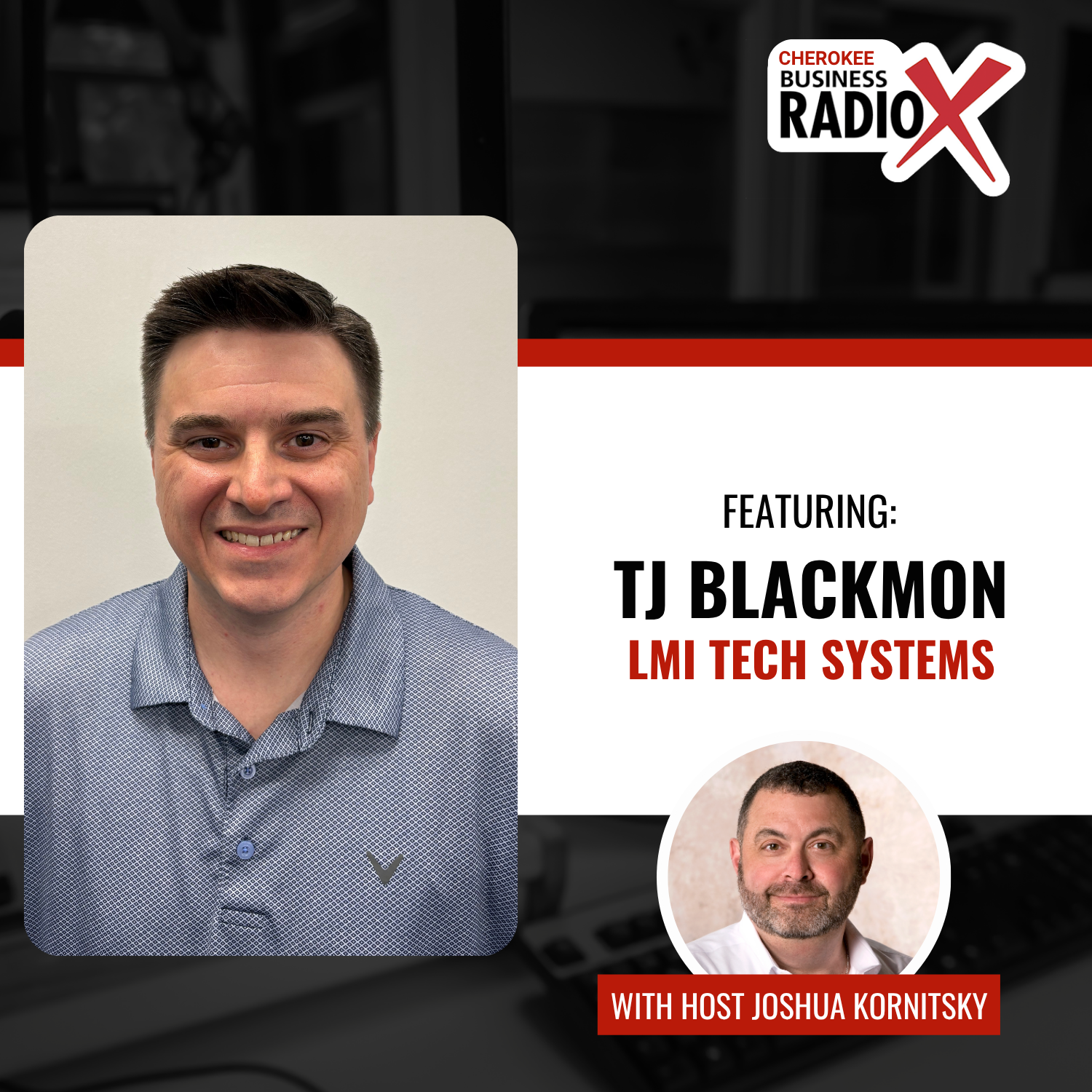
In this episode of Cherokee Business Radio, Joshua Kornitsky interviews TJ Blackmon, Vice President of LMI Tech Systems. The discussion centers on LMI’s innovative Technology as a Service (TaaS) model, which helps small to medium-sized businesses (SMBs) manage technology costs and needs. TJ shares his 25-year journey with LMI, highlighting their evolution from high-end home systems to comprehensive tech solutions for SMBs. Key services include hardware, software, managed services, cloud solutions, telephony, and security. The episode underscores LMI’s commitment to making advanced technology accessible and affordable for all businesses.

 TJ Blackmon is a 30 Year IT Professional, focused on the Managed Services. He’s the CIO/Vice President Managed Services, LMI Tech Systems, LLC.
TJ began his career in the tech industry right out of high school, working for a technology store at age 19. Prior to joining LMI Systems, he worked for Decision Digital managing more than 1000 servers and overseeing the daily operations of 10 engineers.
He currently resides in Lawrenceville with his wife and 19-month-old daughter. When TJ’s not working, he spends time fishing and soaking up the outdoors.
Follow LMI on LinkedIn and Facebook.
 This transcript is machine transcribed by Sonix.
TRANSCRIPT
Intro: Broadcasting live from the Business RadioX studios in Woodstock, Georgia. It’s time for Cherokee Business Radio. Now, here’s your host.
Joshua Kornitsky: Welcome back. My name is Joshua Kornitsky. I am the host of Cherokee Business Radio and a professional EOS implementer. And today in studio, my guest is TJ Blackmon, vice president of LMI Tech Systems. Good morning TJ, how are you?
TJ Blackmon: Morning, Josh. Thank you for having me over today.
Joshua Kornitsky: It’s a pleasure to have you here. So I understand from the conversation we were having earlier that you’ve been with LMI for a little while.
TJ Blackmon: I have, um, it’s a bit of a long story, but I’ll shorten it here. Um, I have actually been with and involved with LMI since I was about 19 years old.
Joshua Kornitsky: And he’s almost 22 now.
TJ Blackmon: So age is getting to me.
Joshua Kornitsky: There you go. So no. So how many years has that been?
TJ Blackmon: Um, this April, it was 25 years. Because I’ll be married 25 years in a month, so I better keep that date, right?
Joshua Kornitsky: Yes. Yes, sir. Um, wonderful. So when, uh, when you started with LMI, you were functioning in the role of a technician, weren’t you?
TJ Blackmon: Yes. I worked for a managed services provider at the time. Um, and this was, you know, late 90s. It was very different than it is today. We were actually on site, uh, all the time because there was no remote access. You drove.
Joshua Kornitsky: That was remote access was. You opened the door.
TJ Blackmon: Yeah. And you and you got in your car. Um, and we got a call that LMI had a server down, and at that time, LMI had a server.
Joshua Kornitsky: Okay.
TJ Blackmon: And, you know, things change. And, uh, I was dispatched there and met the principal owners there. Got the server back up.
Joshua Kornitsky: Okay, good. Yeah. Good.
TJ Blackmon: Um, back in the day, when it was hard. You know, us old guys in it, we joke about that. Everybody today has it easy.
Joshua Kornitsky: There you.
TJ Blackmon: Go.
Joshua Kornitsky: Um, and Hershey bars were a nickel.
TJ Blackmon: Yeah, and I worked for that MSP, uh, until about 2006, and then had the opportunity at another MSP to become the network services manager. Did that for about ten years and then moved on and to LMI to become the CIO at LMI.
Joshua Kornitsky: Well, so let’s back up for a minute, because I guess I should ask you, what’s Lmi’s mission? What do you do?
TJ Blackmon: Again, I don’t have to give you a short answer to a very long explanation.
Joshua Kornitsky: That’s okay. So so let’s let’s start simply. How does LMI help businesses? How about that?
TJ Blackmon: Well, first and foremost, LMI tech Systems, who I work for.
Joshua Kornitsky: Right.
TJ Blackmon: Uh, and LMI systems are two different companies.
Joshua Kornitsky: Forgive me. Okay.
TJ Blackmon: But we have one parent company who owns both, uh, LMI systems is an electrical contractor. Been in business since 1962. Um, LMI as a whole has been in business since 1962.
Joshua Kornitsky: That’s pretty. That’s pretty long. The technology space.
TJ Blackmon: It’s a long time. I haven’t been around that long. Um, but LMI just continued to morph over the years and really to customer needs take on different types of things, from the electrical industry to low voltage to large scale deployments. That division started in about 2012. Um, prior to that, LMI had what’s called LMI home systems, um, which was high end luxury homes, audio visual.
Joshua Kornitsky: Oh, wow. Uh, lighting, home theater, lighting.
TJ Blackmon: Things like that. Um, that business was acquired, uh, and then LMI Tech Systems was really formed around that time where we were doing large scale deployments for very large enterprise type companies, um, multi-site Multi-location US and Canada locations.
Joshua Kornitsky: And I know it may seem obvious to to you and I, but just for clarifying for folks that these were technical implementations.
TJ Blackmon: That’s correct.
Joshua Kornitsky: That’s correct. So what type of technology are were you implementing versus help us still bring us to date of how you’re helping now?
TJ Blackmon: So what we’re what we were doing then was very, like I said, very large scale deployments for us, these larger corporations, multi sites, uh, Wi-Fi installations, point of sale installations. Okay. Um, those type of things. In 2018, we made a decision internally to start take what we were doing on the enterprise level and move it back down to the small business space, the SMB. Now, when I say SMB, that’s anything from one person to 5000 people.
Joshua Kornitsky: So wait, you you kind of made your way based on the enterprise class stuff and you’re able to offer what you’re offering now down to the individual level. That’s true. So let’s talk about what is it that you’re offering? Because right now it’s a mystery.
TJ Blackmon: Well, so our big offer is, uh. And really, our brand is what we call testpac. Everybody’s going to get when you.
Joshua Kornitsky: Spell that.
TJ Blackmon: It’s t a p a k.
Joshua Kornitsky: Okay.
TJ Blackmon: It’s not like the Tasmanian devil.
Joshua Kornitsky: I get that a lot. Okay.
TJ Blackmon: Uh, it stands for technology as a service. All right. So.
Joshua Kornitsky: Okay.
TJ Blackmon: Broad term. Uh, what does that mean? Uh, the best the best way to explain this is to give you an example.
Joshua Kornitsky: That’d be perfect. Thank you.
TJ Blackmon: October this year, Microsoft says Windows 10 are no longer supporting that.
Joshua Kornitsky: Okay. Yeah, I read that.
TJ Blackmon: Um, if you are a small business owner and you have, let’s say, ten computers that are not compatible with Windows 11, which, by the way, thanks, Microsoft. A lot of them aren’t okay. And they can be less than three years old and they’re not compatible.
Joshua Kornitsky: So you’re looking at a big expense.
TJ Blackmon: You’re looking at a very large expense right now, especially with economic factors.
Joshua Kornitsky: The way things are.
TJ Blackmon: The way things are. The average laptop is running about 1200 bucks right now. Wow. Yeah. We’re talking about business.
Joshua Kornitsky: Not state of the art. That’s just business class.
TJ Blackmon: That’s a very standard basic laptop. Okay. Well, let’s let’s do the math on that. You got to replace ten of them. That’s 12 grand, right? That’s $12,000.
Joshua Kornitsky: Sure. Uh, well, and that’s just to sit them on the desk in a box, right?
TJ Blackmon: Yeah, that’s just to get the equipment. Then you’re going to pay somebody to come install it, configure your software. Um, then what what do you do with long term support on that?
Joshua Kornitsky: Right, right.
TJ Blackmon: So we create these packages. That’s the pack piece.
Joshua Kornitsky: Right.
TJ Blackmon: Where we do it all for you. Uh, not only do we do it all, we’re looking at a capital expense versus a rather than a capital expense. You’re spreading that cost out over a contract term.
Joshua Kornitsky: So wait a minute. Because usually I would, you know, I might work with somebody like you to, to buy the $12,000 worth of laptops. And then I got to pay you to come in and set each one of them up and however many hours that is per laptop. Times whatever your hourly rate is. So by the time we’re done, it’s probably 2020 $5,000. Right. So what are you saying that you’re offering that’s different.
TJ Blackmon: What we’re offering is one package that that takes that cost and spreads it out over a contract term. Right.
Joshua Kornitsky: So I don’t have to write the $12,000 check.
TJ Blackmon: No, you don’t have to write the $12,000 check.
Joshua Kornitsky: That’s fantastic.
TJ Blackmon: Yeah. So we have and we’re we have contract terms that go 12 2436 we’ll even take it up to 60. Um, most people, the sweet spot is that 36 months, right?
Joshua Kornitsky: Sure. Well, because the equipment’s going to be old at that point, too.
TJ Blackmon: All right. So what else happens during that 36 month? What if you get one of these computers in six months and it dies? Right?
Joshua Kornitsky: Right. Then I got to pay you to come back out, take a look at it and get on the phone under our program.
TJ Blackmon: You don’t do.
Joshua Kornitsky: That. Really?
TJ Blackmon: We replace that equipment, okay? We come out and we reinstall it. By the way, as part of that, you’re getting our managed services, right? We’re backing that machine up on an image based backup. We’re going to cast that image back to that machine, and it’s just like you left it the day before.
Joshua Kornitsky: So you do this on laptops, on on desktops. What else? What else do you do? You do you handle server and infrastructure stuff?
TJ Blackmon: We do. Um, that has become less and less of a thing these days. Um, we’ve had we we are now in 2025, we are doing more migrations towards cloud based services rather than servers or Microsoft Azure or Amazon Web Services, uh, rather than physical hardware. In, in these large server rooms like we used to have even ten, 15 years ago. Um, it’s more cost effective.
Joshua Kornitsky: Well, so back up a minute, though. You just said that that large server room. So in that server room, you got a UPS, you got switches, you’ve got routers. Do you. How does that get handled?
TJ Blackmon: You don’t need it anymore. You just simply do not need it.
Joshua Kornitsky: Well I mean switches you would always need right.
TJ Blackmon: Switches you’ve always got to have.
Joshua Kornitsky: Right, right. So do they buy their own switches?
TJ Blackmon: We include everything.
Joshua Kornitsky: Down to the cable. So literally turnkey.
TJ Blackmon: Turnkey.
Joshua Kornitsky: Wow. Okay.
TJ Blackmon: So? So we have the capabilities to even handle the electrical, the low voltage wireless and and those, those hardware switches like you’re talking about.
Joshua Kornitsky: So it sounds like it’s a million bucks a month.
TJ Blackmon: It’s not a million bucks a month.
Joshua Kornitsky: It sounds like it’s an awful lot of services that you’re offering. And as you had said, it’s sort of that that cap expenditure versus operational expenditure. So it’s going to help small businesses keep their money in their pockets.
TJ Blackmon: You can budget. Right. That’s it. You don’t have this enormous oh my goodness. I’ve got this $12,000 expenditure that I got to spend in six months. Right, right. You can now budget that out. And we work. We work with customers all the time. All right. Let’s let’s help you work this into your budget so that, you know, every month I’ve got X amount of dollars rather than this. Oh my gosh moment.
Joshua Kornitsky: Well, so you have the variability, a term like you mentioned earlier so that you can help mitigate that cost. Right. What other services do you provide? Because I know that that sitting in an office these days usually still means that you’ve got to deal with other forms of infrastructure like Wi-Fi and telephones and things like that. Right.
TJ Blackmon: So telephones has been a huge thing for us. Um, really, I have a very funny story about this.
Joshua Kornitsky: Okay.
TJ Blackmon: Um, my boss walks into my office about five years ago.
Joshua Kornitsky: Okay.
TJ Blackmon: And we have a customer who says, I’m going to give you all of my IT support and infrastructure and all that. You have to do my phones. All right.
Joshua Kornitsky: Okay.
TJ Blackmon: Remind. Reminder that here that I’m an old school I.T. guy. What’s the one thing I asked you guys hate?
Joshua Kornitsky: Telephones.
TJ Blackmon: Absolutely hate them. Right? You see, you have those old school phone guys who did the punch clock thing.
Joshua Kornitsky: Sure.
TJ Blackmon: That’s not what it is anymore. It is true. Voice over IP. It’s more like a computer. So, Scott, my boss, walks in and says, hey, we’re doing phones. And I said, no sir, we are not. And he said, let me know when you’re done. Okay, so fast forward, the big joke in our office is now TJ’s a phone guy because I do love doing them. Um, ironically, I cannot believe I still say that, but, uh, it really has moved it from something that is less analog to. It’s more like a computer, right? We’re cloud hosting these PBX. They’re no longer a physical piece of equipment in your office that can go bad. It’s all cloud hosted, um, and voice over IP, and you can do anything. These large phone systems usually cost tens of thousands of dollars, right?
Joshua Kornitsky: Absolutely.
TJ Blackmon: For a a small monthly fee, inclusive of all those fees and taxes, those those still exist and those still are there. Um, but we include all that in our packages.
Joshua Kornitsky: So realistically, if I’m sitting in and I have a dozen customers that fit into this myself, right, that they’re sitting in an office where the machines are all of varying ages. They’re running off of an old server that’s been there forever. That’s running Lord knows what version of what. Right, right. And their phone system is sitting in another corner, and all of it’s running in a closet that’s older than dirt and full of dust. One phone call. All of that can be in in a single bill.
TJ Blackmon: Yeah. And really, what we like to do is come into a situation like that and just baseline everything. We really like to do that. We don’t have to do that. Sure, there’s customers who we just do their managed services, right? We just take care of their computers. There’s customers where we do everything.
Joshua Kornitsky: Well, what? So I want to ask you, what about things like security and antivirus and anti-phishing and all of that stuff? Is that is that, uh, a service that you offer, or is that part of the package? How does it work?
TJ Blackmon: It is part of the package. And we’ll also call this the stuff that keeps you up at night if you’re an IT guy. Sure.
Joshua Kornitsky: Um, well, I think at this point it’s an everybody guy, right? It is because everybody has gotten at least one emailer or letter in the mail that tells them that their data has been compromised.
TJ Blackmon: It’s daily and it’s scary. Uh, just saw an article this morning that said all your data is for sale, and you wouldn’t believe how cheap it is.
Joshua Kornitsky: That’s terrifying.
TJ Blackmon: Um, especially when it comes to business data. Sure. Right. It’s one.
Joshua Kornitsky: Thing for your personal that’s the lifeblood.
TJ Blackmon: But it’s your business data. Um, all that is included in our package, right? We brought something to the small business that small business normally don’t get. And we brought EDR. Okay. Endpoint endpoint detection and response.
Joshua Kornitsky: So tell me. Tell me what EDR actually is.
TJ Blackmon: So EDR is the only easy way to explain it is it’s modern day antivirus. Okay. Back in the day, we had our Norton’s and our McAfee’s and all.
Joshua Kornitsky: Sure. Well, you had to run your antivirus. Then on your mail server, you had to have some kind of anti-spam or anti-phishing.
TJ Blackmon: Those days are gone.
Joshua Kornitsky: Really?
TJ Blackmon: We’ve moved to this EDR and XDR. Xdr is extended data response detection.
Joshua Kornitsky: Okay.
TJ Blackmon: It’s real live monitoring of computers and servers that it’s watching more for patterns in data manipulation and how data is being moved around your computer and your server, and your internet in your internet connection. And it knows based on the way that data is moving. Something’s fishy here. Stop it. There’s no there’s no. Let’s quarantine. It has something called quarantine, but it doesn’t quarantine it like old school antivirus did. It just really stops that process.
Joshua Kornitsky: And so let’s say that it’s detected something bad. What? What is it? Does it notify you? Does it know?
TJ Blackmon: Yeah. It notifies. It notifies us. We get we get blinky, flashy things happening on our boards and on our computers.
Joshua Kornitsky: Okay.
TJ Blackmon: We’re monitoring. And then we remediate that. Right. And that remediation is really what the core of our of our managed services is. Right. We still do your normal. My outlook one. Open. This email is not coming through. My printer won’t print all those things. But really we’ve taken that to the next level bringing that to people who normally that would be just cost prohibitive, right? Right. Bringing that to the small business.
Joshua Kornitsky: So you had mentioned earlier you said anything from from really one person and up. When you talk about the the types of businesses that you currently help, I know you had shared with me that, that you’ve got some of the larger organizations and I won’t ask you to name names. Um, just if you give us a sense of scale of of what you’ve got on the high end versus what you’ve got on the smaller side, so that people understand that this isn’t priced to just be for the giant company.
TJ Blackmon: Yeah, I call it uptown to downtown. Okay. Right. Um, I, I come from a very small town, so I appreciate the downtown people, the small business owner, the flower shop down the road. Uh, the restaurant owner. Right. These people are typically cannot afford the level of technology that they can. And they and they do need to be successful. Right. Right. Um, I’ll give you some examples of types of business. We’ve got a few restaurants that we do mom and pop type style restaurants.
Joshua Kornitsky: Okay.
TJ Blackmon: Um, we’ve got, uh, print companies. We’ve got, uh, print supplier companies, um, on up to very large scale, you know, 5000 user enterprise type things that we co-manage it.
Joshua Kornitsky: With their staff.
TJ Blackmon: Right. They have a staff. We just augment them through various different methods. Right. We may supply we may supply the software we talked about. Okay. Monitor that. We may watch their backups. Right. For business like that, backups are critical. Still to this day, uh, or we may help them implement projects. We may be, uh, we’ve got one very large company that we just do project level managed services for. Right.
Joshua Kornitsky: On an as needed.
TJ Blackmon: On an as needed. Okay. Um, they have their continuously growing and acquiring different businesses. We come in and cable their infrastructure, put our switches in and and assist them in the move. Right. So it’s very different than than most MSPs. Sure. Today.
Joshua Kornitsky: Well, and so we were talking earlier before we went live about the fact that the what I always call the the thousand dollar printer. Right. And it sounds like that doesn’t happen with you guys. And to clarify what I mean by that is, is you call somebody to come help you with a printer that cost you $200 and they spend seven, eight hours on it, when it would have been cheaper to throw it away and buy a new printer. But it sounds like the because you’re providing the service, you’re providing the hardware. That bill doesn’t come.
TJ Blackmon: That bill doesn’t come. And I can’t afford $1,000 printer and they can’t either.
Joshua Kornitsky: Sure. Right. No, no, I understand that. So so that makes perfect sense to me that it’s a way on on the small to medium business because I don’t want to call them mom and pops or however you want to refer to them. The biggest roadblock for them with technology is typically access either to the hardware or to the support. And it sounds like you’ve kind of created a way to help make that much more approachable.
TJ Blackmon: Yeah, exactly. Um, we’ve got a local, uh, where we’re headquartered. We’ve got a local brewery.
Joshua Kornitsky: And where are you headquartered?
TJ Blackmon: Tucker, Georgia.
Joshua Kornitsky: Okay.
TJ Blackmon: Uh, just right outside the perimeter. Um, we’ve got a local brewery who needed access control doors. Right? They needed to keep people from going into places through health code and stuff like that. Those things are very expensive.
Joshua Kornitsky: Right.
TJ Blackmon: Um, and it was really just they were lock and key in it. And then if they had to let an employee go or an employee didn’t show up for work, those keys are just floating out there. We we we’ve modernized that facility with access control doors controlled through Bluetooth on their phones or through a little card so that if that happens, they can call us directly 24 over seven and say, hey, lock this person out and lock them out.
Joshua Kornitsky: So it sounds like you’re able to bring people kind of state of the art technology all the way around, but but still keep it at a manageable price.
TJ Blackmon: That’s correct.
Joshua Kornitsky: Wow. So as you work and grow with different organizations, what are some of the things that that you’ve learned with regards to how how you best deliver your service, I guess is, is the way that I, that I’d ask that question.
TJ Blackmon: Yeah, it’s a great it’s a great question. And doing this as long as I’ve, I’ve done this, uh, I’ve seen it done wrong and I’ve seen it done right and I’ve seen it done in between. One of the things that I am continuously trying to get my staff and the people in our organization is the customer is always first. And everybody says that, right?
Joshua Kornitsky: Sure.
TJ Blackmon: In our world, when I go sit down with somebody who’s had a data incident or their managed service provider currently just isn’t doing a good job. The thing I always hear, and I can almost tell you every time I go into those meetings, I always hear this. I don’t know what I’m paying for. I get the I don’t know what I’m paying for.
Joshua Kornitsky: So they just get the the big bill.
TJ Blackmon: Or I get the they do an okay job but and that but.
Joshua Kornitsky: There’s always that.
TJ Blackmon: But I don’t know what I’m paying for. Um, they’re not really looking out for us. They’re just looking.
Joshua Kornitsky: So sort of reactive versus proactive.
TJ Blackmon: Exactly.
Joshua Kornitsky: Okay.
TJ Blackmon: And in, in Atlanta, especially within a three mile radius of here, you could throw a baseball and hit probably two MSPs.
Joshua Kornitsky: Okay.
TJ Blackmon: We all say the same thing. We we do this differently. And all this thing that I have done with this is we put in some something called a CRM. All right. Customer engagement manager.
Joshua Kornitsky: Okay.
TJ Blackmon: That person is our customer advocate.
Joshua Kornitsky: So, wait, you mean they don’t have 11 other jobs?
TJ Blackmon: No. They do one thing.
Joshua Kornitsky: Really?
TJ Blackmon: They are. They are talking to our customers on a really quarterly basis. Right? But they’re engaged with the customers all the time, right? Um, they don’t call them for support. They call them if they don’t feel like they’re getting the support they need.
Joshua Kornitsky: So you have a you have a role specifically designated just for the customer to have someone to, to connect with, right? That’s pretty impactful.
TJ Blackmon: And it has fundamentally changed the way we do business from the aspect of the customer always knows they have somebody on their side, and they know that because a lot of times a customer, if they have a problem, right. If they’re not happy with the way a technician did something, they’ll hold that back. And that just grows and that festers and that becomes the they do a good job. But gotcha. Right. I’m preventing that by having that person and this person is going to call on them. This person is there if they need to add a service, if they really take away a service, if they need to readjust, if they had a, you know, goodness forbid, they have like a layoff and they need to scale back.
Joshua Kornitsky: Or they hire for more.
TJ Blackmon: Or they hire for more, this person makes sure all that gets handled.
Joshua Kornitsky: So that only because you had mentioned this to me earlier, right. What does it look like? So let’s say I add four more people, um, based on the scale that you’re operating at, is that like a three week wait to get the equipment? How long is it?
TJ Blackmon: So current economic issues make things hard to get right now. But for the most part, it’s within a week we’re turning around.
Joshua Kornitsky: Well, and you operate it sounds like at a scale that you probably have a level of inventory.
TJ Blackmon: We warehouse a lot of the common things, um, laptops, desktops, people don’t really buy desktops anymore. So we have mostly laptops. We have a couple desktop phones. We keep a vast inventory of those because it’s the biggest thing.
Joshua Kornitsky: So when you say you do phones, you actually do phones all the way down to the handset on the desk.
TJ Blackmon: That’s it. We take care of everything.
Joshua Kornitsky: I didn’t realize that.
TJ Blackmon: The whole idea of task pack is one hand to shake. Right.
Joshua Kornitsky: Okay.
TJ Blackmon: One hand to shake. We do it all. We handle the wiring. We handle the electrical if need be. We handle, in the case of a phone, the entire phone system, the installation, the norm reporting number. Reporting is huge when it comes to phones, it’s.
Joshua Kornitsky: Yeah, it’s the biggest nightmare I remember from my distant past.
TJ Blackmon: It has gotten no better. It has gotten no better. And now you.
Joshua Kornitsky: Have. It sounds like you’ve got people that do nothing but manage that process with phones.
TJ Blackmon: Now you have more people involved that make it. Everybody’s different. As far as number porting goes. It’s the number one thing that we deal with. Um, but we handle all that. And that CRM person is guiding our customer through this and saying, here’s what’s going to happen next.
Joshua Kornitsky: So no more mushroom theory. Keep them in the dark and shovel stuff on them.
TJ Blackmon: Look, an MSP is constantly battling what I call the 8020 rule.
Joshua Kornitsky: Okay.
TJ Blackmon: All right. And if my guys. If you’re listening and you don’t know this, we’re going to have talk. 80% of everything that we do as an organization is communication 80%.
Joshua Kornitsky: I would agree with that. I would definitely agree with that.
TJ Blackmon: 20% of what we do is technical. And you’re like, well, that doesn’t sound right. Trust me, 80% is communication. As long as you’re communicating with somebody and they understand where you’re at and what you’re doing, the technical part can always be figured out. But if you break that communication, well, that’s it.
Joshua Kornitsky: That’s where trust lives, right?
TJ Blackmon: Sometimes you can’t build that. You, you you can’t fix a communication problem if you if it’s too far down the road.
Joshua Kornitsky: It’s amazing the impact that openness and honesty can have.
TJ Blackmon: For.
Joshua Kornitsky: Sure. And you know, it sounds like in in the traditional model. It’s about as as I would imagine from the managed service provider’s perspective. It’s about to some degree, yes, obviously satisfying your customer, but you’re always looking to make sure you’re preserving your revenue stream. And it sounds to me like you’ve sort of taken that equation off the table because everything’s in there is no added charge.
TJ Blackmon: Yeah. Exactly right. Again, back to the task. Back. I keep going back to that.
Joshua Kornitsky: But no, that’s that’s that’s everything. Right. Because it’s it’s a turnkey from the sound of it for.
TJ Blackmon: Exactly. Um, let’s go back to our computer scenario. Right. We put ten computers in. You’re paying.
Joshua Kornitsky: 12,000 bucks plus plus.
TJ Blackmon: Plus. Then the following morning, you open up in your your outlook just not working, right?
Joshua Kornitsky: Right.
TJ Blackmon: You’ve been charged for the hardware. You’ve been charged for the setup. Now you’re going to be charged to fix that. To fix that support. Right. We take that off the table. Right.
Joshua Kornitsky: So it’s just one bill.
TJ Blackmon: It’s one bill, right.
Joshua Kornitsky: Seems like it’s got to be a lot more predictable.
TJ Blackmon: Oh, it is.
Joshua Kornitsky: So it’s not one bill that that ebbs and flows. It’s just one bill.
TJ Blackmon: It’s just one bill. Okay. And by the way, here’s the other thing. As long as they’re under contract with us, the cost never increase.
Joshua Kornitsky: Really.
TJ Blackmon: As long as you’re under contract. Right. Full hardware replacement. If we run wire as part of that and the wires broke, we’ll fix that.
Joshua Kornitsky: It sounds to me like you don’t upsell, and I mean that in a complimentary way. It sounds to me like you’ve got it all wrapped in.
TJ Blackmon: We do. Uh, and it’s a it’s a testament, really, to what we’ve done over the years and how we develop the business and grew into that. Right.
Joshua Kornitsky: Well, it sounds like your customers wanted predictability.
TJ Blackmon: Yeah. I mean.
Joshua Kornitsky: And you found the ultimate mechanism to deliver it.
TJ Blackmon: As part of the owner of this business.
Joshua Kornitsky: Sure.
TJ Blackmon: I want predictability in everything because I want to be able to budget that. Sure. Right. Um, that goes for insurance and all those different things. We’ve really taken technology and made it a predictable.
Joshua Kornitsky: That’s that’s a pretty big accomplishment when you think about it, because that’s got to be, as I think about the businesses that I work with, that remains one of their largest, most variable expenses because something bad can come around the corner very quickly or just an unforeseen failure. Right? Whether it’s a phone system or server or just two laptops, if they’re the wrong laptops to fail and there aren’t a backup that gets expensive in a hurry.
TJ Blackmon: Yeah, I’m taking that risk. I’m taking the risk off of the customer and putting it on me. Really? Right in in this case.
Joshua Kornitsky: So so it sounds to me like it’s a pretty compelling offer. Um, you know, so one of the things that that I want to make sure that, that we get to is ask how people will get Ahold of you. And obviously, we’ll put everything on our website, uh, so that folks can find you. But before we get there, I always like to ask kind of a a a thinking question a little bit as, as we get towards the close. And, you know, I always you’ve taken us on a journey today, right from from walking in the door as a kid, trying to fix the computers at a place that you’re now part owner of, which is pretty cool in and of itself. And, and I think that says a lot about the culture of your organization, that that opportunity exists. Uh, what about today? Do those opportunities for your employees still exist where there’s the ability to to move up?
TJ Blackmon: It’s funny, we just had this conversation last week internally.
Joshua Kornitsky: Okay. Not not with me.
TJ Blackmon: Not with you. Right. With with my guys. I’m constantly looking for someone to step up to that next level because as we’re growing as a business and I’m bringing in technicians, one of the hardest things we face is getting that mindset right. Right. That customer focused mindset. Sure, I deal with tech guys and, you know, tech guys don’t like to talk to people.
Joshua Kornitsky: Some do, some don’t. Right. But yeah, I broadly follow.
TJ Blackmon: But getting getting that mindset and getting somebody to step up internally, I, I never want to go out and hire somebody to take that next step. So internally, as we’re hiring people, I’m looking for people who I know can take that next step and lead a small group of tech people down this path.
Joshua Kornitsky: Right. So are you looking for people now?
TJ Blackmon: We’re always looking for people.
Joshua Kornitsky: Wonderful. So. And how would somebody get Ahold of you? It’s a perfect opportunity.
TJ Blackmon: Oh. That’s easy. Um, you can contact me on my email address. Uh, that’s t b l a c k m o n. Everybody spells that wrong m o n right at com, or our phone number is 56785782171.
Joshua Kornitsky: All right. And we will have all that information on the website as well. But but coming back to my closing question I wanted to ask you what are what are some of the things that made an impact on you in your in your professional life?
TJ Blackmon: It’s a great question. And, you know, a lot of people say, I have to sit and think about that. I don’t.
Joshua Kornitsky: Okay.
TJ Blackmon: I have been truly blessed to have a core group of about five people that have made me who I am today and have not just parents and grandparents, but professionally, who took chances for me, right? I was 19 years old when I moved here from a small town in Alabama because somebody said, you have the ground floor of what it takes. Right. So they took a risk. And then throughout my career, you know, and now where we’re at at LMI, you’re right. At 19 years old, I walked in that building really not knowing how to get around Atlanta.
Joshua Kornitsky: Sure. Sure.
TJ Blackmon: And now. And now I’m a minority owner in the company.
Joshua Kornitsky: That’s just amazing.
TJ Blackmon: So.
Joshua Kornitsky: So it sounds like there’s been a lot of people that have contributed to that. Yes. Well, TJ, I can’t thank you enough for your time. And I think that we’ve we’ve spelled out what LMI tech systems can offer to, to small businesses. You gave us your phone number. You gave us your email again. We’ll have all of that on our website. Any closing thoughts you’d like to share?
TJ Blackmon: Well, there’s a couple of things, if you don’t mind.
Joshua Kornitsky: Not at all. What’s next, I guess?
TJ Blackmon: Yeah. So we are excited about a big event. We have recently partnered with the Georgia Dental Association. Um, we’re doing their internal IT and uh, have also partnered with them for their upcoming member conference in Amelia Island. Oh, that I believe is on June the 18th. So obviously it’s a private members only event. But there are a I think it’s 3800 dentist offices under that association. Oh, wow. So we’re going to be there and present, uh, to speak to all the owners of those dental associations. We’re excited about that. We’re excited about that opportunity. And we’re looking to further expand that, uh, that team that we’ve built with Georgia Dental, uh, into the next level there.
Joshua Kornitsky: That’s fantastic.
TJ Blackmon: Um, and I have a super secret announcement that will come back in July and talk about. We’ve been working on something internally for two years that we’re very excited about, but I can’t talk about it right now, so we’ll leave that on a cliffhanger.
Joshua Kornitsky: So, yeah. Yeah, we’ll definitely have you back on and you’ll have to tell us what that is and who and how it helps. Um, again, TJ Blackmon Vice president of LMI Tech Systems, thank you for coming in today. I sure appreciate it. And I think it was a really interesting discussion and gave people a lot to think about, because it turns out that there can be one solution to multiple problems.
TJ Blackmon: Yeah. Thank you again, Josh. We appreciate it.
Joshua Kornitsky: My pleasure. So this is Joshua Kornitsky I’m a professional EOS implementer and I am your host here on Cherokee Business Radio. And we will see you again real soon.














