
Brought to you by Diesel David and Main Street Warriors

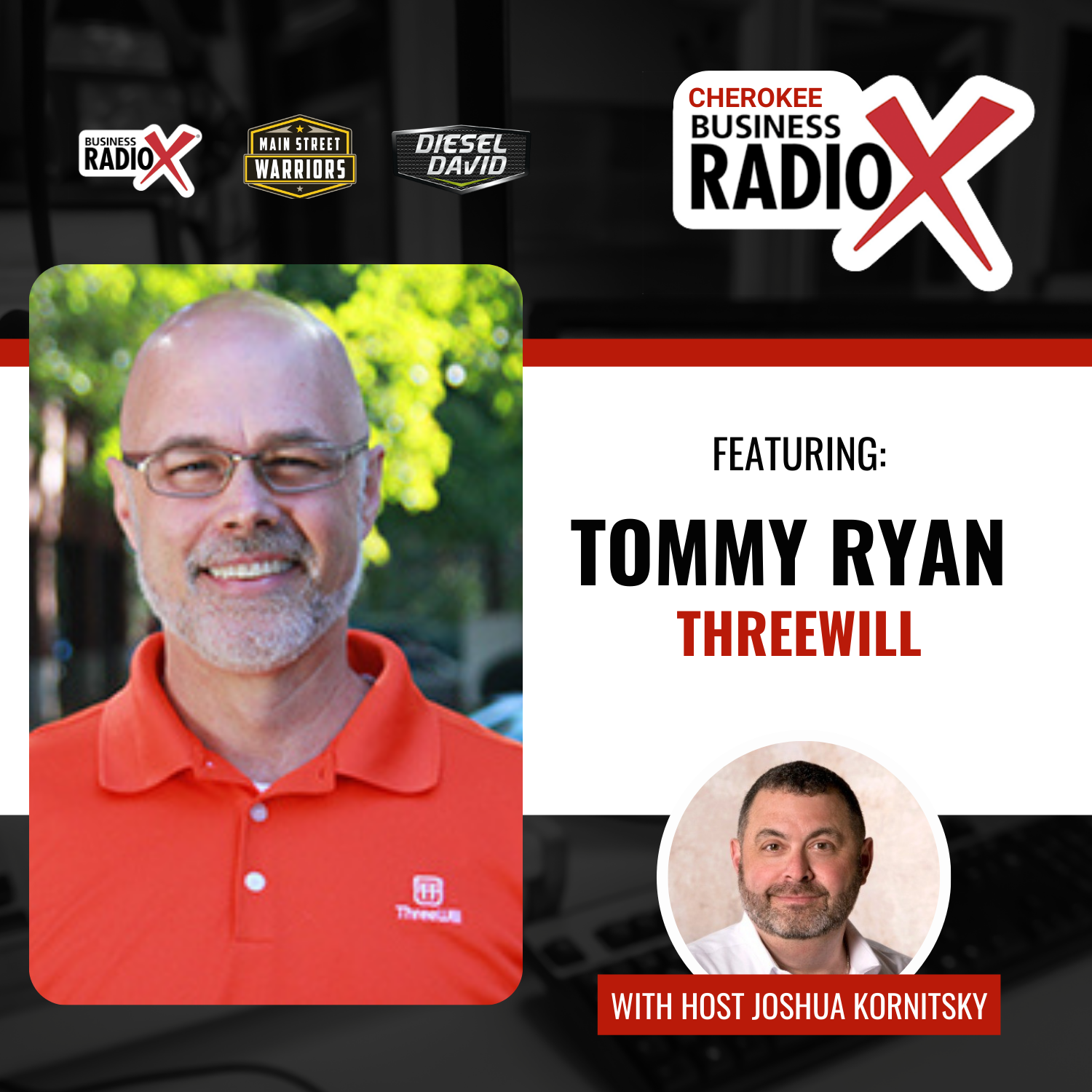
In this episode of Cherokee Business Radio, host Joshua Kornitsky interviews Tommy Ryan, co-founder and CEO of ThreeWill. Tommy shares his journey from process engineering to leading a technology consultancy that helps mission-driven organizations maximize their Microsoft 365 investments. The discussion covers ThreeWill’s tailored approach to technology adoption, the importance of organizational culture, and making tough staffing decisions. Tommy also highlights their community-building efforts through local luncheons and announces the upcoming ThreeWill Productivity Manifesto, offering practical insights for business leaders and technology professionals.

 Tommy Ryan is a technology consulting leader and a passionate organic farmer, driven by a mission to help both people and soil thrive. As Co-Founder and CEO of ThreeWill, a Microsoft Solution Provider, he leads a team dedicated to helping organizations get the most out of the Microsoft 365 and Power Platform.
Through prescriptive, packaged solutions, ThreeWill empowers small and mid-sized businesses to align technology with their people, processes, and purpose—enabling teams to do more meaningful work and leaders to build systems they can trust.
Beyond the world of productivity tools, Tommy cultivates abundance through Iron Mountain Organics, his small-scale regenerative farm on his 6-acre property in North Georgia. With a deep love for soil ecology, compost systems, and flavor-rich food, he brings the same care and systems thinking from the farm to his leadership at ThreeWill.
It’s not unusual for Tommy to show up to a meeting with a basket of freshly harvested vegetables in hand, providing a gesture that reflects his belief in nourishment, connection, and generosity. Tommy is passionate about co-creating with both nature and people.
Whether it’s removing friction from team collaboration or planting a tomato plant that feeds a neighbor, he sees every system as an opportunity to foster growth. His weekly LinkedIn newsletter, Sowing Success, explores the intersection of leadership and land stewardship, offering insights rooted in ThreeWill’s core values: Better Together, Extreme Ownership, Humble Confidence, and Choose Growth.
Each edition draws on the rhythms of nature to inspire healthier, more sustainable organizations.
Follow Tommy’s journey:
LinkedIn Newsletter: Sowing Success
Instagram (for Iron Mountain Organics)
Episode Highlights
- Tommy Ryan’s professional background and early career in process engineering and technology.
- The founding and mission of ThreeWill, a technology consultancy established in 2001.
- The importance of maximizing Microsoft 365 tools for collaboration, communication, and automation.
- Tailoring technology solutions based on clients’ unique business processes and culture.
- The significance of organizational culture and leadership support in technology adoption.
- ThreeWill’s focus on managed services and long-term client relationships.
- Key verticals of focus for ThreeWill: home and community-based services, real estate development, and family offices/credit unions.
- The philosophy of measuring success through tangible productivity gains and reclaiming time for clients.
- The connection between personal interests (like organic gardening) and business principles.
- Community engagement initiatives, including luncheons for local leaders to foster connections and discussions.
 This transcript is machine transcribed by Sonix.
TRANSCRIPT
Intro: Broadcasting live from the Business Radio studios in Woodstock, Georgia. It’s time for Cherokee Business Radio. Now, here’s your host.
Joshua Kornitsky: Welcome back to Cherokee Business Radio. My name is Joshua Kornitsky, professional EOS implementer and host of Cherokee Business Radio. Just a quick note that today’s episode is brought to you in part by our Community Partner program, the Business RadioX Main Street Warriors Defending Capitalism, promoting small business, and supporting our local community. For more information, go to Main Street Warriors and a special note of thanks to our title sponsor for the Cherokee chapter of Main Street Warriors Diesel David, Inc.. Please go check them out at diesel. David. Com. Well, we’ve got another great show lined up today. My guest in the studio is Tommy Ryan. Uh, Tommy is the co-founder and CEO of ThreeWill, a technology consultancy focused on helping mission driven organizations gain more value from their Microsoft investment. Beyond his executive role. Tommy also brings a leadership style rooted in systems thinking, human connection and security of curiosity. Pardon me about the natural world. Good morning. Tommy. How are you?
Tommy Ryan: Good morning Joshua. I’m doing good.
Joshua Kornitsky: Forgive me. I think I brought the frog in my throat today, and I’m trying to clear him out. Um, it’s great to have you. Thank you so much for taking the time to come in. Sure. So tell us a little bit about who you are in your background and what led to three. Well.
Tommy Ryan: Wow, that’s a big question there, Joshua. Yeah.
Joshua Kornitsky: So start.
Tommy Ryan: Large. Yeah. So this all started the the three world journey. Um, probably I’d say ten years before we started. ThreeWill it was started by me and my brother Danny and we were curious about this internet stuff.
Joshua Kornitsky: I hear it’s going to be big.
Tommy Ryan: Yeah, yeah. And this was, you know, back in, let’s say, in the early 90s. Uh, he was a Price Waterhouse consultant. I was a process engineer manufacturing Gore-Tex as a chemical engineer. Okay. And, uh, got very curious about the technology side of process engineering. So I did plc programing. I don’t know if you’ve ever heard of that before. People in manufacturing would recognize that. Okay. It’s kind of the hardened, um, PC technology that operates equipment. And I also worked on the human machine interfaces for that equipment. And that is something that I would just, um, the hours would melt by. Sure. You were with the technology, so I found an early On curiosity for technology and how that can systemize things. So I did that for five years and ended up going to work for Siemens and, and made a transition in my career to support a software product from Siemens that was that HMI human machine interface. And during that time I was talking about, um, starting a company with Danny as it relates to technology. And we said, well, let’s work at the same company to see if we’re work compatible. We did that for, gosh, maybe it was 2 or 3 years at a company called Extreme Logic. It was a very, um, kind of solid consultancy in those days, right before the year 2000.
Joshua Kornitsky: Okay.
Tommy Ryan: And they were the Microsoft partner of the year. They got acquired by HP, and my brother and I were writing technology articles when we were there at Extreme Logic in a company approached us to write a book. It was actually John Wiley and Sons, and it was a blueprint series, and it was back when Net was beta. So we used that as a launching point to say, well, maybe this is the time to start a business. We did that in 2001. Our first sales call was September 11th two, 2001. A very interesting day. Wow. Um, so and they say that’s when to start a business, when times are tough because it makes you run lean, makes you get focused very quickly.
Joshua Kornitsky: So obviously you learned you could work well with your brother.
Tommy Ryan: We did, we did. We worked for 20 years together. And there was it was a great journey as brothers. And now we’re putting a full time effort towards being brothers versus business partners.
Joshua Kornitsky: That’s fantastic. I support that completely. Um, so I mentioned in your introduction that you really help your organization, the organizations you work with get, um, much more value out of their Microsoft investment. Right. What? Tell us what that means.
Tommy Ryan: Well, typically, what we find in organizations that are using Microsoft technologies. Microsoft 365, in particular. Um, they’re they’re very comfortable with email, and they use that communication mechanism to also collaborate with each other and to share content. And it’s a very dated, very, um, reliable technology. Going business to business if you’re not in the same collaboration environment. Um, sending emails is a good way to get information. Sure.
Joshua Kornitsky: Communicating accepted. Norm?
Tommy Ryan: Yes. And, um, and people are comfortable with that. But we help organizations start embracing the other parts of the toolset that helps with better communication, collaboration and automation of kind of the the standard things that they do to bring more predictability to their business.
Joshua Kornitsky: And in the case of office 365, in many cases, don’t they already have license to utilize that?
Tommy Ryan: Yeah, they do, and they probably.
Joshua Kornitsky: Use it for it and they’re not using.
Tommy Ryan: It. That’s right. They use probably 1,020%. That’s common for us to see when we look across, you know, what they own and what they actually use. We believe that it takes a custom tailoring of, okay, um, looking at their business, understanding what are the core processes that drive that organization and looking at where they are in the maturity spectrum of of using technology, meet them where they are, take them on the next step in that journey.
Joshua Kornitsky: So you’ve got to kind of do a deep dive with them to understand where they’re at before you can figure out where you can go.
Tommy Ryan: Yes. Yes. Yeah. That early on kind of analysis, discovery of understanding what makes that company tick. Um, and where what type of people do they have working there? You know. Is it people that are in their 50s or people in their 20s? And you approach technology differently depending on what the demographic looks like in the company.
Joshua Kornitsky: I imagine that your background in systems thinking, in human design must give you a great deal of insight into understanding where they’re at.
Tommy Ryan: Yeah, when we look at productivity, we like to look at ourselves as a fractional productivity department for our customer where they are, you know, they’ve got the guide or the expertise to help them take what they do in their work day to day and, and humanize that work by taking the mundane and the repeatable things and let technology take care of that. Um, so when we think about that journey with a customer, the first step in that journey is making sure they have the right culture. Um, are they are they willing to change? Um, because, you know, we can show them a new way. But if they’re not hungry to improve what they’re doing, if they don’t have the leadership support to say we are going in a, in a, in a direction where we’re going to adopt more technology to enable the mission. Um, then, you know, we’re fighting an uphill battle that we’re never win in.
Joshua Kornitsky: In my other life as an implementer, we say if you have to drag them in, you’re going to have to drag them around. If they don’t want to do it, then then you’re just pushing it uphill. And, uh, so I, I fully agree with you on that in that analysis. So let’s talk about the kind of clients you work with. Or is there a specific vertical because you have a background in manufacturing or or who do you help.
Tommy Ryan: Yeah. So the first 20 years or three. Well was in the space of really enterprise just general enterprise. So you know, some of the clients we still have today. Um, also, but, you know, big companies like Ernst and Young, AT&T, WarnerMedia, CVS health, and we were helping those organizations with custom SharePoint development. Okay, they had SharePoint on premises. They wanted it to work in a way that they thought it should work, versus just embracing what’s there and.
Joshua Kornitsky: Send it to their will.
Tommy Ryan: Yeah, yeah. And spending a lot of money to do that. And and there’s a lot of history to what made us pivot the business. But one of the key things that we wanted to do as a business is have, um, longer term clients where we’re taking a journey with them. So we went in a direction of a managed service that’s affordable, as you know, people that, you know, just like you hire a fractional HR person or a fractional bookkeeper.
Joshua Kornitsky: To fill a need without needing it, unless you need it full time. Yeah.
Tommy Ryan: Without having to staff that department. You’re you’re too small to do that. Or maybe it’s just not in your DNA to, you know, have a technology group. So we we went in that direction and, um, you know, been doing that for the past almost three years. And we found that that’s where it’s more meaningful work for us because we get to know them better over time, and we get to make sure that the technology that’s put in place actually thrives and gets return on investment for them. And what we’ve seen emerge is three different verticals, and we’re focusing on one very strongly this year to get, um, kind of get it off the ground in a more formal way around home and community based services. So think of senior living, home health care, um, community clinics, um, a lot of the care that the community gets that doesn’t come through traditional institutions like a hospital. Right, um, that sometimes, in many cases underserved or, um, in a challenging situations where you might have an adult child that’s 25 still living at their home, can’t live on their cell by themselves. But if they’re in the right kind of community that has the right kind of support, um, that child can move on into an adult life. So, um, that that’s something that kind of breaks our heart and we’re like, hey, if we’re going to help people be more productive, hey, let’s do it. We’re going to make it’s going to be, yeah, a better world after we’ve done the work.
Joshua Kornitsky: That’s, uh, that’s very much aligned with who you are. So I think that’s fantastic. Um, so when, when you engage and. Well, you said there were two other verticals. What are what are the other two?
Tommy Ryan: Yeah, there are verticals, real estate development, which is interesting. It’s, um, you know, that that industry definitely is, um, been through some turmoil with, with Covid and, and kind of hybrid work and how people are getting work done. Um, and just, you know, spaces are actually becoming, um, it’s more popular for this work, live, play type, you know, environments. We’re seeing pop up everywhere. And, uh, we help those organizations with kind of the, the workflow that goes between departments and that, that can, um, there’s can be a breakdown in communication, a flow of information. So it’s, um, like things like multi-family homes, um, you know, that people that are managing that they want the quickest turnaround from the time a tenant leaves to a new tenant comes. So they really appreciate having process to expedite that and have high visibility of where it is in the whole scheme of things.
Joshua Kornitsky: When you work with those types of property management companies.
Tommy Ryan: Yes. Yeah we do.
Joshua Kornitsky: Wonderful.
Tommy Ryan: Yeah. And the other uh, um, the other vertical is taking shape and its, um, family offices and credit unions. It’s kind of a niche in small financial services. So not big bank, sure. But, you know, there’s a theme of community. Um, you know, we we enjoy creating a better member experience, um, for when people come into a local community bank to make information flow. Well, from the time they walk into the door to the time that they leave. Um, so those are the three verticals. And, you know, at the end of the day, Joshua, if I could have just one vertical, I think it would be best for for our company and our customers because it allows us to focus all of our energy into that domain and come to a customer with a point of view, a strong point of view, assets to bear and, um, just to understanding of the challenges that they face.
Joshua Kornitsky: Sure, the more sharpened the the point on the pencil, the more you can probably help them. But it’s good to know that you’re able to to service across multiple sectors. And obviously that comes from time. You had said that all of your endeavors are sort of tailored to meet what the clients need or needs are. How do you broadly define success, or is that something you collaborate on to determine at the beginning?
Tommy Ryan: Yeah. That’s interesting. Um, so, um, you’re familiar with the US? I am definitely we are a company that runs on iOS. And and part of that is you define what your three uniques are.
Joshua Kornitsky: And what.
Tommy Ryan: Are your three uniques are. We have depth and knowledge and that that doesn’t mean just Microsoft technologies, but the domain knowledge of the client journey with you. So that’s influenced us going in a managed services route to say we’re going to we feel like we best serve a client over time Versus a big bang of just, you know, do some technology and hand it off and say bye. And then our last unique is measuring your success. And so when we when you look at productivity, a lot of times that’s thought of as a very squishy thing. So we want to put more science around that. And so every customer we work with, we measure the time that we reclaim by putting technology in place.
Joshua Kornitsky: That is an incredibly valuable service, because often when I work with my clients, they have a goal of a 10% increase in in metric X, Y, or Z over a period of time. But my very first question is that’s great goal. What’s the metric today? Well we don’t know. So my my immediate response is always how do you know you will be 10% better today if you don’t know where you are today? You don’t have a benchmark. There’s just no way to determine that you’ve improved off of it better than yesterday is a wonderful goal. But yeah, In order to really grow, they’ve got to know where they are. That’s right. So that’s great. So you’re able to help them understand where there are where they are. Mhm. And then build towards your their long term goal on the journey with them. Because that’s what you do.
Tommy Ryan: Yeah. Yeah. And we have a pretty lofty goal. We you know as iOS you said a ten year target. And for us it’s reclaiming 10,000,000 hours over the next ten years with our clients.
Joshua Kornitsky: That’s an amazing and really, really thought provoking goal. I love that I hope that you achieve it. Are you well on your way?
Tommy Ryan: We’re about. So we’re in, um, in year two.
Joshua Kornitsky: Okay.
Tommy Ryan: And we’ve got 367,000 hours we’ve reclaimed so far.
Joshua Kornitsky: That’s fantastic. Yeah, I, I wish you well on that journey. Now, earlier, you had shared with me that you’ve got some interesting interests outside of work, right. Let’s talk a little bit about that and maybe how that kind of influenced the way you run the organization and kind of see the world. So that’s what what do you do when you’re not helping others?
Tommy Ryan: Well, I’ve got this nice little side hustle of, uh, growing vegetables. And that is kind of my history is I’m a two time cancer survivor. So I got into organic growing, uh, to know where my food comes from and to, um, essentially try to infuse more good stuff into my diet. Sure. Um, I love donuts. I love French fries. I, I eat all those things, but I look at can I put a little bit more healthy food into my diet? And I am so curious about how nature works. And as I was in the garden, just doing the day to day things into the garden, I would see something or experience something and say, you know what? That is a natural law that applies to my business, and I see it in my business, and I can tell a story about it so people can kind of grasp, you know, that that concept. And so those things that started piling up in my head and I said, you know, one day I have to start writing these down. So about 25 weeks ago, I started the Sowing Success newsletter on on LinkedIn. And basically every week I’m finding, you know, I haven’t exhausted them yet, but I’m finding these concepts that, hey, this happens in nature. I can apply this to my business.
Joshua Kornitsky: Sure. Well, there’s a long history of the natural world really being the inspiration for, I guess, almost everything. Right? Yeah. So. So can you give us 1 or 2 of the of the takeaways briefly that you’ve learned?
Tommy Ryan: Yeah. So, um, gosh, if I reflect back on, um, some of them, uh, I look at, uh, abundance is a recent thing that if you nurture something, um, it can grow in abundance and, you know, pouring into something, um, kind of believing in it and, and caring for something creates fruit at the end of the day. And you can see that with theorem with your employees. I mean, the more you can pour into them, um, your C over time with, with kind of trust and space, um, that your C things flourish because you’re investing into that relationship. Um, also I think there’s, you know, concepts that like pruning that might seem oh, that could be a negative thing. Oh, I’m cutting back. And when you prune, you know, like a bush in your yard, um, it can look ugly after you prune it?
Joshua Kornitsky: Yes.
Tommy Ryan: Right. But what? How? It grows back and it grows back stronger and healthier. That, you know, those are some of the hard things you need to do in business that, um, you know, but but are the right things to do to help your business flourish.
Joshua Kornitsky: So that’s a really great observation, and I appreciate you sharing that, because the reality is, is sometimes we have to make hard decisions both in the garden and in the business in order for the business to grow. And they’re not always fun. And, you know, cutting away the flowers may look may make the bush look ugly for a while. But yeah, come the spring, it’s going to be beautiful. Yeah. Well, you mentioned earlier, Tommy, that that three one is over two decades old.
Tommy Ryan: Yes.
Joshua Kornitsky: So in in those two decades, what are some of the biggest lessons you’ve learned along that journey? Flipping it now onto the business side of your perspective. A little bit out of the garden.
Tommy Ryan: Yeah. So I mean, on the topic of pruning, I think some of the hardest things that I’ve had to do in the business is, is, uh, letting people go. Um, and I think most business owners, that’s kind of the hardest part of the business. And what I’ve learned is, you know, letting people go when I have the data and the know how, hey, the business is moving in this direction. Um, is do I have a seat for this person in the bus? It’s not personal. It’s like, okay, I need these seats in the bus, and it’s just. Do I have the people for that? And the people that don’t have a seat? It doesn’t do them any service to kind of hold them around and them to struggle. Um, that, you know, making that decision faster. Sure.
Joshua Kornitsky: Just kindness, as much as it may not seem it. Yeah. It’s kindness.
Tommy Ryan: Yeah. Yeah.
Joshua Kornitsky: Um, that that’s that’s a hard but true lesson. But but I know that from the time we’ve spent talking already in the little before the show. I know that you also worked to grow and specifically in your community. You work to grow. So what are some of the things that you’re doing to help local leaders?
Tommy Ryan: So at three, well, we have this abundance mentality that, um, we’re about pouring into other people, into our clients and to our employees and to our community. And when, you know, after Covid, um, we found that, hey, we’re not having those person to person interactions and we need you to have more of that. How can we be a part of that? So we started a luncheon for that. And we first started with CIOs to be able to give them a forum to talk to other CIOs about employee, um, productivity and thriving employees and, and bringing topics to the table to talk about that. And then more recently, in the past two years, we’ve focused in on partners or what we call our Alliance luncheon. And there’s no requirement, you know, to say, well, you’ve got to check all these boxes. It’s more of, are you in this local community that you’re trying to drive services for organizations? Um, come and join us or pay for lunch, and you can learn from others and create a more tangible network. You know, of course, we’ve got LinkedIn and that works. And I’ve met a lot of people through that. But to have a physical network, that’s where the magic occurs is just face to face with people and them getting to know the person. And that’s what we focus in on is it’s all about getting to know your your neighboring business owners and leaders that are trying to make things work in their business.
Joshua Kornitsky: Sure, people always do business with those who they know and understand and have a connection with. And when? When is. And you say the lunch is open to anyone that wants to attend?
Tommy Ryan: Yes. Yeah. Just reach out to me on LinkedIn. Linkedin, that’s the best way. And you’ll see posts that I have on it or occasionally say, hey, if you’re interested, come join us. Um, those I do those once a quarter. Um, so I think our next one is in October. Okay. And our post something, um, out on LinkedIn in the next couple of days after this broadcast.
Joshua Kornitsky: So people know when we go live, we will post, uh, all of your social links, your website, your LinkedIn and your phone number, your website. But if if people want to get in touch with ThreeWill, how do they do that?
Tommy Ryan: Of course you can go to three. Worldcom, you know, WW three, Worldcom.
Joshua Kornitsky: And spelled out or is it the numeral three?
Tommy Ryan: It’s spelled out. Yeah. Um, t h r e I l l. And you can reach out to me on LinkedIn. Um, and there’s a contact us page on our website. And you’re definitely can learn about our verticals there. Learn about who we are as an organization, what we care about. And I’m going to be releasing the three World Productivity Manifesto.
Joshua Kornitsky: Oh, wonderful.
Tommy Ryan: And that’s the end of this week, beginning of next week. And that’s a great way to understand who we are as a company. It’s the why for us of why we care about productivity and giving a framework for people to think about productivity.
Joshua Kornitsky: We’ll have to have you back on so you can share some of the highlights of that, and also some of the feedback you get after it’s been out for.
Tommy Ryan: Yeah, I’d love to do that.
Joshua Kornitsky: Uh, we’d love to learn more about it because ultimately it’s about serving our community, which is what we’re about here. Uh, is there anything that I miss, Tommy? Anything else that you wanted to share that I didn’t think to ask about? I always like to ask.
Tommy Ryan: I think this is a journey, Joshua. This is part one.
Joshua Kornitsky: Okay.
Tommy Ryan: All right. And we can continue to peel the layers well.
Joshua Kornitsky: And I can’t tell you how much I appreciate your transparency and your willingness to share and to even go, as we say, into the danger to talk about some of the hard subjects, because understanding and and I should say, getting advice and direction on when it may be appropriate to do some pruning, which is not your primary focus in the universe, but it is a focus that you help folks understand, along with process and along with getting greater value out of their current investments. You’re doing hard work and and as as someone who works with a lot of similar businesses to you, I can tell you that it’s needed and it’s appreciated. Um, thank you again. My guest today has been Tommy Ryan, the co-founder and CEO of ThreeWill. They’re a technology consulting firm focused on helping mission driven organizations get more value from their Microsoft investment. And also with regards to process and even farming, from what I understand. Uh, Tommy, it’s been great having you. Thank you again for being here with me today. And go ahead.
Tommy Ryan: I appreciate the opportunity, Joshua.
Joshua Kornitsky: Thank you. Uh, again, today’s episode is brought to you in part by the Community Partner program, the Business RadioX Main Street Warriors defending capitalism, promoting small business, and supporting our local community. For more information, go to Main Street Warriors. And a special note of thanks to our title sponsor for the Cherokee chapter of Main Street Warriors Diesel David, Inc.. Please go check them out at diesel David Comm. If you’re interested in learning more about the Community Partner Program, please just reach out to me Joshua Kornitsky. Your host, thank you again for joining us for Cherokee Business Radio, and we’ll see you next time.














