
Brought to you by Diesel David and Main Street Warriors

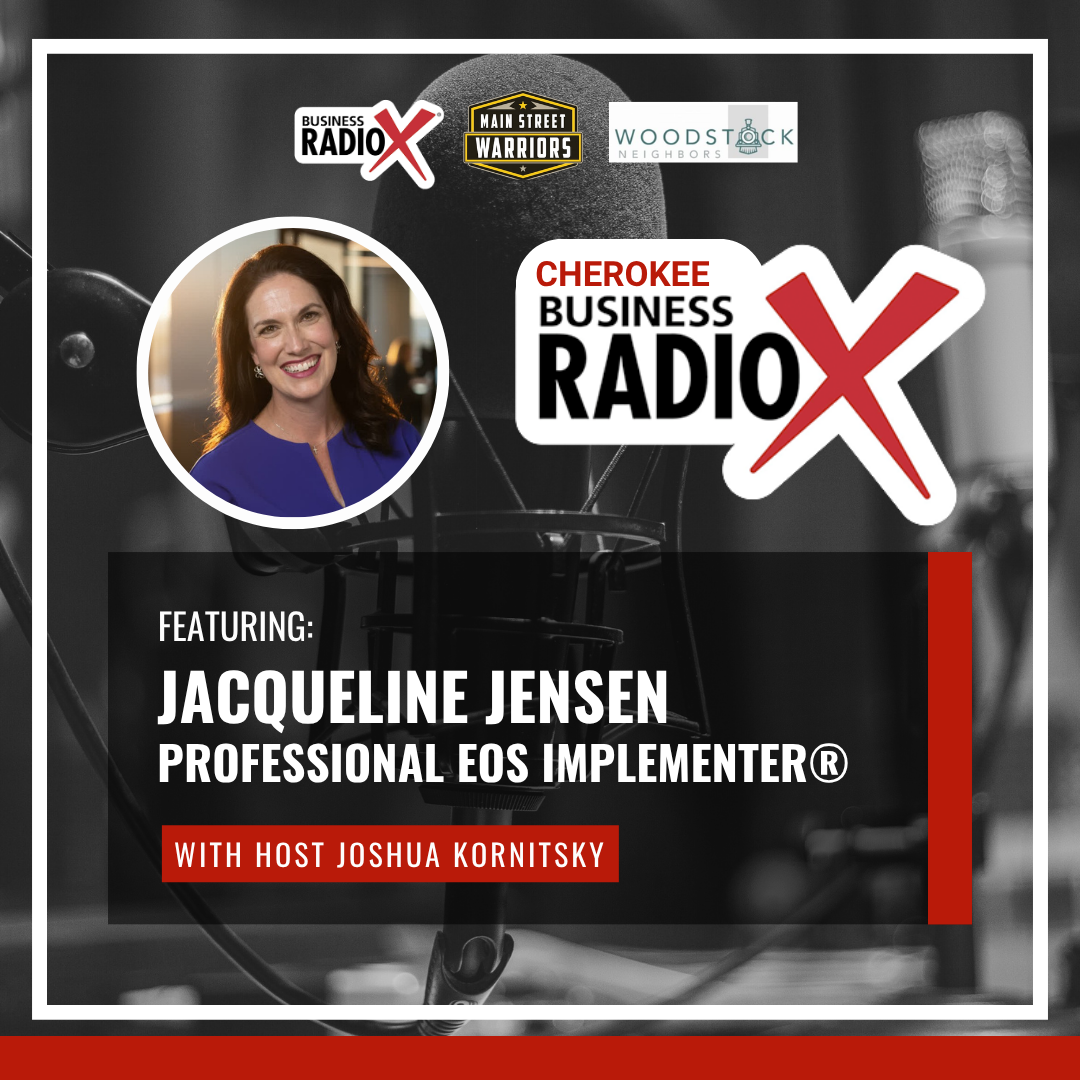
Jacqueline Jensen once led 120 people while working 70–80 hours a week—and spent another 10–15 hours learning and teaching her team EOS, the Entrepreneurial Operating System. After implementing it, her family’s private club reduced staff turnover by 34% and more than doubled profits. On this episode of Cherokee Business Radio, Jacqueline explains why a neutral facilitator can help teams surface inefficiencies, align around shared priorities, and make change stick. She also previews Get Traction, an October 22 panel where business owners from different industries will share what implementing EOS actually looked and felt like.
 Growing up in an entrepreneurial household, Jacqueline Jensen quickly learned that leadership comes with pressure, high expectations, and the need to step up before you feel ready. Those experiences taught her resilience, the value of guiding others with care, and the impact of servant leadership.
As a Professional EOS Implementer, she helps business leaders, specifically family business and service business owners, gain clarity, create traction, and build healthy, aligned teams. She is passionate about helping leadership teams create organizations where culture, vision, and results thrive together.
Jacqueline is also co-launched the ENRG (Entrepreneur Resource Network Group) in the Atlanta area – a space where EOS meets masterminding, accountability, and networking for entrepreneurs committed to growth. Through ENRG, leaders share ideas, gain insights, and support each other in moving the needle for their businesses while building meaningful connections in their community.
Whether working one-on-one with leadership teams or bringing entrepreneurs together through ENRG, Jacqueline’s goal is the same: to help leaders gain clarity, align their teams, and achieve their business goals—so they can focus on the impact they want to make in their organizations and their community.
Connect with Jacqueline on LinkedIn. 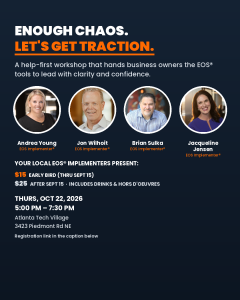
Get Traction: An EOS® Intro Session for Atlanta Business Owners
A help-first EOS® workshop for Atlanta business owners ready to trade chaos for a real plan. Real client panelists, real tools.
Thursday, October 22nd
5:00pm to 7:30pm
Atlanta Tech Village
3423 Piedmont Rd. NE
Atlanta, GA 30305
Episode Highlights
- Implementing the Entrepreneurial Operating System (EOS) in small and midsize businesses
- The benefits and challenges of self-implementing EOS versus working with a professional implementer
- Aligning leadership teams around a shared vision, priorities, and 90-day goals
- Building accountability, discipline, and healthier workplace relationships
- Reducing employee turnover and improving profitability through clearer operations
- Managing change and securing team buy-in when introducing a new operating system
- Identifying operational issues and overcoming business plateaus
- Using organizational checkups to assess alignment, responsibilities, and priorities
- An upcoming panel event featuring business owners sharing their experiences with EOS
- The types and sizes of businesses best suited to EOS and the event
 This transcript is machine transcribed by Sonix.
TRANSCRIPT
Intro: Broadcasting live from the Business RadioX studios in Woodstock, Georgia. It’s time for Cherokee Business Radio. Now, here’s your host.
Joshua Kornitsky: Welcome back to Cherokee Business Radio. I’m your host, Joshua Kornitsky. And I’ve got a really interesting guest who’s got something coming up that I can’t wait to share with everybody. But first, I want to remind everyone that today’s episode is brought to you in part by the Community Partner Program, the Business RadioX Main Street Warriors defending capitalism, promoting small business, and supporting our local community. For more information, please go to Mainstreet warriors.org. And a special note of thanks to our title sponsor for the Cherokee chapter of Main Street Warriors diesel David Inc. Please go check them out@david.com. My guest today is Jacqueline Jensen. Jacqueline is a professional EOS implementer here in Georgia, and she guides people first, business leaders from overwhelmed to clarity so their people and profits can grow together. Welcome, Jacqueline. I’m so happy to have you here.
Jacqueline Jensen: Thank you so much, Joshua. It’s great to be here with you this morning.
Joshua Kornitsky: I always learn something when I have a guest who works to improve businesses, because that’s what we’re always trying to do. So. So tell us a little bit about your background. Tell us how how you got to here and then we’ll talk about this great event you have coming up.
Jacqueline Jensen: Sure. Um, now I was that overwhelmed business leader. So I, at an early age, was working in the family business and was leading a team of about 120 individuals. Wow. And I was spinning my wheels, working 70 to 80 hours a week, just trying to figure out how do I keep our members happy? How do I make this a valuable place for our people to work? And how do I beat last year’s numbers? Because that’s what our ownership cared about. Sure. Uh, and so I was spending all this time looking for these secret source of reading leadership books and management books, and how do I run a better business, essentially, and lead individuals better. And I came across a book traction in 2019 and ultimately self implemented, uh, iOS into our business, which was a private club at the time. And for those who aren’t familiar, traction, uh, is a book written by Gino Wickman. And it is the entrepreneurial operating system outlined, uh, in a book, essentially. So once we implemented, once we implemented iOS, um, I went on that US journey that I now have the opportunity to take clients on and we went and completely converted. The culture of our club, got bought in, got buy in from our, um, from our staff and ultimately reduced our turnover rate by 34% and more than.
Joshua Kornitsky: Doubled.
Jacqueline Jensen: Profits over the last three years I was there. It was a really awesome journey. And so I kind of lived, you know, I got to live that iOS journey. And, um, ultimately I did leave the family business. And now I feel like this system was so transformational for me that other business owners and entrepreneurs, um, need an operating system in their business. Uh, one way or the other, because it’s there intentionally or not intentionally.
Joshua Kornitsky: Well, so I want to ask you a question. And typically I don’t ask questions about the origin story, but you used a term that I want to make sure everybody understands. You said you self implemented iOS. What does that mean versus what you’re doing now.
Jacqueline Jensen: Sure. And so I self implemented meaning that as the general manager, as a boss’s daughter, as the integrator within the EOS terms. Um, I also chose to learn EOS from the backside. Okay. In took my team, my leadership team through the EOS proven process, teaching the tools over about a two year period. Um, now I will say self implementing takes a ton of discipline. It was like another part time job for me. So on top of my 70 to 80 hours a week, I was spending about 10 to 15 hours a week, um, learning EOS and staying ahead of my team. Um, and then facilitating and teaching EOS when you are also the integrator and wearing all these other hats in the organization, uh, it slows the process down a little is what I’ve seen. So it just took us longer to get to healthy. Um, so when we think about teams and embarking on the US journey, we want to strengthen their vision where they’re going, getting teams 100% on the same page with where they’re going and how they plan to get there. And still discipline and accountability. So drive traction within the organization and then also help them become a healthier team. Someone that’s cohesive, open, honest, vulnerable, enjoys working with each other. Um, and it simply took us longer to get healthy, specifically when self-implementing because it’s just hard to wear that many different hats.
Joshua Kornitsky: So, so it sounds like, is that the real value of what you’re doing now is you’re able to take that load off of the organization.
Jacqueline Jensen: Absolutely. And integrators have carries so much weight, um, and pressure already to lead an organization to take on another part time job to learn a system, um, and instill it in an organization and take the leadership team down. A lot of, uh, it’s a lot to take on. And so now, as an implementer, like I carry the weight of teaching the system, knowing the system, reading the room, creating an open and honest environment for everyone to kind of on an equal playing field, um, discuss real challenges in an organization so that they not only implement the system well, but they also smoke out inefficiencies within the organization in an open and honest, we’re like no egos attached to it.
Joshua Kornitsky: Well, and it seems like that method of approach is going to you’re going to get a very different result when your boss is asking you the questions versus having a, a third party facilitator in the room who’s going to ask questions that everybody’s got to answer because it just has a different vibe, right?
Jacqueline Jensen: Oh, absolutely. Absolutely. And yeah, you’re just creating a space again where kind of there’s a level playing field and no one has to feel like, you know, oh, this person signs my paycheck.
Joshua Kornitsky: Right? Exactly.
Jacqueline Jensen: And and I’m asking for open and honest. And I’m like, well, I can’t point out the inefficiencies. They’re gonna take that personally. So a third person, a facilitator in the room can break down, um, those walls and help the organization move further, faster.
Joshua Kornitsky: So now you’re out there working with all kinds of businesses. What, what are you kind of hearing right now out in the world?
Jacqueline Jensen: Yeah. Um, what I’m seeing a lot right now is that teams love their people, right? They have people who are working really hard in organizations. Um, but sometimes there’s so many different, uh, objectives they’re chasing so kind of competing priorities, uh, amongst team members. And so you have these individuals who are high performers, they want what’s best for the organization, and they’re pushing really hard on the items they think is going to move the organization forward. Um, but then what happens is you have seven individuals who are all high performers, who all want to do really well, moving in seven different directions.
Joshua Kornitsky: Gee, what what problems could that cause? Right.
Jacqueline Jensen: And so then what does that feel like? You know, the owner is then what I hear from owners then is like, oh, I have great people, but I just can’t get them going in the same direction or I just can’t. Why won’t they just do what I say? Right. And sometimes it’s because the owner changes their direction every week. And that’s hard for teams. Um, and so that we start digging into the issues that may be underlying in that.
Joshua Kornitsky: So how do you help them sort of set that direction? What, what do you do?
Jacqueline Jensen: Yeah. So one of the things we do kind of early on in, uh, within EOS is help get that vision out of the owner’s head and onto paper. And so we use a tool called the vision traction Organizer. So a two page document that gets this vision of where is this organization? Clearly written down on paper so that the priorities are agreed upon and we know where we’re going. Long term, you know, ten, 30 years from now, we know exactly what it looks like in three years because we’ve created this picture. We’ve painted this picture of what it looks like and feels like to work in this organization three years from now, right? It’s gotten crystal clear on what we want to be true in one year. So what must we accomplish? And then even more drilling down to in the next 90 days, what direction are we moving in? What are the business priorities? And so now those high achieving individuals are focused on a small set of business priorities for the next 90 days. So when the owner comes and has this shiny idea, you’re like, okay, how does this fit in? Are we now pivoting or am I staying unified in this direction? And so by creating this vision, you’re getting everyone to understand it, see it, and choose to be a part of it.
Joshua Kornitsky: So forgive me. I didn’t mean to interrupt it. It sounds like this is all about getting everybody sort of on that same page, moving everybody in that same direction. It it, I’m sure it happens overnight, right?
Jacqueline Jensen: No. Not exactly. Um, but we made some really great progress in 60 days or less. Um, so it is, you know, that’s in the scheme of a business lifetime. It is kind of overnight. Right? If you’re thinking about a business that’s around for 15, 30, 70 plus years. Uh, 60 days is an okay, intentional, uh, commitment.
Joshua Kornitsky: I think people are always looking for magic pills or silver bullets. And, and it, it sounds like it’s a very realistic approach to that mindset because we live in in a society that’s looking for those instant results. But it sounds to me like even if you could flip that switch, it would it would probably do more harm than good rather than giving them the time to get accustomed.
Jacqueline Jensen: Absolutely. And I think that’s such an important piece, right? When you’re choosing. I mentioned early on that every business has an operating system, intentional or accidental.
Joshua Kornitsky: Okay.
Jacqueline Jensen: Right. So if we’re intentionally choosing an operating system, there’s a piece of change management that fits into that as well. And individuals have different emotions attached to the idea of change.
Joshua Kornitsky: And some individuals very diplomatic way of making that statement. I love that.
Speaker 4: But it’s true. It is.
Joshua Kornitsky: And it’s very, very personal.
Jacqueline Jensen: And I think sometimes what we forget is as an owner or as an integrator who says, okay, iOS, yes, iOS is for us. Typically, we’ve seen that business owner or that leader, that integrator has spent some time reading traction or reading Get a Grip, which is a fable. Um, the storyline of a company making that transition to run on iOS.
Speaker 4: Okay.
Jacqueline Jensen: Um, and so without even realizing it, they are taking time to invest in learning more about it and convert to this idea of like iOS will help us. And then what is that business owner or integrator do? They go to their team and they’re all excited and they’re like, come on guys, get on board. Let’s go. We’re doing this. And they forget that their leadership team also needs that time to buy in and consider like, oh, maybe there is a better way to operate. Or maybe we have been operating under this accidental system. Um, without the intentionality or clarity that’s needed to really drive us forward. And so we need to make sure that we’re providing as business leaders, we need to make sure that we’re providing the time for the rest of the organization to buy in to this change.
Joshua Kornitsky: So really, what has to happen for a system like this to work within the organization itself?
Jacqueline Jensen: Yeah, it starts with the leadership team.
Speaker 4: Okay.
Jacqueline Jensen: It starts it starts with buy in at the top from the owner, from the visionary, from the integrator, from the leadership team. Um, and to go through the, the process that Gina really did build this system and pull every lever and make sure that he was very intentional about what tools are taught where in the process. And it’s amazing to see a team come on board with an implementer. And, you know, you start out in the first session, it’s always like a little overwhelm.
Speaker 4: And sure.
Jacqueline Jensen: And then you see kind of the mindset start changing and, and the understanding improve of what the intentions are, um, behind implementing the system. And then all of a sudden the buy in of what it can do for our organization. Um, so there is some, some space learning, as we call it, that needs to happen within the organization to allow the leadership team to buy in and be really clear about the direction of the organization, what the priorities are, and start building a healthier team. And then we find like, where goes the leadership team? So goes the rest of the organization.
Joshua Kornitsky: I think that’s reasonable. I, you know, because they’re going to follow that lead. Um, so. Are you working with failing businesses? Are you working with turnaround businesses or are you working with, uh, businesses that are already kind of in motion. Because when the example you gave about your own family business didn’t sound like it was a business in trouble.
Jacqueline Jensen: Yeah, that’s a great point. Um, yeah, these businesses, like we even said in the family business, um, we weren’t broken. Right, right. We just knew that we had this regular frustration. And as the leader of the organization, especially one that is so customer service based, um, it was vital for us to have staff who bought in and loved our members and provided the level of service that we desire to deliver to them. Uh, and you can’t do that when you have exorbitant, like turnover within the organization.
Joshua Kornitsky: Because nobody knows who anybody is.
Jacqueline Jensen: So that was my pain point for, you know, and working 70 to 80 hours and every person coming to me, that was a lot too. Um, but the level of service we were providing was my pain point. So we weren’t broken. We were doing well. So the business owners that I enjoy working with are are similar. You built a successful business, you’ve just probably hit some sort of plateau or you have this regular frustration or this knowledge of, I know there’s a better way, right? You kind of have this tug in, whether it’s in your gut or your heart or your head. You’re like, I know there has to be a better way. It doesn’t have to be this hard. Um, but they, they built successful businesses. And then I do enjoy working with family business because that transition from first gen to second gen or whatever the next gen is, uh, is so exciting for me and I’ve been in that position. And so I understand the nuances of family business.
Joshua Kornitsky: So if someone’s listening to this and they’re like, yeah, you know, we’re doing all right, but there is definitely room to grow. So how can they assess where their business is today?
Jacqueline Jensen: Yeah. Uh, so us has a, checklist, if you will. So the organizational checkup that’s available on on the US worldwide website.
Speaker 4: And that’s a great place to go.
Joshua Kornitsky: You have a link you can share with us.
Speaker 4: So we’ll.
Joshua Kornitsky: We’ll post that link up so somebody can go through that.
Jacqueline Jensen: Yes. And so it’s about 40 questions and it goes through or 20 questions. And it goes through, um, kind of how do you feel? Is everyone aligned around a vision? Do individuals understand what the priorities are for the next 90 days or are they chasing their own priorities? Are they really clear on what their role and responsibilities in the organization are not their job description, but actually what they’re responsible for executing on on a regular basis? And so it’s a really interesting checkup, uh, to go through and ask. And it’s cool to have not only the business leaders and leadership team do this checkup, but the entire team do it because you receive a different perspective.
Joshua Kornitsky: I think that’s a really interesting point. So that leads me to ask, tell me what’s happening on October 22nd.
Jacqueline Jensen: Yeah. So on October 22nd, um, myself and three other Illinois based EOS implementers are hosting a very help first, um, event called Get Traction at Atlanta Tech Village in Buckhead from 5 to 730. Um, and this event is bringing together three other business owners on a panel who have implemented EOS in their organizations. And so the value here, and I don’t know if this resonates with others, I tend to be a high fact finder. So I love to hear, um, and know everything before I make a decision. I do a lot of research. So by bringing these three panelists together, business owners get to hear from them what it was like to implement EOS, what it felt like to their team. How did they make the decision, you know, when did they start to feel the impact in their organization? What’s been the outcome? What has their journey been? Answer some of those questions for them.
Joshua Kornitsky: Oh, so it’s an interactive panel. It’s not just them extolling what he always did.
Jacqueline Jensen: Exactly.
Joshua Kornitsky: Oh that’s.
Speaker 4: Great. So if you’re.
Joshua Kornitsky: A business owner and you want to hear about it, you can actually ask somebody who’s in it.
Jacqueline Jensen: Absolutely. And they’re there and they’re from all different industries and backgrounds. We have family business built in. We have manufacturing built in. We have some construction or security built in. Other teams that have gone, you know, iOS has smoked out some real issues within their business and then how the system has helped them decipher and ultimately solve or work through, um, those challenges because every business is going to go, you know, every business has issues and issues don’t have to be negative, just an option, an opportunity to, to optimize or operate more efficiently.
Joshua Kornitsky: So with this event, and I’ll repeat, it’s at the Atlanta Tech Village on October 22nd from 5 to 7 p.m.. Um, I know you shared with me before we started that there’s an eventbrite link. We’ll publish that eventbrite link. So you don’t have to read that long thing out. Uh, so that everybody will have it with the podcast so that they can click on it to, to come learn more. What are you hoping that that people take away from that event? And, and it’s the get traction event, correct?
Jacqueline Jensen: Yes. It is a get traction event. Um, I’m hoping that business owners get that real life experience. Like I know when I was looking on and this system really do what it says, like, of course the book is gonna publish it in a great light. Of course, implementers are going to speak of it positively. Right? But I want to hear from those business owners who are actually doing the work. You know, what did it do for them? How did it help them? Um, so I love and I hope that attendees can come and ask those questions that are relevant to them, their business and, and personally, their leadership styles. Ask it of this panelist. Um, so that they feel comfortable with whether or not us might be something, um, that they want to take a more intentional approach at building an operating system within their organization.
Joshua Kornitsky: So let me clarify a little further just to be on the safe side. Who is this event? Um, best for, you know, if I’m a solopreneur, not taking anything away from them. Is EOS the right scale for, for someone just starting out, or is this intended for what size organizations are the best fit?
Jacqueline Jensen: Yeah, that’s a great question. Thank you. Joshua. Um, so this event is really geared towards those successful business owners. Again, you already have a business you’re really proud of. You’re generating real revenue. You have a team of probably ten to maybe 250 employees.
Speaker 4: Okay.
Jacqueline Jensen: Um, yeah. So little, you know, a little larger small to mid-sized company. Uh, we love our solopreneurs as well or early stage entrepreneurs. And if individuals are in that position, kind of less than ten employees, um, or you’re just starting out, like I encourage them to reach out to me as well. I love working with early stage entrepreneurs, but this event probably isn’t the place for them yet. Um.
Joshua Kornitsky: And that’s what I wanted to get clarity on because it’s less with respect about wasting time. It’s just, it’s a shoe too big right now. If, if you’re a 2 or 3 person operation, I know you have other things you can help them with, but this event is simply a little, um, outsized for them. So while the information might be interesting, it’s probably not applicable or useful. It sounds like.
Jacqueline Jensen: Absolutely, yes. It’s not. You’re exactly right. So she’s just a little bit too big. Um, but we love to work with them and encourage them and cheer them on and also provide resources that can meet them where they are at currently. So they are welcome to reach out.
Joshua Kornitsky: I think that’s great. I think that’s a very help. First, as you said, mindset to help those individuals grow. I just always I’ve been the guy in the wrong place. Uh, and when you show up to an event and, you know, this is for companies that make $700 million and above, I’m like, oh, I don’t belong here. Um, so I, it, it saves them time and it saves you the, the, um, having to get them into the right mindset. But when they grow and they’re ready, it’s good to know that it’ll be there. Um, is there a cost to the event?
Jacqueline Jensen: So the event is $25 and it includes some light orders and refreshments and the opportunity to connect with other business owners in the room. Not just the panelist, but other business owners that come as well.
Joshua Kornitsky: That’s fantastic. And you? I want to ask, rather than assume, will you be sharing other information beyond the panelists about EOS?
Jacqueline Jensen: We will. We’ll do a brief overview of what EOS is, what an operating system is, and the model. But it’s going to be very brief. The meat of the meeting is going to be with the panelists, who we believe are bringing the most value. We’ll just provide a baseline understanding of us for those who may not be familiar with it at all.
Joshua Kornitsky: And if people want to learn more, I’m sure you can help them.
Jacqueline Jensen: Yes, absolutely. No. And I know we’ll provide the in the show notes, a link to the eventbrite site for get traction and and some other resources for those who wish to reach out and learn more.
Joshua Kornitsky: Fantastic. Well, Jacqueline, is there anything else that we needed to cover? Because I think we we talked a little bit about you. We talked a little bit about EOS. We talked about the Get Traction event on October 22nd from 5 to 7 at the Atlanta Tech Village. Is there anything else that you’d like to share before we go?
Jacqueline Jensen: No, I don’t believe so. I think we covered about everything. We would just love to see, um, those business owners who maybe are just feeling a little frustrated with their people or their profits, or they just know that there’s a better way of operating. Uh, we would love to welcome them on October 22nd to Atlanta Tech Village from 5 to 730.
Joshua Kornitsky: Oh, I’m sorry, I think I cut 30 minutes off. I apologize, I said 5 to 7. Um, well, thank you again. My guest today has been Jacqueline Jensen. She’s a professional implementer of the entrepreneurial operating system here in Georgia. And she guides people first, business leaders from overwhelmed to clarity. So there are people and prophets can both grow. Jacqueline, it’s an absolute pleasure to chat with you. Thank you again for coming on the show. Uh, and I do also want to take just a moment to thank our sponsor. Today’s episode is brought to you in part by the Community Partner Program, the Business RadioX Main Street Warriors defending capitalism, promoting small business, and supporting our local community. For more information, go to Main Street warriors.org. And a special note of thanks to our title sponsor for the Cherokee chapter of Main Street Warriors Diesel David Inc. Please go check them out at diesel. David.com. This has been another exciting episode. My name is Joshua Kornitsky. Thank you for joining us here on Cherokee Business Radio. We’ll see you next time.