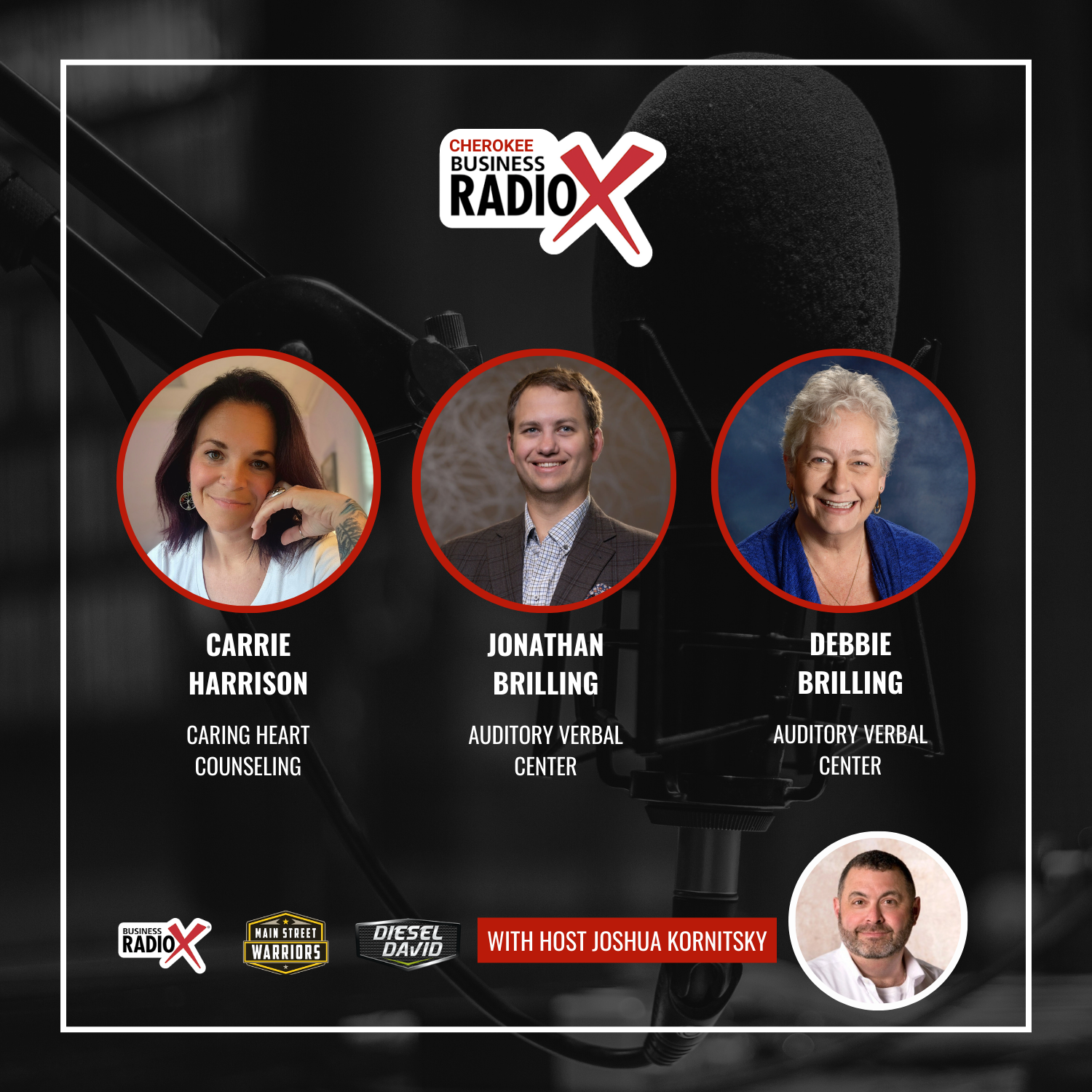

Brought to you by Diesel David and Main Street Warriors

In this episode of Cherokee Business Radio, host Joshua Kornitsky welcomes two organizations making profound impacts in Georgia communities. Carrie Harrison, licensed professional counselor and founder of Caring Heart Counseling, shares her journey from probation officer to therapist and her mission to provide a safe, affirming, judgment-free space for individuals navigating anxiety, identity questions, life transitions, and emotional challenges. She discusses the importance of small goals, accountability, and normalizing mental health conversations.
Joshua then speaks with Debbie Brilling and Jonathan Brilling from the Auditory Verbal Center (AVC), a nonprofit that teaches deaf and hard-of-hearing children—and adults with cochlear implants—how to hear and speak without relying on sign language or lip reading. Debbie shares her powerful origin story as a mother of two profoundly deaf children, both of whom successfully graduated from AVC’s early-intervention program. Together, Debbie and Jonathan explain how early testing, specialized therapy, telehealth services, and barrier-free access help Georgia families transform hearing-loss outcomes.

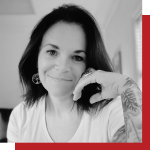 Carrie Harrison, owner of Caring Heart Counseling, graduated from Kennesaw State University with a BS in Psychology in 2000 and after working for several years with troubled teens, she went back to school and obtained her MS in Professional Counseling from Georgia State University.
Carrie has a passion for helping others navigate through the ups and downs of life while providing a safe space and non-judgmental environment for you to explore what it is you are struggling with. She’s been a therapist for over 15 years and has owned her own practice for 5 years.
When Carrie isn’t working, you can find her either at the baseball field cheering on her son, or outside enjoying nature, hiking, reading or enjoying her wide variety of animals.
Follow Caring Heart Counseling on Facebook.

 Jonathan Brilling is a mission-driven marketing and outreach professional dedicated to improving the lives of the deaf and hard-of-hearing community.
For more than eight years, he has served as Outreach & Development Director at the Auditory-Verbal Center (AVC). In this role, he has led donor engagement, fundraising events, mentoring initiatives, and strategic partnerships that expand access to listening and spoken language services—across Georgia, throughout the U.S., and globally.
Jonathan’s mission is to ensure every parent knows their child can learn to hear and speak, and that they have a choice in shaping their child’s journey. He believes every child deserves the chance to hear their parents say, “I love you.” His leadership extends into statewide advocacy.
In 2017, he served on the committee that developed and helped pass Act 462, a law designed to improve the quality of care and language-literacy outcomes for deaf and hard-of-hearing children in Georgia.
He also serves on Georgia Pathway, an initiative committed to ensuring children reach grade-level reading proficiency by third grade, as well as the EDHI Stakeholders Committee and the Advisory Committee for the Georgia Commission for the Deaf and Hard of Hearing.
In addition, Jonathan is a board member of the Georgia Chapter of the Alexander Graham Bell Association. He is also a member of the International Kiwanis, in the Doraville/Tucker Kiwanis Club.
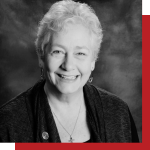 Debbie Brilling was raised in Puerto Rico and moved to Georgia to attend college at Berry College in Rome, Ga where she earned a Bachelor of Science in Business with a minor in Economics
Prior to joining the AVC staff, she owned her own mortgage company for 16 years. 21 years ago Debbie volunteered her time as a member of the board of directors for the Auditory-Verbal Center and then was asked to join the staff in Sept. 2002 and has been the CEO since then.
She is a member of the Alexander Graham Bell Association, Georgia’s Early Detection and intervention (EDHI) advisory committee, and Georgia Pathway to literacy program.
She is actively involved in Kiwanis having served in various leadership roles in her division and on a district level and has received various awards over the years for her passion and commitment to Kiwanis.
She currently serves as Past Governor, chair for the Buck-n-ear program and treasurer for the Past Lt. Gov association. She is currently a member of the Brookhaven-Chamblee, and Doraville/Tucker clubs.
Debbie is dedicated to reaching out to all children who are deaf or hard of hearing to help them learn to listen and speak and to become independent communicators.
Follow AVC on LinkedIn and Facebook.
Episode Highlights
- Mental health progress begins with trust and small, realistic goals — Carrie emphasizes that therapy is not a quick fix; it’s a process built on accountability, partnership, and practicing coping skills outside the therapy room.
- Stigmas still hold people back from seeking help — Carrie notes persistent misconceptions that therapy implies weakness or being “broken,” stressing instead that mental health care is just as essential as physical health.
- The Auditory Verbal Center teaches deaf children to hear and speak — Debbie and Jonathan explain their early-intervention program that uses specialized auditory-verbal therapy to help children with mild to profound hearing loss develop spoken language.
- Early detection and intervention are critical — Georgia’s “1-3-6” model (screen by 1 month, diagnose by 3 months, begin intervention by 6 months) dramatically improves outcomes for children with hearing loss.
- AVC removes barriers for families statewide — The organization never waitlists a child or turns anyone away for financial reasons, offers Medicaid support, provides teletherapy, supplies equipment, and even installs internet when needed to ensure every family can access services.
 This transcript is machine transcribed by Sonix.
TRANSCRIPT
Intro: Broadcasting live from the Business RadioX studios in Woodstock, Georgia. It’s time for Cherokee Business Radio. Now, here’s your host.
Joshua Kornitsky: Welcome back to Cherokee Business Radio. I am professional EOS implementer and your host, Joshua Kornitsky. And I’ve got some really interesting and exciting folks here in the studio with us today. But before I get started, I want to remind everybody that today’s episode is brought to you in part by the Community Partner Program, the Business RadioX Main Street Warriors Defending Capitalism, promoting small business, and supporting our local community. For more information, please go to Mainstreet Warriors and a special note of thanks to our title sponsor for the Cherokee chapter of Main Street Warriors. Diesel. David. Inc. Please go check them out at diesel. david. Com. Well, as I said, I have a really interesting and exciting group of folks here in the studio today and it is my great pleasure to start by introducing everyone to Carrie Harrison. Carrie is a licensed professional counselor. She is the founder of the Caring Heart Counseling. And today, what we’re going to be doing is talking about how she provides a safe, confidential and affirming space for individuals navigating anxiety, identity questions, life transitions, and challenges that come with feeling misunderstood or unheard. Her practice supports people across the community who need a place where they can feel welcomed, respected and genuinely seen. We’ll explore the purpose behind our work and the difference that it makes every day. Welcome, Carrie.
Carrie Harrison: Thank you for having me.
Joshua Kornitsky: Thank you so much for being here. Um, you know, let’s begin at the beginning. I always like to ask the origin story. So what shaped your view of the world that made you want to be in this space?
Carrie Harrison: It’s a good question. Um, I actually graduated many years before I went back to grad school. I graduated from KSU with my psychology degree, but had no clue what I wanted to do. Okay, and ended up being a probation officer for troubled youth for ten years.
Joshua Kornitsky: Oh, wow. You’re here local.
Carrie Harrison: In Cobb County.
Joshua Kornitsky: Okay.
Carrie Harrison: Yes, yes. And somewhere along the lines of that, I had a lot of kids coming up to me telling me that this was going on at home or this was going on at home, or they were getting bullied at school or something was going on, and I couldn’t do anything about it. I didn’t know what to say. I couldn’t help them. My job wasn’t to take care of their mental health, it was to do something else. And I knew I wanted to do more.
Joshua Kornitsky: Was there a specific incident, or it was just this driving desire to to be able to do more, to help more.
Carrie Harrison: I just wanted to be able to do more, to help more. I knew I didn’t want to be a probation officer for the rest of my life. I knew I wanted to kind of help and give people a safe space to come and talk to and feel heard and understood.
Joshua Kornitsky: Makes sense to me. And I guess my first question is you heard me. Do my best to describe what you do. How do you describe what you do? Because I think hearing it in your own words will help people connect better.
Carrie Harrison: Sure. I well, and I want to kind of go a little bit more into the origin of. I actually started after I graduated and did, um, my internship and all of that with some mental health counseling and addiction, which is what I thought I wanted to do. I taught at Ccsu for several years.
Joshua Kornitsky: Oh, okay.
Carrie Harrison: And in that teaching, I ended up specializing in gender identity, gender studies, men and women as well as human sexuality. And that really kind of took my passion to a whole new level in there. So what I tried to do is I provided a safe space, um, and a calming space for anybody who walks through my door. Doesn’t matter who you are to have a place that you can come to, that you can be sure that you’re not being judged, that you are not feeling, um, that everything’s focused on you. It’s all focused on you for you to explore whatever’s going on in your world, however that may look.
Joshua Kornitsky: Sure. And that based on your time teaching at KSU, I can see how that probably bubbled up, because I’m I imagine that it was something that you got to see a lot of, because it’s traditionally younger folks that are still figuring out who they are.
Carrie Harrison: Absolutely. Absolutely.
Joshua Kornitsky: Thank you for tackling such a difficult subject. When when you talk to folks about what you do. Um, you’re not focused in just one area. You’re kind of across the board. What do you find usually makes a light go on for them. And obviously everything ties back to you and where the people you’re speaking to, where they are. But is is it Help us understand the best way to open the door to have the conversation, I guess.
Carrie Harrison: Sure, a lot of times, my very first thing I say to anybody who walks through my door is my job is to work myself out of a job.
Joshua Kornitsky: Okay.
Carrie Harrison: I don’t want them to have to be with me and rely on me for the rest of their lives to get through anxiety or stress or depression or whatever. I want to be able to help them find the tools that they can utilize in their day to day life so that they can go out, live that fulfilling life. Live a life that look. Anxiety comes, stress comes, we get sad. And that’s part of life, right? But it’s those tools of how to handle that. So that doesn’t become their life. It doesn’t become all that’s surrounding them.
Joshua Kornitsky: So I want to ask this as delicately as I can when, when, when people decide that they want to seek help. What are some of the. Well, let me back up. If someone’s not sure if they need help. What are some indications to help them understand that?
Carrie Harrison: I usually ask when they tell me they’re not sure if they need it, or they they’ve got it figured out. I’ll ask them a lot of times is how is that working for you? And that question right there usually goes, well, no, I mean, it’s not or I’ve been trying this for years and it’s not working. Okay, then let’s try something different. Can we try something this way? But a lot of times they come into my office with a really big picture. I want to feel better. I want to feel. I don’t want to have anxiety. I don’t want to have panic attacks. It’s a really big picture. And therapy, unfortunately, is not a quick fix. It is a process. And the more you work on the outside, other than just in my office, the quicker it goes. But I can’t promise you in three sessions you’re going to be anxiety free.
Joshua Kornitsky: No. No guarantee. One and done.
Carrie Harrison: Um, I wish it was that easy, but no.
Joshua Kornitsky: So. So how do you help guide folks, because I understand that. And it’s a weird parallel, but but as a business coach, you know, everybody wants the problem fixed right away. Um, I know what I tell them, but I’m just dealing in business. You’re dealing with their lives. How do you help them approach when when they bring you an elephant into the room and they say, okay, you know, I need this solved? Sure. What what are generically because obviously every case is going to be a little bit different. Yeah. Where do you start?
Carrie Harrison: I asked them to come up with a smaller goal. If we can look at small goals, whether it be a month out or three months out, if we can look at small goals and getting those set, then they can see progress, which then usually keeps them of feeling that motivation to either keep coming or to keep growing and to keep progressing. But usually with those smaller steps of okay, I hear you want to have a life with or without anxiety. However, what can we do? What are some tangible goals in the next 2 or 3 months that you want to tackle? Let’s learn some coping skills. Let’s learn some techniques that will may help you feel better in that process. And so that kind of gives them that sense that they’re actually doing something. They see that progress. They’re working towards it.
Joshua Kornitsky: And is there. And I know this may sound a little silly, but how how how critical to your process is bidirectional trust.
Carrie Harrison: Oh, extremely.
Joshua Kornitsky: Right. So in the reason the reason that I asked that is, um, and this is in the form of a question, um, understanding how you eat the elephant in bites, as we say in my house, is, is also, I presume that their confidence in your ability to help them help themselves grows over that arc of time.
Carrie Harrison: Right.
Joshua Kornitsky: So is that something in in all of this is by way of asking, do you try to communicate that on the front end, or is that a lesson they just have to learn?
Carrie Harrison: You know, honestly, it really depends on my client of if I feel like that’s something that they would understand in the front end. I kind of try to get a sense of some of that on the front end.
Joshua Kornitsky: Okay.
Carrie Harrison: Um, but they do have to I have to trust that they’re going to do it, and I have to. I’m not one of the counselors who doesn’t call you out. I will say it that way. I don’t.
Joshua Kornitsky: High level of accountability.
Carrie Harrison: Yeah, I’m going to hold you accountable, but ultimately, it’s up to you. If you were to walk in my office, ultimately it’s up to you of what you take from what we talk about in our 50 minute session and apply to the rest of your life if you don’t apply it. I can’t do much about that. And I do say that up front. I can’t do much about that.
Joshua Kornitsky: And that very much parallels what being a business coach is like, because I can tell them what to do or suggest to them a course of action. Um, but that that because I’m going to turn this into my own therapy session. Right. Is is it makes me wonder what are some of the ways that you can help people that that understand? Okay, I need to do A, B and C in order to advance towards my goal. Mhm. When they come back and they haven’t done any of it. How do you help them break that. And I know that that’s a complicated question. I don’t know if you can give a generic answer.
Carrie Harrison: It is a little bit harder to give a generic answer if I see that being a um, something that is happening over and over and over where they’re just not putting that into work, I will then try to redirect and find out why. Why is that so hard to do on the outside? What is I talk about blocks a lot. There’s some sort of block that comes up for you that doesn’t want to put that in action.
Joshua Kornitsky: So it becomes its own issue. I it makes a lot of sense. Um, and I am absolutely looking for cheat codes here because it’s, it’s very much a problem that, that I run into all the time of, oh, we know we need to do A, B and C, but We just didn’t. Okay, well, you know, if you do nothing, nothing changes.
Carrie Harrison: It becomes a problem in itself. But at the same time, it’s finding what motivates them to do it. So I like to work with my clients as a team. I have a whole list of things that I can give them. A whole bag of tricks, as I say, right? But it’s got to what works for them. If I ask somebody to to journal or meditate and that’s not what they want to do, that’s not what they’re going to do. But if I tell somebody who enjoys outdoors or things like that to go for a hike, guess what? They’re going to go for a hike and they’re going to do it.
Joshua Kornitsky: And they’re going to inadvertently meditate, whether they realize it or not.
Carrie Harrison: Exactly. Exactly. So it’s finding those things of what works for them, what they feel comfortable doing, and what really kind of speaks to them, and to help them kind of find those tools, because it all ends up in the same place as well.
Joshua Kornitsky: And ultimately, you’re really I’m have to remember to ask the question and not lead the witness. Ultimately, our people and this is a weird statement, but I ask it for a reason. Are people broken or are people simply not understanding who they are? Because I have two daughters and I will not say anything other than I have two daughters. And and often as they’ve grown up, the perception was, you know, I’m broken, there’s something wrong with me. And as parents, my wife and I would always try to help them understand. Number one, everybody is different. But. But there is no broken. Everyone is put together with different puzzle pieces.
Carrie Harrison: Correct. I don’t think anybody is broken. I don’t think anybody is broken. I think that’s a huge stigma around mental health is if I’m going to mental health, then something’s wrong. I’m broken, I’m weak or something like that. And no, I don’t think it’s anybody’s broken. Although I do have a sign in my office that says broken crayons still color.
Joshua Kornitsky: There you go.
Carrie Harrison: So. But it’s not a broken thing. It’s. There’s so much behind it, but it’s a lot of times not knowing what to how to handle what we’re dealing with or the emotions or the feelings or the situations we’re dealing with. It’s and not knowing who you are. You’ve been told so many things throughout your life of what to be or how to be, and it’s finding that authentic self.
Joshua Kornitsky: I think that’s a great point. And that really brings me to the biggest question that I have, which is something we were talking about before we even started. Um, what are what? Even though it’s 2025, and even though we are all much more in touch with who we are as human beings, and we all got to take a year and a half of Covid to reflect. Uh, what are the misconceptions that are still that that just won’t go away about mental health? What are the stigmas that are out there speaking as a man with no mental health issues whatsoever? I can’t begin to imagine why this is even a subject. I’m being sarcastic.
Carrie Harrison: There is a lot of mental health stigma still there, even though it is much more accepted or we’re working in that direction. There’s still a lot of mental health. Like I said, it’s you’re weak for having to go. Um. You’re broken. There’s something wrong with you. But I think it’s also a, a luxury for a lot of people. And instead of thinking of it as part of our health journey, we’re thinking of it as a luxury. So you go to the doctors, you go get your physicals, or you go to the doctors when something’s wrong, you know, um, you go to the dentist and you get your teeth cleaned. You go to the eye doctor to get your eyes checked. All of those are health things. But what about your mental health? That’s just as important as all those other things. Because ultimately, stress, anxiety, depression, trauma, it lives within our body. And if we don’t take care of that, it’s going to manifest itself in physical ways.
Joshua Kornitsky: Excuse me. So. What? Other than drawing attention to the fact that these misconceptions still exist, that people still make these assumptions about mental health? What can we do to help educate people to realize that, that this is just another part of the machine that needs to be taken care of?
Carrie Harrison: Talk about it. I think talking about it is huge. I don’t think it’s still this taboo that people don’t like to talk about going to therapy, or dealing with anxiety, or dealing with trauma or dealing with any sort of loss. I think that a lot of people still kind of keep it close to their hearts. It’s a very personal thing, and I understand that. I’m not saying you have to go out there and say, hey, here’s all my problems. Let’s do this. It’s it’s talking about that. It’s part of our life. Yes. I go to a therapist or yes, I’m talking about this or I deal with anxiety. Also, it’s, you know, the nervousness that comes up with things it’s talking about and making it more normal, normalized.
Joshua Kornitsky: So that people just understand that this is everybody.
Carrie Harrison: Correct?
Joshua Kornitsky: That’s that’s a really insightful perspective on that. Um, what are so I asked humorously, but understanding that as a man. Right. Men are generically in a in a stereotype that they are resistant to talking. That’s not obviously always true. But what are some of the stereotypes as as a father of two daughters. Right. What are some of the stereotypes that women are fighting with regards to mental health? Because I don’t want to just ask about myself.
Carrie Harrison: Well, I think that’s a great question. And women. Women fight stereotypes just as much as men do. Men are taught throughout growing up a lot of times, and I don’t want to generalize it to all men, but a lot of men are taught to kind of suck it up, deal with it, don’t cry, rub some dirt on it, whatever it may be. Um, and women are seen as the emotional ones, so we’re seen as the weaker ones. So I think the stigma that they deal with a lot of times when it comes to therapy is, oh, of course you’re going through therapy, you’re weak, you’re a woman, you know, you’re overthinking things, you’re too emotional. You’ve got to take control of that. But there’s a lot of, a lot of, um, problems that kind of go along with that too, that have a hard time.
Joshua Kornitsky: And I have to ask this one, what do you see? Or how do you see in this a broad category, things like social media impacting mental health.
Carrie Harrison: Oh my God it you’ve opened a whole can of worms on that one.
Joshua Kornitsky: Well, and I want to be specific because I’m not just talking about teens or early 20s. I’m talking about people in their 30s, 40s, 50s and 60s.
Carrie Harrison: There is there’s so many different ways that can go. Can it be positive? Absolutely. It keeps us connected to people that don’t live with us or across the United States or wherever. And there’s a lot of the positive kind of things that you can find on there and and those ways, it’s fantastic. However, it comes with a lot of judging. I hear a lot of that of I’m looking at so and so and they have this great life or they have all the they seem happy they’re going traveling, they’re doing this, they’re doing that. And I’m not doing any of that. Okay. Well they’re only posting the stuff they want to write.
Joshua Kornitsky: It’s an edited it’s a highlight reel that you got to edit.
Carrie Harrison: Exactly. But on the so that’s a huge problem. Um, everybody turning to TikTok for to be their therapist is.
Joshua Kornitsky: That’s not healthy.
Carrie Harrison: I have to roll my eyes. I can’t roll them hard enough on that one. Um, are there some legit things out there? Probably. But how many times do I hear somebody say, well, I saw on TikTok or I diagnosed myself on TikTok, please don’t do that. Um, but turning to all of that and thinking that that is right, you’re not you don’t know if you’re dealing with a licensed therapist. You don’t know if you’re dealing with somebody who is talking, you know, off the top of their head you don’t know what’s going on. And then another problem with social media is the amount of time that we are looking at our phones, taking out the the health part of things, that amount of time we’re looking at our phones and it’s taking our attention away from being present in the moment, from what we’re having to deal with, what we’re going through. It’s a distraction technique, but it’s it just bottles everything up more so, and we’re spending hours and hours online and not being present with those around us or even just in our life.
Joshua Kornitsky: Is that something that you can help people with?
Carrie Harrison: Oh, absolutely. I love bringing people into.
Joshua Kornitsky: Yeah, I think that of everything we’ve talked about, that’s the one that I think has become pervasive in every human being’s life that I know. And it it certainly I am not qualified to call it an addiction, but it certainly if if you were making a list of what’s on the list of things that mean you can’t give it up easily. As a guy who used to smoke. Uh, it sure seems like it’s a version of a cigarette.
Carrie Harrison: Oh, absolutely. I think it is. They’re looking at it possibly being listed as in the addiction thing as being on their phones and social. Not just social media, just phones in general. I mean, it’s a mini computer in our hands, but I love to work through and practice mindfulness techniques. Um, with my clients. I actually have a whole YouTube channel that I’ve started recently.
Joshua Kornitsky: Please tell us the tell. Well, we’ll publish the links, but do you, do you know, off the top of your head?
Carrie Harrison: Carry underscore. Carrying heart.
Joshua Kornitsky: Okay. Perfect.
Carrie Harrison: And so what I try to do there it’s guided meditations mainly.
Joshua Kornitsky: Okay.
Carrie Harrison: Um, but it is to kind of help just there’s short ones trying to kind of help you get more into your body and more present in the moment, even if it’s ten, 15 minutes. It’s little things like that. I’ve just recently started, so there’s only a couple on there, but I’m trying to add more. I practice a lot of mindfulness with my clients, a lot of just kind of being present in the moments and giving them tools to do that on the outside, too.
Joshua Kornitsky: Last question before I ask how people can get in touch with you. Do you how do you feel about the future? Generically, I’m not talking about politics. I’m just talking about in general. You deal with with a lot of people. You deal with mental health. What, how how do you see the future of mental health?
Carrie Harrison: I have hope for it, I really do. I have hope for I see more and more people reaching out for it. Um, it’s it’s a difficult time for a lot of people. I work with a lot of LGBTQ clients, so it’s an especially troubling time for them. So, um, so I know that there’s some there’s some backward sliding in a lot of ways that is causing people to reach out. But I do see a lot of hope that it’s becoming more normalized and more talked about.
Joshua Kornitsky: That makes all of us, I think, feel better. I know it makes me feel better. Um, Carrie, what’s the best way for people to get in touch with you?
Carrie Harrison: I have a website. It’s Caring Heart Counseling, LLC. Com.
Joshua Kornitsky: Okay.
Carrie Harrison: I’m also on Facebook, and I just also had I gave you the link to my.
Joshua Kornitsky: And when we publish and go live with with the interview, we will have all of those links if you’ll share them with us. Um. Thank you. I really found it an insightful conversation. I appreciate the work that you’re doing, and I think you’re helping make the world a little bit happier.
Carrie Harrison: Thank you, I appreciate it, and thank you for having me on.
Joshua Kornitsky: Thank you again. That is Carrie Harrison, licensed professional counselor and the founder of Caring Heart Counseling. Her work centers on creating a safe, confidential, and affirming space for individuals navigating anxiety, identity questions, life transitions, and feelings of isolation or Misunderstanding. I really appreciate your time. And if you would, I’d love if you could stick around.
Carrie Harrison: Yes, absolutely.
Joshua Kornitsky: Thank you. Fantastic. So my next guests are, um, some, some absolutely incredible folks that I had the opportunity to spend some time with and got to see how well they run. Uh, well, let’s just go with, uh, a bag of cats on fire. Except not like they didn’t actually set a bag of cats on fire. That’s an analogy for, uh. They are a very organized group of folks. I’d like to introduce, uh, my next guests, Debbie Brilling and Jonathan Brilling. Debbie is the executive director and the CEO of the Auditory Verbal Center. And Jonathan Brilling is the outreach and development director for the organization. Their work centers on specialized listening and spoken language therapy that supports children and adults with hearing loss. The Auditory Verbal Center has served families across Georgia for decades, and their teams continue to expand access and impact. Um, let’s talk about what the Auditory Verbal Center does.
Debbie Brilling: Okay.
Joshua Kornitsky: Welcome, by the way. Sorry.
Joshua Kornitsky: When when I, when when I was introduced to the two of you through through a member of your board who I know. Well, uh, I did not know such a thing existed, so I, I do want to know the origin story, but let’s start by explaining what it is, because I think that that makes the origin story all the more powerful.
Debbie Brilling: This is true. Well, first off, thank you for letting us come on your show.
Joshua Kornitsky: Absolutely.
Debbie Brilling: Um, what we do is pretty simple. We’re a a nonprofit, a center that teaches mild to profoundly deaf children how to hear and speak without the use of sign language or lip reading. It’s an early intervention family education program, and we do work with adults who also just got a cochlear implant, and teach them to learn to hear and speak with their implant to identify those sounds.
Joshua Kornitsky: Okay.
Jonathan Brilling: Well, I do also want to just go ahead and highlight before we go further into sharing who we are, I want you to kind of put yourself into the shoes that we do and what we what we work with. If you woke up tomorrow and you could never hear again, I want you to imagine what your favorite sound is. And what would your life look like if you could never hear that again? So as you listen to our story, I want you to really picture what your life would look like if you can never hear again.
Joshua Kornitsky: That’s that’s a really hard question on the spur of the moment. And I’m the one asking questions, Jonathan. But no, seriously, that’s that is I, I have a I don’t have a go to on that. So I’m going to think on that in the back of my head. Um, but it sounds like What you do doesn’t make sense because it shouldn’t be possible. I mean, I don’t know how else to say that.
Debbie Brilling: Well, your average person thinks hearing loss sign language. Yes. They don’t realize that deaf children can really learn to hear and speak. My journey started back in 1989 when I gave birth to my daughter, and by the time she was 18 months old, I’m getting nothing. No mommy, no daddy, no sound whatsoever. So I went and had her tested and found out she was born profoundly deaf. Okay, I was told that she would never speak to put hearing aids on for safety and to start sign language. We were going to live in a silent world. I didn’t like what I was hearing. I did a lot of research, um, found out on a national average, children that do sign language only as their only mode of communication graduate from 12th grade with a third grade reading level. So I did more research and I came across the auditory verbal center. And I really liked the philosophy that one day she’ll talk to me and I’ll talk to her and we’ll be able to communicate. So I enrolled in the program. This is a early intervention family education program, so I only go one hour a week, do therapy with my therapist and go home. And I’m expected to do this every day at home.
Joshua Kornitsky: And I just want to ask, at this point, you have no involvement with the organization? No. Okay. I just wanted to clarify.
Debbie Brilling: In fact, my career, I had my own mortgage company.
Joshua Kornitsky: Okay. So I couldn’t be further from it.
Debbie Brilling: Exactly.
Joshua Kornitsky: Okay.
Debbie Brilling: Exactly. And so I’m going down to the center one hour a week, doing therapy every day at home. Two months into the program, I give birth to my son because we just found out about Samantha. They tested him at birth. We’re real fortunate that in Georgia now, every child is tested for a hearing loss before they leave the hospital, which is awesome.
Joshua Kornitsky: So we’re teaching.
Debbie Brilling: Yeah. So we’re catching these kids early now, but back then they didn’t do that. But they did test. Jonathan found out he was profoundly deaf as well. He had his first set of hearing aids on at six weeks old. Um, we enrolled in the program, so now I’m going down there twice a week. Once for Samantha, once for Jonathan, and then at home every day, twice a day. And just bathing them in sound all day long, doing everything that my my therapist, my auditory verbal therapist is teaching me so that I can be the primary role model for my child. I’m the teacher of my child’s language development. So anyway, I’m going down there, um, every day and it goes for a few years. Um, both my kids have a cochlear implant because they were profoundly deaf.
Joshua Kornitsky: And if I can ask to clarify because I don’t understand the definition of the spectrum is is where is profoundly deaf on no hearing whatsoever to limited hearing.
Debbie Brilling: So you have mild, moderate severe and profound okay. Profound is going to start somewhere around the 85dB or louder. So. Um, their hearing loss was at 105 120 being no response at all. Okay, so they could stand next to a jet engine and never hear it without their implant on.
Joshua Kornitsky: Okay. Thank you. I just I wanted to put some context around that because if I’m not familiar with the term, and I want to make sure anybody hearing it understands what it means.
Debbie Brilling: Right. So anyway, we were in the program seven years because back then technology wasn’t as good as it is today. The late diagnosis, um, late to get a cochlear implant. Nowadays we do implants as young as nine months old. Wow. So there’s only a nine month delay, which is awesome. Um, but when we graduated from the program, um, I was still running my mortgage company. I went back and volunteered on the board of directors, um, and worked on the board of directors for a couple of years, and at the same time, Georgia passed a predatory lending law that wouldn’t allow mortgage brokers to do any loans in the state of Georgia. And during that time, they offered me a position as development coordinator, a auditory.
Joshua Kornitsky: Verbal and AVC.
Debbie Brilling: And then later that year I became the executive director CEO. And I’ve been doing it ever since, for 23.5 years now.
Joshua Kornitsky: Wow. So I’m not telling and telling you that everybody else is origin stories is bad, but yours kind of beats them. And you touched on this. But but I want to ask. So, Jonathan, uh, have you went through the program at ABC?
Jonathan Brilling: Yeah. Great question. Uh, yeah. Like she said, I was actually born profoundly deaf in both ears. So when people meet me and talk to me and they just have no idea that when I take off my implant, which I’ll do right now, I know the viewers or listeners can’t see that. But when I take this off, like my mom said, I could stand next to a jet engine and never hear it. Which is fantastic because when I want to turn people off, I don’t want to listen to them. I just take it off like my kids. Sometimes I don’t want to hear them. So when I take off my implant, I hear nothing. But the minute I put on my cochlear implant, I can hear the world. I can talk to people, I can listen to music, I can go dancing. I can hear my kids laughing. I can hear my mom telling me she’s proud of me and that she loves me. And it’s given me everything. And I want you to also know that when my mom took my sister to get her hearing test at Emory, the doctors told her, put hearing aids on start sign language. Your kid will never be able to talk. Well, look at us now. Both my sister and I are talking, and I’ve met your wife.
Joshua Kornitsky: And talked with her, so I can I can verify.
Jonathan Brilling: Yes, you can.
Joshua Kornitsky: Um, so there’s a lot of of discussion here that I want to ask if I may and I guess the, the first let’s talk about the most important Question if you’ve helped clarify, Debbie, that that the state of Georgia is now doing testing at birth or before you leave the hospital. So if someone has a a child who is impacted by hearing loss at whatever level is, how does ABC work? Is it because you said you’re a nonprofit? I want to can we explain the mechanics of it? If someone wants to reach out, how do they engage?
Debbie Brilling: Sure. So when a child is referred at birth or failed the test at birth, it’s real important that they go for a follow up test within 30 days. Georgia implemented yes yes to an audiologist. So Georgia has the Eddy program early detection hearing intervention. And the goal is one, three, six so screened within a month diagnosed by three months. Intervention by six months. Okay, that is the perfect scenario. So we hope that when you refer at birth that you go within 30 days to get a follow up test. If you refer again or fail, then you go for the diagnostic which is an ABR auditory brainstem response. Once you’re diagnosed, it goes into a database on a state level and reports to CDC. And then immediately Georgia Pines and babies can’t wait are dispatched. Um, they go to the family. Tell them about all the services available in Georgia. Um, and guide them like mentors. The cochlear implant surgeons throughout the state all refer to us, because you don’t want to put a cochlear implant in somebody’s head and not learn to hear with it. So most of our referrals come from cochlear implant surgeons and audiologists that work with cochlear implant surgeon. Once they come to us, we do an intake. We talk to you about our expectations. What are your expectations for your child? And if you decide you want to enroll in our program, you can start as early as the next week. I will never, ever put a child on a waitlist, and I will never turn a child away because of money. We take 65% of our clients are on Medicaid. Okay? Some clients don’t have any insurance at all. Some clients have such high deductibles, they can’t possibly meet us. And some insurance companies don’t pay for the services at all. So there’s no. No, because I’m a mom. Been there, done that twice. I’m never going to let any barriers happen. One of the things we started years ago was teletherapy. So back in 2010, way before Covid.
Joshua Kornitsky: You were you were cool. Before it was cool.
Debbie Brilling: I was, I was I watched my kids, they were in college at the time and I watched them Skype and I thought, you know, if they can do that, I can do it. And it worked. So we’ve been doing Teletherapy since 2010, which breaks all barriers for deaf and hard of hearing kids throughout the state of Georgia. So our clients come from all over the state. What we do is extremely specialized. Currently, we hire, uh, speech language pathologists who have a master’s in that. And then it’s three more years of training to get certified in what we do.
Joshua Kornitsky: Oh, wow. So it’s a highly, highly.
Debbie Brilling: Highly specialized there’s only 800 certified speech language pathologists with that degree, that extra three, three years of training, that extra certification in the entire world. Wow. So I’ve got eight of them. Um, which is great. And so we’re covering the entire state. We have an office in Macon, and then my big office in Atlanta, and we are actually looking at opening up another office in Savannah. Okay, so we’re real excited about that.
Joshua Kornitsky: And you are. Just to clarify, Georgia only.
Debbie Brilling: Correct.
Joshua Kornitsky: Okay.
Debbie Brilling: Correct. We can go outside the borders, but our focus is to get every child in the state of Georgia to be able to hear and speak like their hearing peers.
Jonathan Brilling: They don’t want to touch on that, that statement. Um, while we do serve outside of Georgia, the reason why we try to focus more on Georgia at the moment, being born with a hearing loss is one of the top three birth defects in the US, and in Georgia alone, you have, on average, 250 babies diagnosed with a hearing loss per year.
Joshua Kornitsky: Wow.
Jonathan Brilling: Then you have another 300 to 500 diagnosed with hearing loss between birth and five years old. So on average every year you have about 500 children diagnosed with hearing loss. You’re in Georgia alone. And right now we we have 121 clients that we’re serving every week. Well, where are the rest of the Georgian kids? Not everybody is referring to us, so said, we’re really trying to make sure that we cover all ground in Georgia so that these kids can be able to be able to hear.
Debbie Brilling: You know, I talked about taking away barriers, not only taking away the financial barrier. We if you don’t have access to a computer and you’re doing teletherapy, we supply the tablet and an external speaker free of charge, no questions asked to the family. If they don’t have internet in the home, we pay to put the internet in the home as long as they’re still a client. And then every child that joins our program gets a learning to listen kit because everything is done through toys. You got to think about this. It’s an hour long therapy for kids birth to about 4 or 5 years of age. So how do you entertain? You engage them.
Joshua Kornitsky: You even pay attention.
Debbie Brilling: Everything is through toys. Um, we start with learning to listen sounds. We follow the hierarchy of hearing, you know, of learning sound just like a normal child. To detect. Discriminate. Identify. Comprehend. So we’re doing exactly the way a normal child, normal hearing child learns to hear, but through toys. So every client gets a set of toys, which is about 30 of them automatic that they keep so that they’ve got these things to work with at home.
Joshua Kornitsky: Ongoing.
Debbie Brilling: Mhm. Because the key is you can’t, you know, one hour a week with me is not enough. It’s a drop in the, in the bucket of.
Joshua Kornitsky: Like Kerry said you can’t just it’s not a one and done.
Debbie Brilling: No you the follow through at home is so critical. The family whether it’s grandparents, mom, dad, nanny it doesn’t matter. Whoever’s working with this child are taking care of the child needs to follow through with auditory verbal techniques at home every day.
Joshua Kornitsky: And is there, um, is there a a period that that most of this work is done within X number of years, or is it a perpetual ongoing thing or.
Debbie Brilling: Oh no, it’s early intervention. So you’ve got to get these kids as young as possible. Okay. The perfect age is somewhere between birth and 3 or 4 years of age. So I can’t take a ten year old who’s never stimulated the auditory cortex and teach him to hear and speak. Like Jonathan, they’ll be able to do some sound awareness and recognize some things, but they’ll never be totally independent because the auditory cortex of your brain develops atrophy. So there’s nothing I can do. Now we’ve got those two. The auditory verbal program, which is your little kids.
Joshua Kornitsky: Right.
Debbie Brilling: We have um, adult cochlear implant rehab. So your normal hearing right now. But if all of a sudden you woke up and was deaf and got a cochlear implant, it’s short term, 3 to 6 months, maybe a year to learn to hear what? That implant. So you would come to us for therapy, kind of like Rush Limbaugh did. Um, he woke up one day and was deaf. Got a cochlear implant and a little bit of therapy and back. Normal.
Joshua Kornitsky: I and I’m being as as transparent as I can. I don’t know how to process the concept of learning to, I guess hear through the implant. It doesn’t I don’t have a parallel to, to to draw analogy to.
Debbie Brilling: Right. So hearing aids amplified. They get really loud for you to be able to hear.
Joshua Kornitsky: Okay.
Debbie Brilling: A cochlear implant. So hearing aids don’t get loud enough for you to hear the high frequencies that speech comes from.
Joshua Kornitsky: Okay.
Debbie Brilling: So this is when you’re profound and you get a cochlear implant, the cochlear implant, there’s a device about the size of a quarter with a tail, the electrode that’s recessed in your skull above your ear. And then on the outside of the head is a magnet that magnetizes to the piece that’s in your head with a wire that goes down to a processor like John showed you. That looks like a hearing aid, right? So sound now goes in there, converts to electric current, electric impulse up the wire through the magnet to the brain. So the signal is different. It’s not loud. It’s a different sound. Okay. And so you’re just.
Joshua Kornitsky: Learning because I couldn’t my brain couldn’t wrap itself around the concept. Um, which which probably let’s talk about let me ask you, what are some of the barriers that exist outside of money? Which which is obviously a concern for everybody if assuming that that we’ve crossed that hurdle, what are some of the challenges that that um, I would just say a parent is going to encounter that they need to be prepared for.
Jonathan Brilling: So some of the barriers are, let’s say, transportation, right? So we helped remove the barrier by providing teletherapy and the tablet kits for these families to reach our services and be able to get it. Some barriers are even just letting people know that we exist. There’s a lot of bias in the world that we live in, the deaf culture versus the people like me, part of the hearing world now. So some people just don’t want to share with these parents that, hey, you are your child who was born deaf can actually learn to hear and speak. They want to keep them with deaf culture, learning sign language. So there’s a lot of misconception, miscommunication or not sharing awareness and the word about what we’re doing. So some of those barriers are we travel around the state. We do a lot of speaking engagements. We talk to all the health districts, we talk to all the audiologists and Ents and tried to share the work that we’re doing that we’ve been doing, doing for 49 years now. And it’s amazing how many.
Joshua Kornitsky: 49 years.
Jonathan Brilling: 49 years. And it’s amazing that people still to this day have no idea that a deaf child can hear and speak. I recently did a exhibit for, um, the pediatrician convention. You would think medical providers would know that a deaf child can speak pediatrician. It was about 80 pediatricians at this conference, and I could count on one hand how many actually knew that a deaf a deaf kid could learn to hear and speak?
Joshua Kornitsky: So education seems to be the biggest challenge.
Jonathan Brilling: Yeah, education.
Debbie Brilling: Is educating the public is the hardest thing. Yep.
Joshua Kornitsky: So I still have a lot of questions. Um, and I appreciate you helping me better understand this, but I the way I always try to look at it is if I have questions, I think anybody hearing might also have questions. So if you don’t mind, just just a couple more. Oh, sure. Um, so I had asked before, what is the length of time that it typically takes to assuming you, you encounter and engage a child, say, at a year old? How long do you work with them?
Debbie Brilling: Anywhere from 2 to 5 years. It really depends on age of diagnosis. When they find when they got amplified with hearing aids or cochlear implant if there’s other disabilities. We work with all children regardless of the other disabilities. About 60% of our clients have multiple disabilities. So that could change the time that you’re with us. So that’s why it’s 2 to 5 years.
Joshua Kornitsky: Makes sense. Um, what what are some of the success stories that you can share? I mean, we got one right here. Uh, and and, um, I know I met your daughters at Samantha.
Debbie Brilling: Samantha.
Joshua Kornitsky: Uh, so that’s two. But they’re in 49 years. There’s there’s got to be some some great stories.
Debbie Brilling: Oh, there’s a ton of them. Um, Anna Blair Sarsfield, she’s amazing. She graduated from a few years ago. She went to UGA and went on to, uh. She’s a beautiful dancer, and she likes. She’s trying to audition for the Rockettes, which would be just awesome. Um, she now lives in Columbus and, um, engaged to a doctor. Um, doing Incredible. Her brother. And by the way, it’s very rare to have two kids in the same family. Um, with a hearing loss. And 92% of your kids born with a hearing loss are born to hearing parents.
Joshua Kornitsky: Typically, that’s a really important statistic. It is because it is. I imagine that people leaped all sorts of conclusions.
Debbie Brilling: They do. They do. But, you know Anna Blair’s younger brother, Adam. Um, he got his pilot’s license at the age of 16. Now, how amazing is that? Because you’ve got to.
Joshua Kornitsky: Hugh is is a graduate of ABC.
Debbie Brilling: Yes, he’s a graduate of ABC. Profoundly deaf, whereas cochlear implants. But you’ve got to be able to hear on the radio in the airplane. And he got his pilot’s license. We’ve got another one. That’s a, um, stenographer.
Jonathan Brilling: Yeah. Her stenographer. Um, she’s just had a baby, too. So now she gets to be able to hear her child laugh, and.
Joshua Kornitsky: That’s.
Jonathan Brilling: Awesome. All that. And then I want to share, also share about this other lady who graduated our program, who was the first female firefighter in Clayton County. And so she was a firefighter for many years, and now she’s a ms.. So she’s down in Florida being an EMS and working in an ambulance, trying to help save lives every day.
Debbie Brilling: So, you know, it’s real important not to be a lip reader, because you can’t certainly read lips when you’re in the midst of fire. Sure. Um, or on an airplane, you know, flying the airplane. So that’s the impact that we have on these kids is they totally are independent and can do anything that you and I can do.
Joshua Kornitsky: I, I now know that to be true. Uh, and it’s not that I didn’t believe, but now I’ve seen it. I’ve experienced it myself. I had the privilege of of attending the the, uh, Auditory verbal Center’s annual, um, golf tournament. Golf tournament. And, and I got to meet, uh, Anna Blair Sarsfield. Oh, yeah. Uh, and just a lovely human being and wish you nothing but success. So if if someone.
Debbie Brilling: Do want to share two that we two of my therapists are Spanish bilingual, so we offer our services, um, to the Hispanic community in Spanish.
Joshua Kornitsky: How come you’re better at coming up with the questions than I am? But but seriously, I never would have occurred to me because I don’t speak Spanish. But I can understand that the need is just as critical.
Debbie Brilling: It is. And we really believe that a child needs to learn in the language of the home. And if the language of the home is Spanish, we need to teach it in Spanish. Many of these kids come out bilingual English, Spanish, but our therapy is done in Spanish. Um, yeah.
Joshua Kornitsky: That that’s really amazing. So. So if I’m a parent, if I am, uh, interested in learning more in helping the organization or possibly becoming a patient. How do I get in touch?
Jonathan Brilling: You would reach out to auditory verbal centers. You would just call our main phone line. You can also go to our website w-w-w. Um, and just try to just get Ahold of us, schedule an intake appointment, and you would start therapy the very next week. There’s really no waitlist.
Joshua Kornitsky: It’s just amazing.
Debbie Brilling: Yeah, and if you so choose, you can also donate. We are a nonprofit, and there’s a lot of kids that 100% of the money we raise goes towards the program itself. And to help these kids get the services that they need. Um, it doesn’t go towards admin. So these kids need your help because like I said, there’s 65% are on Medicaid, meaning some don’t have any any insurance at all. And others have deductibles that are so high that they can’t meet.
Joshua Kornitsky: So when we publish the link, let’s make sure we have a donation link as well.
Debbie Brilling: Yes, it’s.
Joshua Kornitsky: On our website that that is uh, enjoying the podcast can can give a little of their finances as well as their time.
Jonathan Brilling: And we also want to share for the donors. So it’s it’s more impactful when you see the work firsthand. So we’d love to give tours. So if anybody ever wants to come to our organization, we’re in the Chamblee Brookhaven area off of Claremont Road. You would come in, I’ll give you coffee, have lunch, whatever, and I’ll give you a tour to work with. Doing so, you can see these kids firsthand what their therapy sessions look like, hear them laughing, hear them learning here. And it’s a really impactful way to do that. So if anybody ever wants to come and take a tour, you would just reach out to me directly. And I’m more than happy to schedule that. Even you just come on out.
Joshua Kornitsky: Actually, the person I’m thinking of most right now is is our wonderful pediatrician that we’ve had for many years, uh, who I see fairly often. So I’m going to let her know, um, because she, she, uh, it’s not for me to share her name because she doctors in privacy. Uh, I’ll just tell you guys later. Um, but I think she would benefit enormously from knowing this exists. Um, thank you both for the work that you do.
Debbie Brilling: Um, thank you for letting us come on here and share our story, because it’s so critical. We get the word out there. This is what we need.
Joshua Kornitsky: I guess if I haven’t asked, it would be for anybody that that found value in this to to share it with your pediatrician or with your healthcare provider, because it sounds like it’s an area that needs more attention focused on it to know that there’s options. Um, and again, the Auditory Verbal Center is a nonprofit. And I think it’s important to stress that because this this is not a money making scheme. This is this is offering an incredible level of help to to kids who need this help. Yep. So, uh, well, thank you. Uh, Debbie? Uh. I’m sorry. I’m. I’m tongue. Tongue tied. And it doesn’t happen. Debbie. Grilling. Grilling. Executive director and CEO of the Auditory Verbal Center Jonathan Burling, uh, outreach and development director for the organization. We will have your your contact information, your links, your donation links, making sure everybody hears that, uh, up on the website. Thank you so much. The the work that that happens at the Auditory Verbal Center centers on specialized listening and spoken language therapy that supports children and adults with hearing loss. The Auditory Verbal Center has served families across Georgia for 49 years, and that’s pretty impressive in and of itself.
Joshua Kornitsky: Um, thank you both for being here with me. Uh, thank you, Carrie Harrison, I appreciate you coming in and and staying with us through this great conversation again. Carrie Harrison, licensed professional counselor with Caring heart. Caring heart counseling. I have to screw something up every show or it’s just not right. Um, it’s usually last name’s. Thank you all for having pronounceable last names. Um, and I do want to remind everybody that this episode is brought to you in part by our community partner program, the Business RadioX Main Street Warriors defending capitalism, promoting small business, and supporting our local community. For more information, please go to Mainstreet Warriors. And a special note of thanks to our title sponsor for the Cherokee chapter of Main Street Warriors. Diesel. David. Ink. Please go check them out at diesel. David comm. My name is Joshua Kornitsky. I am a professional implementer of the entrepreneurial operating system, but I’m also your host here on Cherokee Business Radio. Thank you so much for joining us. We’ll see you next time.














