


Brought to you by Diesel David and Main Street Warriors

In this episode of Cherokee Business Radio, host Joshua Kornitsky interviews Todd Lessom Founder of Diakonos Management Solutions and The Data Miners Team, about using data-driven strategies to solve business challenges and improve marketing and customer retention. Later, author and coach Maggie Michaels DeCan joins to discuss her book “Humbled on Purpose,” sharing insights on authentic, vulnerability-based leadership and her transition from corporate executive to nonprofit leader. The episode offers practical advice on leveraging data, building strong customer relationships, and embracing authenticity for personal and professional growth.

 Todd Lessem is the owner and president of Diakonos Management Solutions and The Data Miners Team, LLC.
In a prior life, he was a marketing executive during his 20 year career at Comcast. He loves numbers. He loves to coach. He loves to see the improvement. He loves growth. That is why Todd launched Diakonos Management Solutions.
On a personal level, Todd coaches recreational soccer (over 10 seasons now). He loves watching the beginning to end of season growth he sees both individually and as a team. And while opportunities exist to coach more competitively, he’s passionate about “igniting” a love of the game of soccer and teaching kids how to play the game “the right way”.
Todd brings the Fortune 50 experience to the local business owner that is ready and willing to grow. His team submerges themselves into your business, walk along side both you and your teams, and build actionable strategies. Each Diakonos solutions is personalized to your unique business needs. And each is built leveraging the Fortune 50 secrets that made Todd, his team, and Comcast successful.
When Todd isn’t not helping business owners make smarter, faster business decisions with data and equipping them to grow, he’s a husband to his beautiful wife, and a father to his three children. And when he has a few spare minutes, you will find “Coach Todd” chasing trout in a river fly-fishing.
Connect with Todd on LinkedIn.
 Maggie Michaels DeCan is the author of Humbled on Purpose, an Amazon bestselling, and Good Business award-winning book, about her journey through childhood trauma to corporate America and then nonprofit leadership. She explores how dealing with the implications of her scars from childhood ultimately led her to become a more authentic leader.
Maggie is also a certified executive coach, speaker, consultant and loves pouring into the next generation through volunteer work with her national fraternity; Chi Omega, and alma mater, the University of Michigan. She serves on the board of the Community Foundation of NE Georgia and is active in her church, St. David’s Episcopal. 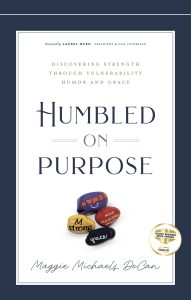
Maggie recently left Roswell’s nonprofit Children’s Development Academy (CDA) where she served as CEO for nearly 8 years. Prior to the CDA, she served as President, COO and CHRO at HoneyBaked Ham for 14 years. She also served in human resources and operations for well-known retailers Circuit City, Belk and Macy’s.
She has been married for 38 years to her high school sweetheart, Bob who was a long-time tennis coach and econ teacher at Etowah High School. They have two grown sons, Brady and Riley (married to Emily) and two dogs.
When not in their Woodstock home, they enjoy time in the Georgia mountains on Lake Nottely.
Connect with Maggie on LinkedIn and Facebook.
 This transcript is machine transcribed by Sonix.
TRANSCRIPT
Intro: Broadcasting live from the Business RadioX studios in Woodstock, Georgia. It’s time for Cherokee Business Radio. Now, here’s your host.
Joshua Kornitsky: Welcome back to Cherokee Business Radio. This is Joshua Kornitsky professional EOS implementer and your host this morning with my guest in the studio, Todd Lessem, the owner of Diakonos Management Solutions and the Data Miners. Good morning. Todd. How are you?
Todd Lessem: I’m doing great. How are you doing, Joshua?
Joshua Kornitsky: Doing fantastic. So happy to have you in. Uh, I appreciate you taking the time to come in and talk with us. So what can you tell me about what the Data Miners is?
Todd Lessem: Ah, the Data Miners. Well, I think the easiest way to to put it into words is I really help larger companies solve business problems. Um, but through it all, I use a data driven approach. I’m a numbers junkie, but, uh, when I say that it’s trying to make sense of the numbers, trying to draw insights out of the numbers, and make them digestible for business leaders so that they can take action and make smarter, faster business decisions.
Joshua Kornitsky: Okay, so what type of businesses do you work with?
Todd Lessem: Wow. Uh, quite a few. I mean, my background is really with either subscription based businesses and the broadband telecom space. Uh, I’ve worked with other SaaS companies, software as a service. Uh, but I’m actually working for a local government, uh, agency right now, and that’s a lot of fun. And I’m while data is at the core of it, I’m doing a lot of process improvement.
Joshua Kornitsky: Okay. So process improvement. What type of stuff are you doing?
Todd Lessem: You know, honestly, uh, Joshua, it just boils down to some of the basics, um, open and honest communication, making sure that people, the right people, are in the room, communicating with one another and making sure that, um, there’s the right structures in place, uh, whether it’s meetings, whether it’s having technology, like a project management tool, just making sure people are using technology and communication in smart, effective ways and not living and dying via email all day long where things get lost very, very quickly.
Joshua Kornitsky: Okay. So when you talk about the types of data that you work with and the types of organizations that you work with, you said you’re working with a government organization now, what do you do? What type of insight are you helping them gain?
Todd Lessem: Yeah, no, that’s a great question. You know, I think there’s a real fear of data in the business world. And that’s not only in the larger businesses, but also for the local businesses as well. So what I really try to do is to teach business fluency and taking the fear away from data. Trying to make it easy to understand and digestible, um, trying to help people understand the power of data. And this is not to talk about very complex, uh, analytics. This is like this number ties to this driver in your growth of your business, or this can help you save money or make more money. And and really trying to help business leaders understand the value of data, not to be afraid of it and and try to use it in smart, equitable ways.
Joshua Kornitsky: So it’s interesting you had shared with me previously that you had been, uh, an executive retention pioneer at Comcast for 20 odd years. Yep. Right. So that’s a really, really long time to spend in a space. How did you get from there to here?
Todd Lessem: Yeah. So being a pioneer, um, I was a startup guy. So over and over again, I had to prove my value and my team’s value to executives all day long. So every month, and because I was in the startup space, bridging out and embarking on new endeavors, new products, new strategies, um, the best way to justify your existence and your team’s existence is having data and being able to storytell what is happening within the business and the relationship between data and the qualitative activities, the behaviors that occur. And with that, I didn’t have full blown analytics teams. So I had to I had to be scrappy. I had to build it from the ground up.
Joshua Kornitsky: Homegrown.
Todd Lessem: Homegrown. Absolutely. So I was, you know, so because I was at the forefront so often, um, I won, I learned I have a love of numbers. They just jump off the page for me. Uh, and I have a God given gift where I can synthesize really complex concepts and strategies using data in very simple manners so that anyone from an executive to a frontline employee could understand it and execute against it and make decisions.
Joshua Kornitsky: So you speak simple, and I mean that in a complimentary sense. Not not in a, in a negative regard.
Todd Lessem: I do, but I think my wife would disagree with that. But I try I try on during my day job.
Joshua Kornitsky: So I’ll just simply say we all hear things through our own ears. They may not align with what our mouths think they’re saying, but I. But I would never speak ill of any other. Okay. So. But there’s another part to your life. And and that part is, is the marketing side. And, and, you know, it’s easy for everybody to say, oh, yeah, of course it’s data. Data leads to marketing. But I really don’t think that in in it’s obvious from what you’ve shared with us. It’s not obvious. And there’s a lot of people that understand they need data. They don’t understand why they need data. You help them, you bridge that gap and you help, um, act as a Rosetta Stone, as a translator from the complex to the simple for them. But how do you then help them take that into action?
Todd Lessem: Yeah. So during my 20 years at Comcast, I had very robust experience. So for much of my career I was focused on the startup side of the house. But then as we grew and the company became a behemoth, now it’s a fortune 30 company. I became the Fixit guy. So I started getting taking those startup principles and those data driven principles and and moving into unhealthy teams. And one of my last ventures was actually within a marketing communications team here in Atlanta. It’s what actually what brought me to Atlanta. So I was able to come in. And basically, if you saw anything that was on TV, radio, print, billboards, digital direct mail, it came across my desk. That was my team here in Atlanta, all the way from Miami up to Detroit. Wow. So how does it tie to marketing? Well, Specifically, um, as we think about this, uh, the creative teams, the teams that are creating all the content that are creating the advertisements, they were struggling to connect their value that they provided back to the business.
Joshua Kornitsky: Okay.
Todd Lessem: So in addition to building a team from the ground up, rebuilding a team from the ground up, putting in all the processes, the structures, all the boring stuff to make a team work.
Joshua Kornitsky: Um, some of us don’t find at that point.
Todd Lessem: I know, but for most people.
Joshua Kornitsky: Sure. You know, the infrastructure side is, is the less, uh, flashy side. How about that?
Todd Lessem: But it works, as you and I both know. Um, but I was able to bring in a data driven discipline to actually tie in. You know, these are the activities. This is the call volume. These are this is the website visits. These are all the visits that were occurring because of the team and the work that was happening, all the fancy stuff. Sure. Um, and it’s really connecting the dots. I was able to connect the dots and actually we helped improve employee churn because people started, they were able to connect what they were doing on a day by day basis to to actual tangible results. And they and it also increased their business fluency and they got excited about it. So tying it back to how does it tie back to marketing? It’s just, you know, I work with large companies, but I also work with some some smaller mom and pop shops here locally. It’s trying to help them understand don’t just throw money out the window at marketing tactics. Build a strategy, make it data driven, but also track your results and.
Joshua Kornitsky: Track your results. You say.
Todd Lessem: Yes, a novel concept.
Joshua Kornitsky: We just throw pennies in the wind. Yes. Um, so I’m curious because you you made this comment about the impact, right, of of drawing the connection. So what are some of the biggest mistakes that you see on the local level? Let’s let’s step away from the comcasts of the world. Because while I’m sure the board of directors is sitting around listening right now, I hope not. We we also touch a lot of local businesses and let’s help them. So what are some of the mistakes that you see there?
Todd Lessem: Yeah, absolutely. Um, one is and I’m a I’m a local business owner as well. So when I’m speaking about what I’m seeing, I’m also kind of giving myself some therapy and a big slice of humble pie actually, in the process. Um, so we act based off of emotion too often. And we are constantly, as a local business owner, looking to drive growth as quickly as possible without making sure we have that infrastructure in place to make sure we can handle that growth. Um, but the biggest mistakes I see are really trying. It’s really the local business owners that don’t understand marketing, but they, they, they, they believe marketing is just tactics. But it’s so much.
Joshua Kornitsky: More strategy, all tactic, all execution. No planning.
Todd Lessem: Exactly. Exactly. And, um. And, hey, I’m guilty of this, too. But it’s amazing of just what a little bit of strategy will do for your business. Um, from a local perspective.
Joshua Kornitsky: So you and I had talked previously and you had mentioned things about, uh, some, some basic non-negotiables. Yeah. Uh, what are some of those things that a business just needs to have on their radar?
Todd Lessem: Yeah, absolutely. These are the three non-negotiables that every local business owner should have. Just hands down. Number one, a website. Um, why? Because if I’m scrolling through and I’m searching for a business, if I have a problem and I’m going to Google and we’ll get to Google in a second. When I look at the different options that are up on Google, if there’s not a website where I can click through and learn more, I bypass them.
Joshua Kornitsky: Immediately. And is that normal? Asking from a marketing lens, is that typical consumer behavior?
Todd Lessem: It is. It is. And it’s it’s just it’s been established to this point, and it’s a credibility proof point at the end of the day. Um, now, that doesn’t mean you need to go out and spend $12,000 on a new website. There’s a lot of DIY options out there, but it has to be informational about you, your business, and also the products and services you offer. That’s number one. Number two is having an SEO strategy. So what is an SEO strategy? Search engine optimization to simplify it. Do you show up on Google? Yes or no. As simple as possible.
Joshua Kornitsky: So Google’s not just going to list me because I’m in business and I’m selling widgets.
Todd Lessem: Nope. They’re not. And in fact they want to make more money off of you, and they’re going to make it more challenging for you to be found on Google so that they can profit off of you. Because remember, they’re in the data business and they’re also one of the leading advertisers. They they’re they’re battling Washington right now on that front. I won’t go down that pathway. Sure, sure. Um, so number one, have a website. Number two, be found, be findable. Found on Google, found on Bing. I know Bing or Edge whatever it’s changing into. Be searchable.
Joshua Kornitsky: Microsoft’s thing.
Todd Lessem: Yeah. There. Yeah. Microsoft uh and then finally, you know, have a social media presence and I’m going to be the first one to say I hate social media. However, as a business leader, as a marketer, I would challenge every listener to think about social media as the television of the 70s, 80s and 90s. But think about it differently. Think about this. You have an opportunity to have free commercials.
Joshua Kornitsky: Right.
Todd Lessem: On over-the-air TV. It now just translate it to a smartphone device, on Facebook, on Instagram, on LinkedIn, whatever your your wherever your target audience is, that is the that’s the magic sauce out there. And trust me, the amount of time people waste on social media is is mind boggling. It increases more and more and more. If you’re not in the social media space, you’re missing out. You’re missing out on opportunity.
Joshua Kornitsky: Well, so. So would you say they’re leaving money on the table?
Todd Lessem: Absolutely.
Joshua Kornitsky: Okay, so so this leads to the the most obvious question, right. How can you help them?
Todd Lessem: Yeah, absolutely. So these are all the areas where those are the non-negotiables. Um, I’m actually the retention guy. So I really help business leaders think through and understand and execute tactics to nurture and drive growth from their existing customers. So one of the biggest things I see is as a new as a as a local business owner, they’re always chasing new customers. They’re chasing after the shiny object and they’re constantly chasing new, new, new. However, and I’m a part of several networking groups, we’ve shared this in the past. Fast. I’m in a room full of about business leaders that I’m in business for five, ten, 15 years. And I asked them, so what focus do you put on your your existing clients, your former clients? How do you increase purchases from them? And I get a blank stare.
Joshua Kornitsky: No strategy at all.
Todd Lessem: No strategy, no execution, no tactics. And that’s kind of my wheelhouse. I was a pioneer at Comcast. This is what I built. Um, so where I really try to come in and I try to help business leaders, local business leaders, think differently about their marketing approach. I help them build the strategy of, uh, an ecosystem of sorts of existing customer tactics, typically in social media. So I do actually do social media tactics and email communications, but I also tie into, in addition to that, the sales, the sales conversations. I work with their teams to make sure that they are actually talking about products and services. The other biggest mistake I see local business owners make. They spend a bunch of money on marketing and then they don’t answer the phone. They don’t respond to emails. They’re leaving money on the table.
Joshua Kornitsky: One of the things that I work with some of my clients on is simply understanding the the value of the consistency of language. Right. That everybody’s got to call a widget a widget. Everybody’s got to call a lead a lead, or it’s got to be a prospect, but use that same language across the board. And it sounds like you’re echoing that right here. Yeah, that that having everybody singing from the same songbook, so to say, makes a big difference.
Todd Lessem: Absolutely, absolutely.
Joshua Kornitsky: Would you would you share with us something from from your past, maybe a piece of advice or something you’ve received that, uh, that might help people better understand?
Todd Lessem: Yeah. Um, it’s the kiss method. Keep it simple, stupid. I think, uh, and I just wrote about this today. I think sometimes Business leaders, business owners. They go chasing the shiny object and they make they make business. They make growth hard when it doesn’t need to be. And sometimes it’s just the simple interactions, uh, smiling when you’re speaking to a customer over the phone, greeting someone who walks into your office and just acknowledging them. Um, that can be a game changer for a lot of people. And this is not some sophisticated marketing strategy that I’ve developed in the past. These are the blocking and tackling that you can do day in and day out that can help move the needle. And, you know, I think we’ve talked about momentum, right. But, um, you know, it’s just these, you know, everyone, every business leader I’ve talked to you. What’s the silver bullet? Todd. There’s no silver bullet. It’s a culmination of lots of little things, behaviors, tactics that then get momentum. And the next thing you know, It’s a waterfall of growth. Um, but you got to keep you got to keep it simple, stupid, and continue to do the little things well.
Joshua Kornitsky: You mean there’s no shortcut?
Todd Lessem: No. I wish so.
Joshua Kornitsky: Because I keep seeing these ads online.
Todd Lessem: Well, absolutely. You know, and I, you know, we’re in the room here and we’re all above, I would say 40. I’ll make that assessment here. Um, you know, and I and look, there’s scrolling behavior on all the social media platforms and taking business advice from someone who’s maybe 19, 20, 21, um, maybe is not the smartest move for you. Just saying.
Joshua Kornitsky: Maybe there, there there are phenoms out there, but tried and true and consistent tends to bear fruit over and over again.
Todd Lessem: Yeah. And and trust me, I, uh, I know that, but if you’re thinking about long term growth, business continuity, slow and steady wins the race.
Joshua Kornitsky: That’s the rabbit and the hare. The. The hare and the tortoise. Sorry. The rabbit and the hare is a boring race to watch. Um. Well. Thank you. Todd Lessem, owner of Diakonos Management Solutions and the data Miners. What’s the best way, Todd, for people to get in touch with you?
Todd Lessem: Yeah. Um, just shoot me an email. Uh, and I can share it with you. Over.
Joshua Kornitsky: We’ll have all of your info posted on our website so people know how to get to you. Yeah. Uh, your socials will be on there. Everything. Every way that anyone can get to you. But, um, if you have the time, we sure would appreciate it if you’d stay with us during the conversation with our second guest. So joining us in the studio now is Maggie Michaels DeCan, author, coach and consultant of the Amazon number one, uh, release for women in Business. Uh, Humble on Purpose. Maggie, thank you so much for being here with us. I appreciate you taking the time.
Maggie Michaels DeCan: Thanks, Josh. I’m excited to be here today. Nice to meet you, Todd.
Todd Lessem: Nice to meet you. Nice to meet you as well.
Joshua Kornitsky: So I really appreciate you making the drive down. And, um, you know, there’s so much to talk about. I’ve started your book. I brought my copy with me.
Maggie Michaels DeCan: Awesome. I have a copy for both of you.
Joshua Kornitsky: Thank you. Thank you very much, I very much.
Maggie Michaels DeCan: I’ll sign it for them before I.
Joshua Kornitsky: Thank you. So, what made you want to write a book? Tell us. Well, let me back up.
Maggie Michaels DeCan: Okay.
Joshua Kornitsky: Who are you?
Maggie Michaels DeCan: Well, I’m Maggie DeCan. I put my maiden name in there. Just kind of out of deference for who I was growing up, but I was, so I, uh, graduated from the University of Michigan, started in retail, and, uh, rose up through kind of a hard work ethic and some, maybe some negative things that I talk about in the book as well. And was, uh, in 2016, I was the president and chief operating officer at the Honeybaked Ham Company. And um was playing on five tennis teams one summer and pretty close to retiring. Thought I had reached the pinnacle of what I wanted to do, and I wanted. I went to the Canyon Ranch. Um. Oh, no, that’s not right. Let me step back. And then I decided I needed to do something with a little more purpose in my life. So I. I got quit from honeybaked, which is a euphemism. My friend Joanne. Harold, uh, says makes it sound better than being fired. But anyway, I got quit, and I knew that I wanted to do something more purpose filled. And so I actually had to work really hard to find a nonprofit that, um, found my skills transferable, ironically. So I went to be the CEO and executive director of the Children’s Development Academy, and I was planning on doing that for a few years. A few years became eight. Okay. And then I was planning on I was on my five tennis teams one summer, ready to retire, taking a walk in the desert with Joanne Harold, who is like my biggest influencer mentor, and she was had just written a book, was, um, coaching people and doing really fun things that sounded better than working on her back end. And I asked her about it and she said, oh, I’ll just connect you with Andrew Vogel at Ripple’s media. And, um, it’s really not that hard. And I was like, oh, good, okay, easy.
Joshua Kornitsky: And it’s the shortcut to success.
Maggie Michaels DeCan: So I met with Ripple’s media and talked about my book, which was going to just be kind of a leadership memoir about going from the C-suite in corporate America to a nonprofit world. And then I wrote chapter two, which was about losing my mother to suicide early and my father to a heart attack on at 17 on Christmas Eve. And so the book also became about overcoming trauma and perfectionism and lots of things that I at one point I kind of suffered imposter syndrome, and I was like, nobody needs to hear this. Andrew, let’s take out chapter two.
Joshua Kornitsky: A lot of people need to hear that.
Maggie Michaels DeCan: Well, now you sound like Andrew. So he made me really think about it, and we kept it in the book. And I’m glad I did, because a lot of people have said, you know what, if you can overcome all of that and do what you’ve done, I can tell my kids that they can overcome, you know, mean girls, that’s middle school, etc.. So anyway.
Joshua Kornitsky: Sure. And to, to just put it out there, you know, Maggie, one of the things that I think people who are, as Todd was mentioning earlier, joking about 19, 20 year old people that are trying to direct marketing campaigns for multi-millions of dollars, right? It. I have two daughters, 17 and 22. Um, I believe they are brilliant and insightful, but like everyone else, they can fall victim to seeing the curated versions of people’s lives, thinking that every moment is champagne and race cars and airplanes. Maybe not race cars, but you know that one’s for sure. And and in reality, it’s it’s just not that way. So thank you for being vulnerable. And it gives me the opportunity to ask you about a term that I know from your book, which is this scar based leadership, because leadership is something Todd and I both share a great passion for. Obviously, you’ve lived to a much greater extent than the theoretical universe that either of you have been through, or even the practical universe taught or I have been through. But tell us about scar based leadership.
Maggie Michaels DeCan: Sure. So losing my mom, discovering how my mom died at 13, which was not the ideal time to learn about it by reading her obituary. In my basement and then losing my dad, I really became kind of a control the universe perfectionist, and I was going to do everything I could to make sure that nothing bad ever happened to me again by controlling everything. So when I went through the Macy’s executive training program and read the book on management, I decided to just follow it, which made me a very.
Joshua Kornitsky: By the book.
Maggie Michaels DeCan: Non-empathetic by the book manager. So when people called and I write about this in the book with great, um, cringe factor, you know, people would call and say, you know, my child is sick. And I would say, you need to have better backup child care with a straight face, like, seriously? And you know, my my truck isn’t working. Well, you don’t have better backup childcare. Backup transportation. This is before Uber even, like, come on, I and my worst one was I was in Charlotte working for Belk, and, um, the hurricane was headed towards, uh, the Charleston. And we’re in Charlotte, you know, and I’m from the Midwest. And so the people start calling out, and I’m the executive on duty. And so I was like, I’ll just go run the switchboard. And the cosmetics associates are known to be the worst divas in the store. And so they start calling out, and I was like, ladies, we’re four hours from the shore. I’ll see you in the morning. Right? And they’re like, But Maggie and I was like, I’ll see you in the morning. And so at 4 a.m. when I’m in my townhome, shaking in the bathtub, praying I don’t get sucked out through the roof, I’m pretty sure that four hours from the shore is going to be on my tombstone. Sure. And the next morning, seriously, the National Guard is out there with, um, machine guns. It looks like it snowed. Greenery. I didn’t have power for a week. Like, um. Yeah, it was, uh, I and I really didn’t learn until I had my own child how to be a more empathetic leader. But when I was, um, I went into HR in my mid 20s, and I stayed there until my boss at Honeybaked. Uh, Chuck Bengochea said, I really need you to take over the stores. You’re a natural retailer. And so I did that. But. But the stores really thought that kind of friendly, nurturing Maggie was going to run the stores. And I started ranking people and having store visits and leave behinds.
Joshua Kornitsky: Accountability.
Maggie Michaels DeCan: Yes. And and that caused some disconnect. So we had a meeting at Oconee, and I got up on stage and I told them who I was and why they already knew I was a perfectionist. I didn’t need to share that, but I told them why I was a perfectionist. I told them about my mom, and I told them about my dad, and I told them I was going to work harder, to be more empathetic, but that I cared about them too much to walk by mediocrity. And, um, and it really broke down walls. Josh, it, um, my ability to be vulnerable. I mean, when I told them that I found my mother’s obituary and it said that it was written in 1963. So the journalistic standards of the time didn’t say she died in her, you know, of natural causes or it didn’t leave it blank. It said she was found hanging from a gas pipe. And so, like, there was a gasp in the audience and people were like, you know, they they got me for the first time. So I call that scar based leadership. And rather than, Then, you know, leading by trying to tell people how perfect you are and trying to be this version of the perfect Jack Welch CEO. I try and let people know I’m screwed up as quickly as I can in any conversation, because it lets people be themselves also, and you can get to the heart of the matter. And I think women especially need to just open up and be themselves and be authentic and let themselves, you know, if they’re nurturing, be nurturing. Stop trying to wear the man’s suit. Sure. And just so scar based leadership is a big principle that I believe in. It’s about authenticity and vulnerability, and I try to talk about it a good deal.
Joshua Kornitsky: Well, so that opens the door for me to ask you, because it certainly sounds like you’ve gone, uh, on a journey from, let’s say, buy the book to to authentic. Right? You are now your true self. Uh, and I should tell you, though, I’m not a woman, it does resonate with me because I, uh, I too, followed the by the book methodology and the very different path. I was raised in the car business and in the car business. Uh, there was black, there was white, and there was no place in between. And I don’t regret my time there. But I will tell you that it made me unnecessarily harsh for the early part of my career. And and, um, while it’s nice to have thick skin, it turns out that that it’s true about honey and vinegar, right? That you get a lot further being kind than you can be in a jerk.
Maggie Michaels DeCan: And at the end of the day, well, that’s what’s important.
Joshua Kornitsky: Well, and so that that leads me to the question. Right. So we’ve talked about author. We didn’t talk about coach and consultant.
Maggie Michaels DeCan: Right.
Joshua Kornitsky: So how do you take that that scar based leadership forward and help others.
Maggie Michaels DeCan: So that is really what’s bringing me a lot of joy right now. I’m really launching coach Maggie Dixon, not doctor, but, um. So I have. It’s funny. God put some, um, clients in my lap while I was still getting my certification. Almost like to show me this is what I really want you to do now. So. And then I got some paid clients while I was still finishing my certification. And I am also doing a lot of volunteer work that is bringing me great joy. Um, but all of it is about coaching people and leading people and listening to people like learning to listen came kind of late in my career. Um, if anybody that is working for me ever listens to this, they will laugh along with me. But, um, when I talk to people who were coaches, they said, you know, Maggie, you’ve been a you’ve been a CEO, you’ve been a CEO. You don’t need to get coaching certification. I was like, really? Boy, I would have been a bad coach. I would have been a good mentor, but a bad coach. Because coaching is all about listening and the neuroscience of getting people to have it be their idea. So I’m excited to say I love working with young emerging leaders. I’m I’m pretty qualified to work with the C-suite, too. And I like that. But it’s really fun to work with the new generation, because to your point earlier, they really think they know everything from TikTok. But there’s a lot they could still learn, and they really are excited when they’re like, oh, that’s how that works. So it’s, uh, and it’s also good to be able to say, okay, I’m going to take out of my step out of my coaching box and be a mentor to you now. And I’m going to tell you how this worked in my life. So I’m excited to do more coaching. And, um, I’ve had some consulting gigs that are really fun. I’m proud to say the first two they tried to hire me, which.
Joshua Kornitsky: Was.
Maggie Michaels DeCan: Awesome. And, uh, it’s it’s probably, though, because I forget I’m a consultant. And I was like, we have to do this. Oh, wait, you should consider maybe, perhaps trying this strategy. So I’m probably not the world’s best consultant, but I love it.
Joshua Kornitsky: Well, it’s funny, I I’m going to butcher it because I don’t remember the quote exactly, but something like a smart person learns from their mistakes. A wise person learns from other’s mistakes. Right? So, but you have to get to a certain point where you’re willing to be able to learn from someone else’s mistake. Uh, it is it is a common theme that seems to repeat throughout all of our lives that we know better, but we do it anyway. Yes, stick your finger in the light socket type of thing.
Speaker5: That’s so true, Josh.
Joshua Kornitsky: But we do eventually learn. Yes, we do eventually learn.
Speaker5: Oh, if.
Maggie Michaels DeCan: Only I could learn in my 30s, like I learned now.
Joshua Kornitsky: Well, I just always wanted the time machine to go back. But even. But I say that knowing full well that younger me wouldn’t listen to a thing. For all I know, I already did it, and and I just ignored all the guidance.
Speaker5: Anyway, if I could go.
Maggie Michaels DeCan: Back knowing what I know now.
Joshua Kornitsky: That’d be. That’d be a whole different thing. So tell us just a little bit about Humboldt on purpose. Your your number one release for women in business. Uh, indie reader approved and good business award winner. Number one. Uh, in number one in vacation.
Speaker5: Yes.
Maggie Michaels DeCan: I’m really proud of it. It took me about ten months to go from idea to getting it to market. And, um, I have 37, five star reviews on Amazon. I need 13 more to hit this magic algorithm. So, uh, if anybody out there is listening and that they’ve read it, please go on Amazon and review it. I’ll even take a four star just to get another one out there. But, um, it it’s really a work of. Of love to go out there. My family really appreciates having it. Kind of put out there that this is mom’s story. It’s it’s really a leadership memoir. And it’s got a lot of life lessons in it. And people will tell me, oh my gosh, I’ve already laughed and cried three times, and I’m on chapter three on the airplane. Or, um, they’re they’ll tell me this was my favorite part and it will be something I forgot I put in it. Right. And so there’s there’s literally something for everybody in there. Um, big lessons, little lessons, you know, don’t do this, do do this, or I learned a lot like my two favorite bosses, Mark Arensmeyer and Chuck Bengochea. When Mark Arensmeyer told me that just because something is true, Maggie doesn’t mean you have to say it. It was like a light bulb went off.
Joshua Kornitsky: Sorry. That’s very funny. Thank you.
Maggie Michaels DeCan: Um, honest to God, I was like.
Speaker6: But it’s true.
Maggie Michaels DeCan: And I was like, oh, well, Chuck told me. Obviously it didn’t quite sink in because Chuck used to say that could have remained a private thought. And I was like, oh my gosh. So I’m trying. At the ripe old age of 62 to now really embrace that. And I do filter things, but, you know, uh, honest to God, when he said that it was really, really a novel idea to me that if something was true, it shouldn’t be said.
Joshua Kornitsky: It doesn’t have to be said.
Maggie Michaels DeCan: It doesn’t have to be said.
Joshua Kornitsky: I’m going to have this painted like an Instagram sign to hang in my house is what I think I’m gonna do.
Maggie Michaels DeCan: Honest to God, it was such a new idea to me. So anyway, and people coming from the Midwest, I could have had a t shirt that said abrupt because I needed to add words to all my sentences. I spent so much time not bless your heart because that’s just, you know, that’s too that’s too southern. But if you might, would you please consider perhaps because abrupt was my middle name and now I go back to Michigan. I’ve been here since 86, and I do find people just a tiny bit short in their senses. But anyway.
Joshua Kornitsky: That’s very funny. So you said there was something else that your other boss had said.
Speaker6: Oh, that was Chuck.
Maggie Michaels DeCan: And that could have remained a private thought. Same theme. Okay.
Joshua Kornitsky: Well, it certainly sounds, uh, as I said, I started the book and I’m getting on a plane later today, so I brought it with me. Uh, and I’ll be reading it in flight. Um. It’s such a joy to have you share this with me. Thank you. With all of us. Um. May you. What’s the best way for people to reach you? And again, we will have everything on our website.
Maggie Michaels DeCan: Maggie. Com is my website, and I would love to talk to people about coaching, speaking at your rotary meeting, meaning doing your book club. Really, I just am in that time of my life when I’m looking to pour into others. So there’s really just nothing I wouldn’t love to talk to somebody about.
Joshua Kornitsky: That’s just fantastic. Well, I want to thank both my guests. Thank you again. Uh, Todd Lessem from the owner of Diakonos Management Solutions in the data miner. Sorry, I had to find my piece of paper because I always want to say the names. Right? And if anyone’s heard my other shows, I screw up names all the time, so I’m trying very hard not to. And then I got lost. And Maggie Michaels, deacon, author, coach, consultant, thank you both for being here. This has been, uh, Cherokee Business Radio. I am your host, professional EOS implementer Joshua Kornitsky. Thank you. We look forward to you joining us again next time.














