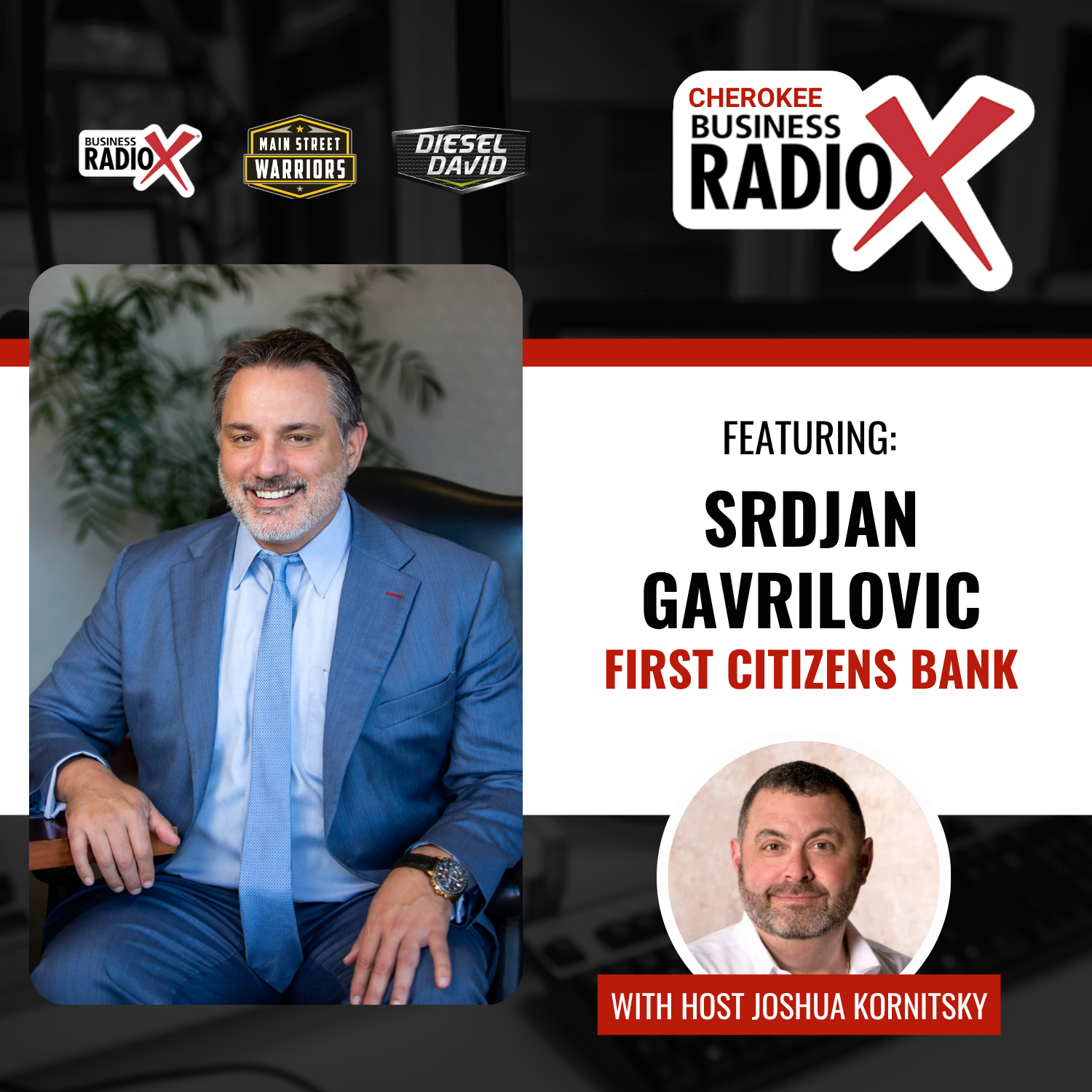


Joshua Kornitsky sits down with Srdjan Gavrilovic, commercial banker at First Citizens Bank, to unpack what growing businesses really need from their banking relationships. With over 25 years of experience, Srdjan shares practical insights on cash flow management, capital strategy, fraud prevention, and the hidden risks that can derail even successful companies. This conversation highlights how the right financial partner can help business owners move from reactive decision-making to proactive growth.
Brought to you by Diesel David and Main Street Warriors

 Srdjan Gavrilovic, SVP Commercial Banker at First Citizens Bank, earned his Bachelor’s degree from Kennesaw State University with a major in Finance. His career includes over 26 years in banking with most of that time spent in the Commercial Banking space.
Srdjan’s specific focus has been working with clients in the Commercial and Industrial space that are in the growth phase of the business cycle.
Srdjan is passionate about spending his time looking for creative ways to help businesses achieve the next stage. He’s also volunteered at several local non-profits by serving as a Treasurer and Board Chair and teaching financial education classes.
Srdjan and his spouse Ivana have been married for 16 years. They are the proud parents of two children who are 8th and 9th graders at the Westminster School in Atlanta. Srdjan’s family loves to travel both domestically and abroad.
Connect with Srdjan on LinkedIn.
Episode Highlights
- The role of a commercial banker goes far beyond lending, acting as a strategic partner who coordinates financial resources and helps business owners make smarter decisions.
- Many mid-sized companies lack true financial leadership, leading to major gaps between perceived performance and actual financial reality.
- Rapid growth can create serious cash flow challenges if capital structure and working capital aren’t managed properly.
- Fraud prevention tools like positive pay and ACH controls are widely available but often underutilized until after a loss occurs.
- Strong accounting practices and accurate financial visibility are essential, since “cash is king and profit is an opinion.”
 This transcript is machine transcribed by Sonix.
TRANSCRIPT
Intro: Broadcasting live from the Business RadioX studios in Woodstock, Georgia. It’s time for Cherokee Business Radio. Now, here’s your host.
Joshua Kornitsky: Welcome back to Cherokee Business Radio. I am Joshua Kornitsky, professional implementer of the entrepreneurial operating system known as iOS. And your host here today. I’ve got a great guest who’s got some real insight to share with us. But before we get started, I want to remind everybody that today’s episode is brought to you in part by the Community Partner Program, the Business RadioX Main Street Warriors defending capitalism, promoting small business, and supporting our local community. For more information, please go to Main Street warriors.org. And a special note of thanks to our title sponsor for the Cherokee chapter of Main Street Warriors Diesel David, Inc.. Please go check them out at diesel, david.com. All right. Thank you again to the Community Partner Program. I’m very excited to introduce the guest that I’ve got here in studio today. He’s, uh, he’s become a good friend. He’s become a great associate and someone who just goes out of his way to try to help. I’d like to introduce my guest today, Srdjan Gavrilovic. Perfect. Gavrilovic. Perfect. Wonderful. So Srdjan is a commercial banker with 25 years of experience in the financial services industry, primarily working with closely held businesses. He’s also a father of two, Sarah and Nikola. 10th and ninth graders at Westminster Schools and is married to Ivana, a business owner with 15 employees. So I imagine working with businesses is something you literally do every day.
Srdjan Gavrilovic: That is 100% true.
Joshua Kornitsky: Well, welcome Srdjan. I’m really happy to have you here today.
Srdjan Gavrilovic: Thanks for having me. It’s a pleasure to be here.
Joshua Kornitsky: So tell us a little bit about your background. How did you end up where you are with and I didn’t do justice. Your commercial bank with First Citizens Bank. I’m sorry I neglected to say that. All right. So how did you get to First Citizens and what brought you into the financial world?
Srdjan Gavrilovic: So, um, I was one of the kids that always knew that the world of banking and finance was what interested me. I kind of chose my career at 14 when really back in what used to be Yugoslavia, uh, offered high schools that allowed kids to specialize and pick their future calling in at 14. And I picked up an economical or high school of economics or business, if you want to call it that. So I had accounting and statistics in high school. That’s not not not very common, but I knew that that was where my interests lied. Even at 14 years of age, a lot of my friends went to a high school that offered general education, and they could be ready for anything later in life. At 14, I let them go into one high school, and I picked the high school where I knew no one. But it gave me set me up for this type of a career. So, um, that was in what used to be Yugoslavia. It’s Serbia now. Um, I moved to Atlanta in 1992 straight out of high school. Um, and I went to Kennesaw State University, well, now University in 1995 when I enrolled, it was still a Kennesaw State College.
Joshua Kornitsky: Right.
Srdjan Gavrilovic: And, um, I declared my major immediately. I made a bet with my best friend at the time that I’m going to graduate in three years. And I could have graduated in two and a half, but I did win the Bet. Graduated in August of 98 with a degree in finance. And, um, one of my college friends, uh, I was waiting tables and interviewing. She walked in with a district manager for what they called an executive lunch. And I ran to the car and grabbed my resume and gave it to him. And I got the job. But what was a division of Wells Fargo 3 or 4 days later. Wow. And their management training program. And that set me on the course in financial services industry. Um, that was a consumer lending world. Um, so I was making loans to consumers only in 1998 2002. One of my coworkers left that world to come to what was then first Union, about to become Wachovia. And a couple of months later, he he pulled me in with him. So I started in Wachovia in 2002, um, and stayed with them through 2011, which at that time it was Wells Fargo. Um, and then I moved to SunTrust banks and I spent six and a half years with them. And every time I’ve gotten a job. So I’ve had four jobs in 28 years, I guess, since I’ve been out of college. Every time it’s been someone that knows me, that recruited me. So the first time it was a college friend in 2002, it was a coworker from Wells Fargo. In 2011, it was a coworker from Wachovia Wells that pulled me into SunTrust. And then in 2017, it was also a former coworker from both Wells and SunTrust that recruited me to First Citizens. So I’ve had four jobs, and every time somebody said, well, I know you like it there, but how about you talk to us and explore this career opportunity? And this has been the best move of my career.
Joshua Kornitsky: Well, I think clearly you’ve got a pretty solid reputation if people keep asking and inviting you along. And that speaks very well of you. So. So let’s start. Now help me understand what does a commercial banker do?
Srdjan Gavrilovic: It’s a very good question. So I coordinate a team of of professionals, cash management and otherwise that um, take care of business owners. So a typical business owner might be a 5 or 10 or $15 million company. And it’s usually owned by a handful of people. Sometimes it’s a single owner, sometimes it’s a family, sometimes there are several unrelated partners. Um, and they need a team that they can call on to take care of everything they need. So my primary role is on the credit side. So I have to know my clients well enough to know what drives the cash flow in their business, and I to recommend the proper credit structure so that they get the credit they need to keep growing their business. And the partners that I bring in are the primary partners are cash management partners. Those are the guys that open accounts, open, set up your online banking and check scanning and ACH and wires and fraud protection, everything that a business needs day to day. Um, and then different partners get involved as needed. Sometimes it’s foreign exchange. So I have some clients that do a lot of international business. They have exposure in foreign currencies and we help them take that risk of foreign currency fluctuations out by hedging their exposure in foreign currency. Sometimes there is a personal planning need, and I bring in a personal planning group that can help create trusts and estates and evaluate existing trusts and estates and different personal planning needs. Um, and sometimes it’s credit card processing and we bring in someone that evaluates credit card processing. Um, and it’s different. Every cash management function has a specialist that that is very good at that. And I need to recognize when do I need to bring in that specialist to help create a better process for this client to make them more efficient?
Joshua Kornitsky: So it sounds like you’re, as you’re explaining it, you’re sort of the lead collaborator, correct? You help understand what the needs are, and then you bring the right folks in to, um, educate and provide the information and or services.
Srdjan Gavrilovic: That’s exactly right. And I’m the officer of record for the client. So that means that anything that happens to that client, I’m ultimately responsible. So I have to coordinate the team and allow the client to not have to know 5 or 55 people. I need to reach inside of the bank.
Joshua Kornitsky: They just know you.
Srdjan Gavrilovic: They want wasn’t me and 1 or 2 other people that are their primary point of contact, but I’m ultimately responsible. So if all else fails, the buck stops here and I have to make it right. And that and that’s kind of the concept that we have a a person that’s in charge of the relationship. And I coordinate whatever resources inside the bank the client needs.
Joshua Kornitsky: You know, in an era where a lot of organizations are trying to, uh, avoid that type of accountability, it’s actually kind of cool to hear that it’s a financial institution that says, no, no, no, we have the, we, the buck stops with this person or this person or this person that that speaks to me very highly of the core values of your organization. That’s, that’s, that’s pretty strong. Um, one of the things that I see with, with the business clients that I work with as an implementer is oftentimes the best way I can sum it up is they kind of don’t know what they don’t know. And I imagine, you know, if a business has grown from, say, 5 million to $11 million over a set period of time, I know from a managing all of the moving parts of the business perspective, those are two vastly different animals as far as just managing the business from a from a cash flow or business banking perspective. Is that something that you’re able to help them navigate? Because I imagine without getting into details, because every case is going to be different, uh, there are pitfalls as, as that revenue number goes up that they need to be aware of, or perhaps tax implications or other things.
Srdjan Gavrilovic: Oh, absolutely. So the, the core principles are what, what matters and, and what changes primarily when you go from 5 to 11 is the team gets bigger in most cases. And with the complexity of team who owns what outcome? And you know, you and I are members of Vistage, and I try to read books that helped me elevate my knowledge. And one of the books that I read many years ago was the Ray Dalio, the process book that talks about understanding who on your team has what strengths and and skill sets and who owns which outcome. And for every outcome, there should only be one person that’s responsible. Couldn’t agree more because there’s there’s no finger pointing. If you are if you’re this, you own that outcome and you need to assemble the right team to get it done. And that’s the biggest difference between 5 and 11 is you’re going to need, you’re going to probably have an extra one, two, three, four key people. And you need to make sure that they have what they need to do their job from a skill set and tools perspective. And then from a banker’s perspective, you need to make sure you have an access to capital so you don’t run out, run out of cash growth if not managed correctly, can cause tremendous financial, um, disturbances and can really create stress that can be dangerous in, if not managed correctly. So my, my job or what I really enjoy about my job is sitting down with my clients every year or multiple times a year if necessary and kind of looking at, okay, so where are you today? How much capital are you using in your, in your business? How is that capital structured? Is it short term capital? Is it long term capital? Is it equity? And is that the right capital structure for your business needs? And then if everything goes well, what is your capital going to look? What are your capital needs going to be over the next 12 months? From a working capital standpoint, from an equipment standpoint, from buildings, from human capital, what does all that need? And once we identify what that is, how are we going to raise that capital? Is it equity? Is it debt? What type of debt is it? And that’s the conversation I want to have with my clients.
Srdjan Gavrilovic: And and then okay, well, that’s, that’s the most likely scenario we have. But what if things go wrong? What is your level of what type of cushion do you have to absorb things not going according to plan. And the bigger the uncertainty around the outcome, the larger the cushion you need to absorb the uncertainty. And that cushion can be anything. It could be personal wealth, it could be lines of credit, it could be a strength of the balance sheet. It could be strength with vendors, but it also can needs to be the nimbleness of the business. If all of a sudden your revenue starts dropping, you need to be able to cut expenses when your revenue starts dropping. And that’s one of the biggest pitfalls I’ve seen with clients that things didn’t go according to plan. Their revenues start dropping, they didn’t react quickly enough, and all of a sudden they’ve dug a hole for themselves that it’s hard to dig out of. And that’s the kind of things you want to prevent.
Joshua Kornitsky: Well, and I think you’ve you have indirectly but directly answered my other question with that, based on my own experience, the biggest difference between a $5 million company and a $12 million company or an $11 million company, is that strategic planning and that vision, that’s where you likely graduate from having something akin to an accountant to having closer to a CFO, somebody who’s going to look at things strategically and work with their banking partner to make sure that they have what they need on the lower end. Again, bank, bank relationships are very transactional. It’s where I keep my money and it’s where I get my money. But as you grow, you have to have that partnership in order to really help your business, not always be under the gun.
Srdjan Gavrilovic: That’s right. And you would be surprised.
Joshua Kornitsky: To me.
Srdjan Gavrilovic: You would be surprised how many 20 and $30 million companies I come across don’t have a proper CFO, and they have an accountant that calls themselves CFO but cannot do any cash flow projections, cannot tell them what are the drivers of cash flow, how to manage their cash flow, what their true margins are. And, and then it creates big headaches. If I have a client that runs a $30 million company and he tells me that he’s operating at 38% gross margins, and then they send me financials and they report 22% gross margins. Wait a minute.
Joshua Kornitsky: Where’s the rest?
Srdjan Gavrilovic: I mean, there’s a lot of things that are outside of our controls. Our gross margins should not be to that extent. I mean, gross margins.
Joshua Kornitsky: There’s going to always be a margin.
Srdjan Gavrilovic: But yeah, they can certainly fluctuate to some level. But 15 points is a lot in a gross margin world and that you should not see that. And that’s just it is surprising how many companies that get into ten, 20, 30, 40, $50 million range do not have proper financial staff and professional advice. And then I have to bring them the bad news that, well, this is what you thought you had, right? This is what your financial statements report. Those are not the same. How do we reconcile this? And that’s that can be a challenge, but it can also be where I bring the most value to the clients. Well, I point something out and they can change their behavior and change the results.
Joshua Kornitsky: Right? It’s it’s about that same level of accountability. It’s about being willing to say, hey, I know you think you’re here, but the numbers are the numbers are the numbers, and they show that you’re here. If this is news to you, that’s an internal problem. If it’s not news to you, then your math is wrong.
Srdjan Gavrilovic: Yeah. Well, it can be an approach to accounting. So.
Joshua Kornitsky: Accounting has variables.
Srdjan Gavrilovic: That’s right. Yeah. So the the one of the famous quotes that I got from a book, um, starts with cash is king. Profit is an opinion and it is a I. That may not be the whole quote. It’s been a minute since I’ve seen it.
Joshua Kornitsky: No, but it gets the point across.
Srdjan Gavrilovic: Those two points are true. Cash is king profits and opinion. And that opinion can change based on how you recognize revenue and how you recognize expenses. And it’s fine that it’s an opinion. You just need to be in the driver’s seat of that. And you need to understand when you’re making these decisions, what is the impact of those decisions? Um, and you know, I still see way too many businesses that are not cash based businesses that are still run their financials on cash basis. And it is very tough to figure out what is the true sustainable profitability of a business that plays games with their, with their cash accounting. Um, so.
Joshua Kornitsky: Well, so, so you bring up a really good point. And I want to ask you, what are some best practices that, um, business owners can use to set themselves up for better success. Uh, again, caveat is that it depends is the default answer. Yes. So speaking in generalities, what are some good best practices that that a business owner listening to this or hearing this should at least keep in mind.
Srdjan Gavrilovic: Of course. So correct. Accounting is very close. If you’re not measuring the right things and you’re not measuring them correctly, you’re going to come out with a with poor outcomes. Um, one of the last vestige or maybe in the last couple of months, we had a guest in our Vistage meeting that talked about the book, the goal that is a manufacturing process book. Um, and one of the first lessons you get out of that book is that they were measuring the wrong things and they, they measured success incorrectly. Well, if you measure the success incorrectly and you create, um, incentives To for bad behavior, you’re going to have really bad outcomes, and you’re thinking that you’re doing great because your metric is performing well, but you actually have the opposite of desired outcomes. So having that understanding that if you want to file your tax returns on a cash basis and the IRS allows you to do so, and it’s and it’s good for you absolutely do so.
Joshua Kornitsky: Right.
Srdjan Gavrilovic: However, if you’re not a restaurant that is truly collecting the money, um, collecting the money at the time of sale and spending the money that really virtually their receivables and payables are close to non-existent.
Joshua Kornitsky: Right?
Srdjan Gavrilovic: You should not be a cash based accounting business. File your tax returns however you want, but you should have true accounting that tells you what your true gross margins are and what your true net margins are, because it’s very hard to manage a business without it. Um, that’s on the accounting side on the, how do you manage your business correctly? Going back to the comment I made earlier around. The larger the variability in your income statement, the larger the stronger your balance sheet needs to be to absorb the variability. Because if you if you are not a utility where you get to send a bill and people have to pay you because you have the monopoly in your, in your market, you’re going to have some variability and you need to be able to absorb those as they happen. Um, the other aspect is understanding what are the true sources and uses of cash in your business. And inventory is a use of cash receivables are a use of cash. And every asset you have in your balance sheet is a use of cash. And if you’re not managing that correctly and you’re just willy nilly and only sending invoices once a month and then waiting for 60 to 90 days to get paid, you can run out of money even though you have intrinsically a successful business, right? So, and just that working capital management billing as fast as you possibly can, allowing your clients to pay you as fast as they can by transmitting that invoice electronically and allowing for electronic payments. Having the correct, uh, fraud protection in place so that you don’t find yourself sending the money to the wrong person.
Joshua Kornitsky: Can we talk about that for a minute? Because I feel like that’s one of those things that somebody listening right now might not understand in regards to banking, what you mean by fraud protection?
Srdjan Gavrilovic: Oh, absolutely. So there’s multiple avenues of fraud protection. One is having the correct cyber security, um, practices in place so that your, your employees are trained not to click on wrong links that can get malware into the system. Um, that’s on the basic side of it, right? Um, the other side is to make sure you have dual controls where the same person is not sending invoices and collecting payments.
Joshua Kornitsky: In the missile silo.
Srdjan Gavrilovic: That’s correct. That’s correct. Yeah. Because I’ve seen a fair amount of internal fraud, and it’s been folks that have access to collect the payments, redirecting them, or creating fake invoices or whatnot. So as a business owner, you need to make sure you have that separated so that, yeah, people cannot just create bogus vendors and start siphoning money out. Um, from the banking solutions banks offer something called positive pay. If you’re a check writer, you should be uploading your checks to the bank so that they know what checks get presented for payment.
Joshua Kornitsky: And there’s something that I had no idea existed.
Srdjan Gavrilovic: Correct. So you upload a file every time. So hopefully you have software that writes checks. You upload the file with with.
Joshua Kornitsky: That image of the check.
Srdjan Gavrilovic: Not necessarily the image. If you’re sending checks, you may not have the image.
Joshua Kornitsky: I see what you.
Srdjan Gavrilovic: Mean, but if the file should contain the check number, who is it payable to and the check amount. And if the bank knows that this check is check number 10,344, payable to Joshua Kornitsky for $589. And all of a sudden the pay gets washed. And we’ve seen large fraud where checks get intercepted. The fraudsters wash out the name and just replace it with the name. So if you’re not looking at that check image, you’re not going to know that you’ve been defrauded. So in some cases.
Joshua Kornitsky: It clears and it.
Srdjan Gavrilovic: Clears. And the check number.
Joshua Kornitsky: Except the guy waiting for the money.
Srdjan Gavrilovic: That’s.
Joshua Kornitsky: Exactly doesn’t get the money.
Srdjan Gavrilovic: That’s exactly right. And the time frames of this can be sometimes short. If you don’t report it correctly, you could end up eating the loss as the business owner. Sure. So and then there’s the ACH version of this as well. Ach being the backbone of electronic transmittals. You create an ACH monitor that says, here are the five people that are allowed to take money from me and these five people here are the limits. So if Georgia Power is taking your power bill every month, you know that they should not take ever more than $2,000.
Joshua Kornitsky: Right?
Srdjan Gavrilovic: And then if a sixth person shows up and tries to debit the account, they get rejected and you get a notice such and such. Just try to debit your account. Did you forget the atom as the authorized person, or was this a fraud attempt? And you know that. And then you get to say, oh, I’m sorry, I forgot to add, this is a new vendor for me. I did get let them do that and you manually override it and you add them. But in the meantime, you’re bulletproof. If you have ACH protection and you have check protection, you’re as bulletproof as you can be. I mean, obviously at the end of the day, there’s still.
Joshua Kornitsky: Fraud is fraud.
Srdjan Gavrilovic: Fraud is fraud. And you know, if they get if the employee goes rogue or somebody hacks into your system, there’s always.
Joshua Kornitsky: There’s always.
Srdjan Gavrilovic: A risk. But this is as close to bulletproof as you can be. So one is creating the right systems in place and the right people so that you have that you don’t, you don’t have a single point of failure from a human perspective and from a systems perspective. The other one is to create the right systems on the treasury side so that you can protect yourself from fraud in that way. And it is amazing. So when your checks clear, the banks are not looking at that image unless you have positive pay, right? If the banks are not looking at that image, the only time the bank looks at an image of the check is if you bring it to a teller, and that teller is going to look to see, does this look right? Does that signature right. But if they deposit through their own checks, scan or somewhere else.
Joshua Kornitsky: Right.
Srdjan Gavrilovic: Nobody’s going to be looking at that check image. So it’s very important that that somebody in your system is either uploading.
Joshua Kornitsky: Something I didn’t even know existed. And it makes perfect sense that it would. And I imagine it happens in this, you know, in the blink of an eye as far as checking to make sure. Correct. But it’s something great for, for a business owner, hearing this to be aware is out there and obviously for citizens must provide that as an available service. Of course. I mean.
Srdjan Gavrilovic: And I mean, it’s a standard banking practice. Most, most, if not all banks provide it. It’s just a matter of does the banker that’s talking to the business owner know how it works and when is it the right solution and what are the alternatives? Because there are sometimes it makes sense and sometimes it doesn’t. And you just need to have the right person in front of you to, to have the alternatives conversation.
Joshua Kornitsky: In a different lifetime. I spent a lot of time deep in the cybersecurity world, and I can tell you that typically they are the victim of that type of fraud, comes to their bank looking for a solution after, not not before. Very few people think of it proactively. So knowing that it’s out there and knowing that, as you said, it’s fairly commonplace. It’s something that if you’re not doing, I think it’s a good idea that you talk to your bank about that.
Srdjan Gavrilovic: Absolutely.
Joshua Kornitsky: Um, so just a couple other questions. If, if you look at the landscape as it is today, and I don’t want to talk about interest rates or things like that, because that’s, Mhm. That’s a roll of the dice, metaphorically, as to where we are at any given moment. What are what are you seeing as some of the top challenges that that your business customers are facing right now?
Srdjan Gavrilovic: So unpredictable unpredictability is one of them. Um, the, um, people are probably one thing that’s always true. Um.
Joshua Kornitsky: You percent of the problems come back to people.
Srdjan Gavrilovic: Year after year after year. When I talk to my business owners, they, they tell me, well, I could do this if I just could hire the right person to help me. Um, and hiring the right talent, whether you are in a blue collar service world and you just need a lot of them that just need to show up every day, they don’t need to have PhDs or anything. They just need to show up every day and have some work ethic to someone that needs a specific skill set. So sure. Um, sales has been a challenging hire for, for my wife, inclusive of, of other business owners by finding the right salesperson that it really knows how to sell and that will produce results. So people have hired folks with resumes that they pay a couple hundred thousand dollars a year for, and two years later, they have nothing to show for or virtually nothing to show for from that large investment. So, um, those are probably the largest. So, uh, obviously we live in some interesting times from a geopolitical perspective correctly. And, and then you have oil spiking and that’s gonna have.
Joshua Kornitsky: A long term impact on a lot of things.
Srdjan Gavrilovic: That’s correct. Yeah. And it bleeds into cost of goods in many different things. And the interest rates have been somewhat unpredictable. Um, and, uh, taxes have been somewhat unpredictable or tariffs for some folks, um, that, that impact of tariffs when, when you kind of all of a sudden overnight, you have a 20 or 30% cost increase that you have to pass on to your consumer that that’s tough. Um, and, you know, so the job market is a little softer now than, than it was. And ultimately we’re a consumer driven economy. So a softer job market is going to probably translate into softer numbers, although we have also held up better than most would have expected. If you look at where our numbers have been over the last 12 to 15 months, um, there were a lot of pundits that would have expected much worse results than what we’ve ended up showing. So there’s both good and, and things to worry about in the economy and the business world.
Joshua Kornitsky: Well, and if I can ask just your opinion, looking at it through the through the lens of your 20 years in banking. Mhm. Um, isn’t there always some form of instability, some form of chaos? I mean, so while it’s very tempting to say it’s the worst it’s ever been, I’m old enough to remember gas lines. I’m old enough to remember a whole lot of other things, right? There’s always something going on. Correct. You know, there’s very few quiet days.
Srdjan Gavrilovic: Absolutely. No, absolutely. I would not say by any means. We’re in the worst that I’ve seen in my however many years, 20, 30, whatever the case may be in this industry. Um, we’re, but we also have these things that could become large disruptors. So we’re, we’re certainly not there today. Are there things out there happening that if go, they go the wrong way instead of the right way could create problems that are much larger than what we’re seeing today? Absolutely. But I mean, but you’re right. You could say that at any point in time, there’s always some big boogeyman that, that, that if that things go wrong could turn into be a major, major impact to the US economy and to a lot of business owners that I serve.
Joshua Kornitsky: I tell my daughters that at some point in the distant future, billions of years from now, our sun will go out. It’s a scientific fact. That’s right. You can spend the rest of your life worrying about it, but it’s not going to change that fact. And it’s also not going to likely arrive in that time frame. So if you want to spend all your time worrying, you will end up exactly where you start. So last question. Let’s end on a happy place. Tell us, um, broadly speaking, 1 or 2 instances where you were able to really help a client where working together, you were able to get them to a good place or a good solution so that we end in a happy place.
Srdjan Gavrilovic: Well, I mean, it’s, it comes down to, um, just really understanding the client’s business and the client’s cash flow drivers and being able to present that to my, my team so that we can provide more capital to allow for further growth. Um, I’ve run into situations where the clients would present financial statements to look in a certain way. And I would go back and tell, well, that’s not what I understood from our conversation. And I go back to their accounting team and the accounting team says, well, you’re right, we didn’t think about that because from our point, what you’re talking about doesn’t make doesn’t is not important to us. And they don’t understand that what you do in accounting will, will have an impact on how the bank views a company. So then we have to go back and get them to, uh, fix things that they did incorrectly or to give us more details so that we understand what’s the true sustainable cash flow that the business provides. So I’ve been fortunate enough that I’ve been able to dig deeper and get things approved. That would have been declined had they come in.
Joshua Kornitsky: Just the surface.
Srdjan Gavrilovic: Level. Correct. If I didn’t go, go back and dig and ask for changes and fixes that, things would not have happened because on face value, the the the loan application would have been declined, the cash flow wouldn’t have been there. Um, and that’s something that I’m proud of, and I get a lot of satisfaction from is, is, is getting some things done that, you know, are not necessarily doable by everybody in every situation. So.
Joshua Kornitsky: Well, and I think you’ve clearly demonstrated just with the tone of this discussion, that you care about the folks that you work with, you care about the, the clients you work for. And it seems pretty straightforward that that it’s all about the relationship.
Srdjan Gavrilovic: No, absolutely. So I am fortunate enough, my goal is to work with people where I can truly help them. I’m, I’m, I’m not a commissioned salesperson, so I’m not looking to make a transaction for transaction sake.
Joshua Kornitsky: Right.
Srdjan Gavrilovic: But every client that I do something for becomes a client that’s in my portfolio that I manage for as long as they are with the bank. So I want to work with people that I can truly help, that I enjoy working with, and that they see value in what I bring to them. I’m not interested in a transaction that’s a one off and, you know, never talk to me again type of a situation. And that’s I’ve been very fortunate to have a number of clients that I consider personal friends now because they’ve been with me in some cases, 20, 20 plus years. I have one, one of my clients has been with me literally my whole career and a bunch of others.
Joshua Kornitsky: A great deal about both of you, really. It does.
Srdjan Gavrilovic: It does. Yeah. And, you know, a bunch of others have been with me for over ten years or 15 years. And that that’s just and it’s really what gives me pleasure. But I wanted to ask, um, to understand a little more about iOS and if you can give me an understanding, since a lot of my clients probably should be on iOS and they’re not, if I can understand the same thing from you, kind of what, what does a client look like before you come into the picture? And you know, what do they look like a year later? And, um, what, what’s one good success story that I can help? Um.
Joshua Kornitsky: So respecting the privacy as, as we have to. Yeah. Um, typically what a, what an iOS customer or an iOS, uh, organization that before I get to work with them, they are usually frustrated in one of a couple of ways. It’s important to note that iOS is designed for healthy business. It’s not intended for turnaround, and it’s not intended really for a startup. We we can do some work with startups to help them get foundationally set. But at the end of the day, having been part of two startups myself, um, everyone’s wearing so many hats in a startup that you sort of need to get the major things settled down. But that having been said, if you’re an organization that’s already got a leadership team in place, that’s usually the, the easiest litmus test for me to know that they’ve gotten to the point where portions of leadership are working on the business rather than just in the business. Now, sometimes they do both, but ultimately, the value of iOS is just a simple set of tools and resources that start with the leadership team getting aligned, getting everybody on the same page, understanding where we’re going to go, how we’re going to get there. Then we work with them on traction, on having the discipline and accountability to be able to execute on that vision. And ultimately, we get to a place where that leadership team becomes healthier. They are working together better, they’re having more fun.
Joshua Kornitsky: Ideally, they’re making more money. And then as goes the leadership team, so goes the rest of the organization. So if an organization’s kind of tried everything and it’s not moving the needle, if they are chasing the bus down the highway where the business owners, uh, find that the business runs them, not the other way around, uh, if they’re putting in all of those hours and not getting the return that they believe they should be getting, those are the types of businesses that I typically can work with and help them make the biggest difference by just introducing some very, uh, widely understood and accepted tools and resources and and approaches to making the business deliver what it is they want from it. The reality is, is, is like yourself, I am not a consultant, you know, I’m not there to tell someone what to do. I magnify the knowledge that’s in the room by asking the questions that are, that are important, that no one in the room has thought to ask. Because often we have to shake up the structure of the organization in order to get a different result than what we’ve been getting all along. Um, the, the most rewarding experiences that I’ve had are when that light goes on for my clients, because for, for the beginning of the process, we start, uh, after an initial overview meeting that takes about 90 minutes.
Joshua Kornitsky: We start by going in and having three different foundational days where we work to, to really build out the knowledge for the leadership team before they try to take it forward into the organization. And that gives them breathing room to learn and to stumble and to make mistakes and and to continue to refine their skills and abilities. Once we’ve got them working in a rhythm, that’s when we work with them to roll it out throughout their organization. It I always tell my clients, it’s, it’s easy. It’s simple. It’s just not easy. Um, it there’s nothing we make no promises of magic pills or silver bullets. Anybody that tells you that about any business methodology or banking system or stock or investment, it’s there is there is no such thing as a free lunch. There is no way to, to, to shortcut the success that the hard work is necessary. Uh, one of my friends and mentors, uh, has shared with me that he’s just a 20 year overnight success. You know, you got to put the time in, and I don’t make any promises about getting you there quickly, but I. Gino Wickman wrote a book called traction that iOS is based on. I always tell my clients that traction is a recipe, and if you want the delicious cake, you have to follow the recipe. If you want to tweak the recipe, you’re not going to get Gino’s cake.
Srdjan Gavrilovic: I’d be a great cake, but it’s going to be a different cake.
Joshua Kornitsky: Well, I’m, I’m living proof. I, I was, I was part of a leadership team that grew by our company by 20% running on iOS. That’s how I first met it in 2015. And then in 2018, I co-founded a simulation training company and built software. And we ran our company on iOS in 2022. I separated from that organization and became an implementer full time. And before I found Business RadioX, that was all I was doing. Now I get to meet wonderful folks like you.
Srdjan Gavrilovic: Thank you. That’s been a pleasure.
Joshua Kornitsky: So I have one one more question for you, and it’s for clarity for anybody listening. And thank you for asking me a bit about what I do, because I don’t truly understand how you engage directly. Are you yourself looking for new commercial clients or do those come to you through the through the relationship with the bank? In other words, should people reach out to you if they are interested in working with you? Or should they just reach out to for citizens and, and first citizens will help them find the right individual in your role or others to work with.
Srdjan Gavrilovic: Now, I mean, I’m always looking for new clients that need a, that are interested in a productive relationship with a banker that really knows them and is responsive to their needs. Um, and sometimes I’m the right answer and sometimes someone else on the team is the right answer. And, and I can make the introductions as necessary, but reaching out directly to first citizens, I’m sure the bank would love it regardless. Sure. Um, selfishly, for me, I’m always looking for folks that that I get to work with personally. But, you know, it’s really what’s the right thing for the client. And in my role, I only work with clients in metro Atlanta. So my, my, the bank expects me to know my clients personally and to sit across the table from them. And so I, every once in a while, I’ll get a referral and it’s in Florida or in California or it’s in some other part of the country. And I’ll look at my directory and see who is my counterpart in that market. And I make an introduction and then they take it from there. Um, so I appreciate you asking.
Joshua Kornitsky: And if it’s not inappropriate, is there a minimum size that you typically work with? I don’t I don’t want to have someone rule themselves out because they’re below X threshold. But I also want to make sure that, that if someone’s hearing this and you say from this point up is usually best, I’d rather that that get clean on the front end.
Srdjan Gavrilovic: Yeah. So it’s not necessarily a dollar amount necessarily that that drives it. It’s do they need me or can my branch partners handle it? Okay. So if my if their capital needs is a couple hundred thousand dollars, then the branch managers that can, can handle that. And you have a one stop shop where the branch manager that does both your checking account and those types of needs, as well as as the lending needs. And then they can bring us, if the, the position gets to be more complex. So I don’t mind being the first person that takes the call, and then we’ll figure out what their needs are. And is it something that I should be handling, or is it one of my my friends that that may be the better fit based on what the client’s needs are? But it’s not it’s not a hard dollar number per se. It’s really more and it’s not it’s not necessarily even where they are today. It might be where they’re going. So even if they are small but by some by some standards where it may not be me, but they really need someone with a little bit of gray hair and a little bit of experience to.
Srdjan Gavrilovic: Because they’re, they’re going to be, you know, a $20 million company at some point. So my ideal clients are, you know, 10 to 20 plus million dollar revenue companies. But I have some clients that are smaller than that, that I really enjoy working with that I think that I can really help. So it’s not really about dollar numbers per se. It is. Am I the right fit from what their needs are? And I don’t mind. I mean, I, I volunteer at a nonprofit that, um, that asked me to evaluate business plans for clients and they sent me their business plans. And like, if I hit it off the out of the park, I’m going to do $150,000 in revenue in the first year. Great. That is a great for you to be, to be a startup and to be a solopreneur and to do $150,000 in revenue. And, but, and I don’t mind donating my time and saying, well, here’s what you should be thinking about. I think you’re thinking too small. And this is a conversation I had three days ago. Three days ago.
Joshua Kornitsky: Right?
Srdjan Gavrilovic: Yes. This one thing can be 150,000, but you could have a thousand of these things and you could be publicly traded in a few years. If you can really execute everything you’re telling me, you can execute. And we’ve had that conversation and it opened the eyes of this business owner who was really creating a hobby, not a business. Because if you’re doing 150,000, you’re basically paying yourself maybe one other person’s salary, right? It’s not it’s a job, not a business. That’s right. But they had an idea that if executed flawlessly, could be very scalable. And I was able to point out some things that they didn’t think about and give them ideas that, hey, maybe this could really be up. Um.
Joshua Kornitsky: Well, it sounds like you’re a great sounding board. What’s the best way for folks to get Ahold of you?
Srdjan Gavrilovic: Um, so my first dot last name at first citizens.com and.
Joshua Kornitsky: We’ll publish that just so that it’s easier. You’re certainly welcome to spell it, but it’ll, it’ll make it easier for everybody. We’ll have that when we publish the interview.
Srdjan Gavrilovic: Yes, it is kind of hard to spell if you’re if you’re not from my neck of the woods. Fair enough. Serbian language is phonetic. If once you hear my name, you know how to spell it. There’s no questions about it. But if you’re not from there, it would be challenging. And my cell phone is (770) 686-6534. My business cell phone, people can always call me and I don’t pick up, just means I’m in a meeting. Leave me a message. I’ll call you as fast as I can. I live by a rule to return all calls by the same business day. 99.99% of the time. I’d be calling you back at 7 p.m., but I’m going to call you the same day you call me and I’ll tell you, yes, I can help, no I can’t. Have you thought about this? Maybe this is a resource, and I’m very happy to look into my Rolodex when I’m not the right solution and tell them, well, my bank doesn’t do that specific thing because we don’t have any experience in it. But let me see if one of my coworkers that I’ve known for 20 plus years. May may be able to help you and point him in the direction of someone that can help. So.
Joshua Kornitsky: I love your perspective. I think it’s that it’s that help first attitude and do what you can to help others advance. And I salute you for it. I can’t thank you enough.
Srdjan Gavrilovic: Thank you for having me. This was this was a lot of fun.
Joshua Kornitsky: My pleasure. Um, my guest today has been Srdjan Gavrilovic. Did I get it right? Gavrilovic. Uh, he is a commercial banker with First Citizens Bank with over 25 years of experience in the financial services industry, primarily working with closely held businesses. He is the father of two, Sarah and Nicola, 10th and ninth graders at Westminster Schools. He’s married to Ivanka. Ivana. Pardon me. Got it wrong. He is married to Ivana, a business owner with 15 employees. Um, thank you for giving your your knowledge and your wisdom and sharing it with everybody.
Srdjan Gavrilovic: Of course. Thank you for having me.
Joshua Kornitsky: And I want to thank also that the community partner program, that today’s episode was brought to you in part by our community partner program, the Business RadioX Main Street Warriors, defending capitalism, promoting small business, and supporting our local community. For more information, please go to Mainstreet warriors.org. And a special note of thanks to our title sponsor for the Cherokee chapter of Main Street Warriors Diesel David, Inc.. Please go check them out at diesel david.com. Again, my name is Joshua Kornitsky. I am a professional EOS implementer. If you’d like to learn more, please reach out to me. And this has been another exciting episode of Cherokee Business Radio. I’m thrilled to be your host. Thanks so much. We’ll see you next time.















