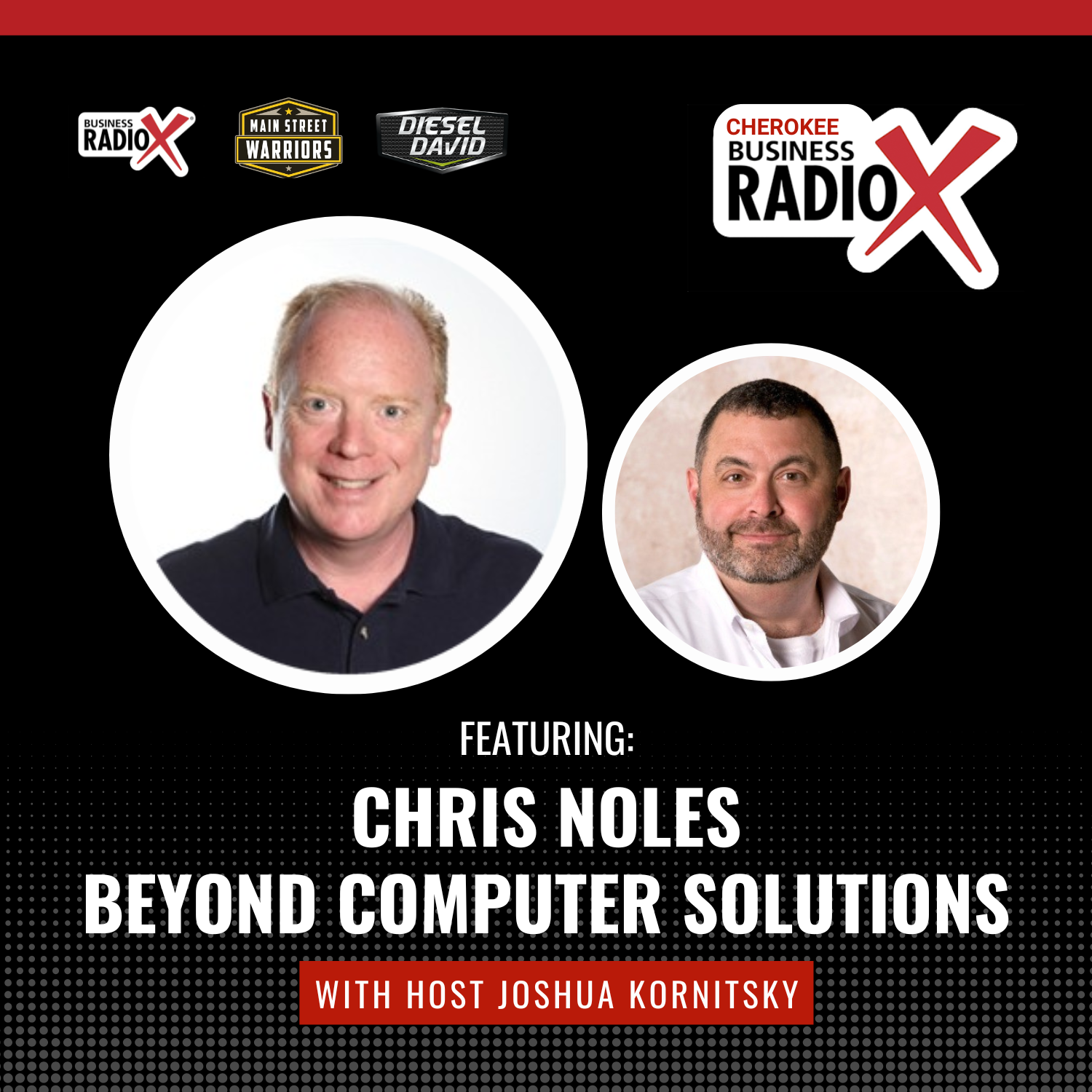

Brought to you by Diesel David and Main Street Warriors

In this episode of Cherokee Business Radio, Joshua Kornitsky interviews Chris Noles, founder of Beyond Computer Solutions, about IT management, cybersecurity, and AI adoption. Chris shares his 26-year journey serving businesses, debunking common misconceptions—such as Microsoft 365 automatically backing up data. He explains the importance of comprehensive cybersecurity strategies, including active monitoring and verified backups. Chris also discusses guiding clients through AI adoption responsibly, recommending paid tools like Microsoft Copilot over free alternatives to protect sensitive data.

 Chris Noles is an experienced Virtual CIO and Technology Consultant to professionals and business owners. Chris has over 30 years of Information Technology experience and over 23 years of experience as a business owner providing Managed IT Services.
Chris began his career in the 1990’s providing specialized IT services for law firms and business owners, and many of those same law firms and business owners continue to work with his team of experts today. Chris is a trusted advisor who has provided IT services, compliance and security solutions to Politicians, Attorneys, Doctors and Executives for organizations of all sizes.
His team has also played a significant responding to and remediating high profile cybersecurity breaches for organizations ranging from 25 employees to 5000 employees.
Chris has been featured in multiple articles providing cybersecurity expert advice to medical and legal professionals who our concerned about protecting their reputation. Chris’s firm has been recognized as one of the top 501 MSPs worldwide.
Connect with Chris on LinkedIn.
Episode Highlights
- Evolution of IT from on-premise to cloud solutions
- Importance of cybersecurity and comprehensive protection strategies
- Misconceptions about cloud security and data backups
- Role of technology partners in providing tailored IT solutions
- AI’s emerging role in business and responsible adoption
- Strategies for leveraging AI to enhance business efficiency
- Importance of compliance and cyber insurance in technology use
- Customization of technology solutions based on client needs
- Co-managed IT services and support for internal IT teams
- Addressing the cybersecurity needs of small businesses and regulated industries
 This transcript is machine transcribed by Sonix.
TRANSCRIPT
Intro: Broadcasting live from the Business RadioX studios in Woodstock, Georgia. It’s time for Cherokee Business Radio. Now, here’s your host.
Joshua Kornitsky: Welcome back to Cherokee Business Radio. I’m your host, professional EOS implementer Joshua Kornitsky. And I’ve got a really amazing guest that I can’t wait to introduce to you. But first, I want to remind everyone that today’s episode is brought to you in part by the Community Partner Program, the Business RadioX Main Street Warriors defending capitalism, promoting small business, and supporting our local community. For more information, please go to Mainstreet warriors.org. And a special note of thanks to our title sponsor for the Cherokee chapter of Main Street Warriors, Diesel David, Inc. please go check them out at diesel. David.com. As I said today, I’ve got a really, really incredible guest. I can’t wait to introduce to everybody. Today’s guest is Chris Noles. He’s the founder and president of Beyond Computer Solutions. Chris has spent more than 25 years helping organizations manage their technology, strengthen their cyber security, and navigate the increasingly complex IT landscape. Chris, welcome to the show. It’s great to have you here.
Chris Noles: Well, thank you, Josh, thanks for having me on the show.
Joshua Kornitsky: It’s an absolute pleasure. I enjoyed the conversation we had offline long before we had you scheduled on the show. And I think we had a lot of interesting things to talk about, but I want to take you back a little bit and ask, how did you arrive here? What is your origin story that that drove you to, to found beyond computer solutions and to head it and drive it in the direction that it’s gone?
Chris Noles: Yeah. So just over 26 years ago, I was working for another IT company and I really saw the need, especially here in the Atlanta market and especially with the real estate lawyers, really saw the need at that time for people to be able to outsource their I.t, have some, have a whole team come in instead of just paying one person part time and getting all the tools that they need to stay up to date, backed up and be able to to have somebody to call when they need help. And so, um, back then it was really more of a consulting opportunity, really grown out to be more of a partner for everything IT and cyber.
Joshua Kornitsky: Well, over the course of 26 years, you must have seen a lot of different changes.
Chris Noles: Oh yeah.
Joshua Kornitsky: Any of the things that and I’m sure it’s a lengthy list, 1 or 2 of those things that stick out that were that really were the inflection point that we thought they were. Because every week there’s some new next big great whatever.
Chris Noles: There’s a lot of truth to what you said. You know, I think the biggest transition I remember in all the curves I’ve had to jump over the years was really the, uh, the shift from on premise technology to more of a cloud or online technology. And for us to be able to, to do more remote support and less on site support. So we were able to serve a lot more people and help reduce costs and increase uptime during that time.
Joshua Kornitsky: So is that really the driver of why people take their, get rid of their equipment or move their equipment off prem or into the cloud?
Chris Noles: There’s a lot of reasons for it. I think one, one thing that people think is different, that’s not I want to clear that up, is they think that it may be more secure if they keep their stuff in their office, or some people think it’s more secure if they keep it in the cloud. The truth is, it depends on what you wrap around either one. So I still have clients that that have technology on premise. They need it for performance. Maybe they’re doing CAD drawings and they just can’t get the bandwidth or the speed they need to be in the cloud. But I will say that it does offer a lot of benefits to be able to have cloud, help people remotely work and scale and compete even at a more regional or national level.
Joshua Kornitsky: Well, and and I understand and just for clarity, for anybody that’s watching or listening, um, it help, help people understand. And I know many people have made that transition. It is not one size fits all. Right. And when you work with your clients, you use the term partner. When you partner with your clients, do you go through any type of a needs analysis to better understand whether it’s moving their machine, their server into a data center, or migrating them completely to the cloud? How do you know what you need to provision, what you need to set up?
Chris Noles: Yeah, that’s a great question. And it really is a consultant consultative process. We really need to go out and do a needs assessment, find out if they’re using technology more in the office or out on the field, what applications They’re using a good many of our clients. Now, I’d say the majority no longer have a server in their building, but there are several that do because it just makes sense for certain reasons. So it the great thing about us is we can partner with you either way, and we’ll help you determine the best way.
Joshua Kornitsky: So earlier you mentioned you used the term wrapper. It depends kind of on on the wrapper that’s around whether it’s on, on prem or in the cloud. And I want to talk about that wrapper because there’s, there’s what you mean by that wrapper and what other people maybe don’t quite understand. I want to use that as sort of a jumping off point to talk about cyber security, because cyber security, it’s, um, it’s a thousand miles wide. It’s 10,000 miles tall. And it means a lot of different things to a lot of different people. Can you help us understand what that is?
Chris Noles: Absolutely. So there’s a certain basic level of services that we want to make sure we cover, whether your technology is in the cloud or on premise. And I always use the alarm system analogy. We don’t want to leave any holes, right? If you have an office that you want to protect physically with security, you usually have locks on the door. You usually have not only sensors, but you have monitoring and even cameras in case somebody does get in. Well, that same technology in the cybersecurity world needs to apply. So whether you have a server or you’ve got your information at Microsoft 365 or a data center, there’s still this, this service that we provide, this value added service that these vendors like Microsoft, they don’t sell directly to small businesses. The technologies you need to protect all of that. And so what I mean by that is, you know, you need to have backups. Microsoft doesn’t do their own backups. Your servers are not going to do its own backups and verify that they’re working every day. And we we have a security operations center that’s also watching all the tools we have in place to make sure somebody didn’t get in anyways. So we log everything that happens. We watch for intrusions. And so you can buy this package where we’re either supporting you with your, your, your infrastructure on premise, or you’re in the cloud and it’s secure. And unfortunately, a lot of cloud vendors or software as a service vendors will make you feel like you don’t really need anything but their service. Right? And it may be true when it comes to access, but when it comes to security and redundancy, we add a lot of value and expose a lot of gaps, um, to, to make sure that you have the full package.
Joshua Kornitsky: Well, and, and it sounds like that full package, one of the, one of the real value adds that, that you intimated but didn’t directly call out, but I can call it out is you’ve got the knowledge and the expertise to know what to pay attention to, uh, from a, from a, from a service licensing or an offering, because I’m sure there are literally thousands of products that I can buy to protect my organization, my hardware, my software, my whatever. But you have 25 plus years of experience that helps you kind of sift through that. And, and to me, that that’s it. It immediately floats up the question, what are some of the other misconceptions that you encounter with businesses that you work with around cybersecurity, security, even just basic password stuff? What are some of the ones that that you see most frequently?
Chris Noles: Yeah, that’s a great question. And there’s a lot to unpack there. I’ll try to be brief, but there’s so many layers and levels of things here that that we want to touch on. And first of all, my goal with anybody is to be their trusted advisor. Like you said, I bring the experience to the table we work with dozens of vendors that that we vet, but there’s hundreds, if not thousands out there that you could go direct with. And then you have to piecemeal it together, manage it, trust that they’re doing their job. Our team, what we’re designed to do is help you bundle everything into a package. Basically, it’s a monthly package you pay for, and it includes the cyber security, which includes all the tools best of breed. It includes our monitoring. It includes the backups and either hourly or remote support. Some of our clients, they can get by with just maintenance if they have maybe a technical person on staff. But for a lot of small business owners, it really makes sense when we add value to give you that unlimited help desk. When something goes wrong, we fix it, or you call us with a problem and we fix it.
Chris Noles: So that’s a huge value add. But I think one of the misconceptions going back to your original question is a lot of people assume that if they’re in Microsoft 365 and their software is in the cloud, or where they have G suite that everything’s backed up and they don’t need to do anything else. Um, the truth is, you know, you need a third party backup. Microsoft actually has it in their fine print that they don’t back up SharePoint, OneDrive email. They leave that to partners like us to handle that for you. Um, the other thing is you may have a tool, but if nobody is monitoring the tool, it’s a threat detection, you know, like an antivirus. Um, then, you know, intrusions happen. I’ve been in on several incident response engagements over the years where an organization thought they had the proper AI tools to detect ransomware. Then because nobody was monitoring and managing it, they actually had all their files encrypted. Their backups were connected to the server.
Joshua Kornitsky: That’s hard to hear.
Chris Noles: Yeah. It’s just, uh, you know, unfortunately, that meant the backups were, were infected as well. Sure. So, um, our technologies, you don’t have to worry about it because we actually know how to separate all that out. We, you know, have a security operations center monitoring it. We report on it for compliance purposes. And we also help our users get trained. Our clients, they all get training with our service. They get password management to help them manage secure passwords. Um, so it’s a complete comprehensive package. And what it all boils down to is people processes, the right training, and of course, the right partner to help you to do all the other things. But our customers have to take some responsibility to train their staff. And we help you do that.
Joshua Kornitsky: Um, it sounds to me like it’s a pretty well thought out approach to handling things. Do you also help your clients? So, you know, whatever my needs are today, I’m, I’m a 15 person operation, but I have plans to grow and grow. Do you help them strategically plan for their futures?
Chris Noles: We certainly do. Um, we actually have a term for that. It’s called virtual CIO, Virtual Chief Information Officer. And we packaged that with our with our service plans so that you can meet with me or one of my staff to help you build a roadmap to grow your business, to add more locations to compete. And even now with AI, how to use AI to help you do more, maybe with fewer people, but people who can use the power of AI to make them superhumans. Um, so yeah, we are all about helping our clients grow and focus, help them focus on running their business while we keep it running.
Joshua Kornitsky: So you, you said it like Beetlejuice. If we say it two more times, it’ll show up here on the call. Can I ask you about AI?
Chris Noles: You can.
Joshua Kornitsky: Um, you said you you said in your virtual CIO program that you’re able to, um, coach and help your clients with AI. Um, again, ten 000 miles across 100 miles high. How. How do you guide any of your clients? You know, not I know I’m asking an impossible question, but what what are some of the things you tell them to be aware of? What are the vulnerabilities? What are what are the things I don’t want to say that keep you up at night, but that you want to make them aware of about AI.
Chris Noles: But we all know it’s changing so fast. Today is July 2026. Okay. And so what I will say today is that none of us have, um, like a silver bullet solution to make your business super powered with AI or, you know, everybody’s looking for how to make AI work for the organization. But what we are finding is great results consulting with our clients to help them figure out what problems they’re trying to solve, and then finding the right AI solution to help them solve that problem. What we do, first of all, uh, to help you prepare for this revolution with AI is the AI readiness program. So we come in and make sure all of your data is searchable for the data that you want, searchable, because there’s stuff that maybe the owners or the C-suite has that maybe in private folders, you don’t want that out in the wild, right? So we help you make sure you’ve got secure platforms to, to, uh, to put the data that you want in AI in a certain place and your private data in another place. But one thing I want to say that’s really important is you’ve got to be really careful with free products like ChatGPT. Um, I love ChatGPT, but we need paid versions of this stuff. And the reason for that is free means you’re the product. And so just like with Google, um, all the searching you do that history stays there where everybody could potentially pull it back. It’s never wiped out. And so the same thing happens when you’re typing stuff into ChatGPT. And there have been stories that have been published about people who’ve lost copyright information.
Joshua Kornitsky: Wow.
Chris Noles: Or it’s fallen in the hands of competitors because they just uploaded sensitive information to the free versions of ChatGPT, and it’s out in the wild. And so the way we help our clients today is we help them hopefully standardize on Microsoft Copilot, since we are a Microsoft partner and we can provide that prescription, that subscription for a monthly fee for each user that needs it. And then that stuff is guaranteed private, it stays in that environment. And so that’s the main main use case for AI right now that we’re finding with our clients, is that they want to be able to prompt AI search, you know, maybe do some generative AI. Um, we can help with that, but there’s a whole lot more to AI that could be a whole separate conversation.
Joshua Kornitsky: Sure.
Chris Noles: But, um, I will say that, uh, equally important, the reason to pay for AI is not just because it’s a good idea, but because compliance and cyber insurance companies are starting to require a written policy on it. So they want to know.
Joshua Kornitsky: That’s a very good.
Chris Noles: Writing.
Joshua Kornitsky: Right?
Chris Noles: That says, hey, our employees are not allowed to use free versions of AI on the company computers. They have to use the standard product that we purchased. And even if you don’t buy copilot from us and you buy ChatGPT or Claude, that’s fine. You just need to standardize on something and pay for it.
Joshua Kornitsky: So you and I talked about this a little bit beforehand. And, and because you just touched on copilot, you had you had explained it to me to some degree. Hopefully I’ll remember it correctly. Copilot, if I remember, is a little bit different than Chat and Claude because Chat and Claude and Gemini, you have to sort of educate them all from scratch when you get started. But in a properly managed copilot environment, you said that’s a little different.
Chris Noles: Yeah. The great thing about copilot is you get all the power of ChatGPT. It uses the GPT engine, but you get the integration with the familiar desktop applications that Microsoft’s been providing for years. That includes word, Excel, PowerPoint, outlook. It can sit alongside of your applications and help you schedule appointments and outlook or modify word documents. And again, you’re getting the the ChatGPT component as well. So if you’re paying for for Google and you’re Microsoft kind of business, uh, you could probably cancel your ChatGPT with, with Google and go straight to copilot and get both. Um, so that that’s kind of the, the main takeaway here right now is that we’re just helping people get on board with the paid compliant version. Sure. That we can help. Co-manage. And then we also have other partners that are providing some pretty amazing technologies with AI for manufacturing companies distribution. There’s a lot of things we can do to help with workflows and automation. We just have to have conversations. It’s a very, um, um, um, unique kind of conversation per business. Like tell me what problems you’re trying to solve. We’ll find an AI to solve it for you.
Joshua Kornitsky: Well, and, in, in without giving obviously anybody’s private information away. Can you give us an example or two of, of the types of things that you’re able working with others to, to put together? Because I think, I think a lot of people hear the promise of that, but they don’t really give me an example because it doesn’t mean anything to me.
Chris Noles: Yeah, no, I think a good example would be perhaps a manufacturing organization is manually still using like an order taking system that they have to. Maybe it’s an access database. We want to be technical and then that doesn’t talk to their customer relationship management program. It doesn’t automatically.
Joshua Kornitsky: Software that doesn’t talk to each other. Never heard of that.
Chris Noles: Yeah, of course not. Right. And 2026 right.
Joshua Kornitsky: Never.
Chris Noles: Happened. And so, uh, a good example would be we create a workflow, not necessarily, you know, reinvent everything they’re doing, right? Create workflows and bots that can be trained to take that information and create automation. And another good example, is if you’re searching for something that’s hard to find, let’s say you’re wanting to buy a Corvette, right? 22,006 Corvette, and you can’t find anything on the Facebook marketplace. You’re scouring the internet. You can train these gpts like ChatGPT or copilot with what you’re looking for and ask it to, to scour the internet, basically, and send you a digest every day at 8 a.m. of everything it found. And then you can just simply go through the links and click on them and maybe be the first one to, to know about the, the, uh, the car that’s out there before somebody else.
Joshua Kornitsky: Um, so that’s a, that’s a great, very digestible use case that if you had told me if I worked at Microsoft or IBM that I could have that built, I would imagine in my head eight months worth of planning meetings, followed by a years of product development. And in 2 or 3 years I would have a product. But you’re saying that that’s accessible even at a small business scale.
Chris Noles: Now it is, it is. And you can even have, um, AI write code for you, you know, like you want a certain outcome, right?
Joshua Kornitsky: Right.
Chris Noles: It can use code to create a mini software if you will, and make something happen. So you just got to have a really open mind, a really creative mind to see what’s possible. It’s not just about asking it questions. A lot of people think it’s just, you know, about, uh, it’s the new Google for searching, right? But you can have it scheduled things, automate things. It can create its own assistant for you. It can, um, talk to your other applications. You really just need a consultant technology consultant like us who can come in. And if we don’t know how to do it internally, we know somebody on the outside that does and they can help you build this, this competitive option that you’re looking for to give you an edge over your competitors.
Joshua Kornitsky: Well, and it sounds like the first big step there is having a guide that you know and trust.
Chris Noles: Absolutely. And so a lot of people think AI is a new thing. Um, artificial intelligence has been around for decades. Um, I even remember back in the Microsoft DOS days, there was a program that you could just talk to it and the more you told it stuff and asked questions, the more it would learn. And eventually you could build this thing over a year to really get to know you and know what you like, what you don’t like. Um, we’ve just really supersized it in 2026. And of course, now it’s with generative AI. That’s, that’s been a revolutionary change where it can now create products, create contracts, create content. And we’re seeing professionals use it all day long, saving a lot of hours and still being able to charge their, their rate. In fact, if there’s one tip I can give you.
Joshua Kornitsky: Please.
Chris Noles: If you’re if you’re selling hours, I think it’s time to start looking at selling solutions and outcomes. Because now I think a lot of professionals that charge by the hour to maybe write a contract or, um, maybe they’re a lawyer. They should be looking at maybe charging a flat rate because they might be able to cut their time in half with the AI, and there’s still value to what they’re doing.
Joshua Kornitsky: Sure.
Chris Noles: I don’t I don’t think AI is a cheat code. I think it’s if you know how to use AI the right way, you deserve to be paid for what you create.
Joshua Kornitsky: Well, and.
Chris Noles: Thinking in terms of time.
Joshua Kornitsky: And it’s important to, to remind everybody that you don’t have an agenda. You’re there as a guide. You’re, you’re not trying to persuade product A, B, or C, you’re not trying to get them, uh, to buy anything other than good guidance. Um, and I think it’s important to reiterate that because we are all so accustomed to being sold to all the time that it, it like in my own role, it’s very hard as an EOS implementer to have people understand that all I really want to do is help them. Um, all you’re looking to do is, is to provide guidance so that they get what they need. But you do have to ask questions in order for you to help guide them.
Chris Noles: Absolutely. It’s all about taking the consulting approach. It’s not really changed. It’s actually become more important now that we ask the right questions as a technology solutions provider, because it’s more custom now than ever. I can’t just sell an AI widget to the same company. Sure. Hundred times over.
Joshua Kornitsky: Sure. And and my needs I what if I sell widgets and the guy next door sells widgets? We still have different needs, even if we’re the exact same size organization. So you need a partner that works with you. Um, what are the types of businesses that you typically work with? Is there a certain size? Is there a certain geography? Who do you best help?
Chris Noles: Absolutely. So we started off working with real estate law and title companies and their unique needs to help prevent wiring fraud and to integrate their Microsoft email and all that with their software platforms, the real estate settlement software platforms. Um, we’ve been doing that for 26 years actually. Wow. But we work with all types of law firms, all types of financial firms, manufacturing. That’s a big one because there’s a lot going on there. You know, there’s emails, order taking, logistics. There’s a lot of interesting things with technology that we have to help with. Um, but I would say that any small business that don’t even have to be Atlanta based, we work with clients outside of Georgia.
Joshua Kornitsky: Okay.
Chris Noles: But any small business, typically five or more employees. Uh, we have a lot of clients, believe it or not, that are just 2 or 3 employees, but we have to have our minimums, right? So sure, you come to us with two people, we’re going to charge you probably like you’re a five person firm, but, um, there’s really not a limit. We even have an organization we work with that has over 500 employees. And the reason why is because they have an IT person on staff and we help co-manage that environment, so she’s too busy to do everything. So we do a lot of the updates and the security and the backups.
Joshua Kornitsky: That’s a really important point that you just shared that Co-manage, because most people have someone that they call, whether it’s internal or external, and sometimes they, you know, someone in ownership is even that person, right? But to know that you’re not there to supplant them, that you’re there to help work with them and improve the environment for everybody, that’s, that’s a big deal.
Chris Noles: And we love those relationships. Um, there’s even a book out there called I Don’t Want Your Job. So if you’re an IT person or a CIO and you’re thinking we’re coming in there to try to replace, you know, you’re, you’re our best ally because you can help keep a lot of the, the noise, you know, like the daily support for.
Joshua Kornitsky: Sure.
Chris Noles: Off of us. And then we can just help you with all the stuff you don’t have time to do. Um, we can’t be great at everything in it, but you don’t want to be bad at cybersecurity because that’s a bad day for a CFO or CIO who, you know, when the boss asks, how did this happen? You’re in charge of our technology. Well, at least partner, if you do nothing else, partner with somebody who can provide the cybersecurity piece. But the majority of our organizations, Josh, they actually need us full service because we work with a lot of smaller organizations. I’d say even up to 75 users, you probably don’t need a full time person in it. When you can have a whole staff that can be outsourced like us and take care of everything, including the tools. Um, but if you do happen to have a full time person reach out to us, there’s things that we can do to help augment, um, even staff augmentation for project. We can do that.
Joshua Kornitsky: That’s great to know. So Chris, what’s the best way for people to get Ahold of you?
Chris Noles: The best way is just to go to our website, www.cs.com. Um, you can also find me on LinkedIn under Chris Noles. I’m very active on there. I share a lot of great free content tips on how to protect your business. Um, one thing you’ll find out about me personally is that I’m very passionate about entrepreneurship and business growth. Uh, even though I was a technologist in my early days, I’ve kind of turned that over to my team to help with the day to day. But I really want to help our clients grow with technology and keep them out of the news. We don’t want anybody getting cyber incidents.
Joshua Kornitsky: Let them be famous for something else.
Chris Noles: That’s right. But you can reach out to me personally, go to my website. Um, if I don’t get back to you personally, I’ll have somebody on my team, uh, follow up. And the next step usually after that is a quick call to see if we’re a good fit and then a free assessment to see if there’s any gaps. We can show you what maybe you think is being done. That’s not being done well.
Joshua Kornitsky: And, and as the old adage goes, you don’t know what you don’t know.
Chris Noles: So you we’re always fair about that. We have some prospects that come to us that everything looks good. They just need another set of eyes. And if they need something down the road, we’ll be here.
Joshua Kornitsky: That’s fantastic. Well, Chris, I’m so glad that we took the time to get connected. And for you sharing all that you have today. Any final thoughts? Anything you’d want somebody to remember other than we will share the links to your LinkedIn and to the Beyond Computer Solutions website. Um, any last parting thoughts?
Chris Noles: Yeah, we’ll say that, um, there’s still a misconception out there where a lot of small businesses think they’re too small to be attacked, or maybe they don’t need somebody unless they just have a problem and they pay somebody by the hour. There’s two things I want to say to that real quick, please. Number one, it’s getting harder and harder to find somebody who will just work by the hour. We call that break fix. There’s not many, um, independent people out there anymore that will do that. And number two, and I want to be really serious about this compliance is coming. A lot of organizations we deal with that already have it. But your cyber insurance, I hope you have it. If you don’t, you need to look into it, they’re going to mandate that you have all these things done. They’re going to ask you, do you have a written incident response plan? Do you have backups? And then they’re going to ask you prove it and share the contact information for the company taking care of it. So don’t think that, uh, you know, you can, especially if you’re in a regulated industry, like maybe, um, an investment broker or you’re an attorney, you have to have a partner, somebody like us, at least talk to somebody. Um, it doesn’t have to be expensive. There’s a lot of great options out there.
Joshua Kornitsky: Excellent guidance. I, I can’t thank you enough, Chris. Um, I’m, I’m grateful for your time today. My guest has been Chris Noles, founder and president of Beyond Computer Solutions. Chris has spent more than 25 years helping organizations manage their technology, strengthen their cyber security, and navigate the incredibly increasing, complex IT landscape. Chris, thank you again so much.
Chris Noles: Thank you. Josh.
Joshua Kornitsky: It’s my pleasure. And I also do want to take just a moment to remind everybody that today’s episode of Business RadioX was brought to you by the Business RadioX Main Street Warriors, defending capitalism, promoting small business, and supporting our local community. For more information, please go to Main Street warriors.org. And a special note of thanks to our title sponsor for the Cherokee chapter of Main Street Warriors Diesel David, Inc.. Please go check them out at diesel. David.com. I am professional EOS implementer and your host here. This has been another wonderful episode of Cherokee Business Radio. We look forward to seeing you next time. Thank you. Other than sounding like a I’m gargling with nails, I think it was great.
Chris Noles: I think it was great too. Your voice held up really well.
Joshua Kornitsky: Well thank you. Yeah, I got a. Usually I have tea next to me and I need to go brew some more, I guess. Um, I will, uh, let me stop the recording. I will throw this on Google Drive. Like I said, raw just to make sure you’re cool with it. Once you are, the way it typically works is it goes audio publish first to Apple, Spotify, all of that. And you know that from John, you just get a link and she publishes that. Do we have did you send over a headshot and a bio or. No, I don’t remember.
Chris Noles: I’m pretty sure I did weeks ago. But if you don’t have it.
Joshua Kornitsky: Let me, let.
Chris Noles: Me, let me know and I’ll.
Joshua Kornitsky: Send it. So I will tell you, um, EOS worldwide, my parent organization on that side of my life, uh, is Google workspace. And my entire life I’ve, I’ve lived in the Microsoft environment. Uh, and I miss it terribly. I do, uh, it’s just, it is, it is not apples and oranges. Um.
Chris Noles: But I tried to do what you’re doing for another business and I really started to hate Google workspace.
Joshua Kornitsky: Yeah. And well, the my LLC is on Google workspace because for me, because I’m the only employee, it was the cheapest option. I knew how to set up a mail domain and it was fine because I have my needs are very, very low. Anytime I need to do anything, I own the domain, I can do whatever I want. But because I’m subject to their rules, um, I have to them being us worldwide. Uh, I can only work within the confines of what they have set up. However, they have enabled the the enterprise license for Gemini. So I’m able to go up into Gemini in my email and just say, hey, did Chris send me a headshot and bio? Um, and it said it did not. Oh, okay. So if you would just send those over. Not hugely urgent, but I want to make sure we use the headshot you want and the bio you want. Um, and that has been the only use that I have found for Gemini in my life and in the, I use gmail in my personal life and have for years. It’s great for the exact same thing that I send my mom an email about this, you know, freely admitting I am the product.
Chris Noles: But yeah, I still have a hybrid of personal use with gmail, but I don’t do any free ChatGPT searches or anything.
Joshua Kornitsky: No, no, all of that stuff is well, I guess you’re right. I my version of Gemini and Gmail, I pay for Google one for the storage space. I don’t know if that gives me their, their, the way they price Gemini and the levels are very, very confusing. Oh, I’m not surprised.
Chris Noles: Well still with Google.
Joshua Kornitsky: Yeah. It really um, yeah. You know, I don’t need to tell you I appreciate it. I think it was a great interview. Thanks for being flexible on the time. Um, yeah.
Chris Noles: And I’m glad that you were pleased with the.
Joshua Kornitsky: Oh absolutely. And I, I hope, I hope that you, uh, are you mentioned previous to today health issues. I hope everything is well with you and next time you come back up this way, we’ll grab lunch again sometime.
Chris Noles: It’s stable, I appreciate that. I’ve got a conference I’m going to try to go to this week. If I continue to feel well down here and, uh, I should be able to get you the logo and the bio here in the next few minutes.
Joshua Kornitsky: Perfect. Thank you very much, I appreciate it. Um, okay. It’s always a pleasure to chat. That’s why I’d love to hang out again when you’re back on the side of town.
Chris Noles: So yeah, yeah, we got that tech nerd gene together, so.
Joshua Kornitsky: Can’t help it, man. It’s just there. All right, all right, have a good one.
Chris Noles: Take care. Okay.
Joshua Kornitsky: Thanks.
Chris Noles: All right.
Joshua Kornitsky: Bye.















