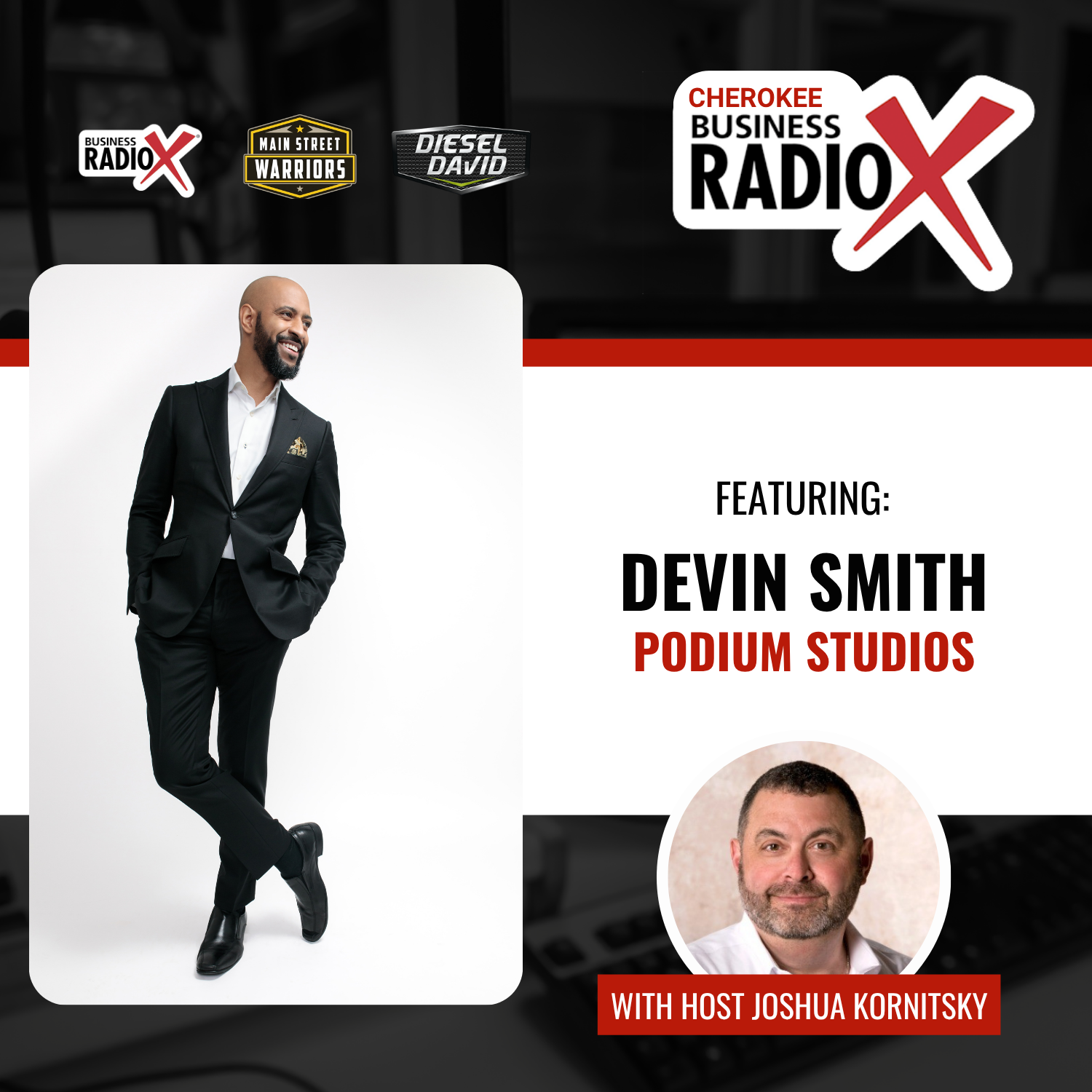

In this episode of Cherokee Business Radio, Joshua Kornitsky visits Podium Studios in Marietta, Georgia to interview founder Devin Smith. Devin shares his journey from advertising to launching Podium Studios, emphasizing the importance of authentic, strategic video and podcast content for business branding. The conversation covers content creation strategies, balancing personal and company brands, and the value of authenticity over perfection. Devin offers practical advice for businesses at any stage, highlighting how Podium Studios supports clients with both advisory and full production services.
Brought to you by Diesel David and Main Street Warriors


 Devin Smith is a branding and experience guy with a passion for quality production and podcasting. He’s spent nearly 25 years cutting his chops in design, advertising, marketing, and branding.
During that time, he worked with major brands like Wells Fargo, Verizon, and Michelin.
These days, he leverages all of that as he does content strategy, production, editing, and even hosting for podcasts through Podium Studios in the metro Atlanta area.
Episode Highlights
- Devin’s background and career transition from advertising to founding Podium Studios.
- Importance of branding and content strategy for businesses.
- Role of authenticity in video content creation and audience engagement.
- Challenges faced by clients in front of cameras and strategies to overcome nervousness.
- The significance of clear communication and avoiding jargon in content.
- Balancing personal and company branding for business owners.
- The evolving landscape of video content and podcasting in business marketing.
- Resources and team requirements for producing professional video content.
- Strategies for businesses at different stages of maturity in content creation.
- Accessibility of content creation tools and the value of starting with basic equipment.
 This transcript is machine transcribed by Sonix.
TRANSCRIPT
Intro: Broadcasting live from the Business RadioX studios in Woodstock, Georgia. It’s time for Cherokee Business Radio. Now, here’s your host.
Joshua Kornitsky: Welcome back to Cherokee Business Radio. I’m your host, Joshua Kornitsky professional EOS implementer. And today I’m excited to be in someone else’s studio, which I’ll tell you about in just a moment. But I want to remind everybody that today’s episode is brought to you in part by our community partner program, the Business RadioX Main Street Warriors Defending Capitalism, promoting small business, and supporting our local community. For more information, please go to Mainstreet Warriors and a special note of thanks to our title sponsor for the Cherokee chapter of Mainstreet Warriors. Diesel. David Inc. Please go check them out at diesel. David. So today is a show unlike any other. Uh, today I’m a guest within the incredible Podium Studios location in Marietta, Georgia. And, uh, with his gracious invitation, Devin Smith, the founder of Podium Studios, has invited me in to record Cherokee Business Radio.
Joshua Kornitsky: Today’s guest is Devin Smith, founder of Podium Studios in Marietta. Through his work, Devin helps leaders and brands create engaging, professional video content that helps strengthen personal brands and expand their reach. His background in design and his passion for branding give him a really unique perspective on how content can be shaped and really help change the reputation and influence the view. We’ll hear directly from Devin about his journey, his insights, and get his perspective on branding, and learn more about the work being done here at Podium Studios in Marietta, Georgia. Well, thanks for having me, having me. Devin, it’s really a thrill to be here.
Devin Smith: My pleasure. You know, honestly, like I was mentioning, I. It’s very rare that I get invited on somebody else’s show. So I’m just glad you’re willing to make the drive and come hang out, man.
Joshua Kornitsky: Absolutely, absolutely. We’re not that far from Cherokee County. It all works out. So tell us a little bit about yourself and your background, if you would. Because if we don’t know the origin story, it’s hard to understand where we’re at.
Devin Smith: I absolutely. So, uh, you know, essentially, um, I kind of I started out in, um, advertising, actually. Okay. Uh, I wanted to go into I wanted to go into animation. My dad convinced me that was a hard field to break into and talk me into going to design school. Okay. Went to design school and then went into advertising industry, working at ad agencies and stuff like that. And, um, and just got to work on, um, big brands, got to work next to world class creatives. Uh, you know, I’m sitting next to people who are writing copy for Verizon and BMW.
Joshua Kornitsky: And I’m curious, was that here in Georgia?
Devin Smith: That was actually that was actually in South Carolina. Really? So that’s where I’m from. I’m from Greenville, South Carolina. And, um, I was working at, uh, an agency in Greenville that, you know, you wouldn’t expect Greenville to house an.
Joshua Kornitsky: No, not at all.
Devin Smith: That is working on major brands like that. Um, but it it does. And now they, uh, I mean, they’re, they’re it was an agency called, uh, they’re now called EP and Co.
Joshua Kornitsky: Okay. They got class here.
Devin Smith: Yeah. Yeah. And they’re now like agency of record for like John Deere.
Joshua Kornitsky: Oh that’s.
Devin Smith: Awesome. And all kinds of big companies. And I also worked at another agency called Jackson. And you know we were again working on Michelin, working on, you know, just um.
Joshua Kornitsky: That’s fantastic exposure.
Devin Smith: Yeah, man. And getting getting to getting to work on those brands and getting to work with those people. Uh, it it taught me how marketing is done in the big leagues. You know, it taught me how brand positioning and creative is done in the big leagues. And, um, you know, I wound up getting out of the ad agency world going into tech. Every company I ever worked at, I just wound up. I wound up, you know, doing creative. Yeah. You know, I’d work on stuff. We’re working on building software. Building, you know, um, web, web apps and all that. And eventually I’d just be like, man, we. What are we doing with the brand guys? Like what? What is this?
Joshua Kornitsky: Which which, honestly, a lot of organizations that’s not high on their list unless they’re specifically marketing focused.
Devin Smith: That’s right. Yeah. Or if they’re big enough to where? They’re used to hiring agencies to handle that stuff, they’re just like, well, we don’t have anybody in-house. You know, we’re not paying an agency. And I just I’m a firm believer that, uh, you shouldn’t wait too long to make sure that you have Professional brand positioning, you know.
Joshua Kornitsky: Couldn’t agree more because it’s a defining. It is the defining characteristic of your business. It’s the public face. And if you’re not going to prioritize that at a certain point, I understand financially it may be difficult, but when you have achieved a level of success where you’re able to prioritize it, it is your best foot forward every time. Yeah. So so you’ve got this incredible pedigree of working with these top tier organizations that clearly brought, uh, a lot of expertise into their marketing and into their creative endeavors. Um, what what got you from being in, in that particular, uh, universe to here where you’re now helping create, uh, incredible video content for others?
Devin Smith: Man. Uh, so that’s a great question. So I, uh, the funny thing is, is that, uh, I wound up, uh, I wound up going out on my own. Um, it was late 22, late 2022. I wound up deciding to start my own business, and I was consulting, and I thought I was going to be helping people build software and still wound up doing marketing. Sure.
Joshua Kornitsky: And eventually tried to get out, and it just kept bringing.
Devin Smith: You kept bringing me back in, you know, and and, um, eventually, like John Wick, you know, people, you know, asking if you’re back. And I’m like, yeah, I’m thinking I’m back. Yeah.
Joshua Kornitsky: There you.
Devin Smith: Go. And and so I had a friend, uh, who had the idea of starting a podcast studio. And so that’s how Podium Studios was born. And I got into podcasting, um, back in like 2020, um, I released my first show, and I tried to work on shows before that and never released anything because I was too much of a perfectionist, you know?
Joshua Kornitsky: Well, and I imagine that does get in the way.
Devin Smith: Yeah. Oh, yeah. For especially, you know, my dad, my dad’s an audio engineer. Musician. Oh, okay. So?
Joshua Kornitsky: So. Yeah. So you do. It has to be perfect.
Devin Smith: Yes. Like, you know, I watched my dad doing that stuff, and he was absolutely maniacal about sound quality. Sure. You know, um, and so I was like that, and that stopped me from releasing things. And eventually I realized, like, I just got to put it out, you know? And so I started doing that. Fell in love. I just fell in love with podcasting. I love I love making shows, man. I love making great shows. One of the things that I, I noticed is like when I’m making my own stuff, you know, I love just going and listening to different theme music and thinking, what kind of podcast could I match this theme music?
Joshua Kornitsky: That’s kind of a that’s an interesting mental exercise. Yeah, yeah, but it still helps you visualize it. I’m all for that. Yeah. So who who are the types of organizations or what size what what are the organizations you find that the work you’re doing is resonating with?
Devin Smith: Oh man. That’s so that is a it’s been an interesting journey to figure figure that out really. And what I’ve found is that you have, uh, people, um, whether they’re business owners or executives who know that content content’s the game now, um, you know, the the smartphone we got in our pocket is the new TV, right? And so people expect you to be there and and we find that we resonate the most with business owners, with executives who understand if you’re not there, it’s kind of like, you know, when we were growing up, if you weren’t on radio or TV.
Joshua Kornitsky: You didn’t exist.
Devin Smith: You didn’t exist. Like, you know, you just weren’t or you weren’t a big deal. Right? Right.
Joshua Kornitsky: Um, mom and pop, location store, restaurant, whatever. One, one location. You didn’t expect anything. But if you’re in multiple locations, you got to have a presence.
Devin Smith: That’s right. We expect you to be on the radio. We expect you to at least be on local TV. People expect you to be on social now. They expect you to be on YouTube. And and they go looking for you there. And some, some people will go looking for your Instagram, especially if you’re a local business. They’ll go looking for your Instagram before they look for your website. And and so people who get that have been our our best clients. And we love working with people who know, hey, we got to get attention. And that’s what we do. We bring people attention through doing great content for them. You know, we do. We do video content, we do podcasts. And, um, you know, we we try to make it to where people just don’t have to think about it too much. They come in and we go to them and we shoot and they don’t worry about the rest.
Joshua Kornitsky: Well, so that brings up to me a really interesting question, which is, okay, it’s harder to put a finger on the exact size because it’s really it sounds like it’s more about mindset, right? They’ve got to understand the value of the content. Yeah. Assuming that you’ve crossed that hurdle and you have someone or a group of people that understand the value of the content, how do you help them arrive at what it is the show is going to be about. Because if I am a painter and and I understand the value of building the the brand of my company, I, you know, people don’t want to talk about paint drying, right? It’s not particularly interesting. So, you know, is that something that you’re able to help understand their brand or do you help them create their brand or how does that work?
Devin Smith: Great question, great question. So, um, coming coming from the branding world, um, that is one of the things that if somebody needs that, uh, we will do that. Most of the people who are coming to us, they have their brand, uh, they have their company brand at least established. Okay. Um, most people don’t have a personal brand established as much. And so we will we’ll go from end to end. So we’ve helped people start podcasts and YouTube channels from nothing. Um, and so we’re talking about the content strategy. We’re figuring out what does your audience care about. You know we’re going to do an audience research to find out what kinds of questions are they asking. Um, what kind of problems are they trying to solve that they’re out there looking for information on. And that’s the stuff that we’re that we’re going to make content about, because we’re meeting them where they are with the way that they think about the problems that they have. So, you know, the titles that we’re going to suggest because we’re we’re helping our clients with, with content strategy, with titles, with, with the actual publishing, with monitoring how the content’s performing. And we’re saying, hey, we need to do four videos. We need to do four videos next week on these topics. You know.
Joshua Kornitsky: So I don’t have to come necessarily with an agenda of these are the things I want to talk about, or that this is what I want to create content around. You’ll help them actually understand what the market’s looking for.
Devin Smith: Totally totally. Because it’s just there’s so much guesswork and you can go, I mean, you can honestly go a year and not strike gold, and it’s just better to go and do the research, find out what people care about, and just skip right to that. And so we we do that. Some people are able to come in here. You know, we had we had a local law firm come in and the partners, they’re just so good at sounding like they prepared a statement, uh, that we could give them a topic and they would go for five minutes straight and it sounded like a scripted video. Most people don’t have that skill.
Joshua Kornitsky: Sure. And that’s that’s sort of a sort of directly related to what they spend their time doing. But yes. Um, what are some of the misconceptions people have? Right. Because I imagine I work primarily in audio and and in audio, it’s considerably more forgiving. Right. Because other than when I broadcast live, I have the ability to help fix things that get stepped on or screwed up. How is it different working with video? What are some of the things people walk in? Um, perhaps misunderstanding?
Devin Smith: Oh, I think the biggest thing is that people expect you to be perfect and they don’t. People don’t expect you to be perfect on camera. They don’t expect you to know every word that you’re going to say. As a matter of fact, they want, especially in the age of AI. They want more evidence that you’re human, that you’re authentic.
Joshua Kornitsky: That’s that’s terrifying, but accurate.
Devin Smith: Yeah, right. You know.
Joshua Kornitsky: We’ve all gotten that one email where you’re like, yeah, no human wrote this.
Devin Smith: That’s right. That’s exactly right. You yeah. You get those emails. You see that blog post? Yeah. Uh, that that it’s evident that somebody just phoned it in with, with, uh, you know, AI and they didn’t even really spend much time on it. And one of my favorite sayings I saw a writer post this on X. He said, everybody wants to write content with AI, but nobody wants to read content.
Joshua Kornitsky: That’s very boy that’s really telling. Yeah.
Devin Smith: Yeah. And so we are I think the biggest misconceptions you got to come in, you got to say all the right words and you got to you know, you got to be perfect. Actually, what people want is for you to be authentic. And they want they want to feel like they’re getting to know you and what you’re going to be like when they meet you in person. That’s actually what they want. And we have to tell some of our clients who are really good presenters, we have to tell them, like, dial it back a little bit.
Joshua Kornitsky: You’re you’re too polished.
Devin Smith: Yeah, exactly.
Joshua Kornitsky: Really. So I think that’s interesting because we were talking earlier about sort of, uh, something I talk with my clients about that perfectionism. Perfectionism is the enemy of progress, right. And if you’re hyper, hyper focused on getting every word right, not occasionally having a misstep, I get that, but we’re not in movie production. We’re we’re having genuine conversations. Yeah.
Devin Smith: And you should be able to let your hair down. You should. I should relax you. Some people that stresses them out. Some people want everything to be prepared ahead of time. Totally understand we have a teleprompter for that reason.
Joshua Kornitsky: You know, there’s lights, there’s microphones, there’s cameras. So people I do think have a tendency to be nervous. Oh, yeah. And and in that, in those contexts, how do you help them overcome that?
Devin Smith: Uh, you know, one of the best tools that we use, essentially, is we just start asking them questions, and we have the cameras rolling the whole time, and they’re just talking and, and we get great content out of just asking them honest questions, especially if we’re, you know, we’re a layman to most.
Joshua Kornitsky: Of our.
Devin Smith: Universe. Yeah. To their whole world. We don’t we’re not experts in that. So we’re asking the kind of questions that somebody who doesn’t know anything is going to ask, right? Um, and that tends to be good content.
Joshua Kornitsky: Near and dear to my heart. Because for me, I always want to make sure that I’m asking the types of questions that if someone ran into you on the street, Devin, and you said, well, I you know, I help companies create content. Yeah. Well, what does that mean? Right. Right. Because those are the things we we all tend to live in our own little professional bubbles. And in in my life as a as a business coach and teacher and facilitator, I have a list of acronyms that I have to carry a lexicon to hand to other people. Yeah. To be like, okay, these are the this is what I’m talking about. Right. Um, that shouldn’t be necessary in a normal dialog.
Devin Smith: Right. And you don’t want that on social media because you won’t get the chance to explain it. And, you know, you think about how much time you spend on a reel before you go to the next one. I mean, you’ve got you’ve got 3 to 5 seconds, tops. I mean, five seconds is generous to get somebody’s attention. And if it’s not, um, easy for them to grasp why they should invest the full 30s to a minute to to watch your your video. I mean, you’ve lost them, you know.
Joshua Kornitsky: Well. And that brings up another question for me. So when you’re when you’re helping create the branding that leads to the content, even if they’ve brought their own business branding to you. And I’m saying branding meaning their their identity. Yeah. Excuse me. Oh. You’re good. When? When they arrive. How do you help separate? Uh, for lack of a better expression. Sort of the ego from the business. Um, because just using an easy example of somebody like Elon Musk. Right? He is his own brand identity. He also has SpaceX, and he has Tesla, and he has Starlink, all of which kind of have their own identities as well. Right? I know he’s an extreme example, but but having worked with many small businesses, often the founder or founders do have their own community identity. So how do you help balance that?
Devin Smith: That’s an excellent question. So the one of the things that we will do, um, is if the if the business is to a certain level of maturity, we will actually create content that is intended to go on the business owner’s personal pages. Um, and so they are drawing people to the business and we’ll make, we’ll make content that goes to the business page as well. But we’re, you know, the thing about social, uh, and YouTube is that people want to connect with people. And so we prioritize, hey, we’re going to make content that get people to know, like, and trust you without having met you in person. And then they’re going to naturally, if they want to do business with you, then they got to go through your company. And so we’re going to make sure that we’re linking off to your company on your social profile.
Joshua Kornitsky: Right.
Devin Smith: You know, that that, uh, they know exactly if they’re in a position where they’re ready to start having serious conversations or they’re ready to buy that they know exactly where to go. But up until then. Um, as a as an executive, as a business owner, as a salesperson, you are producing stuff and putting it out that allows you to be yourself and feels authentic without, um, without you necessarily, uh, painting the entire company with that brand.
Joshua Kornitsky: It sounds like it’s a lot of work.
Devin Smith: Yes, yes, yes. We I when we when we started doing this and it was just a it was just a couple of us and I mean, we were I mean we were up every night, uh, you know, it was me, um, my business partner and my wife. It was just the three of us, and we were doing everything. And my wife was the social media manager and the copywriter, and, you know, uh, me and my business partner were doing the editing and the graphics and the sessions, and, and we were up super, super late every night doing that stuff. And now we have more of a team, which I’m very thankful for. But it is. It is a ton of work. And I think that people, sometimes our best clients, know how much work it is. They know how much work. And I’m not doing that myself.
Joshua Kornitsky: Well and doesn’t. Isn’t that another misconception that this is easy? Right. And and and on on the subject before we leave it of understanding what resonates currently. And and I don’t profess to have any level of social media expertise, however, just on my own personal life, what interests me personally versus the articles I read professionally are really quite different, and the things that catch my attention are quite different. So how do you balance that? Because sometimes, right, if I’m B2C, if I’m home services, right, I sort of straddle that line. But if I’m if I’m in a business accounting firm that only works with other businesses. You know, the the the home grown content probably doesn’t resonate.
Devin Smith: Right, right. And that that is why we try to make sure that we have a balanced approach to it. So there’s some stuff that it’s it’s only really going to make sense on the company profiles.
Joshua Kornitsky: On LinkedIn versus.
Devin Smith: Right. Yeah. And and I will say, you know, for instance, like LinkedIn really good, really good for B2B content, really good for, uh, you know, it’s expected that you’re talking about business there. Sure. Um, Instagram, surprisingly. And I had to unlearn what I thought I knew about Instagram.
Joshua Kornitsky: I’m listening carefully now.
Devin Smith: Instagram is really, really good for local businesses. Um, if you are, if you have a, a, a radius, essentially, uh, a physical radius that you serve. You have a local business that people show up to, or you serve a certain, you know, local geographic area. Instagram is really good at putting you in front of people who are in your area. Linkedin is not as as good at LinkedIn’s.
Joshua Kornitsky: It pretends to be a global stamp. I don’t really know that it is, but right. But on that point and that brings up something very interesting. I know we’re sitting in your in your beautiful production facility, but what if I’m a local business and I what you’re saying right now about Instagram resonates with me. But I don’t have the budget for what I presume is, you know, not an inexpensive endeavor to go into video production. Do you still offer, um, services and advice and guidance to to companies that aren’t going full in on video and just looking for content guidance?
Devin Smith: Yeah, absolutely. So, you know, we we definitely still offer assessments and, and and advisory uh, That, you know, if you, you know, we we like to follow a process that, you know, everybody, everybody when they’re starting with us, if they’re going to go full in, we still have them start out with the assessment advisory. Um, because all that still has to be done anyway. If they bought in fully, still got to do the.
Joshua Kornitsky: It’s a discovery process, right. You got to learn about them and what matters to them and what message they want. Right.
Devin Smith: That’s exactly right. And basically what we do is we start out with the we start out with that process. And if they decide that they want more, we apply what they paid for the advisory and deduct it from the full package. And so somebody who decides, hey, I just want to be able to sit down and hear from you guys on research that you did on, on our market. And, and you give us advice about what content we should even be making, what should we be doing. And we’re able to do that at a low enough cost. It’s accessible for most businesses.
Joshua Kornitsky: And and that’s funny because it doesn’t seem while I get the ask. And I encounter that myself quite often where people people would like you to, they don’t want you to solve the problem. They would just like to get direction from you. And working with entrepreneurs, as we both do, that’s not uncommon because they’re used to solving their own problems. And, and, and some come back around and realize that additional guidance in in ongoing um, let’s go with encouragement is beneficial for them. Some are not. And for some people it is enough. But tell us what if there is an average engagement? If, if if an organization, let’s say they’re going what I presume is the more traditional path that they’re looking for, video content creation, um, what does that look like? Is it for a set period of time, a set number of episodes? Is it a one size fits all? How do you approach, uh, engagement in that regard?
Devin Smith: Great question. So, um, we generally we generally approach it from two different angles. We will, um, come from the we’ll come from the angle of if you’re basically looking to have a us be your content marketing engine, you know that that is that is where we will say, all right, we do a flat retainer and we just take it over. We manage it. We we act like we are taking, uh, control of that function within the business. And you don’t really have to worry. We lead it. We act like a fractional content marketing executive. Okay. Um, and, and, uh, you know, those, those usually start around. Do you want me to talk about pricing?
Joshua Kornitsky: Well, that’s really up to you. And the reason that I don’t typically push on pricing is, you know, for, for a ten person operation versus a 250 person operation, the needs and the frequency. I feel like you’re you’re certainly welcome to. But I, I feel like it wouldn’t be fair because no matter what the price is, it’s not likely to align. I was thinking much more about the sort of the time commitment and and even the production time. So, you know, I don’t know how long it takes to go from ideation to discussion to getting guests in to getting that onto whatever medium you’re going to put it on. I think those are the types of things that that, that people would benefit. Yes, everyone wants to know how much it costs, but like everything else, it the answer almost universally with every guest I have is it depends.
Devin Smith: It depends. Yeah. Right.
Joshua Kornitsky: Yeah. So you can you can order a glass of water, or you can order six lobsters in six steaks. It depends. Right. Right.
Devin Smith: And we generally we try to we try to keep people in rails. We do have an opinion about how it should be done. And so we have some folks who may just want, you know, you can have folks who just want to do some content. They want to come in, they want to do some content. We’ll schedule out a day. We’ll literally do a content day. That’s what we call it, do a content day. They come in and shoot, get, you know, eight short form pieces. We we still do the audience research and and all that and help with the ideas ahead of time. Um, and, you know, we go we go all the way up to like I said, it’s, it’s we are taking over that function and the, the time commitment on the business owner’s part really comes in on, you know, obviously the meetings with us, we try to keep those to a minimum. Um, but we, we want to be available. So we, we try to make it to where the whole reason people are coming to us is because they don’t have time to deal with it.
Joshua Kornitsky: Um, or the skills or the knowledge, because that’s the other piece I’m going to ask about next.
Devin Smith: Sure. Yeah, you’re exactly right. And they don’t want to they don’t want to have to be an expert in that. They have a business to run already. And so we we try to keep it to a minimum. So at most you’re looking at um, somewhere between uh depending on how much content you want to produce. Because. Because, you know, you can go from, hey, I just want some short form videos to I want to have a whole show, and I’m putting out short form content and excuse me, I want clips off of the, uh, off of the show. And so that can turn into. Yeah, you’re looking at probably somewhere between ten and, and and 12 hours a month, you know, depending on how much content you want to produce. 4 to 8 of that is, is, uh, actually shooting content. Um, and then you’ve got meetings and all that, but if you’re just producing, you just, hey, I want to have a steady, steady drip of content coming out. I mean, we’re definitely able to to do that in in eight hours or less, uh, per month. And, uh, I mean, if you give us honestly, if you give us eight hours, we can produce several months of of content.
Joshua Kornitsky: That’s that’s really good to know, because Is one of the other things that’s indicative of of entrepreneurial organizations that are still learning and growing. And a lot of the folks that I work with is the idea of a marketing budget, of having dollars set aside. It’s not that they don’t get there, it’s just that’s part of evolution. Right? And my my wrapped van for my plumbing business is my advertising budget when I start. But when I get up to 4 or 5 vans, I have to think about how to keep calls coming in across the board, and that requires dedicating resources to that on an ongoing basis.
Devin Smith: Yes, yes, that’s right. And that’s generally who we’re going after are people who have said, okay, I know that I need to be marketing. I am willing to spend this much on marketing per month, and we’re able to say, give us, you know, a part of that budget and we will produce results with that budget. Because like I said, we are on, we are on the screens. We are we are in the earbuds. Right. And that’s that’s the game right now, you know.
Joshua Kornitsky: So here’s the question that I was thinking of before. And yes, that that all makes sense to me. So I was trying to think in my head. And I am not a content creation expert in, in the arenas that you are. But I’m thinking, you know, again, that entrepreneurial mindset of I can just do this myself, never mind the cost of the equipment in the room, most of which I can’t identify. Never mind that. Just set that aside. Uh, help me count off how many people need to be involved. So so you’ve you’ve got to have someone. You’ve got to have someone that’s doing the research into social media. Yes. You’ve got to have someone who is steering and directing the client, engaging with the client. Uh, or in this case, let’s pretend we’re doing this in-house. Someone that’s making the creative decisions. So call that a chief marketing officer. What have you. Then you’ve got to have how many production staff would a would an average thing need. 2 or 3 people. Then you need an editor. What about sound and lighting.
Devin Smith: Yeah. Yeah that’s that’s great.
Joshua Kornitsky: And so so I’m up to eight already and and that’s just with the stuff that occurs to me. Yeah. Um, I, I imagine there’s a few more folks that probably get involved. So you’re talking about for, for midsize content creation, anywhere from, what, 6 to 10, 12 people in aggregate. Right.
Devin Smith: Even between our company and their company. Right. And and so we one of the things that that I wanted to do and putting a studio together is that because, you know, because we still go on site for people and we’ll show up with a crew, you know, really.
Joshua Kornitsky: So you can take the whole show on the road.
Devin Smith: Yeah. So we yeah, we can, we can show up on site. Um, uh, you know, if people don’t want to come into the studio if they’re too far. Um, or, you know, some people, they want to be able to show off.
Joshua Kornitsky: Their beautiful space. Yeah.
Devin Smith: And they want, they want because that’s a part of their culture. It’s a part.
Joshua Kornitsky: Of.
Devin Smith: The draw. And so absolutely, we’ll go we’ll go on location and get some of that stuff. But with the studio makes it possible for us to do with, you know, 1 or 2 people what it would normally take 3 or 4 people to accomplish. And so, you know, we’re we’re able to do it at a, at a lower cost. When people come into the studio and we’re able to be more efficient, it takes it takes a lot less time to go from you walked in the door to we’re rolling. You know.
Joshua Kornitsky: It’s the difference between going to a restaurant and having an event catered. Yes.
Devin Smith: 100%. That’s exactly right. And so we, you know. Yeah, you’re. But still even with that, you’re looking at you’re looking at probably 4 to 5 five people who are touching, you know, touching a piece of content to make sure that it it goes up. It’s done well that it’s on strategy and that it goes up on time and with as few errors as possible, we try to make sure that we have zero errors. Right? Sure. But I mean, you’re looking at, um, strategists, you’re looking at, uh, you’re looking at a line producer in the studio or on site. You’re looking at, um, the, the, uh, designer. You’re looking at the social media manager and the project manager. That’s five people, right? And that’s that’s that’s the minimum of of. So you don’t want to hire all those people. Most people don’t want to have.
Joshua Kornitsky: And it doesn’t make financial sense in most. You have to be scaled to a pretty good size for that to make sense. And the reason that I bring all this up is, is it seems to me that hiring a professional who brings all this to the table is actually a cost savings. And um, in my universe, it also creates accountability for if I hire all those people and I’m not afraid of suggesting people take on accountability. But if I hire all that in-house, never mind whatever my budget is and whatever my spend is and my explosion in headcount, I’m now accountable for being at a professional production level. Right? And unless I’ve done this before, that’s that’s like hiring all the staff for for a michelin starred restaurant, walking in the kitchen and expecting to know what to do. Yes. Uh, and and as we talked about earlier in your journey, there was a learning curve.
Devin Smith: Oh, absolutely. So, absolutely.
Joshua Kornitsky: So if if I’m a B2B accounting firm that decides that they get the value of the content. Right. But I think that I should do this myself, it seems to me that politely, the math doesn’t add up.
Devin Smith: No. We were actually, uh, you know, I had a leadership meeting yesterday. We were working on a proposal for, you know, what could be a pretty big client. And we were doing the math on what it would take for them. It’s like, okay, we have to make sure this makes sense for them. What would it cost them to hire what we’re going to do for them? Sure. And I mean, they were at they they were at somewhere between 180 to $300,000 a year in just staff. You haven’t bought any equipment yet, right? You don’t have a space to record in. Um, you haven’t done any of that. You literally just hired staff, and they expect you to be able to direct them.
Joshua Kornitsky: With no experience.
Devin Smith: Right?
Joshua Kornitsky: And and that brings up the other point that that was on my mind, which you just very carefully articulated without meaning to articulate it. You’re putting your customer first in that consideration. I know that that sounds like you’re structuring a business proposal to win business. Yes. Yeah, but it sounds to me like you’re still putting your customer first, because I imagine depending on the engagement, there could be a circumstance where if they had certain staff, maybe you’re not the right 100%.
Devin Smith: You’re absolutely right. And that’s basically what we have to make sure is that we’re acting, uh, we’re acting in the best interest of the client. And so when we do that math, we’re saying, does this make sense for them? Because we’re looking at how much work it is. We’re like, how are we going to do this? And it makes sense for us, but is it a good deal for them? And I’m, you know, I’m a business owner. I’m thinking to myself, well, would I, would I hire me at that rate? If I were them, would I hire me and my team? And absolutely. The the idea of me having to hire all those people to be able to do this stuff. The crazy thing is that this particular company has two people on staff who are really good at production, but they already have other jobs, and so they were doing production for the company. You know what they said? The last.
Joshua Kornitsky: Conversation.
Devin Smith: I had with the marketing director, she said, I asked the question, hey, is so and so still doing video for you guys? And she said, yeah, he’s going to do one more for us. But he said he doesn’t want to do it anymore and that’s why they’re having the conversation with us.
Joshua Kornitsky: Well, and that again not to tie it back to the entrepreneurial mindset, right. Is is in most organizations, even if they’re 200 people, you still have you have folks who have God given talent who are willing to pick up tasks or accountabilities that really aren’t part of their universe, but you get to a point where it’s not scalable, right? Where, where clearly you ask that person to do that job, or to assume that role because of budget, because of constraints of any kind. But at a certain point, if that is a valuable role, you either need to hire someone who is the right person for that seat, or you need to outsource. And this is where I was going before to a third party who is accountable to the contractual standards. The production standards and that if those and I’m sure it doesn’t happen, but it can if those failed to be met, somebody is accountable for that. And the value of having that as someone outside of the house is your hiring expertise. Yeah. Yeah. And, you know, it’s not I don’t want to equate it to a lawyer, because a lawyer can lose a case for reasons that have nothing to do with the lawyer. That’s right. But a lawyer can also lose a case because they’re a lousy lawyer. Yeah. And if they lose the case because they’re a lousy lawyer, that’s who you hold accountable.
Devin Smith: You have recourse.
Joshua Kornitsky: Right. And that’s the piece that I think, particularly in that that entrepreneurial arc, when you reach the point of realizing, okay, content’s unavoidable. I have to create it if I’m going to stay relevant. And I and I even if you weren’t in this business, I think everybody can agree that we’re at a point now where that is the billboard. That is the radio ad. That is whether it’s social media or any of those other mediums. You’ve got to have a presence. If you’re a business that’s looking to grow.
Devin Smith: That’s right.
Joshua Kornitsky: And if you accept that at a certain point, you have to accept the fact that, like your, in most cases, your taxes or like your legal representation or, you know, like the plumbing in the building, at a certain point, you have to engage a professional in order for it to get done, because it becomes cost prohibitive for you to do that on your own. And more importantly, it becomes skill constraining because you know you can be the the greatest B2B accountant in the world. You can have 15 people on staff, you can have 30, 300 whatever. That doesn’t mean you know how to create content. That’s right.
Devin Smith: That’s right. That that’s so well said. Because you realize that this is an entire focus. Um, my business partner, I picked him because he is not just a video guy, he’s not just a photographer. He’s a marketer. And he understands, uh, that you have to be able to make, not only make content that’s of a certain level of quality, but it’s got to be the right content. And we we’re plugged in to what’s happening. I mean, this guy always I love it because he’s always on the cutting edge of what’s happening in the social space of what’s happening in the AI space and all of that. And we’re always talking about, okay, well, how can we take this and apply it to this client? How can we change up the strategy?
Joshua Kornitsky: And that’s expertise. Yeah. And you can’t. Money doesn’t solve expertise. Expertise solves expertise.
Devin Smith: I’m gonna steal that.
Joshua Kornitsky: That’s really it. It’s all yours. You can’t hire intuitiveness. And an intuitiveness comes from exposure to the industry to being in depth and immersed in the industry. And it’s built over time. Yeah. And and you can hire experience, but you can’t hire intuitiveness. Yeah.
Devin Smith: Um, I you get that some of that intuition you get from getting punched in the face.
Joshua Kornitsky: 100%.
Devin Smith: You know, sometimes.
Joshua Kornitsky: Most of it.
Devin Smith: Yeah. And and you learn how to learn how to slip the jab, and and you realize over time that, um, that is something that when you’re a business owner, you can’t always afford the learning curve. You’re at a stage or you’re at an inflection point. The learning curve is actually a much higher cost than just paying the experts.
Joshua Kornitsky: If you get to the point where you’re hiring or considering hiring for content creation, you’ve learned that lesson a bunch of times on a bunch of other subjects already. You have. Yeah. Right. And the the smartest business leaders that I know get to a point in everything across the board that’s outside of their core focus. They hire expertise if it doesn’t make sense to bring it in-house. Sometimes it does, whether it’s content creation or something else. Sometimes it makes sense to hire a creative. Sometimes it makes sense to to hire a maintenance person to care for the buildings. But at a certain point, you realize that that’s not your strong suit. So you’ve got to bring somebody in that, that or someone’s in that can do that. That’s right. So one more question that just is, is I want to know, because I think it’s very telling about you as, as a, as a business owner, but also about you as a creative mind. Tell me a story where you had fun doing what you’re doing.
Speaker4: Oh man.
Devin Smith: Oh my gosh. So so many.
Joshua Kornitsky: I put you on the spot.
Devin Smith: So sorry. No, there’s so many of them. Uh, I gotta, I gotta pick one because one respecting.
Joshua Kornitsky: The privacy of those whose privacy? You know. Yes. You can just call. You don’t have to say Mercedes. You can just say a B, and I put that out there. I’m just saying you can just say it’s a a car brand.
Speaker4: Yeah, yeah.
Devin Smith: So. Well, well, I’ll actually give I’ll give an example of, um, you know, one of our, our clients, you know, we’ve been working on their show now, um, for over a year. And, uh, it’s been so cool to see the progression of, um, their podcast and their skill and, um, the production quality as we’ve increased and just always thinking about how to improve it, you know, I kept threatening them because they keep coming in here and they say a lot of funny stuff, you know, outside of the actual show. And I’m like, man, I’m gonna put I’m gonna start putting some bloopers in the show because, you know, they’re talking about wealth and finance and you know, it. It can be it can be funny a lot. A lot of that stuff is just, you know, it can be, uh, they they have great personalities and they make it. They make it fun. But I was thinking to myself, you guys have so much fun off camera. It’s not right to hide this from the audience.
Speaker4: And so.
Joshua Kornitsky: And it shows that human authentic side. That’s right, that’s right. So so my last question is before I ask how people get in touch with you is, is, uh, going back to that progress over perfection. And this might be a little selfish, but I’m going to ask it anyway.
Speaker4: Yeah.
Joshua Kornitsky: If you don’t have the ability to produce the top tier content, is some content better than no content?
Devin Smith: Absolutely, absolutely. So so the, uh, the thing that I tell people, I actually have a kit, I have a kit I’ve built out in a spreadsheet because I get asked by people so many times, they say, hey, we’re not ready. We’re not financially at the point where we can work with you guys. How can we even get started? And I send them our, you know, I send them that spreadsheet with the starter kit of what you should buy. And thankfully, just as technology gets better and better, that.
Speaker4: List gets cheaper, it gets.
Devin Smith: Easier. You have to have the less less pieces of equipment. I mean, if you’re literally just starting out on your phone, um, that’s what I tell people. Just start. Just start putting stuff out there. Show people what you’re doing. Right. Um, tell people what you’re what you’re working on. And one of the things that I love that I have seen with our, with our clients is we’re producing this, you know, this high grade content for.
Speaker4: To your stuff. Yeah.
Joshua Kornitsky: I mean.
Devin Smith: We try, we try, you know, um, uh, but they will we still encourage them, even though you’re coming in here doing this every now and again. You have a thought. Get the phone out. Just record a story, get the phone out. Just record something and post it and just post the raw thing. And we found that people gravitate towards that. They trust you because they’ve seen all the other stuff we’re doing. Right. But even still, after they’ve done that, some of that raw just I picked up my phone. I had a thought. I wanted to share it with you. Everybody who’s following me, that stuff still plays. If you can’t afford any of this, still do that stuff. That stuff will get you going.
Joshua Kornitsky: Well, it sounds like if I had to distill this down, it sounds like if you are authentic and that that resonates in your message, um, something is going to be better than nothing.
Speaker4: That’s right.
Joshua Kornitsky: And if you’ve got nothing, you still need that brand.
Speaker4: Yep.
Joshua Kornitsky: Um, I can’t thank you enough, Devin. I learned more, uh, today than I have in in the last several weeks.
Speaker4: Uh, it’s great discussion.
Joshua Kornitsky: What’s the best way for people to reach you and for people to learn more about Podium Studios?
Devin Smith: Oh, awesome. So, um, I think the the best way for people to find me, uh, is generally on, uh, if you want to find me on LinkedIn, uh, LinkedIn.com. Devon. Smith. Super easy. Um. Uh, and, uh. Instagram. Devon W Smith on Instagram. If you want to look at our, uh, content as a company on Instagram, uh, that is. I hope I’m not getting this wrong at the podium on on Instagram. So, uh, that and we and we try to provide value to people with our content. Um, if you’re not in a place where you can afford us, we’re trying to help you still make great content.
Joshua Kornitsky: And I think that, more than anything speaks to who you are, right. Uh, because the entirety of this discussion has been from your heart. Uh, and, and it’s clear that helping people grow and succeed is is what’s driving you.
Speaker4: Yeah.
Joshua Kornitsky: Don’t get me wrong. Gotta gotta have money to pay the bills. But but that impact that you’re making Speaking clearly is making a difference for your clients, and I can’t thank you enough for inviting me down here to Podium Studios in Marietta. It’s it’s absolutely beautiful. And the quality of of the production facility alone tells me that they’ve invested a lot of time and money and effort into this. So, um, thank you again. Uh, my guest today. And I’m going to turn because I’m not used to cameras. Uh, my guest today has been Devin Smith, the founder of Podium Studios in Marietta, Georgia. Uh, through his work, Devin helps leaders and brands create engaging, professional video content that strengthens personal brands and expands their reach. And I’m going to stop reading my page there to tell you he’s just a smart, clever, creative, incredible guy that wants to help you succeed. That alone, plus the fact that he can help provide the guidance that’ll get you where you need to go so that you’re in a position to create the video content and other content that they can help you with. Is is worth your time, so please check him out. Um. Thank you. Devin, it’s been a pleasure.
Speaker4: My pleasure, my pleasure.
Joshua Kornitsky: I just do want to remind everybody that today’s episode was brought to you in part by our Community Partners program, the Business RadioX Main Street Warriors defending capitalism, promoting small business, and supporting our local community. For more information, please go to Mainstreet Warriors. And a special note of thanks for our title sponsor at the Cherokee chapter of Main Street Warriors diesel David, Inc. please go check them out at diesel. David. Comm. I’m your host, Joshua Kornitsky. I am a professional implementer of the entrepreneurial operating system, and it’s been my pleasure to share today, uh, from the Unbelievable Podium Studios in Marietta, Georgia. Uh, we’ll see you next time. Thank you.














