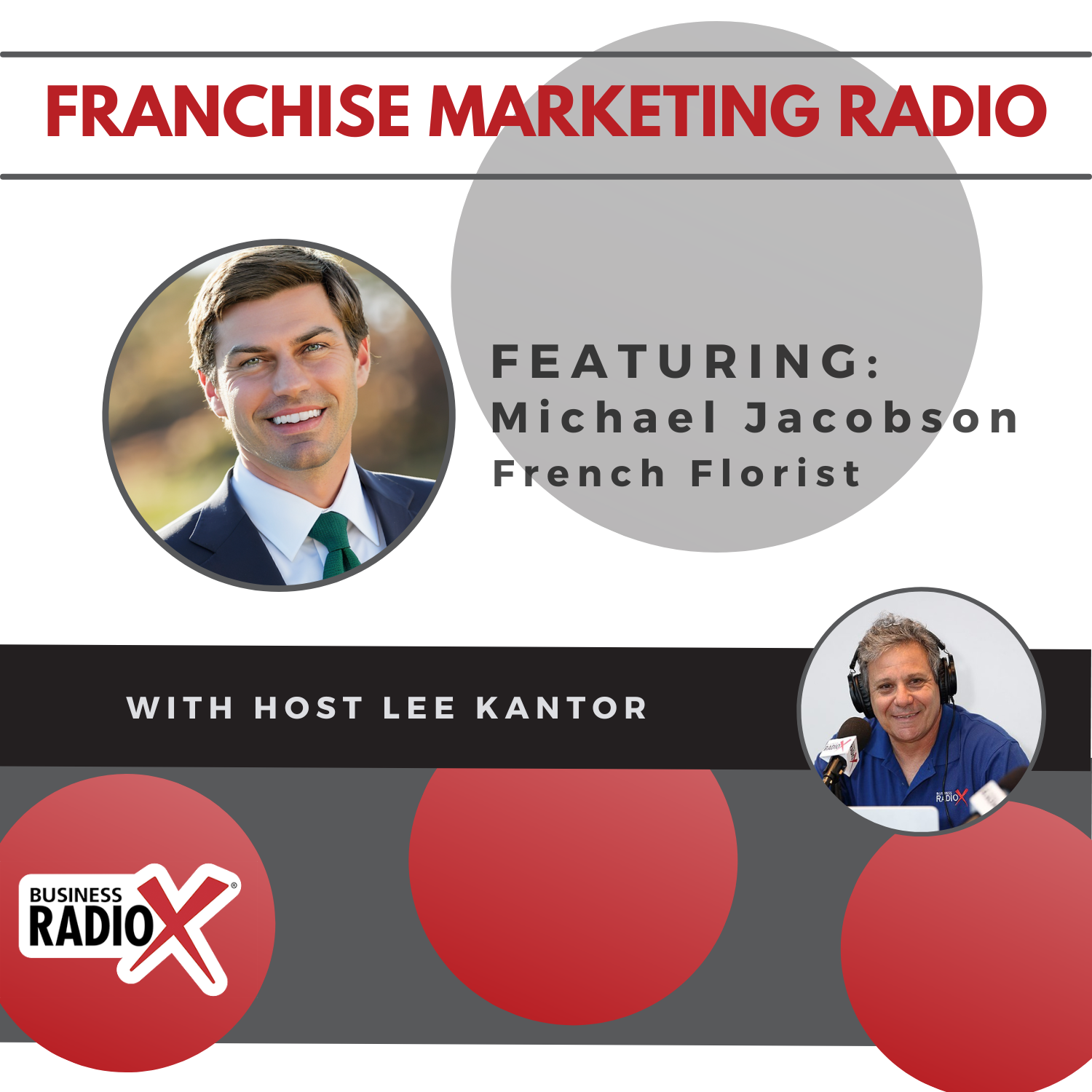

In this episode of Franchise Marketing Radio, Lee Kantor interviews Michael Jacobson, CEO of French Florist. Michael shares his journey from corporate consulting to revitalizing his uncle’s struggling flower shop by adopting European floral culture and modernizing operations. He discusses overcoming industry challenges like outdated technology and high commissions, and explains French Florist’s focus on customer experience, direct sourcing, and franchisee support. The episode highlights the company’s impressive growth, unique franchising philosophy, and commitment to making flowers an everyday joy, not just a luxury for special occasions.
 Michael Jacobson, CEO of French Florist, didn’t walk into a flower shop expecting anything. It was a favor, helping his uncle sell a business most people would’ve driven past without noticing. The kind of place with dusty corners, a poorly-lit sign, and just enough life left to survive. For Michael, standing there, looking around, it sank in.
This was how America gave flowers now. Flowers were rushed, impersonal, and often treated as just a transaction. No ritual. Just product moving through a pipeline. And yet, this was how people were trying to say “I love you.” “I miss you.” “I’m sorry.” The most emotional gesture in human history had been flattened into a transaction. And no one seemed to notice.
It began with a refusal to accept that this was good enough for flowers. He stripped the entire system to its studs and rethought everything. Every process, every touchpoint. He built a new system from scratch.. One that cut out the noise. One that honored the hands, the farms, the designers, the clients giving and receiving. Because when people send flowers, they are trusting us with their heart. And that should never be taken lightly.
To Michael there’s a permanence in flowers that goes much beyond how long they last. The blooms eventually experience their circle of life, but the feeling stays. The moment they carry becomes part of us.
Inspired by the European tradition of living with flowers daily, Michael wants to shift how Americans see them—not as a luxury, but as an essential meaning they bring to life. Flowers are love, and they are how we know that life can be beautiful. Everyone deserves to feel that.
Today, French Florist has grown from a quiet neighborhood shop into a rising national brand, expanding across the country. But to Michael, scale was never the point. The point was to protect a standard.
In a culture addicted to efficiency, French Florist is building something a little more human. Every stem is placed with intention. Every arrangement is an offering. Every delivery is a quiet rebellion against the idea that love and beauty are optional.
For Michael, it’s always been about the flowers. And through them, a more loving world.
Follow French Florist on LinkedIn.
Episode Highlights
- Transformation of the floral industry in the U.S. through European floral culture.
- Personal journey of transitioning from corporate consulting to running a flower shop.
- Challenges faced by traditional florists, including outdated technology and high commissions from intermediaries.
- Strategies for improving operations, technology, and supply chain management.
- Focus on enhancing customer experience and emotional connection with flowers.
- Growth and revenue achievements of French Florist, including significant financial milestones.
- Importance of aligning franchisees with company values and commitment to quality.
- Training and support provided to franchisees, emphasizing hands-on experience.
- Strategies for creating exceptional customer experiences and building loyalty.
- Insights into the franchising philosophy and community-building approach of French Florist.
 This transcript is machine transcribed by Sonix.
TRANSCRIPT
Intro: Coming to you live from the Business RadioX studio. It’s Franchise Marketing Radio.
Lee Kantor: Lee Kantor here. Another episode of Franchise Marketing Radio and this is going to be a good one. Today on the show we have the CEO with French Florist, Michael Jacobson. Welcome.
Michael Jacobson: Thanks, Lee. Wonderful to be here.
Lee Kantor: Well, I am excited to learn what you’re up to. Tell us a little bit about French Florist. How are you serving folks?
Michael Jacobson: Definitely. Yeah. So flowers are something that I don’t know. I’m going to say a couple controversial things on this podcast, so you’re gonna have to curb me if I say anything that’s too offensive. Okay.
Lee Kantor: Fire away.
Michael Jacobson: I don’t think Americans appreciate flowers enough. Okay, hear me out. Our name is French Florist, but we’re an American brand. Okay, how does that make sense? We are a company that borrows from the European way of living, and we want to bring that to America. The current American culture with flowers are, I think, so. I’ll curb myself here. I think we do appreciate flowers, but we think of them as a luxury, right? We purchase them for a birthday anniversary, even if it’s for something sad, like a funeral. And you’re sending your condolences. And no matter why or you know what you’re sending flowers for, what you’re telling the person, if you’re buying it as a gift, is that you’re thinking about them, that you care about them and and that you love them, right. And so at the really at the root of it, love is the core emotion. That is flowers. Flowers are love and flowers therefore are you know how we know that life can be beautiful? They’re the largest, most important emotion that exists on our earth, if I may say that as well. And there’s nothing that’s more powerful than love. And so that’s the industry that we get to work in. And that’s that’s a really cool thing. I don’t know if we should be treating that as a luxury. It’s a heck, I don’t know how to better show love to somebody. I will say in like, in a material way.
Michael Jacobson: Flowers are still material, but I think they’re the most immaterial material gift that somebody can give to show that you love them. I think that diamonds try to do that, but I think the diamond industry is kind of messed up and they’re really expensive. So I think flowers do the job better. And so just full circle back to the European kind of borrowing from there. If you look at Europe, the difference is that Europeans do buy flowers a lot more frequently, buy flowers for themselves, which I think is important. It’s an act of self-love and it’s a way of life. They go home and go to the bodega or whatever it might be to, and it doesn’t even they don’t even have to purchase flowers. I think that it’s a beautiful thing to go and pick flowers from your, you know, grandmother’s house and get them for free. So but it’s a different culture. It’s a different way of life. And it’s a little bit more beautiful. The way that flowers are appreciated, I think creates a little bit more of a loving world. And ultimately that’s why our company exists. Our mission, our driving force at the end of the day Um, is to create a more loving world. And I think that even if we create a 1% more loving world, that’s a worthwhile mission. So that’s what we’re up to.
Lee Kantor: So how what was kind of the genesis? Sounds like part of the Genesis was you went to Europe and you saw some things that you were like, hey, maybe this could work here. But what was like, how did you get into the the florist business?
Michael Jacobson: Lee, I wish I had a romantic story. Uh, it’s, you know, I think that, uh, we try to make life really romantic. And parts of it are definitely when I walk into the flower shop and, uh, it’s it’s a really cool feeling. It is very romantic space to be in, but, um, I know I didn’t travel to Europe, so this is how we started. I was working a really boring corporate job that I hated. Um, I’m sure a lot of folks can relate. And I was at a college, um, didn’t really want to, you know, you hear the risks of startups and how frequently they fail. So I always kind of had that fire in my belly to do something more entrepreneurial, but didn’t want to take that risk right out of college. So I joined a consulting firm. A good firm, and I learned a lot. I’m happy I did it, but it just didn’t feed that fire in my belly. So I was. After a while of working there, I was looking for my next opportunity. Uh, and when you’re looking for opportunity, it’s crazy what can happen. But, um, I got a call from my uncle. He said, hey, Mike, I I’ve been running this flower shop for 38 years. It’s called French Florist. Uh, is it one location? Just mom and pop and just kind of like any other flower shop that you might envision. You know, there’s a green and purple paint on the walls. Uh, paper flying everywhere is like four fax machines. Um, but just, you know, just a neighborhood mom and pop shop. And he said, I want to sell the business. I’m tired. I’m working six days a week, 60 hours, and I’m not making any money.
Michael Jacobson: Uh, you know, so my background is in finance as well, so I’m sure I wasn’t his first call, but, uh, nonetheless, he. I don’t know if he called a broker and the broker didn’t want to list the business. It was, um, there were a lot of kind of nuances on why that business was going to be hard to sell. Uh, but I came in and ultimately I, uh, was going to help him sell the business. So I, you know, it started out as a side project. And, uh, after a couple of months of working with him to clean up the business, get the books in a better condition, um, uh, just get everything ready to sell. Uh, I was doing due diligence on the industry as well. What other shops are doing? Well, what they’re not doing well, what multiples they’re selling for all the normal stuff to sell a business. And I realized that it wasn’t just him that was struggling. Uh, every single florist, um, is struggling with the same, if not the same, very, very similar problems. It’s either related to technology, uh, intermediaries like one 800 flowers taking massive commissions and destroying kind of the financial position of these shops. Uh, the technology supply chain is a big issue. Um, a marketing, the whole whole host of there’s like it wasn’t any one thing, but it was all of them pretty much struggling with all of those problems. An amalgamation of massive issues and the current state of the industry is it got to a very, very antiquated state. And there’s a whole story of how it got to where it is today that we can rabbit hole go down that rabbit hole if you want to.
Michael Jacobson: But it’s a very antiquated space. There’s 30,000 flower shops around the country. 99% of them are single unit owner operators. It’s a very, very fragmented space. So, you know, we have innovation in the coffee industry. Beyond Starbucks. Starbucks was kind of the genesis for consolidation. They created a brand that was consistent, reliable quality at the time. Uh, and they’re trying to make a comeback. But we have innovation beyond that. Now, our our industry, the floral industry hasn’t even had the Starbucks effect. And I don’t we don’t compare our brand to Starbucks. We’re doing things differently. But uh, but that’s how antiquated it is. It’s been stagnant for a long time. So that’s what fired me up. Um, florists were struggling. Uh, and ultimately, what that means is that if, if, if you’re not feeling good inside, you’re not going to show up for the folks around you in the best way that you can. So if the florist is struggling, that’s going to bleed into a poor consumer experience. And so I recognized, um, alongside our team, that the consumers are not receiving a product or service. That is what they could or should receive in our industry. So there’s a systemic issue. And if we could fix this one flower shop and just do it right, um, invest for the long term, you know, ten, 15, 20 year investments as opposed to like needing to maximize ROI over a 2 or 3 year period. Right? Um, that sounded pretty fun to us. So I jumped ship. And that was about seven years ago, and I haven’t looked back.
Lee Kantor: So what? Um, so you look at your your uncle’s floral floral shop and what was kind of the low hanging fruit to, to fix up to improve the situation?
Michael Jacobson: Yeah, there was low hanging fruit. Um, the very first decision that I made in the company, uh, I will tell you that florists are wonderful people. I’ve never met a florist who’s not a great person. Uh, they have huge hearts. They’re very creative. They’re very passionate. Uh, they’re not really money driven, I would say, because they’re working really hard. They love what they do, and they’re not really typically not making a lot, or at least in the past. Right. Um, and so, um, my uncle was no different. He, he was, you know, best friends with, uh, the phone salesman. And I looked at the financials. We were paying, like, $13,000 for our phones. Uh, and, you know, I came into the business and, um, do it. The right thing to do is listen and learn. Uh, I didn’t know much. And so I spent the first couple of months just doing a lot of listening. And, you know, the customer service rep that worked for us, um, said, hey, our phones are really bad, that I have a hard time hearing the customer on the other end, and they have a hard time hearing me. I’m like, perfect. We need to change phone systems. That’s an easy lift. So I looked at the phone bill. We’re paying 13 grand a year, and I went to my uncle and I said, like, why are you paying 13 grand a year? And he’s like, oh, no, it’s the best phone system. Like, here’s the contact. Um, he’s a great guy. He’ll take care of it. If there’s an issue, he’ll fix it anyways. You know, phone sales guy is not, uh, you know, um, I’ll leave it there.
Michael Jacobson: It’s so, you know, we looked at different phone systems, and, uh, we’re now now we’re paying for a way higher quality phone system that is like $120 a month, right? Or $1,000? A little more than $1,000 a year, saving 90%. So there was a ton, like, uh, I kid you not, probably about a hundred things that were kind of like that that got the business from losing money to break even or, you know, in the black, um, a little profitable and, uh, you know, so there was low hanging fruit. But the systemic issues, supply chain, marketing, tech infrastructure, um, uh disintermediating is where as well. The number one player in our space is one 800 flowers. The way that their model works, they syndicate the order that they get to a local florist, which I guess is fine. But the problem with it is they take a massive up to a 40% commission after all of their fees are considered 40% commission on that order. So the florist is getting crushed. So just, you know, we were able to get the business to a decent position by just by cleaning up, like best practice stuff. But in order to transform the business from, you know, doing 200, 300,000 to 500, 600,000 to the next year doing, I think it was like 3 million to 6 million to 9 million out of one location. Um, that there were a lot of issues that we needed to solve that were deep systemic issues. And that’s when we started to tackle those issues. That’s where we started to see real results.
Lee Kantor: And then so. So how do you go to $9 million in a single location? Is there that much floral business in a is that really the potential? So.
Michael Jacobson: Yeah, I mean, I feel like we’re just getting started, too. Yeah. It’s not only, uh, I think it’s a showcase of what the potential is. Um, but yeah, we so we were doing over 9 million out of one location, and, uh.
Lee Kantor: And that’s just local, like, that’s not we’re shipping it to, you know, all over the world. This is in one.
Michael Jacobson: Just one la store delivering within, like a 45 minute radius. Um, yeah. It’s pretty insane. Um, so we were like, wow, maybe LA is a special market and it is. La is a special market. But it’s only I can say that because I’m from here. But, uh, you know, we opened a second store. That store, uh, did over uh, or did just shy of a million in its first year. Um, we opened a third store. That one did over a million in its first year. So as we opened them up, we got better and better at them at doing that. Um, the average flower shop does around 350 K in revenue. So and we’re doing about a million in the first year. Um, so yeah, I mean, it’s.
Lee Kantor: And the drivers of that? Is it just more people ordering more often? Like what is the driver or is it? Brand new people to buying flowers. Like what do you get people to buy more often? Like are you creating more occasions for purchase? Like what drives it?
Michael Jacobson: Yeah, it’s a good it’s a good question. So there’s two types of marketing, right. There’s demand capture which people are already searching for the product. Um, for example, they search on ChatGPT.
Lee Kantor: So they’re just picking you instead of a different floors.
Michael Jacobson: Yeah. So that’s that. And then there’s demand generation, which is like, uh, right.
Lee Kantor: Someone who hadn’t thought of. Right. I hadn’t thought of giving flowers. Now I’m giving flowers from you.
Michael Jacobson: Yeah. So, um. Yeah. So both are great, uh, ways to build revenue. Um, but, uh, but no, there’s there’s really that much demand to capture. People do send a lot of flowers, and, uh, you know, we have, um, I will sit here and say, like, we do have the best customer service. We do have the best quality flowers. Um, we do have the best client experience, but we don’t stop there. Uh, we go beyond all of that and we say, like, having the best. All of those things makes a company good. But how do we make our company great? And that comes down to the emotion, uh, the experience, um, the feeling that people have when they purchase through us and, and then backing that up with a, with an incredibly strong product offering. So, um, it took a lot of that. Branding is important. Uh, but writing goes only so far as your ability to deliver against that brand promise. So you actually do have to have great operational excellence in order to execute. And so, yeah, we, uh, got really good at, um, yeah. I mean, our tech infrastructure is phenomenal. We built a ton of our own tech, so we were able to scale easily, um, supply chain. We started importing from the farms. So we’re getting better pricing, uh, and, um, higher quality flowers. So that’s a better margins for us that we can reinvest into the client experience in other ways. But also, we can pass some of that discount along to the consumer.
Michael Jacobson: So, um, you know, they’re getting really competitive pricing and then also ultimately a better product too. They’re not. The supply chain is normally, you know, grows on a farm, goes to a processor, to a consolidator, to a logistics agency in the country of origin like Ecuador, Colombia, Mexico, Canada, Thailand, Holland, wherever we import flowers from. And then they land in the states at a logistics agency, they go to a wholesaler, then to the retailer, then to the consumer. Right. That’s that is a heck of a supply chain. So we cut a lot of folks out in that by importing directly from the farm and we air freight, um, everything. So, uh, we’re not shipping, you know, flowers on a boat. Um, so we’re just maximizing the, the vase life, uh, in terms of the quality of the flowers are much better purchasing through us. Um, and, uh, yeah, we developed a lot of loyalty that way. So not only did we get good at new client acquisition, but client retention was really, um, started to get good. Um, and it’s it’s there’s not. I wish I could say there’s a secret sauce to what we did. Um, but just kind of like doing the right thing and making literally every decision that we humanly could, um, rooted in how, like, is this decision going to meaningfully improve the client experience? Uh, and, uh, and that’s gotten us pretty far so far.
Lee Kantor: Now, when you’re trying to improve the client experience, uh, as a flower shop owner, the client is the buyer. The flowers, if you’re trying to do that in terms of being a franchisor, your client’s also the franchisee. Um, how do you kind of attract the the right franchisee to French florist?
Michael Jacobson: Yeah. That’s so good. I actually appreciate the way that you asked that question. I think a lot of franchisors sell. Uh, we don’t sell. Um, you’re not going to hear me on this podcast, say, hey, join our franchise. Um, we don’t do that. Um, we find, you know, we we showcase what we’re doing, and, um, if someone feels attracted to the opportunity, then they’ll reach out to us and we can share information in terms of, like, if it’s going to be a good fit. Um, we, I guess, like, pride ourselves on, like, as a franchisor, we are our primary job. Um, if you’re looking at the franchise owner as one of our clients, which you’re right, they are, and their experience matters. Um. Our our job as the franchisor is to make sure that we’re bringing a network of franchise owners in that create an incredible system. And it’s a big deal, because if we make, like people talk about how important hiring is, um, and it is, uh, it really is. But you can theoretically sorry to be blunt. You could fire an employee if you make a mistake. You can’t really fire a franchise owner. Uh, and even if they’re producing great, you know, unit economics are really healthy. And if they’re just, like, an asshole, uh, and other franchise owners don’t like them, or, like, we don’t want that in our system, right? So anyways, we we, uh, we just say what we’re doing out there.
Michael Jacobson: Folks will come in and they go through our process. They realize what our what our values and vision and kind of culture looks like. They talk to a lot of our existing franchise owners to say, you know, if you could go back in time, um, would you open a French florist again? And, uh, that puts a lot of really healthy pressure on us to make sure our franchise owners are really happy. Um, and so a lot of the, uh, a lot of the folks that we’ve been able to attract actually have been through stuff like this, like doing podcasts and just talking about how passionate we are about our industry. And, uh, and that’s been our primary source of leads, actually, is through podcast. Believe it or not, we do some light advertising in other areas. But uh, but yeah, we don’t we don’t. Unlike, uh, we don’t use brokers. We don’t use an outsourced sales organization. Um, a lot of it is very organic. Our cost per lead is like very, very low compared to industry standard.
Lee Kantor: Now, when you’re, um, kind of finding the right partner, uh, franchisee, partner, what are some of the qualities that maybe have bubbled up since you’ve been doing this for a minute? Um, what does successful franchisees, what qualities do they exhibit and what is their background like yours as finance, or are they are they former florists like that are just frustrated of making, you know, 350 and saying, I want a million. Like what? What is the franchisee profile look like?
Michael Jacobson: Yeah, we we really uh, in the early days and we’re still in the early days, uh, still kind of we feel like we’re on the ground floor just kind of getting started, which is really it’s a fun place to be. But, um, in our experience so far, we worked the, uh, almost the full spectrum, I would say, from a florist that’s frustrated and they want to convert their flower shop. We’ve done a few of those. They’ve done really well. Uh, all the way to, like, a president of a private equity firm. Hates his job and wants to quit. Uh, and decided to open up a couple French florist locations. That was interesting. Um, all the way in between, you have entrepreneurs that want to do, like ETA or search fund stuff. They’ll they’ll buy a florist and they want to convert it to a French florist. Uh, we have folks that are, um, like marine, uh, veterans and, uh, um, are looking to get into business after their career, uh, in the Marines in that case. And, uh, just an incredible amount of discipline and ability to follow a process that was remarkable. Um, uh, partner for us and everything in between. But the folks that are doing really well, um, are people that are purpose and mission driven and that, of course, uh, this is business. You’re making a business decision in a large sense. I think a lot of folks try to separate business from personal. I get it. I do it to an extent, I guess, but, um. But it’s all one life, right? Like you can’t. I don’t know if that’s fully how it works.
Michael Jacobson: And so, you know, making a decision in your life and folks that are intentional about this, where there is purpose and the work that you choose, you spend a lot of your life working and being intentional about what you go and do. We try to find people that have gone through that and maybe, you know, you worked corporate for a long time. You, you know, maybe had a lot of success in that and that should be celebrated. But maybe it’s time to be your own boss. Right. And that’s more of the traditional franchise path. Um, I think that’s a great thing. And so what I look for, and if you ask any of our team members, they’ll give you slightly different answers. Our ops team will give you an answer or, you know, everybody will give you a different answer. Mine is really from a values perspective where, um, I get that you want to make money. That’s that’s money can create freedom. And I think it’s a great thing, but, um. Okay. You made a bunch of money. Then what? What are you going to go and do with it? Do you want to go and travel, or do you want to go spend more time with the kids? You want to go and start a charity? I really don’t care what it is, but I like knowing that. Why? And I don’t want I don’t want you to open a French florist for purely for money. Um, there needs to be a deeper reason for it. And, uh, and I think that’s important. So I look for that.
Lee Kantor: Now when a person raises their hand, say, I’m interested, do they have to be the one that’s putting flowers in vases, or is it something that, um, they can be kind of, uh, not in the shop, or you want them to be in the shop? Or do they have to be artistic? You know, what about those kind of qualities?
Michael Jacobson: Yeah, totally. No, I mean, I, you know, look, I came from outside the industry. Um, you don’t want me designing. We have. I mean, that’s really where the magic happens. Uh, so. Right.
Lee Kantor: But do I have to know that or do I have to be inherently kind of creative, or is it something that you can give me a protocol to follow that I can just go, okay, this. I can make something look beautiful, even though that I’m not an artist.
Michael Jacobson: Yeah. So, no, we we recommend. Unless you feel, you know, we do work with some folks that are unbelievably creative and they will be kind of the lead designer or the lead florist in the shop. That’s what they want. Most of our franchise owners are not that way. I’m not that way. So you can run a flower shop without any experience? Um, there’s a lot of training involved. Uh, and you need to hire one of the most important hires that you will make is that lead designer. So you get that hire, right? And a lot of stuff kind of falls into place. Um, people are everything. We we can have great systems. We can have great marketing. We can have great everything. Tech. Um, right. And, uh, but the people that are running the systems, uh, are very important. It’s, um, so, so we make a big deal of hiring and, and we provide a lot of resources for that, and we’ve gotten good at it. So, um, you don’t have to have that kind of experience. What we do look for, though, are folks that are really dedicated and are willing to, like, I’ve done every job, uh, except for designing, I would say.
Michael Jacobson: But, like, delivery driver, um, shop assistant processing the flowers. I have tried my hand at design. Right. Uh, at being the manager of a store, um, being a regional manager, buying the flowers, all of the jobs that couldn’t possibly exist in running a flower shop. But, uh, and I think that it’s been really was a really great experience for me because I know how to do all of the jobs, and I won’t ask someone to do something that I wouldn’t be willing to do. And I think there’s, um, that’s a good thing. But so for our franchise owners, we want them to be kind of in the business, if you will, for, um, about six months, uh, and do all the jobs, uh, and learn it. And you don’t have to be in the business forever. I know the goal is to work on your business. Uh, but, uh, but being in your business and really learning the trade, uh, will give you a point of leverage to be able to make decisions not from the outside, but from the inside. And, uh, that’s taken us really far. And so we’re big advocates of that for our franchise owners as well.
Lee Kantor: Now, you mentioned customer experience and customer success, can you give some advice to our listeners? Um, when it comes to kind of raising the game, uh, when it comes to that customer experience? Because I, uh, I mean, I had one of my favorite brands. I’m not gonna name the name of the brand that I use personally. I love the product, but I hate, hate the customer service, I would switch. Wow. Even though I love the product, I would switch because their customer service is so terrible. Um, so I am a big believer in customer experience and it doesn’t end at the transaction. So can you share some advice when it comes to, um, you know, upleveling customer experience?
Michael Jacobson: Yeah. I’ll give you one thing that’s like more strategic. That’s worked for us. Then I’ll give you one tactical thing that we’ve done that’s worked for us, that you could do for your business. The strategic one. Um, do you know Tiffany’s? The jewelry company?
Lee Kantor: Sure.
Michael Jacobson: So, look, you can go into Tiffany’s, and if you’re buying a gift, uh, presumably diamonds or something, right? Or for someone, you can go in there and you can spend $300 on, uh, on a necklace. That’s probably the cheapest thing that they offer. Um, they’ll also sell you a necklace for $30,000. Right. Uh, the the really interesting part about Tiffany’s for me is that if you buy option A or option B, both of them are going to come in that turquoise Tiffany blue box. And before the person who’s receiving the gift opens the box, the box is the first thing they see. And when you hand somebody a Tiffany’s box, that turquoise blue, it’s that color and that branding that evokes the emotional response, not even what’s in it. There is such incredible power in the feeling that’s associated with that color that they’ve been able to create. Uh, and, um, and that’s a really interesting thing where. You can spend $300 or $30,000, but you can evoke the same emotion because of not before the person even opens the box. Right? So for us, I mean, I think at French Florist, we don’t really want to sell 30,000 flowers, but, um, that’s not the goal. But if we can create a $30,000 feeling where people can walk into our store and kind of get that Tiffany Blue experience with us, even if they’re spending $20, like they can’t spend their whole paycheck on flowers, that’s fine. Uh, we don’t view flowers as a luxury in the way that Tiffany’s views diamonds as a luxury. We think everybody deserves to have flowers. Um, but we want to provide them that kind of Tiffany level experience.
Michael Jacobson: Um, and that’s. And that’s served us well. So that that’s a little bit more like kind of high level. I don’t know how helpful that is, but like one, one example of customer service more tactically that’s been good for us is when one of our core values is exceeding expectations. Uh, we we view that in a lot of different ways, but probably the most important is when it comes to our clients, uh, the folks that we serve, um, how can we exceed their expectations? And so we want to deliver ten out of ten work for them. But before that, ten out of ten ships, uh, we stop and we say, what’s the one thing that we could do to push this from a ten out of ten experience to an 11 out of ten experience? And I think I think a ten out of ten experience probably is like they have these are the best quality flowers that they’ve ever got. Um, the quality is beautiful. Uh, they called to check the status of the order. Somebody picked up within seconds and answered all of their questions. Uh, came in beautiful branding that it’s a it’s a it’s a good some maybe would somebody would even say, you know, a very, a very good experience. Um, how do you make that an 11 out of ten experience? I love what you said. The transaction doesn’t end when at the point of transaction, uh, follow up with them. Um, and what we’ve done and I think something that you could try implementing in your business as well, and we’ve seen profound results with it, is send the customer a handwritten card, like we are in the age of technology and automation and a lack of human connection more than ever right now.
Michael Jacobson: Um, and people are craving that. And if you send them, like a genuine handwritten card, just thanking them and reminding them of, like, how beautiful it is, like, especially for flowers to, um, 95% of our customers are giving flowers as a gift to somebody else. And people put so much emphasis on the recipient and how beautiful of a feeling it is to receive flowers. But what about the sender? Like, what an amazing act that they were, the spark that created that love in the world. And like they should feel like the hero, right? So we’re going to remind them that, like, what an amazing thing that they’ve just done. Uh, and it helps build loyalty, um, and done in a genuine or an authentic way. Uh, they feel that, like, we really do believe in our, uh, the power of flowers and how beautiful flowers are. And, um, we don’t even care if they purchased through us. I think if they purchased through us, they’re going to have great experience. But I think that it builds trust. Where like, hey, this is a company that understands how special flowers are, and I trust them when I do send flowers to somebody that I’m going to purchase through them. Right. So it’s not as transactional. It’s a little more relational. It’s but you do have to do it in an authentic way. Consumers are smart and they’ll see through like, you know, um, tactics that that they don’t truly believe in. So you need to find an authentic way to do it.
Lee Kantor: Now, is there a story you can share about a franchisee that maybe, um, kind of got a result partnering with you and being a franchisee with you that maybe exceeded their expectations? Is there someone that in your system right now that is really killing it and maybe is obviously happy about it, but maybe a little blown away by what could be?
Michael Jacobson: Yeah, I mean, hopefully all of them. Uh, the one that comes to mind, uh, all of them are unbelievable, but are very, very first franchise owner. Uh, he worked for different franchisors before he’s been exposed to the franchise world for a long time. He left his job and said, I’ve looked at franchising for, you know, I’ve been in this ecosystem for a long time. I want to open a franchise now. I’ve seen a lot. I feel like I can make a good decision. So he looked at 5 or 6 different franchises. He ended up choosing ours, which was a nice compliment. Um, and you know, he is early of the early adopter mindset and, uh, we’re we’re still in the early adopter phase. So we’re looking for folks that are willing to kind of go through the learnings with us. But he really was just such a phenomenal partner for us. But even for him, um, you know, we’ve been able to produce great results, uh, in, in the financials, uh, reflect that. And historically, what we’ve been able to accomplish, I think that, um, he opened his first shop and especially as the very, very first owner in the system, he was expecting a lot of rough patches and maybe not hitting the numbers that we would hit. Um, but he. Yeah, no, he blew it out of the water, and he, uh, just has done absolutely phenomenal. He’s, uh, looking at open a opening, a second and third unit now. Um, so it’s, uh, it’s been good. I don’t think that we’re I don’t think we’re under delivering. I think that we continue to invest unbelievably heavily into the infrastructure and support that we’re able to provide our franchise owners as well. Um, there’s always room for improvement. We are in the early adopter stages, so there are rough patches, but like all of our franchise owners have been so good because we genuinely are trying to create a great system for everybody, um, that they’ve been working with us. And so, like, honestly, they’ve exceeded our expectations. I don’t know if we exceed theirs, but you’ll have to ask them for yourself.
Lee Kantor: Well, if somebody wants to learn more, have a more substantive conversation with you or somebody on the team, what’s the website? What’s the best way to connect?
Michael Jacobson: Yeah, sure. I mean, you can always reach out personally. Um, and I’m happy to direct you in the right way or have a conversation. My email is Michael at French Florist. And then if you just want to learn more information on your own, you can go to French florist franchise. Com there’s some information there. And once a month, we host something called the Discovery Days. You come in and spend like 6 or 7 hours with us. You look under the hood, look at all the tech, look at all of that. So it’s super informational and really gives you a good picture of what it looks like to run a French florist. Um, there’s always a lot of fun too. So.
Lee Kantor: And that’s online. That’s virtual.
Michael Jacobson: No. It’s in-person. You fly to Southern California and it’s, uh. Yeah, we show you the real deal for sure.
Lee Kantor: Cool. Well, Michael, thank you so much for sharing your story today. You’re doing such important work, and we appreciate you.
Michael Jacobson: Awesome. Thanks, I appreciate it. Same for you. Thanks for the platform. Appreciate your time.
Lee Kantor: All right. This is Lee Kantor. We’ll see you all next time on Franchise Marketing Radio.














