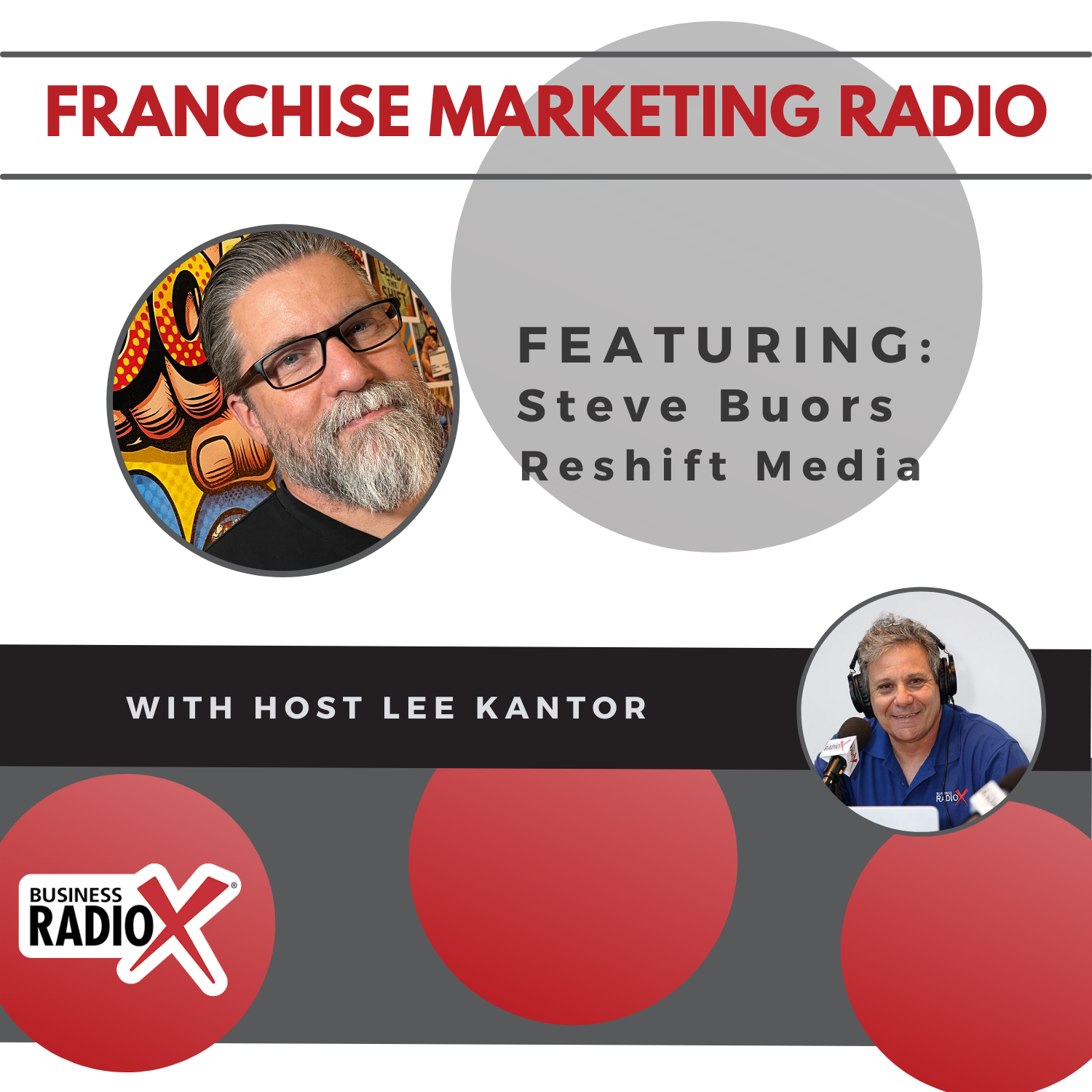

In this episode of Franchise Marketing Radio, Lee Kantor interviews Steve Buors, CEO and co-founder of Reshift Media, about digital marketing strategies for franchise organizations. They discuss balancing brand consistency with local customization, the growing impact of AI on search and SEO, and best practices for attracting franchisees. Steve shares insights on using franchise portals, targeted advertising, and the importance of expert guidance to adapt to evolving digital trends. The conversation highlights how franchises can leverage scalable digital marketing and AI-driven strategies to stay competitive and effectively reach both customers and prospective franchisees.

 Steve Buors has over 20 years of digital marketing experience and has earned a reputation for being at the forefront of emerging digital trends.
As the CEO of Reshift Media, Steve specializes in crafting digital strategies that help businesses attract loyal and repeat customers, expand brand awareness, and ignite innovation.
A tenacious and innovative powerhouse, Steve is a sought-after consultant and speaker. His knack for uncovering hidden opportunities and driving growth is unparalleled.
Follow Reshift Media on LinkedIn and Facebook.
Episode Highlights
- Digital marketing strategies tailored for franchise organizations
- Balancing brand consistency for franchisors with local customization for franchisees
- The impact of AI on SEO and search behavior
- Best practices for emerging franchisors to attract franchisees
- The role of franchise portals and brokers in franchise marketing
- Importance of integrated websites for franchise systems
- Adapting marketing strategies in the evolving digital landscape
- The significance of paid advertising for local customer acquisition
- Optimizing content for AI-driven search results
- Targeted advertising strategies based on demographic and psychographic data
 This transcript is machine transcribed by Sonix.
TRANSCRIPT
Intro: Coming to you live from the Business RadioX studio. It’s Franchise Marketing Radio.
Lee Kantor: Lee Kantor here. Another episode of Franchise Marketing Radio and this is going to be a good one. Today on the show we have CEO and co-founder of Reshift Media, Steve Buors. Welcome.
Steve Buors: Thanks, Lee. Happy to be here.
Lee Kantor: Well, I’m excited to learn what you’re up to. Tell us about Reshift Media. How are you serving folks?
Steve Buors: So we’re a digital marketing organization that specializes in franchise organizations. So we do everything digitally. You could think of social media search, we build websites, we build apps, and we also do franchise development in terms of finding new franchisees for your organization.
Lee Kantor: So what’s your backstory? How’d you get involved in this line of work?
Steve Buors: Myself and my business partner, Kirk. I started the agency about 12 years ago. We saw that there was a gap in the market in terms of franchise organizations and having someone that really understands their business model to be able to serve them better from a digital marketing perspective. And we started with a couple of franchise companies, started solving some problems, and 12 years later, here we are.
Lee Kantor: So what attracted you to the franchise industry?
Steve Buors: Honestly, it’s it was an underserved market, and there was just so much complexity that the big platforms weren’t solving for them. So if you’re a franchise organization, you run a one or you want to run meta advertising or Google advertising across all your locations. It’s actually really tough because it’s really manual and you’re creating multiple campaigns and, you know, it’s a lot of sweat equity. So we ended up developing software and processes to solve those problems at scale. So franchising is all about scalability. And so we created the ability to scale digital marketing for franchise organizations.
Lee Kantor: And in your work before that, were you working just with regular brands, and then you got a client that was in franchising and that’s where the opportunity arose. Or like, how did you kind of dip your toe into franchising for the first time, or were you always working with franchises your whole career?
Steve Buors: No, actually it’s interesting. One of our earlier clients was the UPS store, who’s obviously a franchise, and their president, who’s, you know, still a client of ours. We were working with them to solve his problems, and we were like, man, this there’s there’s a lot of complexity here. And as we started to figure out ways to build scale from a digital marketing perspective for for him, he said, look, you got to come and come to these CFA being the Canadian Franchise Association, the IFA, the International Franchise Association, and share what you guys are doing. And next thing you know, um, we were the franchise digital marketing people and we’re now winning awards. We’ve been named world’s best franchise marketing firm by the Global Franchise Awards three years in a row. We’re number one in entrepreneurs category for franchise marketing firms. We were named disruptor of the Year by International Business Awards. So it’s really. It really just was because we had that one client. He steered us in the direction and now now it’s our thing.
Lee Kantor: Now, one of the challenges I would imagine, when working with franchise is like from a franchisor standpoint, they want the brand, they want more franchisees. But the franchisee in the town just wants more clients from the town. So they want hyper local where the brand may want, you know, a broader reach than that. How do you kind of marry the two?
Steve Buors: I love that question. And that is one of the number one challenges with with franchise digital marketing. The franchisee wants to own their market and do their own thing. They’re an entrepreneur in their market. That’s that’s why they’re a franchisees, because they want to run their own business. Meanwhile, the franchisor obviously is looking for brand consistency and scalability. So That is actually what we spend all of our time solving is that exact problem. So what we’ve done is we’ve developed both software and processes where we’re able to create a standardized campaign that could be Facebook or Instagram or Google or TikTok or Google Performance Max. We create that campaign so it’s scalable and that adheres to brand standards. And then what we do is we publish that to the franchisee to be able to customize for their own needs. So that could be local, targeting their own local budget. Maybe they want to put their own local offer in, um, you know, maybe they want a slightly different terminology in there in terms of how their location is described. And we programmatically serve all the ads off of their local Instagram handle off of their local Facebook page. So what’s happening is you’re getting the best of both worlds, where you’re getting the scalability and brand consistency that the franchisor wants, but the franchisee can now customize it for their market. And the beauty of the whole process we’ve put together is it uses machine learning and it uses automation to reduce cost. So we’re able to run campaigns across thousands of UPS store locations, as an example, at a fraction of the cost that it would typically be to manually create all these campaigns and manage them.
Lee Kantor: And then the franchise owner just passes that cost down to the franchisee that’s built into their marketing spend they have to do.
Steve Buors: Yeah, it’s usually most franchise systems are paying for the software and for our campaign creation through the marketing fund, and the franchisees are paying for their own ad spend. And in some cases, the franchise owners are, you know, charging franchisees directly. And in some cases, we work directly with the franchisees to really give them that white glove customer service, and the franchisee would usually pay for that.
Lee Kantor: Now, do you feel that from a franchisee standpoint, that they need to invest in paid ads in some way, that organic is just too difficult to do for them in a hyperlocal manner.
Steve Buors: Well, we we do a lot of hyper local SEO as well. And obviously with all the AI advancements in search, we’re doing a lot of that. So you can get pretty far from the organic perspective. But it’s it’s not enough, right? Like you need to advertise your business in your local market. So hyper local, uh, Facebook, Instagram, TikTok, Google search ads, that’s how you break through and that’s how you get new customers. Um, they’re going to do their research and they’re going to, you know, search for you locally. Maybe they’re looking for your local hours of operation, maybe they’re looking for your services. But you need to create that impression first, and you need to make sure that they’re even aware you exist before they’re they’re searching for you. So, um, I think it’s both is the real answer. You need proper local SEO to be competitive, but in terms of actually attracting new customers and making sure you get your fair share of business at your local market, you have to advertise.
Lee Kantor: Now, you mentioned AI and obviously that’s a hot topic today. How are you seeing it impact SEO? We’re seeing a lot of people talking about a very large drop in organic search traffic because of of AI. Are you seeing that as well?
Steve Buors: Absolutely. So Google has implemented their AI overviews. So instead of people using the the lists right. The hyperlinked list that traditionally search would have, people are getting the answer they need right in that AI overview on Google. Or they’ve just gone right to AI search. They’re using ChatGPT or Gemini or Cloud or Perplexity or one or the other. True, you know, generative, um, search experiences. Uh, so we are seeing clicks to client websites declined from an organic search perspective. Now, that doesn’t mean you’re not getting visibility. And that’s that’s kind of the big thing we’ve been talking with our clients about is we’ve actually had clients say to us, how do I make sure I’m not in that I overview because I want the click, and that is absolutely the wrong way to think about it. You need to be optimizing to get into those AI overviews and get into ChatGPT and into Gemini. Otherwise, you’re missing out because this is the way search is going in the year two years search won’t even look anything like it does today. We’re the whole, uh, how search works and how we as consumers use it is undergoing a fundamental shift that we haven’t seen since Google was launched, if I’m being honest. Right. Google changed the game when they first launched, and, you know, they used to be Excite and Lycos and all those other search engines that went by the wayside were at that point again, where search will be so fundamentally different that if you as an organization are not optimizing for AI based search, you absolutely will be left behind.
Lee Kantor: So how do you recommend your clients optimize for AI?
Steve Buors: Yeah. So there’s there’s two angles we’re taking. One is optimizing for the eye itself. Um, and kind of a change in mindset where it’s not so much about winning the click, it’s about getting visibility. It’s actually funny because search has always been about getting traffic right. I want to show up as high as I can in the list, and the higher I get in the list, the more clicks I get and the more traffic I get. Um, whereas now search is becoming more of an awareness play in some ways because, um, they’re giving searches, giving you that one answer. So your job as a brand now is to get into that answer. So what that means is you’re creating content that the AI search engine can actually use, and you’re shifting from kind of a thought process around targeting keywords instead targeting useful content. Um, that is more conversational that the search engine can use. So that means things like creating a great FAQ on your website that directly answers questions. Creating how two guides. Product comparisons are great because people are like which products better? Compare these features to these features, providing real opinions and insights. Not just not just fluff, right? Like actual insights and content with actual factual value. And it also means you got to you got to think a little bit off your own website, because obviously your website is a great source of content about your company, your products, your services. But the AI search engine is crawling the entire web to give answers to questions.
Steve Buors: So you need to start thinking about how can you be represented on, um, other forums. Uh, Reddit in particular is is well used by the the generative AI to find information. Core is another one, uh, making sure that your Google business profile is completely up to date with information. If you have a Wikipedia listing, fantastic. If you can be on Wikipedia, you know not every company you know merits a Wikipedia entry, but if you have one, that’s amazing. Social mentions. User generated content is huge. Uh, influencer generated content is actually even more valuable in this, um, in this sort of context, um, and listicles, which is basically, uh, other content creators creating lists saying like, you know, who’s the who’s the world’s best franchise marketing firm as an example and listing your company in there. So it’s it’s a lot of different things to be able to index for the I o reviews. And then at the same time, we have a whole, um, a whole process we’re following to help franchise systems rank even better for local searches, which tend to not be as AI overview generated uh, response centric uh, which does elicit a click. So local search is still a thing. People finding stuff in their in their area and clicking. There is a whole thing that we’re doing to be able to still get clicks, but at the same time you need to optimize for the the AI overview, otherwise you’ll be left behind.
Lee Kantor: Does it matter if the brand, like the franchisor, has a website, and the franchisees website are kind of a part of that franchise website, or does every franchisee need their own kind of unique space that isn’t touching the franchise owners? Um, website?
Steve Buors: Uh, the best approach we’ve found is to actually have one integrated website. So where you got a single domain? Again, if I use the UPS store as an example, right. Um, you don’t want to have UPS store. Com and then UPS store, you know waco.com and Dallas com. Because what ends up happening is the search engine doesn’t necessarily connect all those dots per se, that that’s one company and one set of content. It’s actually more powerful to have a single URL the UPS store. Com or, you know, slash phoenix. Um, and what’s nice about that then is kind of a sense of a rising tide lifts all ships. So if all of your local microsites in this case are well done, so they should have lots of content, they should have differentiated local content. So it’s not that your franchisee shouldn’t be doing anything for SEO locally. In fact, they should be doing a lot. But they do that in part of your network, part of your website, because then each of those local sites that’s strong in their own right, they all help each other. And one of the big selling propositions you have then is a franchise system is, hey, if you join our franchise and we create a microsite for you, as soon as we bolt you onto our network, you’re already having a better chance of ranking than if you’re trying to do this on your own. It becomes actually a bit of a selling point for people to join your franchise, quite honestly.
Lee Kantor: And then they just create content under that microsite and that benefits them locally, plus it benefits the the totality of the franchise.
Steve Buors: Absolutely. And the franchisees benefiting from the strength of the other franchisees. And they’re benefiting from the strength of the overall company website. So it is really a symbiotic relationship. All of those local microsites with people creating content, the franchisees creating content helps the company and the company. Creating content helps the franchisee and the franchisees are helping each other. And it’s that kind of scale and trust and authority that you’re building with search engines that that really helps from a franchise perspective. In fact, it’s in our opinion, it’s one of the franchise organization superpowers that you really can’t do with a lot of other business models. So it actually is one of the key things we recommend to our clients to really have a, I call, an unfair advantage in terms of ranking for searches.
Lee Kantor: Now, when you’re working with your clients, are they typically B2C or B2B? What is a typical franchise client for you nowadays?
Steve Buors: Oh, we work with all kinds of franchise systems. So B2B, B2C, it’s it’s amazing. There’s a franchise for everything. We got a franchise system. We’re working with the where they they do batting cages. We got one where they do dumpster rentals. We got pet services, we have insurance, we have financials. So we work with all kinds of franchise systems. We work across across the world. We’re in 22 different countries with more than 200 different brands. So what’s interesting is the fundamentals of the franchise model are always the same in terms of the scalability and the opportunities, but the implementation is always different, right? Every every different sector has their own challenges, competitive set, consumers, etc. so it keeps life interesting, but we are able to add value on almost every type of industry we we come across. That’s a franchise.
Lee Kantor: Now any advice for that emerging Franchise or that is trying to attract franchisees. Are there some do’s and don’ts that you’ve learned over the years that help them, you know, effectively launch?
Steve Buors: Yes, absolutely. So, um, get your fundamentals right early. So I know it’s tough because you’re you probably don’t have as much cash as you like. You just spent all your money getting your legals in order and you’re just trying to get franchisees. Um, but have a great website. Uh, franchisees look at that. Right? Because they’re buying into your system and they’re buying into your brand. So it’s not just about having a great looking store and touring them of your local store and showing them how awesome it is. Oftentimes, the first thing your customer, your potential customer is going to see is your website. And so the franchisee knows that and they’re looking at the website. Is it good? Is it something I want to buy into? Do you have this thought out. How do you rank for searches? What’s your digital marketing approach? Is there some sort of technology I’m using that makes my life easier? So one of the best pieces of advice we always give, and we do work with a lot of emerging brands, is let’s get this right from the outset. And that way you now have a repeatable, scalable model that you can implement going forward, and you’re not trying to change things and improve things once you’re at 50 units, because when you’re at 50 units or 100 units, sure you have more money and you’ve got more ability to do things, but now you’re trying to change all these locations and trying to change how you do things. You’re just introducing more pain for yourself later. Get it right in the first place. Set yourself up for success, and then you can point to that when you’re bringing franchisees on to say, look, we’re ready to go. We have a great website. We’ve got a firm here who’s doing all this great SEO for us. You join us and we’re going to take off.
Lee Kantor: Now, have the tactics shifted from when you’re searching for a new franchisees because of AI, is there a different strategy you have to deploy? Um, you know, from that regard?
Steve Buors: Yeah, for sure. So we do a lot of franchise development advertising and SEO, and the same sort of issues that are occurring on the B2C side are definitely occurring on the front dev side, where you’re not getting as many click thrus, but people are doing their homework. So again, it’s it’s a bit of a mind shift where you have to recognize that the purchase journey for a prospective franchisee is almost entirely self-managed now. It’s not a matter of they have very little information and they’re just reaching out to franchise systems. No, they’ve done their homework. They’ve looked at your competitors. They’ve thought about their lifestyle. They’ve thought about, you know, what sort of sector they want to be in. And they’re doing all that research when you don’t even know it. They’re looking at your website, your competitor’s websites. They’re looking at whatever comes up on the search engine from an AI overviews or whatever ChatGPT or Gemini are telling them. So it’s so important to be active at all levels of the purchase funnel. Don’t just sit there and run search ads and try and get people right at the point of conversion. Yeah, that feels good because your cost per leads lower and your conversion rate is probably higher. But I guarantee you you are missing out on all those people who earlier in their in their purchase journey, didn’t even know you existed. And so you never entered their competitive set. So you need to be active in creating content. In being mentioned in articles, being on lists of top franchise orders, just making sure that your presence on the web as a place you know the people should want to buy a franchise is is very visible because you need to be in those eye overviews. You need to be in those ChatGPT results. Otherwise, you’re going to miss out, and people will just bypass your brand altogether and buy someone else’s.
Lee Kantor: Now, how do you feel about all the portals and the franchise brokers and things like that? Is that is should that is that a complimentary piece? Is that replace some of the marketing and advertising spend?
Steve Buors: Another great question. So to me, um, there’s there is a place for the listing, uh, organizations where, you know, you pay them to obviously list your franchise and they’re advertising essentially on, on your behalf to draw traffic into their portal. So if you’re an earlier franchise and you don’t have a lot of search visibility, you don’t have a big budget for creating content and trying to get a footprint. That’s a great way to get into consideration. Set right. If someone’s looking for a pizza franchise and you know you can get on that listing, uh, in your a newer, uh, pizza concept, then you can get in someone’s consideration set just because they’re using that particular portal. Uh, and they happen to be looking for a pizza franchise there. So particularly for newer stage, um, franchise organizations, I think that there’s real value there as you get big enough on your own. And if you’re able to actually create a large enough footprint on your own, uh, being a digital footprint, I mean, if you have enough to be able to invest in some advertising, make sure your SEO is up to snuff. That becomes less important, I find, because you really want to convert the people on your own, on your own website. And if you’re kind of one of the bigger companies in your industry, you don’t really need the listing engine quite as much anymore, because all someone’s going to do there is see some of your smaller competitors that maybe wouldn’t have done as well of you as you in the search engine anyway. So I think a lot of that depends on where you are as an organization and how much. Um, I’d say visibility and notoriety you have. And every again, every franchise is different. A lot of our clients actually aren’t on those listing engines anymore, because we’ve been able to build up their SEO and build up their marketing to the point where they’re getting good deal flow without it.
Lee Kantor: Now, what about if you’re a brand that is kind of unique? Like, I could see where a pizza place, you know, they want to be in the conversation. They don’t want to be, you know, just kind of left out. But if you’re like that batting cage company where there’s probably not a dozen competitors. Um, is that more or less important than to, uh, you know, be in those kind of, uh, portals and lists?
Steve Buors: Uh, again, it depends on the concept, but yeah, if someone’s just more generally looking for a franchise, they don’t quite have their concept figured out yet, then for sure. And particularly if you can be featured on one of those portals, you know, you pay for whatever the platinum sponsorship and you, you get some visibility. Absolutely. There’s value there. And again, particularly if you’re, um, an unusual franchise concept and maybe you’re in a, uh, early stages of your growth. I see value there for sure. Now, having said that, you know, if you have specific areas you’re looking for, you can do outbound advertising quite cost effectively to try and increase awareness of your concept, um, and target people who might be interested if they fit a certain profile. Um, but I would say as a general statement, I would see more value in the portals in that scenario.
Lee Kantor: Yeah. To me, it’s a tricky situation when you’re trying to sell a franchisee, a potential franchisee. It’s almost kind of a a needle in a haystack situation. Like how do you find the right fit for your brand as opposed to, you know, because they don’t know what they don’t know yet? And, um, do you recommend for emerging franchise franchise brands to target specific geographies to find that needle in the haystack that’s the right fit for their brand or do kind of macro? Let me just evangelize the brand, and then the right person will pop up wherever they happen to pop up.
Steve Buors: They’re a great question. So, um, the it depends on your growth aspirations. So if you have a smaller budget and a lot of franchise systems, you want to be able to grow Row nearby because you got your distribution there and you have your supply chain handy. Like as an example, if you’re on the West Coast, you don’t necessarily want a franchise location on the East Coast because it’s gonna be hard to service them. So if if you’re newer and you’re looking to expand within your area and you only have limited budget, then absolutely. And we do that quite a bit where it’s here’s the best pockets of people where we want to match a new franchise location based on the demographics or psychographics of potential customers. Um, that works great. And what I love about that is your advertising can be so specific where it’s not just, hey, come get a come get a pizza franchise. It’s like, hey, do you want a pizza franchise in Portland? And it actually very much increases the quality of the leads. You get the propensity for conversion, and you’re able to kind of outcompete other brands who maybe aren’t being quite so specific.
Lee Kantor: Now is a typical franchise Buyer. And in today’s market, are they kind of open to anything? They’re just looking for the right kind of lifestyle, financial fit for themselves because, um, I interview a lot of franchisees and a lot of franchisors, and it seems like there’s a good percentage of franchisees that hadn’t heard of the brand before or hadn’t considered that brand before they purchased, but it wasn’t after they were made aware of how it works and what their responsibilities would be. Then they then they added it to their consideration set. And like, what’s the mindset of this aspiring franchisee?
Steve Buors: It’s a great question. So everyone’s different. So so some people, they know they want to own a bakery franchise right. And they they love baking and that’s their passion. Et cetera. Etc.. But there is absolutely a group of people who are like, I want to be in business for myself. I like the franchise model because, you know, I get a proven system and a proven approach. Uh, we watch, uh, search volume for franchising quite closely, and there are a lot of searches that are quite general. Buy a franchise franchise opportunities. Best franchise to own that don’t have any sector in there. And those searches are incredibly high every month. And so there is a lot of people who kind of start with a mentality of, I want to be in business for myself. What’s a good business that provides me a sort of lifestyle I want and is in an area I want to I want to live and work. Um, now there’s obviously people, like I said, who very much say I want to be a baker, and I love baking and I’m going to do that. But we’ve had really good success kind of targeting that top of funnel to help shape the person’s journey to a degree where, hey, this is a great franchise system that fits your lifestyle. Um, and then they kind of go through their process and rate into consideration set from day one.
Lee Kantor: Yeah, it’s a it’s an evolving market. And it’s just interesting how AI is kind of now permeating this. And and the different pivots that franchise brands have to be aware of and franchisees have to be aware of in order to kind of take advantage of these new opportunities.
Steve Buors: Well, absolutely. And it’s funny because, you know, your general consumers, a lot of them are being exposed to AI searches through through Google because the AI overviews is is very visible. And obviously Google being the number one search engine in the world, but you’re getting more and more people who are using the free versions of ChatGPT or Gemini or Perplexity, where it’s a very different experience. It’s almost more like a conversation as opposed to a search. And we are certainly seeing more and more opportunities on those types of searches. And again, that’s that’s the future of search. No one knows exactly what it’s going to look like, but it’s certainly going to look something like that. It’s going to look much different than the list of blue links that we’re used to seeing. And so from a consumer perspective, a franchisee perspective, just how we as humans find information, products, services, business to buy, that is changing quite fundamentally.
Lee Kantor: Yeah, I agree 100%. I think that what’s happening is we got kind of taught by the Googles of the world that if, you know, I ask Google a question, it pulls up a bunch of links, and I have to then go to those links to find the answer. And now I is just answering the question so I don’t have to go anymore. I have the answer that I want. And from a consumer standpoint, that’s a lot easier. And it’s a lot closer to what I my expectation was initially, but it changes the game for any of these businesses that were putting out content or paying for ads in order to be seen by these consumers.
Steve Buors: Oh, absolutely. Well, in fact, when you say it like that, it sounds kind of ridiculous, right? That that’s how search worked. It’s like, hey, where can you know who’s a great plumber near me? It’s like, here’s a list of links. You go figure it out, right?
Lee Kantor: Right. That’s what it was. That right? Wasn’t that. That’s what search engines were.
Steve Buors: They were exactly. Yeah. At the painstakingly click every link and oh no, this isn’t what I want or oh yeah, I guess that’s it or whatever. Right. Whereas now it’s like, here’s the answer. Um, from a consumer perspective, it’s it’s tremendous. I’m I’m a huge fan. Everyone you talk to is a huge fan. It’s the businesses where this is a massive problem because you said it right off the top of this conversation, traffic is declining. Organic search traffic is absolutely declining because people don’t need to click through. So businesses are struggling with how do I turn visibility in an AI overview or a ChatGPT search? How do I turn that into business for me? And that’s the mind shift that’s happening right now.
Lee Kantor: And that’s why you need a marketing specialist to help you, because the marketing person is trying to solve this. That’s their livelihood at stake here. Where you as a consumer or a business owner of one thing, you just care how it impacts you. But a marketer, this is all they’re thinking about 20%. They have to solve this or they go out of business.
Steve Buors: Well, yes, we have been working on it a lot. You’re exactly right.
Lee Kantor: Right. But that’s why they should hire an expert in this, not just, you know, kind of read a blog post and think you figured it out. I mean, this thing’s changing minute by minute.
Steve Buors: It absolutely is. And nobody knows who’s going to win. Right. Like it’s so cheap. Chatgpt obviously made a huge splash when, you know, kind of suddenly everyone was talking with generative AI and suddenly Google and everyone else was, was pushing their own AI out the door. We don’t know as, as a consumer base, exactly what the winner is going to look like. And we don’t even know what the winning medium is going to be like. A lot of this search is still happening through through text, on a keyboard, on your on your phone or your desktop. Stop. But voice search is taking off like crazy. And so if you look at people under 20 years old, they don’t they don’t type on their phones anymore. They literally talk to the phone. Hey, Siri, you know, where’s the best place for me to get some pizza? Well, think about that in the context of generative AI and the single answer you’re getting like, Holy moly, it’s no more about here’s a top three pizza places. It’s like, this is it. This is the place you should go. And it’s going to tell you that verbally, as opposed to reading it on a screen like it’s crazy. Just when you start to think about how far this is going to go.
Lee Kantor: Right. And you mentioned that the young people who are kind of AI natives or digital natives, they’re using it in a different way than maybe the more affluent business owner who’s older in a different generation is using it. So there’s a large disconnect where the older person who has the funds is spending money, as opposed to how their consumer is really using the thing. So again, this is why having an expert on your team is critical, so you kind of understand the blind spots you might have or the biases you might have when you’re dealing with this, because those young people are not using these tools like the older people are using these tools. So you need an expert by your side in order to do this.
Steve Buors: Well, I completely agree, of course. And it is true. You know, you talk to the business owner or the head of marketing and you got to be careful because because their bias is coming to play. And we as business people spend, you know, a good chunk of our day in front of these big monitors doing work. That isn’t how the vast majority of people interact with your website. That isn’t how the vast majority of the people interact with the internet. They’re doing it on their phones, and more and more, they’re doing it with their voice through their home speaker or in car or just even on their phones. Again, like I said, you watch someone under 20 if they want to do a search on their phone, they don’t type it. They say it and that is indicative of where this is all going.
Lee Kantor: Good stuff man. I can talk to you all day about this. It’s fascinating and it’s ever changing. Uh, if somebody wants to learn more about your services or get Ahold of you or somebody on the team to improve their chances of being found, uh, what is the website? What’s the best way to connect?
Steve Buors: Uh, website is medium.com. And if you ever want to connect with me, I love having these conversations. You can get me at Steve at Medium.com. That’s my personal email. Happy to chat with anyone anytime.
Lee Kantor: Well, Steve, thank you so much for sharing your story today. You’re doing important work and we appreciate you.
Steve Buors: Thanks, Leigh. Appreciate you having me on the show. And I really enjoyed the conversation.
Lee Kantor: All right. This is Lee Kantor. We’ll see you all next time on Franchise Marketing Radio.














