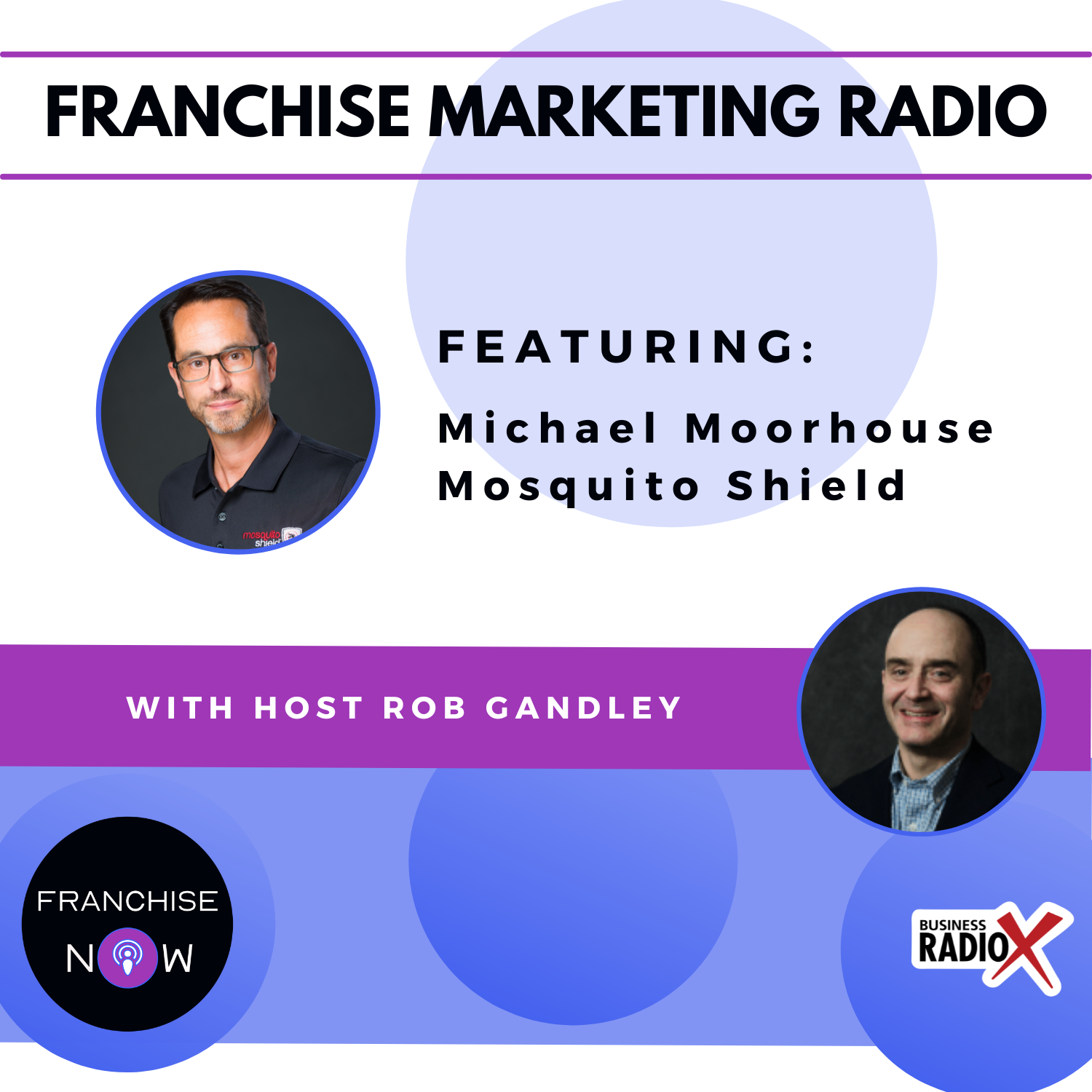

 Michael Moorhouse is president of Mosquito Shield, America’s trusted provider of effective residential mosquito and tick control service.
Mosquito Shield, part of the Five Star Franchising platform of home service brands, was ranked the #1 franchise in pest control by Entrepreneur in 2023, 2024 and 2025.
Connect with Michael on LinkedIn.
 This transcript is machine transcribed by Sonix.
TRANSCRIPT
Intro: Coming to you live from the Business RadioX studio. It’s Franchise Marketing Radio. Ready to revolutionize your franchise with AI? Franchise now empowers franchises with advanced AI solutions, automatic processes, and enhanced marketing strategies. From personalized customer interactions to predictive analytics, we help you harness AI to drive growth and efficiency. Transform your franchise with the power of AI. Visit Franchise Now to learn more and take your business into the future. Now here’s your host.
Rob Gandley: Welcome back, everybody to Franchise Marketing Radio, where we bring you the stories, strategies, and successes behind some of the most innovative and fast growing franchise brands in the market. Today. I’m your host, Rob Ganley, and today our guest is no different. He is not a stranger to our show either. Uh, this is, uh, I think his second or third time back with us. His name is Michael Moorhouse. He’s the president of Mosquito Shield and decorate with lights. Uh, Michael was a dynamic leader with deep expertise in the franchise development, marketing, and business strategy. Under his leadership, Mosquito Shield has, you know, grown into a standout name. It’s been around a while. They’ve been a top brand for quite some time in the home services sector, and they’re known for their unique pest control formula, high retention rates and compelling franchise opportunities. Michael, welcome back to the show.
Michael Moorhouse: Hey, Rob, it’s always great to be with you. So thanks for having me back.
Rob Gandley: Yeah, it’s good to have you back. I love having these conversations with you guys. You do all the hard work in franchising and I get to talk about it. So anyway, you make it seem easy when when I get to spend a 45 minutes with you or what have you. Uh, but I do love talking to you. Thanks for coming back and talking to us about your business model and your brand. Uh, so let’s just get started, like you were. You were on board about a year ago, and we talked. And so why don’t you catch us up? What’s been going on? I know we’re living in a world of fast paced change. Uh, so tell me a little bit about the last year and catch us up. And for anybody that’s tuning in, maybe just a quick overview of the brand and how you serve.
Michael Moorhouse: Um, interesting. You you talked about the timeline in, uh, in March of this past year. It was 17 years for me with mosquito shield, which is kind of mind blowing. So that that caused a lot of time for reflection and pause. And it was really interesting just to reflect back on that whole time period and launching the franchise system back in 2013 and where we are today. So yeah, the past, the past year has been a whirlwind. We, you know, we’ve been blessed to be under the platform of Five Star franchising. So the resources that have come with that have allowed us to just really scale our team internally. I think we’ve had maybe 6 or 7 team members over the last 12 months. Several folks franchise business coaches to work directly with our owners. So the support that we’re providing on that end has been amazing. We’re finally launching, um, officially, you mentioned decorate with Lights, which has been a passion of mine. I helped kick off the holiday lighting brand back in 2016, and we’re formalizing that into its own franchise entity this spring. So that’ll be a separate spin off for us. But it’s a great bolt on business for our mosquito owners, where they can finish spraying in the fall and then go right to decorating, you know, decorating homes. It’s the same clientele, the people that want to have a beautiful backyard, nice summer night, want to have the best looking house during the holidays. So yeah, it’s been a busy 12 months for us.
Rob Gandley: Well, tell me a little bit about Five Star. I, you know, I’m familiar, you know, and then the concept of platform companies is starting to become more common but still not fully understood by everybody. But that does change some things and it’s pretty, pretty cool. When did that happen? I want to catch up on that. But and if you could share a little bit more about what that means to your brand.
Michael Moorhouse: Yeah. So we were acquired so privately owned in we were acquired in 2022. So March of 2022. So we just hit three years. Uh, five star was formed by two amazing franchise, especially home service giants that, uh, Scott Abbott and Chad Jones, who had started five star painting many, many years ago, I think back in 2005. And they grew five star painting into a really large national franchise. And then they sold that to neighborly, and they took a little bit of time off and then said, you know, we really want to get back into the franchise space. Let’s, you know, sort of create our own neighborly, if you would, of home service brands underneath the five star franchising platform. So you know what that means for us as one of the brands underneath their platform is all of the the shared resources that you get, that you can then hand down or pass on to your franchisees. And again, they’ve brought in since day one. They’ve brought in resources that as a privately held company, we just simply didn’t have available to us, you know. So we always struggled to scale as our as our owner base grew, like growing proportionately with that, with the support system. Those are some of the things that they brought to the table immediately.
Michael Moorhouse: And then with the shared services, you immediately got an IT department that’s five times the size of anything you could build on your own. You’ve got marketing resources that are five times what you could ever build on your own and so on. So that’s, you know, it’s been a real, like I mentioned earlier, just a real blessing being with five star learning from these guys that are just accessible 24 over seven on how they grew, you know, their own home service platform to the size that they did. And then the learnings that came with that. And so it it shortens all of our learning curve significantly. So you know, I used to say back in 2013 when we launched, like we were the best mosquito company out there because we were really the only mosquito company. We were a mosquito company that got into franchising everybody else’s franchise entities getting into this space. But we didn’t really know franchising in 2013, and we had a lot to learn in our early franchise owners where our stakeholders in the brand, you know, to this day, they’ve shaped, you know, what mosquito Shield is. But having five star there as a resource has been invaluable.
Rob Gandley: Well, and I did I was just kind of curious. And so I kind of like did a little research on, on some of the other mosquito brands. Right. And you guys and you guys are way older. You’re right. You were the mosquito company that got into franchising. And then not just not because it’s a great business model, started a franchise around it. But I noticed that you’re really or have been around a long time and uh, and I think, I mean, at least the ones I looked at, you were the oldest you had been around. Yeah.
Michael Moorhouse: And I, you.
Rob Gandley: Know, 2001. Right.
Michael Moorhouse: 2001. Exactly. Rob. And when we do new owner training. Uh, so new owners that come to the home office for a week and it’s, you know, it’s a full immersion into the brand. But we start with the history. So I kick off the week with just a quick intro, um, to who we are, because we want them going back to their local markets, embracing that. But I tell them, the most important thing about our history is that we have one right. And there’s so much so, you know, you’re locally owned and operated. You want everybody to know you’re a new business owner in your town, but you should be opening with the 20 plus years of experience that we’re giving to you, right? There’s so many learnings from that. That is such a head start. So that, you know, we lean in on that and we we really make sure that our owners lean in on that. So that’s the way I kick the training off, is making sure they realize that we are, first and foremost, the best at controlling mosquitoes out there because of that, that legacy of of where we started.
Rob Gandley: Yeah, yeah. Now quality is I remember in all our conversations that is a focus of yours. Tell me a little bit about your proprietary approach to your blend, to your to your solution. And I know that your retention rate is 90% plus whatever that is. It’s just really unusual. And I know that’s incredibly powerful for anyone interested in running a local business. But tell me. I know part of it. There’s a lot to that. But part of it is the product. And, you know, much like I think of like a food brand where the, you know, the food, the quality of the food is everything. It’s the marketing. It’s it’s the word of mouth. People talk about it. Same with you guys. I mean, if it works and it just makes your environment better, you talk about it. But tell me about what makes you guys unique there with how you formulate your product?
Michael Moorhouse: Yeah, I’d love to. So we learned a long time ago that, you know, when you buy something off the shelf, like you can get results, but we weren’t seeing the results that we thought would make this a scalable business. And that is what you mentioned, retention rates, which leads to recurring revenue. When you know that 8 or 9 out of every ten customers are coming back for life. Like that’s just that’s recurring revenue. And that’s happening because the results are so good. And I mean, listen, if you look at if you take some of the other other people in this space, you know, and they’re in the 60 to 75% retention rate, like that’s decent in home services, like compared to lawn care, that they lose half their customers every year. People are shopping around for greener grass. As a homeowner, when you have 8,590% of your customers coming back, you can really build off of that. And that’s really a big part of that is the proprietary blend. So we back in probably 2004 started the owner, the founder of Mosquito Shield, to his credit, started, uh, playing with just formulations and doing a lot of research and, and putting together blends of all natural oils. And, uh, there was a lot of trial and error in the beginning of what’s working, what’s not working. But what we saw over a short period of time was just service calls going way down. Word of mouth increasing, so more sales coming in, which meant customers were happier with what was happening. And uh, and we really noticed it.
Michael Moorhouse: If you go back to 2008, 2009, when the economy was crashing, the founder had a lawn care franchise, and those customers were canceling during the during the crash of 0809. But what we saw that was super unique was that they were keeping the mosquito service. So, you know, again, my comment earlier that the important thing about our history is we have one. We saw what happened after nine over 11 because we were in business, and we saw how mosquito increased because people were staying home. And then 0809 was the advent of of the staycation. People were staying home in 0809, canceling their lawn care service but keeping their mosquito control. And then, uh, again, we exploded during Covid, right? So now we’ve got some some uncertainty about the economy right now. And, uh, you know, what we know for our, our owners is that we’re in a really good position because of our history of seeing what happens in down economies, but a lot of it has to do with that proprietary blend. It’s a blend of all natural oils. It’s a 25 B product, which means it’s a EPA exempt product. We do use some control materials that all the other companies use, but this allows us to use a lot less of it, but also to get another what they call mode of action. So it has its own killing properties, its own repelling properties. So when you mix it and it’s a recipe that we call it and we train the owners on it, it’s just it’s far superior results. Yeah.
Rob Gandley: Yeah. So 90% is still really high right. So and your business model, I just kind of want to pack it slightly with why that is. Right. Like obviously the product is key. And I thought actually what you just shared, I never realized, um, but it’s one of those things that people probably don’t want to deal with on their own. They probably aren’t quite sure what to do or what to use. Is it safe? Is it the best product? Right? It’s just interesting that in those downturns, every time people are like, now that’s one thing we’re not getting rid of, right? We’re going to keep that going because it’s almost like you’re wasting everything else. You can’t go outside. You can’t enjoy your house. Right, exactly. I mean, but that’s interesting. I mean, you’re talking in my lifetime. Those are the staple events, like, since I’ve been a professional nine over 11, 2008 and Covid. And in all of those, your model came actually got a boost. So, yeah, unpack a little bit more. Why do you think in the way you guys do business the retention rate is so high and why why you uh, why you’re having. Yeah.
Michael Moorhouse: There’s one other I think there’s one other really big component to what I would call sort of the secret sauce. And I don’t I don’t mind sharing it because it’s out there. Other concepts. I’ve tried to figure it out for a long time. It’s not an easy thing to do, but we don’t spray on a set schedule or a set number of visits. It just simply doesn’t work. And so we tell that to the homeowner. We market it. It’s on our website. We’re going to we’re going to monitor in your market Rob. We’re going to monitor the mosquito pressure and the weather. And we’re going to come out essentially as often as needed. So we tell the homeowner every 10 to 17 days. Any other concept out there is selling a 21 day or a 30 day program. And the reason is the control products that I mentioned, it says on the bottle, it’ll last 21 to 28 days because in the lab it still has some effective active ingredient on that 21st day. But in the real world with rain and heat, that product is not working on the 21st day the way you want it to be. So that’s why we made a shift years ago with our proprietary blender product. And then just the know how that you’ve got to be out there more frequently based on weather, that we’re coming out so much more often than the competition.
Michael Moorhouse: And the crazy thing is, we’re able to do it at a lower price point because we’re also on the property for less time. So knowing where to spray, how to spray so we can we can do a property without getting into the weeds here. We can do a property in 5 to 6 minutes, and the other guys are spending 20 minutes on a property. We’ll use two gallons on that property and they’re using 6 to 8 gallons on that property. We’re getting better results. We can pass that savings along to the homeowner. So our per spray price is less money. So when I when I look at this through the lens of business ownership. Right. So why would somebody choose like mosquito shield as a pest control company. Over over others. Like you’re getting a bigger territory, you’re paying lower fees, but you’re getting all that proprietary know how on the consumer side, like what are you selling to the homeowner? They’re getting more visits, better results, and they’re paying less, right. So there’s a lot of value proposition on both both sides of it. If you’re looking for a business opportunity, we check more boxes than any of the other options. If you buy the business and you’re going out to compete against them with the end user, the homeowner. That’s it. You’re getting more visits, better results, and you’re paying less for it.
Rob Gandley: Interesting. I mean, it’s straightforward right now I’m just curious. So the the idea that you can do what you do and I don’t want you to unpack too much, obviously, but I’m just from what I’m, what I’m, I’m packing in my mind here is you’re you’re going out more frequently. First thing I thought of was, well, that’s probably good. I don’t know that you always see the homeowner each time, but I would say that that’s an opportunity for your brand to be there. Say hello, smile, make a comment, have a conversation, whatever that might be. So that’s always good. But the other side of that was, um, and I guess the question of that would be, do you leverage the fact that you’re out there more? Is there something you think about that way? And then the other part is, is is it something to do with they know where to spray, like if it’s you just had a torrential Downpour for last week. You kind of know, okay, if that happens, here’s where we focus. Is that sort of a little bit of what you guys know?
Michael Moorhouse: You just we we use the term in, in, uh, sort of tongue in cheek when we’re training all of our owners and then even their technicians of, uh, that’s what we call sort of the spray and pray model of just every, every 21 days, dump a bunch of product on the, on the property and pray that it’s going to work. Right. Um, you can have the retention rates that we do without having amazing results, controlling something that’s near impossible to control. Like we can’t get rid of every mosquito on our property. But we will change your life in your backyard like it is a. That’s what I’ve called it forever a quality of life service. We’re allowing you to stay out at night as late as you want, as long as you want. Not having to be covered up in long sleeves or yoga pants or spraying yourself down. That’s the quality of life service we provide. But we go right down to the technician level like we hold boot camps every spring where owners will come, they’ll bring new hires. They’ll send previous texts. As a refresher. Uh, we just launched a a full scale perimeter pest program. Spiders and cockroaches, that kind of thing. So that’s a new service. So we we had a special training for that this year. But we had um, we did in-person training in Orlando. Dallas. Milwaukee. We’re doing one in Massachusetts coming up. And I mean, collectively, we will have trained this season about another 170 technicians from all over the country that are learning those exact things.
Michael Moorhouse: When you get to a property, there’s two places. Again, all the secret sauce. There’s only two places on a property you need to worry about where the homeowner is spending time, which is pretty obvious when you walk around back and see the sitting area, the fire pit, the pool like where the homeowner spending time and then where are the mosquitoes coming from? Like where are the damp, shady areas? Where are the real lush areas? Where’s is there a potential for standing water? You know what’s over the fence? You know, a lot of times you got to look over the fence and you see an abandoned pool or you see, you know, so there’s just a lot of stuff that you need to educate the homeowner on. But that’s what we do at our boot camp. Like we instill this into technicians. They’ve got to take tests. They’ve got to pass the test. If an owner sends a technician to this boot camp but they don’t attend, we report back to the owner on that technician. So it’s just a really, you know, again, learning years ago like it’s boots on the ground and what happens when the technician shows up on that property and, and we got to make sure that they are as equipped as possible.
Rob Gandley: I love that I love that it reminds me my dad was in the computer business, and someone told me a story about him one time, and it was an older guy and, uh, had a lot of respect for my dad as an engineer and a data center expert. And one of the things my dad did once they were torn, a data center, and he lifted up the floor panel and showed him a bunch of dirt on the bottom. It was. It was obstructing airflow. Like like looking on the other side of the fence. Right? It could it could be the major problem. And even though you would think it’s not your business, it’s on the other side. It’s I love that you do that extra step and make sure you know what’s on the other side.
Michael Moorhouse: Is I have this thing. I have this thing at training. I try to attend as many of them as possible. Uh, you know, over the last 12 months with this really robust team we’ve built out, it’s allowed me to not have to go to all of them, which is great. I can focus on other things, but I always tell everybody to look up, and no one ever does. Right? Everyone’s always looking down for puddles. And the problem is, you know, trash and, uh, tarps and anything holding water. But you look up and you see trees growing out of the gutters and like, you know, so it’s just. Yeah, it’s it’s it’s being you’ve got to be you got to really investigate, especially if you get a service call that happens. We do free respray. So if a customer says, hey, I’m seeing like a ton of activity. There’s no charge. We go right back out within 48 hours. That’s a company policy. We’re right back on that property. And and it’s an investigation. It’s it’s like, what did you miss? What’s hiding? Because it’s always something, right? There’s definitely something hiding somewhere that you didn’t, you didn’t see. And, um, and again, that’s what leads to really good responsive customer service, having the best product and know how out there. And then the manner in which we treat the property is, is all sort of that, um, that leads to that, you know, those magical numbers.
Rob Gandley: Yeah. Yeah. Exactly. It’s it’s all about how you make the customer feel. Right. It’s like these guys know their stuff. I love being around people that are experts. I don’t care what it’s about, to be honest. I just enjoy people that really know their craft, you know? I mean.
Michael Moorhouse: Yeah, when you’re in good hands, it’s a comforting feeling. It’s interesting having been, um, having been paralleled so long with the lawn care business because for years that’s I was I was helping with both. I was helping with the lawn care franchise while I was learning the mosquito side and getting ready to launch the franchise in 2013. You’d get people calling in, irate about their lawn, right? But they never wanted to upset the mosquito side of the office. Right. Because it’s like you’re I don’t want them to not come out. So, you know, the service calls would be the funniest thing. You’d hear someone saying, I’ve got a spot on my lawn, and you better get out here and fix it for the grass side of things. And then they’d call and be like, I may I might have seen a mosquito. I don’t, I mean, it’s okay, but like, could you come? You know, they don’t want to disrupt anything because it’s such a life altering service that we provide.
Rob Gandley: Wow. I you know, I never so let’s talk a little bit about marketing and and for those that would consider a model like this, um, I want to stay on this one. Quality of product, quality of experience. Because if you have those things, then your marketing becomes very natural as long as you just follow through a little. Right. And I’m sure you have ways of helping your franchisees figure that out, right? Take advantage of what we’ve already built, which is the best product and the best experience. Now you just need to take that a bit further and let other people know. Tell me a little bit about how you leverage that. What are the some of the tactics and strategies that go into to local marketing?
Michael Moorhouse: Yeah, no, it’s a great question. And feel free to to keep asking or jumping in because you asked a question earlier and I didn’t even fully answer it because you talked about, um, you know, the frequency of what? Of which were out on a property, if you just think about it in and of itself, that truck. And then we’re putting signs everywhere, right? So those trucks and signs are happening 2 to 3 times more than the standard company that’s only out there once a month. Right. So the the visual exposure that our brand is getting in neighborhoods. And that’s really what it’s about. It’s down to the neighborhood level. Right. So the the visual exposure, we track our sales sources every time. Right. So where did you hear about us? In the top five. In the top five. Every year. Every month. Every week is saw sign. Saw van. You know, web search is always up there, but it’s the grassroots stuff. It’s seeing the van in the neighborhood, seeing the signs in the lawn. And, you know, that’s the that’s the critical component to it. With that as some tech that we’ve layered in. So we have, you know, our routing, our software that we manage our customers with. Uh, we have a, we have a neighborhood, um, mailing option right out of the software.
Michael Moorhouse: So if we know we’re doing a route next Thursday, we can mail to that neighborhood, to the people that are not our customers saying, hey, we’re going to be here next Thursday. You know, we’ve got seven happy customers on your street. You know, that kind of thing. So super targeted. But then at the same time, we’re still putting signs out where door hanging, we’re doing all the things that you need to do just to create. If you think about Rob, this number keeps growing. But the number of touch points with the with a consumer. It takes to get them to, to to move or to act on something. You know, I think it’s I think it’s eight to 10 or 12 now of touch points. And you think about it if if a homeowner is driving into their neighborhood after work, they’re coming home, they see the van pulling out. There’s a sign on the corner, there’s a sign on the neighbor’s lawn. There’s a door hanger on their door. They pull into the driveway, go to the mailbox, get some mail, and there’s a postcard from us. Like, we just did a shit ton of things. That’s only five touches.
Rob Gandley: You still got more work to do.
Michael Moorhouse: You gotta do five more. Right. So I mean that.
Rob Gandley: Yeah.
Michael Moorhouse: Right. That’s the, um. That’s the challenge, right? The difficulty. But the beautiful part goes back to that retention rate. Once you get them the lifetime value, you can spend a few hundred dollars to acquire a customer in our model because they’re just year two is just pure profit and so on and so on and so on.
Rob Gandley: So yeah. Yeah. And I was I was going to say, you know, and I’m a digital guy, techie guy and still love all that, but it’s kind of at this point, I kind of go back to the grassroots stuff and the offline. I’m very intrigued. Uh, things like direct mail do much better now, like, than they may have ten, 15 years ago. Uh, especially when you’re talking such a great technique, like focusing on those communities, right? Yeah. For sure. Right.
Michael Moorhouse: Yeah. I think.
Rob Gandley: You know, it’s a.
Michael Moorhouse: Dms changed, like back in the lawn care days when I was helping on the lawn care business. You’d spend out, you’d spend 60, 70,000 pieces to 2 or 3 times, right? Like hundreds of thousands of pieces of direct mail. Now, with our owner base, like, we’ll look at their markets and we’ll look at where we think the lowest hanging fruit is based on data. We’ll pull up the mapping and look at, you know, the demographics of who our who our audience is. And, and they might be a 5000 piece mailer 3 or 4 times, or a 7500 piece mailer. You know, it’s not tens of thousands of pieces that are going out. So it’s very surgical. And then that, that the, um, the tech that we’ve layered in now that is that neighborhood option that’s even more surgical, that might be 15 or 20 pieces that go out once a week to a particular market, because you’re just trying to grow your root density. Right. Everything is about optimization. And how many stops can you do in one day? And um, so when you think about, uh, the fact that we’re on the property a third of the time, we’re using a third of the product, we can do three times as many stops a day as anybody else. So these these texts are cranking when they’re out there.
Rob Gandley: I love that efficiency. I mean, you’re you’re hitting every aspect of the business when you think the way you do, when you guys look at territory planning, how how do you you obviously are probably mapping that out, looking for the right communities, the right neighborhoods, the density that you need within a territory. Is that kind of how you approach it to make sure that looks pretty much the way it needs to look, because you pretty much from there know what you need to do.
Michael Moorhouse: Yeah it is. And the funny, not funny thing the interesting thing is so the franchise development team, the Fran Dev people that we have working for Mosquito Shield, they use a mapping software and they do just that. We’re looking at single family homes at certain income levels and certain home values because we know our target audience, and that’s what we’re selling to the candidate that’s coming in to look to open up a business. But as soon as they do, as soon as they become part of the family with Mosquito Shield, the marketing team goes into that same software and then meets with with Rob, the new owner, and says, Rob, let’s pick the 2 or 3 best areas, not even zip codes, but areas of what you bought. And they look at the just the, again, the lowest hanging fruit of our core audience. And that’s where they’re going to market to the first couple of years. Now that Rob will take in customers from everywhere, but where their where his concentrated marketing efforts are going is very strategic.
Rob Gandley: Yeah, yeah. That’s awesome. It’s it’s very clear. You know what works? You know who your customer is. You know where they live. And you just need to go do bring them the quality product and the lifestyle transformation and keep doing it over and over. So so is there a digital, um, is there something on the digital side you’d like to at least check the boxes? Because from what you just described, you could almost run without digital. I know you need it. I know you need it for credibility and other reasons, but what would you say are the things that you want to have in place? What are the sort of make sure you check the box kind of thing?
Michael Moorhouse: Great question. Because the landscape is changing almost by the day. Right now the cost has gone up significantly. I still think that, uh, quality, like super local organic SEO is going to be really important to any business in any industry like, you know, being found online with credibility. Right. And fresh, relevant content is what gives you that. So a good, strong, really strategic SEO program is, I think, super critical to that. Uh, pay pay per click. The paid digital side of it has to be really strategic now because of, um, just the cost of it and, and making sure you’re getting the conversion on that end. In our business, which is very seasonal for most parts of the country. You know, the nice thing about pay per click is you can turn it on and turn it off so you don’t, you know, SEO, you want evergreen like that’s that’s working for you year round. And you’re always you’re always driving new again, fresh, relevant content on the SEO side. But dialing up your pay per click and having it there. But if you’re not, if you’re not pairing that with a very orchestrated grassroots program, the signs, the door hangers, you’re not compelling somebody to get online to look for you, right? So one does not work without the other. It never will. And I think that that’s where we have it in our system. And it can be frustrating for all of us because owners just want that silver bullet. It doesn’t exist. I don’t think it ever will exist. Right. And it also will never be the same thing. Like the leverage you’re pulling will always change. Right. For a period of time, you’ll be pulling some levers that just seem to be working. And you go back the next season and it’s like, why aren’t these levers working anymore? Right. So if you’re not if you’re not pairing up your, you know, super orchestrated grassroots campaigns, you’re not compelling anybody to look for you. Yeah. Right. If you’re.
Rob Gandley: Going to spend.
Michael Moorhouse: Money on SEO and have a digital agency working for you, and you don’t want to go out and put the signs out, you’re wasting your money on the digital side. So I think I think just, um, again, I keep saying like a super orchestrated campaign, uh, like that’s omnichannel, that’s touching on the core elements of what you need is going to is going to drive, you know, is going to drive the results better than looking for just a couple singular channels and hoping that’s going to work for you.
Rob Gandley: Well, and the way you’re describing it, I can tell you just from all my years of experience, the best way to make a pay per click campaign work good is to have other marketing that works good with it to be to be smart. And like you said, people will naturally search for you when they see you more. And so you’re kind of keeping that that audience really tight and just focusing on converting, right. And then move to the next community, the next community, you know. And but that to me is the way to use it. Right? Versus let’s throw up some ads and hope it works without any other layers of of awareness. Or like you said, there’s 10 to 12 touches, right?
Michael Moorhouse: Yeah. And I think I think validation will always be sort of the end point where, you know, because like, you know, influencer marketing is is big, right? You get somebody that that I mean, I think for us like at the micro level, it’s really important that you get a local influencer in your market that has a that has a robust or decent following is going to is going to help you. But I still think the homeowner they might see, you know, Rob who they follow on Instagram. And he always has great things to say about his backyard. And now he’s using mosquito control. They’re still going to go look to learn more. Yeah right. And so what what do they find when they get there. Are there a bunch of really great, uh, high quantity of Google reviews when they get to, to your site or to to your GMB listing online, like. So there’s a again, there’s, there’s so many things that go beyond just rob the local backyard guy that somebody follows on Instagram, like they’re still going to want to learn more about mosquito shield and what do they find when they get there? That that one little location in that market has, you know, 485 star Google reviews. They’re going to be like, wow, that’s pretty impressive. Rob’s right. And then, you know, you did. You did a really good job on your SEO. So your top of fold on the on the organic listings. You just landed that customer.
Rob Gandley: Yeah absolutely. And you’re right you can’t. They did. The Google is sort of the foundation. Like they will go through that eventually they will. They will validate or verify with some quick Google reviews. And look there no matter how they learn. But I want to talk to you now about like what I believe is, again, brilliant on your part. Uh, first of all, your product design and you’re also you added, uh, some other pests, like spiders and ants and and cockroaches, which I, you know, just kind of a check box. That makes total sense, right? Uh, so that, I guess, can also help with the transaction values. Right. You have more transactions. More, more more more, more use cases. Right. But I wanted to now move into what you created, which is the other seasonal business. And I know you’re just about to launch it, but tell me more about decorate with lights and how that will impact your current franchisees and how they’re doing business. And of course, what I see is a brilliant move to increase. Uh, well, help with marketing, but help with the whole business model. But explain how they will how they will leverage that.
Michael Moorhouse: Yeah. Happily. Uh, so it’s it’s share a wallet, which you just said. Right. You’ve earned you’ve earned a customer in that homeowner. What what value driven services can you provide to them and generate more revenue. Right. Because they’re they’re you’ve acquired them already. So you’ve got that sunk cost in acquiring them. Now share a wallet. What else. You know how much more revenue can you generate from them? The lighting business is fantastic for us in that sense, and we have a really unique model. We take a very high end design decor approach with decorate with lights. It matches our clientele, which is a little bit upstream, uh, you know, of, um, who we target for mosquito control. Um, you know, people with, again, they invest in their backyards, they’ve got outdoor kitchens and fire pits and, and, uh, so the homes are ideal for decorating. They’re in the ideal neighborhoods. It’s a it’s a very low, uh, startup cost for our owners. We currently Rob have about, I think 20 ish owners that are that are doing holiday lighting. The expectation is that we’re actually going to double in size this, this coming year and have 40 owners, uh, doing decorate with lights. It’s a very compressed season. You’re doing it from typically October. You’ll decorate right up until the middle of December. You take a break, and then usually after the second week of January, you start doing the tear down on it. But it’s super high margin, um, low volume. We don’t do a ton. You know, there’s there’s companies out there that will do five, 1200, $1,200 jobs a day.
Michael Moorhouse: That’s not that’s not what we’re looking at. We really again, hold the homeowners hand. Really. It’s a consultative sales approach. So we sit with them, we tell them what their home could look like and we deliver that for them. So it’s a really rewarding process both for our owners because it’s you never get to be in the backyard at night mosquito free with all the homes you sprayed that day. But to be able to drive by or when you’re leaving at dusk and you look behind and see the decorations that you just did and the the beautiful design, it’s super rewarding for our homeowners. The other for owners. The other great thing is Rob it it it extends the employment opportunity for hiring people, which can be a pain point, right? No matter. I tell people, no matter what business you get in HR is going to be the toughest thing. Whether you have a year round business and you’re in retail or you’re you’re doing mosquito control for five months out in the lakes region, like you got to hire people, you got to fill them. What do you do with them at the end of the five months? Well, this allows you now to hire people essentially year round. So it’s a great tool for that, which was the original reason we launched decorate With Lights back in 2016 was how can we provide our franchisees an opportunity to keep people retained, keep their key personnel working year round?
Rob Gandley: Yeah. Now, I’ve heard that numerous times. I think I hear that almost every conversation I have with home services, especially home services. It’s it’s hard, you know, to keep employees anyway, uh, let alone if it’s by design, a part time or seasonal kind of thing. So to have, you know, be able to keep and attract your key people all year round. And I think that’s amazing. Like the whole concept of the way you you described it, um, being able to create sort of again, that experience that when okay, so if you decorate a home and you make it look beautiful, you know how many times that’s going to be brought up in that condensed period of time. And every time it’s you guys that did it, you guys that did it, you guys did it, you know. Yeah. You can’t you can’t.
Michael Moorhouse: Do the amount of jobs that are coming your way. Like that’s the case with our owners. Like it is like how many jobs do you want this year. Okay. You got them. Yeah. Yeah. That’s what it comes down to.
Rob Gandley: Yeah yeah, yeah. And it’s a good thing because it’s a, it’s a good time of year. You know, it’s a time when people can get together with their loved ones, whatever they’re doing. But that is a way to make that environment beautiful for that purpose. And I think it’s just a win win for everybody. So I’m glad you added it. That’s a really smart move. Yeah, definitely a different kind of business. But I think it’s a nice balance, right? Yeah. You know.
Michael Moorhouse: I mean, you know.
Rob Gandley: I’ll.
Michael Moorhouse: Tell you, we’ve got owners that are super successful on the mosquito side and they just want their they want their winter off and they’ve earned it. And, and uh, but then we’ve got a lot that are just like, give me more. Right. Like, what else can we do. And they see the they see they see the scalability and the ramp opportunity with with decorate with lights and um, and every time we launch an owner, they immediately have as much business as they can handle, which is awesome. That’s amazing. It is.
Rob Gandley: Beautiful.
Michael Moorhouse: I wish.
Rob Gandley: I.
Michael Moorhouse: Knew that position on the mosquito side, to be honest with you, was as easy as it is on the, uh, I look back, you know, again, 17 years of doing this, I look back and to me, the holiday lighting business is even more fragmented than mosquito was years ago. There’s people doing it. There’s a bunch of DIYers, there’s a bunch of landscapers that are throwing lights up. It’s not it’s not the quality. It’s not the process that we take. So you can really, really differentiate yourself. And again, um, you’ve got a you’ve got a captive audience. If you’ve built your mosquito business, your, your customers are all already there waiting for you.
Rob Gandley: Yeah, yeah. No doubt. And and it all well and I love that you just casually mentioned. Yeah. They can have off uh, you know, they can have off in the winter and make great a great living and run an incredible business. But be off for a few months. That’s always nice. Any kind of business model like, not that they don’t work really hard in the months where they’re working. I’m sure there’s really no schedule there. You just get the job done. But still, I love that for some. You’re right. That’s something that they would look forward to. And they could be home at their home with their nice lights all all winter. Winner, right? But very cool that you could even do that, right? You could. You could have the option. I think that says a lot about the model. So. So before I let you go, I want to make sure we do touch on technology. You mentioned it a little earlier and I just keep it broad and high level. But I’m wondering is there some technology you just love? Is there a couple of things, whether it’s operational on the operations side or the sales and marketing side, anything that you just love that you guys have implemented, you know, that’s important to your brand and you’re using it regularly. Is there something about technology you’d like to share? And I think it’s just critical to your operation.
Michael Moorhouse: Yeah, I think, you know, certainly touched on I think that new addition that we just layered in for the really we we piloted it last year. It’s full scale this year on the the neighbor, the neighbor marketing. And again, you can go right to the actual house next door. You can do a radius. You can do you can do it to whatever degree you want. But it’s and it’s just a click of a button. There’s no lift on the, the franchisees. And our owners can just add it and it’s done for them. And incrementally they’re just picking up business and it just leads to margins because you’re already on that street. So the more homes you do in a compressed amount of time and route density. So that’s a really big addition to us. We’ve got some cool stuff, Rob, that, uh, we’re working on right now and we’re testing it out, but using, um, predictive analytics on weather because again, like we can predict now. So the seasons around the country right now haven’t really started yet in a lot of markets. Right. You need you need without getting too techie on you, you need night time temperatures that drive mosquito activity. It’s not how hot it gets during the day. It’s when the when the temperatures at night get to a certain point.
Michael Moorhouse: Not going to tell everybody what it is. But we know that we know that number. And when temperatures reach that number at night, we can say, hey Minnesota gang, get ready. Because ten days from now, because the night goes from it goes from an egg to a mosquito in 7 to 10 days. So in 7 to 10 days from now, you are going to have mosquito getting in your market. So get signs out now like get ready and you can predict it. So building that in where we don’t have to have our finger on it to be looking and telling. So having it automated, which is something that we’re we’re piloting, which is really cool. So just stuff, really neat stuff like that, that just shows that this is not a spray and pray brand or model. Like we put a lot into that type of thought process on how to just get better at our craft and then, you know, um, always improving on like the route optimization software that we’re using. There was a call I was on just prior to this one that was showing some, some recent enhancements for the owners to, to see things that they can do that literally just we have amazing route optimization and we just we just released a version that is five minutes faster, like it’s proven to be like it can take it, can move things around and make your routes every route, every day, five minutes faster than before.
Michael Moorhouse: So those little tweaks over the course of you got ten trucks out on the road five days a week. I mean, that’s amazing efficiency savings that, um, so just things like that, we’re just always it’s one of the things that has me so excited after 17 years going into a season like this, I feel like it’s year one for me and that we we don’t ever rest. You know, we talked about the proprietary blend. We had a blend that we launched many, many years ago. One year ago, we spent over $100,000 and went back into the lab and reformulated. We just we had so many learnings over the years of different ingredients and what they do. And and again, through five stars backing and investment, we were able to go back into the lab and and reformulate our blend. And like who does that right. Like who would spend that kind of money on something that really the homeowner doesn’t really touch it. Right. They don’t get to, But it provides those results. So those are just things that I think speak volume about Mosquito Shield as a brand and where we believe we’re positioned within this space.
Rob Gandley: Yeah. No, it’s it’s you know, I do I talked to a lot of guys in your position that are leading brands and, and every time we talk I’m thinking you’re you’re on you have your eyes on every facet of the business. And how can we continually innovate, which I think that’s what franchising is supposed to be, right? Um, because, I mean, if I wanted to do it on my own, I would do it. But I mean, you know, you want to be part of a brand that one quality is first and the customer experience and what? And there’s a million things you could talk about when it comes to technology or. But it’s really things like what would shave five minutes off the route time, what would make the customer happier, what what would increase the the transactional value of every relationship or what have you. But it’s it’s those kinds of ideas but brilliant stuff. You kind of unpack some things. Is there anything else before I let you go? Is there anything else as you look forward into the future about your brand? And I know you want to keep you want to be excited as you wake up every day. But is there is there something on your mind now that you could share that you said, I want to get to that or.
Michael Moorhouse: Well, I mean, I think we have, you know, we have a three year and a five year plan and we do rock setting every 90 days and like so and we’re just in the weeds right now. I mean, the next eight weeks are going to be just chaos for us as a company, right? It’s where everything happens. And so when we we just did our quarterly planning recently and again, we do it through a 90 day lens. But I actually asked everyone let’s look at this as 60 days. What is the most important thing in the next 60 days to to drive our business forward and get the owners what they need? And the marching orders for 2025 has been everything we do has to drive value to our owners, and we have to be able to hold them and ourselves accountable for it. So that’s what my team is. That’s all we talk about all the time. Anything new? Is it driving value to the owners? Do we put it aside for right now? And if we launch something, can we hold them and ourselves accountable to it? So that’s just our focus right now. But long term I mean we have you know, we have Canada, Canada expansion on the radar. Um, additional services. This you know, the dwell decorate with lights launch is pretty big for us. It’s a whole nother offering that can happen outside. We’ll have permanent lighting as part of it, landscape lighting as part of it. So it’ll be bigger than just, you know, Christmas lights on a home. So D.W. is a is a big is a big venture for us. Yeah. There’s a lot of a lot of new new things on, on on the frontier for us.
Rob Gandley: I will want to say I love lights, I wish I, I other than when you know the light when, when the days get longer. Uh, but I just something about when the days get shorter and everybody starts having lights. Um, I always say to myself, Come January, February, I’m like, why do people turn the lights off? I mean, you don’t have to have Santa Claus out there, but I really like it.
Michael Moorhouse: It’s funny, my kids, I mean, they’re older now, but when I, when I, when I launched back in 2016, in the few years after that, you know, we would do the ride at night of the homes we, we decorated. And I’d bring my kids around and my two younger girls at the time, they got to the point where they could pick out DIY jobs and say, those two those whites don’t match. And you know, that’s not the right spacing on the roof line. And, and, uh, and then you’re driving around in the summertime saying, oh, look at that house. I want to decorate that one. And that one would be great to decorate. And I would do that peek, I would do that ridge. And I would put a wreath over there and, but my kids could pick out terrible warm white lights, you know, that didn’t match. Not even house to house, but on a on on a landscape, different lights on different bushes that didn’t match. So like that, you know, that’s the.
Rob Gandley: Level. Yeah. That level. Right. Exactly. You do notice it. The good I tell you. Yeah. You. When you’re really good, you notice the difference after you looked at it enough times? Um, well, that’s good stuff. So why, before I let you go, totally. I want you to share with the audience. You know who you look for. You’ve been alongside this brand since the beginning. You’ve you’ve innovated it. You continue to do so. It’s an amazing opportunity. Who do you guys look for to be your next owners? What kind of qualities are you looking for and what kind of advice would you share with them now?
Michael Moorhouse: Yeah, I mean, I think if anyone’s made it this long through today’s episode, which I hope that, yeah, I think that, um, one thing I’d love to say is, like, I, I really love, um, empowering people into business ownership, whether it’s with our brand or any other. So if they took anything out of today’s call and they want to connect with me, you know, Michael at Mossgiel. Com find me on LinkedIn. I would love to talk about businesses with you and, um, and help you take that leap because I think it’s super important. But, you know, I think we have a unique situation at Mosquito Shield where, you know, we have some very, um, very educated, strong willed, strong minded owners that that, um, bring a little bit of a different level to our brand than I’ve seen in, in others. And I think that that is something that we foster and encourage at the same time, it’s, you know, it’s about following systems. You touched on it earlier in the call, like you could do it on your own. But, you know, there’s so much that a franchise system brings to the table that you want people that you can tell from the beginning are willing to embrace it. You know, we get into the weeds on some other things about like, how well are you capitalized and what is your, you know, what’s your current work situation? Are you just looking to do this? You know, part time? I’m not a huge fan of the of the semi absentee model.
Michael Moorhouse: I do feel like you’ve got to have some skin in the game and be invested in it. So those are conversations that we have as they’re going through the process and then helping them check boxes as much as we’re as we’re checking them. It’s a two way interview, right? When they’re when somebody’s looking at a at a business opportunity there. They’re interviewing us, but at the same time we’re interviewing them. So I think that at the end you want to you want a long term partnership. I look back at some of the the early owners that we brought on are still with us today. And to me that is like just that’s amazing. What’s even better, Rob, is some of them are exiting right now and they’re having like life changing, really meaningful occurrences, which is like, so, uh, just like really means a lot to me that somebody put their faith in, in the brand 11, 12 years ago. And now they’re they’re riding off into the sunset from the hard work that they’ve put in, and maybe a little of the guidance that we gave them over the years. And, and they’re having meaningful they’re having a meaningful exit. So those are the types of people that we’re looking for.
Rob Gandley: Yeah. What an amazing thing to be able to say that. Like it’s uh, that is the end to end, isn’t it? Like, not everybody exits.
Michael Moorhouse: On our end. Yeah, it’s really rewarding because it wasn’t without hardship. It wasn’t without a lot of pushback. It wasn’t without a lot of back and forth. And, um, but again, I mentioned, you know, some of those early owners are are what I consider to be true, true stakeholders in our brand. Yeah.
Rob Gandley: That’s amazing. Yeah. They they were there with you in the beginning and, and helped you launch this thing. It’s always nice to see that. And you know like I said, the impact that then people can make with that, that exit right for themselves, their families, their community, whatever they go on to do. And franchising is full of those stories. A lot of times guys go on to build something else. They had an amazing early success with a different brand, right? And so that’s what I love about the industry. So it’s good stuff. Well, it was great having you on the show today. Um, I want to make sure we share the URL to the best way to reach out. Uh, I have it as Mo Shield franchise. Com.
Michael Moorhouse: That is.
Rob Gandley: Correct.
Michael Moorhouse: Shield franchise. Com if you’re if you’re interested in learning more about that opportunity. Beautiful.
Rob Gandley: Good stuff. Well, Michael, thanks again for being on the show today, as always, sharing what comes naturally to you. Thanks for being a great leader too and really doing cool stuff with your brand. Awesome!
Michael Moorhouse: No, it’s a pleasure hanging out with you again. I, uh, it’s, uh. I consider you a friend going way back now, so thanks again.
Rob Gandley: I know it’s starting to add up, isn’t it? Goes fast. Yeah, it feels like yesterday we had the first interview. But anyways, it’s great to have you. And to our listeners, thanks for tuning in. Please check out Mo Shield Franchise Comm if you have any interest. These guys are professionals. They’re entrepreneurs. They’re knowledgeable. I’d reach out if you have any interest at all and, uh, get to know them. It’ll guide you, I promise you of that. But thanks again for tuning in. And bye for now.














