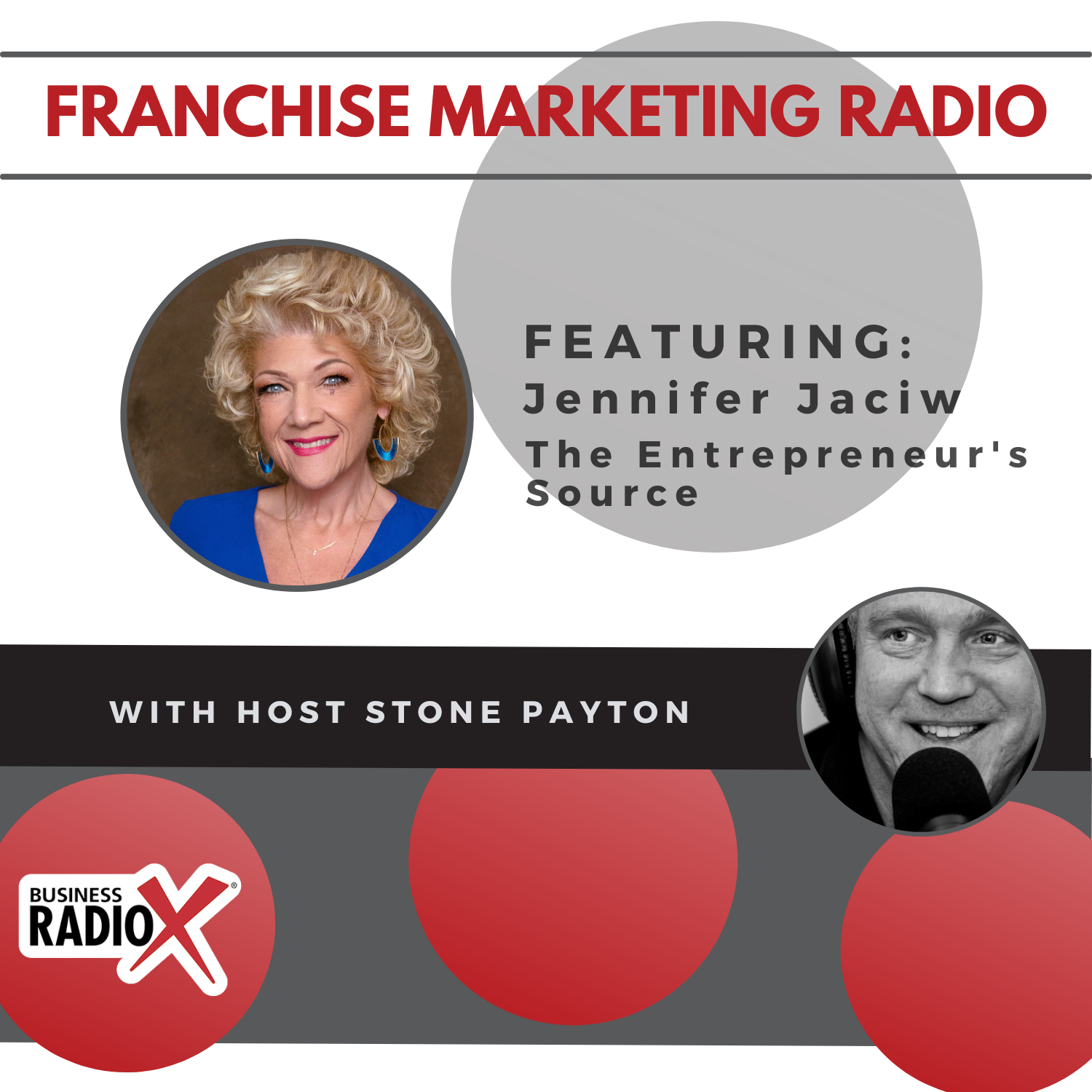

In this episode of Franchise Marketing Radio, Stone Payton interviews Jennifer Jaciw, franchise coach at The Entrepreneur’s Source. Jennifer shares her personal journey through career transitions and explains how her organization helps professionals explore franchise ownership as a new path. She details their complimentary coaching process, which uses assessments to match clients with business opportunities that fit their goals and strengths. Jennifer emphasizes a supportive, non-sales approach, current trends in franchising, and the importance of lifestyle alignment.

 Jen Jaciw (sounds like “Jasseff”) is a Career Ownership Coach, Consultant, Connector, and Speaker, dedicated to helping professionals take control of their futures.
With over 25 years of business management experience spanning Sales, Marketing, Operations, and Entrepreneurship, including owning a successful Silicon Valley transportation company — she empowers individuals to transition from traditional careers to fulfilling business ownership.
Beyond coaching, she’s spent the past 10 years mentoring small business owners, leading networking organizations, and advocating for domestic violence resources.
As a speaker, she brings authenticity, insight, and actionable strategies to topics like goal setting, career transitions, branding and marketing, and entrepreneurial success.
Website: https://jjaciw.esourcecoach.com/
Linked In: https://www.linkedin.com/in/jenniferjaciw/
Facebook: https://www.facebook.com/jaciwconsulting
Instagram: https://www.instagram.com/jenniferjaciw/
What You’ll Learn in This Episode
- The role of The Entrepreneur’s Source in supporting career transitions.
- Jennifer’s personal journey and experiences leading to her role as a franchise coach.
- The complimentary coaching program offered by The Entrepreneur’s Source, including assessments to identify client strengths and goals.
- The misconception of franchising as merely buying a job versus building a scalable business.
- The ideal client profile for franchise coaching, focusing on corporate executives and senior professionals.
- The importance of identifying transferable skills and aligning them with business opportunities.
- The coaching process that allows clients to explore different business models without pressure.
- Risk mitigation in franchising through established systems and branding.
- Current trends in franchising, including recession-resilient business models and the integration of technology.
- The emphasis on time freedom, flexibility, and sustainability in choosing a business model.
 This transcript is machine transcribed by Sonix.
TRANSCRIPT
Intro: Coming to you live from the Business RadioX studio. It’s Franchise Marketing Radio.
Stone Payton: Welcome to another exciting and informative edition of Franchise Marketing Radio Stone Payton here with you this afternoon. Please join me in welcoming to the broadcast with the entrepreneur source, Jennifer Jaciw. How are you?
Jennifer Jaciw: Well, thank you so much for having me back and for pronouncing my last name correctly.
Stone Payton: Well, uh, we are fortunate that we are welcoming you back to the Business RadioX microphone. And I think largely due to that and a little bit of background work, we, uh, we made sure that we pronounced it properly. We are so delighted to have you back with us. Um, but, you know, we we, uh, we had more questions, Jennifer. And and you did such a great job with us. Uh, last time, uh, before we dive into some of those, though, maybe, uh, it would be a good idea to to provide our, our audience with a little bit of an overview, some context. The entrepreneur source. Jennifer, how would you articulate mission purpose? What do you what do you guys out there trying to do for folks?
Jennifer Jaciw: Yeah, that’s a great question. To start with, the entrepreneur Source is an organization that’s actually been around for 40 years, and not a whole lot of people have heard of us. Um, I think we’re gaining some notoriety through things, opportunities like this. But, uh, we have been helping people for a long time, and our mission is to help folks that are in some kind of transition, whether that be something they’re contemplating in the midst of, or have been forced into a career change of some sort, some kind of transition is going on in their lives and their professional lives. And so I work with corporate executives and professionals that have had successful careers, but they’re just not, um, satisfied doing what they’re doing anymore. They want more. And it could be like I said, something that they’ve chosen or something that it’s, you know, there’s a lot of layoffs going on. So that’s kind of how I ended up with the entrepreneur sources. I had experienced a couple layoffs myself.
Stone Payton: Well, yeah. Say more about that, if you would. Your backstory, how you landed here, because I’m operating under the impression that’s probably as much as anything else, really equipped you to truly identify with, empathize with, and be in a position to serve others when they’re in transition, like you describe?
Jennifer Jaciw: Yeah, I think so. I think because I’ve lived it, um, you know, it’s easier for me to coach about it. I mean, I certainly went through a lot of training and continued to do so with this organization. One of the things that I love about them is they’re always innovating and they’re always providing continuing education for us. But, you know, I had owned my own business originally in Silicon Valley, California. I had it for 15 years, but it was something that I built from scratch with my husband. And, you know, that was a totally different experience. So and it was all I knew for business ownership was starting something from scratch and working out the bugs. And, you know, it took a long time for us to figure things out. So when I did reenter the workforce, when I moved from California to New Mexico, I took a year off and I said, okay, what next? I had made enough money in the sale to buy our home and take some time off with my husband, but I knew that I wasn’t ready to stop working. So I reentered the workforce. It was a lot harder than I thought it was going to be here in New Mexico. There just aren’t a lot of, um, upper management type opportunities here. And I came in very confident, you know, running my own business for 15 years and selling it to a national organization.
Jennifer Jaciw: But it didn’t matter. You know, it’s just that’s I live in a poor economy here. So I landed in a different industry, and I was laid off twice in two years. And I said, never again. So I looked at what else I could do with my transferable skills, and somebody approached me about introducing me to an entrepreneur source coach. And I said, well, I don’t know anything about them, but I’m open. You know, I didn’t really know what I wanted for my next chapter. It was a rather stressful time, as it is for anyone that’s been in that situation where they’ve been laid off. I met with my coach and I absolutely loved the process. I thought, um, you know, when she started mentioning franchises. I said the only thing I ever equated franchising to was French fries, and I knew that I didn’t want to own a McDonald’s. I didn’t, you know, I didn’t really know that there are lots of businesses that we see on our streets that are franchises, and I just didn’t know that. You don’t know what you don’t know. So she took me on this journey and she identified, you know, what kind of skills and strengths I could move into a different type of business and different business models that were available. And that’s kind of how I fell in love with this whole concept and this whole process, this coaching program that we offer.
Jennifer Jaciw: I asked her if she would present this business as an opportunity to me, and she did, along with two other businesses that were not related to coaching. And, you know, I got to meet with all three businesses as part of this experience. And one of the things I love about this coaching program is we create a safe space for people to do that, you know, to try on some new hats and see if something fits them a little bit better than what they’ve been wearing. And so I did I went through this process, and this really was the business that spoke to me the loudest. There were two driving forces that I discovered in my assessment work with her, and one of them was that I truly want to help others. I was put on this planet to help others in some regard, and this really gives me the opportunity to impact people’s lives every day in the work that I do. And the other was, I really needed a flexible business. You know, my folks are still in California. They’re both still alive, thankfully, but they’re both, uh, facing some pretty significant health challenges at this point. So I need to be able to get back and forth whenever it’s needed. And I’m able to do that with this business. So it really fulfilled the two things that I was most, uh, driven by.
Jennifer Jaciw: I am really grateful for that.
Stone Payton: You know, I’ve heard people over the years, uh, in one fashion or another, almost equate buying a franchise to, uh, to buying a job. But I don’t hear that in your tone. I don’t hear that in your description. That’s not the frame you put around it at all, is it?
Jennifer Jaciw: No, it’s not. And there are certainly franchises out there that can be replacing a job. You know, you’re you’re going to work the 9 to 5. You’re going to wear all the hats. Um, but I don’t look at it that way. I wanted something that I could build, I could scale with. While my clients don’t necessarily see it, I have a whole team behind me, not only on, uh, the virtual side. I have a virtual team of people that help me fill my calendar. So they reach out to folks through different platforms like LinkedIn and CareerBuilder and things like that. Um, but I also have a marketing team, and I have a technology team. I have a whole host of people. So I have scaled the business, and I love what I do, and I love that it’s not a job. You know, for me, I it’s really work that I’m truly interested in and I love participating in. But I get the time because I have all these other people in place to work on my business, not just in my business.
Stone Payton: You know, you touched on it earlier in the conversation, but I’d like to dive a little deeper if we could. On on the who. Right. Who is that person that really ought to have a conversation with with you? And who are you finding are, you know, these are the people I know that I can that I can really help that that the marketing people call it like ideal client, I guess, or candidate or something like that. Who is this person?
Jennifer Jaciw: Yeah, I would say the bulk of my clients are corporate executives that have had really successful careers. They have those, uh, skills, you know, that can certainly transfer from running a business, you know, an organization where they’ve been in some kind of senior leadership role and have made those decisions. They’ve just been making them for other people. So those leaders that really shine, those professionals that are smart and capable and driven, but they want more control over their time or their income or their future or all of the above. You know, sometimes, like I said, they’ve been laid off and they’re just trying to figure things out. Um, a lot of people underestimate their transferable skills. They forget that leadership and problem solving and decision making are way more important than industry experience. In a lot of cases. Um, they also can over romanticize passion. A lot of people say they want to leave the corporate world and work on something that they’re super passionate about. Passion matters, but I think profitability systems and scalability matter more. So I think that’s really important. And, you know, thinking that they may have to do this all alone, uh, it can be very daunting. It was for my husband and I in that first business. We had a limo company, and we figured things out, you know, but it took longer. It took a lot longer to get things up and running and cash flow positive, because every dollar we made went back into reinvesting in the business. In the franchise world, you’ve already got a lot of systems in place, so you know you’re going to have that support, that built in support and community that you don’t have from a startup.
Stone Payton: It’s an interesting insight that you are bringing to light for me, and this idea that a great many of us and I’m sure I fall into this same trap, you know, sometimes we we actually underestimate what we could bring to the table, especially in a little different environment, or approaching an environment or situation in a little different way. But now that you say that, it occurs to me that could be a, you know, maybe even the bulk of your work in trying to and trying to serve someone like a stone, really help them identify those strengths and then find the the best place to put them to work. Yeah.
Jennifer Jaciw: That’s exactly what we do in the coaching program. So that’s that’s a great lead in to what that looks like. You know, the coaching program I offer is actually complimentary to the client. So, uh, and we start with a lot of assessment work, some really good deep conversations on what you want this next year to look like. What does that look like for you really take some time to think about that. What are the goals that you want to focus on? You know, is it financial? Is it lifestyle? Is it a is it a blend of both? You know, and what kind of industries interests you? What have you thought about? What do you dream about? So we’re going to talk about that. And we also do a very comprehensive assessment, behavioral assessment that not only pulls your strengths, which most of them do, it also drives into or digs deep into your driving forces, which is what I was talking about earlier with me. My driving forces, you know, we’re really important. Impact was important for me. Flexibility was important for me. So we’re going to talk about that. You know, we’re going to identify what those things are, what motivates somebody like Stone to get out of bed in the morning. You know, what do you want in your day? You know, what do you want more of less of? We’re going to talk about all those things. And as I get to know my client more and, um, to a point where I feel like I have enough information, enough pieces of the puzzle to put together, then I will go to my portfolio of businesses and try to find something that I think will at least interest them to learn more about. And, you know, we’ll have some really good conversations around that too. You know, I want to hear from them why they think I picked that business for them to explore, you know, and that can lead to some really good conversation.
Stone Payton: To have a truly invested yet objective pair of eyes and ears working on on my behalf. I was just thinking as you were talking, I love archery, everything about it. And, uh, I’m probably the last person in the world that should be what we call a bowyer. Someone who runs a bow shop that. Yeah, I’m the. And I’m an entrepreneur, right? I love archery, yeah. And I’m an entrepreneur. I am probably the last guy in the world that needs a retail bow shop where I got to be there. That’s hilarious.
Jennifer Jaciw: And so and and that’s true. And some people think that that’s what it’s about, right? Finding that thing or buying that business or, you know, starting a business on something that you absolutely love. For a lot of people, like I talked to a lot of men, actually, that love to cook, but they have no desire to open a restaurant because they won’t enJaciw it anymore. You know, they that’s you don’t want to take that away. You know, you want to make that something that you actually truly enJaciw. We definitely want to do something that interests you, you know, find something that interests you, but not necessarily replace, you know, your hobby with something that’s going to turn it into something you don’t enJaciw anymore.
Stone Payton: And you’re right that those a lot of those people you’re describing would not enJaciw it, but I’m not sure they would see that initially without the benefit of you in there really challenging their thinking, helping them think it through. And I love, uh, what I think I’m beginning to see as the business model for the entrepreneurs source. It’s not like you’re just coming to market with, you know, the show book, right? Like with this. Okay. You want to buy a business? Great, right? Uh, here’s your list.
Jennifer Jaciw: You know exactly that is. That is so not what we are. Because we are not licensed brokers. I’m not here to sell anything. I make that very clear on our introductory call with any client. I’m not here to sell anything. I am helping you find clarity in what you want to do next. And if I can give you some business ideas that you never would have thought of for yourself, then I’m doing my job, you know, because I want you to start thinking outside the box. And that’s exactly what this does. This program does. And, you know, if nothing, people will always learn something about themselves, something new about themselves, and they’ll learn about some other businesses, like I said, that they probably never would have considered for themselves.
Stone Payton: And you know, I am, you know, red blooded entrepreneur, been one for, you know, 30 plus years. Um, but I wonder, do you do you run into some folks that do want to explore some type of transition, but in their mind, they’re not an entrepreneur or not suited to be an entrepreneur, but through exploration and through serving them, you discover, yes, in a certain way, we really can be an entrepreneur. Do you ever do you have clients that make that mental shift over time in working with you?
Jennifer Jaciw: Oh, absolutely. A lot of people do. You know, some people come into the experience knowing that they want to be a business owner. They just don’t know how or what, you know, makes sense for them. And so those are really fun because they’re curious already, you know, they already have some interest. But I have a lot of clients that say, you know, I’ve never considered business ownership, but this might be a great opportunity for me to explore that in a safe space. Um, because I create a safe space for people. I don’t want anybody to feel pressured to do anything. I do want people to come into this experience and be open and curious and ask questions, and I can help with that, too. You know, if you’re afraid to talk to a business because you don’t know where to get the conversation started, I can help with that. I can, you know, give you some examples of questions that you might want to start with. And once you get the conversation going, it’s going to be a lot easier for you. But, um, I just think it’s, it’s it’s a really cool experience for people that, you know, are just, like I said, the best ones, the most, the ones that get the most value out of it are the ones that are curious and open.
Stone Payton: And going back to this, we’ll take both sides of the coin risk and reward or opportunity. So many of these opportunities that you might be able to help them, not just be aware of, but really dive into and explore some depth. Uh, there’s, there’s repeatable processes and and and and transferable tasks. There’s there’s all this there’s infrastructure and history and brand equity. It really I mean, so much of that can can really shrink the timeline and remove the, the friction and lower that risk profile on, on these things. Can it.
Jennifer Jaciw: Absolutely. And we talk about risk you know, in the coaching program because a lot of people you know it’s it’s it could be that it’s a husband in the program. And he’s maybe more risk averse. The wife or spouse might be more risk, um, you know, open to risk or risk taker. So I work with a lot of couples, actually, um, uh, one of the, you know, I’ll start with one partner. And as they get deeper into the conversation with me, the other partner, the other significant other will get curious. They’re on their own and say, okay, what is this person doing with you? And why are you so excited about this? And and so I welcome them to join the call, because I want them both to be on board with any kind of risk. But yes, you are right when it comes to franchising or any kind of resale opportunity, you know, there is a lot of risk mitigation in that because it can be managed a lot easier for first time business owners, especially because you are stepping into a proven model. These are things that have been replicated.
Jennifer Jaciw: You know, there was one business owner that started it years and years ago typically, and they’ve replicated over and over and over again and they chose to franchise it. So these are validated systems, established branding, known economics and training that shortens your learning curve. So I know that that was a huge difference for me Personally. You know, like I said, it took probably three years before we were cash flow positive in the limo company because we were figuring things out. And when I stepped into this business, it was like a three month ramp up, you know, because there were so many symptom systems already in place. Um, it just made it so much easier. The training, the systems, the community, all of it, you know, and you also have historical financials, uh, with a resale opportunity, you know, you’re going to have the financials already there. Existing customers, often many, uh, positive Google reviews and a trained team already in place. So a resale opportunity can be even less risky feeling, you know, if they have those things already in place for somebody that’s never done this before.
Stone Payton: Well, I’m glad you mentioned that because I didn’t think about resale on the how does the whole because you’re running a business too. You’re helping other people find businesses. But you got to run a business too, to have that opportunity. How does the whole sales and marketing thing work for, for you for, for a for a practice like, like yours, how do you how do you get to have those conversations?
Jennifer Jaciw: Yeah. So resales are part of our portfolio as well. And a lot of people ask me, well, how do you get paid if this is a complimentary program? And it is as simple as this, if I do introduce my client to a, either a, a brand new franchise or a resale opportunity, and they fall in love with it, they’ve done their due diligence. They decide they are going to invest. Then that business will pay me for my services. So I do not get paid with every client that I work with, because not everybody’s ready for business ownership. But I want them to know, you know, up front that, you know, I’m not going to ever ask you for a dollar for my services, because I will be taking care of in enough circumstances that I make a decent living. You know, I wouldn’t do this otherwise, you know, if I couldn’t support myself. But that, you know, again, that goes back to me not being a salesperson. So even though that is the way that I get paid, I’m perfectly fine with giving people the time that they need, the time and the space that they need to make a confident decision. I don’t want anybody to go into business ownership without being fully prepared as much as they can be, and have that understanding that they’re going to have support and systems throughout, you know, the term that they have their business and most, most licenses are about ten years. Some are five, some are 20, but most the average is ten.
Stone Payton: Well, if that’s your mindset and your value system, and I am coming to believe that that it is. It strikes me that if I would err on the side, I think of reaching out to you and wanting to have a conversation with you. I’d rather err on being early than late, right? Like, don’t, don’t wait till I’ve necessarily got to pull the trigger tomorrow. And I got all my funding and everything I want to reach out and and talk to to Jennifer early. Is that is that accurate? Does that make sense?
Jennifer Jaciw: Yeah. That that’s a great I mean, if people already have an idea on the type of business that they want and they have their funding in place, then it makes more sense for them to go directly to a broker, you know, because that is a transaction. They don’t need all the other work. Maybe they’ve done that work on their own. Um, but for somebody who’s never, you know, been through this experience before, they don’t know what type of business they want. They don’t know what they would be good at. I can help with that. You know, that’s what this experience was created for, for those types of people that know they want something more than what they’re doing. They want something different than what they’ve been doing, but they just don’t know the how or where. Or you know, what type of business you know. Do they want something, uh, full time, you know, owner, operator where they’re hands on. Do they want something more semi absentee, where they’re working behind the scenes and not having to be part of the day to day? And we have a few investment only opportunities where they really don’t need to be involved with the business.
Stone Payton: Before we wrap let’s if we could let’s leave our listeners with a a pro tip or two, something to be reading, thinking about, asking themselves, asking other people just uh, and look gang, the number one pro tip is if this conversation is striking a chord with you at all, reach out and have conversation with Jennifer. But to to satiate them between now and then. Jennifer, let’s leave him with an idea or two to to be noodling on.
Jennifer Jaciw: Yeah, I think that, um, I’d like to mention just a couple trends that are going on in franchising because a lot of people like, like me only thought of it in the restaurant world. But what we’re seeing now is a lot of people are looking for a recession resilient business models, you know, because with the economy being what it is up and down, um, you know, it’s not feeling quite as stable as it was, you know, before the pandemic. So a lot of people are looking at recession resilient type brands and those are service based. Typically it could be home services, it could be senior care, health and wellness. It could be children. Those are the types of, um, businesses that are always going to be around. They’re always going to be necessary and people will always spend money on those things. So that’s something to consider. Um, I also think that people the franchises that I work with a lot, most of them, I would say are more set up as a CEO style business where they’re manager led models so that they can, you know, operate as a CEO like they have been in the past, where they’re not doing the day to day functions. It could be something that they scale with their leadership skills, not, you know, that exhaustion from being burnt out.
Jennifer Jaciw: Um, I also think that AI and tech platforms are just, uh, totally. I mean, I can’t believe some of the things that people are creating within the franchise system for their franchisees these days, including mine. Um, we just had an AR AI education call this week, and they have created so many new innovations within our CRM that are going to make our job so much easier, and a lot of franchises are going that direction to make things easier for franchisees, even easier than they already were. Um, and you know what I’ve seen over and over and over again, especially since the pandemic, is people are more focused on time, freedom, flexibility and sustainability than anything else. They want that alignment with their lifestyle. So really, those are the things that I would like people to think about if they don’t have that in their own life. You know, whether they be working or unemployed, how can we do something to help you with that? Make that, you know, we we want to design a life that you love to live. And that’s my whole mission in this work is to help you get there.
Stone Payton: I am so glad I asked. That sounds like marvelous counsel. All right. What’s the best way for our listeners to connect with you, maybe have a more substantive conversation and and really seriously consider engaging in, uh, in this kind of activity. What’s what’s let’s get some coordinates.
Jennifer Jaciw: Yeah, probably through my website. I would love for people to just check me out, you know, learn a little bit more about me and the process. So my website is JJ, I dot. Com and on the top right there will be a section there that says schedule a call. So that introductory call is typically 30 minutes. You can find a time on my calendar and we’ll just see if we’re a good fit for each other. It doesn’t cost anything. So, you know, accept some time. And that’s really the only obligation you make in this process with me is scheduling the time and keeping your appointment. That’s really it.
Stone Payton: Well, Jennifer, it has been an absolute delight having you on the program. Thank you for your insight, your perspective, and thank you for the work that you’re doing. Please keep up the good work and we sure appreciate you.
Jennifer Jaciw: Well thank you, Stone, I really appreciate being asked to come back. I, I love, you know, what I do and love to share it with others. And Business RadioX has been a great place for me to be able to do that. I really respect the work that you guys do as well.
Stone Payton: Well, I’m delighted to hear it and it is absolutely my pleasure. All right, until next time. This is Stone Payton for our guest today, Jennifer Joseph with the Entrepreneur Source and everyone here at the Business RadioX family saying, we’ll see you next time on Franchise Marketing Radio.














