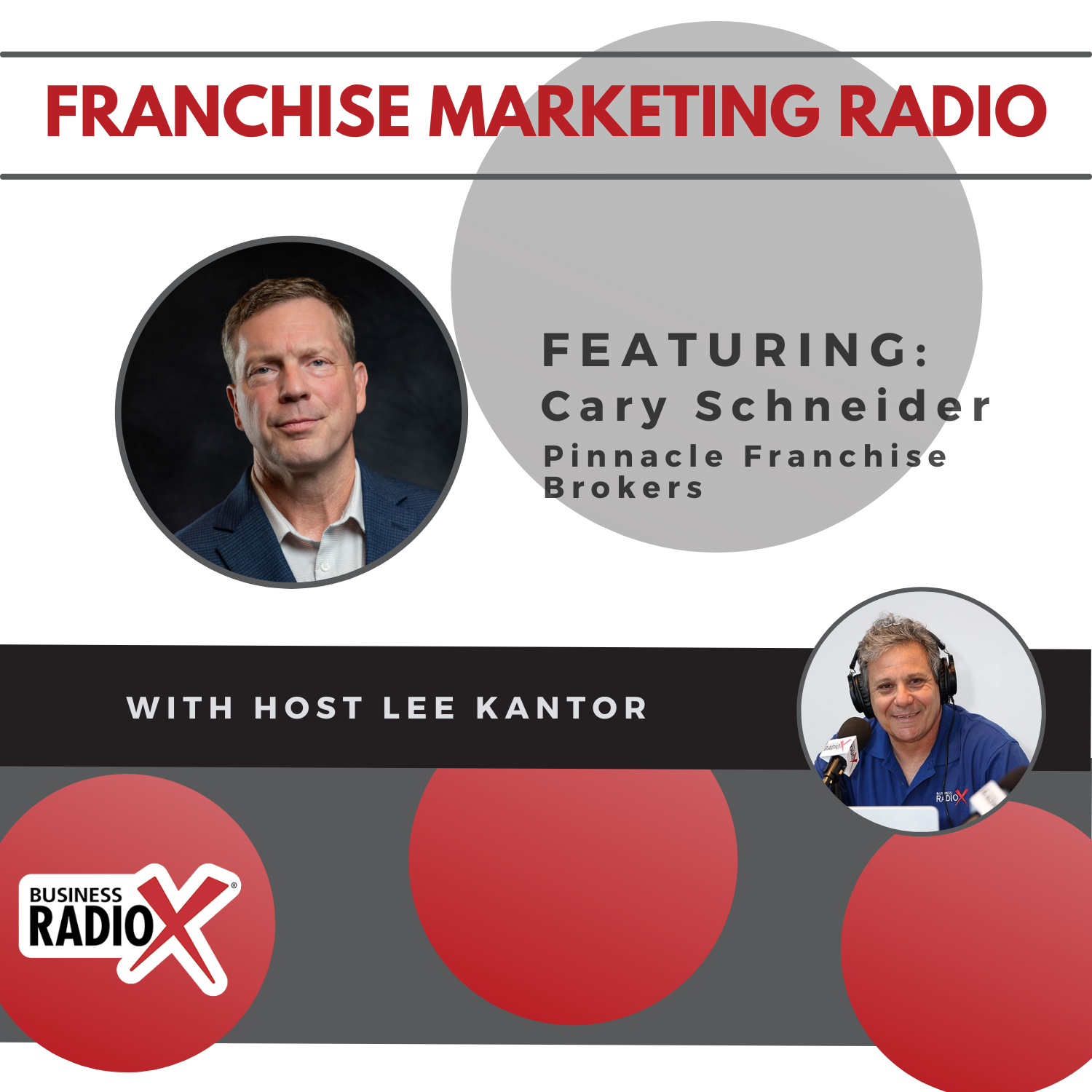

In this episode, Lee Kantor interviews Cary Schneider, franchise consultant and founder of Pinnacle Franchise Brokers. Cary shares how he helps corporate professionals explore business ownership and find franchise opportunities aligned with their financial goals, skills, and desired lifestyles. They discuss the evolving franchise industry, the realities of semi-absentee ownership, common misconceptions about franchising, and the importance of understanding the financial commitment and time required to build a successful business. Cary also explains his personalized approach to matching candidates with the right franchise model, the value of strategic planning, and how veterans and corporate professionals can leverage their experience to become successful franchise owners.

 Cary Schneider is the founder of Pinnacle Franchise Brokers, where he coaches aspiring entrepreneurs through the transition from corporate professional to business owner.
Having spent nearly 20 years in corporate leadership before spending another two decades founding, buying, and selling multiple companies, including operating as a franchisee, he deeply understands the W-2 mindset candidates are leaving behind and the operational reality they are walking into.
Since launching his brokerage in 2015, he has specialized in franchise due diligence, funding strategies, and aligning buyers with ownership models that fit their risk tolerance and lifestyle goals. He is a former Franchise Brokers Association (FBA) Advisory Board member and a recent recipient of the FBA Broker of the Year Silver Award and has been a Million Dollar Producer in multiple years.
A graduate of the University of Oregon with a background in Finance and Management, he resides in Bend, Oregon, where he serves as the elected Board Chair for the Bend Park & Recreation District.
Connect with Cary on LinkedIn.
What You’ll Learn In This Episode
- Understanding the transition from corporate employment to franchise ownership.
- Recognizing the realities and financial demands of semi-absentee franchise ownership.
- Exploring franchise opportunities beyond traditional food, fitness, and retail businesses.
- Identifying franchise models that align with personal strengths, financial goals, and lifestyle preferences.
- Understanding the importance of business model compatibility assessments and franchise ownership blueprints.
- Preparing for the financial commitment, business development, and ramp-up period of a new franchise.
- Leveraging corporate and military experience to build a successful franchise business.
- Taking proactive steps toward business ownership before reaching a career or financial crossroads.
 This transcript is machine transcribed by Sonix.
TRANSCRIPT
Intro: Coming to you live from the Business RadioX studio. It’s Franchise Marketing Radio.
Lee Kantor: Lee Kantor here. Another episode of Franchise Marketing Radio. And this is gonna be a good one. Today on the show, we have franchise consultant and founder of Pinnacle Franchise Brokers, Cary Schneider. Welcome.
Cary Schneider: Hey, Lee, thanks for having me.
Lee Kantor: Well, I’m excited to learn what you’re up to. Tell us about pinnacle. How are you serving folks?
Cary Schneider: Yeah, I founded Pinnacle Franchise Brokers back in 2015, basically to help people usually that are, uh, interested in leaving the corporate world, help them figure out what that next path may be with business ownership primarily in franchises. And, uh, did that because I was in that same boat many years ago after leaving the corporate world in 2007. So that was, uh, my goal was to help others maybe find a successful path for themselves as well.
Lee Kantor: So how have you seen kind of the role of a franchise broker evolve over the years since you’ve been involved in the industry for quite some time?
Cary Schneider: Yeah, I think, uh, economic winds, uh, whether favorable or unfavorable, have played a large part in that. Whether how people perceive their level of safety in the corporate world has definitely driven much of the interest in people reaching out to me. So that perception has played a part, uh, political environment as well, or just, you know, people identifying maybe what their best path is to control their future financially lifestyle wise as well. Also probably seeing an influx of people, you know, doing something similar to myself. I think this industry has grown over the years. When I started this back in 2015, it felt like there was maybe just a couple hundred people doing this. Now, I would say it’s probably tenfold or more of people interested in helping others, uh, you know, identify that right opportunity for themselves as well.
Lee Kantor: So has kind of the franchisee evolved as a different person, a franchisee that now than they were when you started?
Cary Schneider: I think to some degree, I see a lot more people interested and maybe trying to hold on to a W2 role and start a business, maybe in parallel. Uh, that may or may not be successful as far as what that may look like and what their expectations are. Or maybe more historically, I would often see people that are ready to, to make that full time commitment and move into business ownership. And so while I still get some of that, I get a lot more interest for people that want to stick with their corporate role. At least that’s their initial intention. When we start talking, whether or not they ultimately make that determination after they may be educated themselves a little bit is also to be determined.
Lee Kantor: Now, it’s funny you bring up this kind of corporate refugee. I was just at a, um, a party and my neighbor who has like a corporate job and a big company, uh, that people have heard of. He told me that he’s buying a franchise and not only buying a franchise, he’s buying like a five pack where, um, two of them are already operating. He’s taking over the whole, um, operation, but he wants that. He called it semi passive income. He wants to manage managers. Are you seeing those words kind of bandied about nowadays?
Cary Schneider: Yeah, absolutely. Uh, and there are definitely what all, you know, as you say semi absentee or passive opportunities. But it’s going to come. All things being equal, the larger investment right. You’re going to need more working capital to cover the the salary and the overhead of those managers. And so if you’re trying to keep your job, you’re basically eating into your own salary to subsidize others, running some of the day to day of your other operations. And it definitely requires, you know, leadership skill set that not everybody brings to be able to build a culture and drive a team. Uh, you know, in those other locations, if it’s a service based business, you might operate the equivalent of three, 4 or 5 locations, but just out of one location, just serving a larger market. And sometimes that’s more conducive for somebody versus, you know, literally trying to oversee two, three, 4 or 5 separate locations out of the gate, especially if it’s their first time as a business owner.
Lee Kantor: Now, as part of your role as kind of a coach consultant to help these people, uh, make the leap into the world of franchising, what are some of the kind of maybe myths that you have to dispel? Because I think a lot of times it sounds good, but they don’t realize what really happens on a day to day basis.
Cary Schneider: Yeah. Well, you definitely hit on one of them right there. You know, one is the myth to some degree of semi-passive ownership. And again, there is a group of opportunities that that makes sense for. But I would say a majority of franchises and just business ownership in general are going to dictate a full time commitment out of that gate to ramp that business up successfully. Or maybe you have a family member or a trusted key person that you might even give a little bit of equity to that might overcome that particular barrier. But for most people coming in expecting to be semi passive, either without a larger capital influx or without somebody in mind to that they can trust that can help them build that day to day is typically going to be unsuccessful. Um, the other thing I would say is just the ramp up period. Uh, you know, you, if you’re leaving a W2 role and you need to replace an income, we need to be strategic about ways that can realistically do that because businesses typically take time to ramp up before you’re going to hit that break even point. There are ways to offset that, and that’s part of the work we do together in determining what that funding structure and what that ownership structure may be to potentially allow you to take a W2 income from the start, even if the business isn’t necessarily generating the revenue to offset that initially.
Lee Kantor: So when you’re talking to somebody who has a corporate job and they’re exploring this and what is kind of the triggering event that gets them to reach out to you or somebody on your team is like, did they just get passed over for a promotion? Or the writing’s on the wall that, hey, there’s not a lot of 50 year olds in the business that I’m working in. Like, like, is something happening that is like a, hey, this is something I should be checking out.
Cary Schneider: Yeah, that’s a classic trigger is, you know, the frustration with their current work environment and maybe seeing that ceiling. Uh, coincidentally, I just had a conversation with a guy on Friday who in many ways has been very successful in the corporate world. Um, promotions and great income. But he also recognized he’s putting in 60 hours a week and building somebody else’s wealth. And so when they realized that that, uh, you know, they instead of doing that for somebody else, they could do that for themselves. That often is the trigger point. And so actually posted on LinkedIn about that just yesterday about that dynamic. But yeah, it’s usually somebody who’s come to some frustration or realization that that corporate role isn’t necessarily going to either provide them the financial security they’re looking for. And that could be income, but maybe more significantly, that long term wealth, uh, or maybe lifestyle, you know, they have kids or they have family and they’re missing events and they want an opportunity to build that allows them eventually that lifestyle flexibility to really meet those goals that they’re looking for with a family.
Lee Kantor: Now, are you seeing any folks that are like, you know what? Um, my kids kind of floating around a little bit and, um, maybe this is an opportunity for me to fund a future for my kid and stay involved and we work together. Is that something that’s happening in the industry?
Cary Schneider: It is. And I mean, there’s definitely, you know, the younger generations are a little disheartened with maybe what the traditional academic environment can be and the debt they’re picking up or, or maybe the the type of jobs available to them coming out of college. So I do sometimes see very qualified, you know, 20 something individuals with a degree that are might be partnering with a parent that might have the financial resources to help them get into a business for themselves that has that proven track record and that business model that they can come in and follow and execute a high level, their probability of success can be higher. Uh, not a majority of people I work with, but I definitely see that component where that parent might be the financial resources and might take, you know, somewhat of a passive role in the business as well. Initially when they’re really relying on the, on the, on the center daughter to operate the day to day.
Lee Kantor: Now, when you’re having initial conversations with somebody who maybe isn’t as familiar with franchising as you, when you tell them that there’s literally thousands and thousands of franchise brands and they cover, you know, hundreds of Industries. Is that something that’s like a, you got like the they’re kind of blown away because it’s not obvious a lot of times. And they think that, you know, if it’s not a fast food chain, then it’s not a franchise. But there’s lots of choices.
Cary Schneider: Yeah, exactly. You’re right. I mean, I would say majority of people I have an initial conversation with, they’re thinking food or fitness or maybe retail, something that they really, uh, attached to a franchise model. And so we start talking a little bit more granular. Maybe not the initial conversation, but usually by that second conversation about really some of the ownership traits that that they want to prioritize. So things like operational hours, size of staff, type of staff, the environment, is it a brick and mortar? Would they prefer to be home based? Uh, we talk about, you know, what are they passionate about? How do they want to spend their typical day? And that really starts to open their eyes to other industries that might be much more conducive to really what an ideal business ownership environment may look like. And usually I’ll tell them, hey, I understand. I want to respect your interest in maybe franchise X or Y that we initially started talking about, but I’m going to show you maybe a few wild cards that might really give you some awareness, some other other opportunities. It might be a much closer fit to your goals, whether it’s financially or a lifestyle. And so that’s part of the value add that hopefully myself and my team can bring to them as well.
Lee Kantor: Now, when you’re choosing which franchises to partner with, how do you go about that vetting process when you put together your portfolio of franchises that you represent?
Cary Schneider: Yeah, I’m fortunate to be a part of a couple of the franchise consultant broker associations here in the country that have already established relationships. A lot of franchisors. And so that’s usually where I’ll start. But I also take a lot of pride in not just limiting myself to that. And so I really let that candidate kind of guide what type of franchises we’re going to look at and doing this now for, for 12 years, I’ve, you know, of course, gained a lot of awareness of what’s out there, but I also carve out time each week to try to get, you know, familiar with some other opportunities that maybe I have not worked with in the past and again, really allow that candidates desired interest to drive what we are going to focus on. I’ll do some initial vetting of those opportunities and then bring those to them and let them prioritize, which they would like to first initially learn about.
Lee Kantor: So you don’t have, um, kind of a portfolio of brands that you represent. You’re, you, any brand that the person’s interested in might, you might be able to help them with.
Cary Schneider: Yeah. There are definitely a segment of franchisors out there that because of their size and scale and maybe their internal development teams won’t necessarily, um, honor a, an introduction from myself or others in this industry, but that’s probably a minority. Um, there are plenty I reach out to, to have that initial conversation to let them know I have a qualified candidate that may have an interest in your opportunity. And so I’ll check territory. And also whether or not that franchise oversees an interest in viability in that market. So yeah, while I do have franchise owners that I’ve got probably closer relationships through these associations that I’m a part of, I don’t feel limited by that as well.
Lee Kantor: So walk me through or walk a candidate through what it’s like to work with you or a franchise broker on your team. What what’s like? Is there an assessment? Like once there’s kind of a, hey, I’m interested in this, what’s the, what are the next few steps?
Cary Schneider: Yeah, I mean, initial conversations, usually just more of a get to know each other a little bit and understand kind of what their motivations are and tell them about our process. It’s usually the second call that we dig much deeper. And prior to that second call, I will send them an assessment that I would call kind of a business model compatibility assessment. And it takes about ten minutes. It’s very quick, but it’s going to give us some great objective insight into really what kind of business model they’re likely going to be most successful in. And then we’ll dig into the results of that in that second conversation. And we’ll start to talk more about some of those other business model ownership traits that I referenced earlier. And we build out what I call a franchise ownership blueprint out of that. And that also incorporates their financial requirements, what they need to get out of this business. But what also, of course, they can realistically put into it and we build that. And then we after that, I’ll start going to work and identifying opportunities that hopefully align with many of those criteria to bring back to them.
Cary Schneider: And then I’ll walk them through in that subsequent conversation, typically a large handful of opportunities and just give them a chance to prioritize which of those they’d like to learn about first, and then I’ll facilitate some introductions that come out of that, and then be alongside them as they go through more of that formal due diligence or discovery process. I think one of the things I also bring with that, Lee, is, you know, I mentioned my background. I spent 20 years in the corporate world myself. And so I can often relate to that. But I also grew up in franchising in the food space. And then I have started and by several businesses myself, many of those not franchisees. And so that allows me to provide some perspective and maybe some of the pros and cons of, hey, starting a business from scratch, or do you want to buy an existing business? Or what does a franchise model potentially bring to you and give them maybe more of a holistic understanding of the pros and cons of each of those paths?
Lee Kantor: Now, does franchising work for corporate folks that are in certain roles, like are certain jobs certain more conducive to being a successful franchise owner? Um, you know, rather than other kinds of jobs.
Cary Schneider: I would say, you know, a lot of franchisors prefer somebody that is comfortable, um, interacting with others and maybe with has experience in leading a team. And if there’s some sales acumen there, that’s also plus because as we kind of inferred earlier, there’s going to be a business development process typically as you launch that business. And that’s a critical role to fill. Um, but we can work around that. There are franchisers out there that do more of the heavy lifting on the the lead generation side or, um, you know, you can bring in somebody that might bring in that skill set. And so I work with people with a broad range of corporate backgrounds and honestly, skill sets. Um, and we try to identify franchisees that leverage those and then either allow the franchisor or maybe somebody that, that candidate brings on their team to fill some of those other roles that maybe isn’t a strength for them as well.
Lee Kantor: Now, um, let’s talk a little bit about kind of the business development side of this because like you said that that’s, uh, most, I’m sure most of the franchises that’s a nice to have for any of the candidates. How do you kind of help educate and help maybe coach up some of your candidates in terms of what it’s going to take from a business development? Immerse yourself in the community standpoint that maybe they haven’t done directly in their role in corporate.
Cary Schneider: Yeah, it’s a great question. And, and there are definitely a segment of franchisors where that franchisee needs to bring that skill set, or at least the desire to learn that skill set and get out there and be actively engaged in your community. And so we’re definitely looking for that. And that assessment that I referenced earlier helps us identify that. But we talk about the interest there. And if I work with somebody who one doesn’t bring that skill set and two maybe doesn’t have that inclination, then we’re focusing on a business model that maybe doesn’t require that business development component. So that might be more of a brick and mortar where there’s tremendous brand awareness. And so it’s all about location and national brand awareness, or maybe something that is more of a capital expense type of business, for example, vending or something else that doesn’t require more of that active business engagement. But generally, to your point, you know, every, every business franchise or not requires a marketing component and an effort. And it’s a matter of identifying which type of, um, type of effort is going to be required for that candidate to be successful in building that critical revenue stream.
Lee Kantor: Now, how long does it typically take for somebody to say, you know what? I’m I’m interested. I’m, I’m motivated to make this happen. And then, you know, an actual grand opening signs out there.
Cary Schneider: Yeah. Well, if it’s a brick and mortar, I mean, from signing to opening could be six, nine, 12, 18 months. Most of that is just driven by the ability to identify and secure a location. And then what is that condition, that location? How much build out is going to be required. So that goes a little bit into our efforts. If it’s somebody who needs cash flow quickly, you know, brick and mortar may not be the right fit. If it is more of a services based business where they’re operating out of maybe a small flex space, maybe a home based business from signing to opening could be 60 days, maybe 90 days really just depended on how quickly they can get through the onboarding and get that business ramped up. And in that situation, you know, your marketing is more driven by social media, SEO, pay per click, instead of waiting for that business location to be built out.
Lee Kantor: Now, are you like, what percentage are opening brick and mortar versus, um, kind of more of these, um, service based and not requiring a, you know, an actual office to go into in order to, to do the work.
Cary Schneider: Yeah, I would say probably 60 to 70% of the people I’m working with are going into more of a brick and mortar business. And that’s driven one just economically, much lower investment. All in all, things being equal, because you don’t have the significant expense of a lease in a build out. And then two, just the quicker ramp up period. And so to your to your earlier observation, those are often opportunities people are not initially aware of because they’re thinking food or fitness or retail and brick and mortar. And so once they recognize there’s an alternative that can cash flow faster, much lower investment, and maybe provide some greater lifestyle flexibility because they don’t have the retail hours and the weekends. Those often can be very attractive to those individuals.
Lee Kantor: And those tend to be service based in some way.
Cary Schneider: Yeah. Usually they’re serving a customer or a client at that customer’s home or business. And so they might be based out of a small flex space or maybe a nondescript commercial office building or potentially home based. And so they’re relying on, you know, SEO or pay per click or other marketing efforts to drive that awareness. And then often that potential customer or client is reaching out, maybe going through a franchise or call center to get something scheduled.
Lee Kantor: So is there a story you can share? Um, you know, don’t name the individual, but maybe share the challenge they came to you with and maybe they were nervous, or maybe they had low expectations and they kind of killed it and blew it out of the water. Is there kind of a story that you can share that kind of illustrates, you know, what a best case scenario could look like for somebody?
Cary Schneider: Yeah, yeah. I actually have had the privilege of working with recently retired military individual, younger gentleman, mid 30s, and he wanted to relocate. He was in San Diego at the time, wanted to relocate back closer to family in Texas. Really wasn’t sure what that looked like, but wanted to get back there and needed an income to really make that work. And so we went through that process and we kind of talked about it earlier. And ultimately, he got into a services based franchise, specifically a residential property management company, actually a subsidiary of the largest franchisor in North America. And, uh, we went through that process. He identified that type of business model is really a great fit for not only something he was passionate about, but also fit financially and also from a lifestyle perspective. So he opened up that business, uh, I believe in Tyler, Texas, uh, about a year ago and talk with him fairly recently, and he’s had some great success. And in building that business. And that’s a business that takes some time to ramp up because it’s very much relationship driven. You’ve got to get out there and meet these individuals that are looking to potentially have somebody manage their properties to preserve the value or hopefully appreciate in value. But that’s a great story, not only because of the status of of serving our country and to all of our benefits, but also really meeting his goal of getting a chance to be closer to family.
Lee Kantor: Yeah. Franchising offers a great opportunity for military folks. I mean, a lot of them offer special deals and, um, and what they learned in the training and development in the military transfers nicely to a lot of franchises.
Cary Schneider: Agreed. I mean, they’ve already learned the benefit of following a proven system. And so they often, um, you know, will really embrace that with a franchise model. And to your point, franchisors recognize that as well. And so they are often looking for people with that background and will incentivize him financially in other ways to bring them in, and they often get a chance to work with a lot of other veterans as part of that franchise. And so that, you know, that community and that collaboration is there for them as well.
Lee Kantor: Now, any advice for that corporate person? Um, that’s about to take the leap. Is there advice along the lines of what should be kind of a realistic expectation of, you know, making money, breaking even maybe some of the money side of things? Um, any advice along those lines?
Cary Schneider: Yeah. I mean, the first thing I always, you know, try to get out there is don’t wait until you’re in a desperate mode because then that financial part really becomes important and starts to limit your options if you have to, you know, cash flow in the next 30 to 60 days, that’s probably not realistic. So, you know, once recognizing that maybe there’s an alternative path to that corporate role is when is the best time to start your, you know, assessment of, of what you want to do. And so the sooner that we can get together to start having those conversations. The greater the opportunities will be, but with long. With that said, there are ways, as I mentioned a little bit earlier, that we might be able to structure the funding, one that may minimize your out of pocket contribution. Uh, when I first left the corporate world, I used what’s called a robs short for rollover business startup and basically use some of my 401 K from that job to invest and buy stock in my own company. And basically out of that to my investment portfolio, that allowed me to do a couple things. One, it allowed me to reduce my out of pocket traditional cash investment in my business. But two, it also allowed me to be a W2 employee of my new company and take a salary from day one. And so there are ways to be strategic and effective of, of taking a salary to cover those personal expenses. But it takes that strategic planning to do that. And so, you know, the more proactive an individual is of starting to identify and educate themselves on what’s out there, the better. And then, you know, to your point, just being realistic about what is that income look like, recognizing that it’s probably your best benefit to reinvest in that business as much as you can those first couple years for bigger, brighter days ahead.
Lee Kantor: So if somebody wants to learn more, have a more substantive conversation with you or somebody on the team, what’s the website? What’s the best way to connect?
Cary Schneider: Yeah, definitely. A website is great pinnaclefranchisebrokers.com is a good way to catch me or also I’m active on LinkedIn if they want to search for me there or just Cary-Schneider on LinkedIn. And those are the ways that typically most people find me.
Lee Kantor: Well, Carrie, thank you so much for sharing your story today, doing such important work. And we appreciate you.
Cary Schneider: Yeah. Thank you. Lee. I appreciate you having me.
Lee Kantor: All right. This Lee Kantor we’ll see you all next time on Franchise Marketing Radio.