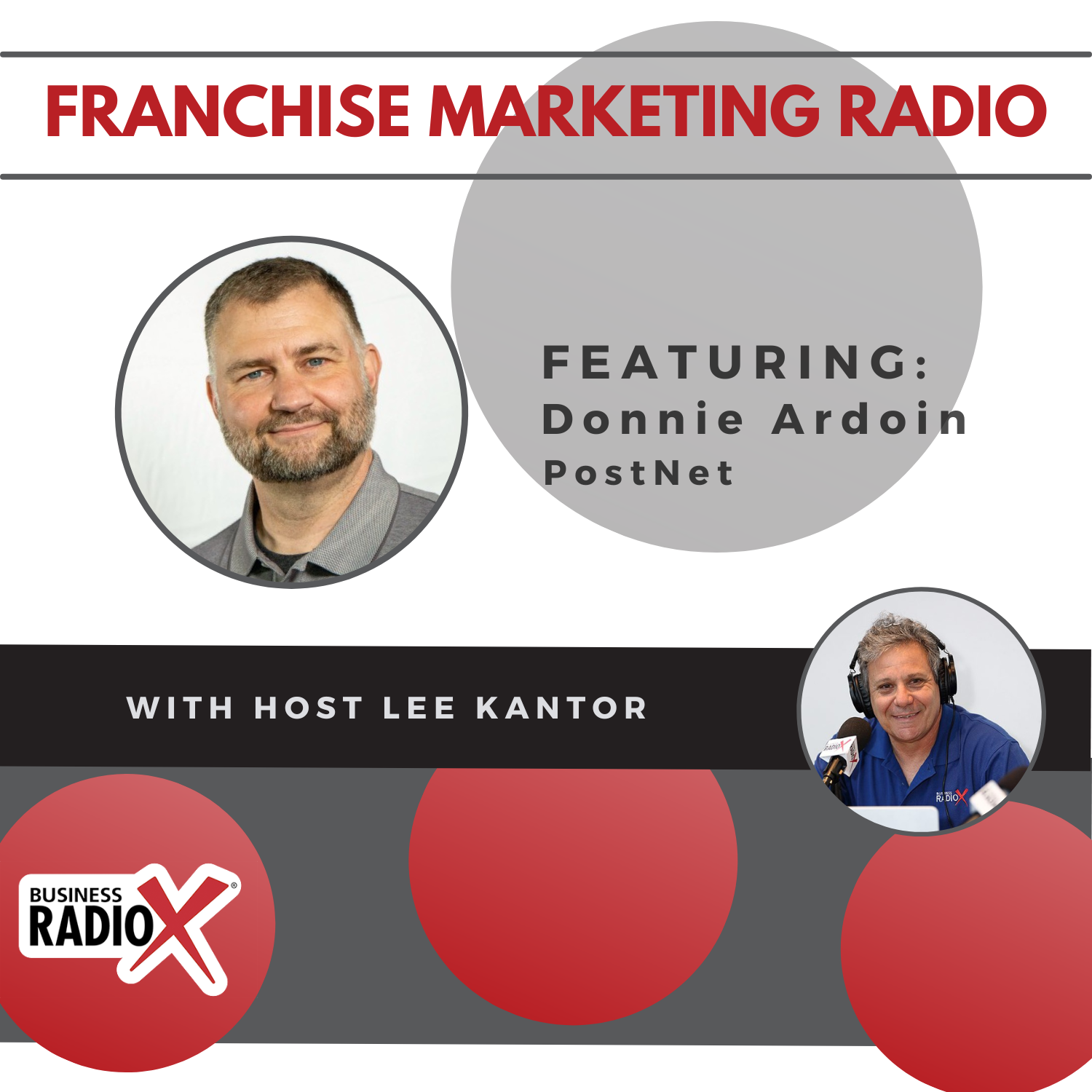

In this episode of Franchise Marketing Radio, Lee Kantor interviews Donnie Ardoin, owner of PostNet in Lafayette, Louisiana. Donnie shares his transition from a 20-year career in the oil and gas industry to becoming a franchise owner. He discusses the importance of networking, community engagement, franchise support, and building strong business relationships. Donnie also offers practical insights into what it takes to succeed as a franchisee and why investing in yourself can be one of the most rewarding career decisions.

 Donnie Ardoin is the owner of PostNet in Lafayette, Louisiana, where he helps businesses and individuals with printing, design, shipping, and marketing solutions. Before becoming a franchise owner, he spent more than 20 years working in procurement and management roles within the oil and gas industry.
Seeking greater control over his future and the opportunity to build something of his own, he transitioned into franchising with PostNet in 2021.
Together with his wife, he has grown the business through community involvement, strong customer relationships, and a commitment to delivering exceptional service.
He is also an active member of PostNet’s Franchisee Advisory Council, where he collaborates with fellow franchise owners to share best practices and support system-wide success.
Connect with Donnie on LinkedIn and follow PostNet on Facebook.
What You’ll Learn In This Episode
- Evaluating franchise ownership as a path to career independence.
- Transitioning from a corporate career into entrepreneurship.
- Leveraging franchise systems and support to accelerate business growth.
- Building strong community connections through networking and relationship-building.
- Creating long-term success through consistent owner involvement.
- Developing strategic partnerships that generate new business opportunities.
- Understanding the value of collaboration over competition in local markets.
- Growing a business through exceptional customer service and word-of-mouth referrals.
 This transcript is machine transcribed by Sonix.
TRANSCRIPT
Intro: Coming to you live from the Business RadioX studio. It’s Franchise Marketing Radio.
Lee Kantor: Lee Kantor here. Another episode of Franchise Marketing Radio and this is going to be a good one. Today on the show, we have the owner of a PostNet in Lafayette, Louisiana, Donnie Ardoin. Thank you for being here, Donnie.
Donnie Ardoin: Hey. Thank you. You know, you did good with the name that time. That was great.
Lee Kantor: Look, practice makes perfect. Um.
Donnie Ardoin: You got it right.
Lee Kantor: Well, tell us a little bit about your backstory. How long you been with PostNet?
Donnie Ardoin: Uh, we just made five years on the. We actually. So we signed our franchise agreement in February of 21. We opened soft opening June 16th of 21. So that was, you know, about ten days ago, we made five years that we actually opened. So five years basically.
Lee Kantor: So for folks who were listening out there who are considering becoming a franchisee like you did, can you talk us through kind of the thought process because you worked not in this area for your career, right?
Donnie Ardoin: Oh no sir. No. So I spent 20 years in the oil field, as a lot of people do down here in South Louisiana. You just naturally, you try to avoid it, but you somehow you end up in the oil field anyway. So out of college, that’s kind of where I ended up. And I spent 20 years in procurement in the oil field. So, you know, that’s where I started.
Lee Kantor: So then you’re in the oil fields and then are you laid off or you make a decision that, hey, I want to, you know, kind of change gears here. Like what was kind of the impetus that got you at least considering a franchise at that point?
Donnie Ardoin: Yeah. So, you know, the oil field is one of those things where it it’s good. It’s good. When it’s bad, it’s bad. It’s very volatile, very up and down. So when everything times get hard, you always start worrying. All right. You know, is is, is am I going to be out of this thing and before I’m ready. And so you kind of think about different things. Um, nothing very serious during that 20 years that I thought about, but I would read articles and things like that. And, and one of those articles that pops up is, you know, the best franchises. I think Forbes puts that list out. And the UPS store is usually right up there in the top five as a, you know, a franchise to, to be part of. And we actually had not one far one not too far from our office. And I’d go in there all the time is always busy. And the people didn’t look like they were pulling their hair out, you know, so it was, it seemed like it was pretty interesting deal. And so I, you know, just kind of when you’re goofing off and surfing the web, you kind of look at those things. And there was never a franchise here available in Lafayette to the UPS store. So I never gave it a whole lot of thought. Well, um, you know, you fast forward to Covid And a lot of things happened. A lot of people got laid off and things like that. Um, I was actually, uh, in corporate management.
Donnie Ardoin: Um, you know, I was part of a ten person team, uh, for a fairly large oilfield company. And, um, they, you know, when times got hard, they just started cutting, you know, and they went through most of the management team and let them go. Uh, for me personally, they actually furloughed me to part time. Um, basically they were handing out, uh, unemployment to anybody and everybody during Covid just to, you know, to keep the economy going. And, you know, it was suggested to me that I go and collect unemployment for part time and work part time. Um, but I, you know, for 20 years, I never, or plus 20 years because I worked during college as well. I never collected unemployment and I had no desire to start now. So I went and, uh, just kind of asked around and found another job, uh, in sales, um, with a security company. Um, and I worked there for a year. Um, just kind of trying to figure out what what I wanted to do next. Uh, I didn’t really feel like doing inside sales was something I really wanted to do. It was just kind of confining for me. And so I enjoyed talking with people. And unfortunately, you know, when you visit with people and talk with people, it doesn’t always translate to sales. So it was a, it was a, it was a, it wasn’t my thing. I don’t think so. Uh, I dive back into this, you know, just kind of poking around with franchisees, our franchisees.
Donnie Ardoin: Excuse me. Uh, I had a friend of mine who I worked with in, um, for 20, 20 years at my old company and he had actually gotten laid off and we kept in touch. And one day he called and just asked if I had ever looked at franchises. And I told him the story about the UPS store and, you know, and other things. And he said, look, I said, I’ve been looking too. And he said, here’s a broker. Give him a call. And, uh, you know, he’ll kind of gauge your interest, your experience, and, uh, help you find a match. And so I said, all right, I’ll do it. So I figured there was nothing to lose here. So I called him and we chatted for a little bit. And, uh, you know, about a week or so later, he came back with probably five different options of things. Um, and, uh, post that was on that list. And, uh, because I had already looked and just kind of fantasized, I guess about the UPS store, uh, this was most appealing. And, uh, you know, my wife was on board and it’s something that we could do together. Um, you know, we wanted something we could both do because she actually, um, was working part time and still does actually work part time for a nonprofit. So she had some time that she could put toward, you know, another venture. And so this is where we ended up. Um.
Lee Kantor: So tell us kind of what was your thinking like? Were you going in? I know you had the UPS store kind of in the back of your mind, but were you was like everything on the table? Were you like, okay, let me see a yogurt shop. You know, a burger place. Like what? What was kind of your first thought? Because franchising, there’s a million franchises in a million different areas.
Donnie Ardoin: Yeah. No, I mean, I really had no idea it was that was the only one I considered was the UPS store. Um, that’s why I reached out to the broker and he was really good. I mean, he asked, you know, what, what have you done before? What are you interested in? And we went through everything. And he, he proposed some interesting things. Um, but as I kind of laid them out and I said, this one, this one, this one, you know, and, and looked at all of the things they did. None of them really said, no, I want to do that long term. That’s something I want to do. Um, for the, you know, the rest of my life, hopefully, you know, that’s not, that’s not something I want to do and post it. And there was, there was another one that came up, but, uh, those two were the only ones that really I saw myself doing, um, and posting it. I didn’t know exactly what I was getting into. And it was, it’s definitely different from what I had first thought, but even had I known that, I probably still would have landed here.
Lee Kantor: Now, when you were deciding, were you thinking, okay, I’m going to get one and then I’m going to get another one and I’m going to build. I’m going to be Donny the Empire builder in my area. Like, like what were you looking at? Or were you thinking, okay, this is going to be, I don’t want to say you were buying a job, but you were saying, okay, I’m going to really immerse myself in the community and I’m going to be the go to resource for this here where I live.
Donnie Ardoin: No, I actually did not see the Empire for sure. And then I’m definitely not there anyway. Um, no, I just something I can work with people and, and do something I enjoyed doing, uh, rather than, uh, a job, you know, and, you know, that does come up with people. You, you just did you just buy a job? Well, no, a job is something you don’t really enjoy and, you know, don’t have any interest in doing. You just do it to put food on the table. You know, uh, this is more something that I didn’t mind waking up to do every day. Um, you know, something that was my own and an investment in myself, I guess. You know, so it was definitely different from that. Um, I never saw it as a oh, okay. This is how I’m gonna get rich. You know, it. It’s just more or less, um, we have to work. So I wanted to do something that I enjoyed doing. And, you know, I was hoping I was picking something that, that met that need. You know, and fill that void. So, um, no, I guess it was neither one of those. It was not buying a job and it definitely wasn’t building an empire. I mean, of course, if it, if it gets to that and, you know, you know, so be it. But no, it was literally just I, I’m, I’m pretty content, you know, um, doing what I do.
Lee Kantor: Now when you, when you, uh, chose PostNet were you thinking, okay, I’m going to be an owner operator. This is going to be me. I’m going to go in every day. You weren’t looking to kind of No delegate and find a manager. And, um, you wanted to kind of immerse yourself in this world and do and be there.
Donnie Ardoin: You know, franchisees and, um, you know, the PostNet will send them to me just to kind of so they can get some validation. And, you know, I tell them, be prepared to work. I mean, you know, and that’s just from my own experience, um, I, I don’t ever do anything without, um, committing to it. You know, I, I don’t make a commitment with not knowing that I can put everything I have into it. Um, if I can’t do that, then I tend not to do it. Um, and that’s just my personality. Uh, I tell everybody this is kind of like your first child. Um, this, you know, this, this, uh, store is more like my first child. Uh, you hold it like a hand grenade. You know, you you don’t trust anybody with it right off. You know, it takes time to, to ease into that where you’re willing to let go and, and let somebody care for it like you do. Um, so I fully planned to be involved and to do this myself. And, um, you know, I’m not close to the idea of, you know, eventually turning it over, uh, to someone I trust. But, you know, I understand that’s going to take time. And, uh, it’s hard to find somebody that treats it like you do.
Lee Kantor: So what has it been like working with your wife?
Donnie Ardoin: Um, you might have to ask her that. Uh, um, no, for me, it’s not bad. I mean, um, I’m probably harder to work with than she is. Um, but the, the good thing is that, um, we both have our strengths. And I tell everybody this, you know, it really worked out for us. Um, I have a marketing degree, which for 20 years I didn’t use, but I do have a marketing degree. I also have a computer science degree. Um, so I kind of feel those two parts of our business. I’m the one who’ll do things like this. I’m the one who’ll go out and do marketing and networking events and, um, you know, and post ads and things on Facebook and, and come up with, you know, different, uh, design and stuff for marketing people. Um, when we do our graphic design here. Um, and of course, with my computer science degree, I run a lot of the equipment. Um, I do the design work and everything like that. Um, she is an accountant. She does, she has an accounting degree, so she handles a lot of the numbers. She definitely does all the accounting bookkeeping. That is not my thing at all. Um, but she also because she is so good at that, she is very good at things that require patience. So when we have hand work to do, um, sorting, uh, you know, cutting things, assembling, you know, different, uh, like booklets and things like that. She is very good at that. Whereas my patience run short on it. So we both really, really complement each other well. So, um, I know that’s not the case for everyone, uh, but for us it really works. Well, um, we have found that um we have had employees in the past, but we worked so well together. We’re far more efficient, just the two of us, than having a third person in the mix sometimes.
Lee Kantor: Now how has it been working with PostNet? Does, did they, um, are they kind of meeting your expectations in terms of the support that you need in order to be an effective leader in your store?
Donnie Ardoin: Um, I definitely could not be, um, as successful as I have been without them. You know, it’s kind of funny. I was thinking about that this morning. Um, you know, I am one of those stores we, we do well enough to where they kind of hands off with me for the most part, unless I need something because I, you know, I do what I’m supposed to do as far as the franchise goes, but I’m capable of figuring things out on my own and everything now. Um, so they don’t, they don’t get too involved in it at this point, but starting out, I had no idea how this business was run. Um, I knew no one who knew how this business was run. So without posting it, there’s no way I would be able to do what I do now. Or maybe I could, but it would have been a much harder road, uh, to do that. And I mean, anybody will tell you, you know, when you open up a business, um, you know, the first couple years are the hardest and, uh, having PostNet there to help me and to advise me, um, absolutely made that, that a lot easier. I can’t imagine having to go through those first couple years without having that support. So, um, at this point, um, you know, I’m, I’m comfortable and, you know, I get more value now from PostNet in the other owners, the, the people like me that can relate to me and that, you know, I can network with and I love that part of it now more so, um, that I’m kind of self-sufficient on the, you know, on the, on the basics. So, um, you know, it’s kind of evolved over time, but definitely it has helped me in more ways than one.
Lee Kantor: So talk about how you interact with other PostNet folks around the country. Is that, do you, are there a handful that you kind of, um, I don’t want to say rely on, but, you know, you kind of support each other. Like if you have a question, you go to somebody in particular or they can come to you with a question. Is it very collaborative in that regard because you’re not really competing with you each other when you’re in different states?
Donnie Ardoin: To. Encourage to do when you sign up is to, to reach out to owners, uh, and get their feedback, just kind of get their experience. Um, and, and people do that. Of course you want to have an owner and owner brag or anything. Certainly not the case. But, um, I like to talk and I, you know, I like to relay, you know, uh, my experience with people. So they do send a lot of potential owners to me. Um, so when I talk to them about this stuff and I and I make that point, uh, there have been others who have reached out to other owners who are not quite as accommodating to those things. Uh, and I tell them when I was looking, I found the people or, and when I, when I was looking in both, when I started, I gravitated more to the successful owners, the ones who were putting up numbers, the ones who were doing really well and who were open to sharing their experience. And usually the ones who were open to sharing their experience, um, were more successful. So I tend to gravitate toward those people because I knew I could learn more from them.
Donnie Ardoin: Um, and so I have naturally have that network. And so when I do need something, I can reach out to one of them and say, hey, how do you handle this? Or, or, you know, what would you do here? Um, and I, I encourage other owners who are just getting started to do the same thing for me, you know, to reach out to me as well to learn. Um, but now, uh, there, there is a, a large group of owners who are like me, who are open to, you know, answering questions and helping and, um, definitely not competing against each other. Um, I am actually part of the franchisee advisory council, which I think pretty much every franchise has. And so I get to network even more. So I was asked to join it and I was happy to join it because it gave me that opportunity to work with the, the franchisees who were, uh, in that group who were successful and who I could learn from. Um, you know, I wanted to help my own, my fellow owners, but I also wanted to learn from the more successful owners out there.
Lee Kantor: So do you have any advice for that new franchisee? How do you kind of launch and jumpstart a brand in a local market where you hadn’t, you know, really been, I guess that plugged in before? You know, how do you kind of create that escape velocity? You need to be thought of as kind of the go to resource for the community?
Donnie Ardoin: Um, you definitely need to take every opportunity to, to attend networking, anything that can get you in front of people and, and, you know, and people, leaders in the community and other business owners more than anything, um, that’s where you want to be. And of course, that does vary by the business. Not all businesses are like that. Some are very specific to who they tailor to, um, posting that fortunately we can help everyone. So getting out and meeting any and everyone I could was important. Um, I went when we first opened, I hit every business around here. I went and visited to introduce myself, said who we were, where we were, what we did, you know, all those things. And, uh, first, one of the first things I did was join the Chamber of Commerce. Um, and whenever they had an event, I went, uh, you know, the first couple years are a little slower, you know, so you have a lot of downtime. So I used every minute of that downtime to go and meet people, network with people. Um, you know, that that was, that’s always the advice I give everyone, uh, even if there is a post and people already know what post that is near, you still go out and, and, and take every opportunity, even join BNI groups, just any and everything where you can meet people. And if you’re not the person who likes to go and talk to people and, and you know, and be open to, to that experience, find someone who will, because it’s absolutely critical to, uh, getting through those first couple of years for sure.
Lee Kantor: Now, have you found that your business, um, is kind of geared towards a certain group? Like, do you get most of your work from small to midsize business owners, individuals? Like who is that ideal, uh, client profile for PostNet in your market?
Donnie Ardoin: Um, so this is always kind of funny. And I tell everyone, um, my biggest customer was someone I thought was a competitor. Um, it, uh, I in my time as a purchasing manager, um, one of the things we bought a lot of was uniforms in the oil field and my uniform company, they also do signage and, uh, you know, and other business print, they do all of those things. And so when I opened here, of course I wanted shirts with my logo on them. So that was the first place I knew that was the only place I knew because I’d done business with them for so long. So I, you know, I went to them when I needed uniform shirts. And, you know, of course they made shirts, but while I was there, of course, again, you know, when you first opening, it’s slow. And so you take every opportunity to network. So I sat and visited with their graphic designer, um, you know, and we spent about 30 minutes just kind of discussing things and what PostNet was and what we did. And, um, lo and behold, probably a month or two later, um, this company, you know, they were in a bind and they needed business cards and they needed them pretty quick. And so he suggested they call me and they did. And so I, you know, offered them a wholesale rate, uh, on, on print. And, you know, I made them business cards. And then that order turned into another one and turned into another one, turned another one. And at this point, they’re my biggest customer.
Donnie Ardoin: Um, of course, like I said, we do shirts now. I can do my own shirts and, uh, we can do signs like they do. Um, but for the small print items, I’m their go to for the most part. So, um, yeah, that, that, that is my, oddly, that is my biggest customer and I have several of those now, uh, I’m right across the street from a fast signs. Um, fast signs of course make signs just like we do, but um, I’m friends with the owner. Um, you know, he’ll send work to me. I send work to him. We work together on things. He’s definitely not one of my top customers, but he is a customer and a good one too. Um, but in this market, I can literally help anyone. Obviously, I think B2B is a little more. Lucrative for me. Um, it’s a little easier, uh, than working with individuals, but, um, you know, I’ve, I’ve told people before, it doesn’t matter to me. Um, if an individual comes and it’s a small $20 project, I will still help you the way I would if it was a $2,000 project. Um, because I know that word of mouth goes a long way. Um, recommendations and referrals go a long way. And, um, I, I still feel that’s as important as the day I open. So, uh, I treat them all the same. Um, of course I, if I have a choice, B2B is the way to go. Um, like I do, you know, for the most part now, but B2C works too.
Lee Kantor: And that’s a great lesson for our listeners to cast a wide net. Don’t kind of make a judgment of who’s the right fit. Until you have a conversation, get to know the person because you never know. Like you said, a person that might on paper look like a competitor might be a customer. You know you’re going to do some elements differently than they can and you can do it, you know, faster, cheaper, better than they can. So don’t assume that somebody isn’t the right fit without having a conversation first.
Donnie Ardoin: Yeah. Never, never assume that they’re hostile either. You know, assume that they’re open to the, you know, the collaboration as well. Because, um, I mean, obviously I’m not going to go in and work with, you know, an Office Depot or something like that, you know, but, you know, the people I do work a lot with, they’re people just like me. They’re small business owners and they’re trying to make it. And we’re fighting the battle against the, you know, the big dogs. And so anything we can work together on, uh, you know, helps us both.
Lee Kantor: Yeah. And that’s, that’s so important to, I think a lot of times business owners forget about kind of the humanity of the work. You know, you’re human beings interacting with other human beings. And if you can get down to that level and have conversations and meet each other and try to collaborate together, uh, you’re going to be okay. You know, you don’t have to, um, automate everything and, and, and get rid of the humanity behind, uh, working, especially in smaller markets. I mean, those are your neighbors and friends and you don’t know who, who they know. Um, and, and word of mouth is critical.
Donnie Ardoin: Absolutely.
Lee Kantor: So what do you need more of? How can we help you?
Donnie Ardoin: I need more business. I always say that. Um, no, I mean, you know, I, uh, I just I’m happy to help anybody who’s, you know, thinking about this and, um, I don’t usually try to ask for anything. And, you know, I can’t think of anything that I need. Um, but I, I, actually get a lot more out of just helping people make that decision. And it’s not for everyone. Um, I tell everybody who’s potentially looking at a franchise or any kind of their own business, you know, you do it in scratch or you do a franchise, be prepared to work. I mean, um, you, it goes a lot farther when you put yourself into it. Um, uh, you know, I can’t recommend that anybody just hire somebody and expect that it’s going to do as well as if you did it yourself.
Lee Kantor: Yeah. I agree 100%. I mean, no one’s gonna kind of love your business more than you, so you better choose wisely when you’re adding a team member.
Donnie Ardoin: Yep. That’s why I’m still here. I’m still I’m still taking care of that baby.
Lee Kantor: So if somebody wants to connect with you, what’s the best way to do that? Is there a PostNet website that they can find you in Lafayette? Um, what is, uh, do you are you on LinkedIn? Like, what’s the best way to connect?
Donnie Ardoin: I’m on all of them. I mean, you can find us on Facebook. You can find us on Instagram and LinkedIn. Those are the three big ones. Uh, of course we’re on the PostNet website as well. Um, we are PostNet LA 103. Um, that is our store number. And usually if you search PostNet LA 103 will pop up. Um, any of those is a good way. Email also works. Um, where la103@postnet.com. So um, yeah, know any of those, those ways? Um, of course, if you, if you need help with print, then la103@postnet.com is the way to go. That’s the fastest and easiest way.
Lee Kantor: Well, Donnie, thank you so much for sharing your story today. You’re doing such important work and we appreciate you.
Donnie Ardoin: No thank you man.
Lee Kantor: All right. This is Lee Kantor. We’ll see you all next time on Franchise Marketing Radio.















