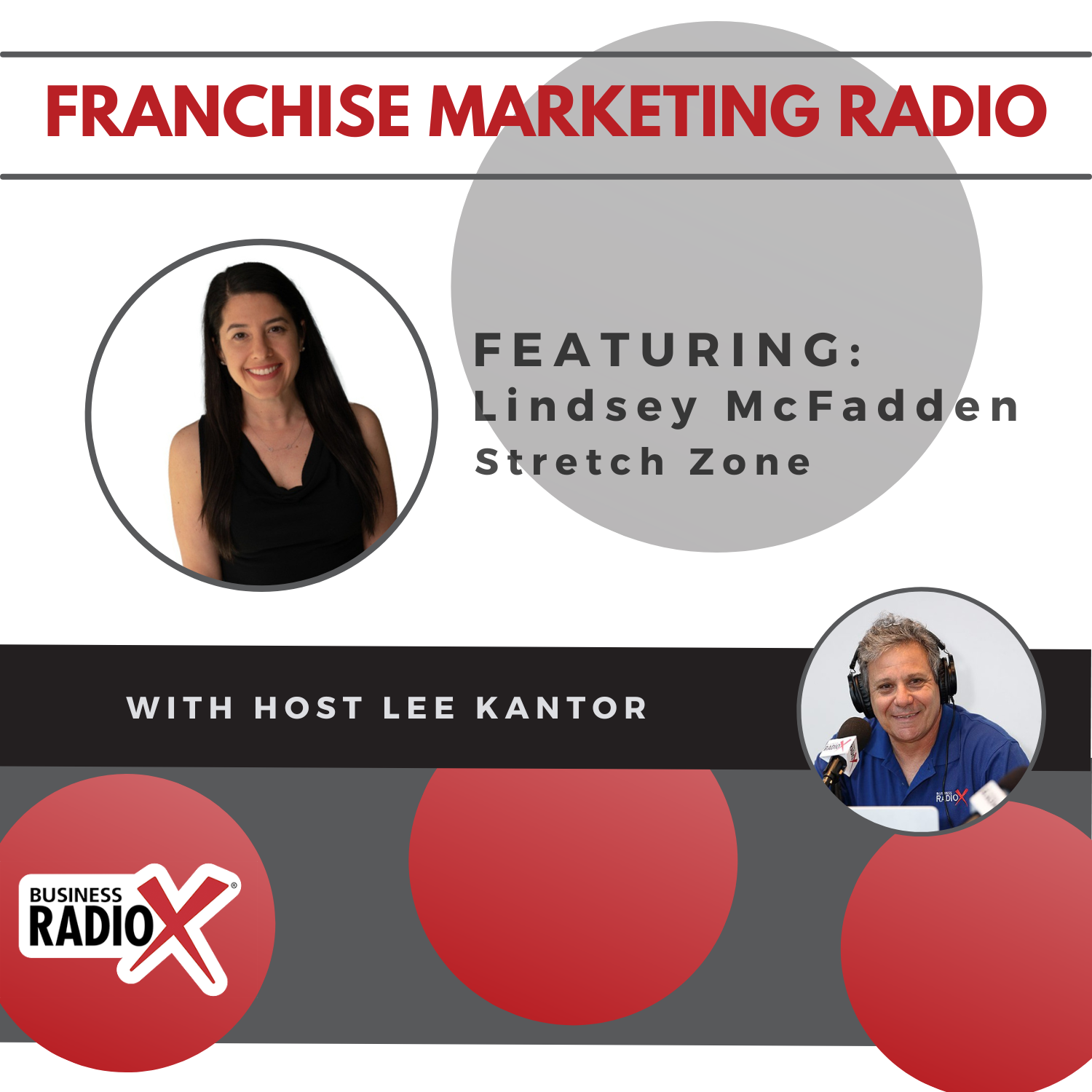

In this episode of Franchise Marketing Radio, Lee Kantor interviews Lindsey McFadden, Chief Marketing Officer of Stretch Zone. Lindsey shares the origins and growth of Stretch Zone, a franchise specializing in practitioner-assisted stretching. She discusses their unique approach to stretching, inclusive client base, and the ideal franchisee profile. The conversation highlights Stretch Zone’s collaborative franchisee support, grassroots and digital marketing strategies, and commitment to community engagement. Lindsey also outlines future plans focused on operational basics and franchisee empowerment, emphasizing the importance of relationship-driven business practices for long-term success.

 Lindsey McFadden currently serves as Chief Marketing Officer (CMO) at Stretch Zone.
In this role, she leads the company’s marketing operations: overseeing advertising, branding, public relations, corporate communications, and support for franchisees.
Connect with Linda on LinkedIn.
What You’ll Learn In This Episode
- Origins and founding story of Stretch Zone
- Unique approach to practitioner-assisted stretching services
- Target customer demographics and client benefits
- Marketing strategies and community engagement efforts
- Franchisee support and ideal franchisee profile
- Growth plans and operational strategies for 2025
- Importance of relationship-building in franchise operations
- Balancing digital marketing with in-person outreach
- Collaborative dynamics between corporate and franchisees
- Educational resources and tools for franchisee success
 This transcript is machine transcribed by Sonix.
TRANSCRIPT
Intro: Coming to you live from the Business RadioX studio. It’s Franchise Marketing Radio.
Lee Kantor: Lee Kantor here. Another episode of Franchise Marketing Radio. And this is gonna be a good one. Today on the show, we have the Chief Marketing Officer with Stretch Zone, Lindsey McFadden. Welcome.
Lindsey McFadden: Thank you so much for having me. Good to be here.
Lee Kantor: Well, I am so excited to learn what you’re up to. For folks who aren’t familiar, share a little bit about Stretch Zone. How you serving folks?
Lindsey McFadden: Absolutely. So Stretch Zone is a franchise network of practitioner assisted stretch studios where we do all the work and you get all the benefits. That’s kind of our unofficial tagline. So. So what we do is one thing and one thing only, and we professionally stretch people. We have a proprietary protocol in series of stretches that we do, and we have a patented strapping system that is affixed to our tables to make sure that you’re properly positioned, stabilized, and isolated, to really get the most of the stretch, and also to ensure that you are safe and secure. And so all of our sessions are 30 minutes and they are one on one. Think like personal training where one of our certified and trained practitioners guides you through a series of stretches to to address whatever your needs are. You know, people that come to us sometimes perhaps have sciatica pain or lower back issues. Others are athletes, you know that just use stretching as part of their recovery and really everywhere in between. So that’s kind of who we are and what we do. We just hit 413 locations open across 41 states.
Lee Kantor: So what was the genesis of the idea? How did this kind of launch?
Lindsey McFadden: Sure. So our founder, Jordan Gold, his grandfather, his Pop-Pop, is kind of the why behind stretch zone. So his grandfather was suffering from loss of mobility due to side effects of diabetes, and a personal trainer and kind of therapist by trade, he said, you know, I’m going to start stretching him every day and see if I can get him some quality of life back. And that’s kind of how Stretch Zone was born. And so he started that. But it was really a one on one business for about ten years. And he just had clients and would travel the world stretching people. And then in kind of 2014 ish, it became a business. And then in 2017, we began franchising, and all of the early growth was was really organic and authentic because of the impact stretch zone was having on people’s lives. It really spread like, like wildfire solely through word of mouth. And that’s really the genesis of Stretch Zone and how we started our growth story.
Lee Kantor: So at some point it just transitioned to stretching. Only that was the only kind of protocol that was being offered.
Lindsey McFadden: Correct. So, you know, kind of Jordan’s theory behind stretch zone is that you can’t overstretch a muscle. Right. Think of it like a seat belt. When you slowly pull out your seat belt to get buckled in, it’s loose and it’s easy and it’s fluid. If you jerk your seatbelt, it’ll recoil right? And tense up. Muscles are very similar, so instead of trying to elongate or lengthen the muscles, our theory for stretching is that we really work to reeducate your your nervous system and your stretch tolerance so that over time with our protocols you’re more flexible, but it’s really adjusting your stretch tolerance and your reflex than it is stretching your muscles.
Lee Kantor: And at the beginning, it sounds like the first, uh, kind of person to use it was just a regular person. It wasn’t a professional athlete. They were using it to kind of help with a medical concern.
Lindsey McFadden: Right.
Lee Kantor: So is that kind of the lens that you look at it through, like the the client can be anybody That’s right.
Lindsey McFadden: We say our geographic base is is really everybody anybody can benefit from stretching. You know, if you talk to your doctor or a physical therapist or personal trainer or really anybody, everybody knows that stretching is beneficial for your body. And so we say we have a limitless demographic. You know, we stretch everybody over the age of 14. Um, and we do not stretch pregnant women, but otherwise, really we see people. I think our oldest, um, member we had was 104. Uh, so, so really, everybody comes to stretch zone.
Lee Kantor: Now, when you’re trying to attract somebody who maybe isn’t athletic or considers themselves into fitness but leads a sedentary life, how do you kind of even find those people in a local market and introduce just the concept of stretching, and that they might see benefit?
Lindsey McFadden: Yeah, I think that what we’re seeing, though, you know, here in America in general, is such a shift towards wellness culture. Right? There’s just so much more of an awareness of alternative, I alternative, I think wellness avenues that ten years ago didn’t exist. So when people are looking for, um, for solutions to problems, right, whether they’re just googling something or through word of mouth stretching really is so much more common today as an actual vertical in the space than it was, you know, even just a few years ago. So I think, you know, we try to lead by, by telling the consumer what are the problems that we’re solving, right? So whether you have sciatica pain, say you’re not an athlete at all. You just have that nagging pain that affects your sleep or your posture, you know? Or maybe you’re hunched over a computer all day, right? We’re we’re trying to lead with what we solve. Right. And you don’t have to be an athlete or a weekend warrior or even a senior. Everybody can benefit from stretching. And that’s really the message that we’re working to get out to the to the general public.
Lee Kantor: But how does a layperson who isn’t kind of fitness minded even connect the dots that their lower back pain might be solved by stretching rather than, you know, like a doctor would maybe prescribe something for for that alleviate the pain.
Lindsey McFadden: Yeah. So we work with a lot of what we kind of call referral sources unofficially, you know, with we have a lot of actual franchisees that are chiropractors, for example. So when people are looking through more traditional mediums of of care, whether chiropractic or physical therapy, we work closely with a lot of those modalities as a referral source for either if those are not working or care after the fact. And then, you know, we do a lot of consumer education. So our franchisees in the markets they serve, we really focus on a lot of grassroots marketing, showing up at, you know, green markets or events in communities where we can display our service and really get the consumer to have eyes on it, because if you’ve never seen it, you might not know what it is or even what to expect. And so we really try to take an education first approach through, you know, thorough blog writing that we do on our site. We do a lot of press and really local engagement to try to get the word out, um, in local communities that we serve.
Lee Kantor: And what is that profile of that ideal, uh, franchisee? Are they people that are chiropractors or are chiropractors, for example, just a referral source?
Lindsey McFadden: Yeah, most of our franchisees are not. I think the commonality between our franchise owners is that they want to make an impact in their communities. They’re looking to be entrepreneurs, or they already have perhaps other businesses. And this is another step in their entrepreneurial journey. Um, but they really want to work in a service that makes people feel better and impacts the lives of their community. You know, there’s a lot of people that say, sure, there’s a lot of ways to make money in this world. You know, you can have a franchise in food or coffee or something. And I’m sure those are lucrative as well. But are you actually helping people? And so I think the common thread between all of our owners is that goal and that desire to help people. Um, some of them do have either a medical background or exercise science physiology, but a lot of them are really just looking for a business that is focused around community connection and helping people.
Lee Kantor: And then is this typically, are they leaving kind of a corporate background or a more enterprise level organization? And this is kind of their first venture into entrepreneurial ism, or are they kind of just expanding their base from, you know, maybe I was a personal trainer and I’m just going to add this to, you know, what I’m doing?
Lindsey McFadden: The answer is really all the above. I mean, we have owners that are from, you know, fortune 100 companies to people that are, like you said, personal trainers or massage therapists that have looked to own their own business and, um, and everything in between. And one of the things that makes Stretch Zone so attractive is that there’s a very low barrier to entry from a capital perspective, and we have an exceedingly quick and easy build out. Um, you need, you know, basically a 1000 square foot box with a bathroom and we supply the equipment. Right? There’s no waste spoilage, uh, overhead, moving inventory. And so I think because it’s a, quote, easy business to open and maintain, it’s very attractive to first time entrepreneurs. And then there’s a lot of synergies of multi-unit ownership. So that is what really attracts, I think, more seasoned entrepreneurs or business professionals. Um, 93% of our owners are multi-unit owners.
Lee Kantor: And then there there is also a mobile unit. You mentioned that you show up at different, um, markets and events. Is that a another revenue stream or is that more for promotional purposes?
Lindsey McFadden: Yeah, that’s for promotional purposes. We have portable tables that are patented, straps affixed to so we can demo our service. But that is not um, that’s not the main business. That’s really just community awareness and outreach.
Lee Kantor: Now, um, you’re in next year. I think you’re trying to really kind of put the pedal to the ground. This is going to be a big year for you. Next year hopefully.
Lindsey McFadden: Oh, that’s if I do my job right. That’s the goal.
Lee Kantor: So for folks out there that are, um, you know, part of a growing franchise system like yours, how do you prepare for kind of a growth surge? What are some of the things you’ve done as the chief marketing officer to kind of launch the year in the in the way you hope it goes?
Lindsey McFadden: I think that we’re really focused our kind of 2025 mantra, at least for, for me and my department was back to basics. You know, I think this pendulum swung really far from organic and grassroots and, you know, connection marketing to almost an entirely digital space, largely as a result of Covid, right? Our events and all of our, you know, in-person marketing kind of went to zero. And and I’ll tell you, I think as a system, we didn’t really recover from that in terms of our our event initiatives and our marketing in different markets that we serve, really until this year. And so I think the focus this year was really back to basics and connecting the community. And that’s how this business was built. I mean, we had hyper successful stores before Meta or Google ads were ever a thing in our world. And so as we prepare for for next year and what’s to come, I think it’s really making sure our foundation is solid, right? Making sure that everybody has a handle on our tools and platforms and is really up to speed with where we are. So, for example, the entire month of December, my team has been hosting what we call refresher trainings, where we have a live training. Two of them a week every week to on everything. Right. So people who are new to the brand or people that just want a refresher as the name states, can really opt in. You know, it’s really our goal to make information accessible and make sure we have beyond ample training resources for our franchisees and for their staff. Um, and so we really prepare by kind of making sure your house is in order, um, and doubling down on the training and support for the tools that we have to execute.
Lee Kantor: So you’re really leaning into the franchisees and helping them just be more effective community builders locally.
Lindsey McFadden: That’s right. And making sure it’s not just them, but their staff is familiar with all the tools at their disposal, right. Because it’s one thing when you first go through training, but, you know, life happens and maybe you get busy. So I think it’s really, you know, arming them to be pillars of their community, whether it’s the franchise owner themself or somebody on their team. Um, that’s really where our focus has been and making sure that we can meet the consumer where they are. Right. You know, we have definitely seen, um, shifting consumer behavior. Um, for sure. There has been a return to work culture also, right, in this post-Covid time. And so making sure, for example, that our studios are staffed on nights and weekends. Right. Because if you’re a working professional, which many of our members are, you need options of when you can come in. So it’s really when I say back to basics, you know? It sounds like an oversimplification, but really doubling down on the basics of availability and scheduling and really using the tools that are at their disposal has been our focus for this year.
Lee Kantor: And it sounds like you’re really investing in the franchisee. You’re trying to upskill their learning and and their whole staff, not just the one person that cut the check, but just give everybody on the team this the knowledge to serve the community.
Lindsey McFadden: And people want connection, right? People want to be part of something and something that they believe in. And if we empower not just our franchise owners, but their teams, they become, as a marketer, walking billboards for me and for us and for our business and the service that we offer. Right. So getting them to to really buy into the business and the culture and the change that we see in our members lives is really paramount. Because if we’re grounded in the why, then the rest kind of comes easy. And I think that, um, we’ve always been a business again. We are not like a McDonald’s type franchise or something, where it’s exactly the same in every single community that we serve. The service and the stretch absolutely is. But the way that our franchise owners connect with their communities. You know, we have some that are in very heavy golf or tennis communities and some that are nowhere near a golf course or a tennis court. Right. And so we want to make sure, you know, we’re just launching some new creative, for example, around skiing and snowboarding for some of our mountain town owners. So the goal is that we’re really making sure that we arm our owners and their staff to meet their customers where they are.
Lee Kantor: Now, how are the franchisees? Are they kind of saying, thank you? Where have you been all my life? Like, is that exactly what I need? Or are they kind of like, oh, now you’re giving me another thing I have to learn and do?
Lindsey McFadden: I think they’re really receptive. And one thing that stretch zone and you know, kudos to to Tony, our president, CEO, my boss, um, is that we’ve always been really focused on the core business. You know, there’s so many shiny balls that you could be chasing and new objects and and I’m gonna be honest with, with past colleagues and people in the franchise space, I see that end so poorly all the time, you know, trying to implement a new tool or try something new. And it creates this whiplash effect for the owners because there’s so much to learn and to keep up. And maybe some are successful and others aren’t. Uh, but I think that we’ve really remained true in our support of the franchise owners, and they’re very receptive and appreciative of that. And I think that we have an exceedingly open dialog. Um, like we have a franchise advisory council. We had a call today. And, you know, if they don’t like something we’re doing, they’re not shy about telling us and we vet and run all of our things by them as well. So to me, we have an exceedingly collaborative relationship with our franchise owners. Um, and that is definitely not always the case. I’ve been part of other organizations where I would not be able to say the same.
Lee Kantor: Can you share maybe something that you’ve kind of decided to do from a corporate standpoint, that may be the initial idea was brought to you by one of your franchisees.
Lindsey McFadden: Oh, absolutely. I mean, it might sound silly, but having trainings on nights and weekends, you know, we have franchise owners that they have staff that only works nights and weekends. And so we had to expand our training calendar and our training offerings to meet nights and weekends as well. Um, that was just something super simple, but I think that we rely on them because they’re the ones in the field every day executing, and we rely on that feedback to help guide what we’re doing, to make sure that we’re adequately supporting them. Or if we’re not, what can we do to change to ensure that we are now?
Lee Kantor: Part of your playbook is kind of to create these, um, partner relationships or at least referral partner relationships with some of the local community people. Do you have kind of a some best practices when it comes to, uh, building up those kind of referral systems? Because a lot of franchisers talk about that. And then they kind of leave it up to the franchisee to figure things out. But do you have a kind of go to market strategy in order to help your local franchisees build those relationships with people who might refer their next customer to them?
Lindsey McFadden: Absolutely. We have an exceedingly thorough guide. We have a checklist. We have scripting, for example, you know, if you’re going to approach this type of business, here’s how to position the service. If you’re going to approach that type of business, here’s how to position the service. Because, you know, we work really well with a lot of boutique fitness concepts. So whether that is a CrossFit or a Pilates studio or a hit gym or whatever it is in market, we do a lot of, um, events and co-branding initiatives with those types of businesses. But then we also work a lot with corporate initiatives, right? Dentist’s office, doctor’s offices, um, attorneys, or just big corporate offices where people are sitting all day and, you know, they need to be stretched out. And so, you know what you would say when you’re going into a a fitness brand versus a corporate office is certainly not the same approach, right? So we have all of that scripting and those best practices outlined for our our owners. And I know it sounds silly, but my main pillar of marketing is it’s really hard to make things really simple. But if you make things really simple, people will do it. And so, um, I got some funny looks when I rolled out this guide and it was, you know, very thorough and step by step. But I said, listen, I want somebody to be able to pick this up at a studio in Pick Your City USA, who’s never done any sort of sales or introductions to feel comfortable and confident that they have the tools at hand to be able to do so.
Lee Kantor: Now, is there a story you can share about maybe, um, how one of your marketing ideas helped take a franchisee, maybe who was struggling to a new level?
Lindsey McFadden: Oh, absolutely. I mean, one of the biggest things is we have an ownership group here in Florida that has a lot of stores. And, you know, I was really, really focused on they need to stop spending so much money on digital ads and get out in the community and create, like a budget spreadsheet, allocate your team’s time and dollars to these events. And for four weeks, do two events a week and get back to me and see how it is. And it was incredible because it’s not just about selling at the event, but those connections, those referrals. And that eyes on Your brand is such a downstream effect as it pertains to lead generation and even conversion of of members, because if they’ve seen the service or they’ve even experienced it, that is that’s a really warm lead versus somebody that’s scrolling, you know, on Facebook or Instagram that happens to see a picture or video.
Lee Kantor: Yeah. If you figured out how to, um, move people away from digital ads to, uh, more human interactions, uh, kudos to you, because a lot of people are just looking for that magic bullet that, oh, I just run these ads and I don’t have to think anymore. And this is just going to fill my, you know, blank business. But I just think that that’s shortsighted. And especially today, it isn’t working anywhere near as well as it did maybe in the past.
Lindsey McFadden: Of course, we see that that’s exactly what we see, right? It’s more it’s more costly. It’s less efficient. And, um, and you need to supplement that. Right. And so for sure, we have owners that are not doing what I say or, or following that same guidance, but the ones that that are, are seeing such success that I really try to highlight them as case studies almost, you know, don’t listen to me, listen to them. They did it. And here’s what they’re seeing. Um, so I think the goal here is really from, from our system is how can we leverage, uh, those positive stories to really tell the story to the other owners that are perhaps on the fence or just not participating?
Lee Kantor: Yeah. It’s so funny that, um, people don’t realize when they’re doing digital ads. The worst case scenario is that nothing happens, right? But the worst case that happens when you do a human to human interaction is they know who you are and they like you. Like the worst case scenario is so much better. Um, it might be more inefficient in terms of numbers, but it’s a much better outcome.
Lindsey McFadden: Yeah. And I think that we see that, you know, in terms of, you know, customer lifetime value too, you know, that’s just a way more informed and interested consumer. And I think even if you’re, you know, we say this all the time, if somebody has seen you stretching people out at a fair or a street event or something at a gym in a community, even if they’re not looking to sign up right now, they’ve seen it. And you don’t know that they’re recommending it to their brother or sister, cousin, husband, whatever it is, as a referral. Um, that’s going to come to you in a day, a week, a month, whatever, have you. So, you know, I think that’s that’s really our goal. And it’s not free, right. Like, there’s certainly a cost to doing that. But what I, what I try to teach the owners is that the cost is so much lower than you think it is, and so much more efficient than digital ads. And the long term benefits are just so much greater.
Lee Kantor: Yeah, but it takes that kind of long term view. This isn’t kind of you have to be really a relationship minded person to believe what you’re saying, as opposed to a transactional minded person who just wants to throw dollars at something and hope, you know, that leads are going to come from that.
Lindsey McFadden: And I think we try to, especially now, you know, I’ve been around the brand for for a little while now and, and we try we are exceedingly clear on that, especially during our franchise vetting process. Right. When we’re looking to bring new owners into the business or people are looking to join the business, is that, you know, this is not a set it and forget it business. We’re in the people business. We’re in the relationship business. And you meaning potential franchise owner needs to understand that and be on board with that. Right? And if you’re not, then this is probably not the business for you.
Lee Kantor: Yeah. I mean you got to have those conversations at go. Not after they wrote the check, that’s for sure.
Lindsey McFadden: For sure.
Lee Kantor: Well, uh, congratulations on all the momentum. If somebody wants to learn more, what’s the website? What’s the best way to connect?
Lindsey McFadden: Yeah. Go to. Com and you can find the location nearest you. Um, for all of our studios, your first stretch is free. Uh, we believe in in that and letting everybody experience the service themselves. So I would encourage anybody to find the location nearest them and get stretched if they haven’t, um. And write about it. Let us know how you enjoyed it.
Lee Kantor: Well, Lindsay, thank you so much for sharing your story today. You’re doing such important work and we appreciate you.
Lindsey McFadden: Thank you for having me. Appreciate it.
Lee Kantor: All right. This is Lee Kantor. We’ll see you all next time on Franchise Marketing Radio.














