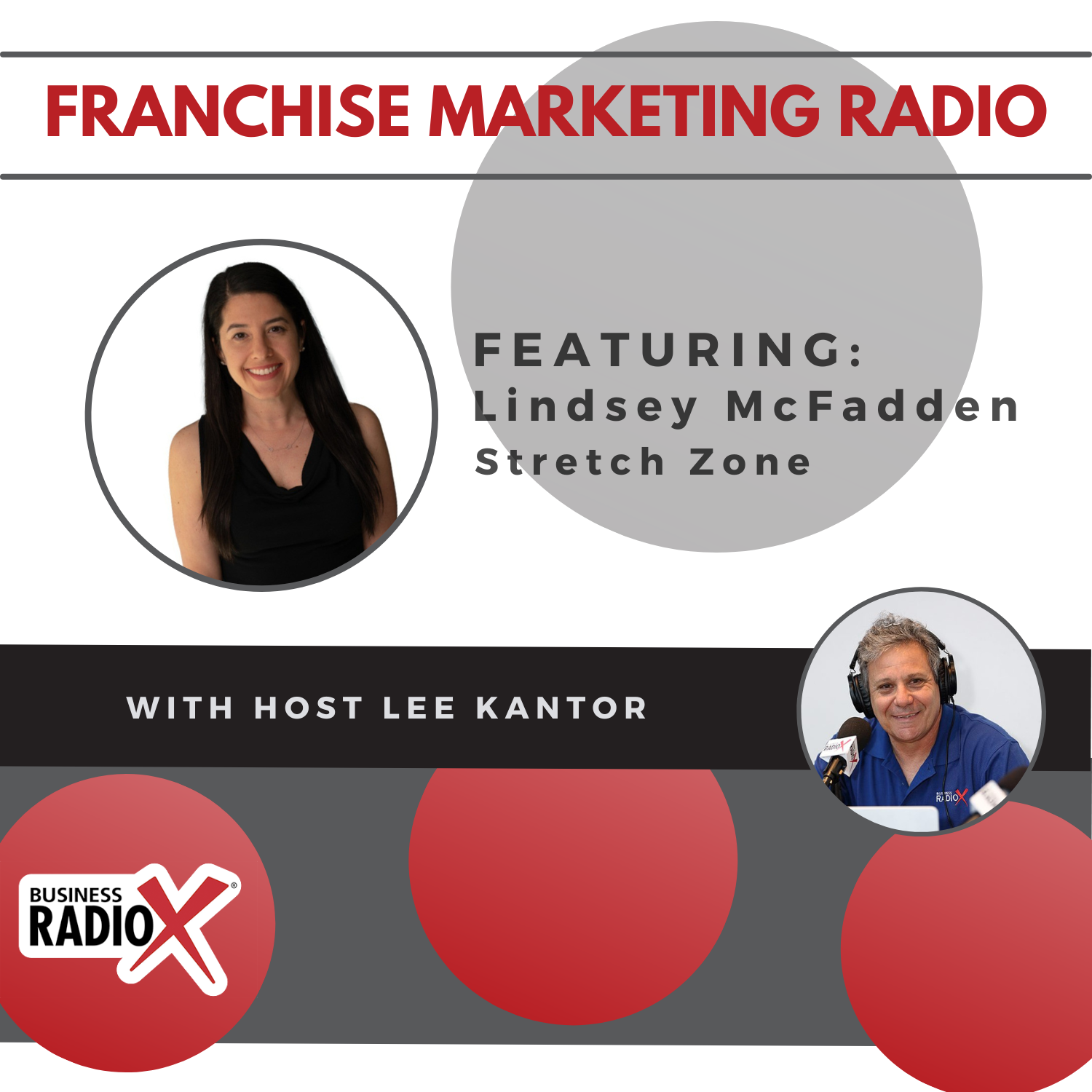

In this episode of Franchise Marketing Radio, Lee Kantor interviews Lindsey McFadden, CMO of Stretch Zone. Lindsey discusses the company’s growth from a single location to a leading practitioner-assisted stretching franchise with hundreds of locations across North America. She shares insights on franchise marketing, customer loyalty, community engagement, brand consistency, and the impact of AI on franchise operations and marketing.

 Lindsey McFadden is the Chief Marketing Officer at Stretch Zone, where she leads a dynamic team driving advertising, branding, PR, and communications initiatives for both corporate and franchise partners.
First introduced to Stretch Zone through a consulting engagement in 2019, Lindsey quickly became inspired by the brand’s rapid growth and its tangible impact on communities nationwide. Under her marketing leadership, Stretch Zone has surpassed 400 open studios with zero closures, and continues to expand at a rapid pace.
Lindsey began her career in the multi-unit space, supporting franchise owners and operators, before joining an ad agency to deepen her creative expertise. She then co-founded a consulting practice focused on multi-unit and franchise brands, where she first collaborated with Stretch Zone.
Since joining Stretch Zone in-house, Lindsey has bplayed a central role in opening over 140 locations and building a strong, recognizable brand poised for continued growth.
She earned her Bachelor’s degree in Marketing and an MBA from Florida State University. Lindsey lives in South Florida with her family and works from Stretch Zone’s corporate headquarters in Fort Lauderdale.
Connect with Lindsey on LinkedIn.
What You’ll Learn In This Episode
- The origin story and rapid growth of Stretch Zone through franchising.
- How standardized systems and protocols create a consistent customer experience.
- Strategies for balancing national brand standards with local market relevance.
- The role of community engagement in driving franchise success and customer loyalty.
- How membership-based wellness businesses build long-term customer retention.
- Key differences between practitioner-assisted stretching and traditional massage services.
- The importance of focusing on a core offering rather than chasing industry trends.
- How AI is transforming franchise marketing, reporting, and operational decision-making.
- Best practices for managing innovation and collaboration within a franchise network.
- Future opportunities for enhancing customer experience through technology and wellness services.
 This transcript is machine transcribed by Sonix.
TRANSCRIPT
Intro: Coming to you live from the Business RadioX studio. It’s Franchise Marketing Radio.
Lee Kantor: Lee Kantor here. Another episode of Franchise Marketing Radio and this is going to be a good one. Today on the show we have the CMO with Stretch Zone, Lindsey McFadden. Welcome.
Lindsey McFadden: Thank you for having me.
Lee Kantor: Well, I am excited to learn what you’re up to. Tell us about Stretch Zone. How are you serving folks?
Lindsey McFadden: Well Stretch Zone is the leading provider of practitioner assisted stretching. We’ve got a 427 locations across 41 states and Canada. So likely wherever you’re listening from, there’s there’s one near you. Um, and we do one thing and one thing only and that is professionally stretch people. So if you’ve never been stretched before, I’m sure you’ve heard anecdotally, your doctor, your trainer, physical therapist, chiropractor, Everybody knows how important stretching is and how beneficial it is for your health. And so that’s what we do for all of our members, is we have a patented strapping system on our proprietary tables that our practitioners use to position, stabilize, and isolate your muscles, ensuring you get the best stretch.
Lee Kantor: So what was the genesis of the idea, how this whole thing come about?
Lindsey McFadden: Our founder, Jordan Gold, his pop up, his his grandfather, as he called him, suffered from mobility issues due to complications of diabetes. And Jordan had a background in bodywork and, and personal training. And he started stretching his grandfather every day. And he went from being bedridden to over the course of a year, walking with a walker and then a cane and ultimately then unaided. And Jordan realized the power of stretching and said, we need to bring this to the masses. And so that was really the birth of stretch zone. So from that story, we had about a dozen or so corporate locations before we began franchising in 2017.
Lee Kantor: So it just started out in one location and just kind of organically grew around the area.
Lindsey McFadden: That’s exactly right. Complete word of mouth, no sales initiatives. And because the product, it really works. And we were changing people’s lives and there was such a organic growth in kind of word of mouth happening at the early days that we said, oh, wow, there’s, there’s really something going on here. How do we scale this? And at the time, Jordan and, and Tony found franchising as the vehicle to do exactly that.
Lee Kantor: Oh, so it didn’t even start out to be a franchise. That was something that it was like, hey, we might as well franchise we got we’re growing like crazy.
Lindsey McFadden: That’s right. Exactly right.
Lee Kantor: Wow. That I mean, that’s exactly what you want in a franchise, right? That’s that good locally. And then now you’re expanding nationally and have expanded globally. What was that transition like to go from a local shop to a national brand. Like, can you talk about that transition?
Lindsey McFadden: Yeah, I think from having super successful local studios, we’re based here and started in South Florida translating and really documenting that SOP guideline, right of operations of the stretching of the manual. And I say we have two things that really differentiate us, um, from, from other modalities or concepts. One is our patented strapping system, but two is our, our protocol driven approach. We have specific outlined stretches that we’ve put together in a certain series that we call protocols. We have different protocols depending on why you’re coming to us. Maybe you have sciatica pain, or maybe you’re recovering from an injury, or maybe you’re training for a marathon or something. Whatever your why is for coming in. We have standardized protocols, and those protocols ensure a real consistency of experience. No matter where you’re stretching. All of our members have the availability to use any of our locations nationwide. So if you’re coming into a studio in South Florida, but then you’re traveling for business and I don’t know, let’s say California in, um, the system, the practitioner in California can see exactly what stretch you had done on Monday in Florida and can pick up where that left off on Friday in California. So our protocols and our table are really what enable us to give such a continuous experience. And so really formalizing the business around that is the what what happened at the inception of our franchising journey now?
Lee Kantor: So is it sold by the session or is it sold as kind of a subscription, a monthly service?
Lindsey McFadden: Uh, both is the answer. But overwhelmingly we are membership based. So it’s a month to month membership. No kind of long term contract or anything like that. And um, our, most of our members come once or twice a week.
Lee Kantor: And then that’s why you can go to any location.
Lindsey McFadden: That’s right. That’s right. Any location nationwide.
Lee Kantor: So now let’s talk a little bit about how as you’ve grown, you’ve been able to, um, kind of marry the national brand consistency with that hyper local relevance that, you know, franchises strive for.
Lindsey McFadden: Well, I think the reason that you buy into a franchise, right, is for the brand strength, that brand equity. So we want to maintain that. And no matter where you are in any studio, you should be very clearly that you’re in a stretch zone with the specific stretches and the tables and everything as a consistent experience. But in local markets, we want to make sure that our, our owners and their staff can resonate with the, the population that they’re dealing with. You know, our, our South Florida, you know, stores in the winter are very different than our stores in Minnesota in the winter. Right? So having ads and content and creative that really speaks to the members and where they are both geographically but also physically as what they’re looking to get out of their stretching sessions is really what our marketing has been focused on. And, you know, we have markets that are, for example, very heavy Spanish speaking. We want to make sure everything is is translated and local and makes sense for that market. Um, in Texas, our owners have y’all in their ads. We don’t really say that here in South Florida. So I think that we want, we want the studios to feel like they’re a pillar of the community and a fabric of the town that they’re in. So allowing for that local customization while still respecting and protecting, truthfully, the stretch zone brand, that’s kind of what we aim for.
Lee Kantor: So how are how, how do local operators in the market, how do they use social media? Or is it something that they are allowed to, you know, kind of have do their own thing? Or is it something that he this is the kind of the brand and this is you can work around this template.
Lindsey McFadden: Both. So we have, we have content from corporate and messaging, whether it’s around initiatives from the business or a promotion or whatever it is. But we we advocate and we ask all of our local owners to, to supplement that with content in market, maybe they’re supporting at a, at a charity event or a five K race, or they’re stretching at a golf tournament, let’s say we want to capture that content and share that with their local market so that the people in market can be familiar with them and what they’re doing. So we do both. We, we supply stuff from a corporate standpoint down across all locations, but then we really try to give our owners and truthfully, their staff the playbook and the guide for how they can supplement that with the most effective local content.
Lee Kantor: Because I would imagine that this is since this is the service is so personal and, and intimate with the customer, that community engagement has to be critical. I mean, you, they have to be kind of out there and, and in front of a lot of people. How do you how do you recommend kind of in a local market? How do you optimize community engagement, like you mentioned some of the things, but I would imagine there at farmers markets, they’re, they’re really immersed in their community chambers of commerce. They’re doing all this stuff they have to do to, you know, make friends.
Lindsey McFadden: Exactly. Right. So it really starts from before a studio opens. We have, um, we have a dedicated resource on our team, um, that handles what we call our grand opening process. So we create a community outreach calendar for them. We talk about best practices for local events and grassroots marketing. And it really starts as simple as your neighbors, right? All of our studios are in shopping plazas. How do you introduce yourself and work with your neighbors as either a referral sources or cross-promotional opportunities? And then, you know, collaborating with other boutique fitness brands and then all the things, like you said, whether it’s a golf course, a chamber of commerce, community organizations, we have a lot of stores that work with with schools and also minor and major league sports teams in markets as well.
Lee Kantor: And does it also the high school teams and things like that. And all the we.
Lindsey McFadden: Do a lot with a lot with high schools because we we it’s a great opportunity for us because not only for the athletes themselves, we stretch anybody that’s over the age of 14, but also for the parents and the coaches. And then a lot of our owners are really involved in like teacher appreciation and give back. So not only do they advertise and service the, the high school population, they also give back to, to the organizations as well.
Lee Kantor: So how, how are you positioning it different than like a massage place?
Lindsey McFadden: Yeah. So interesting. And it’s a good question and a great point of clarification. So our studios are all open air shared space. So a typical studio has about 5 or 6 tables in it. So unlike a massage where it’s very kind of dark or dimly lit and relaxing music and private one on one behind closed doors experience. Ours are. Think about walking into a boutique fitness studio, open bright, good vibes, good music, people talking. It’s very lively environment and massage. You feel oftentimes from massage relief in the short term. What stretching does, especially with our protocol based approach, is the gains and the mobility builds upon itself. So we are gradually extending your range of motion, which leads you to feeling better longer. Those are lasting gains, not just momentary release or relaxation in that one session.
Lee Kantor: So how how long? Like how many sessions does it take to to feel like noticeably more range of motion?
Lindsey McFadden: That’s a great question. So we actually conducted last year a research study because we’ve heard anecdotally for years, you know, stretch zone changed my life. Stretch zone saved me from having back surgery or stretch zone cured my sciatica, whatever it is. So we conducted a research study of different cohorts of groups, people that came, a control group. Of course, people that came once a week, twice a week, 30 minute session versus an hour. And what we the data at the end of the first 30 days is that 85% of people had increased mobility, 58% had improved sleep quality, 66% had more energy. So these are real tier one claims that we can now make that are substantiated by by data and published in a peer reviewed medical journal. So anybody listening here, you can read yourself. It’s called the stretch zone effect. You can Google it or find it on our website. Um, but now we have the data to prove that the effects that you’re feeling from your stretch session are not just temporary relief. They are lasting improvements that that retain over time.
Lee Kantor: Now, is it something that you can be done? Like, okay, I have my, I’ve retained my, um, former range of motion. So now I don’t have to go anymore. Is it something that it’s like you should be on some sort of a maintenance program to just kind of keep it going.
Lindsey McFadden: Yeah, a little bit of both. So we have some people that come in for a specific period of time, either maybe they’re gearing up for a race or training for something, or they’re recovering perhaps from a surgery or an injury or something. But then I will tell you, the majority of our members, it’s part of their lifestyle. It complements whatever their fitness routine or their golf or tennis or pickleball. It’s part of their weekly activities. So we do have both. But I will tell you, most of our members are coming on a routine basis.
Lee Kantor: And when you’re trying to get that type of customer loyalty, which is everybody’s dream, where it just becomes, like you said, it’s integrated as part of my life. It isn’t something I do once in a while. It’s just part of my week. Um, any advice for other brands out there that are trying to get that level of buy in from their customers, that type of loyalty? Do you have some do’s and don’ts when you’re working on Building a brand that really does a great job when it comes to customer loyalty.
Lindsey McFadden: I think that loyalty, if the product or the service is not top tier, you can have the best loyalty program or perks or rewards points or whatever you want to call it. And that doesn’t matter. The reason people keep coming back is because the service works. It has tangible and meaningful impacts on people’s lives, whatever they’re dealing with. And that’s why they keep coming back. I’m not saying every single person that steps into a stretch zone is a is a member for life. But I will tell you that it’s it’s not just a fad. And I think that’s something that you see a lot in, in the wellness space in general is first it’s saunas, then it’s cold therapy, then it’s both of them together, then it’s red light, then it’s blue light, whatever, all of that that is. We’ve kind of stayed true to our one thing and one thing only, which is our, our stretch offering and not gotten distracted by supplementary offerings or ancillary products or things because we know are one thing and we do it really well, and we don’t dilute that or confuse it with other things. As you know, a quick cash grab or a innovation of some sort that’s not really meaningful or tied to our core business. So I think because we only focus on one thing and doing it better than anybody else, that’s what keeps our members coming back.
Lee Kantor: Now let’s talk a little bit about AI. How has AI impacted what you’re doing from a marketing standpoint?
Lindsey McFadden: Well, good and bad. Uh, the challenge I have is that now some of our owners or their staff thinks that their, uh, what do you call it like armchair graphic designers with the use of ChatGPT? So there’s a lot of rogue things out there that we’re now trying to corral, which is a level of complexity that didn’t exist, you know, just a couple years ago. Um, but it’s also changed the game in been so helpful in just automating reporting insights, content, leveraging, um, AI tools to really just amplify the work that my team is already doing. Save us time on, on a lot of redundant tasks that that we’ve now really streamlined. It’s been a game changer. And, and also gleaning insights from different markets that we’ve, um, we had previously not been able to do in a systematic way. So we’re using it a lot as part of our data analysis, which is really driving then strategy, creative direction and decisions. And, um, it just enabled us to kind of pivot and test faster.
Lee Kantor: And then, um, but how are you managing kind of the franchisees because they have $20 a month too. So, uh.
Lindsey McFadden: Yeah, it’s, uh, I don’t know that we’re doing it. Well, to be clear, I don’t know that it’s that big of a problem. I don’t know that it’s a negative. I think we have a lot of great owners that are always trying to push the boundaries and challenge us truthfully to do better and more. And so we’re listening to that and leaning in. Um, I think there’s a delicate balance though, between, um, a knee jerk reaction to just, you know, enabling agents or bots across all sorts of different business units. What we really want to do is be focused on if you’re trying to implement AI into the business as an owner for something, I want to understand what each are you trying to scratch that we’re not assisting you with? So for me, it’s really just they’re trying to do something or gain something that they feel that they’re not getting from us in terms of like managing with the owners. So really it’s just a vehicle for dialog. What are you using this for? Why don’t you tell us how we can help? Maybe there’s something here that we can make available to the system as a whole. So I think it’s really starting a lot of conversations more than anything. And then selectively, we’re implementing and adapting different parts.
Lee Kantor: Yeah, I think it’s tricky from a franchise standpoint on managing the the franchisees because on one hand, you’re selling hard on be your own boss, be your own boss, and you’re also selling systems and processes and had to operate. And, um, you know, for that local person, there’s some local people that, you know, really want to own their own business and do their own thing, but they also want the safety and the, uh, that a franchise offer. So it’s tricky, you know, when you’re dealing with that many, especially you have so many franchisees now that I’m sure you’re going to get some rogue people out there that are.
Lindsey McFadden: Oh, for sure.
Lindsey McFadden: I mean, I say it all the time when we when we uncover things like that, it’s like, listen, if you thought it was so easy, you could open Lee’s stretch shop and do it yourself, right? Right. But not into a franchise for a reason. We have the systems, the tools, the processes and the support here to ensure that you’re successful. So lean into that and help us help you. Right? There’s no reason to reinvent the wheel if and again, I say it all the time, whenever people are doing that, it’s usually one of two reasons. One, because they’re either not aware or they’re not engaged with the business. And so they’re not aware that there is a tool or a system or a solve for whatever they’re doing. So they’ve gone rogue in their mind out of what they think is necessity. But really, it’s usually just lack of knowledge or understanding that that exists and is standardized. Or two, sometimes franchisees have have ideas and things that we haven’t thought of or we haven’t been able to implement yet. And then that just starts a conversation of, oh, that’s really interesting. We should look into that and then let’s let corporate quarterback that right save you the time, energy and effort. Let us run with it, and then we can deploy it in a way that works, um, across the whole system.
Lee Kantor: Right? And that these are people that some of them are creative people that want to scratch that itch and play with the new toy. And they, you know, they own a stretch zone in a local market and they want to play. That’s right. They want to experiment. But I think that the, the tighter your relationships are and the trust that you have with them, that they should want to work together rather than go rogue. I mean, it should be part of the culture is work together to make it better for everybody.
Lindsey McFadden: 100% agree. And I think we have a really awesome franchise advisory council. It’s ten owners of our system, all multi-unit owners geographically, um, spread across the nation. We rely on them really heavily. We meet with them super regularly and we use them as a sounding board and we also learn from them. Like you mentioned, some of them are have very successful careers prior to stretch zone. So we learn from their knowledge and experience that they can bring to the table to help the system as a whole.
Lee Kantor: Right. And I think that to your point, that if if you have a brand, a franchise brand that a bunch of people are going rogue, it probably means you don’t have a good franchise advisory board.
Lindsey McFadden: Right? And corporate is probably lacking and not giving the support or the tools or the systems to make the, to make the system as a whole engaged and in line.
Lee Kantor: So good stuff. Um, so what do you need more of? How can we help you?
Lindsey McFadden: That list is long. I’m just kidding. Um, I think what’s really interesting, and as we look to the future and kind of what’s on on tap next, I think that the, the wellness market is evolving and we want to make sure that our service is evolving with that. You mentioned earlier a question about packages versus membership. You know, we’ve kind of pivoted to meet our our members and customers where they are. Um, we’re working on some really enhanced, um, features and functionality for our app. So, you know, what’s next. I think that we can always improve user experience across all of our platforms, making sure that prospect journey is super streamlined and engaging and informative. And then for our members, we want to make it easy for you to book your sessions, use them conveniently. Um, and we want to take care of our members and our franchisees. How can we help support them better? I think that, you know, we’ve had the really awesome luxury of being able to invest in some more corporate resources in terms of support staff to to ensure that we’re ahead of growth, which is really exciting. And so, yeah, back half of 2026, I think is for us is really focused on, um, kind of optimizing and enhancing what we’ve already got underway and growing the team to further support our network.
Lee Kantor: Good stuff. And if somebody wants to learn more, where should they go?
Lindsey McFadden: Head to stretch.com. Your first stretch is free if you haven’t tried it. No need to be fearful. It’s a great experience. Head there and find the studio nearest you and I hope you enjoy it.
Lee Kantor: Well, Lindsay, thank you so much for sharing your story today. You’re doing such important work and we appreciate you.
Lindsey McFadden: Thanks for having me, Lee. It’s been great.
Lee Kantor: All right. This is Lee Kantor. We’ll see you all next time on Franchise Marketing Radio.















