
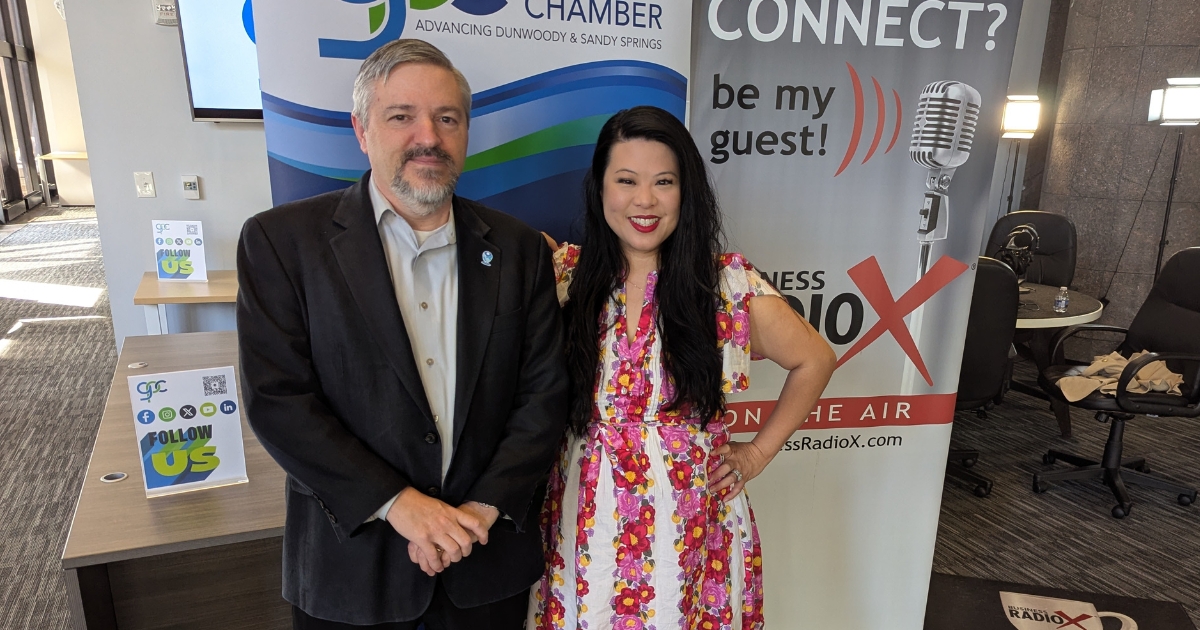
In this episode of Greater Perimeter Business Radio, Eric Boemanns speaks with Tracy Lee, CEO of This Dot Labs, about the intersection of technology and business, focusing on AI integration. Tracy shares her experiences in technology consultancy, emphasizing the importance of aligning AI initiatives with business value. She introduces the seven stages of AI adoption and highlights the role of skilled engineers in leveraging AI tools. Tracy also discusses her community engagement efforts and offers advice for new founders, stressing the importance of mentorship and building genuine relationships.
 Tracy Lee is the CEO of This Dot Labs, a leading software development consultancy that partners with companies like Stripe, Xero, Twilio, and Google to deliver innovative web solutions and empower startups from proof of concept to implementation.
With 16 years of experience as a startup founder and angel investor focused on developer tooling, she is passionate about go-to-market strategies, automation-driven customer acquisition, and open-source ecosystems.
A recognized JavaScript developer and RxJS core team member, Tracy is also a Google Developer Expert, GitHub Star, and Microsoft MVP who spends her time building products, communities, and mentoring entrepreneurs. 
Connect with Tracy on LinkedIn and X.
 This transcript is machine transcribed by Sonix
TRANSCRIPT
Intro: Broadcasting live from the Greater Perimeter. It’s time for Greater Perimeter Business Radio. Now here’s your host.
Lee Kantor: This episode of Greater Perimeter Business Radio is brought to you by Mirability with their new compliance Exo service taking you from it risk to it reward. Now here’s your host, Erik Bomans.
Erik Boemanns: I’m joined today by Tracy Lee, CEO of This Dot labs, a software consultancy firm dedicated to empowering businesses leaders to execute technology roadmaps with precision and speed. She is a founder, an angel investor, a speaker, a mentor, a technologist, and a community builder. Tracy is also recognized as a GitHub star, Google Developer Expert, Microsoft MVP, and a Google Women Techmakers lead, as well as a member of the RxJS core team. Welcome, Tracy. What’d I miss?
Tracy Lee: Thank you. A few things, but that’s okay. I think I do too much now that I heard you read that right.
Erik Boemanns: So, um, it’s great to have you here. And I know we first met through a networking group and kind of quickly learned just from meeting you all the different groups, organizations that you’re involved with. Um, how do you decide what events that you want to support and be a part of?
Tracy Lee: It’s quite difficult. I think one of them is who’s who’s the loudest, right? The squeaky wheel gets the grease, but it also has to kind of align, if you will. And then I think another thing is what excites me right now. So there’s definitely been situations in which if something isn’t giving you joy, bringing you joy, then you shouldn’t really be doing it. I think a lot of times we get into habits. I think this is why Covid was really good for us. It kind of forces you to stop doing the same thing over and over and over again, and it forces you to kind of reevaluate and reset. So I don’t know. I mean, there’s a lot of, like, community things that aren’t happening now, but I think it’s for the better because I think those people who were running it before who aren’t doing it now are happier.
Erik Boemanns: Yeah, that makes sense. And so you mentioned it has to excite you. What is exciting to you right now?
Tracy Lee: Oh my gosh, I is exciting me right now. I know it is exciting or annoying everybody, you know. I definitely am. I do a lot in the healthcare and life sciences space. And you know, previously I’m on the Tag Digital health board. And one of the guys there was like, yeah, you know, I went to vibe, I went to health and everything was I, I, I, I, I. So it can get annoying to keep hearing that. But it is really, really, really exciting for engineers. It is really exciting for businesses. What you can do now and just how far the journey has taken us, just even in the past year.
Erik Boemanns: Yeah. And I know that since you’re in the technology consultancy space, I’m sure your clients are asking you about AI, AI, adoption. Are there things that they need that they can be thinking about from how do they get involved with I.
Tracy Lee: You know, I feel like last year we had a lot of conversations about POCs. We had a lot of conversations about executives getting aligned with, okay, what does this actually mean for our business? A lot of the consulting we were doing was trying to make sure that I wasn’t just a buzzword that leaders were wanting to integrate into their organizations, but more something that actually added business value. I think that’s difficult to make sure that you actually do that. You know, you can you can build a chat bot, you can do a lot of things. But if you’re not, you also have to maintain technology, right? So if you’re not doing something that actually adds business value, then it’s just going to be a flash in the pan.
Erik Boemanns: Yeah. And you said a couple of things. I think that I want to come back to the idea that AI is a buzzword. Absolutely is right. If you just add the word AI to your product, It’s worth more now, right? Even though it may actually not do anything different.
Tracy Lee: It is wild. One of my friends over at Stackblitz, Erik Simons, um, he he’s in the Silicon Valley and he went from 0 to 40 million in. I can’t remember if it was three, 4 or 6 months, but that is insane. You know, 0 to 40 million. And then he just raised 80 million on a $700 million valuation. I mean, before Stackblitz was not I, you know, it’s it’s basically a tool. They have a product called bolt dev. Everybody should definitely check that out. V0.dev is another one of my favorite products, but it allows you to just rapidly prototype something using AI. Um, but I mean, my gosh, that’s crazy. It’s amazing.
Erik Boemanns: Yeah, completely. And I think one of the questions I think because we just said AI is the buzzword. Yes, there’s actual technology, real meaning behind that. And to your point, some of those have business value and some of those are just buzzword flash kind of ideas. How do you break that down for your customers, your clients?
Tracy Lee: Well, I think I think that a lot of people are just saying I. But if you really dig down you, you if you really look at what people are doing with AI, sometimes it’s like, oh yeah, we are AI enabled. Okay. What does that mean? That means we have a chatbot like. Yeah okay. Sure. So there’s the operational side of the things that I can do to help you. And then there’s the actual product side, if you will. Right. So, um, I think that the biggest business value that people are going to get these days and the things that are kind of like the low hanging fruit, if you will, are definitely on the operational side. And I think everybody sees that. Right. Like every marketing team, every ops team, every development team. Right. They’re just using AI tools to kind of just make your job a little bit faster. I always like to tell the story of, you know, once upon a time I was a non-technical founder at a startup and I had this boyfriend, and he was an engineer, and I would come home to him and tell him my problems. And for about a week he would always say, just give me five minutes. And what he would do is he would write me a script. And by the end of that week, he basically eliminated someone’s job, right? So not eliminated, but she was able to do other things. But that saved me like 40, $50,000 of him doing five minutes a day of just writing scripts for me. Right, right. And so that’s kind of difficult for people who are non-technical to understand unless you’re sitting next to an engineer, which is why I like just having engineers and talking to them is really great. But I think with AI, that type of help just becomes infinitely more accessible.
Erik Boemanns: Sure. Yeah. Because it it can write the scripts for you now, right? You can have.
Tracy Lee: Exactly.
Erik Boemanns: A conversation with it that you were having before.
Tracy Lee: Exactly.
Erik Boemanns: Yeah. So a business has identified a technology that makes sense for their for them, whether it’s automation, whether it’s a chatbot, whatever it is. Right. And they have, um, kind of tied that back to the business value. I’ve heard this, um, this idea of a seven stages of adoption. Do you want to talk about that?
Tracy Lee: So the seven stages of AI adoption. I actually haven’t googled to see what other stages of AI adoption are out there, but it was something that I was just so passionate about. And so I wrote it up and I’m going to start giving talks on it, actually. So I’m happy to go into companies and talk about this, because I think one of the biggest things for me as a technologist is accessibility and educating people. Um, but I really do believe that, like, there’s this seven stages of AI adoption, you know, specifically for developers. You can probably apply this to anybody really using AI. Um, so the first is denial. Like AI is just a fad. It’s not going to work for me, right? Like a lot of people are like, this is just hype. When is it going to die down? Um, and then the second is okay, now all of a sudden are tools are becoming more and more and more common. So a lot of people are kind of here where oh, okay, we’re looking at AI, but you hear all this stories of, oh, it wrote this, it wrote that or like it made this mistake. And so people are dismissing AI or they feel overwhelmed. Right. So I don’t know if it’s like an anger thing, but it’s kind of like a, like a dismissal kind of phase, right? Um, a lot of common thoughts in this phase are, wow, AI generated code is trash. Um, juniors, you know, aren’t going to be able to learn the fundamentals because they’re not actually coding or this is going to flood the industry with, like really bad quality developers.
Tracy Lee: I think at any stage, you’re still kind of having these conversations and trying to figure out what AI is going to do when it comes to working alongside engineers. Um, and then kind of the third stage is like, I don’t know, another path along the except like another stage of the path of acceptance. So this idea of bargaining. Right, like, oh, well, maybe I can just use I for a small thing. So one great thing is, you know, developers, I mean, some developers love writing tests. Some developers don’t love writing tests, right? Yeah. Um, but if I can write those tests for you or do, um, uh, translate small things for you, then you know, all the better, right? So they start using it for small things. And, uh, you know, again, it’s this whole idea of, like, I’m only going to let I do the small things and I’m going to do the important stuff myself. Right. Uh, and then I think the fourth is this idea of just kind of being a little bit depressed, like, am I even needed? Like, I is just doing my job for me. Why should I even bother? Right. Um, and, uh, you know, then then the next step is really acceptance, right? And I actually think that doesn’t stop right there. But acceptance is really just understanding that are is just a tool, not a replacement. And that’s really important to understand. But it’s so great for just doing the stuff that is boring to you. Like the menial tasks like folding your laundry, right.
Tracy Lee: Or whatever. I mean, it would be amazing if I could fold your laundry. Soon. Soon, I would hope, I would hope, but for engineers, it’s the same thing, right? Like God, there’s even tools out there that will actually write documentation for you using AI these days. I mean, I know some developers love to write documentation, but most developers do not love to write documentation. Same thing with commit messages. Imagine if all your commit messages could be written for you. Like, all of this stuff again is just very, uh, you know, stuff that you it would be nice if you didn’t have to do. Yeah. Uh, but then the sixth phase of adoption is kind of like this slump where quality actually decreases. So now developers have adopted it. There is an acceptance, but then they decrease because they’re overconfident in what I can do for you. So then they become lazy. Or like developers start relying too much on AI generated code. They skip the critical thinking. They don’t think they have to think anymore, because all of a sudden AI is doing my job for me. Um, and I think also at this phase, it’s trusting the AI too much. All of a sudden you think like, maybe the robot is smarter than you. So then you decide that, you know, you’re kind of like, not in the driver’s seat anymore. Yeah. And I think that’s where I mean, I’m sure you’ve seen, like, everybody can go into code and just be like, well, this was AI generated, you know, so.
Erik Boemanns: Or a online post. Right. Whatever.
Tracy Lee: Exactly. Yes, I know all of us, you know, on LinkedIn are like, oh my God, here we go. Here’s this AI crap. Um, but then is really mastery. So being able to have that superior outfit. And I think that’s when you’ve decided okay. Yes, I is tool. Yes, I am going to use it. But then you’ve decided that like wow, now I have breathing room and space to be more strategic, right? To, to use the intuition I have, the creativity I have the problem solving skills. And that’s really again what I is trying to do. Like if we can be more creative, have more problem solving, be more strategic and make better technical decisions, because all of a sudden, if you can think of AI as junior developers, you have somebody you’re managing, then like, I don’t know, life is just amazing.
Erik Boemanns: Yeah. And, um, I’ll say that’s kind of I’m not sure I’ve gone through all the phases just yet, but I have kind of ended in that last spot where when I’m using it, I think of it as that junior developer. Right? I’m like, help me with this. I have this, do that, and then I review it, and then I make sure that to your earlier point, it doesn’t just look like it’s machine generated code. Yeah. Or I do and I because I don’t care what depends on the problem that I’m trying to solve.
Tracy Lee: And I think that’s okay too. You know, if you think about it, I think a lot of people kind of like in phase one and two, right? That the people who are kind of, hey, you know what? This is generating crappy code. Did you see that? I did this thing like, it’ll never replace a human. It’s not meant to replace a human. It’s meant to be a tool. And a lot of the the skeptics are like, well, a junior developer wouldn’t even have made this mistake. A human wouldn’t have even made this mistake. Well, yeah, that’s. Yes, that’s very true. But you kind of have to view like these little AI developers or whatever you decide to call them, right? Um, as you know, a new thing. Yeah. Like a new a new being. And, and and this AI is not going to behave like a human. So you shouldn’t be skeptical, but you should just understand that, like, okay, well, this is like another thing I need to learn, like another culture. I need to learn. And as I talk about that, I’m like, oh my gosh, I’m literally talking about AI. Like it’s like a, like, you know, somebody from another country, right? Yeah.
Erik Boemanns: And so I can the seven stages I can definitely. You hear how they can be mapped out to like even an organization from an individual to an organization, different careers. But what struck me as you walk through all that is AI consulting might be better done as counseling, like you’re actually offering counseling services to people like, let’s let’s help you get through this AI experience.
Tracy Lee: And yeah, I mean, I think as a consultant, you know, I mean, this thought we we do application development, right? So, um, you know, we’re not like a branding agency or a website agency, but it’s it’s we’re focused on problems that are a little bit more difficult, whether they be migrations, whether they be like ambitious mobile apps that you want to build. Right. Um, you know, our clients are people like Roblox, Twilio, Wikimedia. Um, Google, meta, uh, stripe, DocuSign. Right. We love working with startups too, though. It’s really great. And obviously on the mid market side it’s great to come in like kind of like as a fractional, um fractional CTO type type person for those types of teams. Um, but one thing that we’ve been doing that I think is really great because I’m big on education, right, is, well, actually get two engineers who really know how to use AI and embed them into teams. And the reason is because it doesn’t matter what stage you are at, right? Like the seven stages of AI adoption, every developer, every human, every business is going to be on, you know, it’s not going to be aligned, right. It’s not like everybody in your company is going to be at stage three at the same time.
Erik Boemanns: Yeah.
Tracy Lee: But it’s really inspiring to just work alongside somebody. So embedding somebody in your team that is AI focused. Have them use AI in their day to day jobs and, uh, see what happens. Right. Like inspire your team and then your team will start adopting it. But they’ll do it just because they’re exposed to it. And I think that exposure of people who are like really, really heavy AI engineers is something that the industry doesn’t have yet is something that a lot of companies don’t have yet.
Erik Boemanns: Yeah. And that kind of brings me to the next question is we hire consulting companies when we have a hard problem, we can’t solve ourself. Right? Yes. And so I’d be curious to hear some stories from this dot, from this Dot labs where you have some interesting problems, whether they’re AI or not, and how you’ve helped those clients.
Tracy Lee: We do like to focus on the hard problems. So, you know, this started off in big tech, right? So a lot of the companies that I just named to you are, you know, really big tech companies. And that’s amazing because I think for most of our clients in big tech, you know, especially in the Silicon Valley, right, like a lot of our business comes from the Silicon Valley. They look at engineers and consultancies out there and they’re like, well, you know, the talent pool is so great in Silicon Valley. If I’m going to be hiring a consultant, they better be as good as what I’m going to hire full time. So the fact that, like our engineers are up to that level is awesome, right? We try to keep that quality bar pretty high. Um, and then I think the second thing is if you’re going to be embedded into a team, right. Like, especially these days with how the economy has changed in the past year and a half or so, like you don’t need a butt in a seat, you need somebody who is going to add business value immediately. Right? So one of my clients over at Roblox, he said, Tracy, one of the greatest things about working with your team is I never had to communicate business value. I never had to have a conversation and justify the contract with the C-suite. Um, and he said it’s because, again, every single week we delivered value, right? So with Roblox, for example, some of you may be familiar if you’re if you’re really techie, maybe familiar with, um, probably last year or so, there was a there was it went viral on Reddit.
Tracy Lee: Uh, Roblox basically converted the entire react ecosystem into Lua. And so which is like difficult, right? And being able to like, maintain everything and contribute upstream and like just keep all of that without like a big team of engineers. But what we did is we actually worked on that project. So again, being able to like maintain parity with like the react ecosystem, um, and then being able to automate it so that we weren’t needed anymore was a really, really, really fun project. Um, I think another one, uh, we really love doing is just platform validation. We’re great at, uh, marketplaces. So we recently helped DocuSign launch their marketplace last year. So platform validation and then also helping them build out the first app. So built out some of the apps we’ve worked on. There are Monday.com, Jira, Monday.com, Jira, uh, slack, asana Sauna and I could go on about a few more, but that type of stuff is just so fun. And then again, being able to translate that into other industries like health and life sciences or financial services, and kind of bringing that like big tech perspective of best practices into people who are really deep in their kind of like knowledge space is really, really fun for us.
Erik Boemanns: Yeah, I get that. And so as we think about AI kind of takes all the oxygen out of the room in terms of IT topics right now. But there’s all all the other topics are still there and still matter kind of. What are some other top items that people are coming to you for?
Tracy Lee: Well, we’re past the framework wars. You know, we do a lot of front end development, web development. Um, you know, a few years ago there was like this framework war thing. Right now, we’re kind of going into the meta frameworks. I think everybody has kind of accepted that, um, server side rendering is huge right now. Right. Performance, I feel like is huge right now. Um, you know, a lot of times when we go into companies, It’s it’s really not you know, it’s kind of like this idea of like paying a plumber. You know, sometimes it’s like, oh, you just paid a plumber $500 for five minutes of work. What the heck, right? But it’s just kind of being able to figure out what the actual problems are. And again, just like I said, right. Like as how the economy has changed. I think, um, businesses, you know, more and more need to have people by their side who are more partners in anything. You know, you need somebody who’s kind of like in it when it comes to AI, you need somebody who’s kind of like forward facing on the trends and the technologies, at least to make sure that you’re just like generally on the right path. Uh, before you, you know, go off and do whatever you need to do. But like, I think getting people on the right path is really important. And, you know, I mean, it’s the same reason anybody goes to a coach or something like that, right? Like even if you go to a coach and do like executive coaching every quarter, every month or so, it’s just to make sure you’re like continuously on the right path and trending forward.
Erik Boemanns: Yeah, I think that makes sense. Um, so if somebody is interested in having you speak to some of the AI education that you mentioned earlier or this Dot labs to help get involved with their technology projects, how do they find you?
Tracy Lee: Well, you can check us out this dot dot co. That’s t h I s dot dot co. Or you can find me on LinkedIn. I’m Tracey S Lee on LinkedIn. Um I’m also on Twitter slash x uh so you can find me there at Lady Lit. Uh, we do a leadership podcast as well, which we’ve had you on or had you on for Erik. And, um, just a lot of really fun stuff on YouTube. You know, we have a top ten, uh, web podcast, for example, as well called the Modern Web. So doing again, a lot in the healthcare and life sciences, doing a lot with women in leadership. I feel like I’m hosting a lunch and doing things like every single week. I think I am.
Erik Boemanns: I think so, yes.
Tracy Lee: Um, so really just getting a contact if you just want to be connected, right. I’m a part of chief as well. I host those lunches every month. Um, I don’t know, it’s just fun. Life is fun. Atlanta is growing. It’s. It’s just really fun to be here right now.
Erik Boemanns: Yeah. And part of that, I think, is a lot of there’s a strong startup community here as well. And as a founder yourself, what are some words of wisdom that you give to those new founders who are just getting started?
Tracy Lee: Oh my goodness, there is so much. I mean, you just got to be coachable. It’s funny because if somebody is not coachable, I don’t know how you tell them to be coachable. I feel like people just give up on them. Yeah. But if somebody’s giving you advice and you want them to keep giving you advice, then listen to their advice.
Erik Boemanns: That is true.
Tracy Lee: Yes. I mean, some of my very first investors, you know, I remember Will bunker, founder of Match.com. He was actually my first investor and I wasn’t even trying to get him to invest. I was just like, can you just give me some advice on this pitch deck? Um, and I sat down and I started going through the slides, and after the second slide, he was like, look, let’s just have a conversation. And then, you know, he gave me some advice and then I was like, okay, I started doing it because, you know, I, I trusted him and, you know, admired what he did. Um, and then at some point in time, he decided to invest in the company. And I still remember, like my co-founder, my technical co-founder at the time, he was still working a full time job. And I said, if Will joins the team, tell me, you will quit your job tomorrow. And he’s like, if Will joins the team, I will quit my job because, like, there’s no way the founder of Match.com is going to join like our random startup, right? Um, but then he did, and then my co-founder quit his job, and then we decided to do it full time. So, you know, it’s really amazing. Again, like the people you meet and the connections you make. So I think also like making things less transactional, right. If you’re going and you’re going to like, let’s say a bunch of investors or a bunch of people you want business from, and you’re just trying to be like, hi, I need your business. Listen, you know, like, people want to work with people. You know, life is long. And so if you’re not enjoying the people you work with or building relationships with the people you work with, then they’re not going to want to work with you.
Erik Boemanns: That is great advice and very true. Very true. Um, so yeah, thank you. Tracy Lee, CEO of this Dot labs, for being here. Anything to close us out?
Tracy Lee: Uh, no, that is all. But I’m excited to work with you, too. So Erik and I met through, like, a fractional C-suite. I don’t know, community or something like that, but, Erika, Erik’s going to be helping us with our, uh, certifications. So I’m really excited.
Erik Boemanns: To be there.
Tracy Lee: Yeah, I know. Super excited about that. So definitely check out Erik and Mirability as well.
Erik Boemanns: All right. Well thank you.
Tracy Lee: Thank you.
About Your Host
 Erik Boemanns is a technology executive and lawyer. His background covers many aspects of technology, from infrastructure to software development.
He combines this with a “second career” as a lawyer into a world of cybersecurity, governance, risk, compliance, and privacy (GRC-P).
His time in a variety of companies, industries, and careers brings a unique perspective on leadership, helping, technology problem solving and implementing compliance.














